Ithaca Film Journal: 5/8/25

What I’m Seeing This Week: I’m going with The Surfer and Thunderbolts*, both of which are at both Cinemapolis and the Regal Ithaca Mall. My oldest daughter has chosen A Minecraft Movie for our next Family (née Friday) Movie Night, so we’re all going to see that at the Regal as well.

Also in Theaters: The best new film playing Ithaca RIGHT NOW that I’ve already see is The Shrouds, but after its final screening at Cinemapolis tonight, Sinners (which continues its run there and at the Regal) will reclaim this coveted title. In addition to everything listed above, I also hope to see Secret Mall Apartment before it closes at Cinemapolis. There don’t appear to be any compelling special events this week, but on the repertory front my May, 2024 Drink & a Movie selection Stalker is playing Cinemapolis on Wednesday as part of their latest “Staff Picks” series. I caught the 4k restoration they’re showing on the big screen at Kingston, Ontario’s The Screening Room last April and can assure you that you definitely don’t want to miss it!

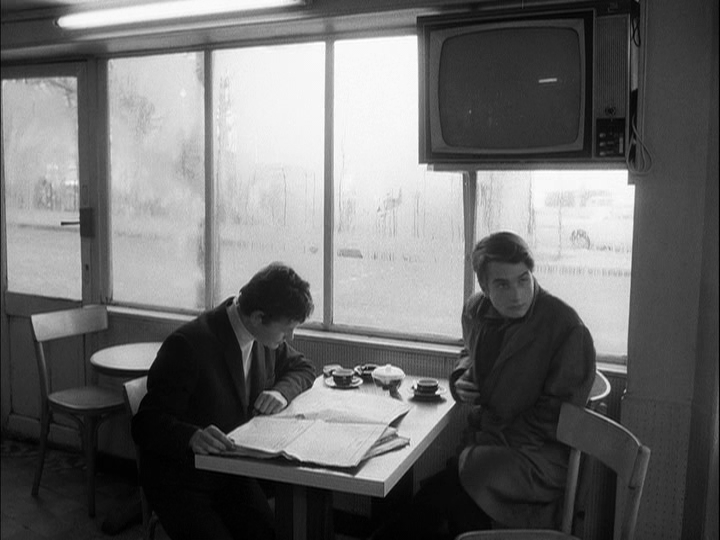
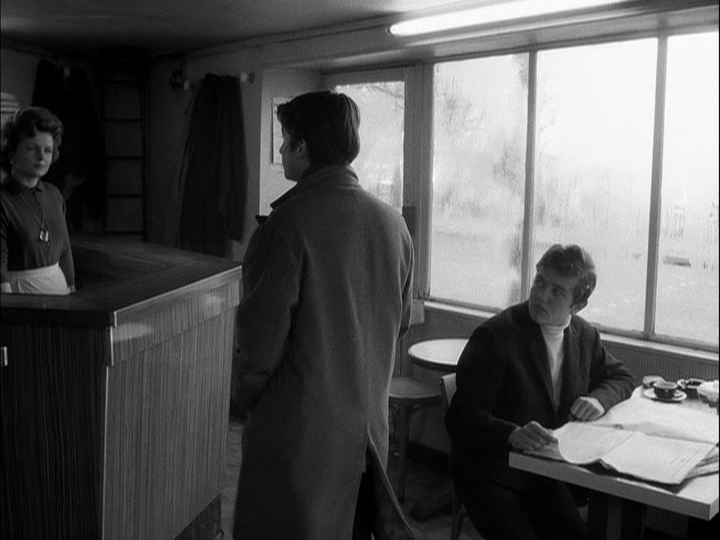
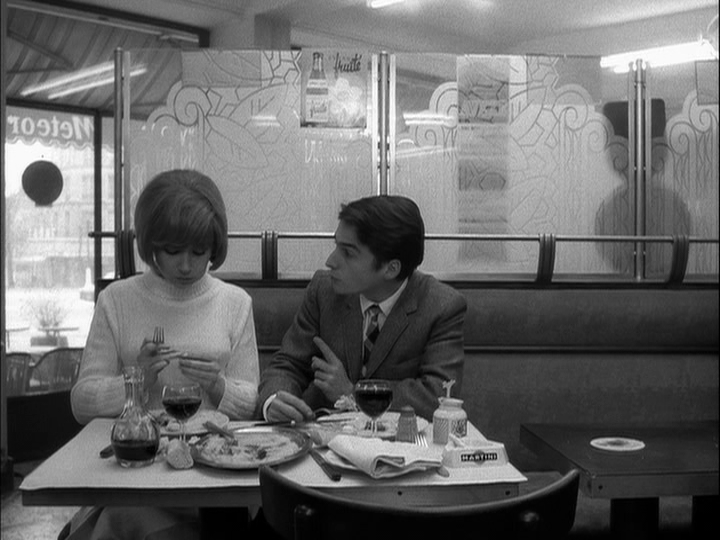
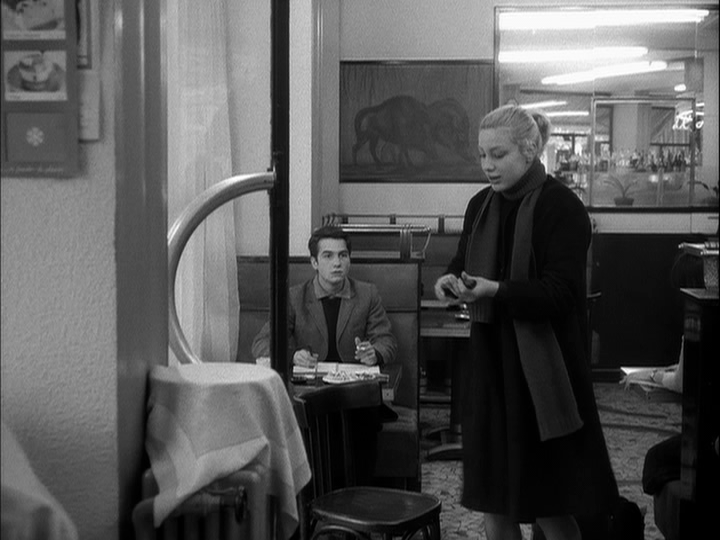
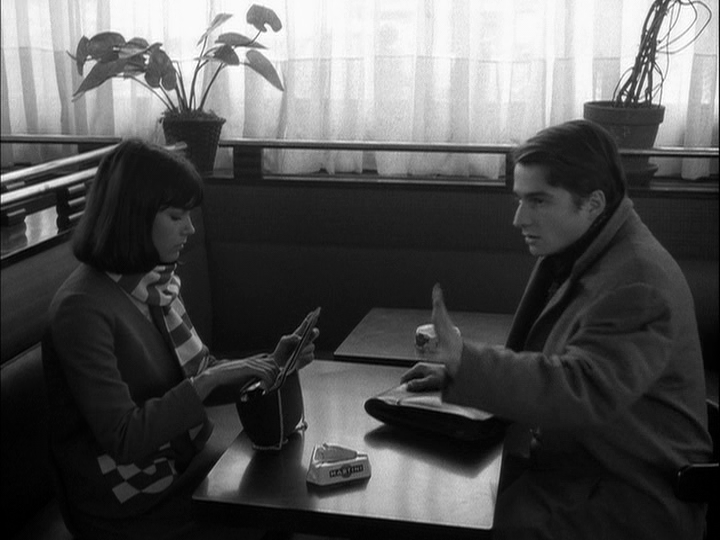
Home Video: In my recent Drink & a Movie post about Masculine Feminine, I quote Penelope Gilliatt as calling it “the picture that best captures what it was like to be an undergraduate in the sixties.” This inspired me to finally revisit Funny Ha Ha, which current Cornell University faculty, staff, and students have access to through Kanopy via a license paid for by the Library and which can be streamed as a rental via a variety of commercial platforms as well, for the first time in twenty years. Here’s what I said about it on Letterboxd afterward:

When I saw Funny Ha Ha for the first time in 2005 I would have been less than a year into my first full-time job after graduation and still a couple away from enrolling in a master’s program and it hit me like a bolt of lightning because I finally got to experience something for myself that I had read other people describe: the shock of recognizing myself onscreen. Which even then I felt just a bit sheepish about; after all, American movies have always been chock full of white middle class young people. But they’d never before looked exactly like my friends, unglamorous yet always dressed in the perfect killer thrift store find t-shirt. They’d never before sounded just like us, smart but inarticulate and begging the god(s) we didn’t so much not believe in as rarely think about to please not let us be misunderstood. They’d never before drifted listlessly through the Kuiper Belt of planetoid hangouts that didn’t quite rise to the level of parties orbiting some other college town, helping themself the requisite meager offering of bottom shelf bottles en route to another hookup and maybe a deeper connection and eventually an actual adult life in an entirely different place. Because, to go back to Gilliat, Funny Ha Ha is the picture that best describes what it was like to be recently *not* an undergraduate in the mid-2000s but, like Kate Dollenmayer’s Marnie, not quite as far along the road to things like a career and a long-term relationship as your peers, many of whom were beginning to leave, leaving you behind.

I can confidently recommend this film to almost anyone as the rootstock of mumblecore, a historical record of the brief time when cellphones coexisted alongside answering machines, and a rebuttal to the “No Girls Allowed” sign outside Jean-Luc Godard’s Children of Marx clubhouse. You probably aren’t going to be gobsmacked by the scene in which Andrew Bujalski’s Mitchell impulsively drops a beer off a balcony unless you once did the same thing with an empty bottle of champagne for the same silly reasons, though.

Previous “Ithaca Film Journal” posts can be found here. A running list of all of my “Home Video” recommendations can be found here.

May, 2025 Drink & a Movie: Cinema Highball + Masculine Feminine

I knew right from the start that this series would eventually feature the Cinema Highball, an ingenious rum and Coke variation created by Don Lee and included in The PDT Cocktail Book, but what to pair it with? A name like that suggests primacy of place–should I save it for the final entry and write about it alongside my favorite movie, I wondered? But then I’d have to pick a single favorite, and as the days went by my options narrowed. The Flowers of St. Francis and Early Summer came off the board within six months of this project beginning and The Passion of Joan of Arc and Pyaasa followed in its second year of existence. Meanwhile, another question was beginning to vex me: which of the 100+ films directed by Jean-Luc Godard was I going to tackle? The solution to both my problems arrived simultaneously last May when I realized I wouldn’t finish my post about Stalker before the first of the month, eliminating a possible hook: what better way to commemorate May Day 2025 than with a post celebrating “the children of Marx and Coca-Cola”?

Title card in French which reads "This film could be called" in white all-caps font against a black background
Title card in French which reads "the children of Marx and Coca-Cola" in the same font
Title card in French which reads "understand what you will" in the same font

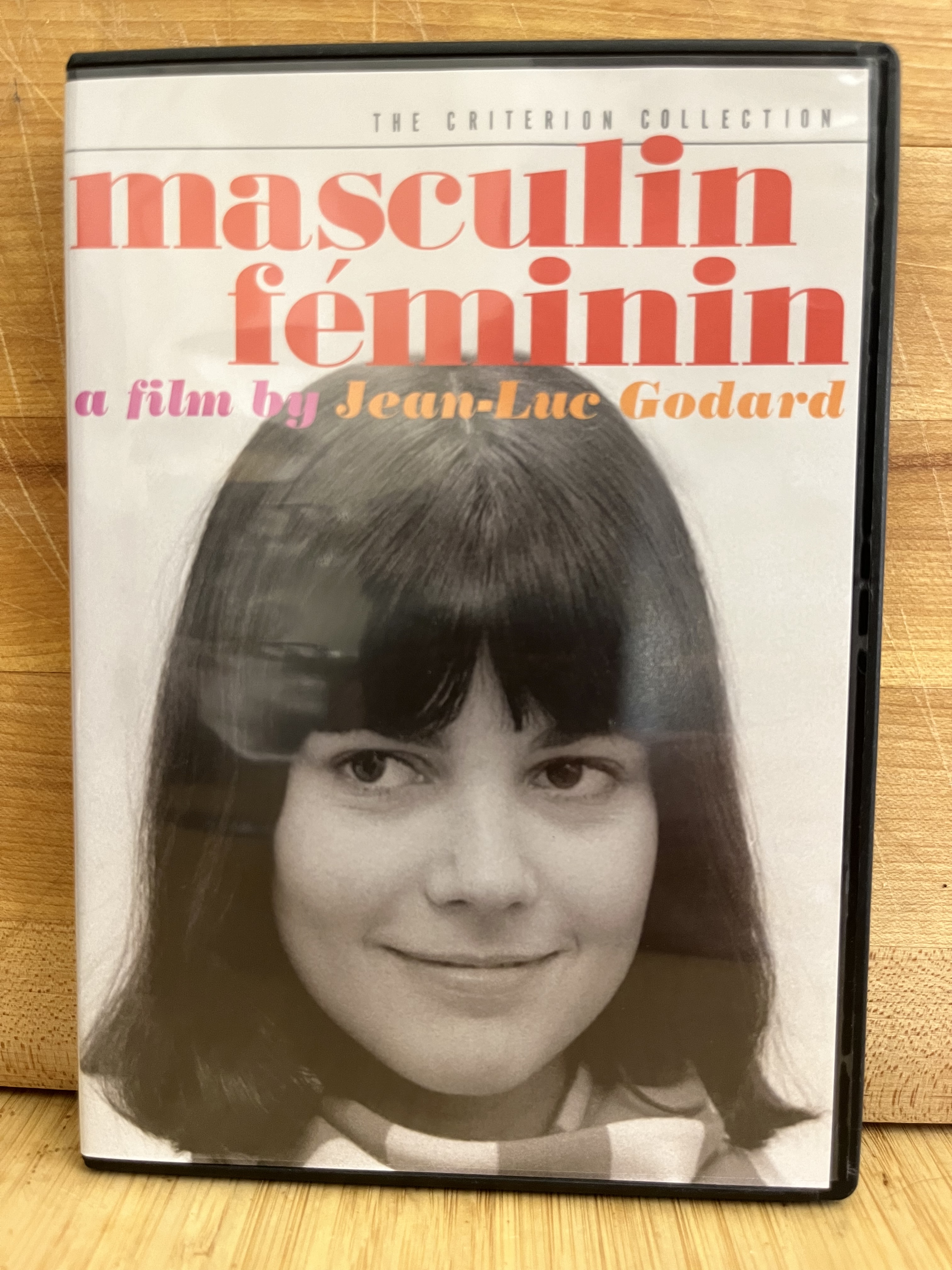
The source of these title cards is, of course, Masculine Feminine. Here’s a picture of my Criterion Collection DVD copy:

Masculine Feminine DVD case

You can also stream it on the Criterion Channel and Max with subscriptions or via Prime Video for a rental fee, and some people (including current Cornell University faculty, staff, and students) may have access to it through Kanopy via a license paid for by their local academic or public library as well.

The drink, which lends itself beautifully to batching and bottling (Lee sold them out of a vending machine at his Greenwich Village bar Existing Conditions), requires advance preparation, but is otherwise dead simple. Here’s how you make it:

4 1/2 ozs. Coca-Cola Classic
2 ozs. Popcorn-infused Flor de Caña Silver Dry Rum

Infuse the rum by combining one ounce of freshly popped corn per 750 milliliters of rum in a nonreactive container and let sit at room temperature for one hour. Strain to remove the solids, then add one ounce of clarified butter per 750 milliliters of rum, cover, and let sit for 24 hours at room temperature. Freeze the liquid for four additional hours to solidify the butter, then fine-strain and bottle. To make the cocktail, combine both ingredients in a chilled cocktail glass filled with ice cubes.

Cinema Highball in a highball glass

The impression of taking a big swig of soda while your mouth is still full of movie theater popcorn is so pronounced that you may instinctively start trying to pick kernels out of your teeth! If you can’t get Flor de Caña, another smooth silver rum like Planteray 3 Stars would work just fine here as well. Finally, while I suppose you *could* use something other than Mexican Coke made with real cane sugar in this drink, I don’t know why you would.

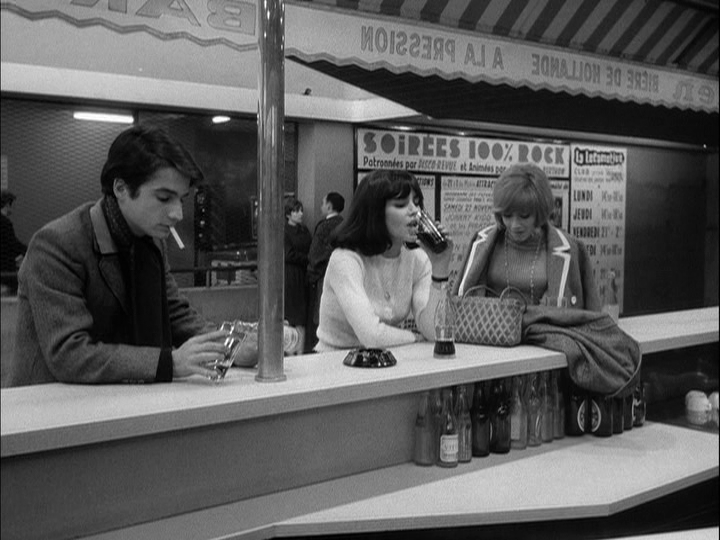
Masculine Feminine‘s Paul (Jean-Pierre Léaud) is actually a highball drinker himself, although he prefers Vittel (a brand of mineral water) and cassis.

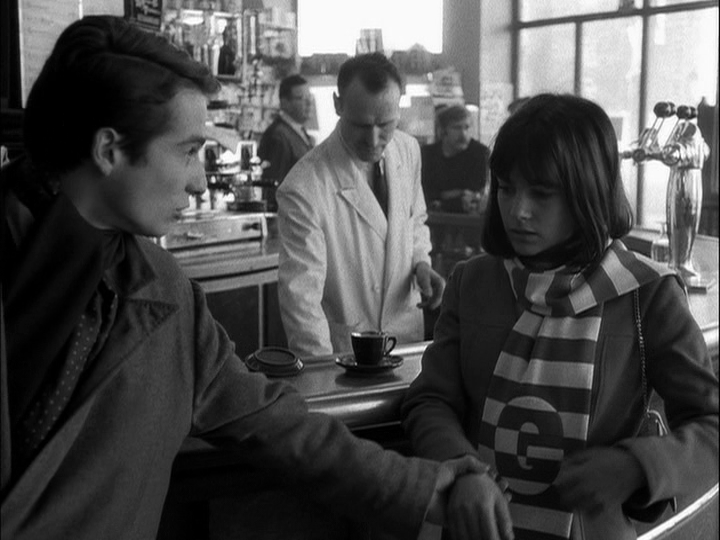
Paul, Madeleine, and Elisabeth drinking at a counter

He is shown here with Madeleine (Chantal Goya), whose character’s name also comes from Guy de Maupassant’s short story “Paul’s Mistress,” and her roommate Elisabeth (Marlène Jobert). This is one of two by the author that inspired the movie; as Richard Brody notes in his book Everything is Cinema: The Working Life of Jean-Luc Godard, the other manifests most directly in the form of the erotic Swedish film (which many people also interpret as a parody of The Silence) these characters go to see with their friend Catherine (Catherine-Isabelle Duport).

Close up of Birger Malmsten's "man in the film" looking at a comically distorted image of his face in a mirror

Despite apparently missing this connection completely, Roger Ebert surfaces another even more interesting one in his review of the 2005 American rerelease:

The movie was inspired by two short stories by Guy de Maupassant. I have just read one of them, “The Signal,” which is about a married woman who observes a prostitute attracting men with the most subtle of signs. The woman is fascinated, practices in the mirror, discovers she is better than the prostitute at attracting men, and then finds one at her door and doesn’t know what to do about him. If you search for this story in “Masculine-Feminine,” you will not find it, despite some talk of prostitution. Then you realize that the signal has been changed but the device is still there: Leaud’s character went to the movies, saw [Jean-Paul] Belmondo attracting women, and is trying to master the same art. Like the heroine of de Maupassant’s story, he seems caught off-guard when he makes a catch.

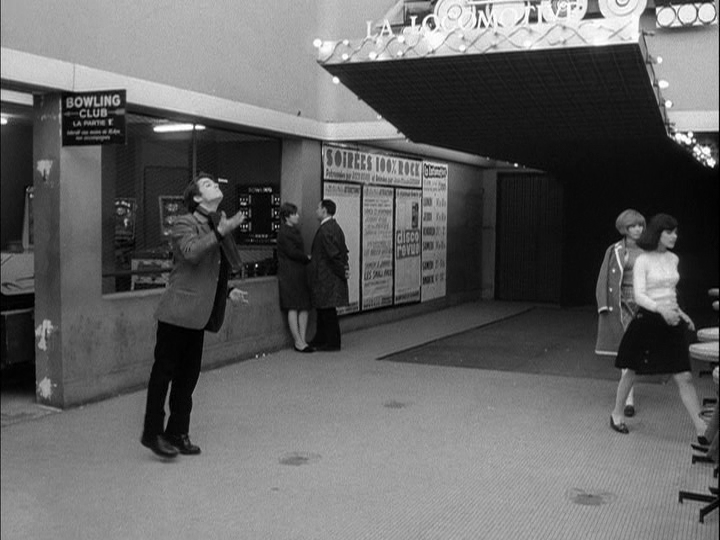
He is referring to a cigarette flip trick Paul attempts numerous times through the film (I stopped counting after five) but isn’t ever quite able to execute, making him look silly instead of cool:

Long shot of Paul attempting to flip a cigarette into his mouth

“Paul’s Mistress” also shines light on how to interpret our hero’s failure to survive the film, which in her insightful contemporaneous review Pauline Kael describes as “like a form of syntax marking the end of the movie.” Or, as Godard himself says in an interview with Gene Youngblood collected in David Sterritt’s book Jean-Luc Godard: Interviews, “even though my adaptation is very different, the de Maupassant story ended with Paul’s death. But I think death is a very good answer in that kind of movie. There is no meaning in it.”

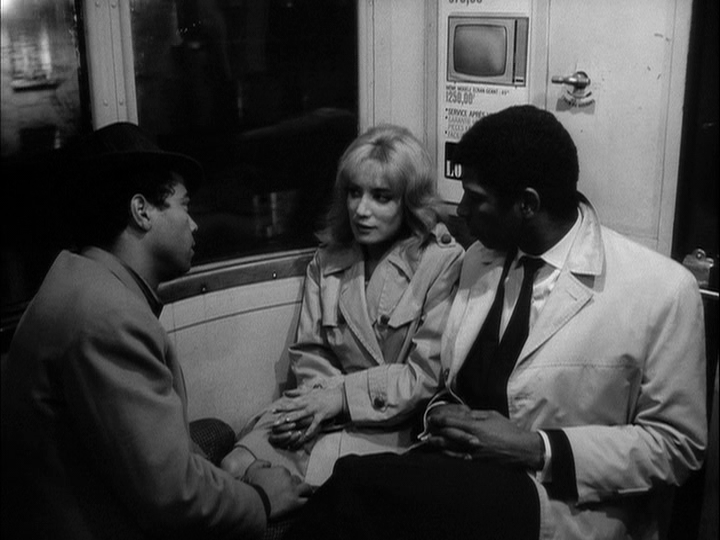
Quotations from other works abound as well, most conspicuously in the form of three members of the original French cast of Amiri Baraka’s play Dutchman (Chantal Darget, Med Hondo, and Benjamin Jules-Rosette) performing dialogue from it in character, which introduces a racial component to film’s sociological analysis of male-female relationships:

And perhaps most famously in Paul’s monologue about his generation’s relationship to the movies, which per Brody is clipped “nearly verbatim from Georges Perec’s novel Les Choses,” with Godard’s main contribution being the specific reference to American cinema:

We went to the movies often. The screen would light up, and we’d feel a thrill. But Madeleine and I were usually disappointed. The images were dated and jumpy. Marilyn Monroe had aged badly. We felt sad. It wasn’t the movie of our dreams. It wasn’t that total film we carried inside ourselves. That film we would have liked to make, or, more secretly, no doubt, the film we wanted to live.

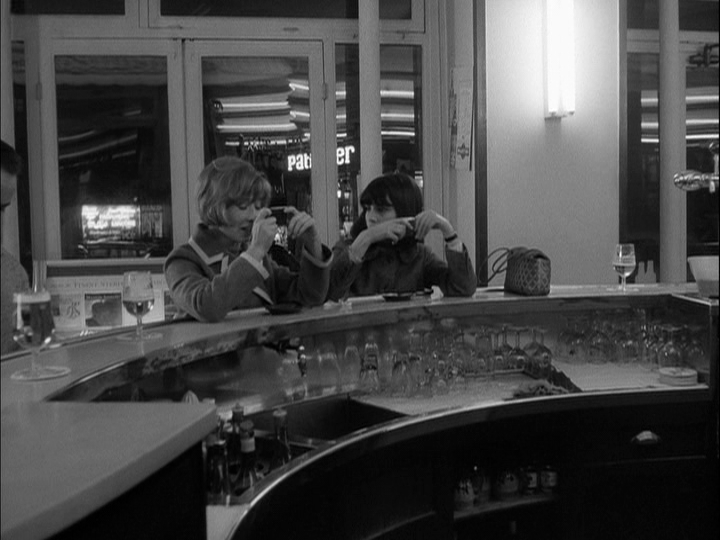
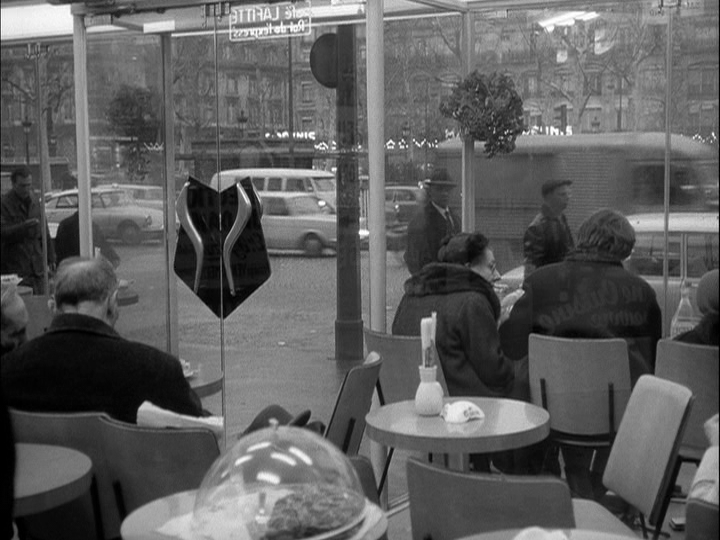
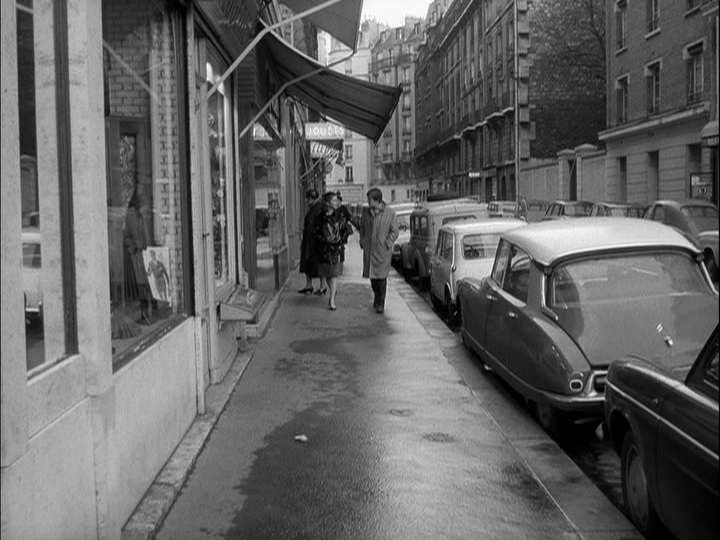
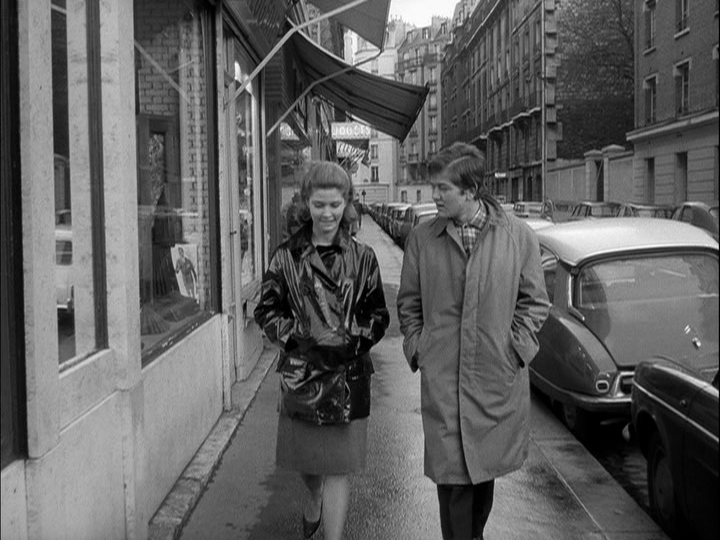
Scenes like these, each of which would require a blog post entirely its own to fully unpack, represent Masculine Feminine at its most intricate, as does the 39 second-long sequence Richard Roud analyzes in his monograph about Godard which flips back and forth between day and night five times in a way that “more or less” parallels what we hear on the soundtrack. The first shot accompanies a voiceover by Paul in which he says, “lonely and dreadful is the night after which the day doesn’t come”:

Interior long shot of Elizabeth and Madeleine sitting at the counter of a café at night

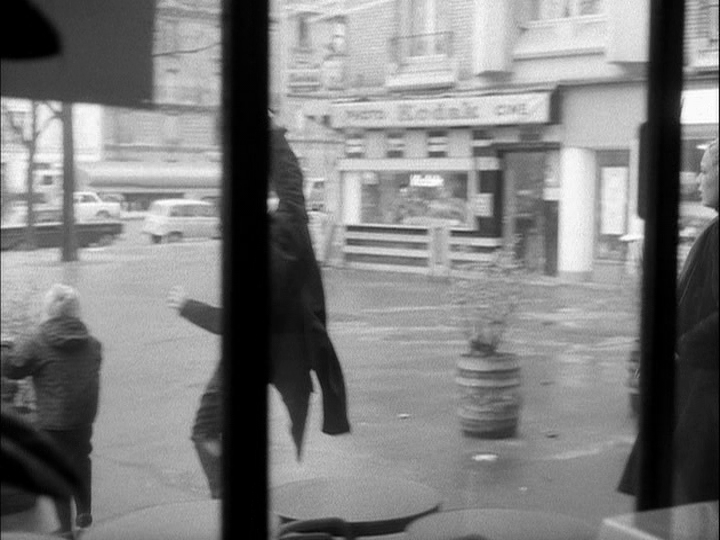
The second, third, and fourth go along with voiceovers by Catherine and Paul’s friend Robert Packard (Michel Debord) saying, “American scientists succeeded in transmitting ideas from one brain to another, by injection” and “man’s conscience doesn’t determine his existence–his social being determines his conscience” respectively:

Daytime street scene shot through a café window
Nighttime street scene in the rain
Extreme long shot of Catherine and Robert walking along a sidewalk toward the camera

And finally the fourth, fifth, and sixth are paired with voiceovers by Elizabeth and Madeleine saying “we can suppose that, 20 years from now, every citizen will wear a small electrical device that can arouse the body to pleasure and sexual satisfaction” and “give us a TV set and a car, but deliver us from liberty” in turn:

Continuation of the previous shot, but Catherine and Robert are now almost upon the camera
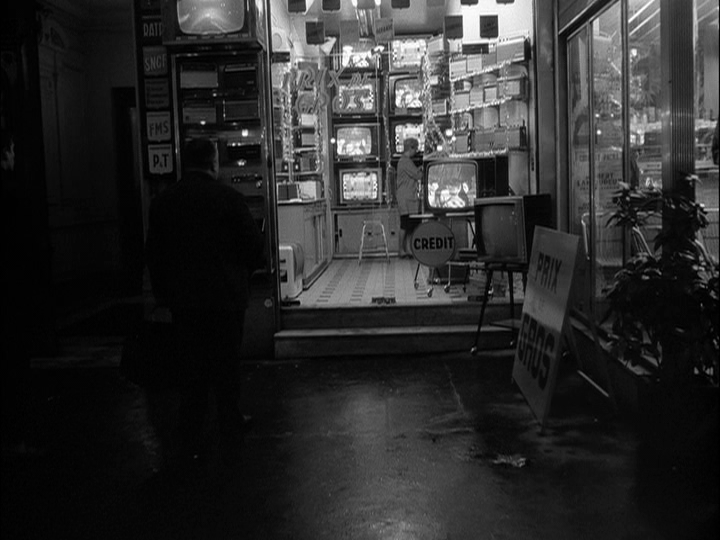
Exterior shot of a shop window at night
Daytime shot of public works employees cleaning a city street wet from rain

Roud postulates that “one could make out a case that Godard has treated this sequence dramatically.” According to the theoretical argument he outlines, “darkness corresponds to Paul’s loneliness, to Robert’s pessimistic view of life and to Madeleine’s plea for a television-set,” while “daytime would correspond to Catherine’s rosy optimism about what science will be able to do and to Elizabeth’s Utopian future in which sexual problems will be solved by a gadget.” He believes that such ideas are “meant to be only lightly suggested,” though, and to him the real interest of this sequence is that it “shows Godard reaching towards that almost total escape from the shot as filmed” that he will achieve later in his career” and “brings out even more strongly than before that dialectical tension between reality and abstraction which forms the basis of all Godard’s later films.”

Did you get all that? I certainly didn’t my first (or second) time around, and I still don’t agree with every part of it, but the genius of Masculine Feminine is that it’s apparent that *something* is going on, which keeps you coming back to take a closer look. The fact that this is invariably rewarding is what I think Dave Kehr is talking about when he calls Godard “very strict in his sloppiness” in his capsule review for the Chicago Reader. The movie also offers many more straightforward pleasures, including an extremely animated Paul telling a Robert a story in a laundromat sequence punctuated by a panoply of jump cuts:

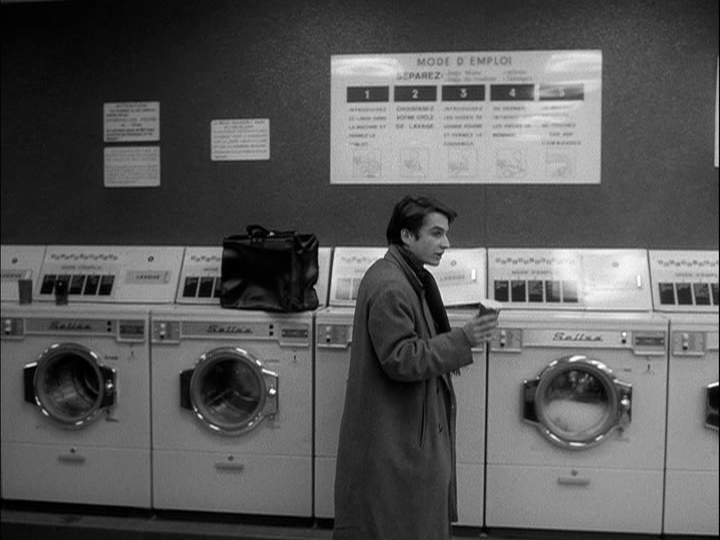
Long shot of Paul facing right in front of a bank of washing machines, gesturing with a cup of coffee
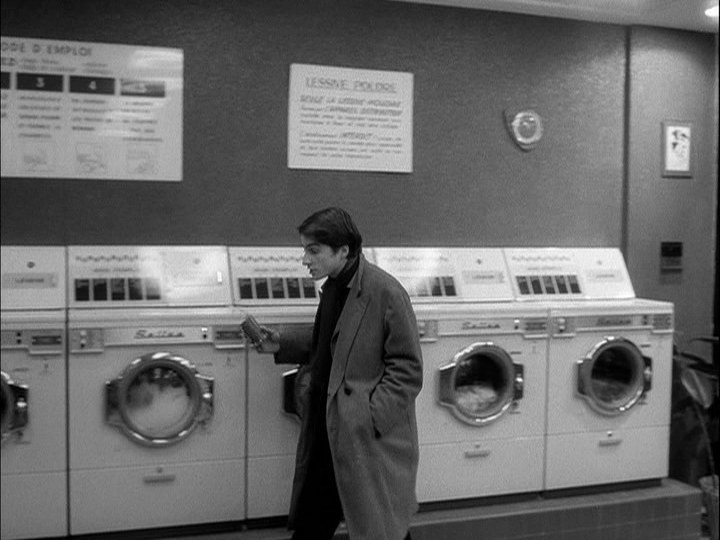
Basically the same shot as the previous one, only now Paul is facing left

A hilariously cheeky depiction of him “putting himself in someone else’s shoes” by copying the actions of man who asking for directions to the local stadium:

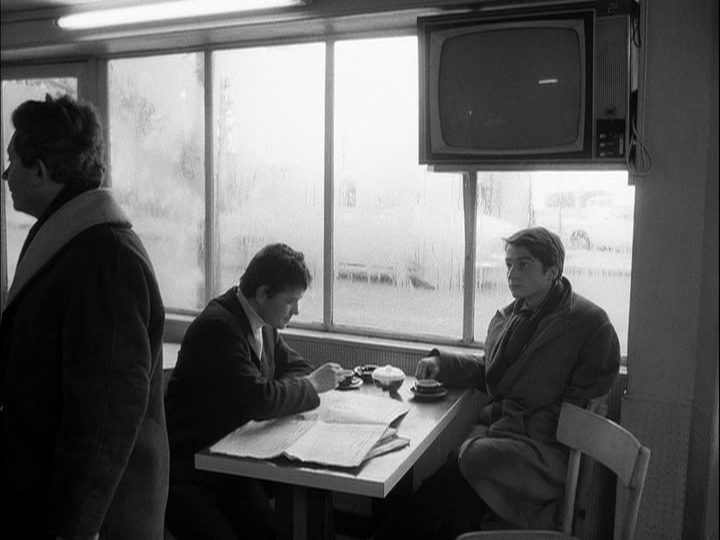
A man asks for directions in the left foreground of the frame while Paul observes him in the right background--Robert is at the same table as him in the middle of the frame
The same shot, only the man in the foreground is gone and Paul is starting to rise from his seat
Paul is now in the left foreground "asking for directions" from a woman at a hostess stand while Robert looks on from his table in the background

Paul telling the story of how his father “discovered” why the earth revolves around the sun, an experience I myself had in a third-grade science class when I figured out where rainbows come from seconds before the teacher explained it to me and my fellow students:

Paul and Elizabeth, facing the camera on the left half of the frame, talk from their seats at a café table covered in food and wine

And Chantal Goya’s songs, which are crucially far more interesting than any statement Paul or Robert ever makes on screen.

Medium shot of Madeleine in a recording studio framed such the entire top half of the image is basically just empty space

Penelope Gilliatt called Masculine Feminine “the picture that best captures what it was like to be an undergraduate in the sixties” in an article for The New Yorker, but moments like these are remarkable because they also feel timeless to one like me who went to college in the early 2000s. As do, sadly, the random acts of political and tabloid violence that Gilliatt speaks of next: “five deaths recorded; total apathy expressed by the characters.” Only two are depicted, a woman shooting her husband outside a café:

Interior shot of a woman loading a pistol in the foreground as she exists a café while Paul looks on from a table in the background
In a continuation of the previous shot, the woman aims her gun through the doorway of the café
Exterior long shot through the window of the café of a man being shot

And a man (Yves Afonso) who appears to be about to mug Paul before he suddenly turns his knife on himself:

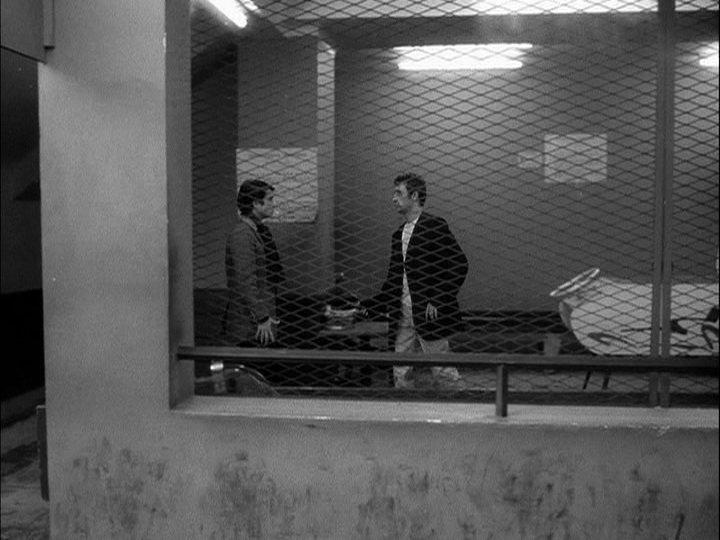
Long shot of a man threatening Paul with a knife, shot through a screened window
Medium shot of the same man stabbing himself in the stomach

Non-diegetic gunshots also appear throughout on the soundtrack, though, which Adrian Martin describes in his essay for the Criterion Collection as “harsh aural interruptions, firing at unpredictable points” that represent “the violence of everyday modern urban life” in concentrated form. Can you blame Paul if he’s so inured to it that he’s more worried about the draft coming in through an open door than the murder taking place outside of it, or about his matches than the man about to immolate himself with them in protest of the Vietnam War? Maybe so, but my point is that while Godard, who styled Masculine Feminine a “concerto on youth” in an interview with Pierre Daix collected in the Grove Press film book about it, may not approve of his protagonists playing at pop stardom and philosophy while the word burns, he (to paraphrase another great work of music) obviously understands that they didn’t start the fire.

One of the movie’s most talked-about shots is Paul’s single take interview with “Miss 19” (Elsa Leroy), which lasts nearly seven minutes and is introduced by a title card which reads “dialogue with a consumer product.”

Medium shot of Miss 19 framed by a window

His questions are seemingly designed to reveal her ignorance about current events, but as Stephanie Zacharek observes in her 2005 review, “the scene is fascinating because although on the surface it seems Godard is asking us to join in ridiculing this girl, in the end it’s Paul’s vulnerability and naiveté that are exposed.” He is also every bit as concerned with his image as Madeleine is, it’s just that where she’s specifically focused on hair and makeup:

Close-up of Madeleine looking in a compact and putting lipstick on

He’s attuned to the power of mise-en-scène in all its dimensions (remember that cigarette prop?) and nearly scraps a marriage proposal entirely when he can’t make the location he has scouted work:

Paul grabs Madeleine's arm in close-up and pulls her away from a café counter
Medium long shot of Paul gesturing with his arm to indicate that the room he and Madeleine have repaired to still isn't right
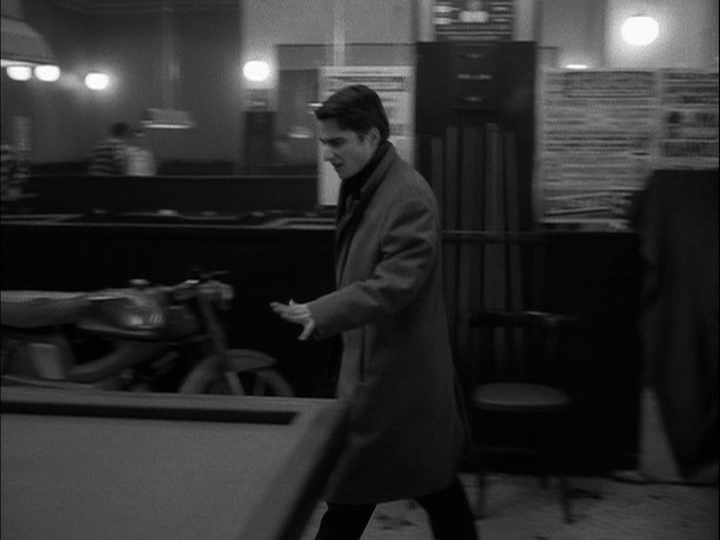
Medium shot of Paul raising his hand in frustration on the right side of the frame because the table he and Madeline, who is on the left side of the frame, are now sitting at still doesn't meet his standards

It really is too bad that Masculine Feminine‘s boys map so clearly and simplistically to Godard’s notion of the “children of Marx” and its girls to the progeny of Coca-Cola, but it strikes me as a major stretch to say that the former come away looking better than the latter, especially when, as Ed Gonzalez points out in his Slant Magazine review, the ladies get the final word: “the last shot of the film acts as a female-empowering solution to Godard’s philosophical algorithm of the sexual politic. FIN.”

Title card in French which reads "feminine" in white all-caps font against a black background
The same title card, only all of the letters have been eliminated except three that spell out "fin."

Cheers!

All original photographs in this post are by Marion Penning, aka My Loving Wife. Links to all of the entries in this series can be found here.

Ithaca Film Journal: 5/1/25

What I’m Seeing This Week: I still haven’t made it to The Legend of Ochi, so seeing it at Cinemapolis or the Regal Ithaca Mall is my top priority. I’m also hoping to catch The Surfer at one of those two theaters before it closes, but I’m going to take a gamble that it will stick around for more than a week and see La Haine at Cinemapolis on Wednesday instead.

Also in Theaters: I’m still processing The Shrouds, a typically visionary outing by director David Cronenberg which maybe didn’t come together in the final reel the way I was expecting it to? But that may well have been the entire point, and it definitely is my favorite new movie now playing Ithaca that I’ve already seen. Sinners isn’t that far behind, though. Both films are at Cinemapolis and the latter is at the Regal as well. I also enjoyed Drop and One to One: John & Yoko, which continue their runs at the Regal and Cinemapolis respectively. Thunderbolts* doesn’t really seem like my cup of tea, but it’s garnering positive reviews, so I probably will see it at Cinemapolis or the Regal eventually. This week’s special events are highlighted by Cornell Cinema‘s traditional end-of-semester “mystery screening” tonight and a presentation of the “vegan horror” movie A44, which was shot in upstate New York, at Cinemapolis on Saturday followed by a Q&A with cash members. Finally, your best bet for repertory fare is Monty Python and the Holy Grail, which is at the Regal on Sunday and Wednesday.

Home Video: I went on a Toots & the Maytals listening binge after the MUBI Podcast featured The Harder They Come as part of their “Needle on the Record” season a couple of years ago, but somehow never got around to watching the film itself until just the other day. Here’s what I said about it on Letterboxd:

Sun sparkling on the water straight out of Black Narcissus and one of the great movie soundtracks of all time. It isn’t just a *container* for great music, though: it’s a mischievously subversive acknowledgement that these songs are dangerous which works because director Perry Henzell & co. also successfully argue that suppressing them would be an even bigger mistake. Jimmy Cliff’s Ivan, who at his heart is apolitical, is a much bigger threat as a one-hit wonder revolutionary martyr than as a popular entertainer, because Lord help the establishment if someone comes along later and groks the FULL power of the lyric “they know not what they’ve done.”

You can stream The Harder They Come on Peacock with ads, but I sprang for the Criterion Collection Blu-ray, which is out of print but still readily available through Amazon and other retailers.

Previous “Ithaca Film Journal” posts can be found here. A running list of all of my “Home Video” recommendations can be found here.

How I Learned to Stop Worrying and Love “Professional Top Chef”

If memory serves me right (as Chairman Kaga used to say), once upon a time the Food Network used to bend over backwards to avoid referring to Top Chef by name. I first noticed this begin to change in the waning years of Iron Chef America, when competitors started to call on people with TC experience more and more often to serve as their sous-chefs. Then, of course, TCS4 winner Stephanie Izard actually became an Iron Chef prior to the show’s final season. Today Top Chef veterans are everywhere on the channel: last week, for instance, Antonia Lofaso (S4 + S8) became the fourth to win Guy Fieri’s Tournament of Champions in six seasons, which is even more impressive when you consider that she beat Sara Bradley (S16 + S20) to do it, who in turn had to get past Lee Ann Wong (S1, S15, S17) in the semi-finals. Meanwhile, you couldn’t make it through a single commercial break without seeing an advertisement for shows hosted by Eric Adjepong (S16 + S17), Brian Malarkey (S3 + S17), and other alums.

This makes sense when you consider that while there’s a lot of overlap, the skillset of a successful chef isn’t exactly the same as that of a television cooking competition champion. Bravo figured out early that compelling back stories, diverse cooking styles, and telegenic personalities shine brightest in an evenly-matched field and has made an artform out of balancing these attributes with traits like the ability to handle adversity and work quickly, endurance, and familiarity with emerging cuisines and techniques likely to impress the judges week after week. As their casting improved, it created a virtuous cycle whereby appearing on the show has opened doors for a higher and higher percentage of people, giving Bravo an even more impressive field of applicants to select from, resulting in an even bigger hit rate, etc. Couple this with enhanced vetting introduced after allegations of sexual harassment against Gabe Erales surfaced shortly after he won season 18, which at least so far has worked as intended, and Top Chef is basically doing the Food Network’s job of identifying rising stars for it.

The elevated standard has had a discernable impact on the show. Most gratifyingly, with total duds now far less frequent, a decision was finally made to start showing every dish prepared in the Quickfire challenges starting in season 19, and I think this year’s new prize of getting to cook an exclusive dinner at the James Beard House is also a product of increased confidence that whoever wins will be worthy of the honor. It has likewise enabled Top Chef to survive the departure of longtime host Padma Lakshmi without skipping a beat by providing the producers with a deep bench of highly-qualified replacements to choose from (Kristen Kish, the one they chose, also deserves a ton of credit for rising to the occasion, of course) and providing a chance to introduce enough sensible tweaks to things like how “immunity” is awarded to create the sense that the show is continuing to evolve without moving too far away from what made it a hit in the first place.

It has, however, created a bit of a dilemma for me as well. Like Tyler Cowen and Matt Yglesias, I consider the opportunity cost of watching television to be substantial relative to that of movies and thus allocate the overwhelming majority of my viewing hours to the latter. After season 19, I wondered for the first time if a consistently high floor might actually start to get boring at some point and mentioned this again on X last year following S21E3 in a thread that also referenced the Top Chef “eras” I came up with in 2018. Here they are again in a revised version that I’m about to add to:

  • Seasons 1-3 = Early Top Chef
  • Seasons 4-8 = Classic Top Chef: “I suspect these are the seasons most fans of the show consider to be the best, but upon second viewing the top contenders benefit from less competition than the winners who will follow them.”
  • Seasons 9-10 = Baroque Top Chef: “It’s almost like the only way they could think of to top All-Stars was by going as big as they could with the challenges and setting, and then of course S10 features the biggest cast in series history. It’s all just too much.”
  • Season 11-15 = Neoclassical Top Chef: “You could drop S11, S12, and S15 into the Classic era and they would fit right in. S13 very intentionally reflects on the show’s history, and S14 of course brings back eight former contestants.”
  • Seasons 16-20 = Modern or “Nice” Top Chef: “As described by Michelle on S16, ‘We don’t bully each other, we lift each other up. We’re all extremely talented and we’re above all that.'”

At the time I thought season 21 fit into the final category, which would have made it the longest in duration in the show’s history. I now think that S20, the second All-Stars season, served a similar function as its predecessor S8, though, which was to put the capstone on an epoch. And so I give you era number six:

  • Seasons 21-present = Professional Top Chef. The final positive evolution of the show. TC now functions in reality as well as rhetoric to usher chefs into the national spotlight by funneling people into the competitive cooking circuit and, to a lesser extent, by providing national exposure for future industry thought leaders like Kwame Onwuachi. Minor tweaks to the rules to optimize entertainment value are welcome, but if it changes significantly again, look out for signs that it has “jumped the shark.”

This isn’t just a matter of deciding once and for all where to slot the most recent seasons in my schema–it represents a significant change in the way I’m thinking about it. Just as I’m not expecting the NBA or NFL or any other professional sports league I watch on TV to change from year to year, nor am I looking for Top Chef to continue to evolve. And while I still feel great about my decision to stop tweeting out reactions to each individual episode last year in favor of one or two blog posts per season, I’m no longer worried that I’ll eventually have nothing at all to say about each one. The Top Chef Pick’Em game I run for family and friends (and friends of friends) is now eight years old, and I can easily see it still going strong at twice that age if Tom Colicchio and company stick around that long.

It would be silly to publish a post about Top Chef on the very eve of Restaurant Wars without saying anything specifically about the current season! Tristen has established himself as the prohibitive favorite in my eyes, especially now that he has immunity going into the challenge which has been the bane of many a frontrunner in the past. Behind him César’s pickle dessert from episode six is the dish from this season that I’d most like to try, and I still consider Lana a contender even though she hasn’t actually won anything yet; however, there’s a big gap after that which no one except maybe Vinny has shown they might be able to close. I like this year’s challenges, which have showcased Ontario and given the chefs every opportunity to excel, and the production design is typically first class, if not necessarily noteworthy in any obvious way. In other words, long live “professional Top Chef“!

Links to previous posts about Top Chef can be found here.

Ithaca Film Journal: 4/24/25

What I’m Seeing This Week: I’m excited to finally see The Shrouds, which opens at Cinemapolis today! I’ll probably try to catch The Legend of Ochi there or at the Regal Ithaca Mall as well.

Also in Theaters: The best new movie now playing Ithaca that I’ve already seen is the blues-drenched People’s History of Anne Rice’s The Vampire Chronicles Sinners, which meets both of Fritz Lang’s requirements for widescreen cinematography (snakes and funerals . . . check and check!) and continues its run at Cinemapolis and the Regal. I also enjoyed Drop, which is down to one showing per day at the Regal, and One to One: John & Yoko, which remains at Cinemapolis. This week’s special events are highlighted by a bevy of free screenings, many of which feature panel discussions and Q&A sessions: The Brutalist and Machines in Flames at Cornell Cinema tonight, Beyond the Straight and Narrow at Cinemapolis tonight, Human Again and National Velvet at Cinemapolis on Sunday, Deaf President Now! at Cornell Cinema on Monday, and Fancy Dance there on Tuesday. Finally, Anora now counts as “repertory fare,” so the screening at Cornell Cinema on Wednesday is my top recommendation in that department.

Home Video: An old and new favorite that I mentioned on this blog in the past year are both among the films leaving the Criterion Channel at the end of the month. The Palm Beach Story, my “Drink & a Movie” selection for last April, begins with an all-time great opening credits sequence, ends with an impressively advanced special effect for its era, and features maybe my single favorite movie prop ever, he notebook in which Rudy Vallee’s J.D. Hackensacker III writes down all of his expenses, in between. Of more recent vintage, About Dry Grasses came in eighth on the top ten list I published in March. I don’t actually say much about it there, but as I noted on Letterboxd after my first viewing, Deniz Celiloglu’s Samet is one of 2024’s most compelling unlikeable protagonists, and as I added after a second one the subjective sound design that puts the viewer in his headspace right from the start is also interesting.

Previous “Ithaca Film Journal” posts can be found here. A running list of all of my “Home Video” recommendations can be found here.

Ithaca Film Journal: 4/17/25

What I’m Seeing This Week: I’m going with One to One: John and Yoko, which opens at Cinemapolis today, and Sinners, which also begins a theatrical run today there at and at the Regal Ithaca Mall.

Also in Theaters: I’d be prioritizing The Ugly Stepsister, which I heard intriguing things about out of Sundance, but it’s only playing the Regal and I’m without a car while the rest of the family spends spring break in Canada. Hopefully it will run for more than a week! The best new movie now playing Ithaca that I’ve already seen is Drop, an extended metaphor for what it must feel like to re-enter the dating pool as a single parent in 2025, which continues its run at the Regal. I hesitate to say I “enjoyed” the brutal and intense Iraq War film Warfare, which is there and at Cinemapolis, but it’s definitely worth seeing if you have opinions about that conflict or any other one. Noteworthy special events include free screenings of Santo vs. the Vampire Women, The Dybbuk, and Remembering Gene Wilder at Cornell Cinema on Monday, Tuesday, and Wednesday respectively, and of The Empty Chair at Cinemapolis on Wednesday. Finally, your best bets for repertory fare are the screenings of Vengeance Is Mine, Parasite, and Star Wars: A New Hope at Cornell Cinema tonight, on Saturday, and on Sunday respectively. A New Hope might actually be the movie I’ve seen in theaters more times than any other, now that I think of it, and if you’re of my generation (X or Y depending on how you count) you really owe yourself the pleasure if you’ve never had it.

Home Video: I watched the biopic Better Man on Paramount+ (which I get for free through Spectrum) as part of my tantalizingly close to successful campaign to see very film nominated for one of this year’s Oscars (I caught 48/49) even though I honestly somehow didn’t know subject Robbie Williams as anything other than the fella who covered “Beyond the Sea” for the end credits of Finding Nemo and enjoyed it enough to go back and listen to everything he ever recorded on Spotify. I revisited it the other day and I’m happy to report that when you’re actually familiar with the songs, the way they’re presented in the film makes them even more interesting, especially the Baz Luhrmann-esque staging of “She’s the One,” acoustic retelling of the origins of “Something Beautiful,” and revisionist history of “Rock DJ” as a Take That track that Williams was actually permitted to write lyrics for. I still can’t (and probably never will be) recreate the experience longtime fans presumably had of seeing a familiar *face* in their lives replaced by that of a CGI chimpanzee, but even this works for me as speculation about where the trail blazed by last year’s documentary The Remarkable Life of Ibelin might lead in the future.

Previous “Ithaca Film Journal” posts can be found here. A running list of all of my “Home Video” recommendations can be found here.

Dispatch from the Minneapolis St. Paul International Film Festival

Logo for the 44th edition of the Minneapolis St. Paul International Film Festival

When travelling to a library conference I always try to make time to see a movie at the local arthouse theater. Upon looking up my options during ACRL 2025, I was delighted to discover that the Minneapolis St. Paul International Film Festival was opening the same day as my arrival! Despite the best efforts of United Airlines (5/6 flights I took on this trip were delayed) to derail my plans, I was able to see three movies at The Main Cinema, which has a pretty amazing Midwest industrial (neon signs advertise Gold Medal Flour and Grain Belt Beer) riverfront view of downtown Minneapolis. I actually want to begin this dispatch with a meal, though, because it was the best part of my experience.

Despite the fact that Owamni has been hailed by both the James Beard Foundation and the New Yorker as one of the best restaurants in the country, I was easily able to grab a seat at the bar as a walk-in by arriving between the lunch and dinner rushes. When Sean Sherman, aka The Sioux Chef, appeared on Top Chef last year as a guest judge, I noted that “if I could conjure up a Michelin-starred restaurant in Ithaca, it would serve food like what we saw on this episode,” which was devoted to indigenous American foodways. Owamni is even more impressive than what I imagined because it doesn’t just serve delicious, innovative food in a beautiful airy lightbox setting, it’s also approachable. Although the wait staff was still clearly getting to know the new spring menu, all of their recommendations were spot-on and they cheerfully tracked down the answers to all of my questions about unfamiliar preparations like ashela (a savory porridge) and ingredients. I started with “their version of bar nuts,” crickets and popcorn, and a pint of Lake Monster Brewing Company‘s Last Fathom Wild Rice Lager, which “came out like a stout” like my server said it would and went great with the sweet (from candied seeds) and savory (toasty dried insects flavored with, I believe, sumac) snack. I also loved the jammy blackberry mignonette that came with my oysters (from Washington) on the half-shell and the micro-carrot tops that garnished that dish and my vegetarian tartare, which also featured dried huckleberries, pickled juniper shallots, and fresh raspberries that brought everything together. The star of my meal was definitely the duck papusa, though, which sat atop an incredible red pepián mole that I couldn’t get enough of and which paired exceptionally well with a glass of Bruma Ocho Rosé from Mexico’s Valle de Guadalupe.

I don’t fault Quisling: The Final Days, the movie I saw after walking across the Mississippi via the Stone Arch Bridge, for failing to live up to this memorable repast, but I do object to its weak tea version of The Zone of Interest‘s fascination with the inner lives of demonstrably evil individuals in denial. It’s a thoroughly professional production anchored by strong performances by Gard B. Eidsvold in the title role and Joachim Trier’s muse Anders Danielsen Lie as the priest assigned to show him the error of his ways, which if successful would somehow benefit the church and Norway. The most interesting thing about it for me, however, was the palpably approving reaction of the (fairly large) audience I saw it with to a scene in the final reel immediately after director Erik Poppe’s own The Act of Killing reference, which served as a visceral reminder of how much pleasure people take in seeing the mighty humbled. I worry that it’s this more than the healthy fear that something rotten inside ourselves explains the sorry state that the world is in which accounts for its The Zone of Interest‘s success, but that may just be me being cynical.

Sister Midnight, a bizarro companion piece to fellow Cannes 2024 alum All We Imagine as Light (one of my favorite films of Movie Year 2024), was much more my speed. Both are about Indian women trapped in unfulfilling arranged marriages, but where Kani Kusruti’s Prabha adopts an alternative family of female friends in the latter, Sister Midnight‘s Uma (Radhika Apte) literally creates a pack of stop-motion vampire goats to run with. The late night double feature picture show vibe is further reenforced by an entertainingly eclectic international pop music soundtrack and a kitchen sink approach to horror comedy tropes, but what I enjoyed most were the Jarmusch-like rhythms of Uma’s game if resentful initial attempts to adapt to the tedium of her new life as a Mumbai housewife. Director-writer Karan Kandhari is very deserving of his BAFTA Film Award nominee for Outstanding Debut by a British Writer, Director, or Producer for this movie and is definitely someone to keep an eye on.

The MSPIFF selection I enjoyed most was the first one I saw, The Things You Kill, which the programmer who introduced it explicitly identified as being indebted to the late great David Lynch by way of preparing us for a mid-film narrative logic curveball, but an even more salient influence is Asghar Farhadi, who numerous internet sources state that director Alireza Khatami worked under as AD (although none seem to indicate on which productions), specifically his magnum opus The Salesman. The Things You Kill is every bit as interested in how much an American text can teach us about another society and the people who belong to it, only here the object of scrutiny is a comparative literature professor who lived abroad for 14 years instead of a play. It also features breathtaking Anatolian landscapes and a short-tempered teacher that serves as a bridge between Khatami’s country of birth Iran (see Universal Language for a recent example) and Turkey (About Dry Grasses, another movie on my 2024 top ten list) where this film is set. I wish it delved a bit deeper into how frustrating and emotionally exhausting infertility issues can be for couples who want to have children, and I’m not sure how believable some of the actions of the protagonist played by both Ekin Koç and Ercan Kesal are if you’ve never known anyone who has struggled against them, but The Things You Kill is a first-rate psychological drama which is right up there with Eephus and The Woman in the Yard as one of the best movies I’ve seen so far this year.

All in all I was pretty impressed by MSPIFF’s lineup, venue and setting! I love a city that makes it cheap and easy to get from the airport to downtown via light rail, and the stadiums of a number of professional sports teams are all located within walking distance of the festival, so I could definitely see my my family returning as part of a vacation that also includes watching the Knicks play the Timberwolves or the Mets play the Twins, or maybe even a Minnesota Lynx game if the festival or the WNBA changes its schedule. I just might be more selective about who I choose to fly with, is all.

Previous posts about film festivals can be found here.

Ithaca Film Journal: 4/10/25

What I’m Seeing This Week: I’m happy to report that I am finally going to make it to the Finger Lakes Environmental Film Festival! The screening I’m targeting is the one of 7 Walks with Mark Brown at Cinemapolis on Sunday. I’m also hoping to catch Warfare there or at the Regal Ithaca Mall and Drop at the Regal.

Also in Theaters: Had I but world enough, and time, other FLEFF events I’d want to attend include the screenings at Cinemapolis of Sleep with Your Eyes Open tonight and The End of St. Petersburg (which includes live musical accompaniment by local legends Cloud Chamber Orchestra) on Saturday, and the live performance using 19th-century optical devices called “Elliott and Schlemowitz’s Magic Lantern Show” there on Sunday. My favorite new movie now playing Ithaca that I’ve already seen is The Woman in the Yard, a well-crafted chilling psychological horror film about my greatest fear as a parent which continues its run at the Regal, but maybe only for one more week (it’s down to one showing per day). I also enjoyed Black Bag, which closes at Cinemapolis tonight, and A Working Man, which continues its run at the Regal. Noteworthy special events include free screenings of last year’s Best International Feature Film Oscar winner I’m Still Here at Cornell Cinema on Monday and Matter of Mind: My Alzheimer’s at Cinemapolis on Wednesday and free “sensory-friendly” screenings of the PBS children’s television program Carl the Collector at the Tompkins County Public Library on Wednesday. Finally, your best bets for repertory fare are the 4k restorations of North by Northwest and my November “Drink & a Movie” selection The Searchers at Cornell Cinema tomorrow and Sunday respectively as part of their “VistaVision!” series.

Home Video: I’ve been meaning to check out Wooden Crosses on the Criterion Channel ever since Kristin Thompson and David Bordwell (RIP) referred to it as a “masterpiece unknown to most modern viewers” in their “The ten best films of … 1932” blog post a few years ago and I finally got around to it the other day. Here’s what I posted to Letterboxd after my second viewing:

As a committed pacifist war films aren’t my favorite genre. It is the shame of our species that we’re still fighting each other at this point in our development, and there isn’t much else to say about the matter. Wooden Crosses is largely exempt from this argument, though, because of when it was made and because it isn’t so much anti-WAR as it is anti-war PROPAGANDA. While it has elements that are maybe more appropriate to the silent era like a double exposed dual parade of living and dead soldiers, it’s very smart about sound and neither of its most crucial scenes would work as well or even at all without it. First Corporal Breval (Charles Vanel), far from leaving his comrades with lofty sentiments or pearls of wisdom as he expires instead instructs them to make sure everyone knows what a slut his wife is. Then Gilbert Demachy (Pierre Blanchar) is denied a hero’s death and succumbs to a gutshot wound after an entire day spent whimpering pathetically in no man’s land as he waits for nightfall and the promise of stretcher bearers who never arrive. The point is clear: there is nothing ennobling about their “sacrifice.” Their stories were simply cut short and wasted, leaving behind a lifetime of unfinished business. Wooden Crosses is also justly famous for the documentary-style combat footage that is the reason 20th Century-Fox studio head Darryl Zanuck bought the North American rights to it (so that the footage could be reused in The Road to Glory), the maddeningly incessant sound of artillery is again the reason this is *effective*. I would even go so far as to say that it compares well to some scenes from Band of Brothers, which is impressive considering it preceded that work by nearly 70 years.

Previous “Ithaca Film Journal” posts can be found here. A running list of all of my “Home Video” recommendations can be found here.

April, 2025 Drink & a Movie: Chapuline + Black Sheep

I didn’t conceive of it as such, but my “Drink & a Movie” series is a fair approximation of my personal cinema and cocktail canons because (predictably, in retrospect) I have mostly chosen to write about my “go-to” directors and ingredients and scenes and techniques, the ones I’ve spent the most time thinking about and which have therefore played the biggest roles in shaping my point of view as a cinephile and drinker. My tastes are constantly evolving, though, and to conclude my three-post-long celebration of crème de cacao I’ve selected two new discoveries from the past few years.

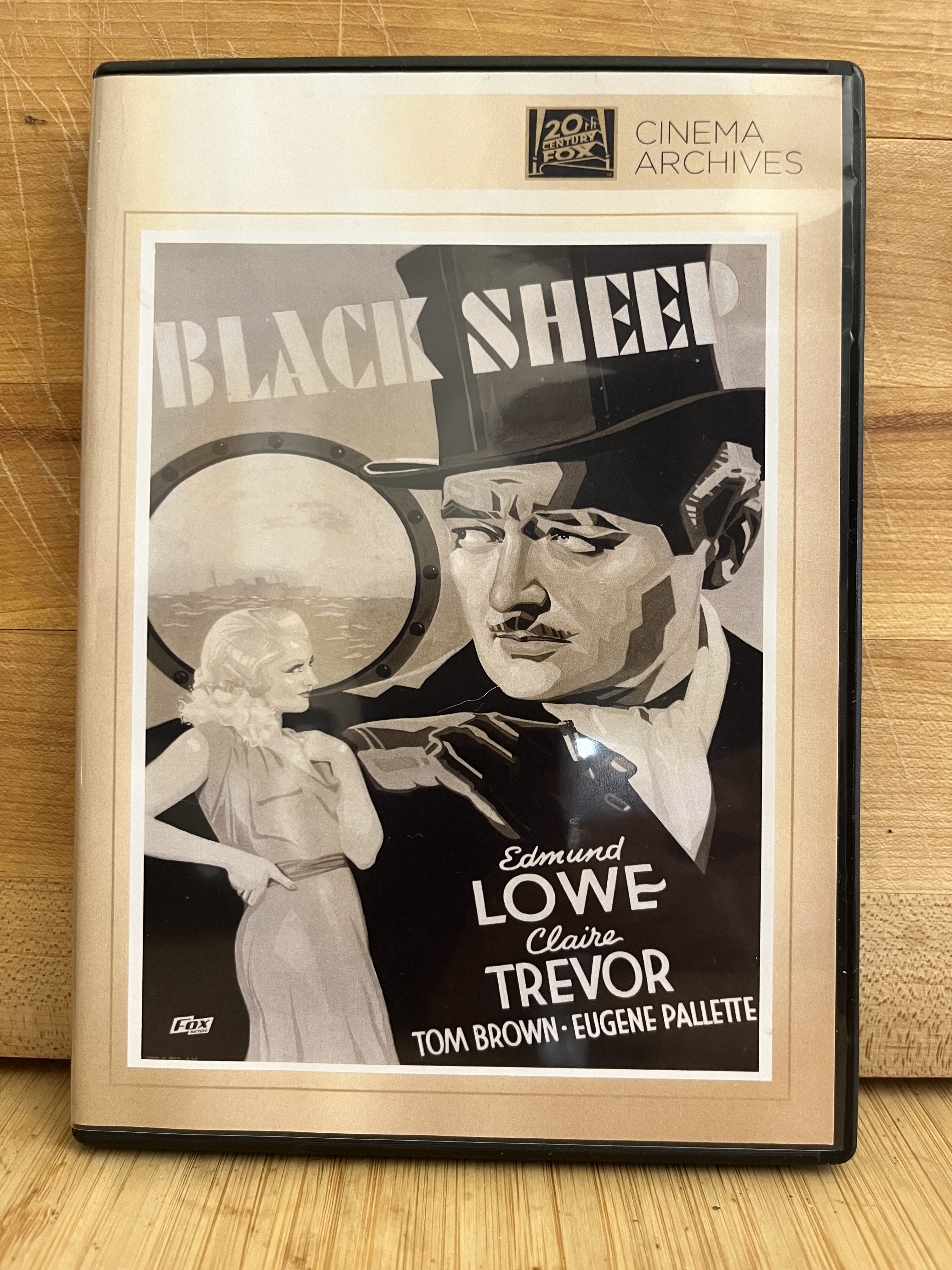
Shortly after I watched Black Sheep for the first time, I talked about it first in an “Ithaca Film Journal” home video recommendation as “total catnip for me,” then again a few months later in my “Top Ten Movies of 2023” post as “the most fun I had with a movie all year.” Here’s a picture of my bare-bones 20th Century Fox “Cinema Archives” DVD copy:

Black Sheep DVD case

Unfortunately, although I originally saw this film on the Criterion Channel as part of a collection called “Directed by Allan Dwan,” it doesn’t appear to be streaming anywhere right now.

One of the things I found so delightful about Black Sheep are the old-school drinks heroine Claire Trevor’s Janette Foster orders: she asks for, in sequence, crème de menthe, a crème de menthe frappé, and Dubonnet. I wanted to offer a more complex alternative to Janette’s usuals like I did with the sweet vermouth on the rocks with a twist ordered by Andie MacDowell’s Rita Hanson in my Drink & a Movie entry for Groundhog Day, and I quickly settled on the Chapuline, a delightful variation on the grasshopper created by Toby Maloney of Chicago’s The Violet Hour. He specifically calls for green crème de menthe, but does so while making a joke related to presentation: “the white pales in comparison.” I’ve never been able to find the bottle by Marie Brizard he recommends and every verdant variety that *is* available in Ithaca tastes unbearably artificial in comparison to Tempus Fugit Glaciale, so that’s what we went with. In addition to tasting much better, I submit that it also looks just fine in this yellow glass we picked out to serve it in. Here’s how we make it:

1 oz. Crème de cacao (Tempus Fugit)
1 oz. Crème de menthe (Tempus Fugit)
3/4 oz. Pisco (Macchu Pisco)
1 oz. Heavy cream

Shake all ingredients vigorously with ice and double strain into a chilled cocktail glass. Garnish with a spanked (to release its aromas) fresh mint leaf.

Chapuline in a cocktail glass with a pearl necklace

As he notes in The Bartender’s Manifesto, Maloney’s goal was “to prove that [he] could take a gauche drink and make it at least interesting, at best delicious.” Mission accomplished! The first thing you notice is its beautifully silky texture. The flavor that pops is peppermint immediately followed by chocolate–the effect would be almost exactly like eating a York Peppermint Pattie except that there’s also a burn which resolves into grape on the finish, as if the drink was morphing from a grasshopper to a stinger, the other classic cocktail most commonly associated with crème de menthe. You wouldn’t get this with a barrel-aged spirit like cognac, obviously, so the choice of pisco is quite brilliant!

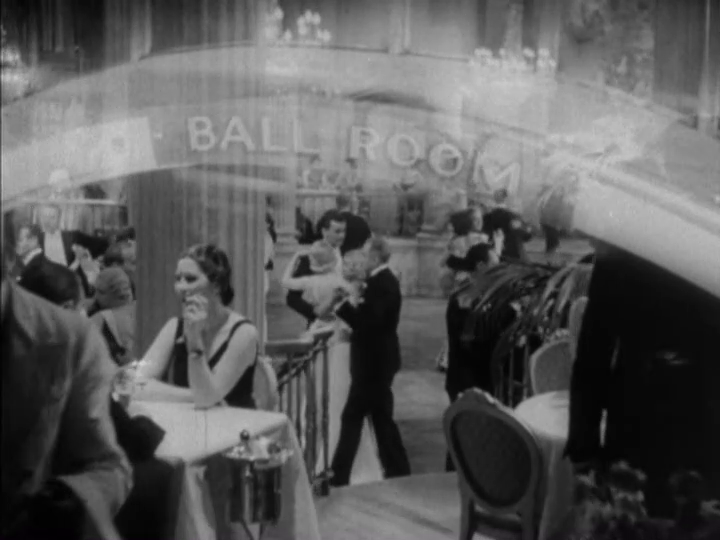
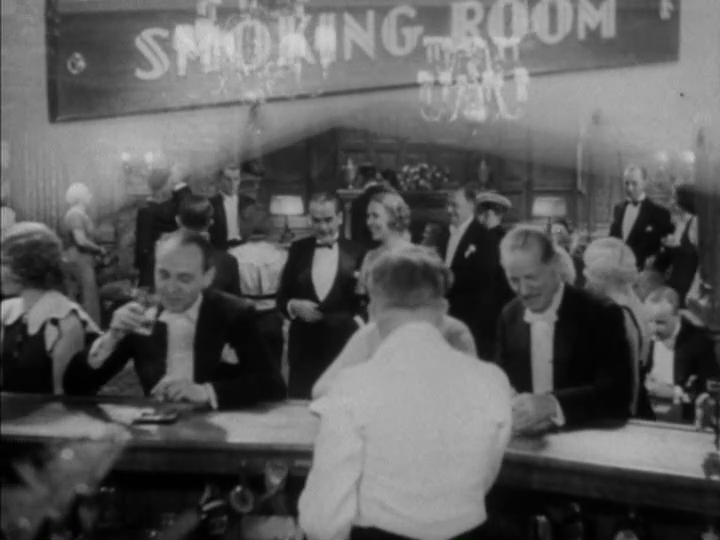
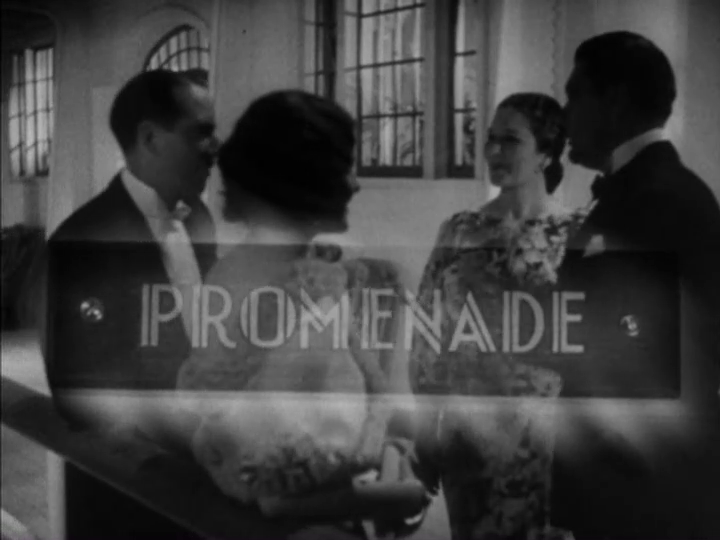
Maloney’s recipe includes instructions to shake “like it owes you money,” which is actually a pretty excellent segue into discussion of Black Sheep since income, like the film’s camera movements, represents both freedom and confinement for its protagonist John Francis Dugan (Edmund Lowe) and the other characters. As Frederic Lombardi writes in his book Allan Dwan and the Rise and Decline of the Hollywood Studios, “the opening shots of the film give a full sense of the great breadth of the ship Olympus but as the story unfolds, there are increasing attempts to restrict the space in which Dugan can move, so that he must literally know his place.” To start at the beginning, an introductory montage provides a tour of the ship’s first-class spaces:

Double-exposed shot of a sign that reads "Ball Room" superimposed over that space
Double-exposed shot of a sign that reads "Smoking Room" superimposed over that space
Double-exposed shot of a sign that reads "Promenade" superimposed over that space

Before the gliding camera comes to rest on this sign:

Close-up of a sign on a railing that reads "Second class passengers not allowed beyond this point"

And then goes tumbling down the stairs:

Close-up of the top of the stairs that the sign in the previous shot blocked
Close-up of the bottom of the stairs from the last two shots
Close-up of the ceiling of the deck that the stairs lead to, which in combination with the previous two screengrabs creates the impression of a fall

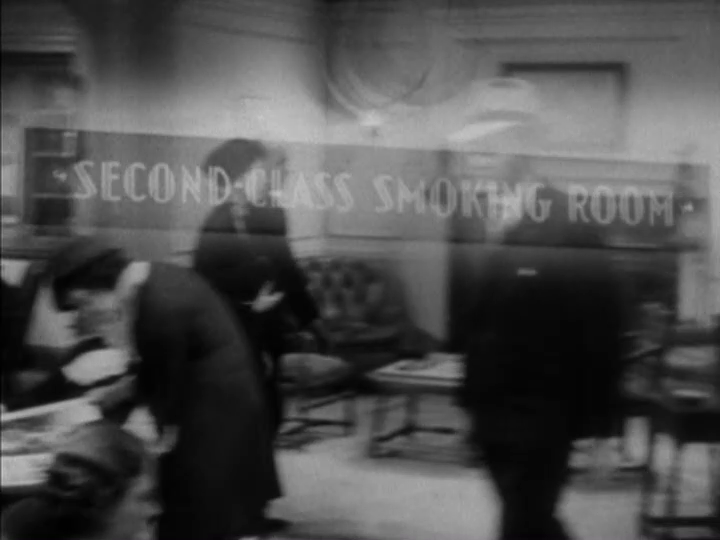
Moving at a much faster pace than it did earlier, cinematographer Arthur Miller’s camera now repeats its double-exposure trick to show us we’ve been taken down a notch to second class:

A sign that reads "Second-class smoking room" superimposed over that space, which is blurry because the camera is tracking rapidly to the right

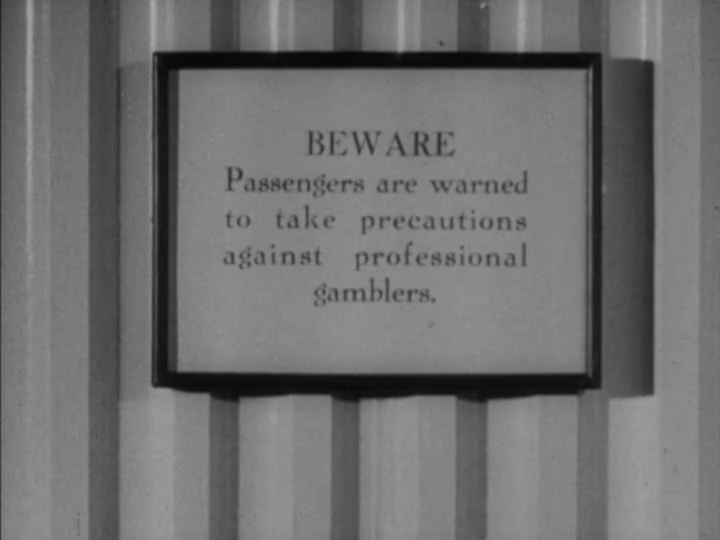
Before it finally stops on a sign and cuts to Dugan playing solitaire:

Close-up of a sign that reads "Beware: Passengers are warned to take precautions against professional gamblers"
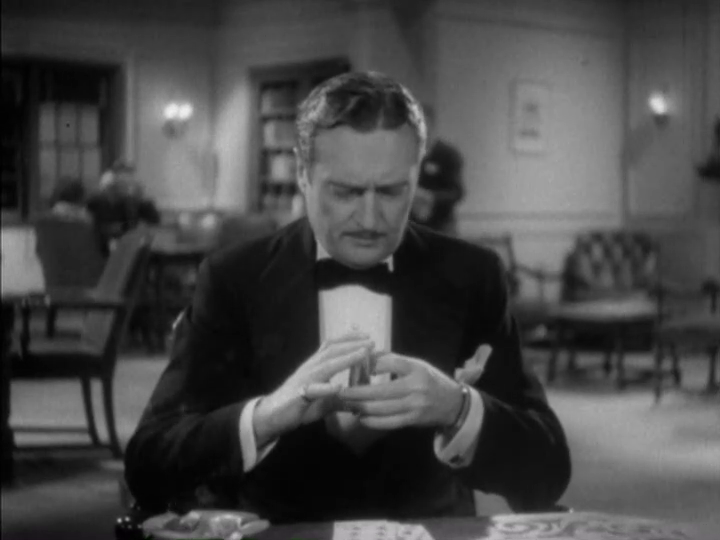
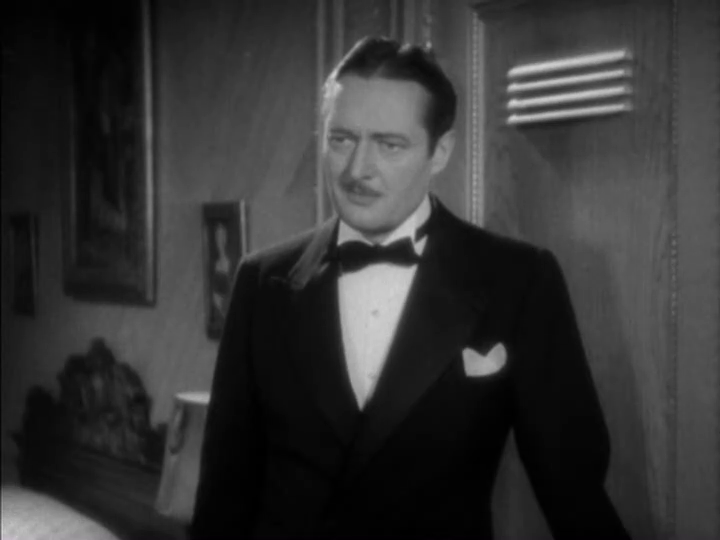
Close-up of John Francis Dugan

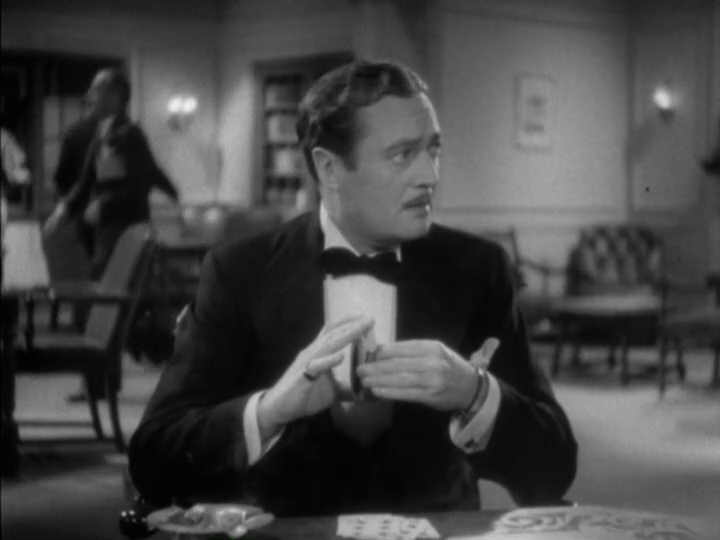
In just the first of many examples of what Fernando F. Croce calls Black Sheep‘s “limpid storytelling,” our logical assumption that he must be one of the sharps that the people on board the Olympus are cautioned to be wary of is confirmed by the two shots which follow him looking up from his game at his fellow denizens of the second-class smoking room.

Medium shot of Dugan looking stage left

First a woman indignantly responds to her companion’s suggestion that they play bridge for a tenth of a cent per point by saying, “I should say not! I lost 55 cents at a twentieth last night. I’ll play for a fortieth or nothing.”

Medium shot of a bridge player looking indignant

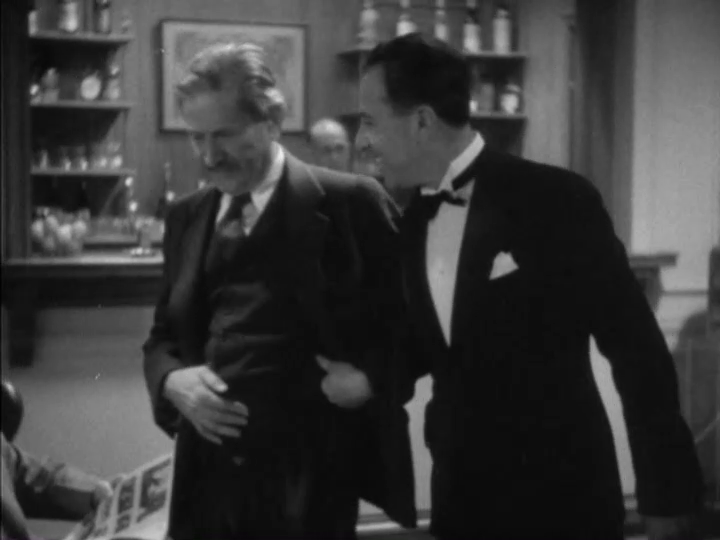
Then one man responds to another’s suggestion that they play checkers by saying, “I don’t mind if you don’t play for money.”

Medium shot of two men walking arm-in-arm to an offscreen checker board

Dugan shakes his head and returns to his game, but is soon distracted by an offscreen clicking noise which a quick tracking shot soon reveals to be caused by Foster’s vain attempts light a cigarette:

Medium shot of Dugan looking up and stage right
Medium shot of Claire Trevor's Janette Foster looking down and to stage left at a lighter that doesn't work

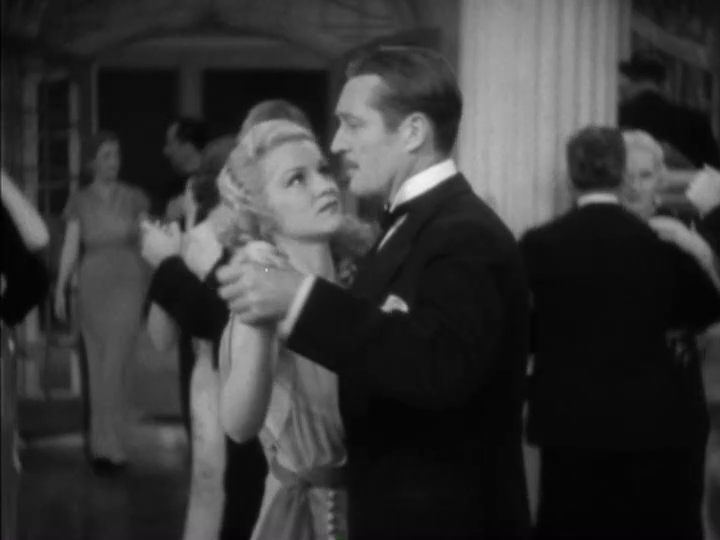
And with that we’re off and running! Foster’s lighter doesn’t work because it isn’t supposed to: “that’s how I meet so many nice people,” she informs Dugan. It’s a toss-up for me whether the *very* best thing about Black Sheep is the dialogue by director Allan Dwan (who wrote the story that the movie is based on) and screenwriter Allen Rivkin or the chemistry between its stars, who David Cairns brilliantly describes as “so delightful together you long for a whole season of Thin Man type romps for them to connive through (as he says, “sometimes film history just misses a trick”) although these things are of course related. The snappy one-liners come fast and furious right from the start: when Foster asks if she can buy Dugan a drink, his reply is “I don’t know, can you?” A few beaters later she labels them “two good mixers with no ingredients.” Then a bit further on after the two sneak upstairs to “see how the rich people live,” Dugan condenses a whole lifetime of back story into just a handful of sentences. “There are two things that always floor me,” he tells Foster, “horses and dames. One keeps me broke, the other crazy, and you can’t depend on either of them.” When she quips, “don’t tell me a horse jilted you!” he replies in kind: “yes, and a girl kicked me.”

Medium-long shot of Dugan and Foster talking as they dance

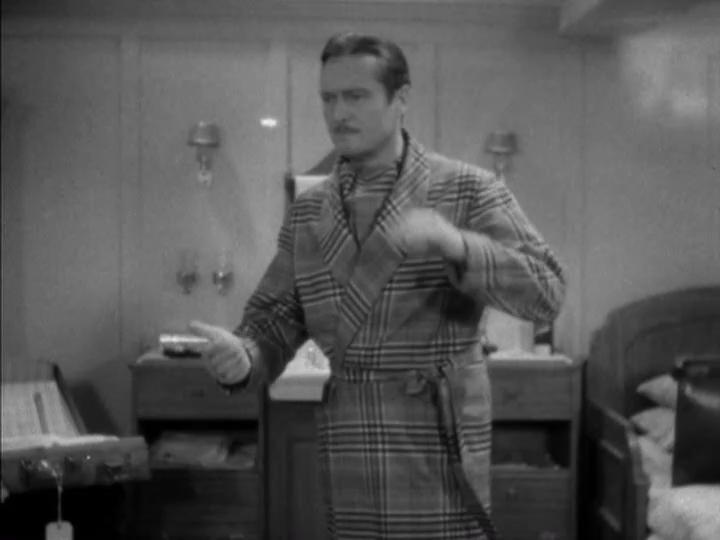
But then he adds: “that was twenty years ago. Forget it.” Speaking of coin flips, in addition to sharing a profession in common with the main character of last month’s Drink & a Movie selection Bob le Flambeur, Dugan similarly uses them as an external signifier of his deference to the Fates:

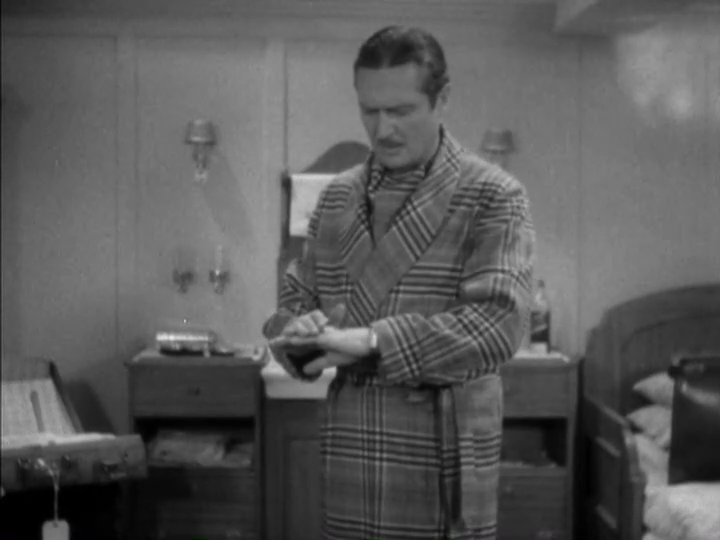
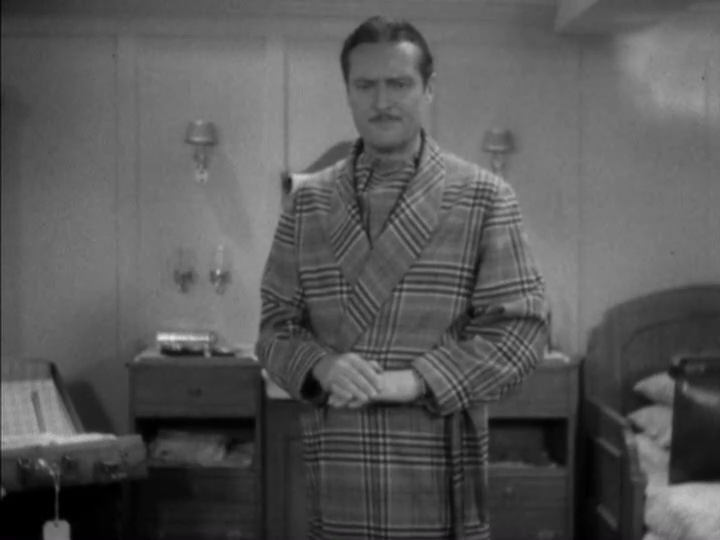
Medium-long shot of Dugan, who is wearing a bathrobe, preparing to catch a coin in midair
Medium-long shot of Dugan lifting his hand and peering at the result of the coin flip
Medium-long shot of Dugan looking somewhat displeased at the result of the coin flip

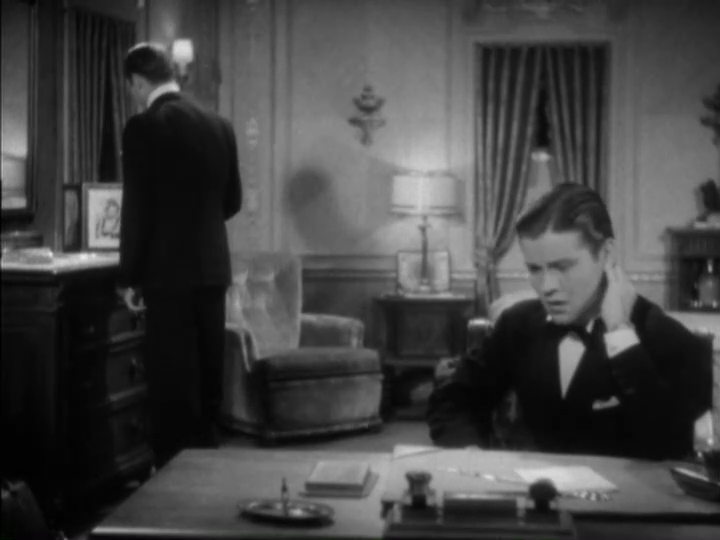
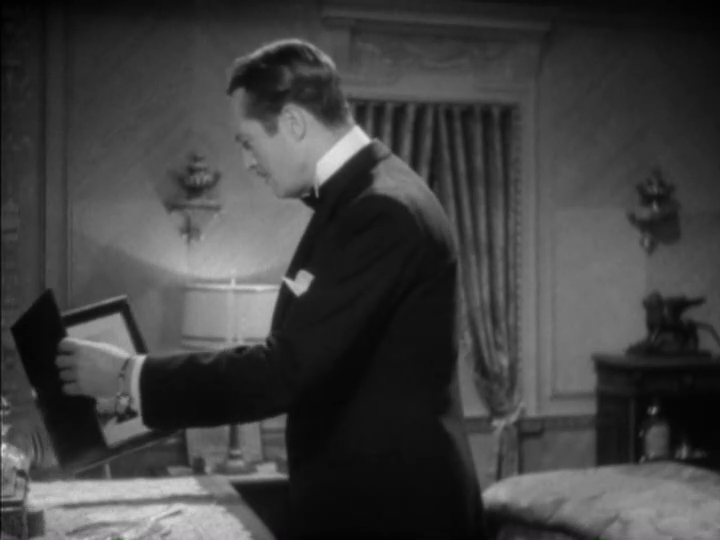
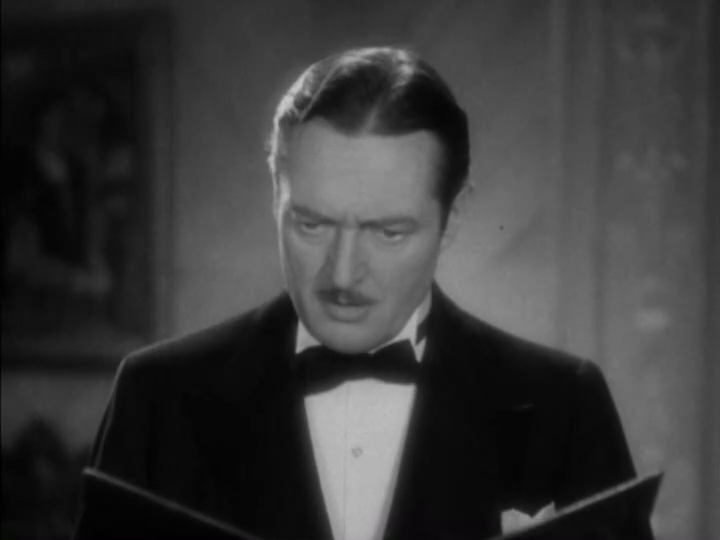
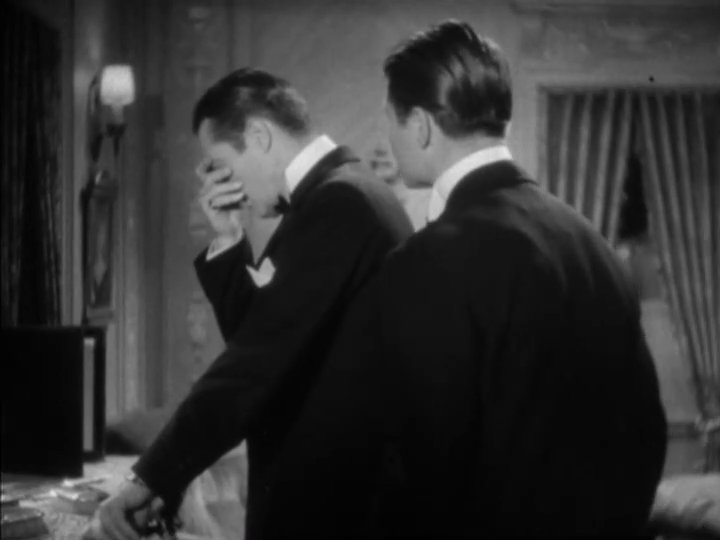
“Dugan and Foster stay in business,” he says after this one, referring to the partnership they have entered into to help a young man named Fred Curtis (Tom Brown) they observed getting fleeced in poker during their upper deck sojourn who also, as it happens, turns out to be Dugan’s son. This fact is revealed in a moment that Matt Strohl describes as “an emotional bolt of lightning in the middle of the film” which occurs after Dugan has helped Curtis win back some of the money he lost to Eugene Pallette’s and Jed Prouty’s buffoonish oil tycoons Colonel Upton Calhoun Belcher and Orville Schmelling by posing as his friend, but only at the expense of his own profits when he is forced to accept the checks Curtis wrote them as payment or risk giving up the ruse. He’s right in the middle of getting tough with Curtis (“I’ve got $1800 coming from you and I want it–in cash”) when suddenly he spots a set of framed photos:

Curtis looks stressed in the foreground while Dugan spies a framed set of photos in the background
Medium shot of Dugan picking up the photos
Close-up of Dugan looking stunned

“What’s the matter?” Curtis asks him after he notices the older man’s reaction:

Medium shot of Curtis asking Dugan, who has his head in his hand, what is the matter

“Oh, nothing, nothing–I probably had too much to drink or something,” Dugan stammers. He gives no further explanation, but immediately changes his tune regarding repayment. “Where’s that note for those rubber checks?” he asks, then looks on with what my daughter Lucy would call a “thin smile” while Curtis writes it:

Medium-long shot of Dugan looking bemused

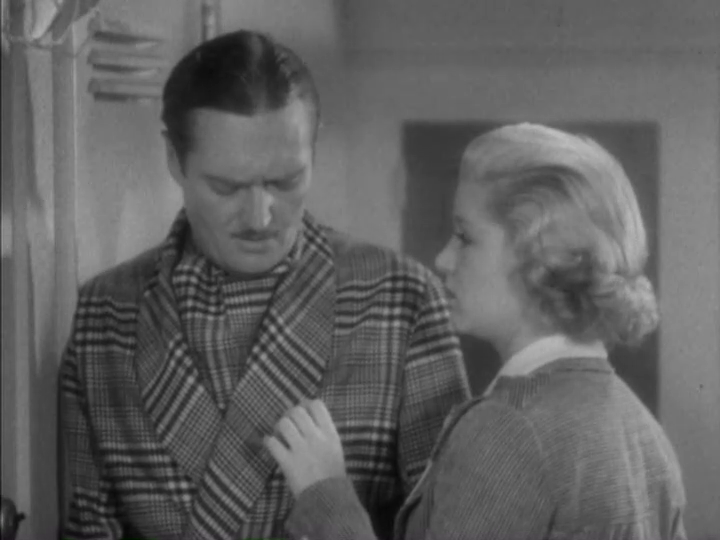
As Strohl notes, although Dugan never reveals his discovery to Curtis even through the end of the film, “that one reaction scene reverberates and lends weight to everything that follows,” including what I think must be the romantic non-kiss in the history of cinema. It takes place about halfway through a 30-second-long shot that begins right after the coin flip depicted above when Dugan notices Foster’s hand on the lapel of his bathrobe:

Medium shot of Dugan looking at Foster's hand

They put their arms around each other and lean in, but suddenly he pulls back:

Medium shot of Dugan and Foster leaning in for a kiss . . .
Dugan and Foster lean in closer
Suddenly Dugan pulls back

It’s just for a second and they lean in again, but the result is the same:

Medium shot of Dugan and Foster leaning in to each other again
Dugan pulls back again
Foster smiles as Dugan raises his head

Foster is already smiling as he lets out a perplexed sigh and is laughing by the time he calls for the steward to “take this lady out of here”:

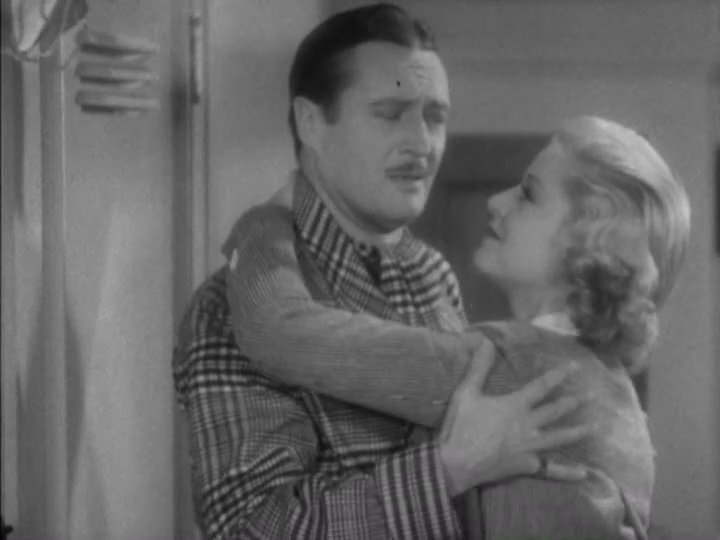
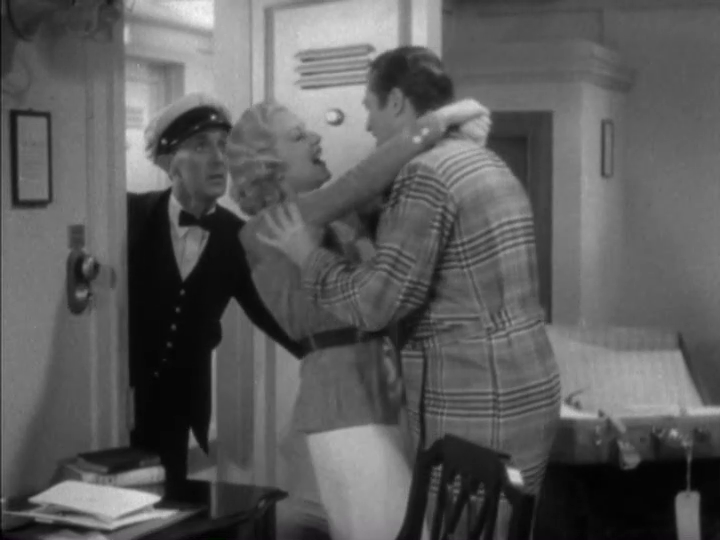
Medium-long shot of Foster, her arms still around Dugan's neck, laughing as steward opens the door and looks puzzled

Destiny can bring lovers together but in my experience the key to a happy marriage is that you have to really like each other! Dugan is clearly wondering what the heck happened to him and there’s work still to be done, so the wedding bells will have to wait, but these two clearly have a future together and he’s earned it. And that brings us right back to where we started! The steward appears in this scene because Dugan is supposedly under lock and key, and as Lombardi notes “restriction of movement is a severe violation for a Dwan character and film,” but Dugan “uses his room arrest to serve his ends.” In other words, all those attempts to put Dugan in his place ultimately fail, which is another connection between him and Bob Montagné: they both remain true to themselves no matter how down and out they find themselves and are eventually rewarded. Which now makes three “exceptions to the rule” I wrote about in my February Drink & a Movie post about The Young Girls of Rochefort, suggesting that it’s time to update my notion that “the human experience of trying to become a better person” is a theme of this series. After all, resisting the temptation to change more than you need to can itself be a challenge. Which, come to think of it, is the secret to the Chapuline’s success, too, isn’t it? Toby Maloney elevated the grasshopper by tweaking its proportions just a bit and adding one single ingredient. Or, to reframe this in terms that Dugan and Bob (and Kenny Rogers) would appreciate, sometimes the highest form of wisdom is knowing how to quite when you’re ahead.

Cheers!

All original photographs in this post are by Marion Penning, aka My Loving Wife. Links to all of the entries in this series can be found here.

Ithaca Film Journal: 4/3/25

What I’m Seeing This Week: I am currently out of town at a library conference, but I’m hoping to catch a few films at the Minneapolis St. Paul International Film Festival while I’m away. I’ll write them up in a dispatch blog post if I’m successful, so stay tuned! I’m also going to try to see The Woman in the Yard, which I’m hearing good things about from people I trust, at the Regal Ithaca Mall after I return.

Also in Theaters: If I was in Ithaca this week, I’d be prioritizing the Finger Lakes Environmental Film Festival, specifically the screenings at Cinemapolis of Snow Leopard on Friday; Sleep with Your Eyes Open on Saturday; and Little, Big, and Far on Tuesday. The best new movies now playing local theaters that I’ve already seen are the enjoyable genre exercises Black Bag (spy film), which continues its runs at both Cinemapolis and the Regal, and A Working Man (Jason Statham), which is at just the Regal. This week’s special events are highlighted by free screenings of the movies Improper Conduct and The Accelerator at Cornell Cinema on Monday and Tuesday respectively. Finally, your best bet for repertory fare is Princess Mononoke, which is at the Regal all week.

Home Video: I’ve been digging the fact that there have been many pre-Code movies with ~60 minute runtimes featured on Watch TCM lately because they’re the perfect thing to watch when, say, we miraculously get the kids settled on Thursday night with about an hour to spare before Top Chef comes on. My favorite recent discovery is the 1933 film Female, which starts where Movie Year 2024’s Babygirl ends: with a girlboss CEO exiling an employee she has slept with to a faraway branch office. A lot of people seem to be hung up on the messaging of the climax, but the preponderance of available evidence suggests to me that whatever they say to each other in the final scene, Ruth Chatterton’s Alison Drake is much more comfortable in the board room than George Brent’s engineer Jim Thorne is ever likely to be. Anyway, the film also features delightfully profligate back projection and some outrageous wipes, so be sure to check it out before it disappears from the platform on April 9!

Previous “Ithaca Film Journal” posts can be found here. A running list of all of my “Home Video” recommendations can be found here.