Dispatch from the 2025 Nitrate Picture Show

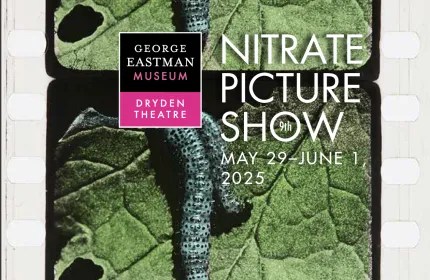
Cropped picture of the cover of the program for the 2025 Nitrate Picture Show

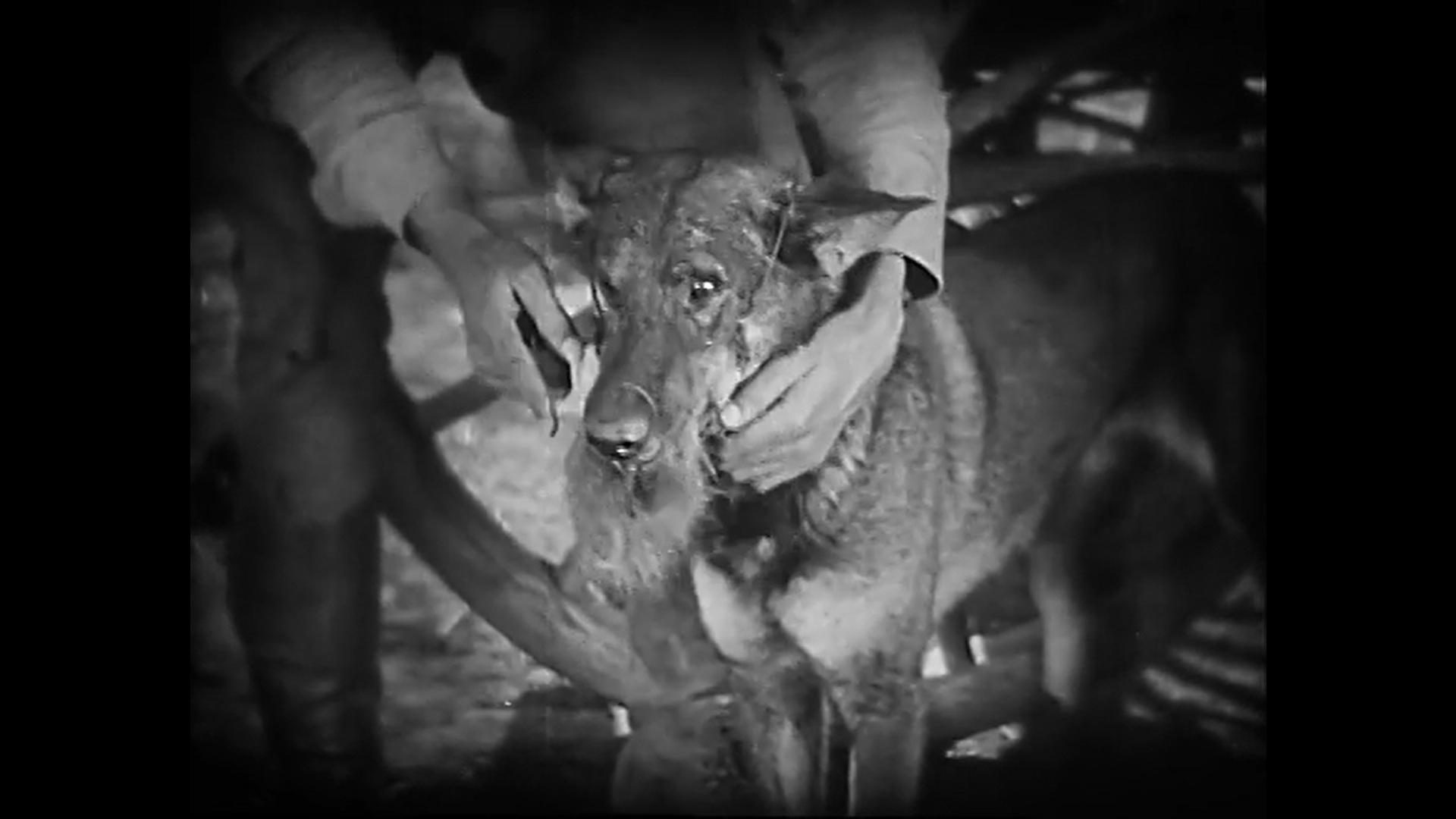
The story of the 2025 Nitrate Picture Show begins at the end. Like the eight that preceded it, this year’s festival concluded with a “Blind Date with Nitrate” screening of a film identified in advance only by one single frame enlargement on page 26 of the program, and as the lights went down and the hypnotically lush gold curtains of the Dryden Theatre slowly rose, very few people knew for sure what we were about to see. Although I also attended NPS last year and in 2023, I didn’t stay past Sunday morning either time, so as a novice blind dater the absence of applause or any other kind of reaction when the title card appeared didn’t strike me as all that odd. I noticed it, certainly, but while NPS is one of the few occasions when I operate under the assumption that I’m probably not the smartest person in the room, I have seen a lot of damn movies, and Occam’s razor suggested that this plus the fact that I had never even heard of The Trip to Tilsit before must just mean that it was legit obscure. All of this faded from my mind as the movie continued and I began to analyze what I was seeing with a modified version of the wine tasting steps in Kevin Zraly’s Windows on the World Complete Wine Course that I’ve been trying to discipline myself to use so that I don’t overlook essential attributes of whatever I’m watching. And so: academy ratio, black and white, classical Hollywood editing with a mobile camera, and a sophisticated use of sound. We must be in the mid- to late-30s and this is a studio production from somewhere, presumably Germany based on the language it’s in . . . holy crap, could this thing be from the Third Reich!?

The program notes by festival director Peter Bagrov handed out after the film confirmed that yes, it sure was. I didn’t recognize the name of the director Veit Harlan when it showed up in the credits, but I definitely learned about his follow-up work Jud Süß as an undergraduate film studies major. Bagrov describes it as “arguably the most famous piece of antisemitic propaganda in the history of cinema” and goes on to observe that Harlan was “put on trial twice, charged with crimes against humanity, and, controversially, acquitted both times” after the war. So why screen The Trip to Tilsit? The opening remarks by Bagrov and NPS founder Paolo Cherchi Usai, who told a confusing story about Jewish and Palestinian friends of his who both loved D.W. Griffith, weren’t super helpful, but the last two lines of Bagrov’s program notes are much more illuminating. “Harlan’s reputation besmirched all of his works, even the purest of them. But, as Henri Langlois allegedly said, ‘All films are born free and equal.'”

Langlois was already on my mind because the print of La Ronde that we watched on Friday came from the Cinémathèque française that he founded in 1936 and directed until his death in 1977. This screening was marred by problems with the live subtitles and after a French-language print of Three Little Pigs was shown without them the following day, I found myself wishing that the earlier movie had been presented the same way since its appeal is much more visual than verbal and I could have done without the distraction. After all, it’s my understanding that Langlois regularly programmed unsubtitled foreign language fare; he also didn’t always announce what would be playing on a given night in advance. This is not to say, however, that the experience of those audiences was somehow more pure as a result. Every movie tells the story of its origin and all viewers go through a version of the interpretive process I describe above, even if only unconsciously. Meanwhile, we almost inevitably spend exponentially more time with our memories of the things we watch than we do with the objects themselves, and even if some NPS attendees enjoyed, say, Tilsit‘s scene stealing big fluffy dog or the Katie Ledecky of horses more than they would have had they realized they (or their owners, anyway) were probably Nazis, it’s hard to imagine this fundamentally changing anyone’s relationship to the text.

If you scroll through the recent reviews of this film on Letterboxd, you will find many from people who felt tricked into seeing something they may have preferred to avoid. While I myself am glad to have been present at what I believe will be remembered as a historically significant, if perhaps notorious, screening, I’m also sympathetic to the argument that they should have been given a choice. That said, Americans are living through a period of our country’s history which may well be remembered similarly to Germany 1939, and not knowing for certain if I had called this movie correctly helped bridge these two eras in a more concrete way. In the end I personally found spending 90 minutes with a popular entertainment for “good Germans” more edifying than recent critical darling The Zone of Interest, which was too easy to reject as not actually saying anything about me for reasons I attempted to articulate more fully last April.

The Trip to Tilsit may have been the de facto main event, but when I think back on NPS 2025 the first title that will likely come to mind for me is one from a different future Axis power. Wife! Be Like a Rose! was the first Japanese sound film commercially released in the United States. Ninety years later it began the process of correcting probably my most egregious cinephile blind spot by becoming my official introduction to the work of director Mikio Naruse. Like Tilsit it revolves around a love triangle, but here it’s a truly equilateral one: there’s no Aryan saint or Polish devil, just three-dimensional human beings with virtues and flaws. Protagonist Kimiko (Sachiko Chiba) is the daughter of two of them, and while Etsuko (Toshiko Itô) and Shunsaku (Sadao Maruyama) are technically still married, Wife! captures what it’s like to watch your divorced parents interact with each other as an adult better than any other movie I’ve ever seen, which was not something I was expecting to encounter in one from 1935! The final shots are a masterpiece of hard-won empathetic understanding and they combine with the drawn shades of the opening sequence to make a fascinating set of book ends. A thirty-film Naruse retrospective is currently making its way around the country, and hopefully at least one or two titles will make their way to upstate New York at some point; in the meantime, I look forward to working my way through the “Directed by Mikio Naruse” collection on the Criterion Channel.

In retrospect the comment that “within five years all but German foreign language films were banned as Japan mobilized for war” in James Layton’s program notes for Wife! looks like a clue. So too does the emphasis on the fact that the version of Three Little Pigs screened in the color-themed “Nitrate Shorts” included a joke excised from the version of record premised on the idea that the pigs would let the wolf in if he was dressed as a Jewish (and therefore kosher) peddler. It also featured three animated shorts made in Czechoslovakia between 1935-37, one of which, The Crucial Two Minutes, is an incredible depiction of drunkenness doubling as an advertisement for toothpaste starring a severely depressed man who may or may not say something about the mindset of a nation on the verge of occupation. A highlight of the program was another commercial, Len Lye’s entrancing abstract direct animation Colour Flight, which I appreciated in part because commissioned works are often overlooked by movie snobs despite the fact that they remain an arena for experimentation to this day–the short Snowbird that Sean Baker directed in 2016 for the fashion brand Kenzo is maybe my favorite of his works, for instance. I was also wowed by The Destroyers of Our Gardens, which consisted of four minutes of stencil-colored macro footage of caterpillars that wouldn’t embarrass David Attenborough despite the fact that it was made almost a decade before he was even born accompanied by the legendary Philip Carli on piano. But best of all was director Mary Ellen Bute’s Spook Sport, her follow-up to Synchromy No. 4: Escape, which I was lucky enough to see at NPS 2023. Once again the shapes and colors, especially amorphous red and blue shapes gamboling in front of a receding starscape, moved me in a way that’s hard to explain and certainly can’t be replicated in a home viewing environment.

The 1916 release print of The Destroyers of Our Gardens shown on Saturday was actually the oldest one ever screened at NPS. This year’s festival also pushed boundaries in the opposite direction with Mother Joan of the Angels. As Ken Fox explained in his program notes, “though most of Western Europe and the United States had long since phased out nitrate film stock in favor of acetate safety film, the Soviet Union and some Central and Eastern European countries continued to use it well into the 1960s.” The entertaining Argentinian noir Hardly a Criminal represented another first when it became NPS’s inaugural foray into South America on Friday. Neither blew my mind the way Spook Sport did, but I enjoyed their interrogations of the respective notions of earthly and heavenly rewards thoroughly, and while many people writing about this event wax poetic about the unique properties of nitrate film stock, these three selections exemplify what I have come to think of as the main reason to travel to Rochester each spring: whatever intrinsically superior qualities the format might have, what matters even more is that it’s how everything screened at NPS was originally meant to be seen.

This is particularly relevant in the case of opening night movie Becky Sharp, which apparently defied some attendees’ expectations for what it was “supposed” to look like. Bagrov noted in an introduction the following day that those attributing its muted colors to age were incorrect because Technicolor doesn’t fade and that this instead represented as a conscious decision typical of the era (as I learned at NPS 2023) that has not always been honored by the people responsible for Blu-ray and DVD restorations. It also started things off on an anti-establishment note which I thought would be my primary throughline for this dispatch right up until the final day of the festival. Although Sharp is set in the Napoleonic Era, Miriam Hopkins’s titular heroine is clearly a woman of the 1930s who in hindsight says a lot about how little (or, more cynically, how much) our leaders learned from World War I. You Only Live Once (which I actually skipped at NPS in favor of a nap, unhurried lunch, and writing but caught up with after the festival ended) is even more pessimistic about society’s willingness to cut the wrong sort of person any slack, while It’s in the Bag! is a guerilla film made right under the noses of the French would-be fascist authorities on leftover Pathé sets in a short window of time before they were torn down and tweaks the same appendage with jokes about predatory capitalism, somnambulistic fascist salutes, and populist headgear that the appreciative laughter of my fellow audience members suggests have sadly come back into style.

Other not-quite-as-light-as-it-may appear fare included an old favorite in My Man Godfrey and a new discovery for me in Hue and Cry. The latter’s ragamuffin kids playing air raid games in the bombed out ruins of post-Blitz London make it a fascinating companion to last year’s selection Germany Year Zero, but it might pair even better with No Greater Glory as a pre-/post-war double feature about the affects of militarism on a nation’s youth. The NPS 2025-iest movie of all, though, was probably Canyon Passage, which features a love pentagon, the year’s most breathtaking (salmon) color celluloid sky, and a burgeoning western society marked as corrupt by a poker game that only Dana Andrews’s protagonist Logan Stuart seems to realize or care is fixed. Its naive suggestion that Manifest Destiny could have been a win-win if only white settlers had cooled it a bit with the rape and murder is redeemed by its frank acknowledgement that acts of the latter sort absolutely did take place and a brutal saloon fight that makes it clear that director Jacques Tourneur and company have no illusions about the Wild West being some sort of Garden of Eden.

I headed to NPS in May thinking it might be my last one for awhile because even though the price of a festival pass is extremely reasonable and I’m fortunate enough to live just a short bus ride away, taking three days off from work to stay in a hotel, eat out, and watch movies still strikes me as a questionable extravagance in a time of rising costs. It occurred to me even while I was there that the eve of the tenth anniversary edition was a funny time to duck out, though, and I’ve gotten quite good at economizing by staying just a few blocks further away from the Dryden than most of my fellow attendees and being thoughtful about my meals: a large Italian Assorted sub from Calabresella’s is not only delicious, for instance, but also big enough for two lunches if you have a fridge in your room! I’m planning to give my liver a full year off from booze for services rendered after my “Drink & a Movie” series wraps this December as well, so that’s one more opportunity to save money. Most importantly in light of the uproar surrounding this year’s Blind Date, I want to make it clear that I support this unique annual event as much as ever, so I’m stating now for the record that I intend to return in 2026, hopefully to a reserved seat (a new initiative that from my perspective was an unqualified success) in the first row as close to the middle as possible. I’ve got my fingers crossed that director Frank Borzage will finally make his NPS debut, but otherwise what I’m looking forward to hasn’t changed: I can’t wait to be surprised!

Previous film festival dispatches can be found here.
Dispatch from the Minneapolis St. Paul International Film Festival

Logo for the 44th edition of the Minneapolis St. Paul International Film Festival

When travelling to a library conference I always try to make time to see a movie at the local arthouse theater. Upon looking up my options during ACRL 2025, I was delighted to discover that the Minneapolis St. Paul International Film Festival was opening the same day as my arrival! Despite the best efforts of United Airlines (5/6 flights I took on this trip were delayed) to derail my plans, I was able to see three movies at The Main Cinema, which has a pretty amazing Midwest industrial (neon signs advertise Gold Medal Flour and Grain Belt Beer) riverfront view of downtown Minneapolis. I actually want to begin this dispatch with a meal, though, because it was the best part of my experience.

Despite the fact that Owamni has been hailed by both the James Beard Foundation and the New Yorker as one of the best restaurants in the country, I was easily able to grab a seat at the bar as a walk-in by arriving between the lunch and dinner rushes. When Sean Sherman, aka The Sioux Chef, appeared on Top Chef last year as a guest judge, I noted that “if I could conjure up a Michelin-starred restaurant in Ithaca, it would serve food like what we saw on this episode,” which was devoted to indigenous American foodways. Owamni is even more impressive than what I imagined because it doesn’t just serve delicious, innovative food in a beautiful airy lightbox setting, it’s also approachable. Although the wait staff was still clearly getting to know the new spring menu, all of their recommendations were spot-on and they cheerfully tracked down the answers to all of my questions about unfamiliar preparations like ashela (a savory porridge) and ingredients. I started with “their version of bar nuts,” crickets and popcorn, and a pint of Lake Monster Brewing Company‘s Last Fathom Wild Rice Lager, which “came out like a stout” like my server said it would and went great with the sweet (from candied seeds) and savory (toasty dried insects flavored with, I believe, sumac) snack. I also loved the jammy blackberry mignonette that came with my oysters (from Washington) on the half-shell and the micro-carrot tops that garnished that dish and my vegetarian tartare, which also featured dried huckleberries, pickled juniper shallots, and fresh raspberries that brought everything together. The star of my meal was definitely the duck papusa, though, which sat atop an incredible red pepián mole that I couldn’t get enough of and which paired exceptionally well with a glass of Bruma Ocho Rosé from Mexico’s Valle de Guadalupe.

I don’t fault Quisling: The Final Days, the movie I saw after walking across the Mississippi via the Stone Arch Bridge, for failing to live up to this memorable repast, but I do object to its weak tea version of The Zone of Interest‘s fascination with the inner lives of demonstrably evil individuals in denial. It’s a thoroughly professional production anchored by strong performances by Gard B. Eidsvold in the title role and Joachim Trier’s muse Anders Danielsen Lie as the priest assigned to show him the error of his ways, which if successful would somehow benefit the church and Norway. The most interesting thing about it for me, however, was the palpably approving reaction of the (fairly large) audience I saw it with to a scene in the final reel immediately after director Erik Poppe’s own The Act of Killing reference, which served as a visceral reminder of how much pleasure people take in seeing the mighty humbled. I worry that it’s this more than the healthy fear that something rotten inside ourselves explains the sorry state that the world is in which accounts for its The Zone of Interest‘s success, but that may just be me being cynical.

Sister Midnight, a bizarro companion piece to fellow Cannes 2024 alum All We Imagine as Light (one of my favorite films of Movie Year 2024), was much more my speed. Both are about Indian women trapped in unfulfilling arranged marriages, but where Kani Kusruti’s Prabha adopts an alternative family of female friends in the latter, Sister Midnight‘s Uma (Radhika Apte) literally creates a pack of stop-motion vampire goats to run with. The late night double feature picture show vibe is further reenforced by an entertainingly eclectic international pop music soundtrack and a kitchen sink approach to horror comedy tropes, but what I enjoyed most were the Jarmusch-like rhythms of Uma’s game if resentful initial attempts to adapt to the tedium of her new life as a Mumbai housewife. Director-writer Karan Kandhari is very deserving of his BAFTA Film Award nominee for Outstanding Debut by a British Writer, Director, or Producer for this movie and is definitely someone to keep an eye on.

The MSPIFF selection I enjoyed most was the first one I saw, The Things You Kill, which the programmer who introduced it explicitly identified as being indebted to the late great David Lynch by way of preparing us for a mid-film narrative logic curveball, but an even more salient influence is Asghar Farhadi, who numerous internet sources state that director Alireza Khatami worked under as AD (although none seem to indicate on which productions), specifically his magnum opus The SalesmanThe Things You Kill is every bit as interested in how much an American text can teach us about another society and the people who belong to it, only here the object of scrutiny is a comparative literature professor who lived abroad for 14 years instead of a play. It also features breathtaking Anatolian landscapes and a short-tempered teacher that serves as a bridge between Khatami’s country of birth Iran (see Universal Language for a recent example) and Turkey (About Dry Grasses, another movie on my 2024 top ten list) where this film is set. I wish it delved a bit deeper into how frustrating and emotionally exhausting infertility issues can be for couples who want to have children, and I’m not sure how believable some of the actions of the protagonist played by both Ekin Koç and Ercan Kesal are if you’ve never known anyone who has struggled against them, but The Things You Kill is a first-rate psychological drama which is right up there with Eephus and The Woman in the Yard as one of the best movies I’ve seen so far this year.

All in all I was pretty impressed by MSPIFF’s lineup, venue and setting! I love a city that makes it cheap and easy to get from the airport to downtown via light rail, and the stadiums of a number of professional sports teams are all located within walking distance of the festival, so I could definitely see my my family returning as part of a vacation that also includes watching the Knicks play the Timberwolves or the Mets play the Twins, or maybe even a Minnesota Lynx game if the festival or the WNBA changes its schedule. I just might be more selective about who I choose to fly with, is all.

Previous posts about film festivals can be found here.

Dispatch from the 2024 Nitrate Picture Show

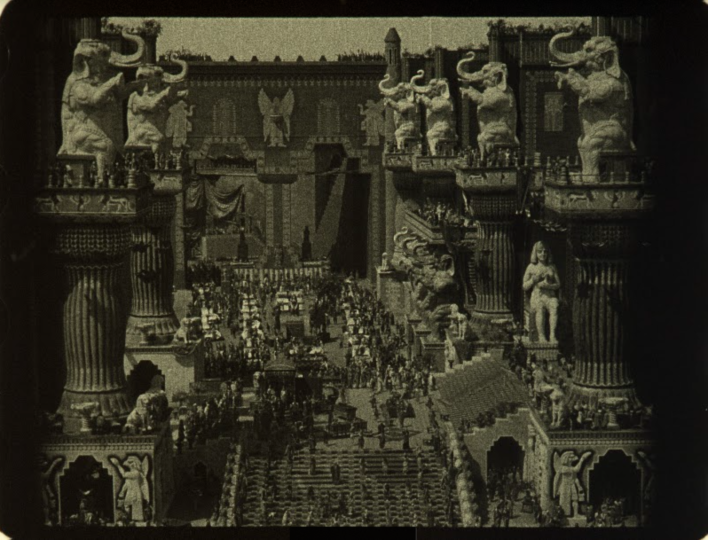
Image from Intolerance

How you watch a film inarguably impacts the way you respond to it. The Nitrate Picture Show is a unique viewing experience in a very obvious way: every screening features specific nitrate prints that people in the audience worked on, projected by individuals who, far from remaining anonymous as they typically would, are instead introduced each time as the stars of the show. Because nitrate was phased out in the early 1950s, it also consists exclusively of titles made before then. Lately I’ve been thinking about some proclivities of mine which I believe matter to my personal brand of cinephilia. For instance, even though movies are a hugely important part of how I make sense of the world, they’re something that I fit into my life around my family and job. The way I accomplish this is by favoring sparsely attended late afternoon and early evening showtimes. I also prefer to be near the screen–not necessarily as close as possible to “receive the images first” like Matthew from The Dreamers, but ideally in the middle of the third or fourth row–which in practice means I don’t always even know whether or not I’m the only person in the theater (I frequently am) because anyone else who arrives is likely to sit behind me.

NPS screenings are all packed, and not just anyone is willing to travel to Rochester, New York for an event like this, so in addition to being the biggest crowds I’m likely to be part of this year, they were also probably the most intelligent and opinionated. All of this absolutely affects my reactions. As does the weather! This year we were blessed with sunny days great for walking that introductory speaker Bryony Dixon described as perfect conditions for experiencing A Day in the Country, which played as the second half of a double featurette with The Plow That Broke the Plains. The two served as a study in how captivating black-and-white skies can be on nitrate: the ones in the latter showcased about 50,000 different shades of gray, while the former was distinguished by a mesmerizingly deep, dark color that my brain keeps insisting must actually have been blue. The low-angle shots of Sylvia Bataille‘s Henrietta standing up on a swing set were not at all ruined for me by Dixon’s tongue-in-cheek description of them as “upskirting” and were probably the most joyous images I saw all weekend.

The closest competitor for this honor would probably be the lavish Babylon sequences from opener Intolerance, which can be glimpsed in the image at the top of this post that I grabbed off the NPS website. This film is also connected to Plow via World War I, which ties it to the first feature that screened the next day as well. De Mayerling à Sarajevo portrays Archduke Franz Ferdinand (John Lodge) as a would-be reformer cut down too early by the enemies of tolerance and love; in fact, I kept wanting to identify war as a throughline for the whole festival, but its appearance in so many movies may be attributable to nothing more than the entirety of the nitrate era being within a decade of a global conflict. Anyway: I’ve always respected Intolerance, but now appreciate it more than ever as a full-fledged masterpiece made barely twenty years after the Lumière brothers introduced the world to moving pictures. I particularly enjoyed the hallucinatory Temple of Love scenes and emotional close-ups of the stellar female leads Mae Marsh, Margery Wilson, and Constance Talmadge, which are another link to Sarajevo: there’s a shot of Edwige Feuillère in a pearl-studded veil that would have fit perfectly alongside them.

Per introductory speaker Peter Bagrov, director Max Ophüls rushed to finish that film in the early days of World War II, which is perhaps most evident in a handful of still images used in place of actual establishing shots which felt extremely out of place in a work otherwise characterized by a lively camera. A still image of ambiguous intentionality also appears in the first movie that screened in the “Nitrate Shorts Program” that kicked off day two of the festival, The Flute of Krishna, which like Intolerance was accompanied by the legendary Philip Carli on piano. This dance film attributed to Martha Graham and an uncredited Rouben Mamoulian was shot at Rochester’s Eastman Theatre and features beautiful, strong colors produced by an experimental Kodachrome two-color process. Unlike last year, the majority of the rest of the movies in the program were black-and-white or tinted, such as the five burlesque films compiled into a single program and given the name Juke-Box Follies. The exceptions were a Terrytoons cartoon starring Gandy Goose and Sourpuss the Cat called Lights Out and two “advertising snipes” which would have played in between movies during the nitrate era, a Chevrolet ad called A Wise Choice and a promo for a “Halloween Fun Fest.” Like Know for Sure, a film about the dangers of syphilis and how to avoid it that Lewis Milestone directed for the United States Public Health Services, all of these titles served as welcome reminders that that the moviegoing experience has always encompassed more than just features. NPS’s didactic impulses were also on display in the decision to screen Disney’s The Skeleton Dance twice in a row: we were told that we’d see safety diacetate and nitrate prints back to back, but not in what order, and then asked to guess which was which. Most everyone (again: this is a smart crowd!) realized that the one with inkier blacks was actually the safety print, which looked “better” because it was in superior condition–the unique properties of nitrate are worth celebrating, but it isn’t magic.

The shorts were rounded out by Le Vieux Chateau, an animated film with cubist influences set to a lighthearted song about a haunted and rat-infested medieval mansion by the French duo Pills and Tabet that is now on our Halloween mix, a delightfully absurd amateur/experimental film by native Rochesterian James Sibley Watson Jr. called It Never Happened, and the highlight of the program Zarozhdenie Zhizni, which uses a variety of frame rates to create what director Vsevelod Pudovkin called a “close-up in time.” It also contains a shirtless reaper whose body glistens with sweat that rhymes with the glint of sunlight on the blade of his scythe and the sparkling dew on the grass he’s mowing who I won’t soon forget.

My most noteworthy discovery was The Good Fairy. It opens with children being led in song by a woman who exhorts them to sing with “more freedom,” then the camera pulls back to reveal the bars of the fence that surrounds the orphanage they all live in. Real and metaphorical jails figured in many of this year’s NPS selections, but here it’s just the first of an avalanche of jokes, which is hardly surprising considering that the screenplay is adapted from Ferenc Molnár’s Hungarian play by Preston Sturges, who must have loved the fact that the main character’s name is Luisa Ginglebusher. She’s played by an utterly charming Margaret Sullavan, who gets to swing from a light fixture and admire herself in an infinity mirror wearing “genuine foxine.” This movie got bigger laughs than any other, and when Herbert Marshall’s Dr. Max Sporum finally kisses Luisa, everyone applauded. But my favorite part was the fairy tale ending at the end, unless it was the scene in which Sporum waxes poetic about a new pencil sharpener, or maybe it was Frank Marshall’s business tycoon pretending to be a “wizard” in a film made four full years before that actor was cast the titular role of a certain Judy Garland vehicle that played NPS last year. In other words, it was a blast! The print we saw came from director William Wyler’s personal collection, which was also cool.

The Good Fairy was one of three movies that Alan Hale appeared in, along with Stella Dallas and The Strawberry Blonde. He plays a carousing gambler who falls on hard times in the former, which had quite a few people in tears. The one moment that almost got me was Barbara O’Neil’s Helen leaving the blinds open so that Barbara Stanwyck‘s Stella Dallas can watch her daughter Laurel (a radiant Anne Shirley) get married without attending the wedding, but I was too distracted by doubts that this noble “sacrifice” was either necessary or even good for Laurel to really lose myself in it. Hale’s best performance of all, though, is as the quick-tempered father to James Cagney’s Biff Grimes in The Strawberry Blonde, a love letter to the Gay Nineties which I had somehow never gotten around to seeing before. I’ll definitely be coming back to it for Olivia de Havilland perfecting the art of the suggestive wink, Rita Hayworth stealing a kiss from Cagney in silhouette, and the dinner scene in which a bunch of perplexed Americans square off against an unfamiliar foreign delicacy called “spaghetti” for the first time.

A very different attitude toward the past is on display in Kikyō, a somber and ultimately angry elegy for the soul of post-war Japan directed by Hideo Ōba, a filmmaker I confess I wasn’t previously familiar with who intro speaker Jo Osawa described as a mentor to Japanese New Wave icon Nagisa Ōshima. Per Peter Bagrov this was the first known U.S. screening of this movie since 1978, which explains why it isn’t better known in this country. Kikyō ends with an image of a man smoking a cigarette in front of his own grave, but this is exponentially less bitter than the conclusion of Germany Year Zero, a chronicle of life in another defeated Axis power which is right up there with Intolerance as my most memorable screening of NPS 2024. Protagonist Edmund Köhler (Edmund Moeschke) is almost exactly the same age as Willing Mandible, the hero of Lionel Shriver’s novel The Mandibles: A Family, 2029-2047; both are only slightly older than my children, and my fear that there’s no good reason to think this can’t happen here are further exacerbated by my having seen The Natural History of Destruction, which shows how prosperous Germany Year Zero‘s bombed-out Berlin settings looked just a few years earlier, at last year’s Finger Lakes Environmental Film Festival. This movie’s subject is something that pretty much no one wanted to see when it was made in 1948: Ken Fox’s program notes describe it as “a bitter pill for either victor or vanquished to swallow” which temporarily (thankfully!) destroyed director Roberto Rossellini’s reputation. That’s exactly what makes it essential, though. “We saw disaster coming and did nothing to prevent it,” says Edmund’s father (Ernst Pittschau)–if we lack the conviction to ask whether or not this describes us, too, we’re begging to suffer the same fate.

Germany Year Zero is a devastating and brilliant film, never more so than during its one moment of transcendence, a man playing an organ in the ruins of a church, which is abruptly cut short; the Finnish release print we watched, which featured both Finnish and Swedish printed-in subtitles, also taught me a lesson itself. My local arthouse theater Cinemapolis has a great practice that they call “Captioned Wednesday” whereby all screenings between 5-6pm on that day are presented with English subtitles. Although I think this is a terrific initiative, I’ve been avoiding these screenings myself, but I now see that this is silly: neither the subtitles on this movie nor the German ones on De Mayerling à Sarajevo distracted me at all! This isn’t all I learned. I mentioned earlier that we were quizzed after The Skeleton Dance. I did not raise my hand even though I thought I knew which print was which because I wasn’t sure, but last year I probably wouldn’t have had any idea, and maybe next year I’ll have the confidence to venture a guess. The point is that NPS isn’t just a lot of fun, it’s also making me a more educated and perceptive viewer. Throw in Rochester’s great food and drink options (Swillburger and Rohrbach Brewing Company‘s Space Kitty Double IPA were my favorite new experiences on this trip) and the fact that I can get there quickly and cheaply via OurBus, and I’m starting to believe that I’d be crazy not to make this an annual excursion. Certainly I’m going to return next year, schedule permitting. Till then!

Previous film festival dispatches can be found here.
Dispatch from the 2023 Maine International Film Festival

2023 Maine International Film Festival poster

I heard about the Maine International Film Festival for the first time a few months ago. I was chatting with legendary cinephile Brian Darr (whose blog Hell On Frisco Bay remains one of this site’s chief inspirations, although he has been posting mostly on Letterboxd and Twitter lately) about this year’s Nitrate Picture Show, which we were both hoping to attend. Although he wasn’t ultimately able to make it, we somehow realized that we would both be in Maine (us to see my father and his wife) at the same time this summer, and when Brian mentioned that there was a pretty good film festival in Waterville, we decided to meet up there instead.

Brian had other plans the first Tuesday evening we were in town, but on his recommendation I decided to check out 20,000 Species of Bees, which he said had been getting good buzz (his pun, not mine!) on my own. The film is about a crucial summer in the life of eight-year-old the world sees as a boy named Aitor, but who is beginning to identify as a girl named Lucía. Actress Sofía Otero won a Silver Bear for Best Leading Performance at this year’s Berlinale for her performance in this role, and the honor was well-deserved. She embodies a character whose calm exterior masks a storm raging within, which is extremely impressive for someone who just turned ten a few months ago. First time feature film director Estibaliz Urresola Solaguren also deserves kudos for the balancing act she performs. Bees teeters on the edge of tragedy for nearly the entirety of its two-hour runtime, but resists pat resolution of either the unbelievably happy or unnecessarily sad variety, culminating in a forest search scene that had my fellow audience members calling out to the people on screen. They mostly got what they wanted, but I doubt it was as cathartic as they were hoping it would be. Which, that’s real life for you! Patricia López Arnaiz is very good as Aitor/Lucía’s sculptor mother, and the supporting cast is excellent as well. This movie deserves to be widely seen and I hope to see it show up in Ithaca later this year so that I can recommend it to everyone.

The MIFF program included a strong contingent of repertory screenings, but the chance to finally see Werckmeister Harmonies made choosing between them easy. I’ve long suspected that director Béla Tarr represented one of my biggest cinematic blind spots and now I’m certain of it. Nearly two-and-a-half hours long but consisting of only 39 shots, the film is an allegory of the cataclysms that befell Europe during the twentieth century. It opens with a magnificent long take set during closing time at a bar in an unnamed town. The drunks refuse to go home until local mailman János (Lars Rudolph) organizes a dramatization of a solar eclipse. Had this been the only indelible image Werckmeister left me with, I still would have been glad to have seen it. This isn’t even the movie’s best shot, though! That could be the almost unbearably long march of a mob to the hospital where they intend to unleash chaos, unless it’s the one at the end of this scene in which, chagrined by the site of an perilously frail old man’s naked body, they shuffle home afterward. Or maybe it’s the harrowing sight of Hanna Schygulla’s Tünde Eszter dancing with a drunk police chief (Péter Dobai) with a gun or the brilliantly lit entrance of a “circus” into town. But no, surely it must be one of the shots of the whale carcass which is its star attraction! My point, obviously, is that I loved it.

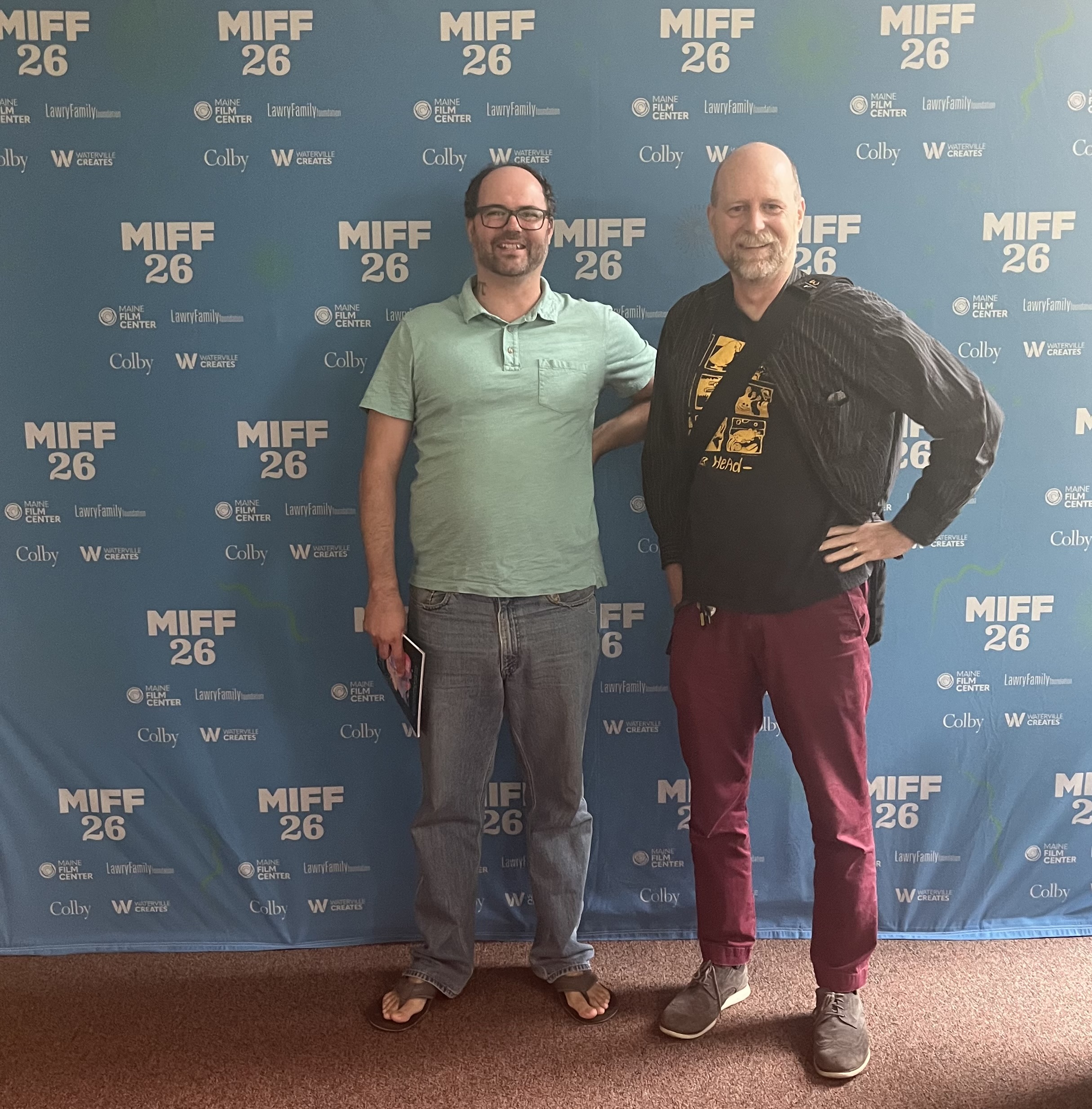
Werckmeister Harmonies played to an understandably small (given that it was 4pm on a weekday) crowd at the beautiful Waterville Opera House, a suitably grand venue for an undeniably great film. Afterward my loving wife snapped the following picture of me and Brian standing in front of the MIFF logo wall, which I believe is the first time I’ve ever utilized one of these things for its intended purpose:

Brian Darr and me

What I perhaps appreciate most about film festivals is the opportunity they provide to identify connections between movies it may not otherwise have ever occurred to you to compare. So it is that I find myself thinking about Aurora’s Sunrise partly in terms of the film which preceded it. Arshaluys Mardigian endured unthinkable horrors during the Armenian genocide, but survived to play herself (under the name Aurora Mardiganian) in a silent film called Auction of Souls. Aurora’s Sunrise blends original (partially rotoscoped, as described by director Inna Sahakyan in this interview with Creative Armenia) animation, interviews with Mardigian shot on video in the 80s, and clips from the 20 minutes of surviving footage from Auction of Souls to tell Mardigian’s story. One of its most impactful moments comes at the end, when Mardigian suggests that the failure of the rest of the world’s governments to publicly condemn what happened in Armenia empowered the Nazis, which links the movie to Werckmeister Harmonies through the person of the old man mentioned above, who deliberately evokes the Holocaust. Another is the juxtaposition of a crucifixion scene from Auction of Souls that wouldn’t be out of place in a Cecil B. DeMille epic with an animated sequence which depicts in graphic detail the even more inhuman form of torture that Mardigian actually witnessed whereby Ottoman soldiers killed Armenian women after raping them by forcing them to sit on pointed stakes, impaling them through their vaginas. But lest I inadvertently make the film sound unrelentingly bleak, my favorite line is probably Mardigian’s wry response to arriving in St. Petersburg (then Petrograd) en route to America in the midst of the Russian Revolution: “after everything I’d seen, now this!?”

I also value festivals for the chance they provide to see films which for whatever reason probably *aren’t* coming soon to a theater near me. In the case of my final MIFF selection Bravo, Burkina! the problem is its runtime. At 64 minutes it isn’t quite a feature, but is also too long for most shorts programs; however, this made it the perfect length for the second half of an ad hoc double feature with Aurora’s Sunrise! The movie is a love story about two Burkinabe emigrants who meet first in Italy, then again in Burkina Faso after they separately return to their homeland. Each is played by multiple actors, and while this isn’t quite a “non-narrative film,” the plot is definitely of secondary importance to the sound and images. Where it is most successful is making two very different African and European locations look differently but equally beautiful. It also features spectacular costume design, which isn’t at all surprising considering that director Walé Oyéjidé is a fashion designer (he is the founder of Ikiré Jones) who worked on both Black Panther and Coming 2 America. Bravo, Burkina! would pair well with the thematically similar Past Lives and would be a perfect fit for the Criterion Channel’s “Afrofuturism” collection, which favors a big tent interpretation of that term.

All in all I had a wonderful experience at MIFF! I obviously never visited the Maine Film Center at its old Railroad Square Cinema location, but the Paul J. Schupf Art Center, which it moved to late last year, seems like a good home. Parking was easy to find, there are numerous nearby food and drink options, and the seats are maybe the most comfortable ones I’ve sat in all year. With family one town over in Fairfield, I think we’ll almost certainly be back, quite possibly sooner rather than later. I will be looking forward to it!

Dispatch from the 2023 Nitrate Picture Show

I feel like I’ve known about the Nitrate Picture Show ever since it started in 2015, but somehow it never occurred to me that one of the perks of moving to Ithaca, New York was that I could easily go. Not until last year, that is, when Rico Gagliano’s MUBI Podcast devoted an episode to it. “Rochester is only 90 miles away!” I thought. Less than six months after that I purchased a festival pass, and last Thursday I boarded an OurBus which deposited me at the Frederick Douglass – Greater Rochester International Airport two hours later. And so it was that I found myself sitting in front of these amazing gold curtains that evening awaiting the start of my first close encounter with a nitrate film print:

The Dryden Theater's curtains

The movie they sloooowly rose on was Black Narcissus. The Nitrate Picture Show is different from other events I’ve been to in that its constituent parts aren’t just movies, but individual prints of those movies. As Camille Blot-Wellens pointed out in her “Keepers of the Frame” talk, every scratch on them provides clues about the conditions under which they were exhibited in the past, and these stories are “part of the history of film itself.” Graham Brown characterized the print we saw of Black Narcissus as “better than very good” when introducing it, and his program notes explain that it also opened a legendary 1992 Pacific Film Archive series curated by Edith Kramer called The Primal Screen. The film serves up a heady mixture of the ludicrous (David Farrar’s Mr. Dean bouncing up and down on a tiny pony in shorts which Brown described as getting even shorter in each scene) and spectacular (matte paintings of the Himalayas by W. Percy Day) which is every bit as strange as the feelings which bewilder Deborah Kerr’s Sister Clodagh and her fellow nuns. I loved the moment when Sister Philippa (Flora Robson) leaves a bouquet of the flowers she’s been growing instead of vegetables at the grave of Sister Ruth (Kathleen Byron) and the Christmas scene in which Mr. Dean is simultaneously his best and worst self. I saw Black Narcissus for the first time about twenty years ago in a film class and thought it was terrific, but somehow never got around to watching it again. I won’t wait that long next time!

Two other movies I was eager to revisit were The Blue Angel and Duel in the Sun. I think it’s fair to say that the former is more well-known today as director Josef von Sternberg’s first collaboration with star Marlene Dietrich’s than as a great film in its own right: according to this awesomely bonkers spreadsheet, only seven critics voted for it in the latest Sight & Sound poll, good for a tie for 520th, while the They Shoot Pictures, Don’t They? Top 1,000 list has it at 553rd. The print we saw is from 1931 and (to casually toss around some language I became quite familiar by the end of the festival) had a shrinkage rate of 1.1%, which per Anna Kovalova’s program notes is low for one nearly a century old. I remembered this as a fall from grace story, and to be sure the sight of Professor Immanuel Rath (Emil Jannings) cock-a-doodle-dooing on stage in front of his former colleagues is one of the most devastating in all of cinema. But what struck me on this viewing is that Rath isn’t very impressive at the beginning of the film. He is rather an officious stuffed shirt who is more concerned about whether the pile of books on his desk is perfectly straight than he is in actually teaching his students anything. Indeed, his moment of humiliation echoes an earlier scene which takes place on his wedding night–after he has already thrown away his career. See too his dead pet bird, which had “stopped singing long ago.” This man needed a change! Could he have been happy as a clown or in some other role with his wife’s cabaret troupe? And if he had truly embraced this new career, might he not have ever lost her respect?

Duel in the Sun, which screened the following day, suggests that the answers to these questions is “no.” Pearl Chavez, who is played by a 27-year-old Jennifer Jones but is (somewhat disconcertingly) clearly supposed to be 13-15 years old, is in love with Joseph Cotten’s Jesse McCanles and lusted after by Jesse’s brother Lewt (Gregory Peck). When the latter rapes her, she’s spoiled forever as far as Jesse is concerned. Heartbroken, she decides to go all in on being Lewt’s girl–in the next scene she’s even chomping on an apple! But she winds up in pretty much exactly the same place as Immanuel Rath, pathetically clinging to Lewt’s leg in an unsuccessful attempt to keep him from fleeing to Mexico without her. The print we saw was compiled from two in Martin Scorsese’s collection at the Eastman Museum, which is pretty darn cool.

The most revelatory screenings for me were all part of the “Nitrate Shorts” program. It began with a selection of Technicolor trailers which per Anthony L’Abbate’s program notes documented the evolution of the Technicolor “look” from understated yellows and browns in the 1930s to a brighter color design by the middle of the next decade and ended with screen tests from Gone with the Wind, both of which were interesting. I also enjoyed the Disney animated shorts Flowers and Trees and The Band Concert. But I was positively blown away by Norman McLaren’s direct animation Hen Hop and Mary Ellen Bute’s “seeing sound film” Synchromy No. 4: Escape. Both can easily be found online, and it’s definitely possible to appreciate the conceptual framework behind them this way. I doubt you’ll find the brilliant reds of the former or mysterious blue smoke and luminescent orange triangles of the latter moving the way I did last Friday, though, in the absence of a big screen, archival print (from La Cinémathèque québécoise and Museum of Modern Art respectively) in good condition, and theater full of cinephiles. It makes me wonder what other experimental films that I saw under suboptimal conditions I’ve been guilty of underrating.

Robert Flaherty’s Oidhche Sheanchais/A Night of Storytelling is a similar case. In the podcast referenced above, founder Paolo Cherchi Usai explains that the Nitrate Picture Show started with the question, “why do [early films] look so awful?” The answer is that they don’t–this impression is rather the fault of the bad reproductions which are the only versions of these movies most people ever get to see. The print we saw of Oidhche Sheanchais embodies this ideal. This screening was actually the first time it was ever projected for an audience and Haden Guest’s program notes describe it as being in “excellent physical condition, with a remarkable flexibility and without a single splice.” As the first sound film ever made in the Irish language, I would have been intrigued by this movie regardless; under these circumstances, I was spellbound. Another festivalgoer remarked to me over dinner that Seáinín Tom Sheáin’s “story that was already old a thousand years ago” didn’t seem to have any particular moral. To me this is exactly the point. Something happened to Martin Conroy and his sons that was so crazy, people are still trying to figure out what it means generations later. I think this must be the exact kind of immortality that Brendan Gleeson’s Colm Doherty chose to pursue in The Banshees of Inisherin.

My biggest discovery of the weekend was probably You and Me, which Peter Bagrov’s program notes describe as “one of the best prints ever screened at the festival.” It jumped around a bit at times, but was the source of the most memorable black and white images I saw, which is of course a credit not just to nitrate film stock, but also to cinematographer Charles Lang. George Raft and Sylvia Sidney are terrific in the lead roles, and the latter performs calculations on a blackboard which rival Hippolyte Girardot’s mathematics in A Christmas Tale even if they are misguided–crime may not pay, but you still can’t afford most of the objects of desire in Kurt Weill’s opening musical number on honest wages. As I already said on Twitter, I had no idea that director Fritz Lang’s filmography included anything so eclectic! There’s also a wonderful tour of late-30s New York City ethnic restaurants. The final reels of Force of Evil and Leibelei/Flirtation made nearly as much of an impression on me. Ken Fox’s program notes indicate that the print we saw of the former was “one of the most challenging for a projectionist” due to its 100+ splices and significant warpage. Indeed, this was the only movie which needed to be stopped, but the brief pause didn’t detract one iota from the inventive final shootout in a darkened office or John Garfield’s Orphean descent down, down, down to the banks of the Hudson River not to bring back his deceased brother (who is played by a very good Thomas Gomez), but rather to redeem his soul. The latter, meanwhile, features impressively inventive photography for so early in the sound era, including an unforgettable snowy sleigh ride and a camera which agonizingly refuses to look away from the face of a young lady (Magda Schneider) who has just been informed that the love of her life (Wolfgang Leibeneiner) was killed in a duel over another woman (Olga Tschechowa).

I saw two other films which were new to me: Silence Is Golden, an airy light trip down memory lane to the dawn of France’s film industry by director René Clair starring Maurice Chevalier, and a Technicolor print of a “sponsored [by Westinghouse Electric] film” called The Middleton Family at the New York World’s Fair from the Prelinger Archives. Cain and Artem would have been on this list as well, but I skipped the Sunday afternoon screenings in favor of meeting my family at the Strong National Museum of Play and hitching a ride home with them afterward, which also means I missed the “Blind Date with Nitrate” screening of The Third Man. I did, however, attend the Sunday morning screening of The Wizard of Oz. In the festival’s second “Keepers of the Frame” lecture, Jon Wengström speculated that while even in a post-physical media future people will undoubtedly continue to find ways to project movies on big screens for large audiences, such exhibitions will no longer be standardized. He might have been thinking of this very film. As Anthony L’Abbate noted in his introduction, the print we saw from 1945 afforded Nitrate Picture Show attendees a rare opportunity to enjoy The Wizard of Oz the way audiences did during its initial theatrical run, which is not true of nearly anyone who sees it today on DVD and Blu-Ray releases which feature colors updated for contemporary tastes “that would make [Technicolor consultant] Natalie Kalmus turn over in her grave.” I can’t rationalize leaving my loving wife to take care of our girls by herself for days at a time just so that I can watch see movies more than once or twice a year, so I went to Rochester thinking it might be awhile before I returned. Experiences like this one are utterly unique, though, and I find that my appetite isn’t nearly satisfied. This may not turn out to be an annual excursion for me, but think I’m at least going to have to go back for more in 2024.

Dispatch from the 2023 Finger Lakes Environmental Film Festival

The first two Finger Lakes Environmental Film Festivals that took place during my time as a resident of Ithaca, New York were online-only affairs thanks to the COVID-19 pandemic. Last year’s festival did feature in-person events, but all films were still screened virtually. Although FLEFF provided me with a number of great movie memories prior to this year, including my favorite film of 2021 in Ahed’s Knee, I definitely didn’t feel like I ever got anywhere near the full festival experience and was therefore excited to dive into this year’s program!

As Girish Shambu noted in his blog post about attending FLEFF in 2019, event organizers define the word “environmental” so broadly that “the purview of the festival turns out to be all-encompassing.” The two films I was most eager to see, recent documentaries by Ukrainian director Sergei Loznitsa, are good examples of this. Neither Babi Yar. Context nor The Natural History of Destruction (despite its name) takes nature (which I would normally assume to be the focus of an event like this) as its subject, but the way they each combine restored footage found in archives across Europe with original audio and portray the same events from different vantage points perfectly embodies the festival’s theme of “polyphonies,” which as the FLEFF website explains “offer an embrace of the many, the multiple, and the diverse into a more energized whole, rejecting the singular, the mono, and the linear.”

Babi Yar. Context is about a ravine in the vicinity of Kiev where tens of thousands of Jewish and other inhabitants of the city were massacred during World War II, but wasn’t commemorated in any way until decades later. The Natural History of Destruction is essentially a history of the war narrowly focused on bombing and missile attacks on non-military targets. Both are harrowing depictions of humanity at its absolute worst which use their too-perfect soundtracks to shift our attention from the fact that they are historical, i.e. about events that actually happened, to the idea that people are responsible for these things and might do them again. This was further underscored by festival Patricia Zimmerman’s introduction for Babi Yar, during which she noted that Loznitsa originally intended to come to Ithaca in person, then planned to answer audience questions via Zoom, but couldn’t ultimately do either because he’s in the field making a new film about the war currently raging in Ukraine.

A munitions factory sequence in The Natural History of Destruction is reminiscent of my favorite movie from this year’s festival, Matter Out of Place, which travels around the world to show how the inhabitants of a variety of far-flung locales solve their common problem of what to do with their trash. The film’s title is borrowed from a euphemism used by the volunteers who clean up after the Burning Man festival in Nevada, and just as director Nikolaus Geyrhalter’s Our Daily Bread forever changed the way I look at the food I eat, I suspect this film has permanently altered the way I think about the concept of “waste.” Some particularly unforgettable moments include the opening, which cuts from a pristine mountain lake to a close up of a beach covered in plastic, and a dump in Kathmandu where garbage trucks can only navigate the narrow, muddy path that leads to it with the aid of bulldozers to push them along when they get stuck.

Less obviously connected to the festival’s themes, but in keeping with one of its longstanding traditions, were the silent films I saw, both of which are celebrating their hundredth birthdays this year. Introductory speaker Michael Richardson encouraged us to ponder about what lessons the German Expressionist Warning Shadows, which was accompanied by local ensemble Cloud Chamber Orchestra, might offer for the present day. With a timeless extended shadow puppet dream sequence and a plot that could easily be described in terms of “toxic masculinity,” this wasn’t hard to do. The Harold Lloyd vehicle Safety Last!, which screened on an absolutely gorgeous spring day and was accompanied by “deep groove zydeco” band Li’l Anne and Hot Cayenne, is a trickier case. Looking back on it with Richardson’s challenge in mind, I believe that it does perhaps train the viewer’s eye to look differently at the built landscape? There is, of course, Lloyd’s famously effects-free scaling of the Bolton Building, but also a POV shot from an ambulance and enough ingenious techniques for avoiding detection by bosses, landlords, and police officers to make a how-to manual.

My final FLEFF film was No Bears, which somewhat embarrassingly is the first one I’ve ever seen by director Jafar Panahi, although I did catch his son Panah’s latest Hit the Road at Cinemapolis (where all the screenings mentioned in this blog post took place, by the way) last year. Like that movie, No Bears is set near the border between Iran and Turkey. In fact, the character played by Panahi inadvertently crosses it at one point despite the fact that, like his real-life doppelgänger (although thankfully not any more, apparently), he has been forbidden by the Iranian government to travel abroad. I loved the film’s strangely (at first) artificial opening shot, which doubles as the beginning of a docudrama that the fictional Panahi is making. The latter takes a tragic turn late in No Bears just as things also fall apart in the small village that the director is staying in to be closer to his film shoot as the result of a controversy over a picture he may or may not have taken of two star-crossed lovers. Much of the discussion during “Talk Back” session which followed the film focused on its humorous and political aspects and how they play against and with each other, but I think I’ll remember this primarily as a master class by one who would know on the many ways in which making movies about “real issues,” which sounds so noble, can be horrifyingly costly for the people both in front of and behind the camera.

My biggest regret about this year’s FLEFF was that my schedule got in the way of all the free screenings I was targeting, which also means I didn’t catch anything with an Ithaca connection. Looking ahead to the future, I’d also like to try to attend at least one or two roundtable discussions or other events not tethered to a screening. But that’s the nice thing about a local film festival, isn’t it? You always do have next year!

Dispatch from the 2019 Maryland Film Festival

MDFF Banner

I have been slowly working my way through Negative Space: Manny Farber on the Movies for the first time in years the past few months. My favorite essays in the book are Farber’s dispatches from the New York Film Festival, which see him taking advantage of the opportunity that watching a large number of new movies in a short period of time presents to draw conclusions about the current state of cinema. This seems to me to be the most highly evolved version of an irresistible temptation inherent in the film festival experience: cataloging the inevitable connections between everything you see. After all, there are only so many techniques and themes available to even the most gifted artists.

The most obvious and potentially meaningful commonality I noticed at this year’s Maryland Film Festival was a preoccupation with fake news. Donbass begins with actors preparing to appear on a television news broadcast as witnesses to a shelling attack. They will return at the end of the movie, when the price of their complicity in this deception is revealed. In between, director Sergei Loznitsa’s protagonist-less film presents roughly a dozen other vignettes depicting life in the Donbass region of Eastern Ukraine amidst the separatist conflict which started in the aftermath of Russia’s annexation of Crimea in 2014, and which does not appear (as someone who reads four news sites every day, it’s crazy how little I know about this) to have ever ended. As the credits rolled, I felt exhausted by the film’s relentless pessimism; three weeks later, however, I find myself thinking about Donbass more often than anything else I saw at MDFF. A room full of well-dressed men on their cell phones begging for money in particular has emerged as probably my favorite movie scene of the year so far.

The hijacking of the media by government interests was a topic near and dear to the heart of the subject of the only documentary I saw at this year’s festival, Recorder: The Marion Stokes Project. Alarmed by the way the official story about the Iran Hostage Crisis seemed to change nightly, Stokes, a public intellectual and former librarian from Philadelphia, began recording television news programs in 1979. This project eventually expanded into a 24/7 operation capturing everything shown on multiple networks, an endeavor involving more than 70,000 VHS tapes, entire apartments used for nothing but storage, and the assistance of paid help. The film falters toward the end when it tries too hard to use Stokes’s archive to make a case for her as a visionary without really grappling with the fact that only an EXTREMELY WEALTHY person would have had access to the immense (forgotten fact: video tapes were pretty expensive for much of the thirty year period Stokes was recording) resources this project required. Recorder is nevertheless a fascinating story about a unique individual and a welcome nod to the good people at the Internet Archive doing the hard work of making Stokes’s tapes available to the public.

In contrast to the sophisticated propaganda machines in Donbass and Recorder, the military government which haunts Aäläm-Wärqe Davidian’s Fig Tree doesn’t even bother trying to deceive anyone about what it’s up to. While 16-year-old Mina (Betalehem Asmamawe) lives in constant terror that her boyfriend will be impressed into military service, dictator Mengistu Haile Mariam makes speeches castigating the Ethiopian people for raising a “generation of cowards” because they don’t volunteer their sons to fight as soon as they’re old enough to hold a gun. Although Davidian succeeds in creating a palpable sense of what it was like for her to come of age in Addis Ababa against a backdrop of civil war, I felt that Fig Tree was outshined by another debut feature which also ends with a shot of its young woman protagonist running toward the camera, Annabelle Attanasio’s Mickey and the Bear.

Like Mina, Mickey (Camila Morrone) is struggling to navigate a path to adulthood complicated by war. In her case, it comes in the form of her father Hank (James Badge Dale), a survivor of two tours in Iraq struggling with a host of afflictions including PTSD, poverty, alcoholism, drug addiction, a war injury, and grief at the loss of his wife (Mickey’s mother) to cancer. As Mickey approaches the end of her senior year of high school, Hank’s destructive impulses begin to manifest in increasingly creepy and threatening forms, leaving her with an impossible choice between abandoning a loved one to his demons to accept a college scholarship and risking her own health and happiness to stay by the side of a man the film clearly identifies as being beyond saving. I thought Mickey and the Bear‘s Anaconda, Montana setting and the scenes of Mickey at work in her part time job as a taxidermist were terrific, but wanted much more of both, and I’m conflicted by the film’s depiction of Hank as a problem without a good solution. There’s no denying, though, that Morrone’s and Dale’s performances constitute some of the best acting I’m likely to see this year.

Ham on Rye (yet another debut feature) deals with a similar stage in life, but couldn’t be more different from Fig Tree and Mickey and the Bear. Working with a cast featuring numerous veterans of Disney Channel and Nickelodeon shows such as Danny Tamberelli (All That, The Adventures of Pete & Pete), Lori Beth Denberg (All That), Clayton Snyder (Lizzie McGuire), and Aaron Schwartz (The Adventures of Pete & Pete), director Tyler Taormina and cinematographer Carson Lund (who wrote about his experience shooting the film for Filmmaker Magazine) focus single-mindedly on recreating the feeling of finishing high school and going off to college (or not) in the suburbs in the late 90s and early 00s. As a member of Conestoga Valley High School‘s class of 2000, I was definitely picking up what Ham on Rye was laying down, but I still thought the film was overlong, an impression reinforced by my fonder memories of Little Waves, the short film which preceded it. The latter probably wouldn’t have worked as well stretched out to feature length either, but the point is that it wasn’t.

Rites of passage also figure prominently in my favorite of all the movies I saw at MDFF, South Mountain. It opens with Talia Balsam’s Lila and Scott Cohen’s Edgar hosting close friends for dinner at their home in the Catskills. Edgar excuses himself, supposedly to take a call about a script he’s working on, but in actuality to witness the birth of his child with another woman on his iPhone. The rest of the film could accurately be said to focus narrowly on Lila’s efforts to come to terms with this specific event and its aftermath while still trying to be there for an old friend recovering from breast surgery and her two daughters, one of whom is returning from camp and the other from a sea voyage. It would be even truer, however, to say that it’s more generally about coping with change that arrives at precisely a moment when you are planning on settling down for awhile, a theme that most viewers can likely relate to. I must admit that South Mountain appealed to me in part because of Lila’s house, which in real life belongs to director Hilary Brougher’s mother: I spent much of my time in between MDFF screenings setting up appointments to view houses for rent in Ithaca, so I enjoyed spending so much time with a lovely piece of upstate New York real estate. I was also extremely impressed by how present nature was in the film both visually and as part of the soundtrack.

All in all, the 2019 Maryland Film Festival was a fitting way to say farewell to the Baltimore film scene. I was never able to become as involved in it as I would have liked, but I’m still leaving with quite a few great memories. Most notably: meeting John Waters, meeting DeRay Mckessen (who’s quite the cinephile, by the way!), managing to visibly annoy Alex Karpovsky by not knowing when to let something go at a Q&A for Supporting Characters (“does that answer your question?” he asked, to which I replied, “no, not really . . . “), muddling my way through managing a sold out screening attended by not-yet-disgraced mayor Catherine Pugh, and all my interactions over the years with the wonderful MDFF staff and scores of my fellow volunteers. Special shout out here to Karol Martinez-Doane, who was always awesome to work with as Venue Manager, and who brought me bibimbap from Brown Rice Korean Grill one year just because! Of course, I still have family and friends in Baltimore, so this isn’t really goodbye. Let’s say, instead: ’till we meet again!

Dispatch from the 2019 Bastard Film Encounter

BFE Header.png

Two weeks ago I had the pleasure of attending the 2019 Bastard Film Encounter, a weekend-long event devoted to the screening and discussion of films which are “ill-conceived or received; embarrassing or beyond the bounds of acceptability; poor in conception or execution; undesirable to those who should be caring for them; proof of something that should have never happened.” Although noted cinephile and friend of the blog Brian Darr describes the BFRE as “legendary,” I must confess that I had never heard of it before organizer Stephanie Sapienza, a colleague at the University of Maryland, mentioned it to me a few months ago.

The first three iterations of this biennial affair were held in Raleigh, North Carolina. This year, though, it relocated to Baltimore, with most events and all screenings taking place at The Windup Space. I originally thought I wasn’t going to be able to attend, since we are right in the middle of trying to get our house on the market, but when I learned that a limited number of one-day passes were available, I leaped at the opportunity to snag one. The day began with a public domain film (which is actually available on YouTube) called Tip Over VNR presented by John Klacsmann from Anthology Film Archives as part of a program called “Teach Me, Teacher (Part I).” For me, it was an absolutely perfect way to start. The release of Pet Sematary has drawn my attention to the fact that since becoming a parent, I can’t even read about the death of a child in a movie review without feeling queasy, so it was fascinating to examine my reaction to a film comprised of nothing but fake children being crushed by furniture over and over again and contemplate (as Klacsmann suggested) what must have been going through the heads of the government officials who ran and recorded these simulations.

The rest of the program consisted of a film created to train Target employees to spot “hot” checks which featured an actor that presenter Dan Erdman was able to identify as a former wrestling heel from Minnesota, and a video found in a shopping mall 20 years ago which extolled a philosophy known as “informationalism.” The latter dominated the conversation which followed the films when a debate broke out over whether or not it was genuinely the copy of a copy of a copy that it looked like or some sort of art project. Nothing in the next block of screenings titled “Manly Pursuits” generated the same level of discussion, but the films were, if anything, even more interesting. I was particularly captivated by “A Hidden Index of Female Presence in a Vanishing Container,” which reminded me of the moment in The Tillman Story when I suddenly realized I was watching the creation of those weird video portraits they use in Sunday Night Football broadcasts, the origin of which I had never previously contemplated, and a video celebrating/roasting a Texas businessman which was presented by my fellow past chair of the American Library Association’s Film & Media Round Table Brian Boling.

In between the two morning programs, a number of bastards (as BFE attendees affectionately refer to one another) were invited on stage to show off talents including a Werner Herzog impression and a rendition of “Here Comes the Bride” on a fart piano (which is exactly what it sounds like), and we were treated to a slide show preview of a bike tour that one of the local participants was leading later in the weekend before lunch as well. Lunch itself arrived in the form of a taco bar provided by Golden West Cafe which, if you’re not familiar with Baltimore, is a pretty boss thing to come included for free with the price of registration. As were, by the way, the stylish t-shirts.

Anyway: the afternoon screenings kicked off with a program featuring what is apparently a BFE staple, footage depicting animals being used for medical research, and continued on with one called “Teach Me, Teacher (Part II: The #MeToo Edition),” which the schedule described as featuring “[f]ilms and videos meant to teach women something strange, obscure, or life-alteringly informational.” The latter included a “social media blackout,” whereby the audience was asked on behalf of the presenters to please not take pictures or discuss the details of the film being shown, a request that I absolutely will honor. I only mention it because I believe the existence of such a thing is a crucial part of BFE’s mission to facilitate free and open dialogue about film objects which aren’t typically and maybe even (in some cases) shouldn’t be studied and talked about.

The penultimate program of the day and last one I was able to stay for was called “Children of the Damned.” It started out with a clip from an absolutely fascinating BBC television production called Improvised Drama: An Enquiry Into Its Value in Education, which you can find on YouTube (we started at 13:18). The last two films were rough. The first, The Idiot Child, was an excerpt from Vsevolod Pudovkin’s Mechanics of the Brain, a documentary based on the work of Ivan Pavlov, presented by film studies scholar Marsha Gordon, and the second was a 1971 film called Who Should Survive? which made a fascinating, if disturbing, bookend with Tip Over VNR. Bret McCabe described it thusly in an article for Bmore Art:

The film was ostensibly made to start a conversation around medical ethics. The cultural shifts between then and now, however, are so profound that what once was normal vocabulary in medical science sounds absolutely appalling, and watching it now you might wonder why it was ever made. A better question: How should we think about it now?

The shorter version of Who Should Survive? that we viewed is available on YouTube here. The subject matter of the film is shocking and affecting, but it’s equally noteworthy for the disparate contexts in which it has been seen: its original screening at the Kennedy Center for the Performing Arts was covered by the New York Times as an intellectual event, but according to presenter Martin Johnson it might be all but forgotten today were it not subsequently adopted by the pro-life movement as an emotional appeal to potential supporters of their cause. In the discussion period which followed the film Johnson argued that it should be included in the National Film Registry, a compelling notion that this librarian for one supports.

All in all, the Bastard Film Encounter was a great experience. I connected with a surprisingly large number of colleagues from the University of Pittsburgh and elsewhere who I haven’t seen in years, made a few new friends, and was reminded of some reasons I became interested in movies in the first place which I haven’t thought about in a long time. My major regret is that I wasn’t able to participate in the social aspects of BFE, such as the 16mm mashup dance party, closing night dinner and duckpin bowling outing, and Sunday brunch at the home of two Baltimore-based bastards. I’m pretty sure that I’ll be back in 2021, though, so: next time!

Tentative Schedule for the 2019 MDFF

When I left Pittsburgh in 2011, I was a movie lover who worked in a library. By the time I moved to Baltimore in 2012 (following a transitional year in Westminster, Maryland), I had become a librarian who loved movies. The distinction is subtle, but important: whereas I reorganized my entire life to facilitate seeing as many films as possible at the Three Rivers Film Festival each year, the Maryland Film Festival was always an event that I scheduled around my obligations to work and, starting in 2016, family. I actually haven’t seen many films at the festival at all since I started serving as a volunteer in 2013: the theater captain shifts I typically signed up for each represented a six- to eight-hour commitment, so I had to choose whether each day of the festival was going to be one I worked or one where I watched, since as a parent I didn’t have time to do both.

This year’s MDFF is my last as a resident of Baltimore because (as I announced on Twitter earlier this month, but have not yet mentioned on this blog) I am moving to Ithaca, New York in June to begin a new job at Cornell University. To celebrate, I’ve decided to treat myself to an old school festival experience: I’m going to devote an entire day to seeing as many movies as I can. So as not to completely shirk all of my parental duties, I now (updating another recent Twitter post) plan to split this day up into two parts: I’m going to attend movies during the day on Friday and at night on Saturday, with one Thursday screening thrown in for good measure. As I did in days of yore, I’m posting my tentative schedule here. Please let me know if you think I should reconsider any of my choices, or if you’ll be in town and would like to meet up along the way! The full film guide can be found here. Without further ado:

Thursday, May 9

Two films in the last time slot on Thursday jump out at me: Mickey and the Bear, which is part of the ACID lineup at this year’s Cannes Film Festival, and Premature. Stephen Saito saw the former at SXSW and the latter at Sundance and hailed both for their acting. This will probably be a game-time decision.

Friday, May 10

I should be able to see three movies on Friday. The first time slot features an impossible decision between Donbass and Manta RayBoth have already spent some time on the festival circuit, where each of them picked up some impressive endorsements. Daniel Kasman saw Donbass at Cannes last year and described it as “the kind of film [the] festival should embrace, one which attacks the distress of the present with a virtuosic anger and desire to communicate experience.” Steve Dollar saw Manta Ray at New Directors/New Films earlier this month and said that it “has deep affinities with the work of Thailand’s better-known Apichatpong Weerasethakul, while inscribing the screen with its own uncanny grace.” Ray & Liz  is also playing during this time slot. Daniel Kasman saw it at Locarno and called it “one of the few new films here I haven’t been able to stop thinking about,” but others who caught it there or at the New York Film Festival have been less enthusiastic, so I think I’m going to pass.

I’m leaning toward Fig Tree for my second film of the day. Ethiopia is a part of the world I’d like to know more about, and according to Michael Sicinski director Aäläm-Wärqe Davidian “is successful at generating an all-enveloping atmosphere of panic and confusion as she recreates 1989 Addis Ababa and the Ethiopian Civil War.” I am also intrigued by One Man Dies a Million Times, which Steve Dollar saw at the American Film Festival in Wroclaw, Poland [note to self: research this event further!] and described as exerting “a hypnotic pull into its imagined world […] that is difficult to shake off once the lights come up.”

For my last film of the day I’ll likely either see Mickey and the Bear if I haven’t already or take a flyer on Recorder: The Marion Stokes Project, which hasn’t yet been reviewed much, but is about media preservation, a topic that as a librarian obviously interests me.

Saturday, May 11

As a rule I always try to see at least a few short films at every film festival I attend, so that will definitely be a part of my Saturday viewing schedule. Candidates include the “Character Study,” “Altered States,” and “WTF” programs. Depending on which one(s) I go with, I might also see American Factory, which documents the opening of a Chinese factory in Dayton, Ohio or South Mountain, which Beatrize Loayza described as one of the highlights of SXSW.