I’m going to wait until closer to Oscar night like I always do to pick my ten favorite movies of the year, since many of the top contenders (including The Brutalist, Hard Truths, and Nickel Boys) haven’t made it to Ithaca yet. I am, however, happy to usher in 2025 by sharing my 2024: The Mixtape, Vol. 2 Spotify playlist and new year’s resolutions for the blog! As usual, the songs which made it on the former shouldn’t *necessarily* be regarded as my choices for the “best” new music that has been released since I published Vol. 1 in June, but this is what I’ve been listing to on heavy rotation, so there’s a lot of overlap with any such list I might make. Here’s the track listing:
Miranda Lambert – “Ain’t In Kansas Anymore”
Osees – “Earthling”
Mount Eerie – “I Saw Another Bird”
Jamie xx feat. The Avalanches – “All You Children”
Gillian Welch & David Rawlings – “The Day The Mississippi Died”
Dame Area – “Si No Es Hoy Cuándo Es”
Johnny Blue Skies – “Right Kind of Dream”
Been Stellar – “I Have the Answer”
Billy Strings – “In the Clear”
Toro y Moi feat. Kevin Abstract & Lev – “Heaven”
Father John Misty – “I Guess Time Just Makes Fools of Us All”
Charley Crockett – “Ain’t Done Losing Yet”
Kim Dracula & Alex Boniello – “Going Down”
Los Campesinos! – “Feast of Tongues”
Fucked Up – “Paternal Instinct”
Doechii – “BOILED PEANUTS”
Anna McClellan – “Like a Painting”
Being Dead – “Ballerina”
Jessica Pratt – “Life Is”
Luke Combs – “Ain’t No Love in Oklahoma”
The mix begins and ends with songs from the soundtrack for Twisters, which I still think is the year’s best, and I’m using them to try to set up a rough double narrative: tracks 1-10 have an otherworldly The Wizard of Oz/The Man Who Fell to Earth vibe, while tracks 11-20 chart a path from disillusionment and anger to acceptance and determination.
As far as new year’s resolutions go, my ones for 2025 are pretty straightforward. If I publish thirteen Drink & a Movie posts over the upcoming twelve months like I’m planning to, I’ll be just one away from my ultimate goal of 54, so that’s my top priority. I’d also like to figure out a long-overdue social media strategy of some sort which preserves my desire to not spend too much time online, but exposes me to content from the people I want to follow who have migrated from X to Bluesky, Threads, and other platforms. On the personal front I’m boringly going to try to run more, drink less, and not fiddle so much with my fantasy football team. In other words, I’m fortunate enough to be in a pretty good spot in my life right now and am hoping to keep on keeping on!
Thanks for reading, and Happy New Year!
Links to previous mixes I’ve posted about can be found here.
I can’t help but wonder what determines which emotion is ascendent. Is it just whichever one appears first? If so, this would justify Phillips’ support for the fact that in the Inside Out universe controlling your anxiety looks like “sitting her down in a cozy recliner with a cup of tea.” But could a person who isn’t anxious all the time have a mind where Anxiety is in the driver’s seat but takes advice from other emotions in much the same way that Sadness and Anger do in the case of her parents? Suddenly I find myself eager to spend some time with Inside Out 2 after it comes out on DVD (hence the “Part One” in the title of this post) to see if it offers any hints!
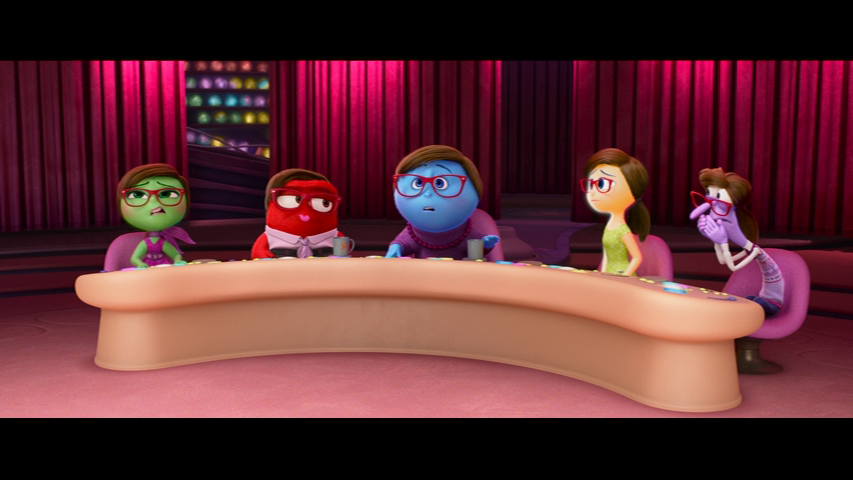
Unfortunately, a second viewing of the sequel didn’t shed much light on the matter. We get just brief glimpses into the command centers of only four characters other than Riley. “Well, we all knew this day would come,” says Riley’s mom’s Anger (Paula Pell) the morning after Riley enters puberty, in reply to which her Sadness (Lori Allen), who is in the driver’s seat, reminds everyone to remain calm and “stick to the prepared script.” She then pushes a button that causes Riley’s mom (Diane Lane) to launch into a speech about a “beautiful butterfly”:
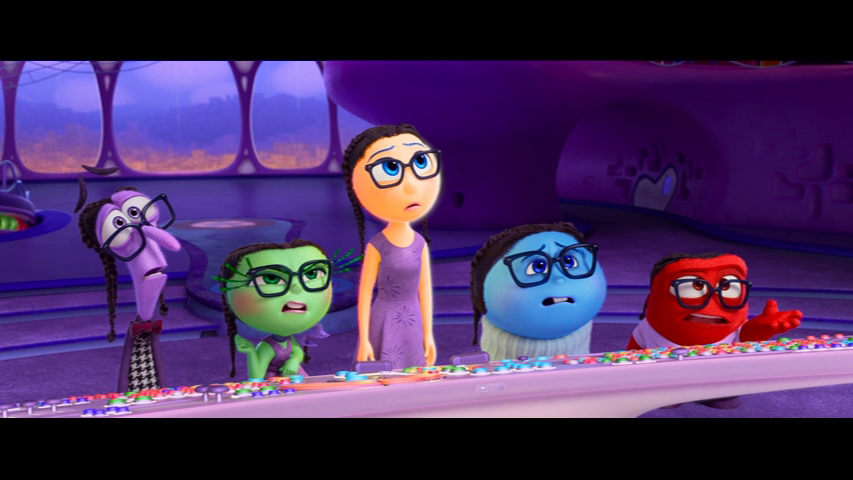
Next, we see the emotions of Riley’s friends Bree (Sumayyah Nuriddin-Green) and Grace (Grace Lu) during a conversation that ends with Riley discovering they won’t all be going to the same high school like she thought:
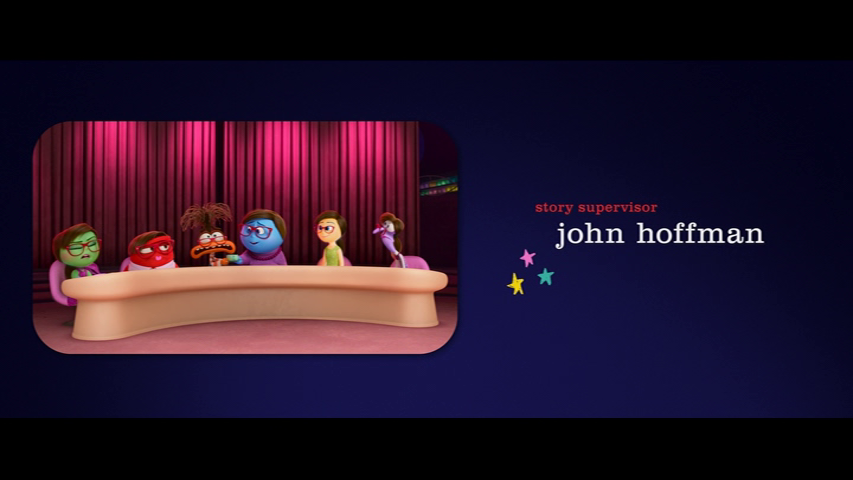
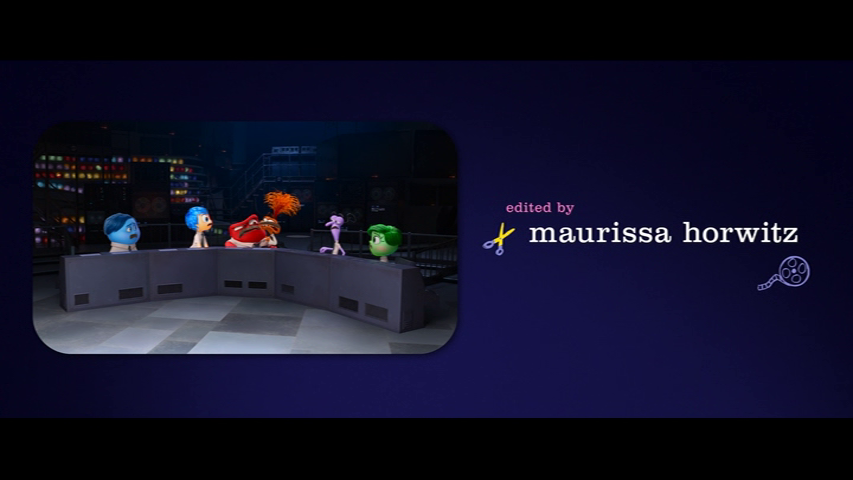
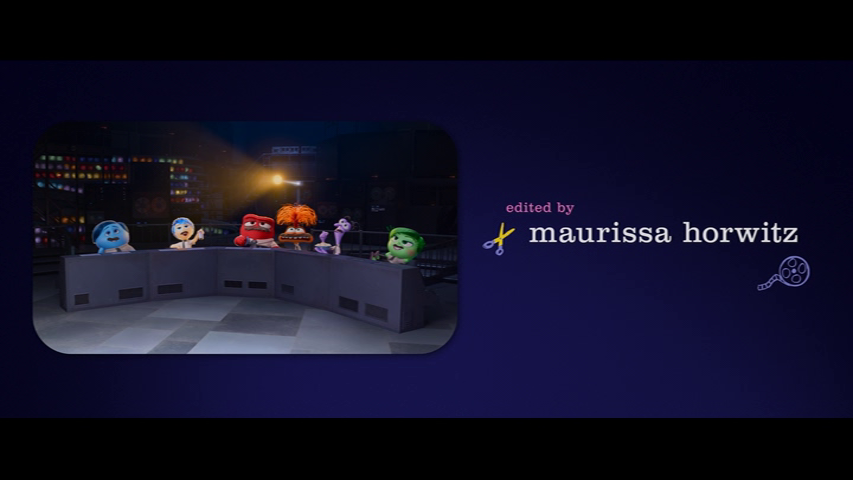
Their positioning suggests that Joy is in charge of Bree’s emotions (left) and Fear is in charge of Grace’s (right), which seems to match what little we know about each girl, but this is obviously inconclusive. Finally, we meet someone else’s new (since the last film) emotion for the first time when Riley’s mom and dad (Kyle MacLachlan) react to her terse (“it was good”) response to a question about how the sleep-away hockey camp she just got back from was during the end credits. “What about the red in her hair? Did she join a gang?” worries her mom’s Anxiety (Mona Marshall), to which her Sadness replies, “welcome back” and hands her a cup of tea:
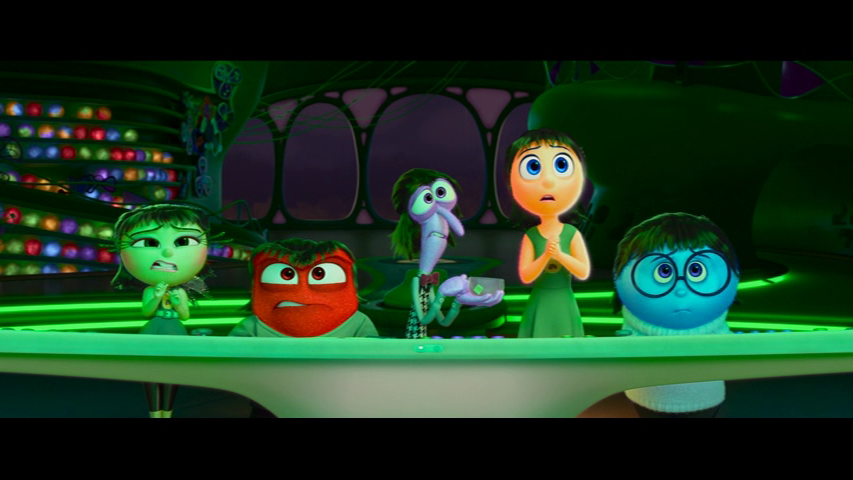
Then Riley’s dad’s Anxiety (Roger Craig Smith) bursts into his command center and cries, “she goes away for three days and all we get is ‘good’?”
“Yeah, sounds right, back to the game,” says his Anger (Pete Docter):
Interestingly, a popping can sound effect indicates that at least one of his emotions (Joy?) may be drinking a beer, which connects his response to Anxiety to that of his wife and daughter. As mentioned by Phillips, a calming beverage is also how Riley’s emotions control their Anxiety:
That’s it for new evidence, though, so I guess we’ll have to wait for a third installment in the franchise to learn whether a peaceful coup is possible in the Inside Out universe or if the only minds dominated by Anxiety are unhealthy ones.
Also in Theaters: The new releases mentioned above account for most of our local big screen real estate, but holdovers worth considering if you’re in the mood for something different include the sequels Gladiator II and Moana 2, which continue their respective runs at the Regal, and Wicked, which is at both the Regal and Cinemapolis. It’s understandably a light week for special events and repertory fare, but there *is* a “sing-along” screening of Wicked at the Regal every day at 11:10am if that sounds like your thing.
Home Video: The greatest New Year’s Eve movie of all time is indisputably (I assume) The Phantom Carriage, but I already recommended it in this space last October. Number two on my list is the first Coen brothers film I ever fell in love with, The Hudsucker Proxy which can be streamed on the Criterion Channel through the end of the month/year. It’s a particularly great choice if you’re ready to move on from whatever other winter holiday(s) you celebrate, since it’s set in a universe in which none of them seem to exist. If you aren’t a Criterion Channel subscriber, you can also watch it on Tubi if you don’t mind ads.
Previous “Ithaca Film Journal” posts canbe found here.A running list ofall of my “Home Video” recommendations can be found here.
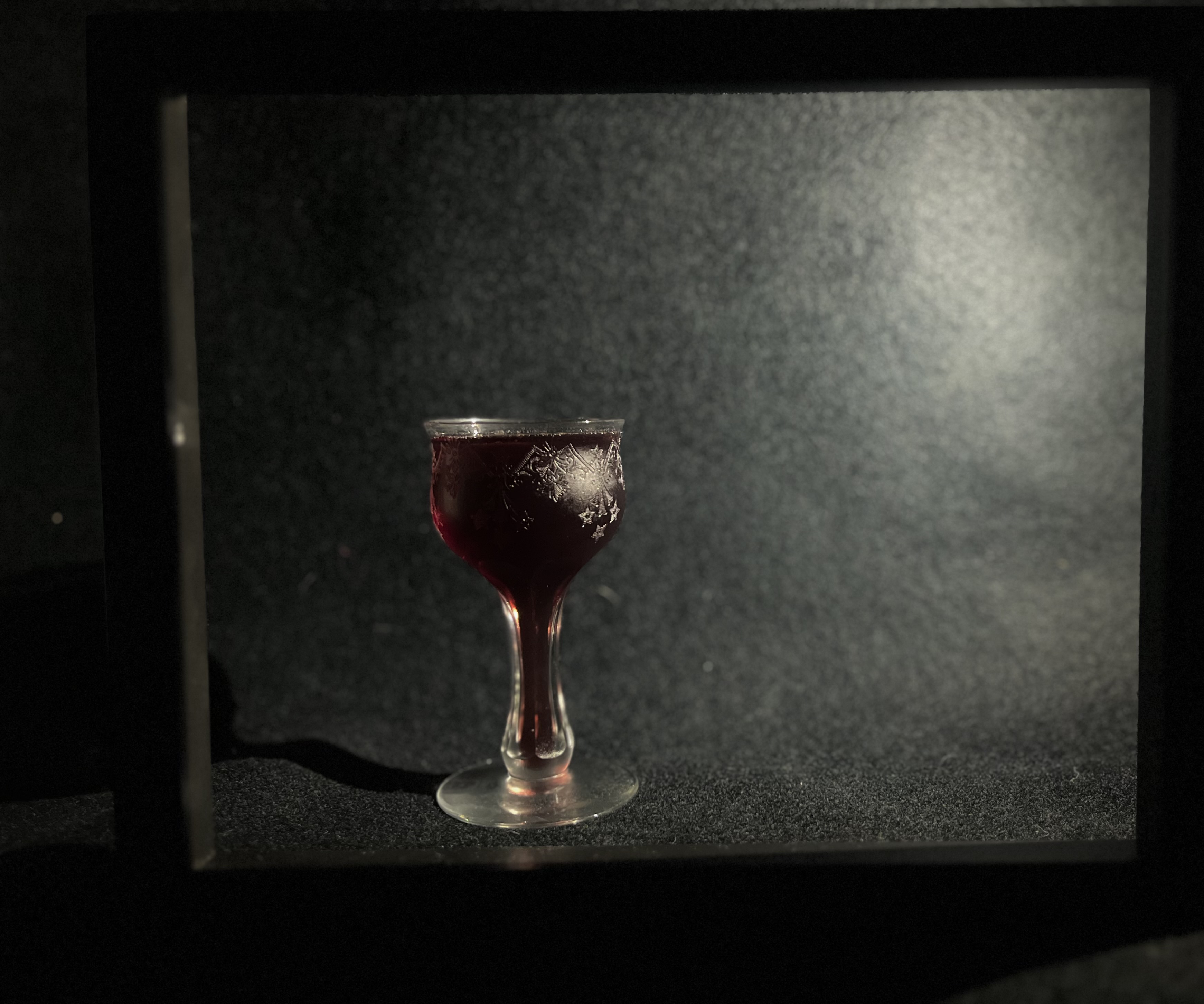
Thanksgiving dinner was one of the first meals I ever taught myself to cook. My roommates and I moved off campus prior to our sophomore year at the University of Pittsburgh, and to our delight we learned that we could earn a free turkey by accruing points when we did our grocery shopping at the local Giant Eagle. Thus was born an annual “Friendsgiving” tradition which became my earliest foray into wine pairing when I turned 21. Having no real idea what I was looking for, it’s little wonder that I gravitated toward the endcaps laden with colorfully-labeled Beaujolais nouveau. Although it’s no longer a fixture on my holiday table, I usually can’t resist the urge to pick up a bottle or two every year for old time’s sake. Most (including this year’s selection, the Clos du Fief Beaujolais-Villages Nouveau La Roche 2024 I purchased from Northside Wine & Spirits) are genuinely enjoyable on their own, but my preferred use for them is in Jim Meehan’s Nouveau Sangaree from The PDT Cocktail Book. Here’s how to make it:
2 ozs. Beaujolais nouveau (Clos du Fief Beaujolais-Villages Nouveau La Roche 2024) 1 1/2 ozs. Bonded apple brandy (Laird’s 10th Generation) 1/2 oz. Sloe gin (Hayman’s) 1/4 oz. Maple syrup 2 dashes Angostura bitters
Stir all ingredients with ice and strain into a chilled cocktail glass. Garnish with grated cinnamon.
As Robert Simonson said when writing about this drink for the New York Times, “sloe gin and maple syrup remind you that life should be sweet during the holidays.” The former amplifies the floral and fruity notes of the wine, while the latter creates a creamy texture and combines with the caramel and vanilla flavors of the applejack to linger on the palate. The overall impression is something like a poached pear. Meehan’s recipe specifically calls for “Grade B” maple syrup, but as I mentioned back in August, 2022 that rating no longer exists, so use “Grade A Dark Robust” or just the best stuff you can find. Finally, he employs an apple fan garnish, which probably would announce the presence of the brandy more clearly, but this is a bit fussy for us and we’re happy with just grated cinnamon.
The movie Playtime is a perfect match for this beverage because its centerpiece Royal Garden sequence embodies the celebratory and improvisational nature of the celebrations from my 20s I want to commemorate. They’re also both great fits for the month of December. In the case of the cocktail that’s because it can help use up leftover bottles of wine, while the movie employs a seasonally-appropriate green and red color scheme to great effect. Here’s a picture of my Criterion Collection DVD copy of the latter:
It can also be streamed on the Criterion Channel with a subscription and rented from a variety of other platforms, and some people (including current Cornell University faculty, staff, and students) may have access to it through Kanopy via a license paid for by their local academic or public library as well.
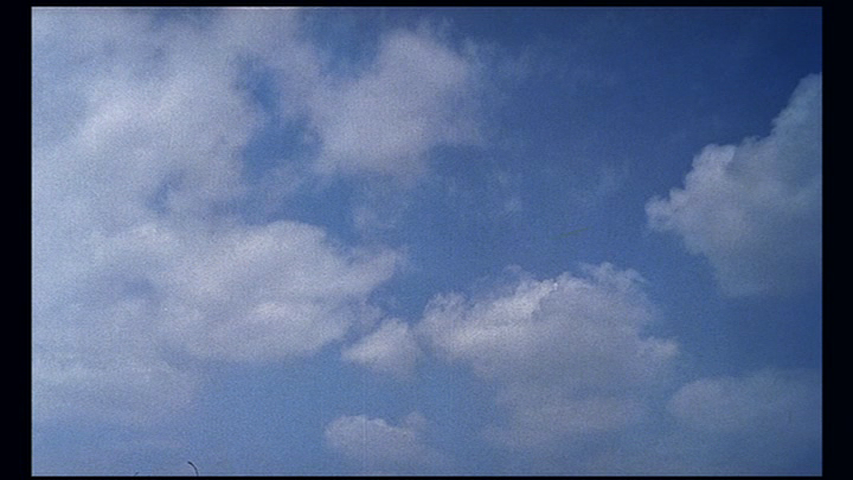
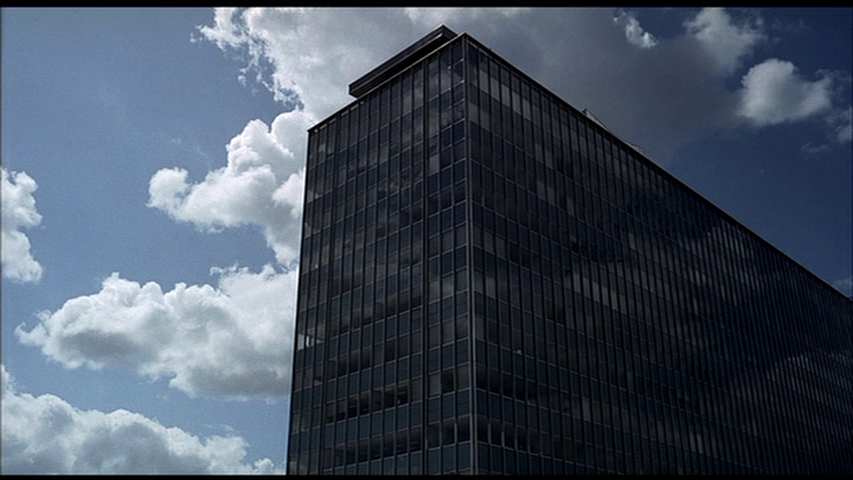
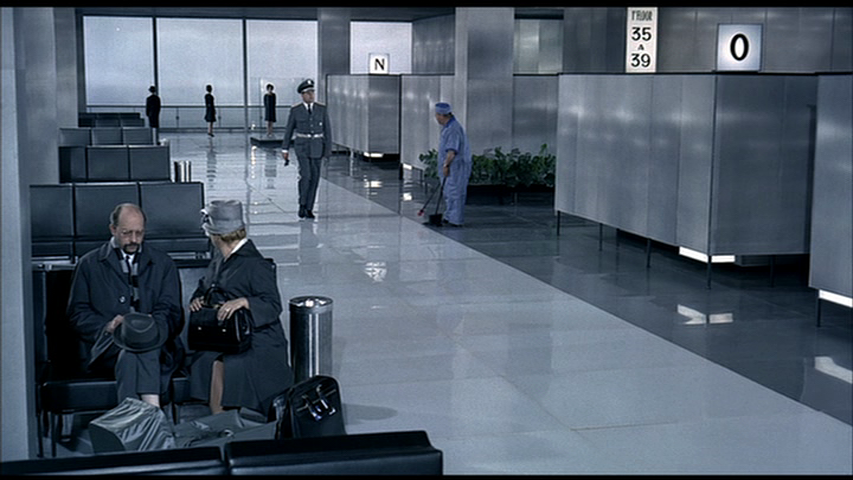
Playtime begins in a place that My Loving Wife, watching it for the first time, assumed was some sort of anteroom to the afterlife, a reading that I imagine director Jacques Tati would have loved. An opening credits sequence featuring clouds, which ties it to some of my other favorite movies, gives way to an establishing shot of a glass and steel skyscraper:
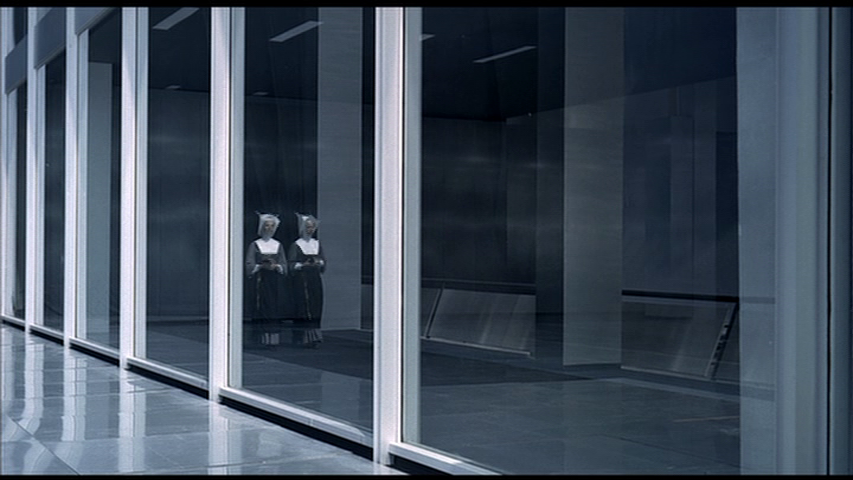
The first human beings we see are two nuns:
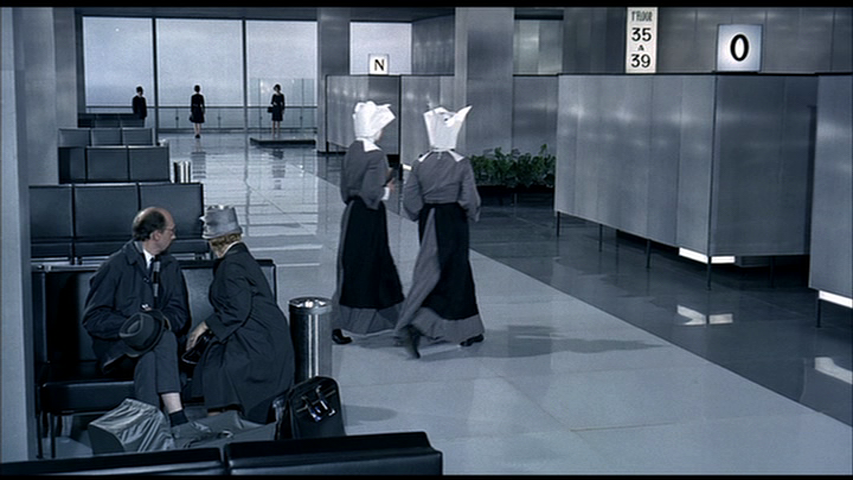
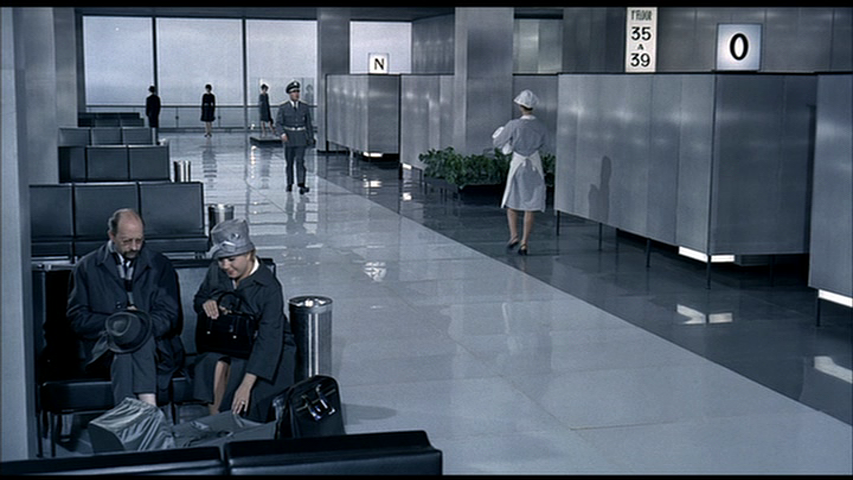
And a cut on motion sets up the film’s first gag. Two people, a man and a woman, talk in the foreground.
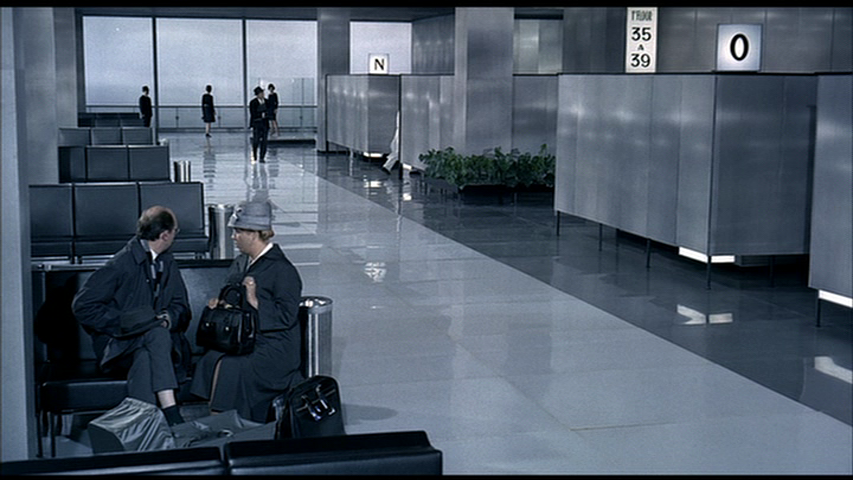
We can tell from their conversation that he’s going somewhere: “wrap your scarf around so you don’t catch cold,” his companion tells him, and “take care of yourself.” They also talk about the other people who appear in the frame with them, including first a man who “looks important” and then “an officer”:
It’s only when a woman who looks like she could be a nurse carrying a bundle of towels that resemble an infant in swaddling clothes appears accompanied by the sound of a baby crying that we notice the gray stroller in front of them which up until this point had completely blended into its surroundings:
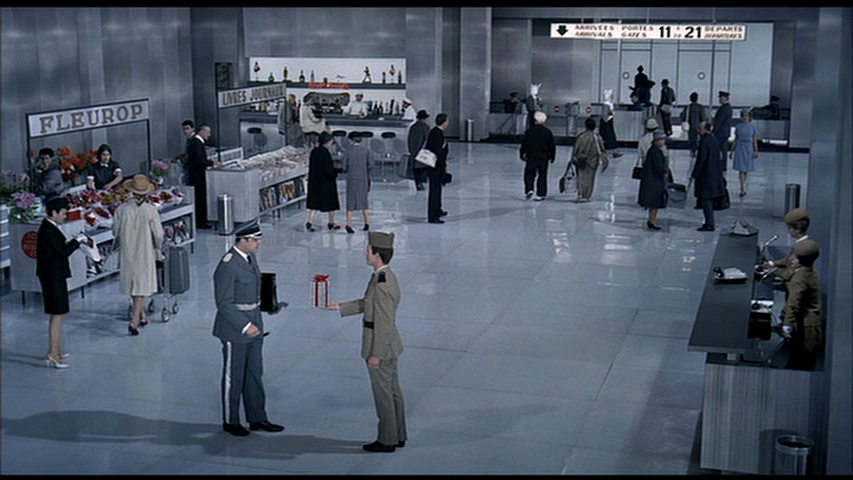
This is just the first of many instances of what Lucy Fischer (who was chair of the film studies department at Pitt when I was a student there) calls “one of the major functions of Tati’s remarkable soundtracks” in a Sight & Sound article called “‘Beyond Freedom & Dignity’: An Analysis of Jacques Tati’s Playtime“–the way they “provide aural cues to guide our visual perception.” As Fischer notes, he uses color the same way, beginning with the elaborate presentation of a gift which we pick out from a crowded monochrome mise-en-scène in large part because of its bright red bow:
It’s also an early example of what Lisa Landrum identifies as Tati’s use of color to “symbolically to reveal narrative and allegorical meaning” in her chapter in the book Filming the City, here as a “crimson reminders of life’s more sensual pleasures.”
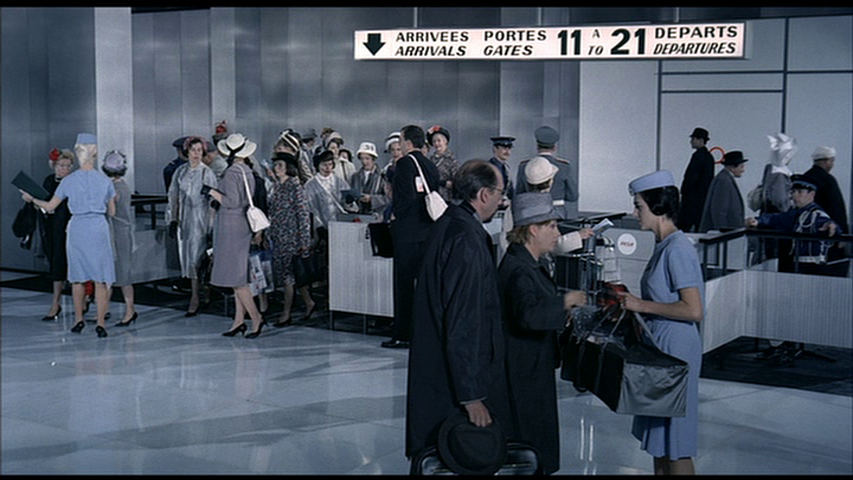
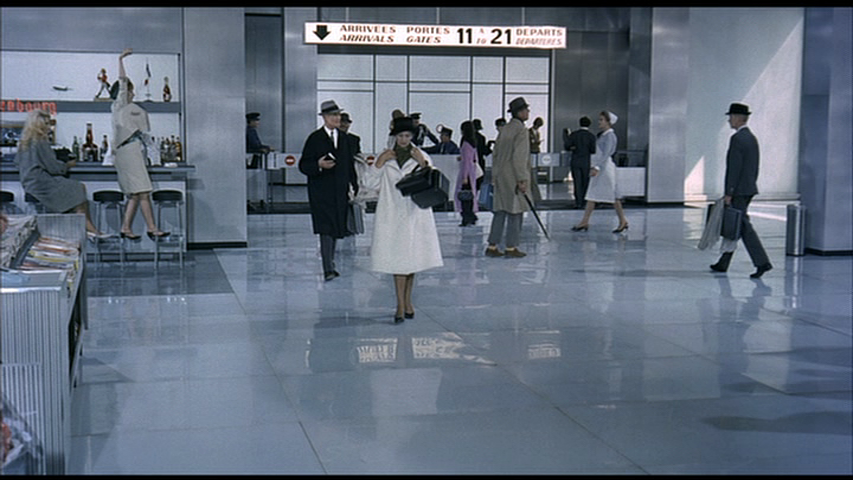
We next encounter a gaggle of American tourists who will eventually lead us out of what by now we realize is an airport:
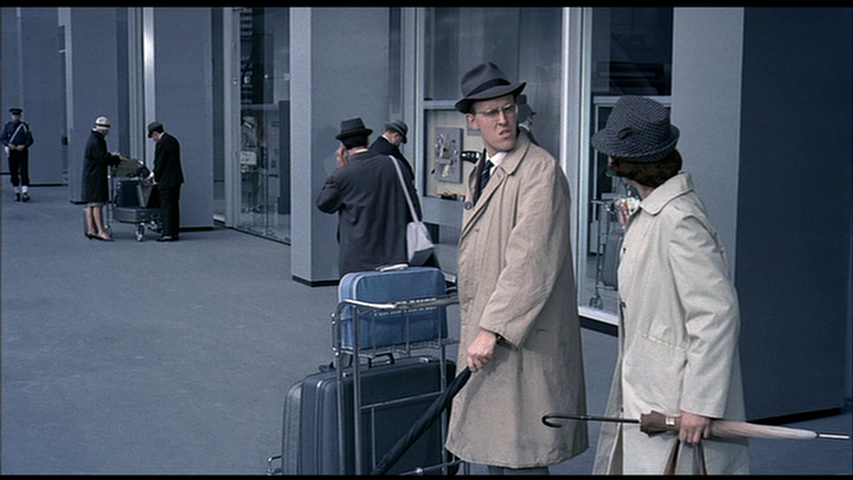
Followed by the introductory appearance of our ostensible protagonist Monsieur Hulot (Tati) with his signature hat, overcoat, and umbrella in the background of the same scene:
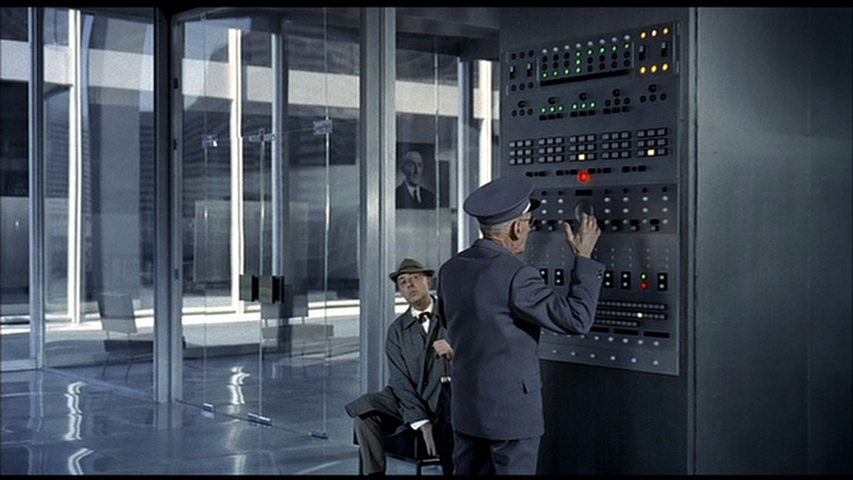
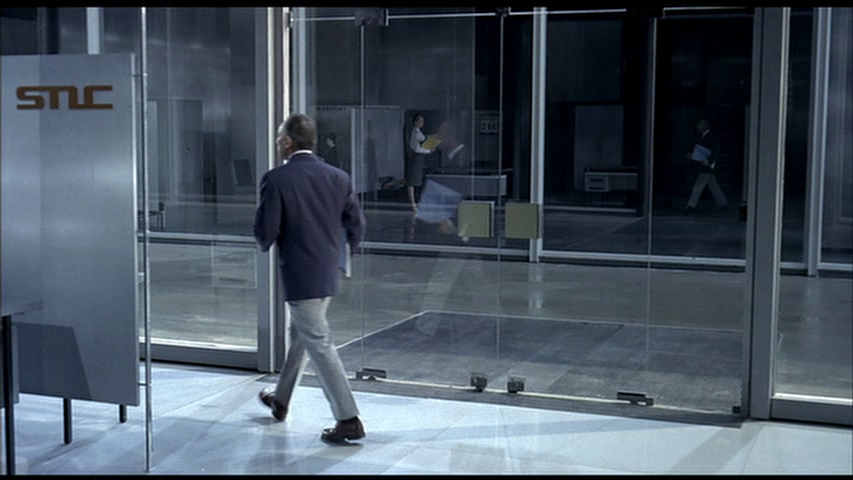
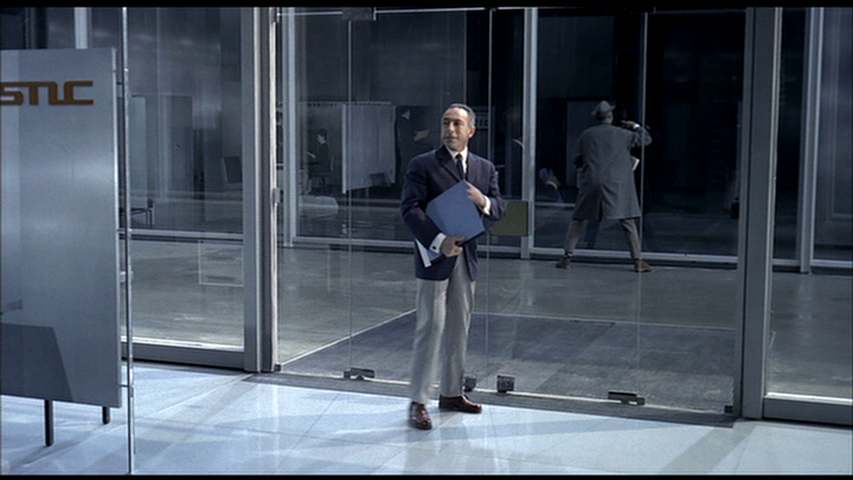
It’s unclear (and completely irrelevant) what Hulot is doing at the airport, but we next encounter him making his way to an appointment in another modern high-rise, where he is announced via the most over-engineered intercom system on this side of Toontown:
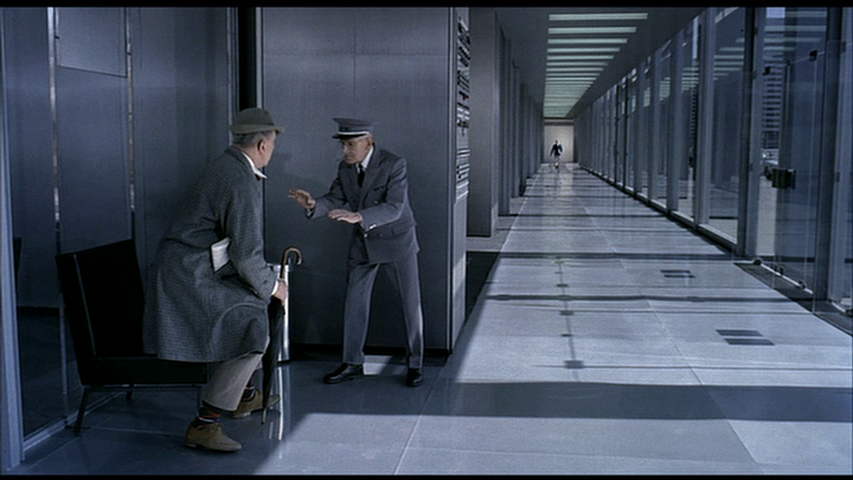
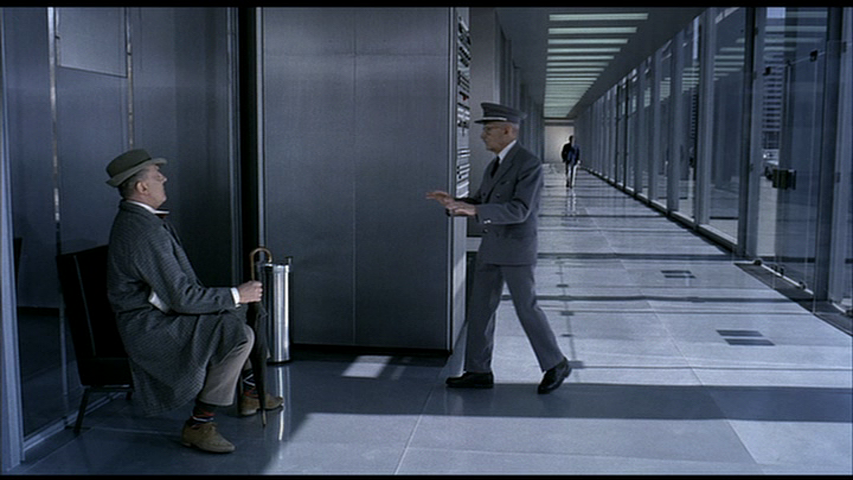
We hear the footsteps of the man he’s there to meet, Monsieur Giffard (Georges Montant), before we see him approaching down a deep focus corridor so long that the doorman (Léon Doyen) tells Hulot to sit back down twice:
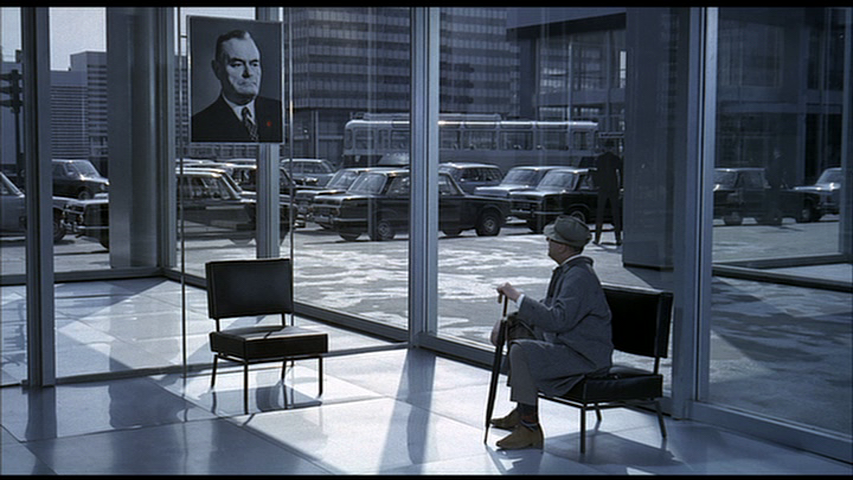
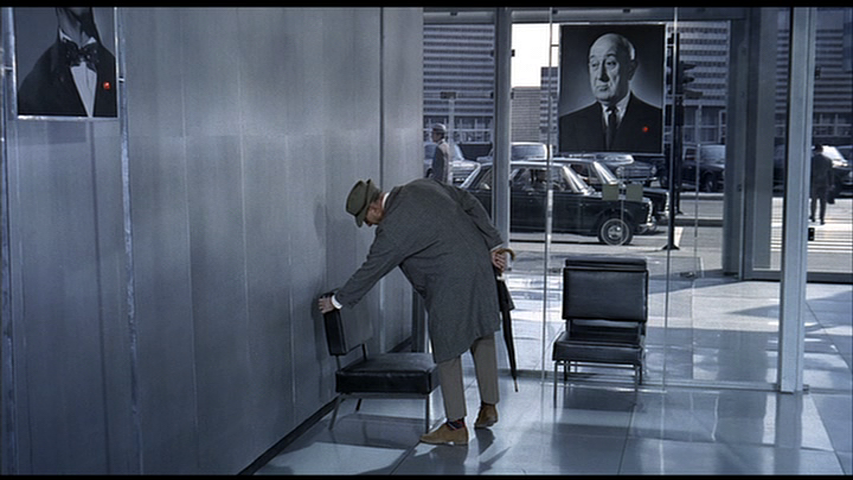
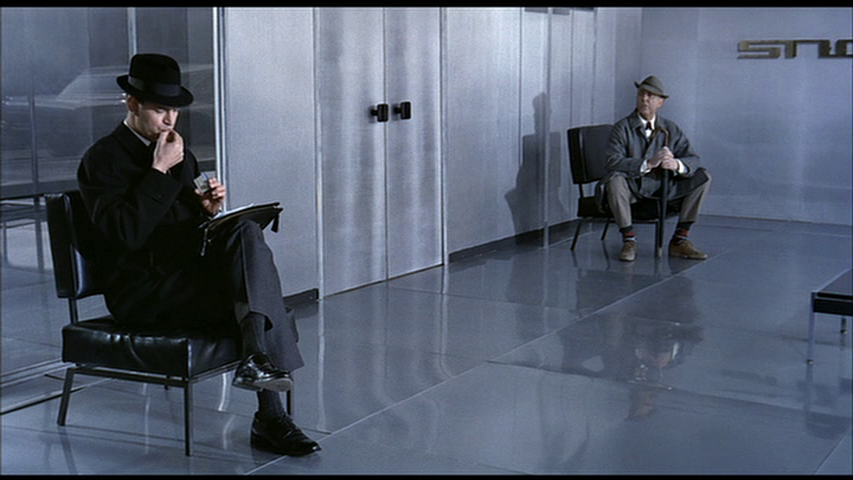
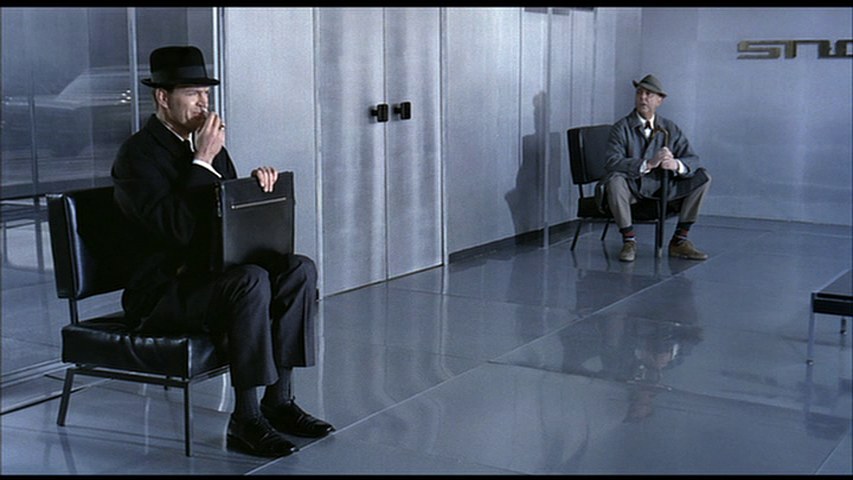
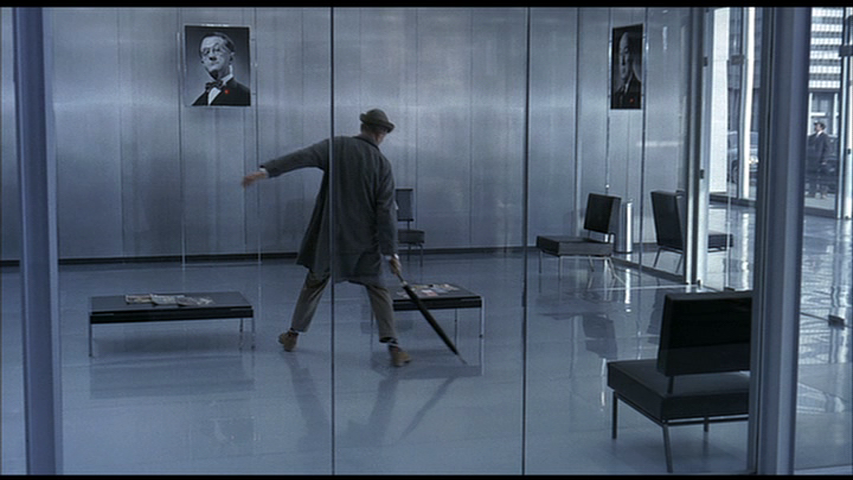
When Giffard finally arrives, he ushers Hulot into a display case-like waiting room filled with portraits that seem to disapprovingly watch his every move:
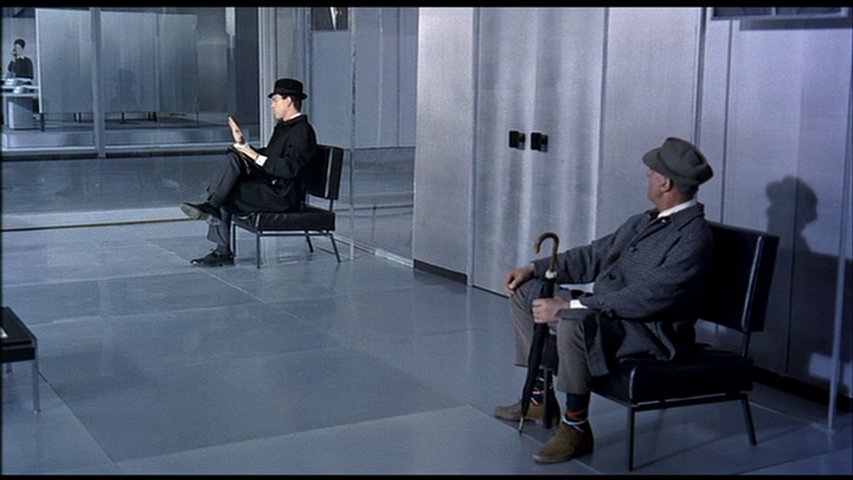
A man with fascinatingly robotic habits that seem to mark him as a natural inhabitant of this sterile environment:
And a slippery floor that causes what Rosenbaum describes as “the first significant curve in the film that undermines all the straight lines and right angles dictated by the architecture and echoed by all the human movements”:
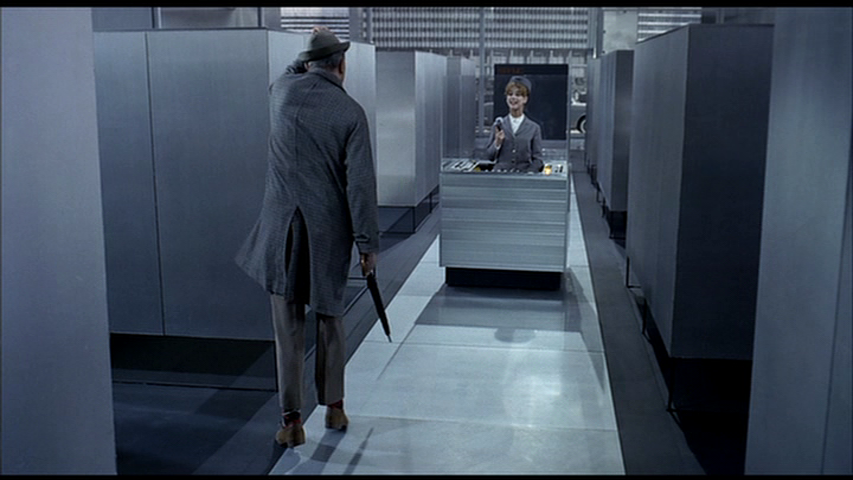
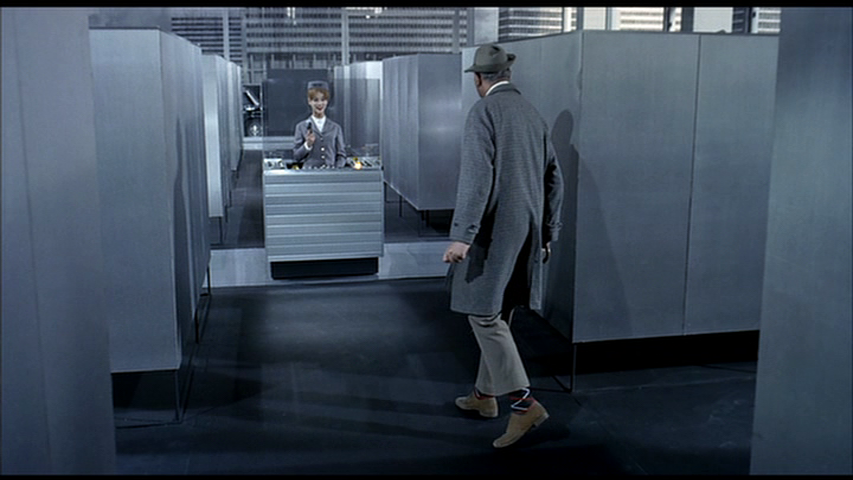
Giffard and Hulot wind up chasing each other through a maze of cubicles in which a receptionist’s rotating chair creates the impression of turning a corner and getting nowhere:
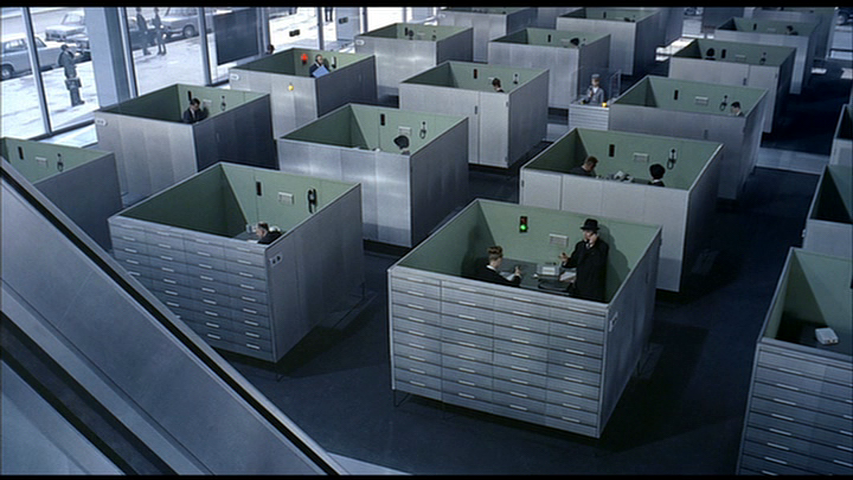
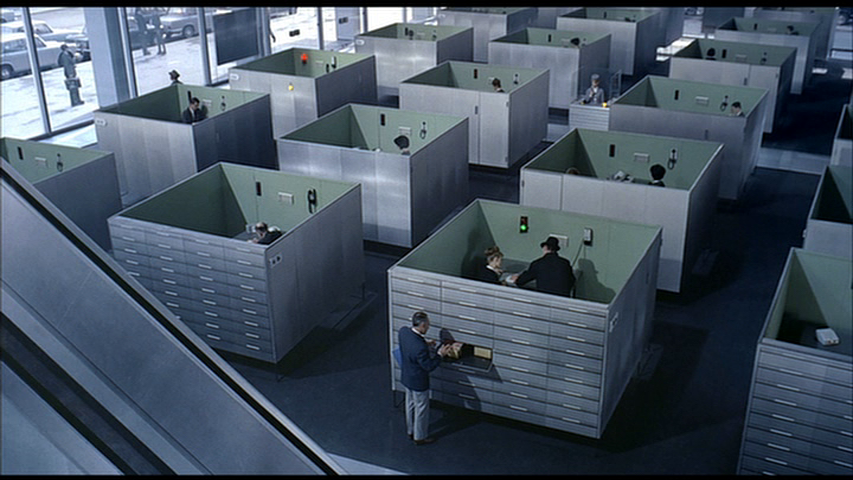
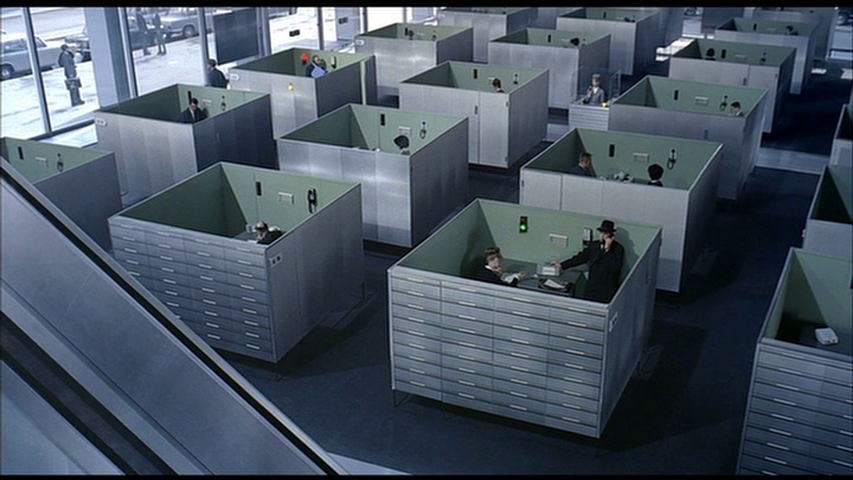
Green (bottom right of frame) and red lights (top left) draw our attention to two people who don’t realize they’re standing right next to each other talking on the phone:
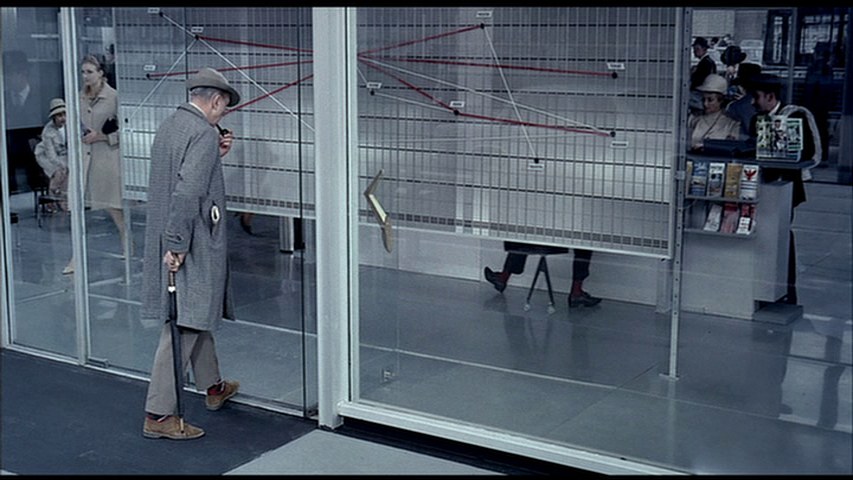
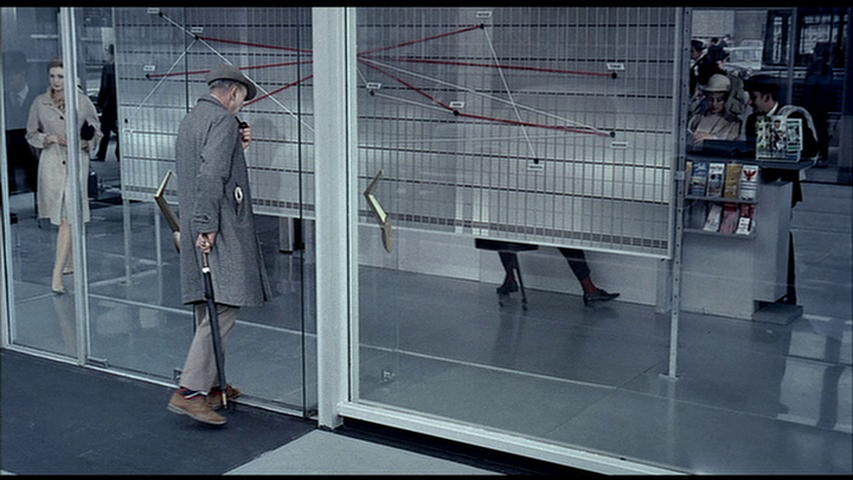
And Giffard’s reflection results in them losing each other for good when Hulot leaves the building they’re both in for the identical one next door:
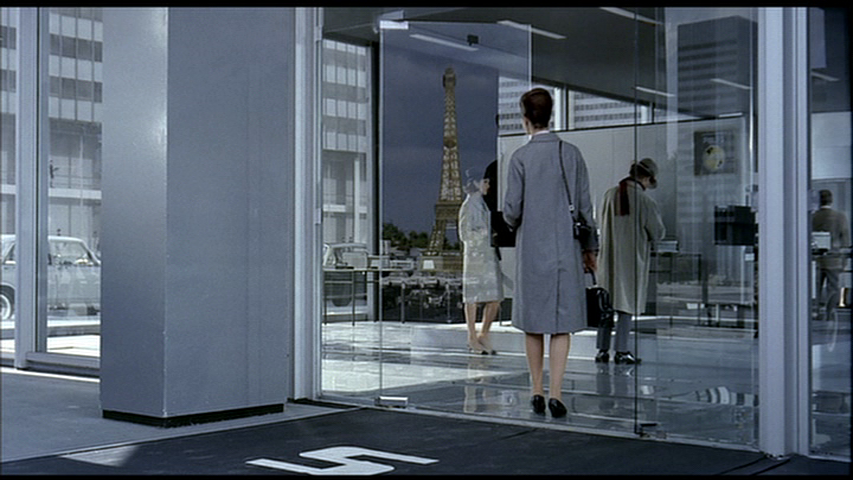
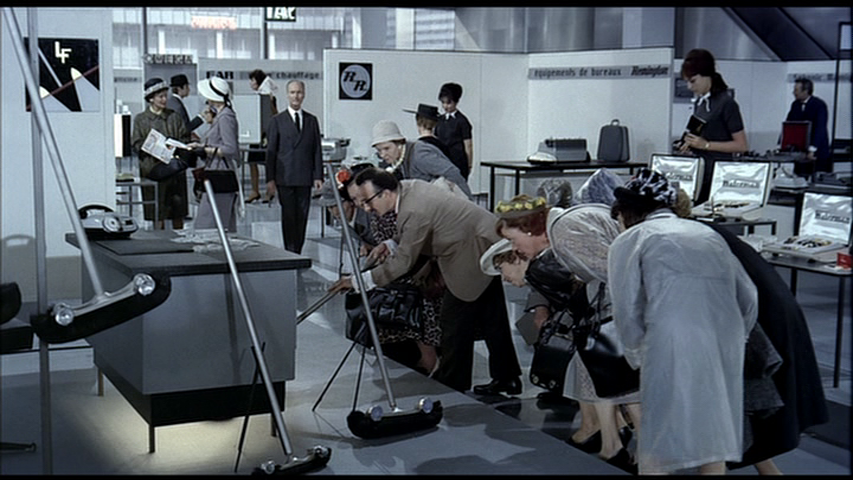
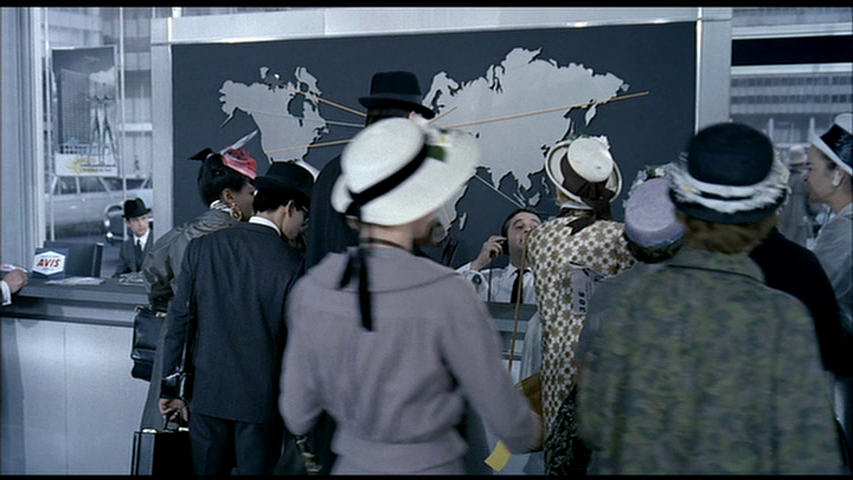
The next 20 minutes or so of the film unfold during a business exposition that both Hulot and the Americans from the airport find themselves attending, him by accident and them on purpose. One tourist named Barbara (Barbara Dennek) pursues an illusive “real Paris” that she’s only able to glimpse in reflections while her companions ooh and aah over a broom with headlights:
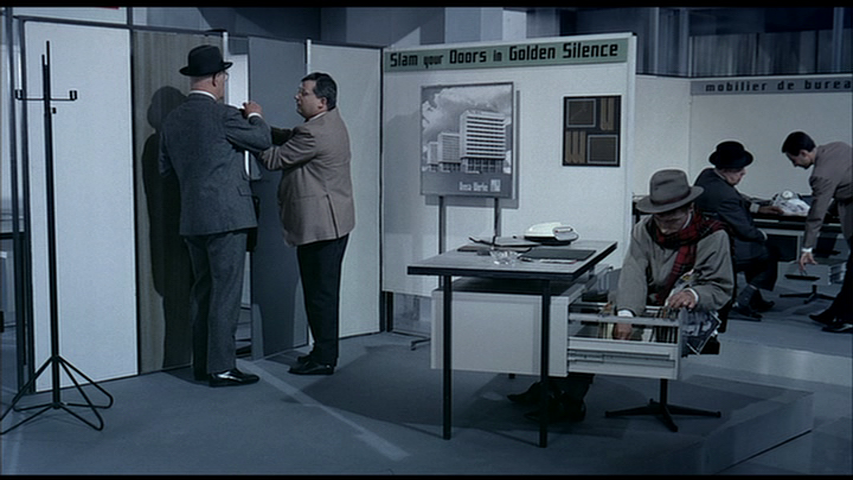
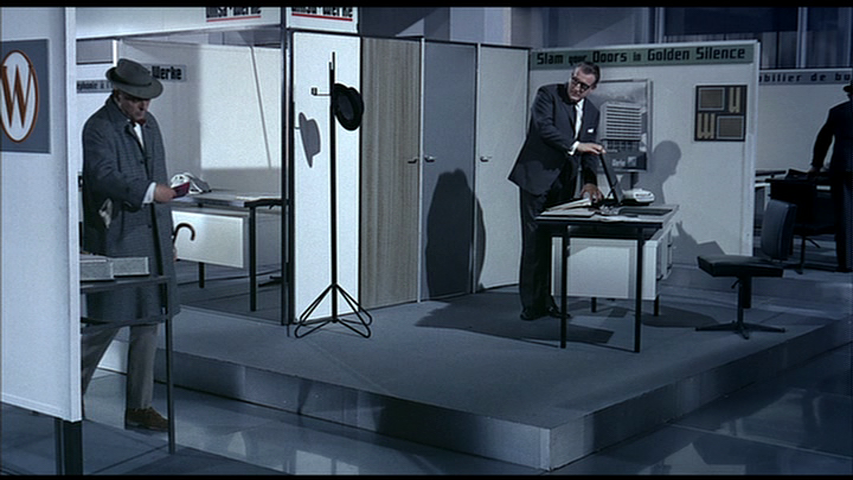
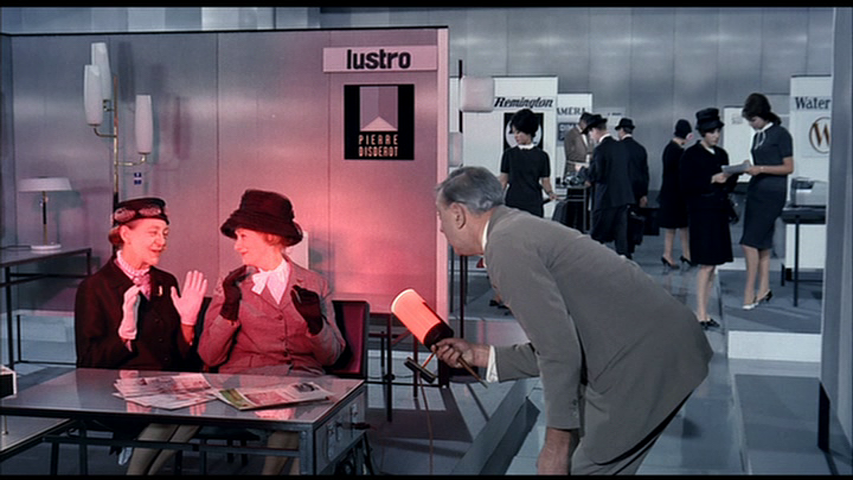
Meanwhile, Hulot is mistaken (due to confusion with another false Hulot) for first a corporate spy by a German businessman whose company’s motto is “Slam your Doors in Golden Silence,” then a lamp salesman when he loses his trademark outerwear:
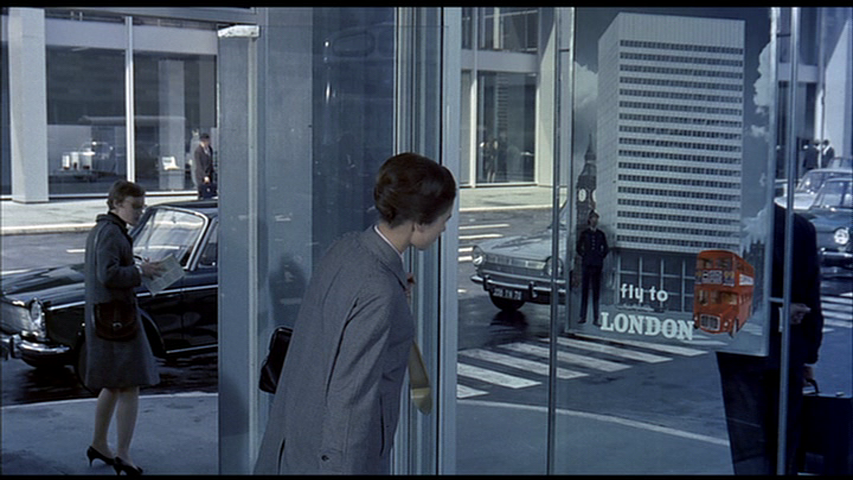
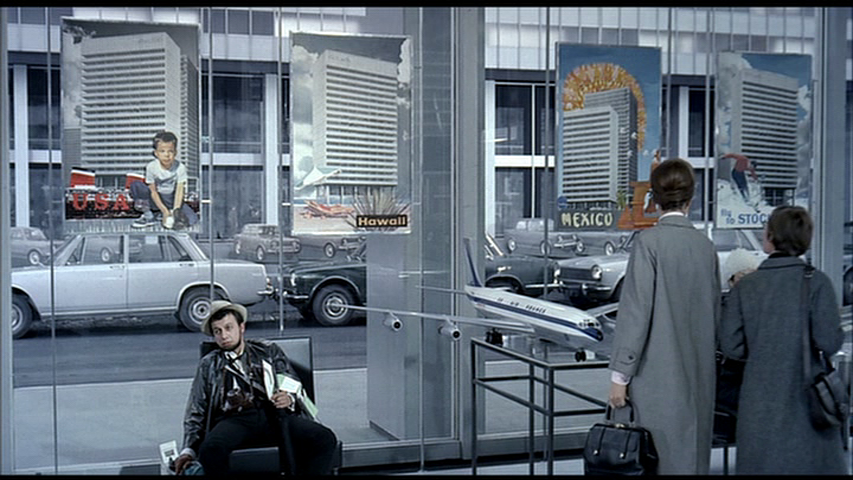
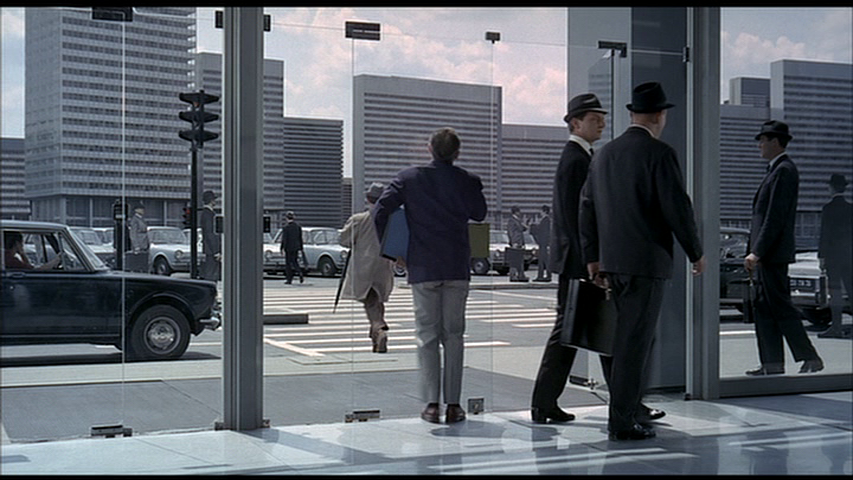
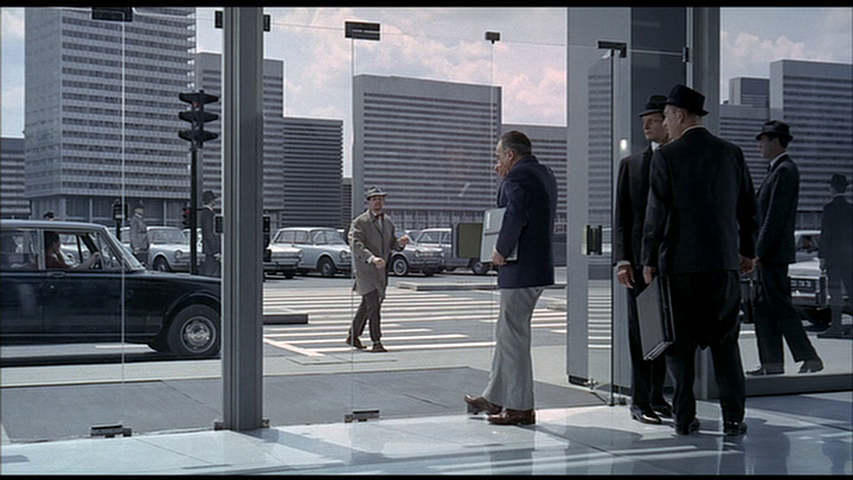
The sequence ends with Tati making his critique of the sameness of contemporary architecture more explicit via a set of travel agency posters:
Hulot watching the appearance of a disembodied pair of dancing feet created by a busy travel agent on a stool with wheels when viewed from behind:
And Giffard bumping his nose when he attempts to wave down yet another false Hulot through yet another pane of glass:
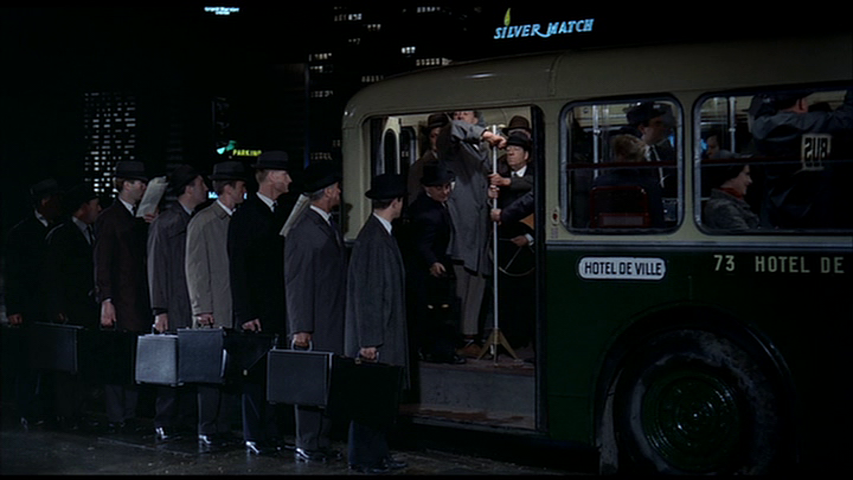
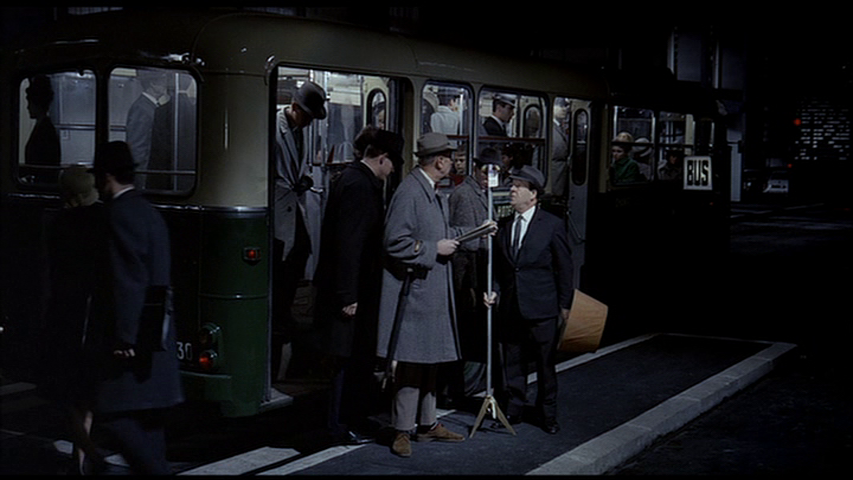
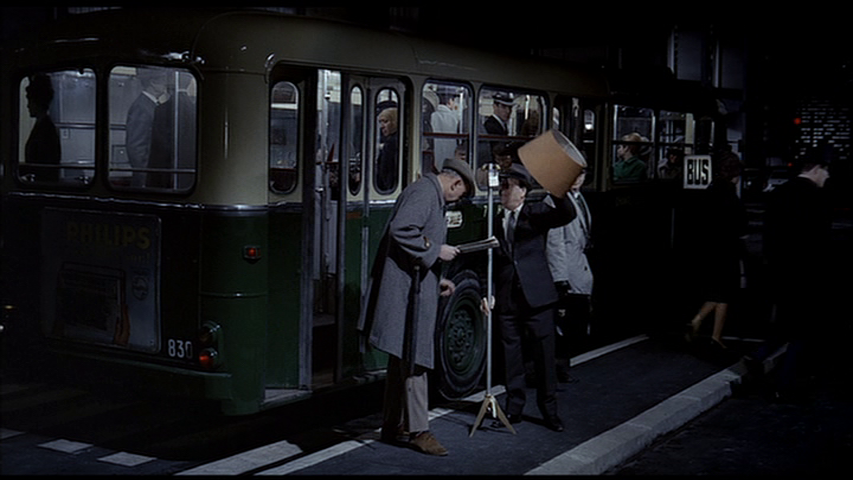
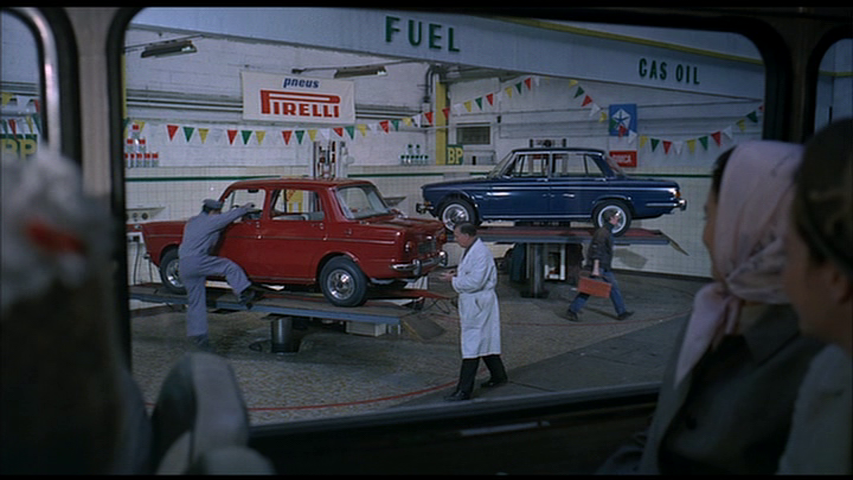
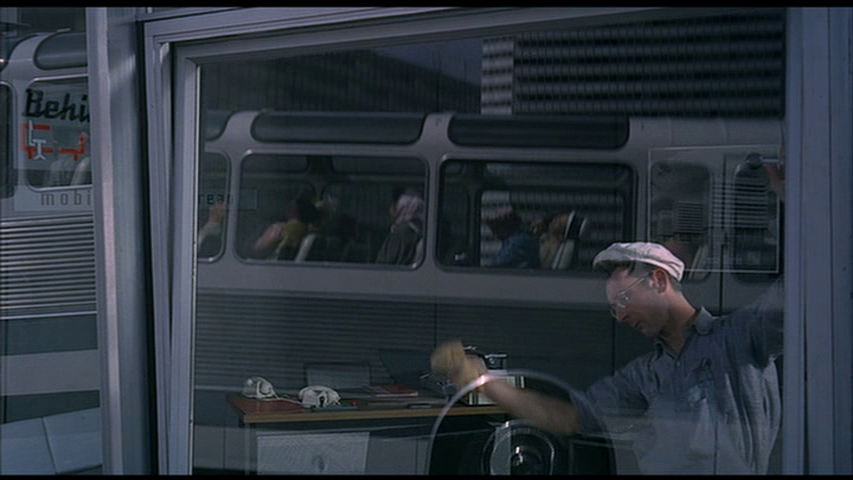
The gap to the three set pieces that are the reason Playtime rates as one of cinema’s all-time great comedies in my book is bridged by a transition featuring a nice bit of business whereby Hulot holds onto a lamp thinking it’s part of the bus he’s riding:
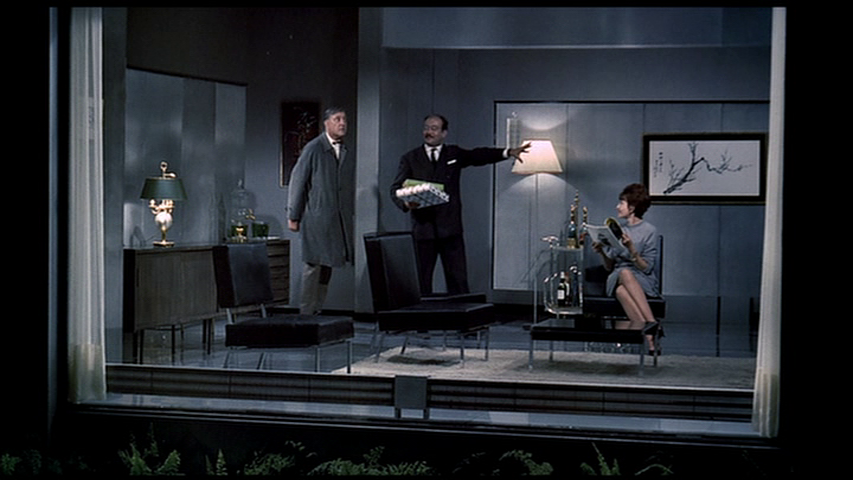
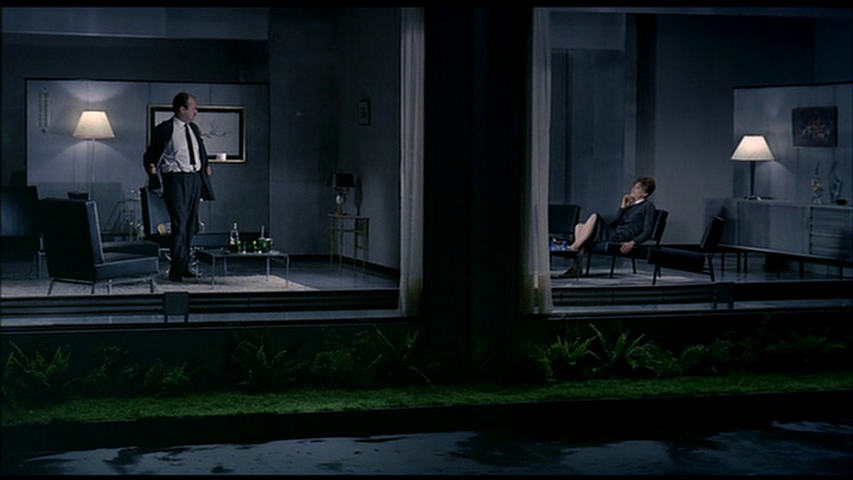
As soon as he disembarks, he is hailed by an old army buddy named Schneider (Yves Barsacq) who invites him to the apartment that inspired this month’s drink photo:
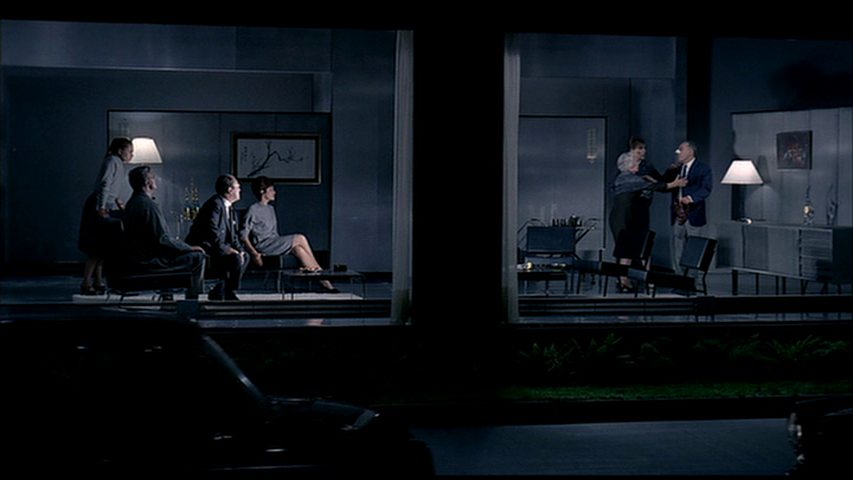
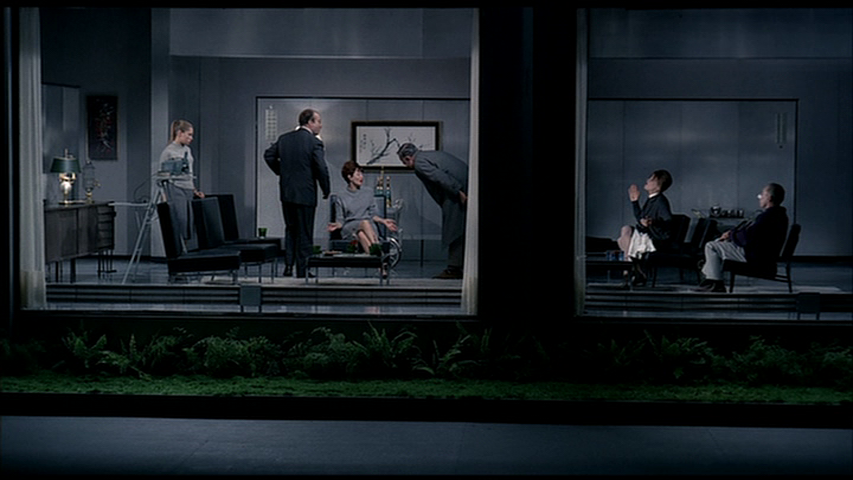
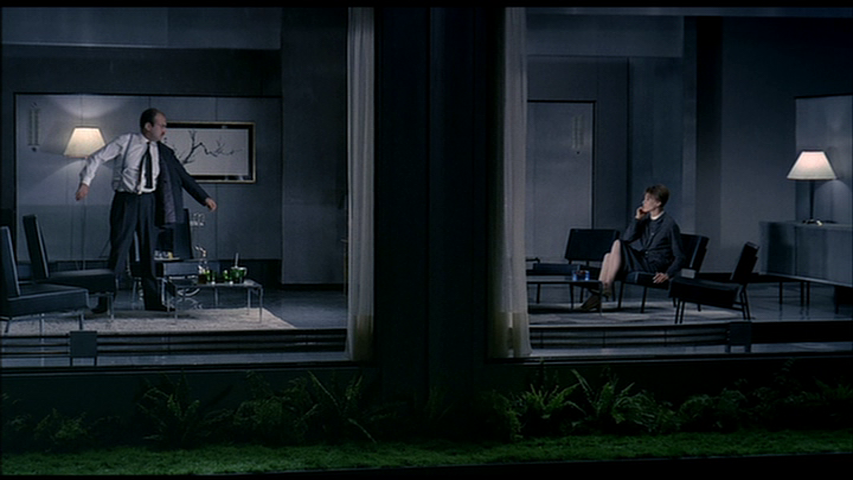
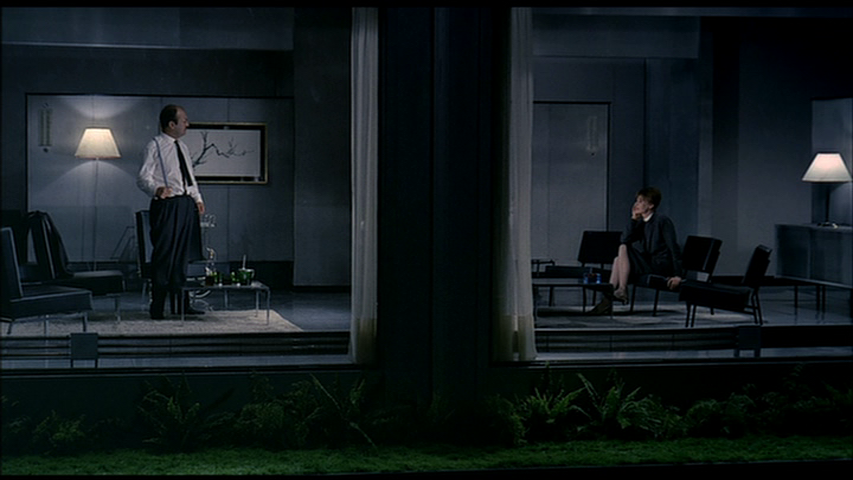
We view everything that transpires over the subsequent ten minutes from this same outside view, and when the camera pulls back to also show the neighbors’ living room as well, characters who can’t really see each other seem to be interacting. The apartment next door turns out to belong to Giffard, and the Schneiders and Hulot appear to stare in surprise when he comes inside with a bandaged nose:
The sequence also includes what look to us like offended reactions to rude gestures:
And, best of all, a striptease:
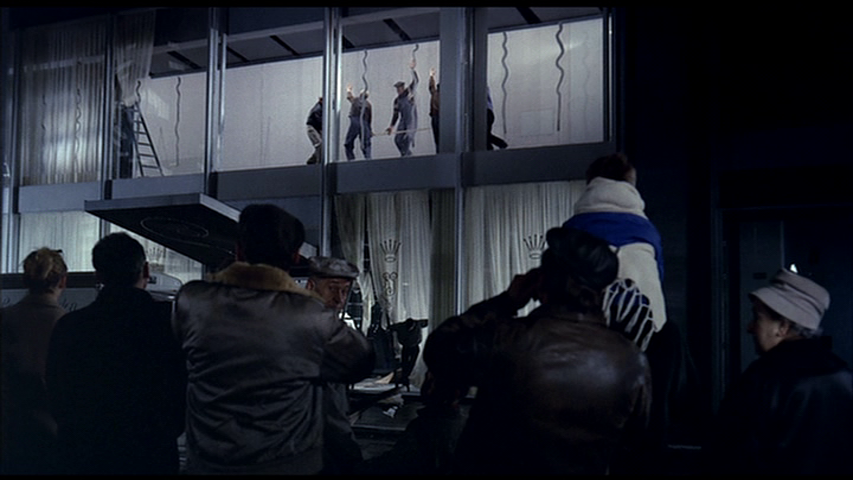
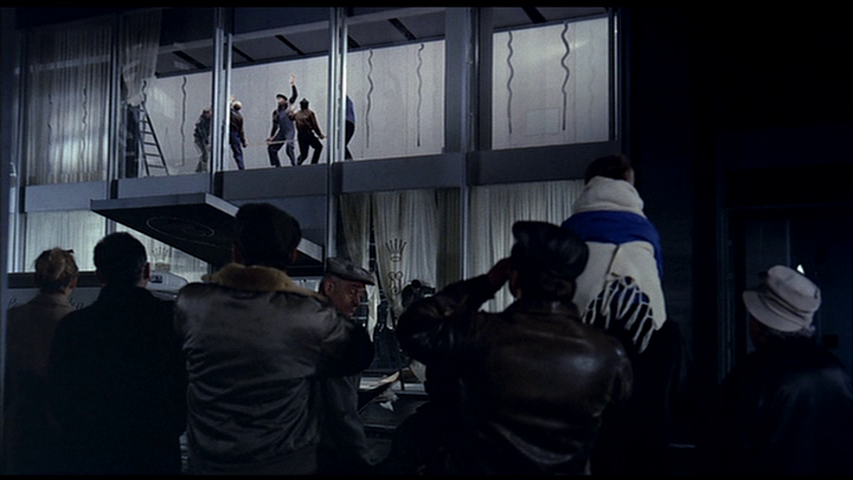
After departing, Hulot finally meets up with Giffard in a crowd of bystanders watching some construction workers who look like they’re performing a vaudeville routine:
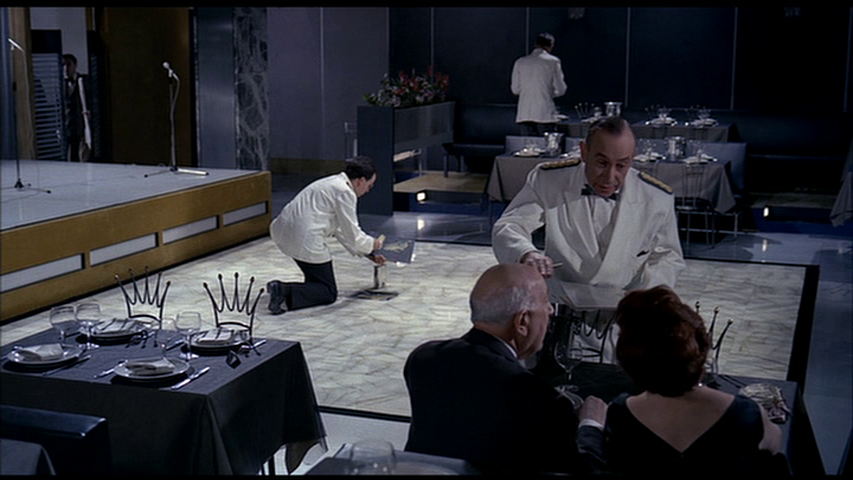
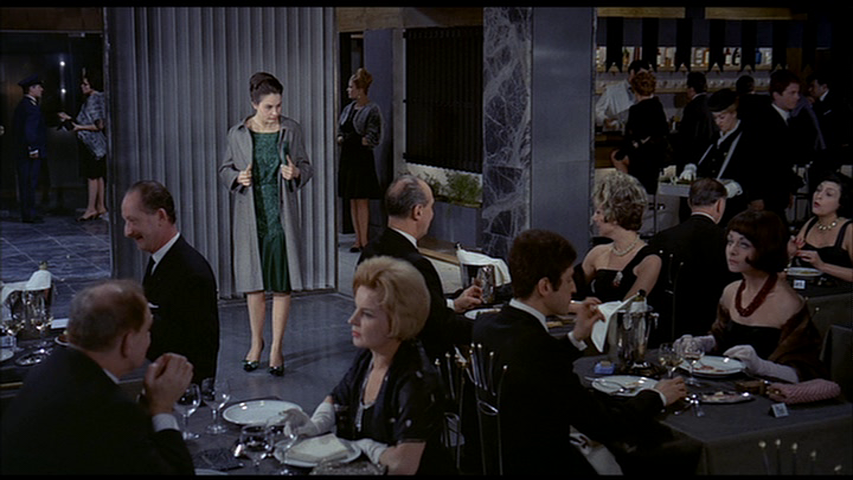
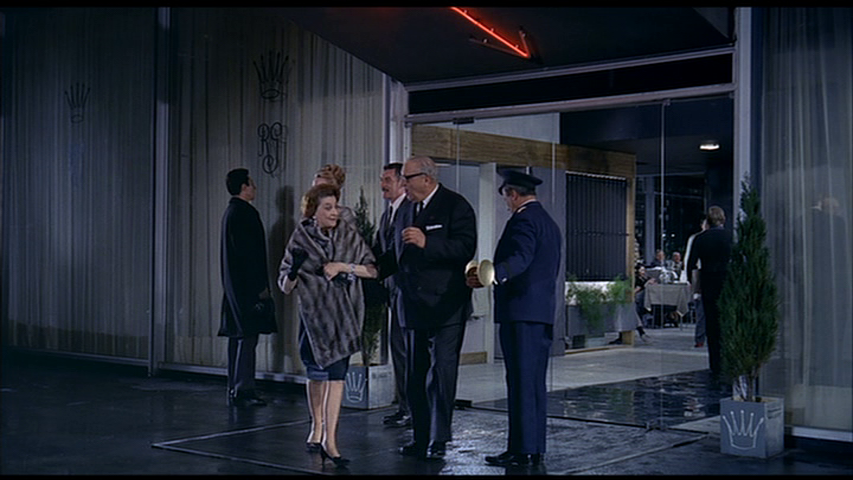
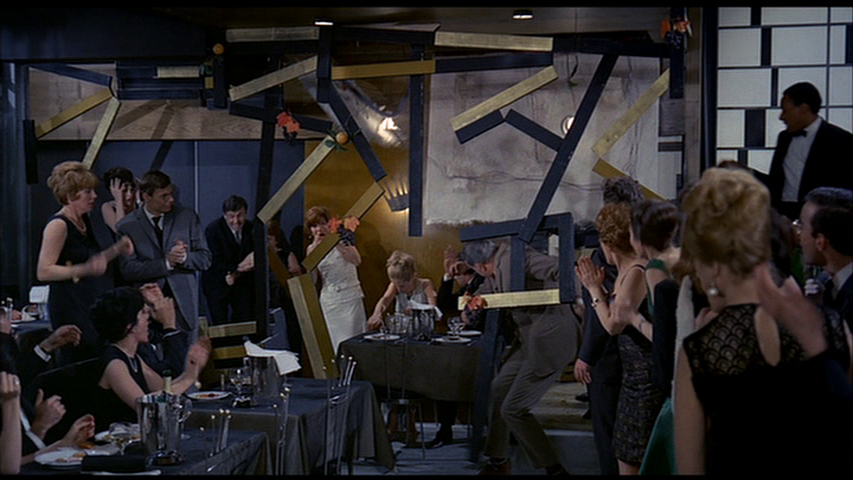
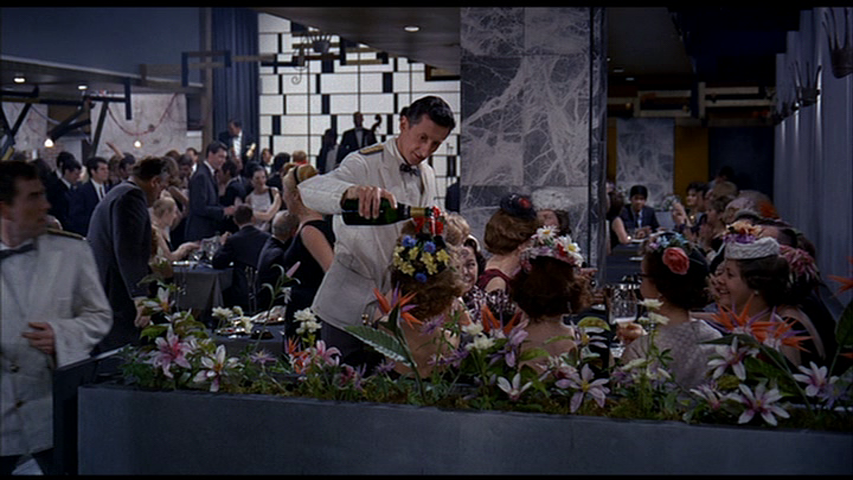
Before finding himself at the soft opening of an establishment called the Royal Garden at the invitation of the doorman (Tony Andal), another friend from his military days. Of course, this tour-de-force, nearly hour-long sequence has been going on for twenty minutes by the time he arrives, which is about par for the course according to Malcom Turvey, who calculates in his book Play Time: Jacques Tati and Comedic Modernism that Hulot is on screen less than 50% of the movie up to this point. I’d need a whole separate post to do justice to the way the nightclub basically falls apart over the course of a single service to the delight of its guests, who have more and more fun as the evening spirals further and further out of control, but highlights include a waiter fixing a broken tile in the background while another pantomimes saucing a fish in the foreground using the exact same motions:
Barbara and her companions arriving to complaints from the locals that they’re “so tourist,” but also admiring comments about how chic her outfit is, which solidifies a theme running throughout the film that there’s actually very little we can do to control how other see us and that this is neither inherently positive or negative:
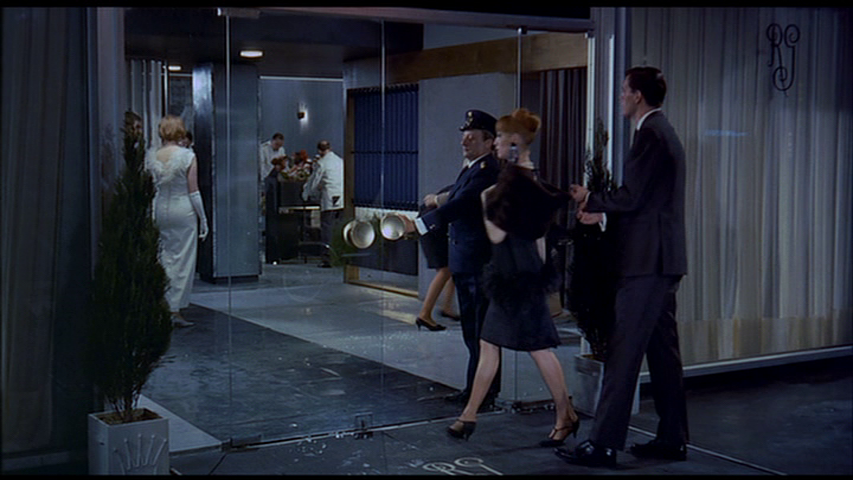
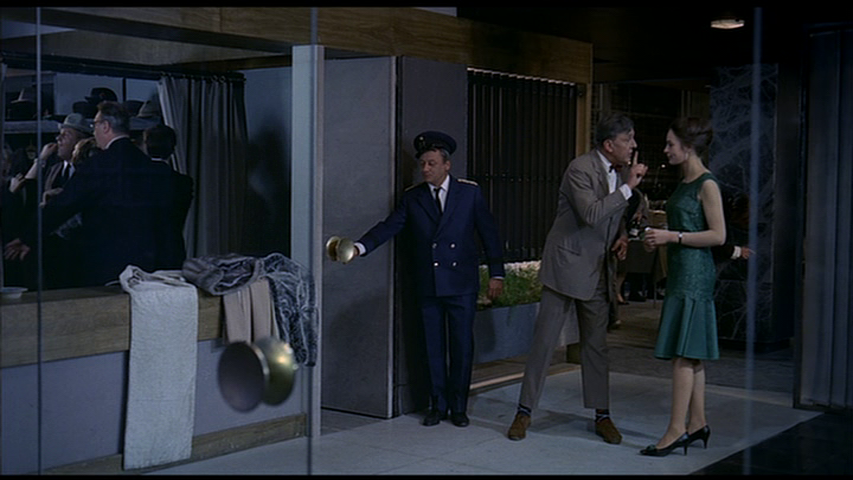
Hulot’s friend letting people in and out of a mobile invisible door after Hulot walks into it and shatters the glass:
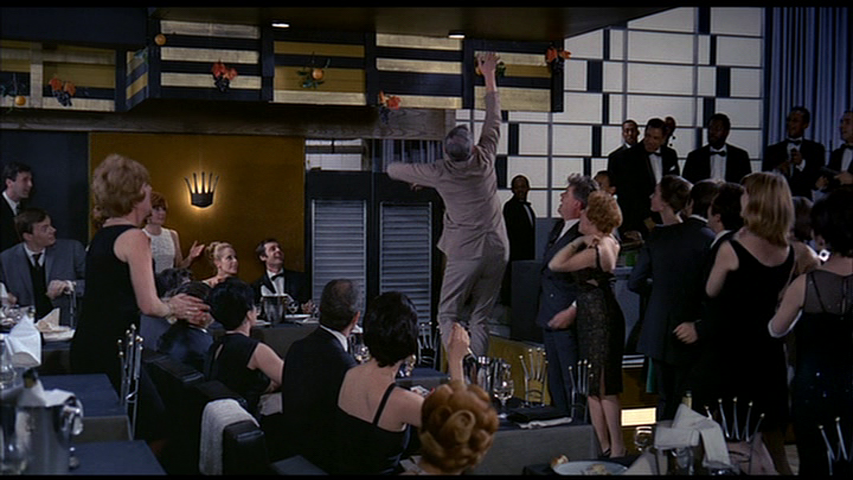
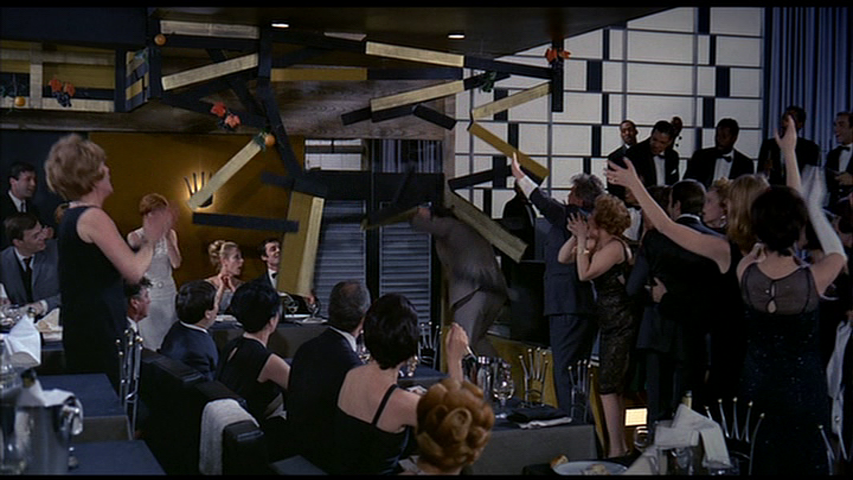
A ceiling that comes tumbling down when Hulot leaps for a golden apple decoration at the behest of a wealthy customer named Schultz (Billy Kearns), whose nationality Turvey finds significant because “it is Americans and American culture that disrupt the homogeneity of the modern environment, thereby allowing for the carnivalesque, utopian moments of communal enjoyment,” and which further ties the movie to the drink I’m pairing it with via the Laird’s:
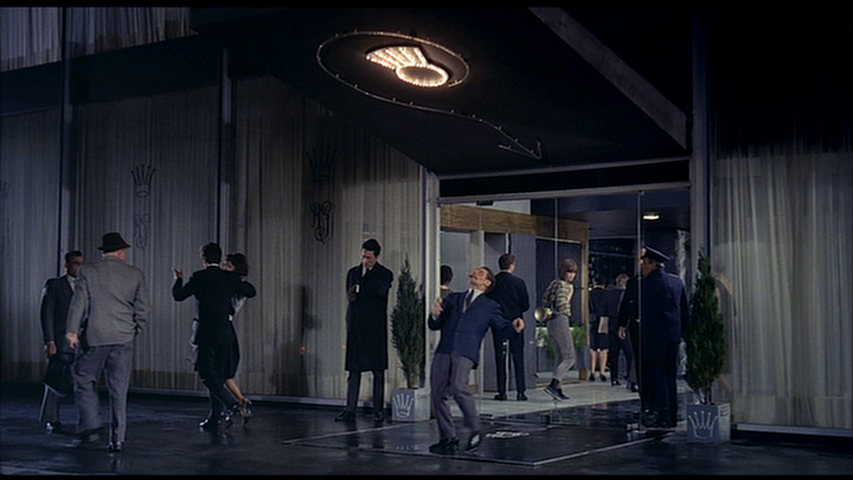
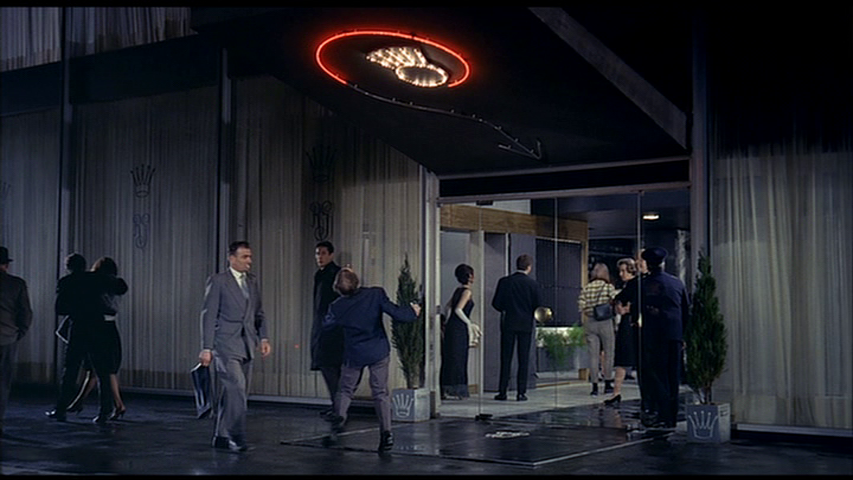
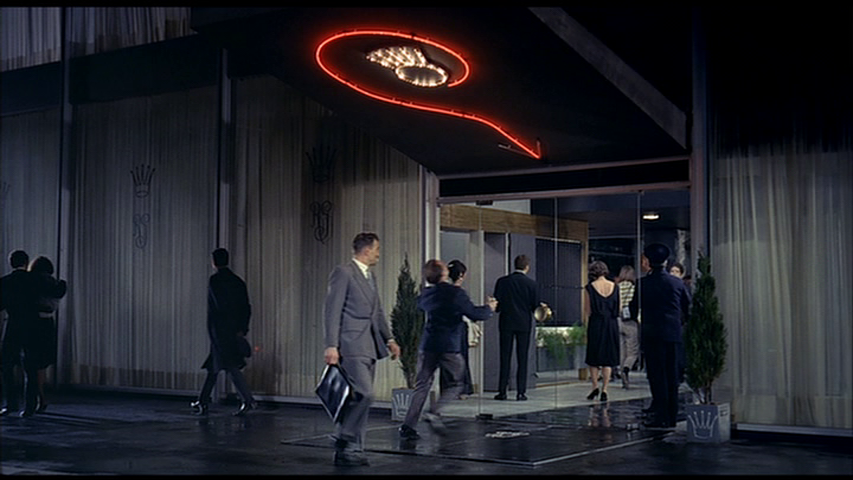
A drunk who has just been kicked out of the Royal Garden following its neon arrow sign back inside:
Flowers that look like they’re being watered with champagne:
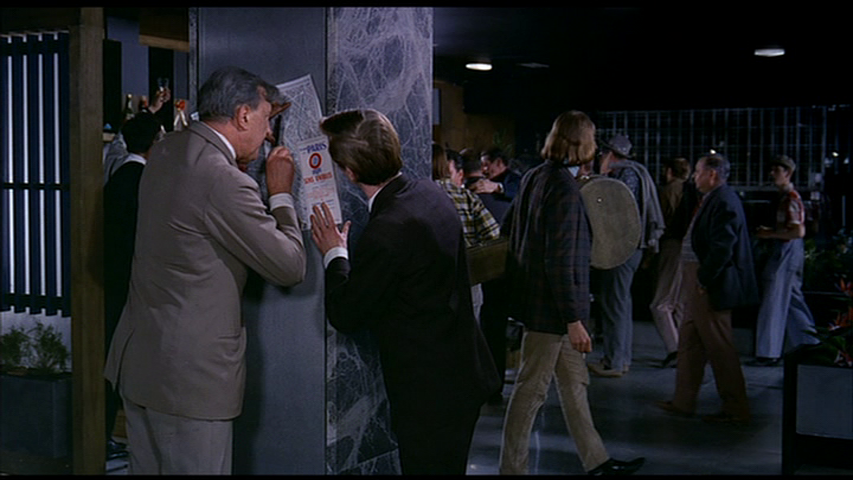
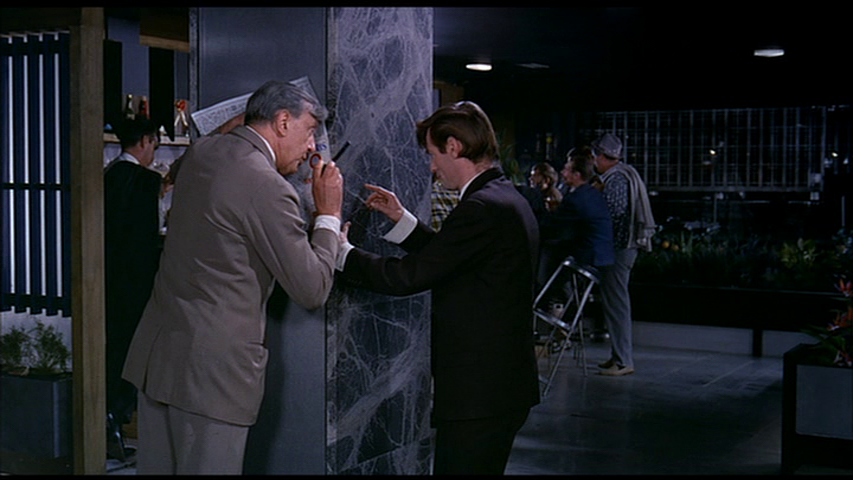
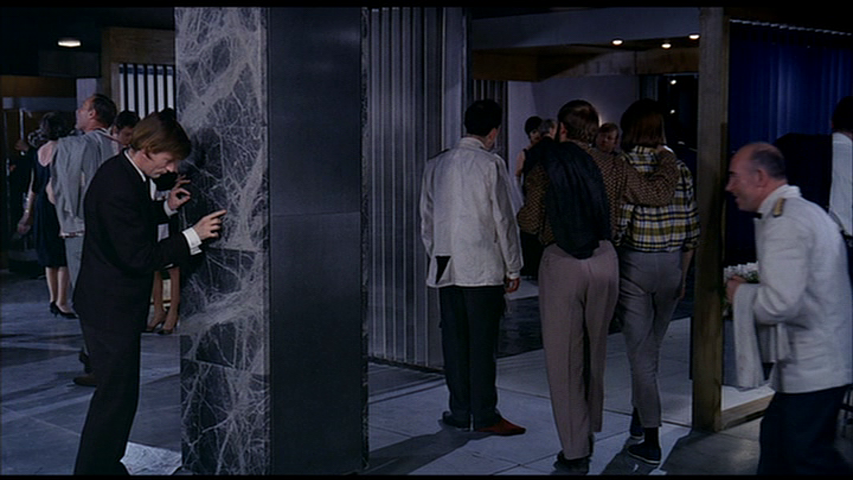
And another drunk confusing the lines on a marble pillar for a map:
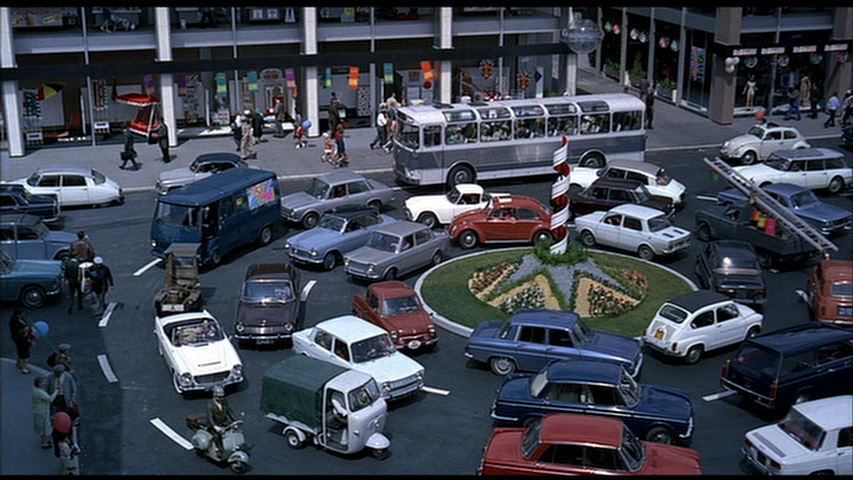
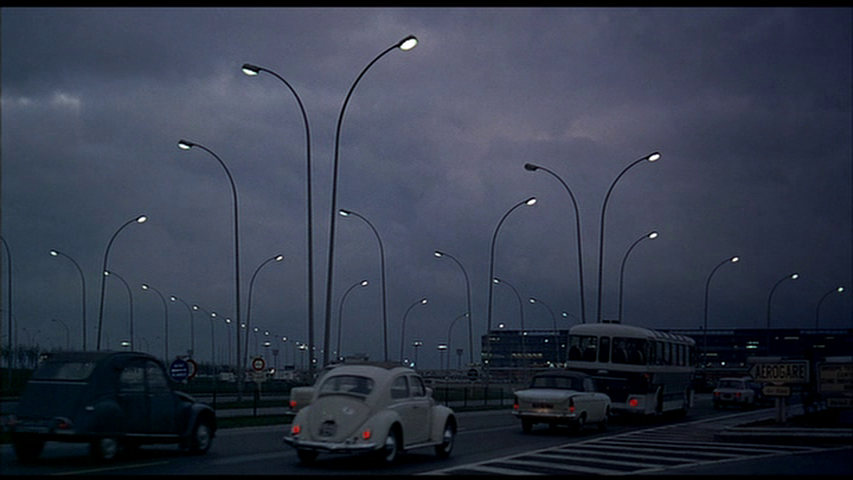
But for all the joyful anarchy of this scene, my favorite part of Playtime is definitely its ending. As Barbara and her tour group make their way back to the airport the following morning, Paris transforms into a carnival, complete with a traffic circle carousel that stops and restarts when a man puts a coin in a parking meter:
A hydraulic lift ride:
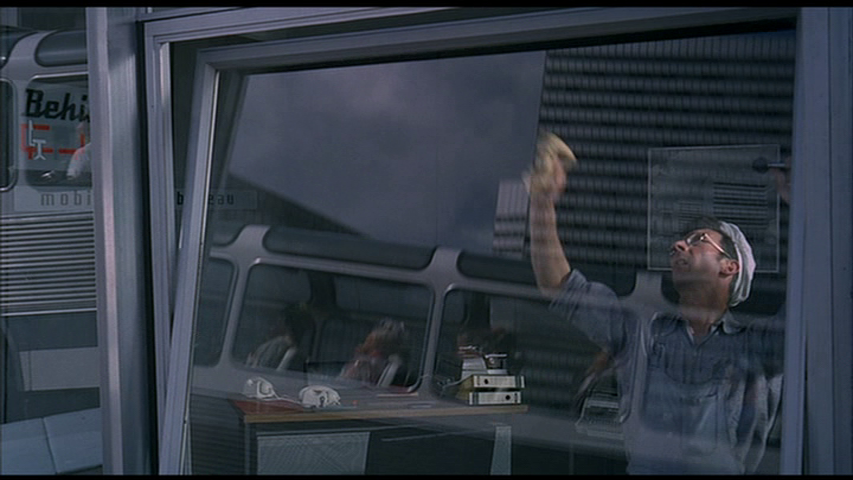
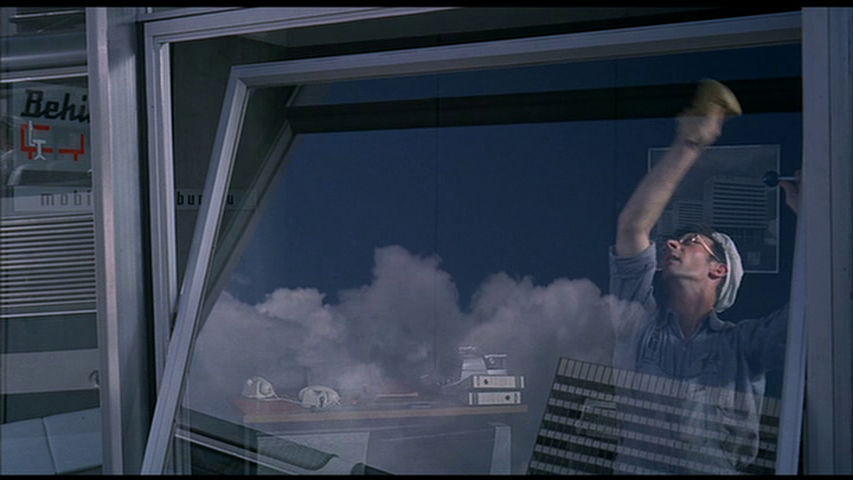
A vertiginous effect created by a tilted window:
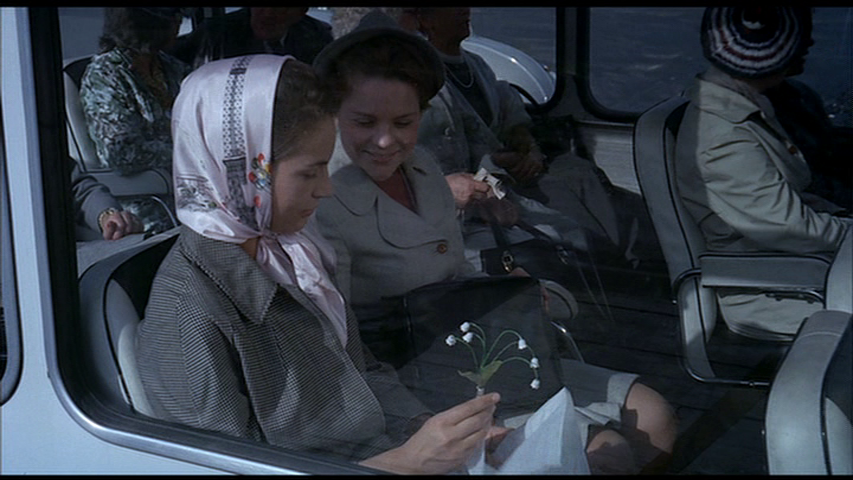
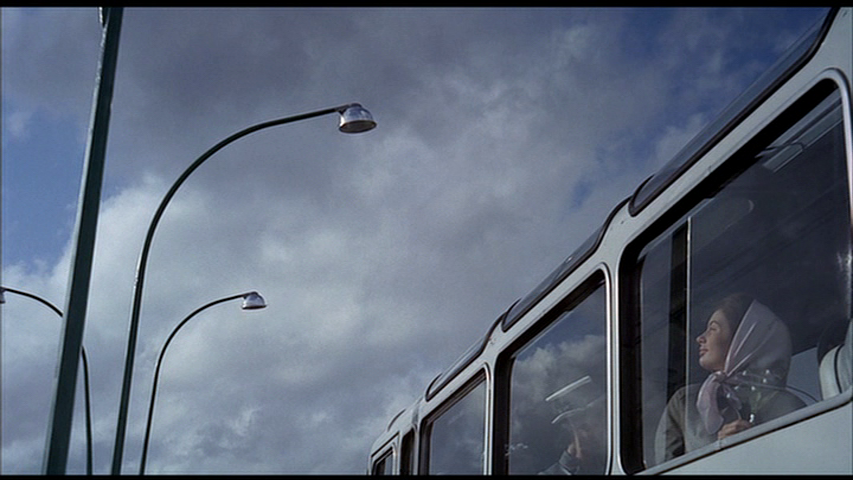
And streetlights that will now forever remind you of lilies of the valley thanks to a thoughtful parting gift that Hulot gives Barbara:
As Sheila O’Malley writes in a blog post about the movie, “if urban alienation is portrayed in Playtime (and it is), it is portrayed in a way that is distinctly absurdist, turning the mundane into the surreal. It does not bemoan the fate of modern man, it does not say, ‘Oh, look at how we are all cogs in a giant wheel, and isn’t it so sad?’ It says, ‘Look at how we behave. Look at how insane it is. We need to notice how insane it is, because it’s hilarious.’” While you absolutely can read the film as a critique of what automation and commercialism have done to the world of the 1960s and today, I prefer to treat it the same way O’Malley does, as a how to guide to finding pleasure in it: keep your eyes open, use your imagination, and don’t take yourself to seriously. Which is pretty good advice for stress-free hosting and family dinners, too, so: happy holidays!
Cheers!
All original photographs in this post are by Marion Penning, aka My Loving Wife.Links to all of the entries in this series can be found here.
What I’m Seeing This Week: I am excited to finally see All We Imagine as Light, the first film from India to compete in the main competition at the Cannes Film Festival in 30 years, at Cinemapolis!
Also in Theaters:Flow and Anora, which conclude their respective runs at Cinemapolis this week, are both contenders for the back half of my Movie Year 2024 top ten list, so those are definitely my top new film recommendations. I also enjoyed A Real Pain, which is also playing Cinemapolis just until the end of the week, as is Queer, which it sadly looks like I’m going to miss. All the blockbusters dominating local screens that I’ve seen deliver more or less what their previews and posters promise, so if you *think* you’d like them, you’re probably right: in (very) approximate order of preference, that’s Gladiator II (the Regal Ithaca Mall), Moana 2 (Regal), Wicked (Cinemapolis + Regal), and Red One (Regal). There are no repertory screenings of note this week, but there are a whole bunch of other movies opening at both Cinemapolis and the Regal on Tuesday or Wednesday that I’m eager to see, including Babygirl, A Complete Unknown, and Nosferatu.
Home Video: If you missed The Night of the Hunter when it played Cinemapolis last month as part of their “Noirvember” series, fear not: it’s screening on the Criterion Channel until the end of the year! This retelling of the fable of the reed and the oak features velvety black and white cinematography by Stanley Cortez that opens with disembodied heads on a starscape reminiscent of October, 2023 Drink & a Movie selection The Very Eye of Night and contains two of cinema’s most indelible images, a dead woman’s hair slow dancing with underwater reeds at the bottom of the river and knuckles tattooed with the words “love” and “hate.” With an ending set on Christmas morning, it’s also a great example of what I call a “holiday mixtape movie” in that it’s a terrifically terrifying change of pace from the wonderful, but tonally similar seasonal favorites that many of us spend the month of December watching.
Previous “Ithaca Film Journal” posts canbe found here.A running list ofall of my “Home Video” recommendations can be found here.
Also in Theaters:All We Imagine as Light is appearing on all sorts of year-end Best lists, so I’ll definitely make sure to see it at Cinemapolis before we start our holiday travels next week! Queer–director Luca Guadagnino’s second film of Movie Year 2024 after Challengers, which I enjoyed–opens there tomorrow as well. My favorite new films now playing Ithaca that I’ve already seen remain Anora and A Real Pain, both of which are also at Cinemapolis. Moana 2 is “fun for the whole family,” as the fella says, and Gladiator II and Wicked deliver more or less what they promise, too. All three movies are at the Regal, and Wicked is at Cinemapolis as well. Finally, your best bets for repertory fare are holiday favorites A Christmas Story, which screens at Cinemapolis on Sunday, and White Christmas, which plays the Regal Sunday-Tuesday.
Home Video: With Anora still going strong in theaters, now is a fine time to check out Tangerine, the film that put director Sean Baker on the map, on Netflix. Especially since it takes place on December 24! To be sure, it’s even less of a “Christmas movie” than (in)famous debate cases like Die Hard, but it does feature a centerpiece performance of the song “Toyland” by protagonist Sin-Dee (Kitana Kiki Rodriguez) that calls to mind Judy Garland singing “Have Yourself a Merry Little Christmas” in Meet Me in St. Lous . With no disrespect to his latest effort, this remains my favorite one of Baker’s features.
Previous “Ithaca Film Journal” posts canbe found here.
What I’m Seeing This Week: We rented a theater at Cinemapolis for a private screening of my oldest’s favorite movie The Mitchells vs. the Machines for her ninth birthday party, which we’re all pretty excited about! I’m planning to see Gladiator II there or at the Regal Ithaca Mall this week as well.
Also in Theaters: I’d be seeing Flow, which opens at the Regal tonight and Cinemapolis tomorrow, if I wasn’t saving it for next week when it will be eligible to be my Family (née Friday) Movie Night selection. In the meantime, my favorite new film now playing Ithaca remains Anora, which is at Cinemapolis, and I enjoyed A Real Pain (Cinemapolis), Conclave (Cinemapolis), and The Wild Robot (Regal) as well. Upcoming special events include the free student-led Hilltop Film Festival of Diversity and Inclusion screening at Cinemapolis on Sunday and Cornell Cinema‘s traditional end-of-semester “mystery screening” of a 35mm film print tonight. They’ll be back with their spring lineup in January. Finally, your best bet for repertory fare is the Studio Ghibli classic My Neighbor Totoro, which is at the Regal Saturday through Wednesday.
Home Video: With no disrespect to winner Encanto, The Mitchells vs. the Machines was easily my favorite nominee for the 2022 Best Animated Feature Film Oscar, so you really should check it out on Netflix if you haven’t already! Our girls, who have never known a world without YouTube, dig its clever use of a meme aesthetic, while My Loving Wife and I appreciate the way it finds meaningful things to say about parenting without devolving into sappiness, and we all love Beck Bennett and Fred Armisen voicing malfunctioning robots with the “human names” of Eric and Deborah . . . bot . . . 5000.
Previous “Ithaca Film Journal” posts canbe found here.
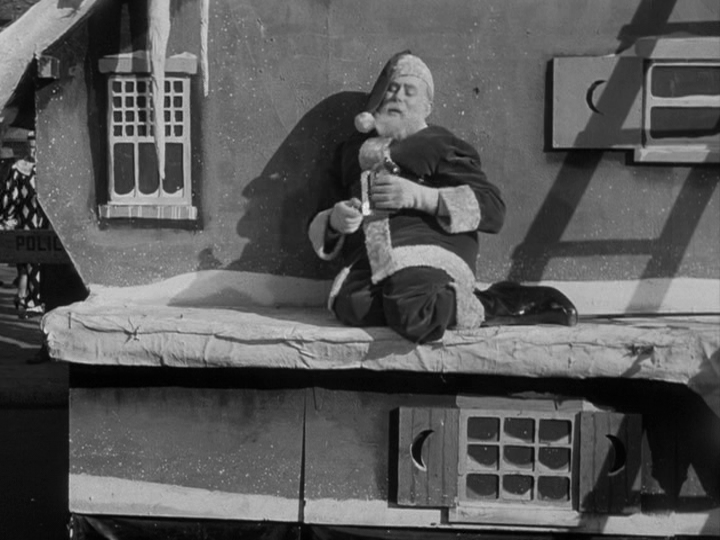
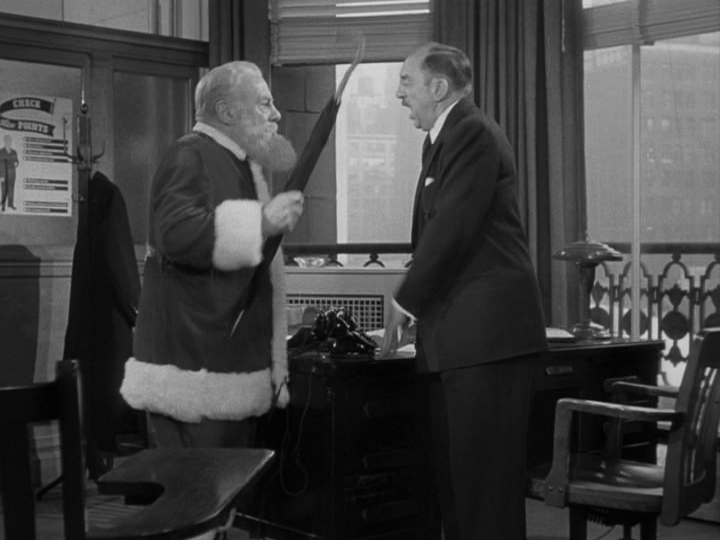
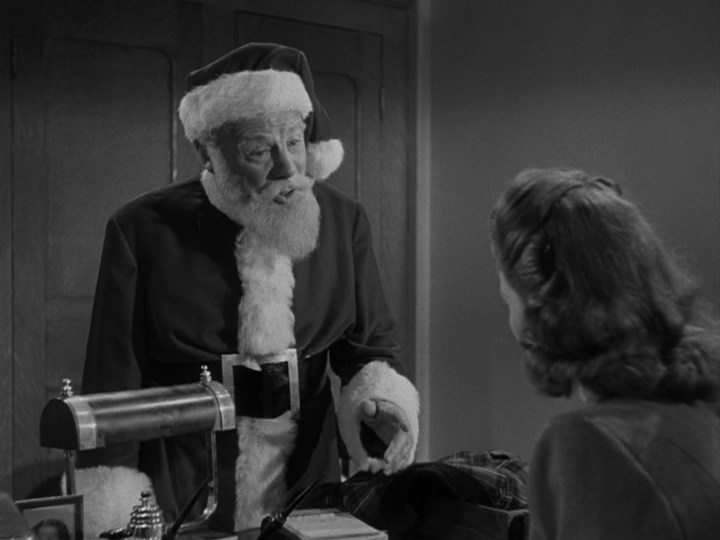
As I have mentioned on this blog before, the first movie my family traditionally watches after Thanksgiving is Miracle on 34th Street, which made it an obvious choice to fill one of the six “bonus” Drink & a Movie slots I need to get me to my goal of 54 total posts. The beverage we’re pairing it with is from Sarah Baird’s Flask book and it would surely be just as effective at keeping the intoxicated Santa Claus (Percy Helton) Macy’s originally hired to star in their annual holiday parade warm as whatever is in this bottle:
I’ll bet it tastes better, too! The recipe is a creation by New York-based bartender Sother Teague, who writes that it was inspired by shots of Rittenhouse rye that a friend of his used to serve with 14 dashes of Angostura bitters added to them, which turned it dark like the bread that the drink is named after. Here’s how you make Teague’s version, which Baird describes as “the perfect flask cocktail to sip after a long Thanksgiving of listening to relatives argue about politics, television, and who makes the best green bean casserole”:
3 ozs. 100-proof rye (Rittenhouse) 1 1/2 ozs. Ramazzoti amaro 1 oz. Punt e Mes 14 dashes Angostura bitters Lemon twist
Stir all liquid ingredients with ice, express the lemon twist over them, and funnel into a flask.
This is a seriously bitter drink, but it’s also delicious, and to me this makes it ideal for slowly consuming over the course of an entire evening via very small sips. The Ramazzoti tastes to my palate like a milder version of one of my favorite amaros for Manhattan variations, Amaro Montenegro, and it works beautifully here in combination with Punt e Mes as a counterpoint to the Angostura. Rittenhouse is my go-to rye for cocktails, and while it isn’t necessary in this drink per se, you definitely want something high ABV.
Our 20th Century DVD Fox DVD copy of Miracle comes packaged with the colorized version of the film created in the 80s, but I don’t think anyone has ever watched it all the way through, because why would they? Here’s a picture of the case:
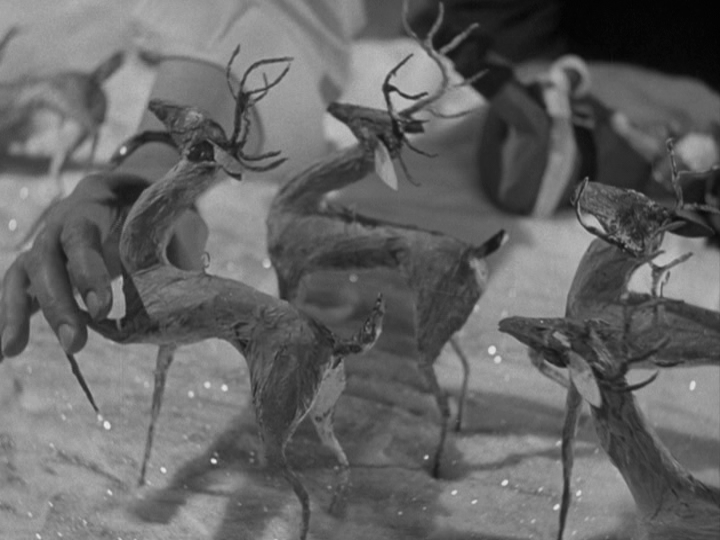
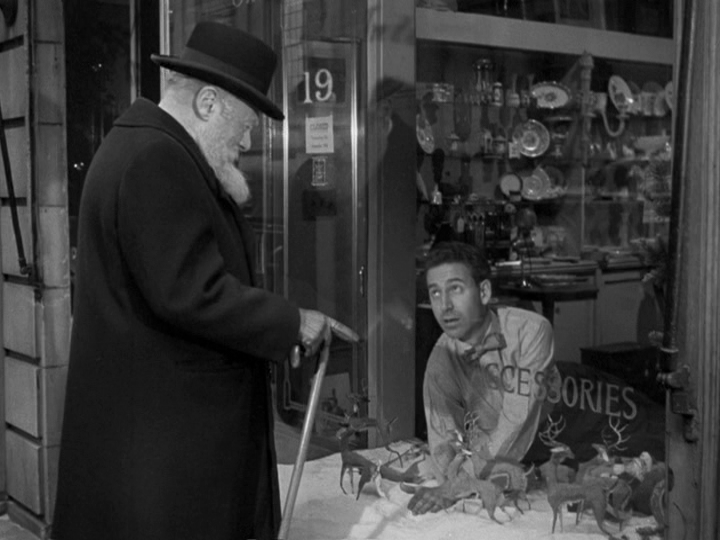
The film is also available on Disney+ with a subscription or via a number of other platforms for a rental fee. Ostensibly a film about whether or not Santa Claus really exists, Miracle stars (Best Actor in a Supporting Role Oscar notwithstanding) Edmund Gwenn as a man named Kris Kringle who we first meet attempting to correct the reindeer work of a window dresser (Robert Gist) which inspired this month’s drink photo:
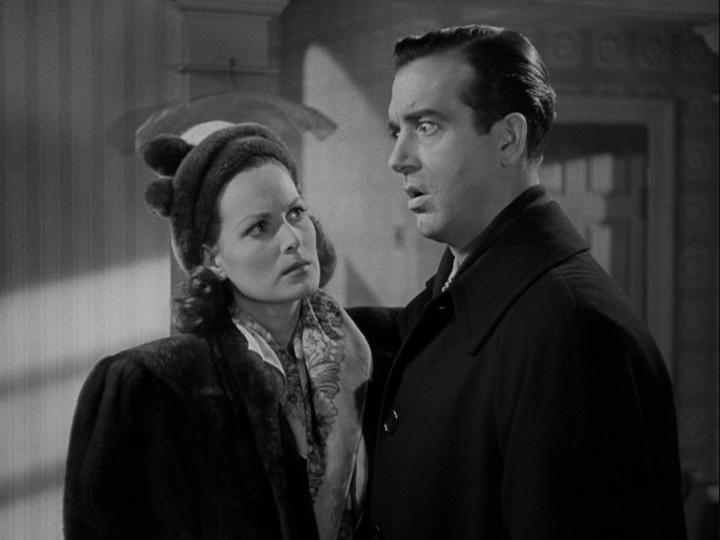
When he proves to be a great success at replacing the aforementioned drunk Santa in their parade, Macy’s employees Doris Walker (Maureen O’Hara) and Julian Shellhammer (Philip Tonge) ask him to continue playing the role for the duration of the holiday season. Needing to find him a place to stay when he isn’t at the store, their highly questionable original plan is for Shellhammer to ply his wife (Lela Bliss) with “triple-strength” martinis as a preface to asking her if Kris can use their spare bedroom.
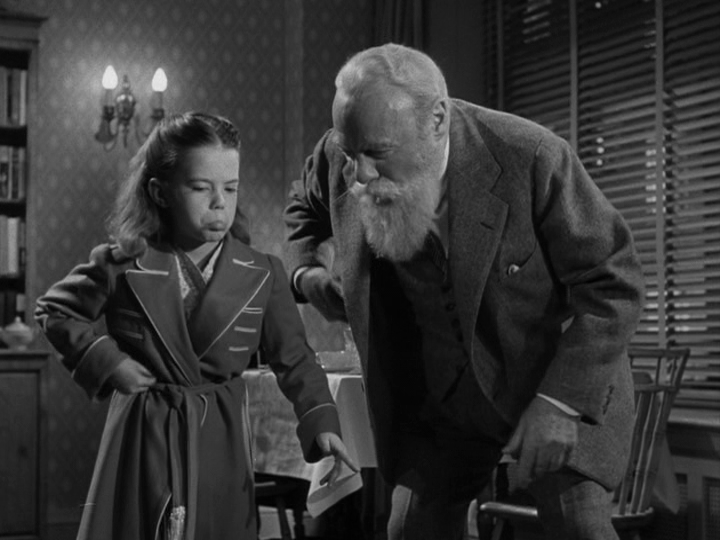
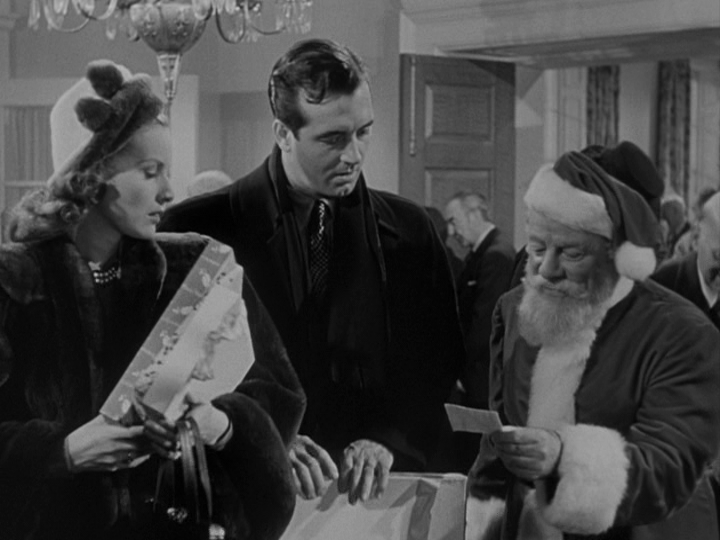
It works, but by that time lawyer Fred Gailey (John Payne) has already leaped at the excuse to see single mother Doris, his neighbor, more often by offering up his extra bed. Kris is a hit with Macy’s customers and although Fred annoys Doris by taking her daughter Susan (Natalie Wood) to see him while he’s working (“We should be realistic and completely truthful with our children and not have them growing up believing in a lot of legends and myths,” she tells him), everything seems to be going well otherwise–until she finds out that Kris openly identifies himself as the genuine article:
Leading her to worry that he may be insane. This ultimately results in a petty and vindictive store psychologist named Granville Sawyer (Porter Hall) who Kris bops on the head (which, to be fair, is assault) getting him committed:
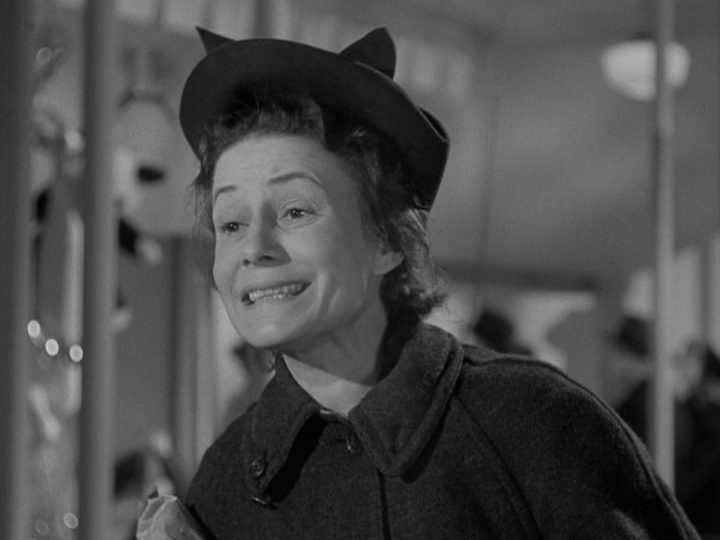
And it’s up Fred to get him released by successfully executing the unorthodox strategy of proving in court that Kris really is who he says. What’s interesting about Miracle is it’s clear that no one in the movie over the age of ten actually has any doubts on the matter, and they divide not along lines of believers and non-believers but rather those who think Kris’s delusions are harmless or even valuable and those who consider them dangerous. Hall of Fame character actor Thelma Ritter, in her first (uncredited) screen role, is unequivocally in the former camp:
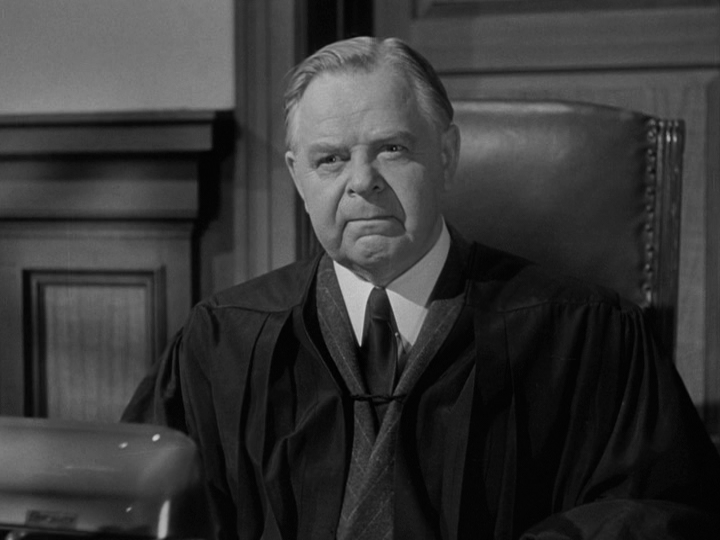
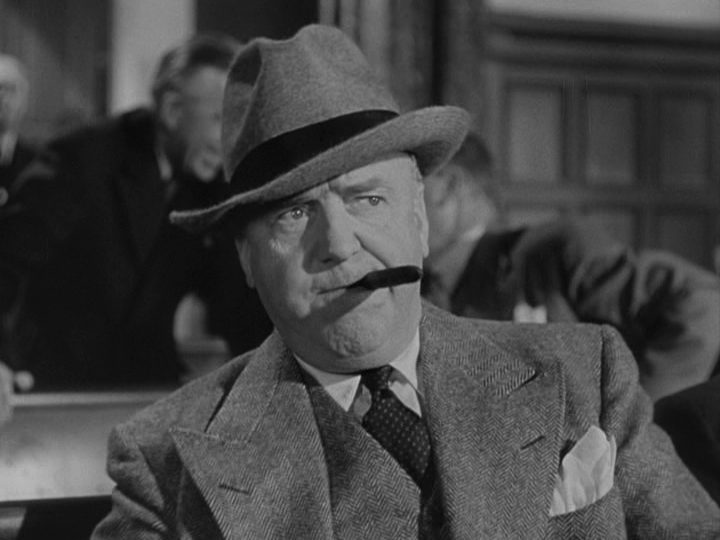
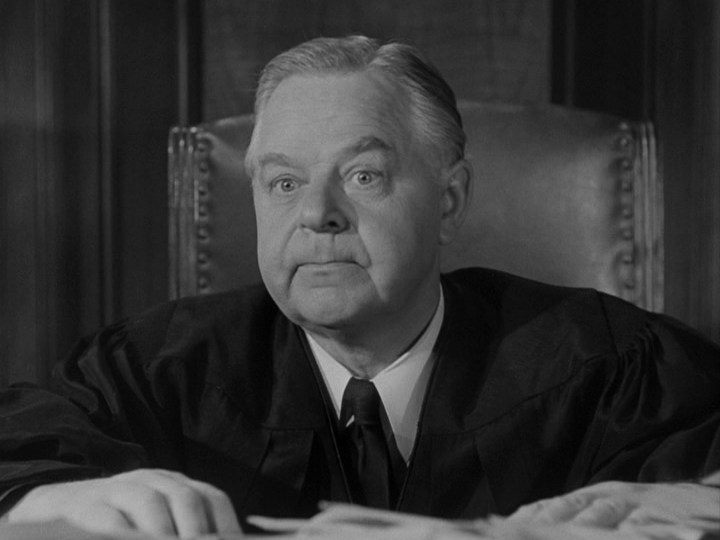
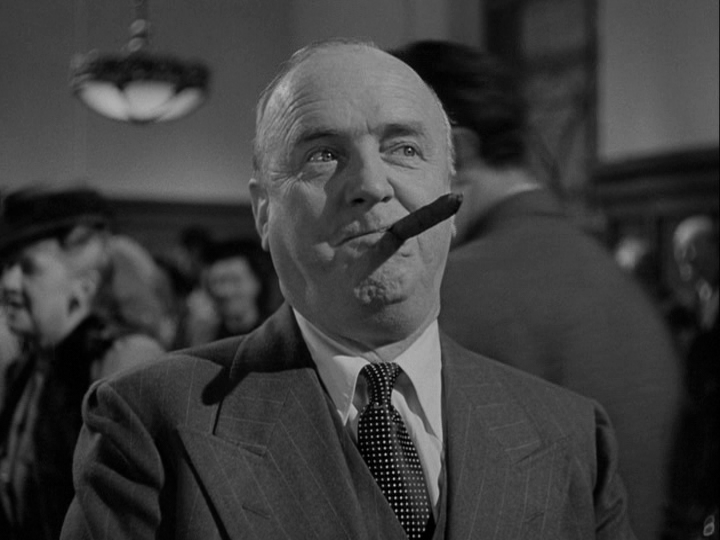
While Mr. Sawyer is the champion of the latter. Doris and Mr. Shellhammer aren’t sure at first, but when Mr. Macy himself concludes that Kris’s insistence on sending parents to other stores to get the toy their children want if that’s where the best price can be found is good for his bottom line (“we’ll be known as the helpful store, the friendly store, the store with a heart, the store that places public service ahead of profits–and, consequently, we’ll make more profits than ever before!”), they quickly come around. The real drama, though, accompanies Fred’s attempts to convince Judge Henry X. Harper (Gene Lockhart), who has to balance his apparently sincere desire to faithfully discharge his public duty with the need to appease the electorate who gets to decide if he will continue in his role. Score is kept by the number of approving or concerned looks his political advisor (William Frawley) shoots him every time the hearing takes an unexpected turn:
Meanwhile Kris, far from being a mere pawn in the games of others, has been pursuing an agenda of his own the whole time. “Christmas isn’t just a day,” he tells Doris, “it’s a frame of mind, and that’s what’s been changing. That’s why I’m glad I’m here–maybe I can do something about it. And I’m glad I met you and your daughter: you two are a test case for me.” She’s obviously confused, so he continues, “yes–you’re sort of the whole thing in miniature. If I can win you over, then there’s still hope.”
It isn’t just Mr. Macy’s approval that makes up Doris’s mind, but also witnessing the ripple effects of his altruism. His practice of referring customers elsewhere instead of pushing overstock on them is soon adopted as official store policy, then co-opted by rival department store Gimbel’s, then rolled out to all of each of their branch locations resulting in the following photo op:
And thus was born “compassionate conservatism”
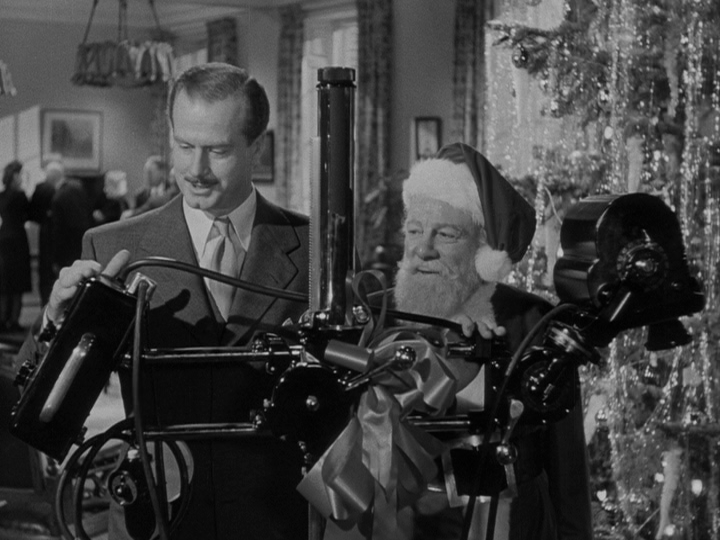
And a promise to procure a much-needed expensive new x-ray machine for a doctor (James Seay) Kris knows:
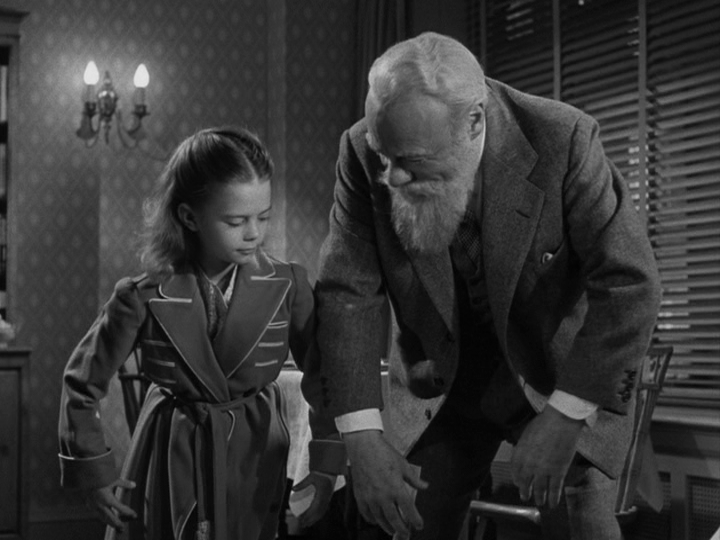
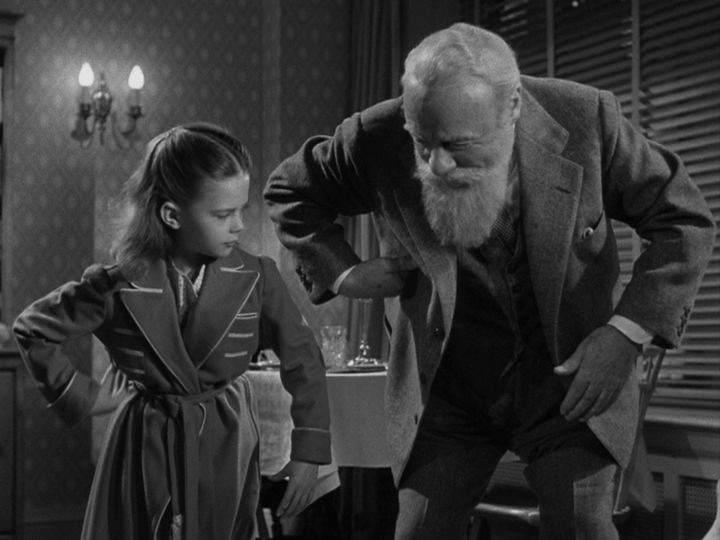
Kris sets the stage for Susan’s conversion by teaching her the joys of imaginative play by showing her how to be a monkey:
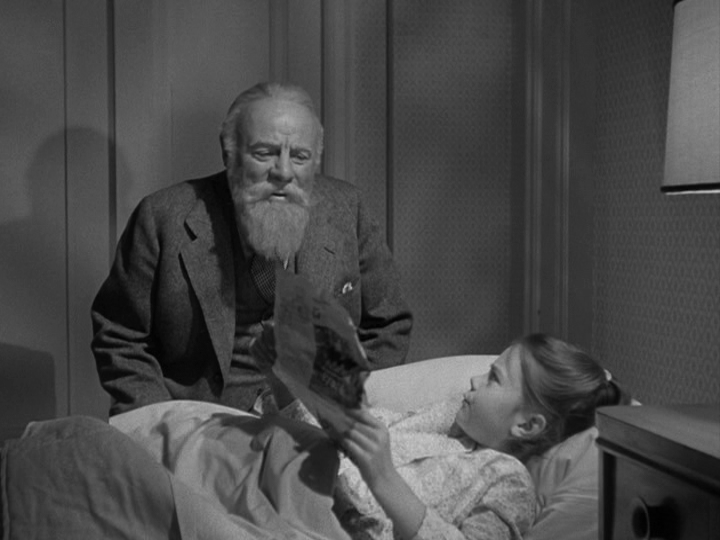
And after much prodding she finally tells him what she really wants for Christmas:
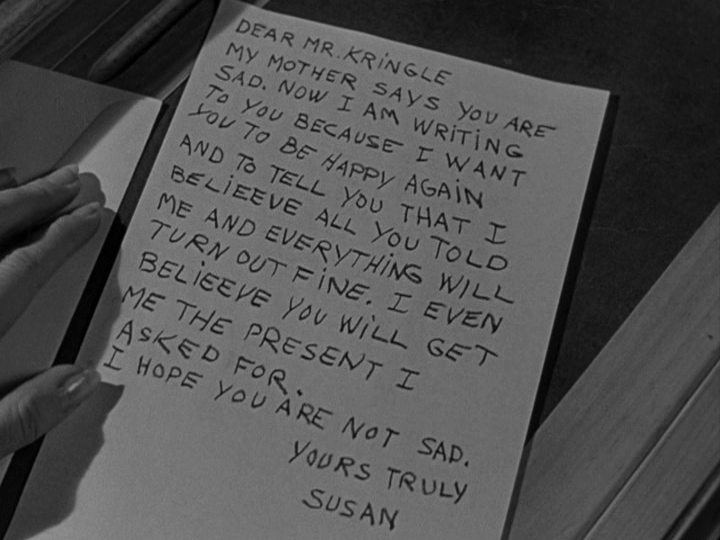
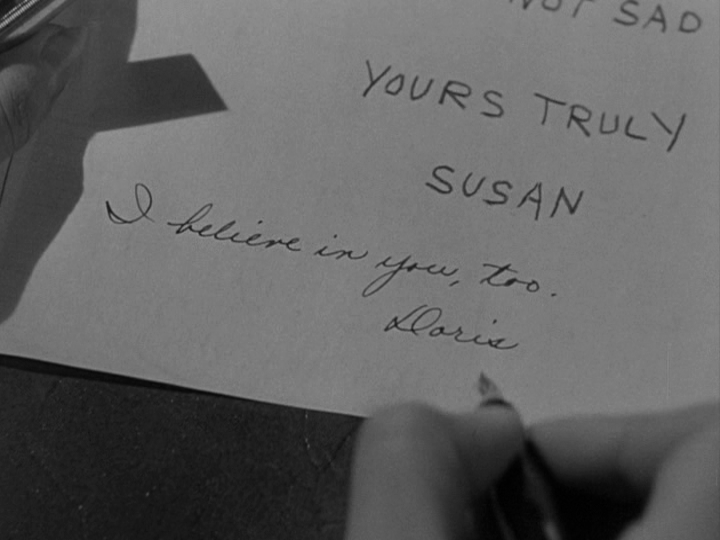
No, not a doll’s house: a real one. Interestingly, this dream is similar to one harbored by Fred, who confides to Kris that someday he’d like to get a place in Long Island. “Not a big house,” he tells him, “one of those junior-partner deals around Manhasset.” Anyway, just when Kris’s mental competency hearing seems to be definitively heading south, Susan writes him a letter that Doris appends a note of her own to:
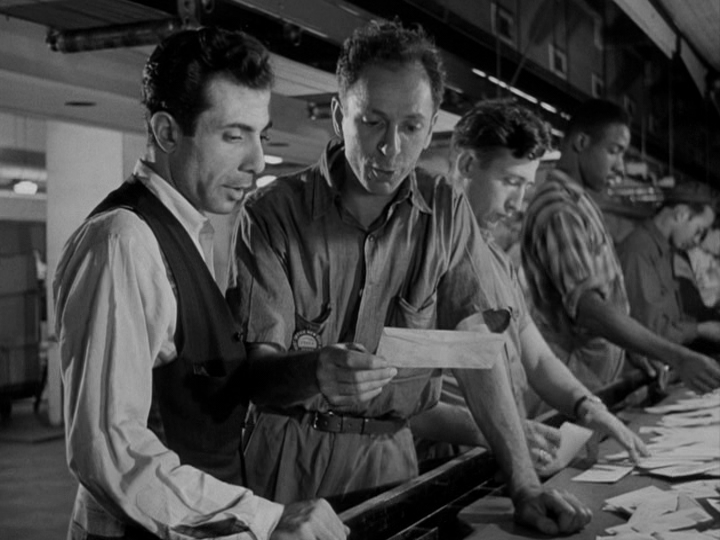
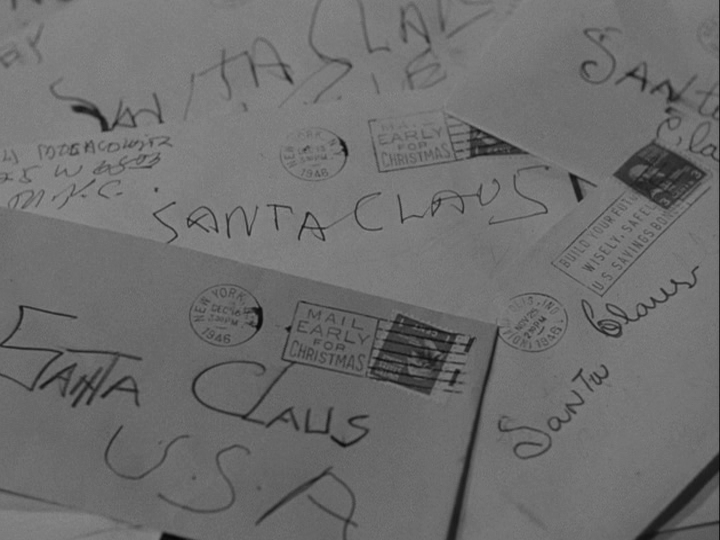
And it morphs into a deus ex machina that arrives just in the St. Nick of time when a couple of opportunistic United States Post Office employees named Al (Jack Albertson) and Lou (Guy Thomajan) identify it as a way to finally relieve themselves of thousands of previously undeliverable letters addressed to Santa…
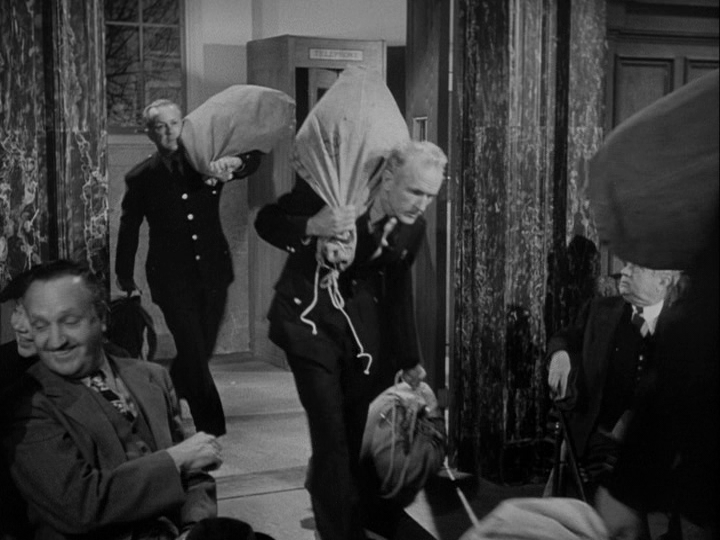
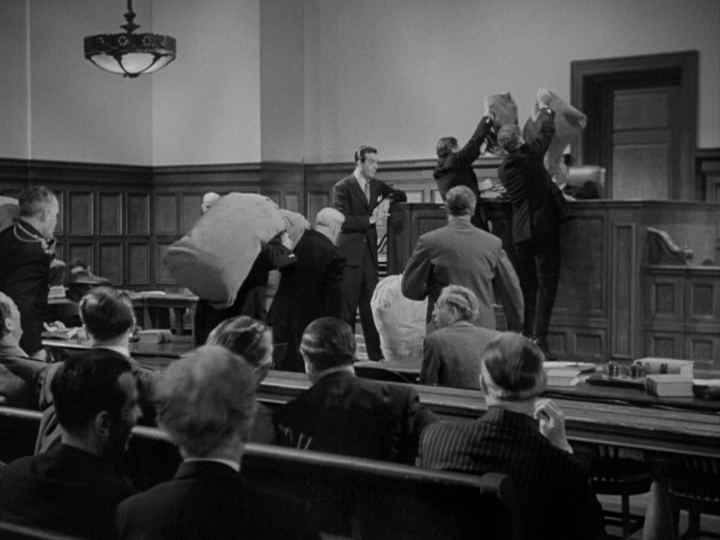
…thus handing Fred the ability to provide Judge Harper with an out in the form of the ability to appeal to a higher legal authority. He has all of the letters that have been delivered to the court house dumped out on Harper’s desk:
Harper makes eye contact with his political adviser one last time:
Then announces that, “since the United States government declares this man to be Santa Claus, this court will not dispute it. Case dismissed!” Miracle ends with Kris providing Doris, Fred, and Susan directions home from a Christmas party they’re all attending which will supposedly help them “miss a lot of traffic.”
As they’re driving along, Susan’s eyes suddenly go wide:
“Stop, Uncle Fred! Stop!” she cries and hurtles herself out of the car.
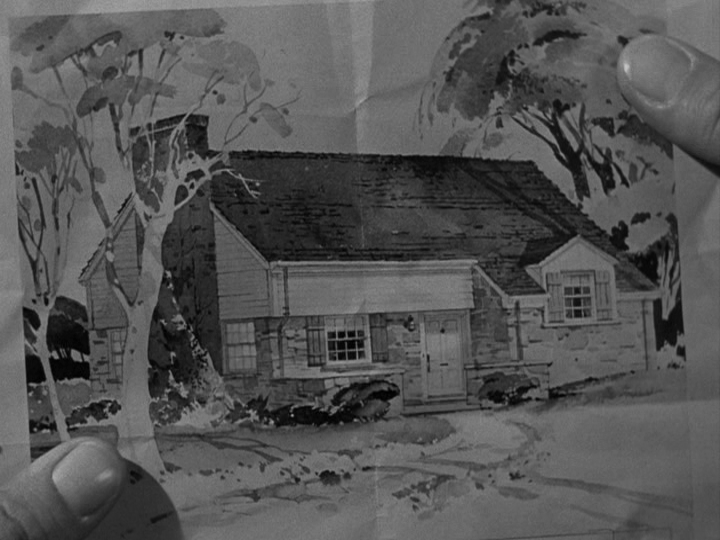
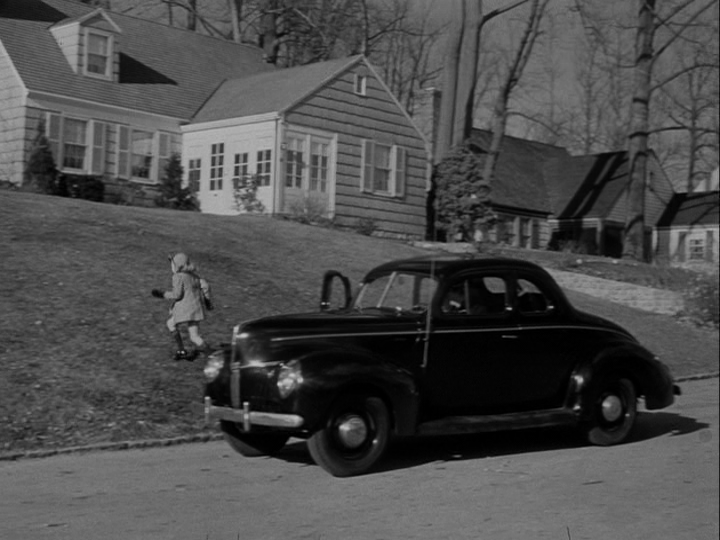
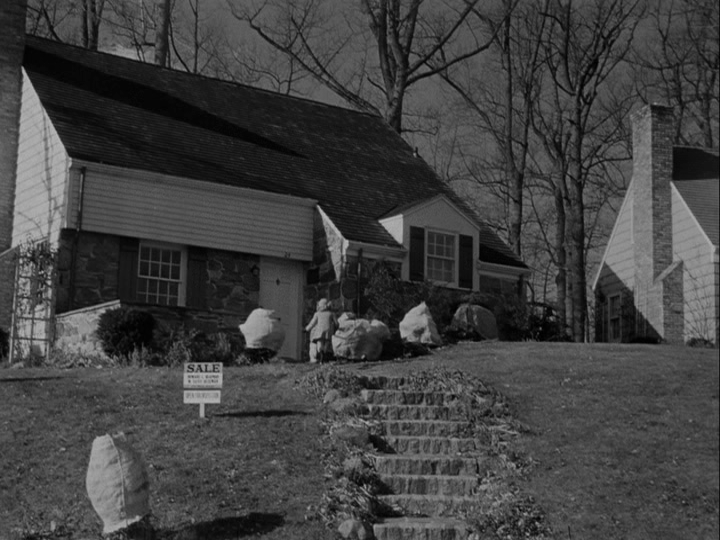
The camera pans left, and we see that she’s running toward a house that’s a dead ringer for the picture she showed Kris, only this one has a “For Sale” sign in front of it:
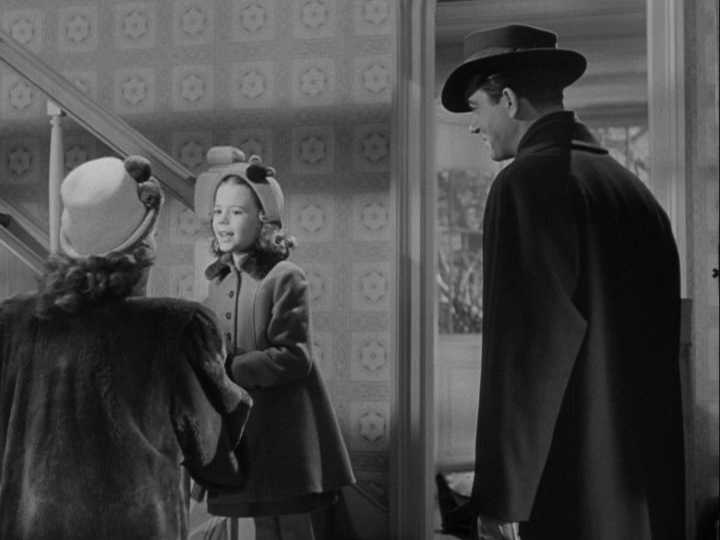
Doris and Fred follow her inside, where Doris admonishes her: “you know you shouldn’t run around in other people’s houses!” “But this is my house,” Susan replies, “the one I asked Mr. Kringle for!”
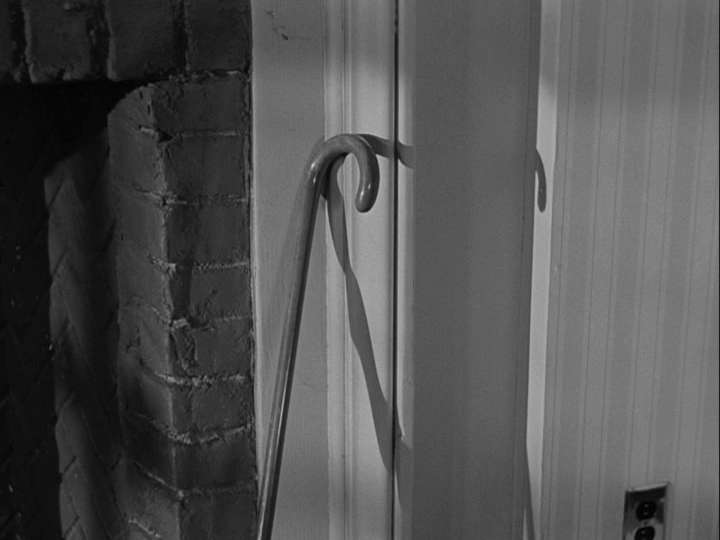
As she runs to see whether or not there’s a swing (“there is one!”), Fred takes Doris in his arms and kisses her. “The sign outside says it’s for sale,” he says, “we can’t let her down.” Then: “it even makes sense to believe in me now. I must be a pretty good lawyer. I take a little old man and legally prove that he’s Santa Claus.” But suddenly he stops mid-sentence, distracted by something offscreen:
“Oh no, it can’t be!” Doris exclaims. “It must have been left here by the people who moved out!” But it certainly does look a lot like the one we saw Kris with earlier, and as “Jingle Bells” plays in the background, Fred replies, “maybe I didn’t do such a wonderful thing after all.”
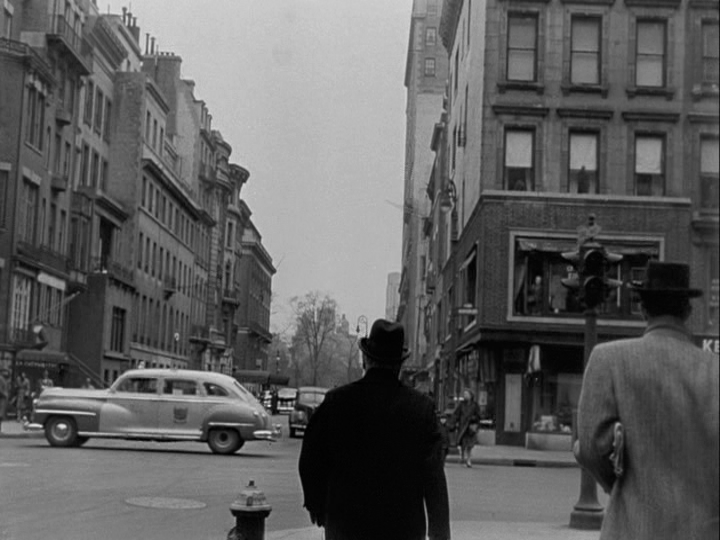
Nothing here definitively dispels the possibility that Kris is just a guy who knows how to read toy advertisements and real estate listings, but the film’s style and tone has inarguably evolved from its opening credits sequence that features an almost neo-realist following shot of him walking the streets of Manhattan:
To this fantastical conclusion. And yet, to its enormous credit, it does not matter which side we come down on. The important thing is that Susan has discovered (as I recently suggested to my own budding rationalist) that life is more fun when not everything has a strictly logical explanation, and as long as you’re confident that all of your options are good ones, it can occasionally be liberating to take a break from constant decision making and let the universe choose for you. We are a secular family, so for us Jesus isn’t the reason for the Christmas season. This is what the holiday is all about. And that’s why Miracle on 34th Street isn’t only the first Christmas movie we watch each year, but also one of our favorites.
Cheers!
All original photographs in this post are by Marion Penning, aka My Loving Wife.Links to all of the entries in this series can be found here.
Also in Theaters: There wasn’t much turnover in local theaters, so most of my recommendations are the same as last week: my favorite 2024 film now playing Ithaca is Anora, which is at Cinemapolis, and I enjoyed A Real Pain (Cinemapolis), Conclave (Cinemapolis), and The Wild Robot (Regal) as well. In addition to the two I’m seeing, the new release dominating screens nationwide is Gladiator II, which is at Cinemapolis and the Regal. Finally, Cornell Cinema once again has both the most interesting-looking special event and your best bet for repertory fare, the opening of an exhibit called “Inspired by Edith Head: Fashion Vignettes for a Film Series” at the Jill Stuart Gallery on Cornell’s campus on Wednesday at 4pm followed by a screening of Samson and Delilah at Willard Straight Theatre at 7pm.
Home Video: Looking for a palate cleanser between epic blockbusters past and present? Please allow me to recommend Here, which is now streaming on The Criterion Channel! At 84 minutes it’s short, and it features quiet but sophisticated sound design, contemplative extreme close-ups of moss, a multifaceted extended roots metaphor, and a scene in which a bunch of men sit around eating soup and talking about their emotions, all of which also makes it a great way to take a break from the hubbub of the holidays. As I mentioned on Letterboxd, pretty much the only thing I *don’t* like about it is its name, which it confusingly shares with another, more prominent Movie Year 2024 release (that I haven’t yet seen).
Previous “Ithaca Film Journal” posts canbe found here.
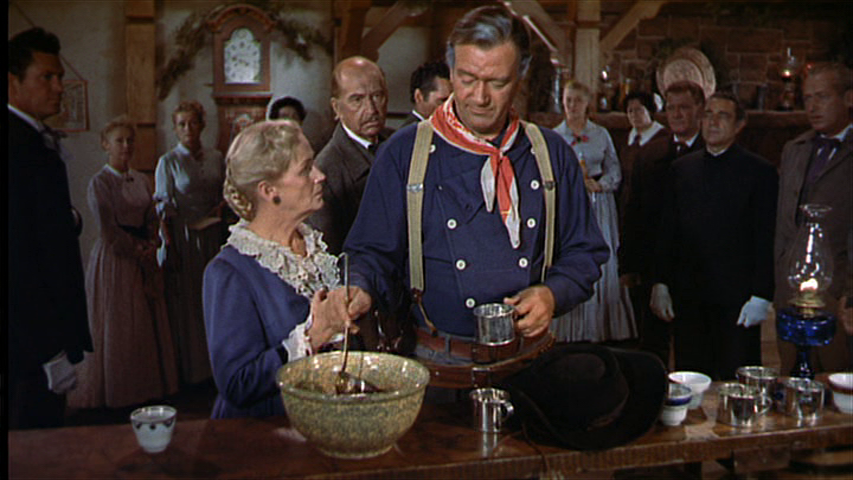
USS Richmond Punch was a big hit when I made it for Thanksgiving a few years ago. It’s on the menu again this year, so I definitely wanted feature it in this month’s Drink & a Movie post. When thinking about what film to pair it with, the name immediately made me think of one of cinema’s great antiheroes, unapologetic former Confederate soldier Ethan Edwards (John Wayne) from The Searchers. Interestingly, David Wondrich identifies the recipe as originating during the Civil War era, which means it theoretically could be the concoction in this punch bowl:
Prepare an oleo-saccharum by removing the peels from the lemon, trying to get as little of the pith as possible, and muddling them with the sugar. Set aside for at least an hour. Meanwhile, juice the lemons and make the tea by pouring 16 ounces of hot (but not boiling) water over two tea bags and steeping for exactly five minutes. Add the lemon juice and tea to the oleo-saccharum and strain into a gallon container. Add the spirits and refrigerate overnight. When ready to serve, add to a punch bowl with a block of ice and the sparkling wine. Garnish with lemon slices and grated nutmeg.
As a special occasion beverage, this is definitely a time to break out your favorite spirits, which is why we go with Smith & Cross, Pierre Ferrand 1840 Original Formula, and Roederer Estate Brut. We are a family of tea drinkers and that flavor is prominent here, which is one of the main reasons we love this punch, which is sweet and tart and just a bit effervescent. It does pack a wallop, though, and the tannins on the finish will make you want to take another sip and then another, so handle with care! Or, you know, just be sure to snack liberally while you imbibe.
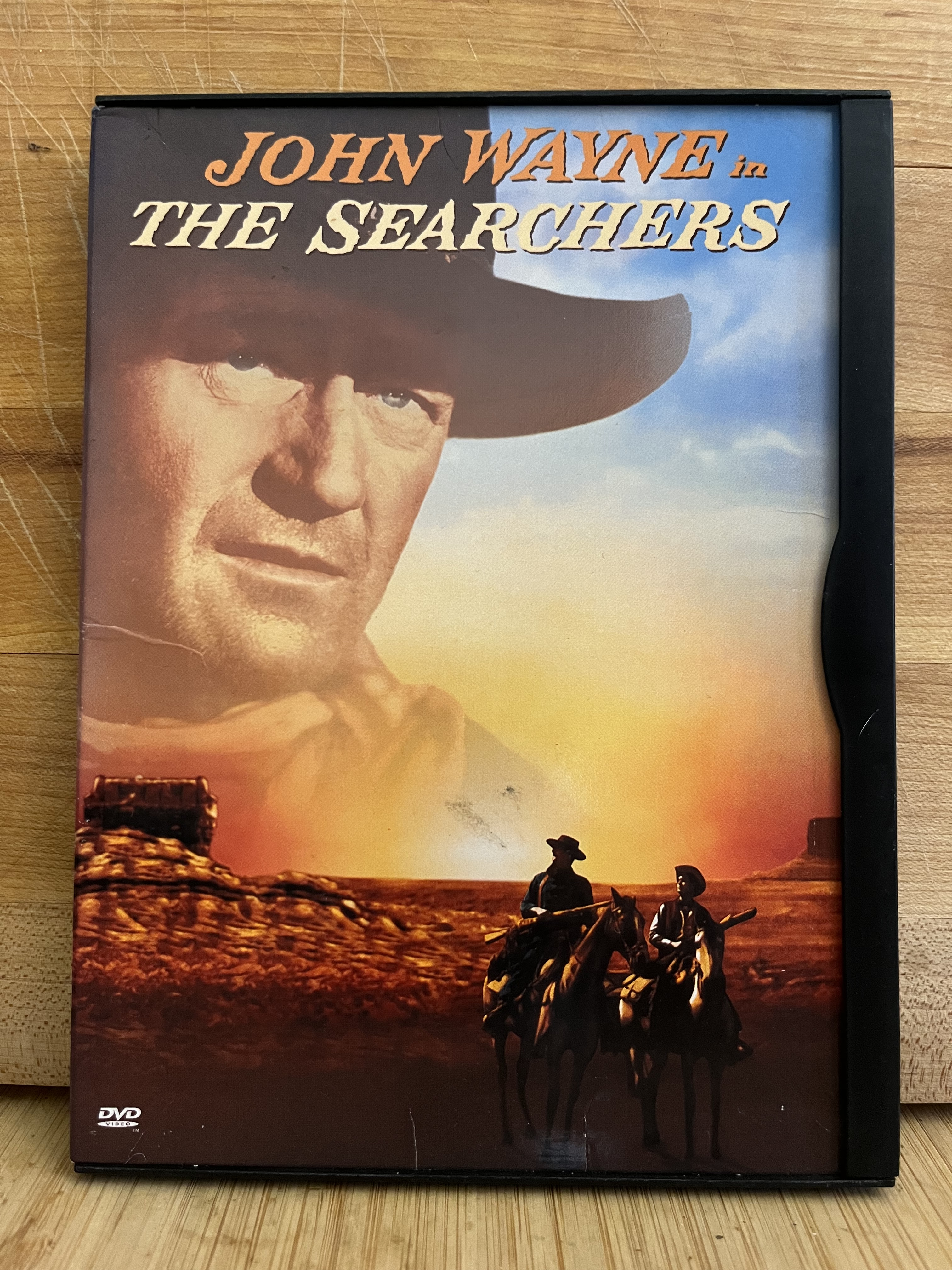
The screengrabs in this post are from my Warner Home Video DVD copy of the film, which is still going strong after 25 years:
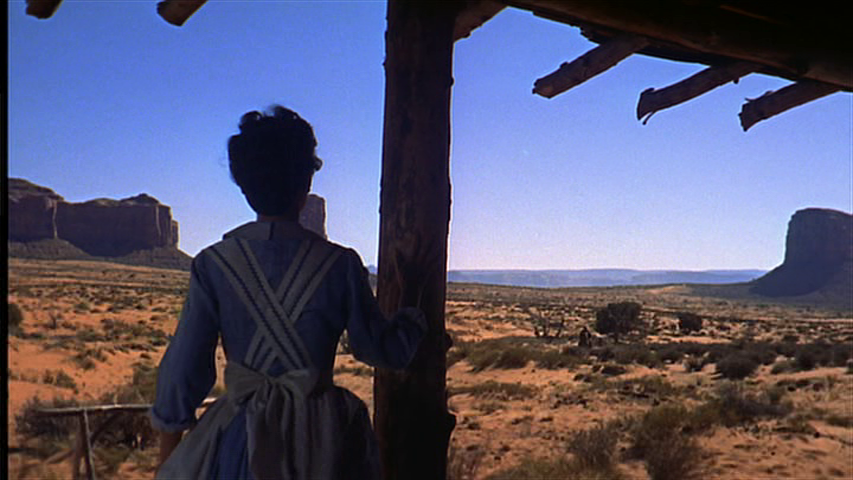
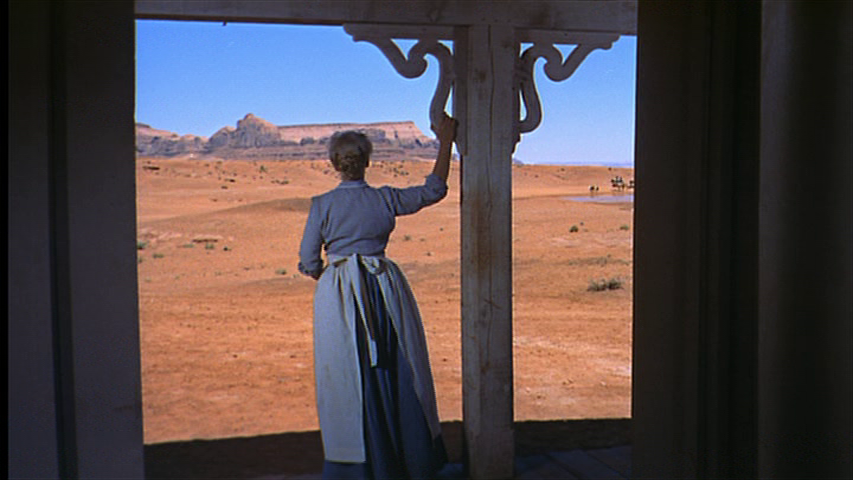
It can also be rented from a number of streaming video platforms. The Searchers is hardly immune from the sins of representation which plague many classic westerns: see, for instance, Tom Grayson Colonnese’s observation in the collection of essays on the film edited by Arthur Eckstein and Peter Lehman that allowing the Navajo extras who play Comanches to speak their own language is as discordant “as if when we meet the Jorgensens, they have Italian accents, or as if the Hispanic Comanchero who finally leads the searchers to Scar speaks with a heavy Swedish accent.” Unlike most of them, though, racism is one of its explicit themes. It begins, famously, in “Texas 1868” (as an introductory title card reads) with Dorothy Jordan’s Martha Edwards opening a door:
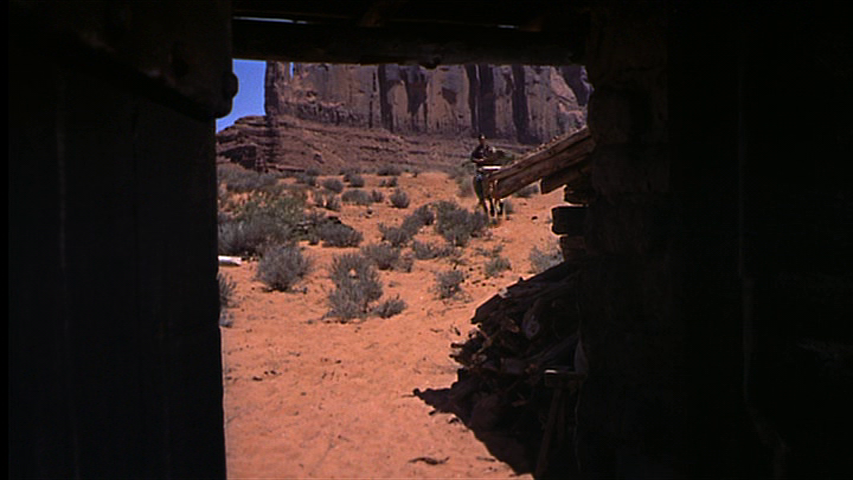
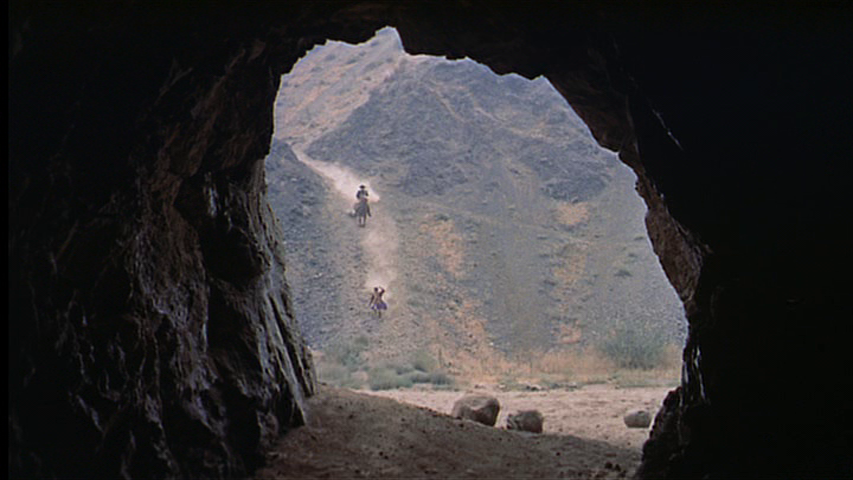
As the camera tracks forward, following her outside, a tiny figure on horseback emerges out of the striking desert landscape:
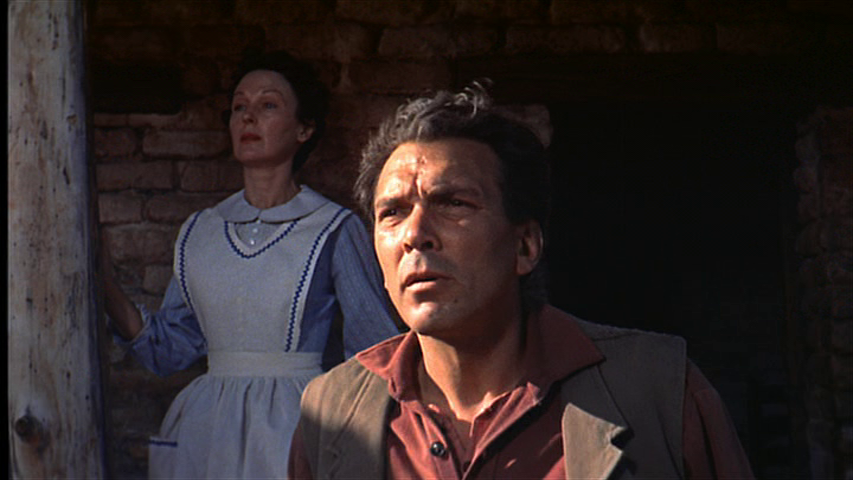
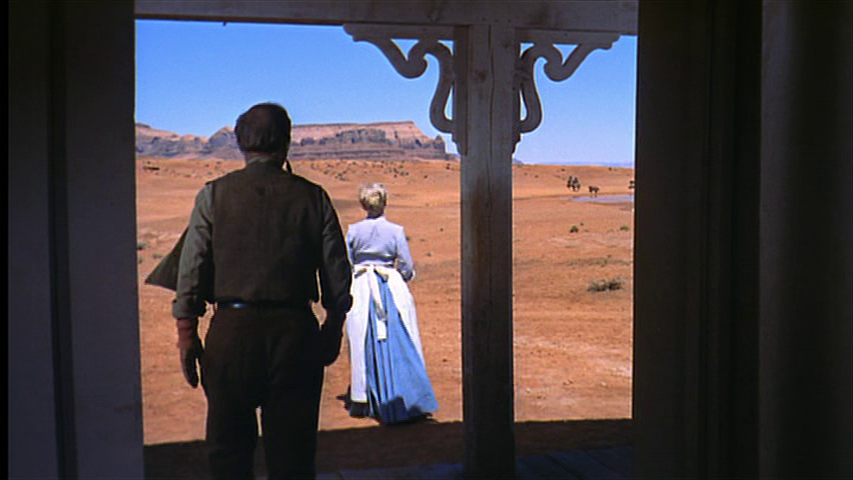
As it draws closer, Martha is joined first by her husband Aaron (Walter Coy):
Then their three children. “That’s your Uncle Ethan!” says Pippa Scott’s Lucy to Robert Lyden’s Ben.
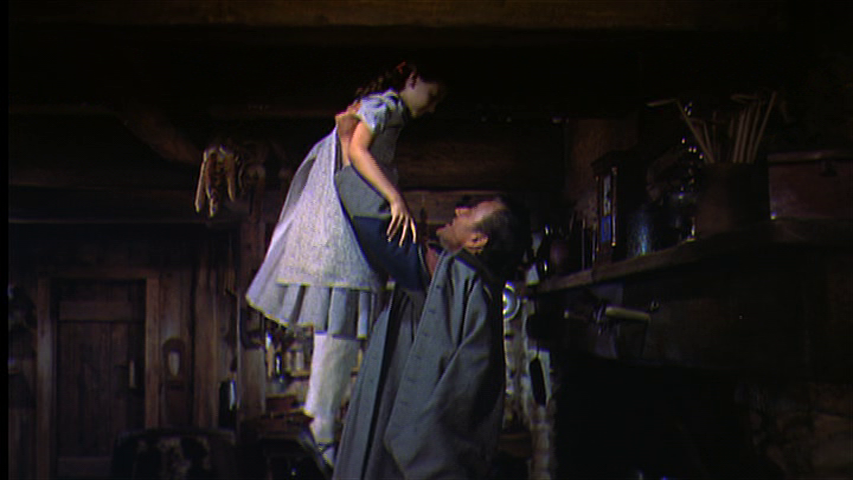
Inside, Ethan lifts his youngest niece Debbie (Lana Wood) to the rafters:
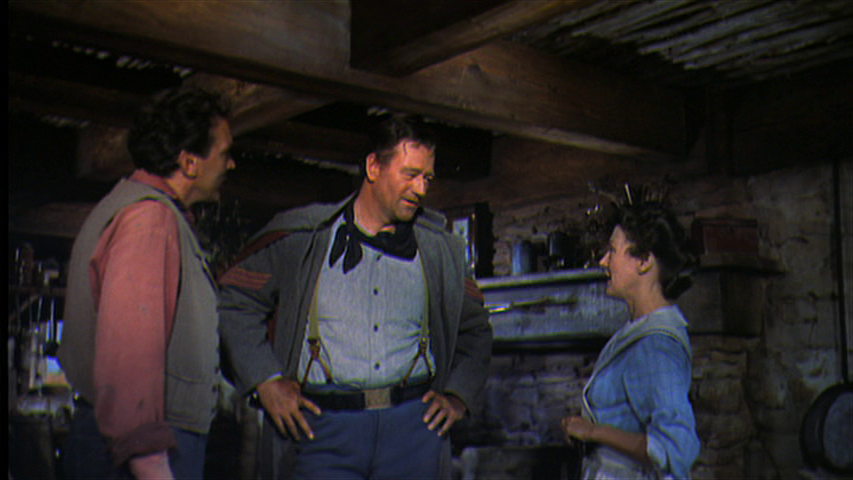
And although he declines to answer Aaron’s question about where he’s been for the past three years, he does specify that it wasn’t California, gazing at Martha the whole while:
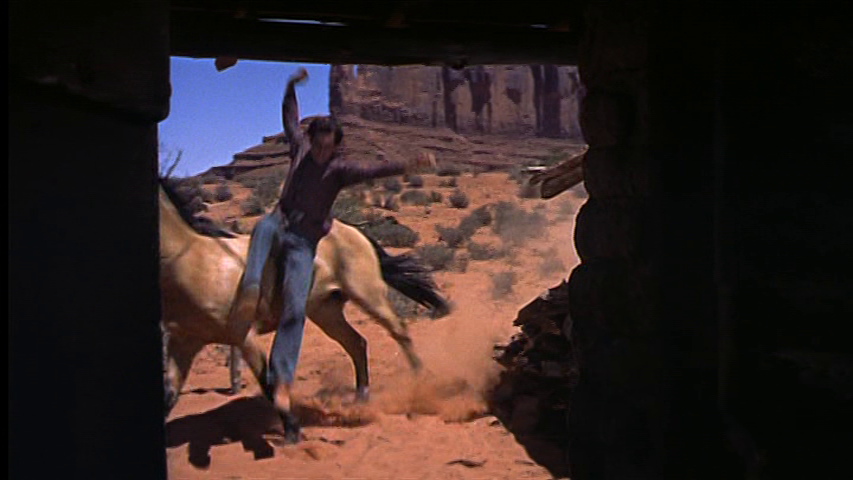
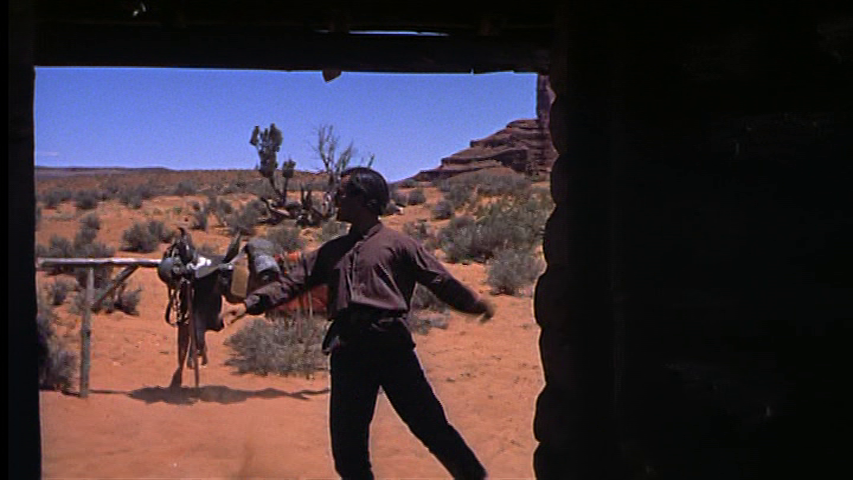
The final member of the family, Jeffrey Hunter’s Martin Pawley, is introduced in the next scene in a variation on Ethan’s entrance:
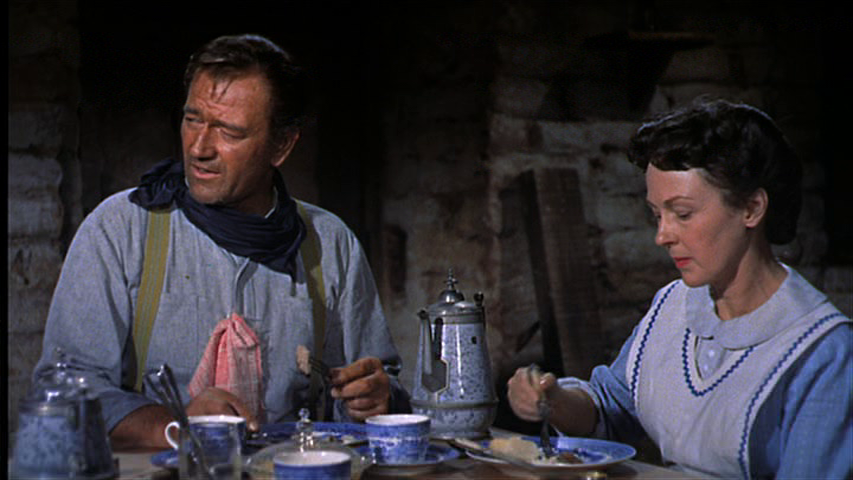
“Fella could mistake you for a half-breed,” Ethan tells him over dinner.
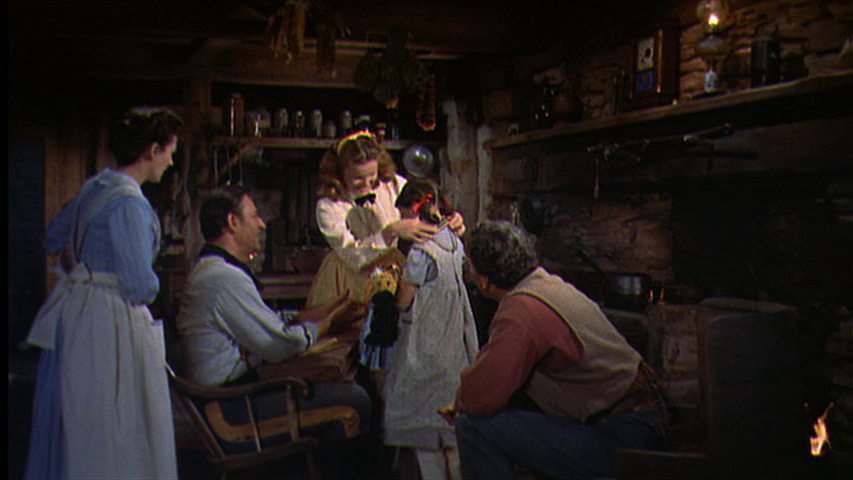
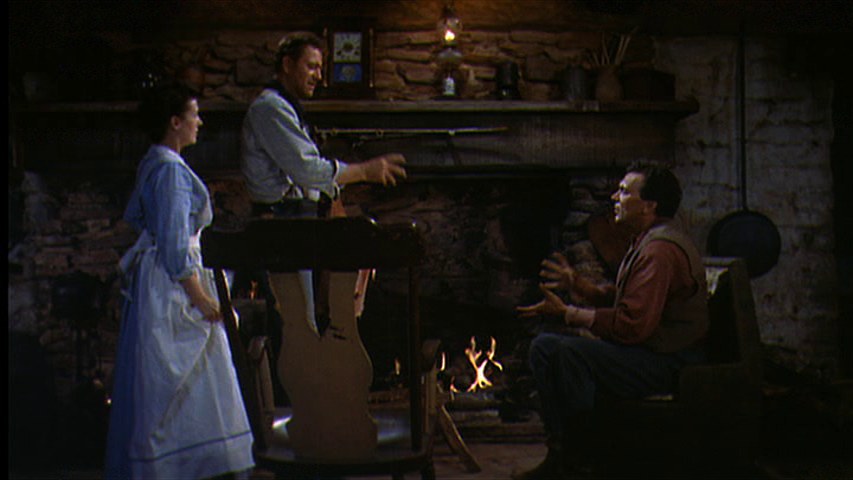
“Not quite: I’m one-eighth Cherokee, and the rest is Welsh and English,” he replies. “At least that’s what they tell me.” You see, “it was Ethan who found you, squalling under a sage clump after your folks had been massacred,” Aaron explains. “It just happened to be me,” Ethan says, “no need to make more of it.” That night before the children to go bed, he makes Debbie a present of what Frank Nugent’s screenplay describes as “something appropriate to Maximilian of Mexico”:
Moments later, he tosses Aaron two bags of double eagles by way of clarifying that he expects to pay his way.
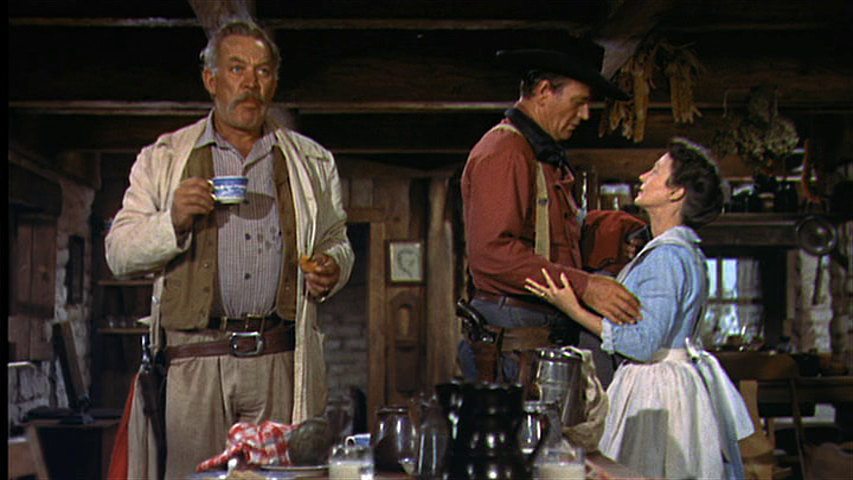
“That’s fresh minted–there ain’t a mark on it!” Aaron observes, to which Ethan simply says, “so?” The next morning breakfast is interrupted by a visit from Ward Bond’s Reverend Captain Samuel Johnson Clayton and his company of Texas Rangers, who are looking for cattle rustlers who they think have run off the herd belonging to Lars Jorgensen (John Qualen), whose son Brad (Harry Carey Jr.) has been “sittin’ up with” Lucy. Their intention is to deputize Aaron and Marty, but Ethan tells his brother to stay close in case the real culprits were Comanche. As they prepare to depart, Clayton chivalrously declines to observe a goodbye which makes it clear that Ethan and Martha are in love with each other:
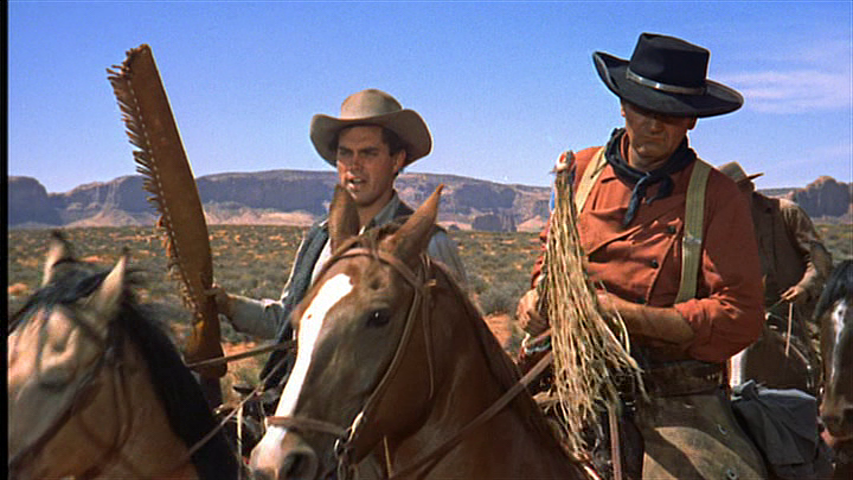
The posse is 40 miles away when Marty rides up to Ethan to comment that “there’s something mighty fishy about this trail.”
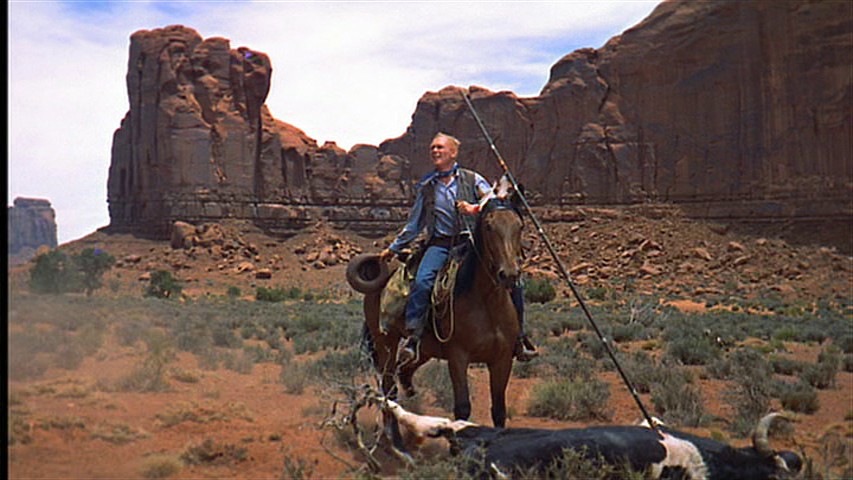
Sure enough, Brad finds his father’s prize bull with a Comanche lance in it.
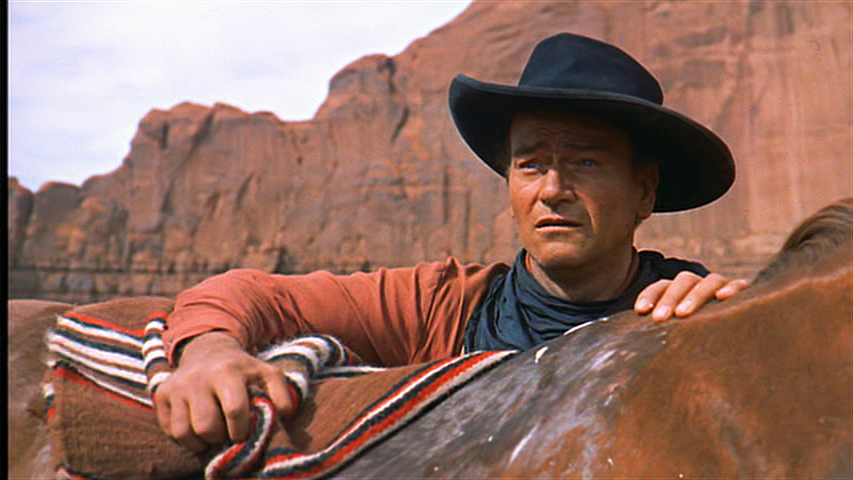
Ethan is the first to realize what it means: “stealing the cattle was just to pull us out. This is a murder raid.” The most likely targets are either the Jorgensen or Edwards places, and the majority of the Rangers ride for the former because it’s closer. Marty immediate heads for home against the advice of Ethan, who observes that their horses need rest and grain. The younger man obviously thinks he’s being callous, but the anguished look on Ethan’s face as he rubs down his horse is anything but:
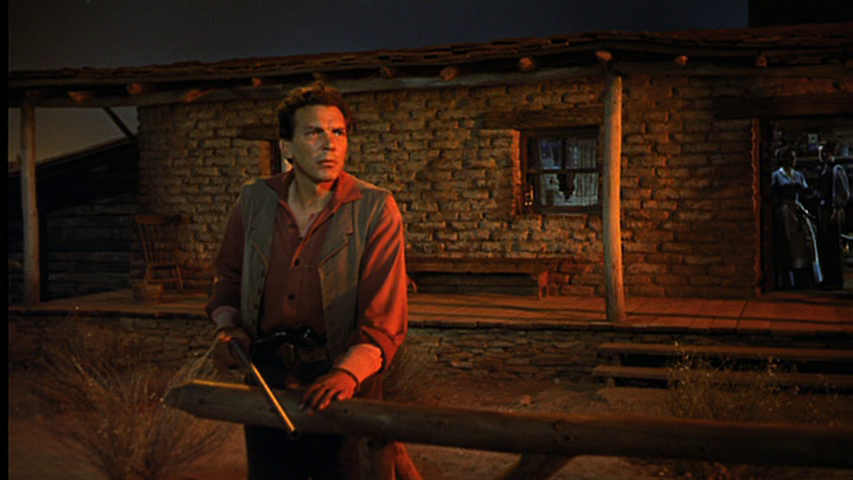
The attack itself isn’t shown, only the brilliantly tense lead-up to it which features outstanding crepuscular lighting:
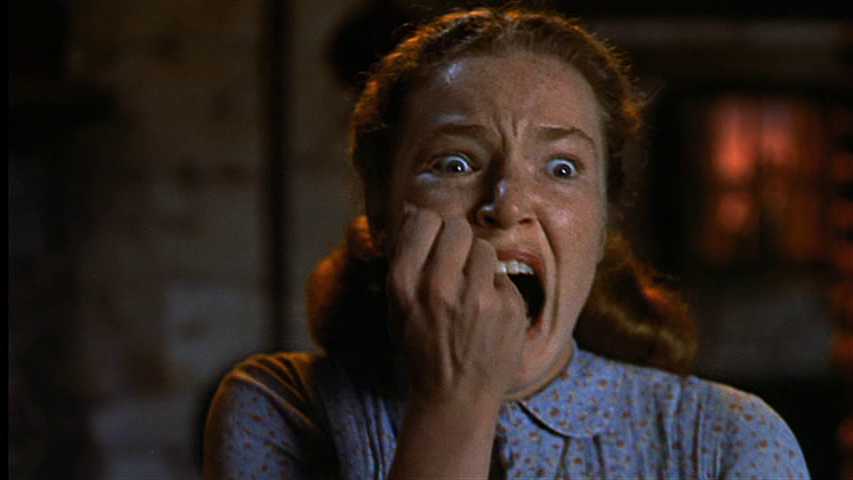
A devastating camera movement toward Lucy when she realizes what’s about to happen:
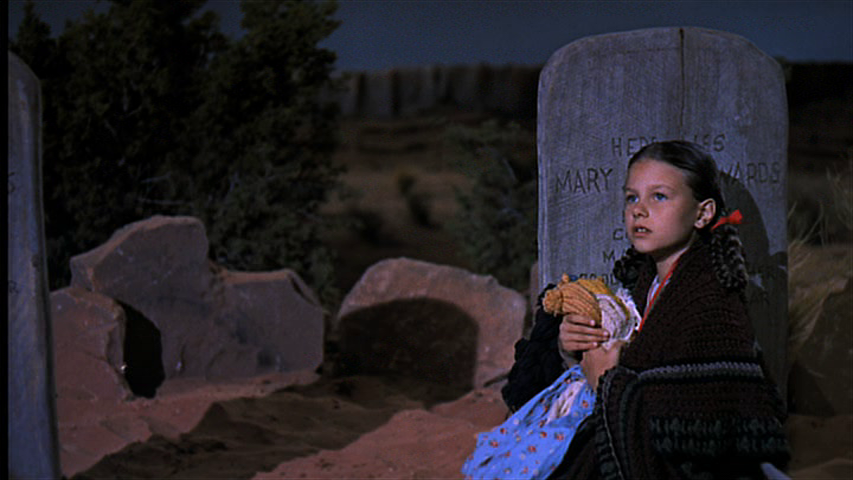
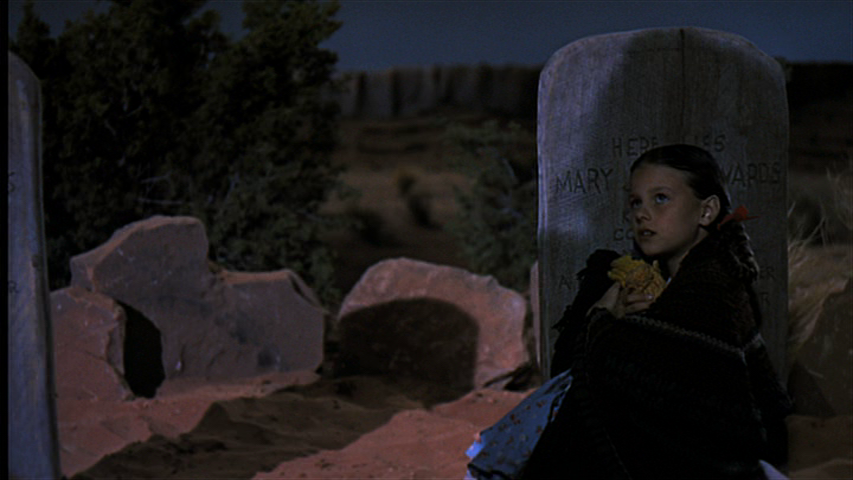
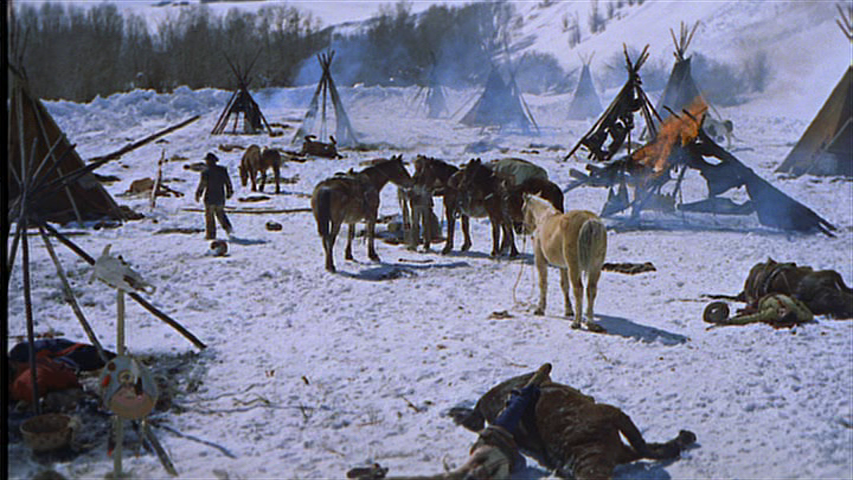
And a terrifying shadow falling over a tombstone that informs us that Ethan and Aaron’s mother was also killed by Comanches:
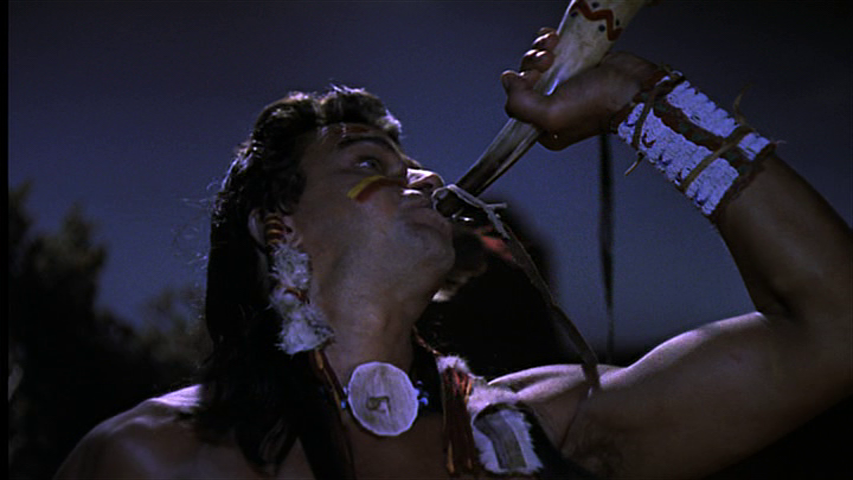
It ends on a close-up of the Comanche chief Scar, who unfortunately is played by a white man (Henry Brandon), blowing a horn to signal the start of the attack:
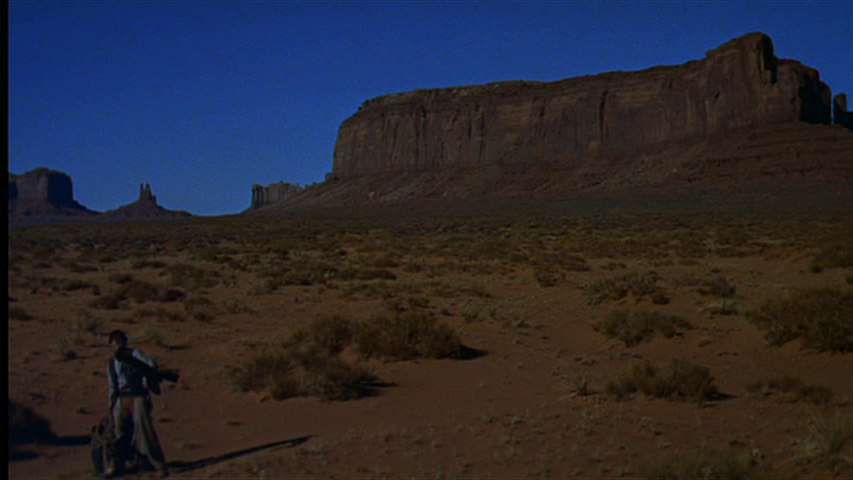
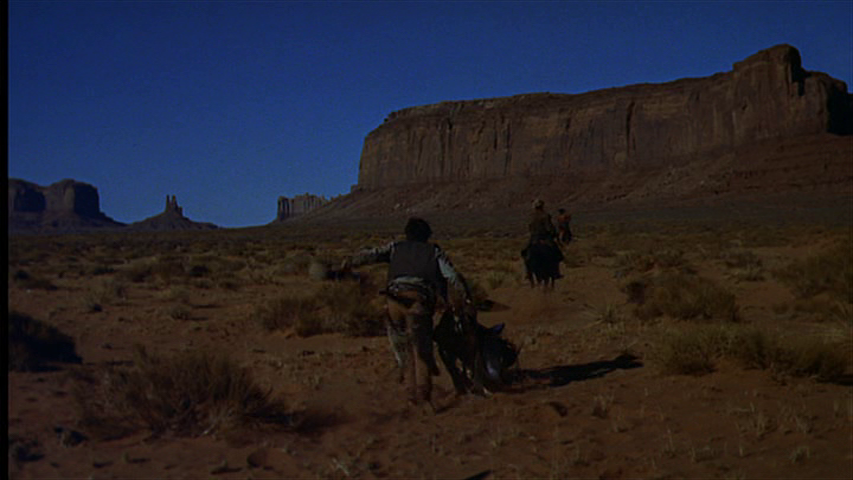
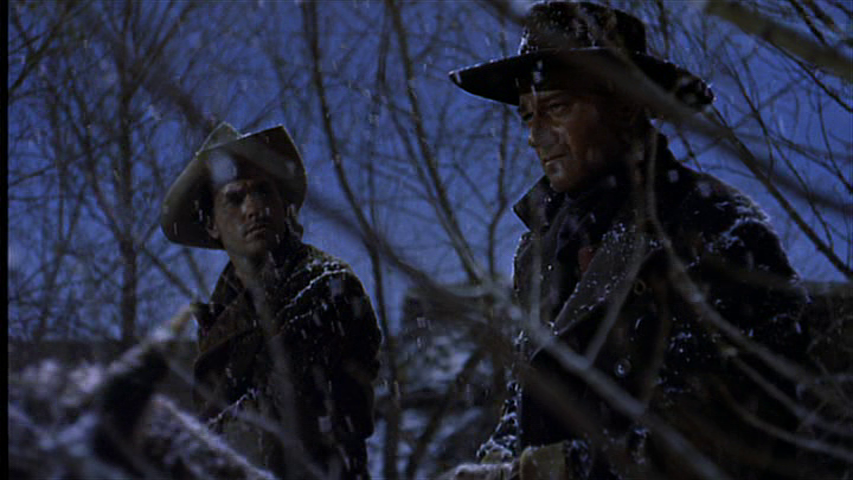
Fade to black. Ethan is proven right about the horses when he and Mose Harper (Hank Worden), who stayed behind with him, overtake Marty and ride past him:
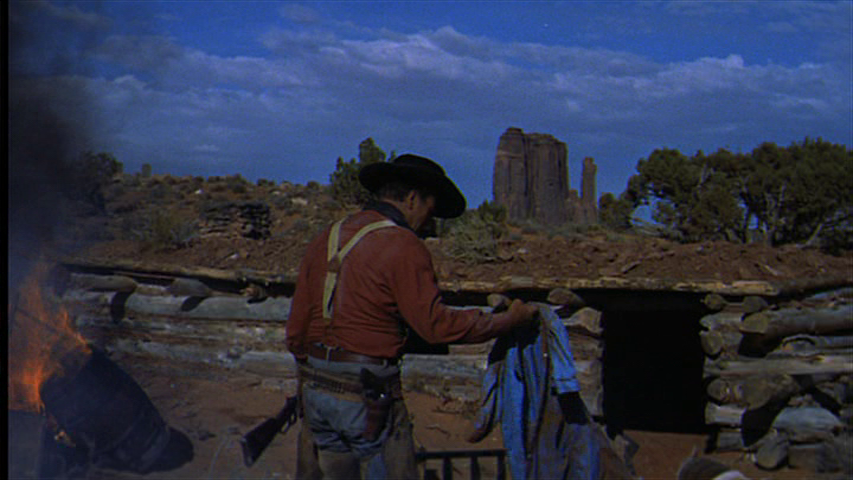
But they arrive too late to help. Ethan discovers Martha’s body in another reprise of the film’s opening shot:
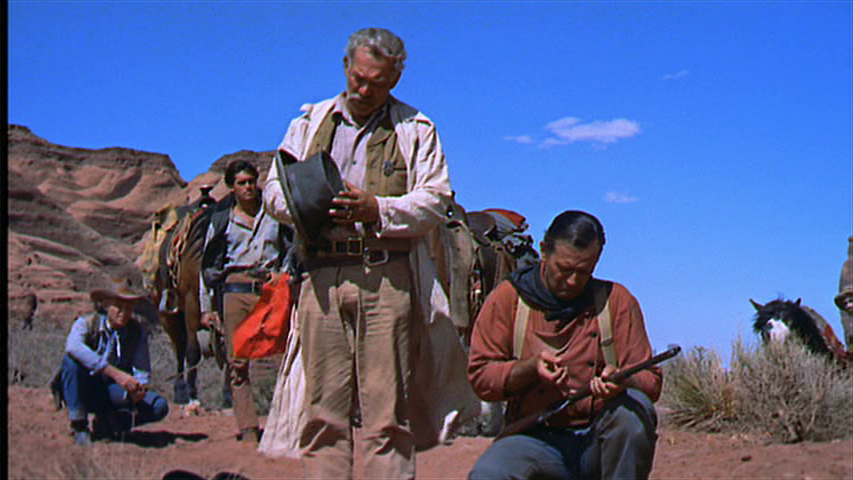
Aaron and Ben are also dead, while Debbie and Lucy have been captured. And thus begins the titular search. The same number of men ride out after the girls as went looking for Jorgensen’s cattle earlier, and soon enough they’re following a trail of corpses as warriors Aaron wounded die on the trail. Ethan shoots out the eyes of one, prompting Clayton to ask him, “what good did that do you?”
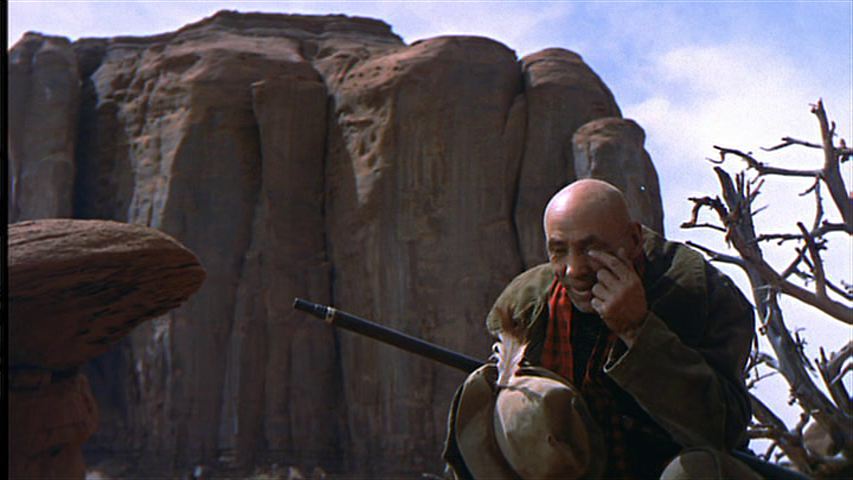
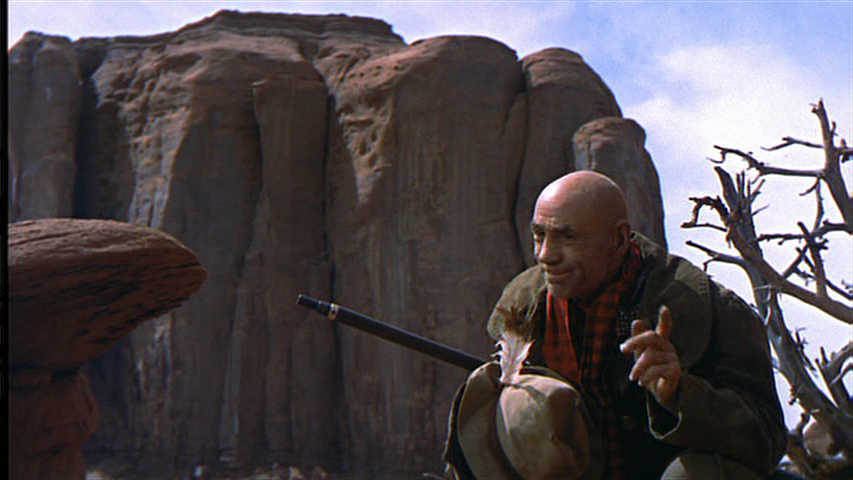
Mose pantomimes Ethan’s cold reply: “by what you preach, none, but what that Comanche believes, ain’t got no eyes, can’t enter the spirit land and has to wander forever between the winds. You get it, Reverend.”
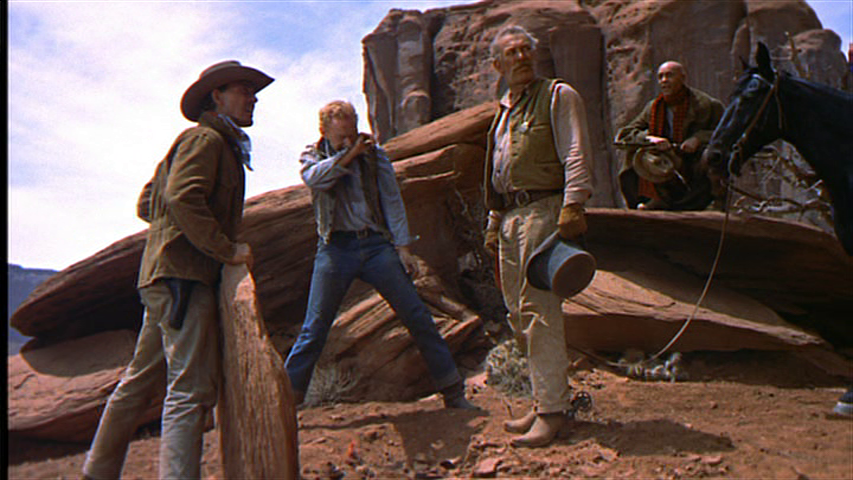
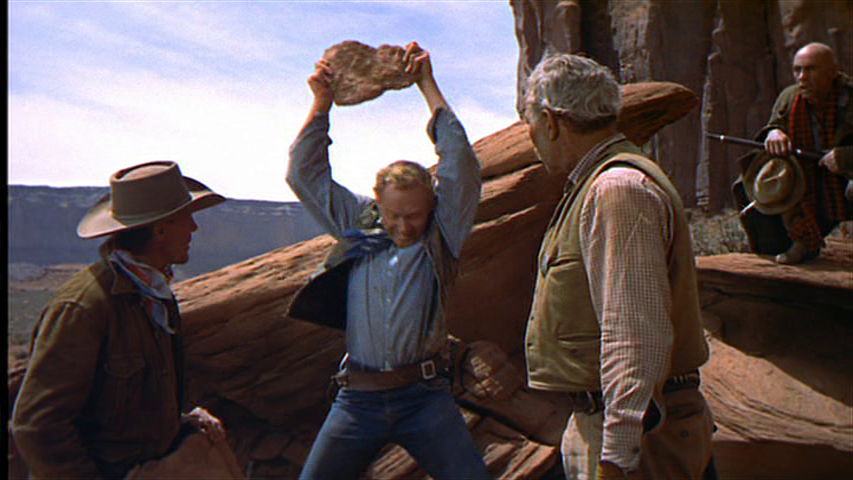
Sam Girgus writes in his book Hollywood Renaissance: The Cinema of Democracy in the Era of Ford, Capra, and Kazan, “of course, Ethan doesn’t ‘get’ that he really has just described his own life and destiny of wandering over a nightmare landscape that denies ‘the spirit’ and the value and meaning of life,” but I find it significant that his action is prompted by Brad desecrating the body first with a rock:
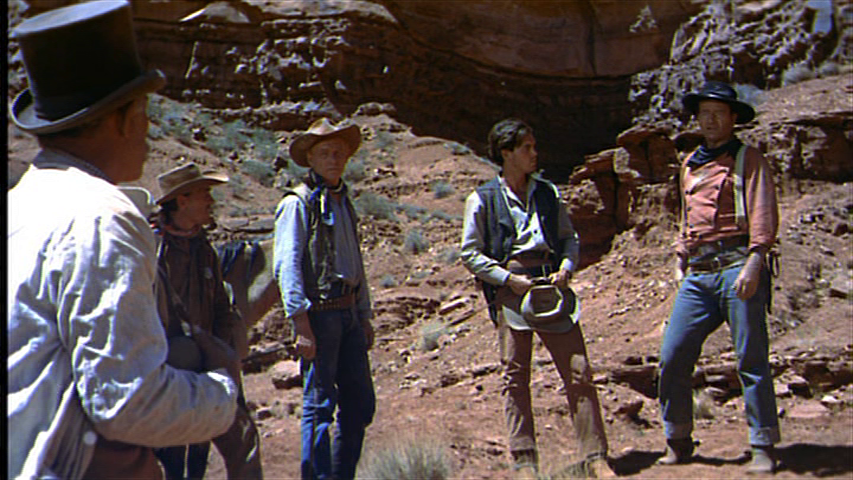
In fact, not even Ethan’s most extreme racist actions or sentiments expresses are unique to him, which seems to support the statement Joseph McBride and Michael Wilmington make in their monograph on director John Ford that “it is chillingly clear that Ethan’s craziness is only quantitatively different from that of civilization in general.” Anyway, he soon locates the raiders they’re looking for and proposes that they wait until nightfall and then jump them. Clayton decides they’ll try to run off their horses instead. Ethan disagrees, but Clayton says, “that’s an order.” Ethan replies by hurling a canteen at him with the words, “yes sir, but if you’re wrong, don’t ever give me another.”
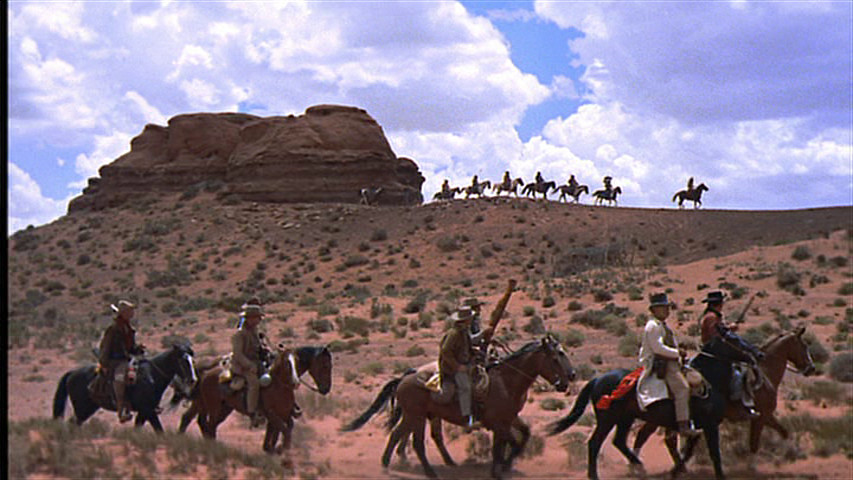
This is followed by another one of the movie’s great set pieces, a frantic ride to a strong defensive position across a river that features lots of great parallel and intersecting lines after Clayton’s plan fails and the posse finds itself surrounded:
Ethan continues the search alone with Brad and Marty because, as Clayton acknowledges, “this is a job for a whole company of Rangers, or this is a job for one or two men.”
Three become two a few minutes of screentime later when Brad suicidally confronts the Comanches alone after Ethan finds and buries Lucy’s defiled body, which we hear but don’t see:
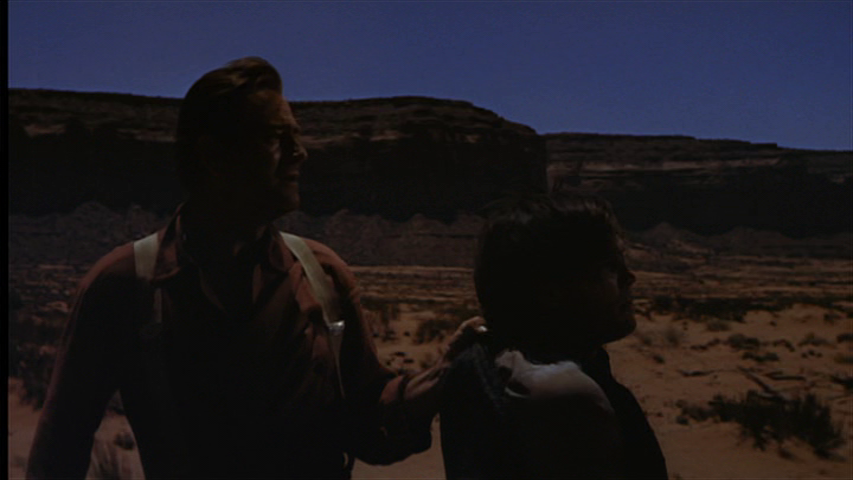
The final two searchers lose the trail soon after. “We’re beat and you know it,” Marty says. Ethan’s reply is my favorite line in this or any film (obsolete pejorative slang aside), because it’s basically the inverse of my philosophy of life: “Injun’ll chase a thing till he thinks he’s chased it enough, then he quits. Same way when he runs. Seems like he never learns there’s such a thing as a critter’ll just keep comin’ on.”
They briefly return home to the Jorgensens in a sequence that features framing which ought to look familiar by now:
But are off again the next morning in pursuit of a lead that came to the Jorgensens in the form of a letter, much to the chagrin of daughter Laurie (Vera Miles), who reveals to Marty that “you and me have been goin’ steady since we was three years old.”
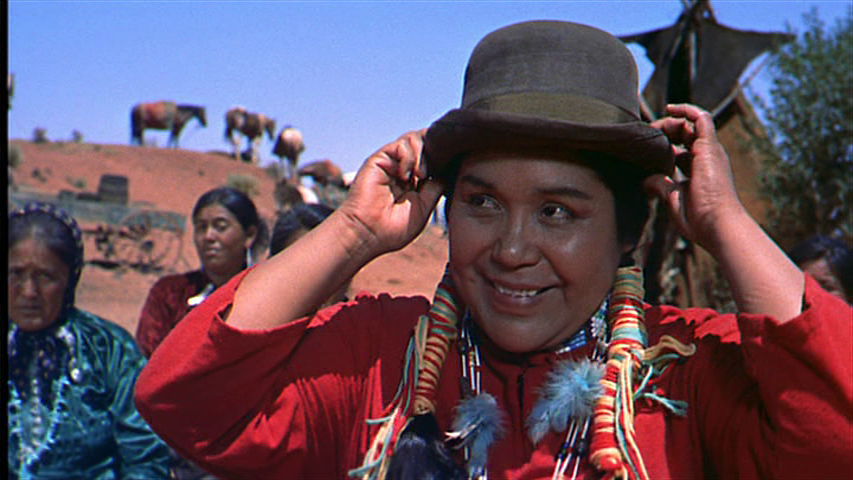
A big chunk of what happens next is shown in flashback as Laurie reads a letter that Marty writes to her, including his accidental (he thought he was trading for a blanket, not a bride) marriage to a woman named Wild Goose Flying in the Night Sky (Beulah Archuletta) that many people find distasteful in the way it’s played for comedy, but which M. Elise Marubbio defends as essential to understanding how “Ford’s direction throughout the film suggest an understanding of racism as a neurosis that permeates a community, including the viewer” in a chapter in the book Native Apparitions: Critical Perspectives on Hollywood’s Indians:
And an encounter with a cavalry troupe that has just massacred an entire Comanche village, including Marty’s wife, who ran off (possibly to look for Debbie) after she heard the two men talking about Scar.
Ethan and Marty finally catch up with him in New Mexico Territory, where the medal Ethan gave Debbie at the beginning of the film reappears during a conversation in which the chief reveals that two of his sons were killed by white settlers:
Debbie (now played by Natalie Wood) is there, too, and runs after Ethan and Marty when they leave to warn them they’re in danger:
When she tells them, “these are my people,” Ethan pulls his gun.
But Marty is having none of it:
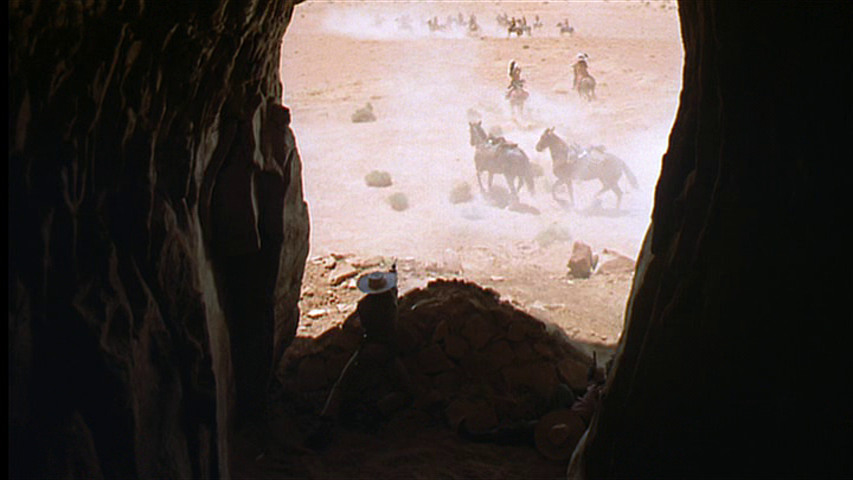
They’re interrupted by a poison arrow which wounds Ethan in the shoulder and escape (without Debbie) to a nearby cave where they fend off another attack:
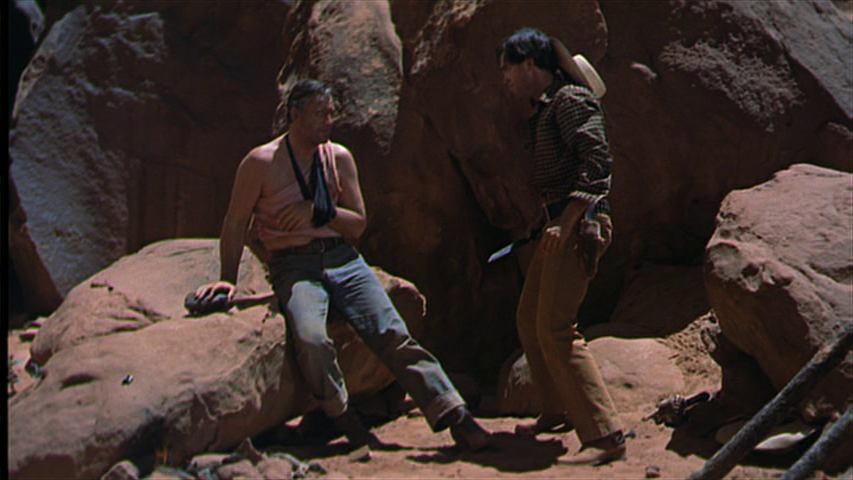
And where Ethan attempts to write a will that leaves all of his possessions to Marty on the grounds that he has “no blood kin,” to which Marty says, “I hope you die.”
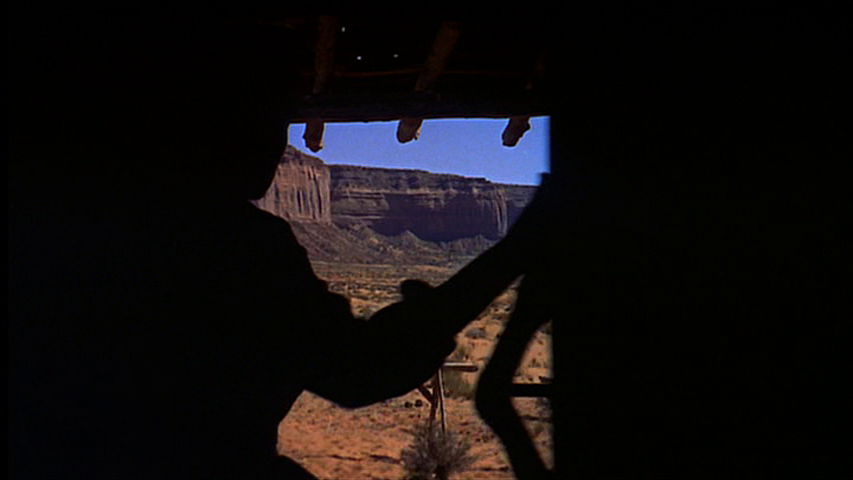
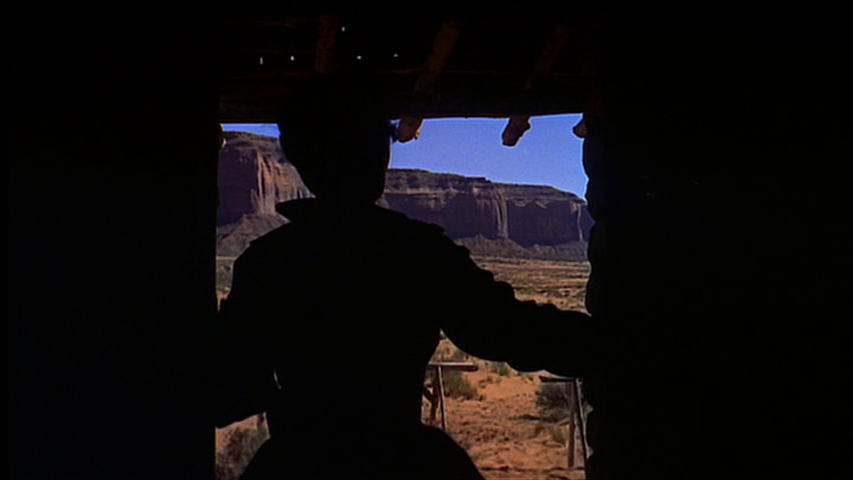
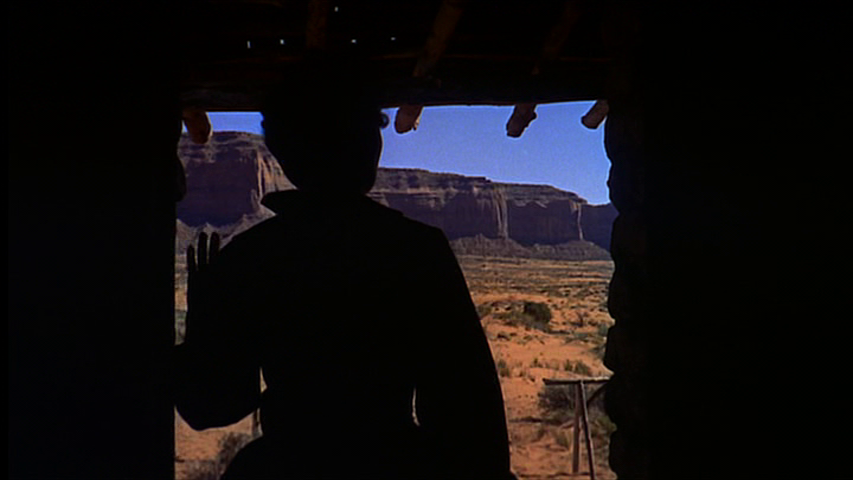
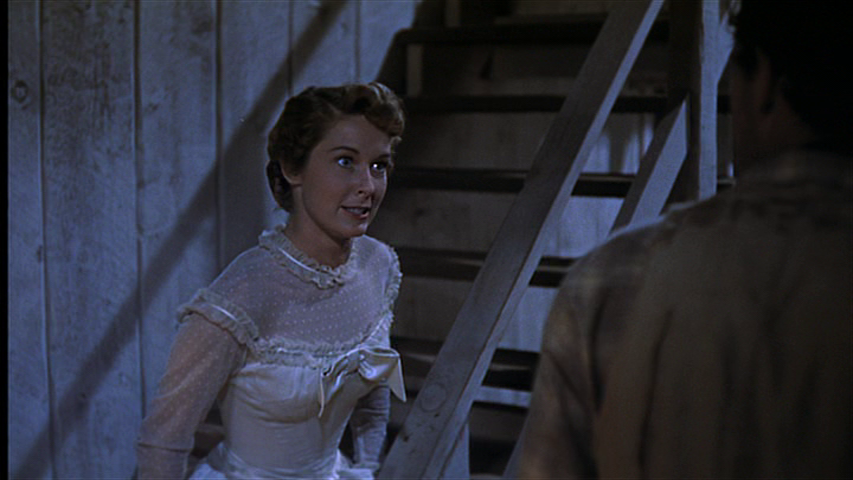
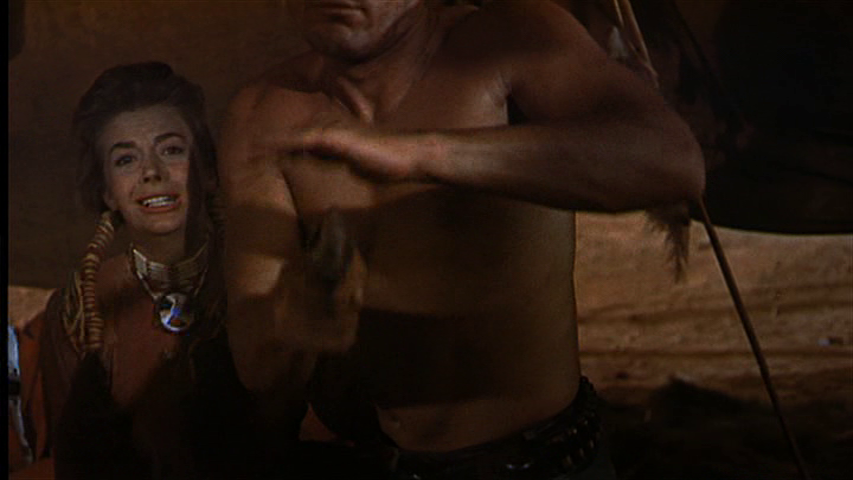
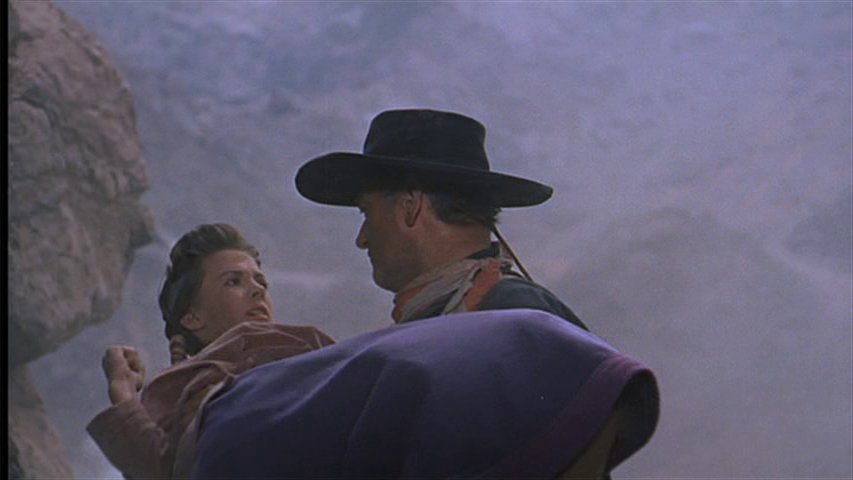
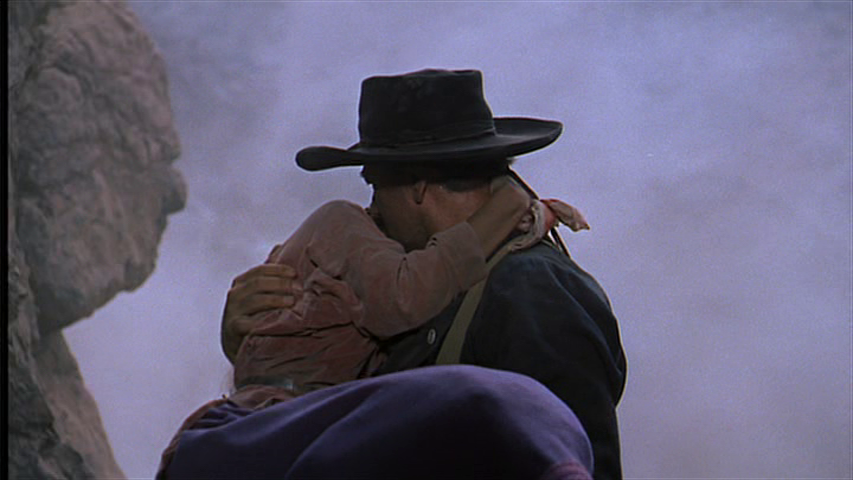
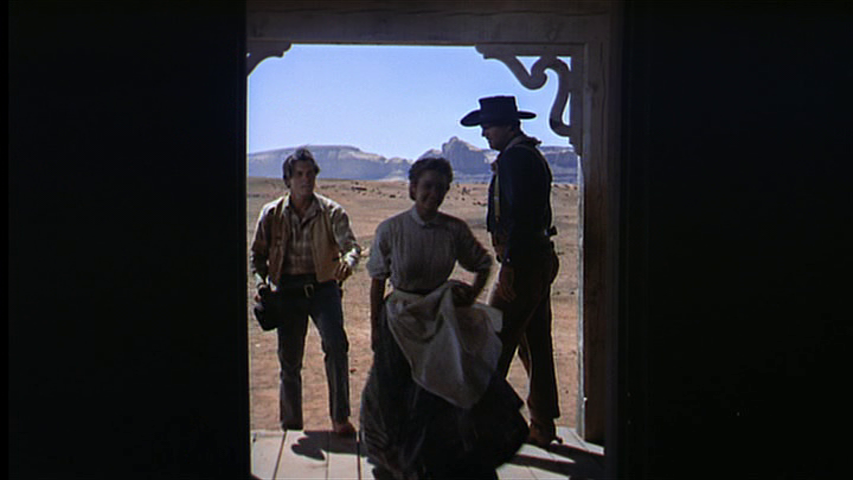
Which finally brings us to the wedding in the screengrab at the beginning of this post, where Laurie, who McBride and Wilmington describe as “resplendent in the virginal white of her wedding dress,” harshly echoes the sentiments Marty almost just stabbed Ethan for when he tells her he has to leave one last time to retrieve Debbie, who they’ve just been notified is camped nearby with Scar and the rest of his band. “Fetch what home?” she cries. “The leavings of Comanche bucks sold time and again to the highest bidder with savage brats of her own? Do you know what Ethan will do if he has a chance? He’ll put a bullet in her brain. I tell you, Martha would want him to.”
This leads pretty directly to the film’s key moments. Marty daringly sneaks into the camp alone and convinces Debbie to leave with him, but has to kill Scar in self defense, raising the alarm.
The Rangers ride in after them, and Ethan claims Scar’s scalp, which judging from his face doesn’t bring the closure he expected:
Just then he spots Debbie:
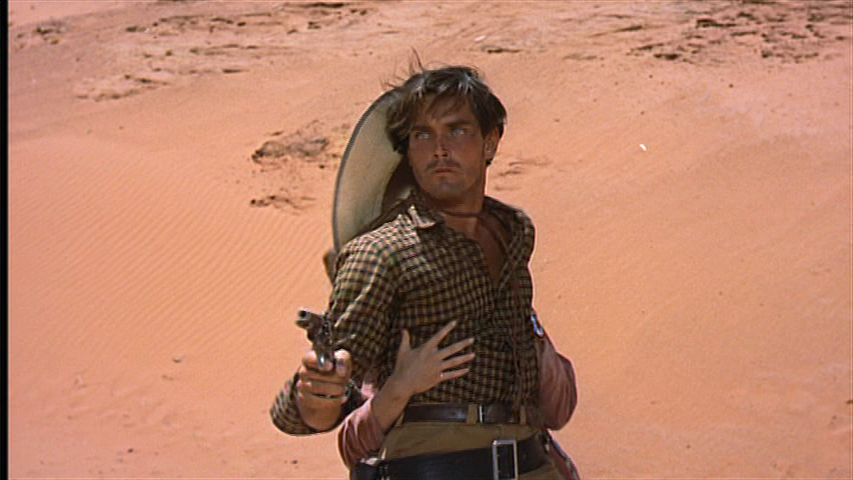
Marty tries and fails to prevent him from riding after her:
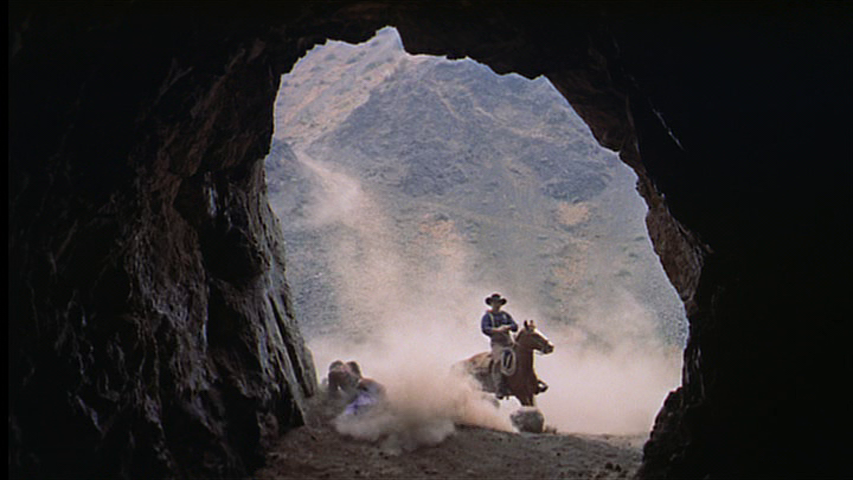
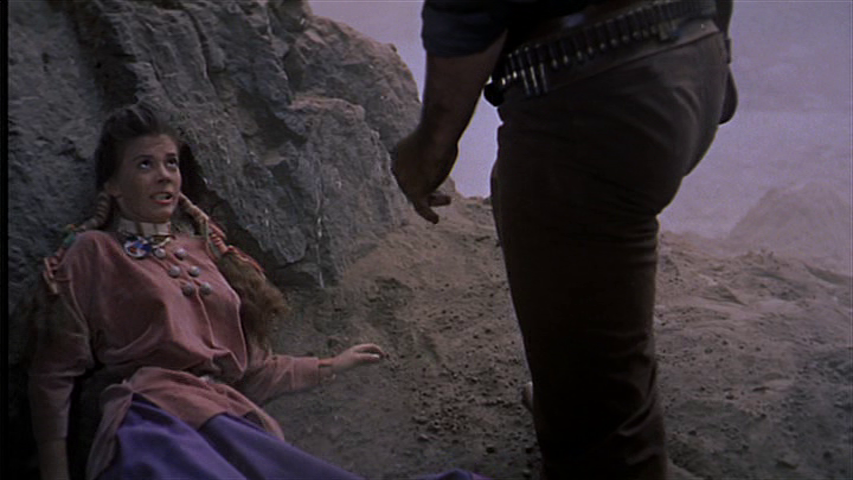
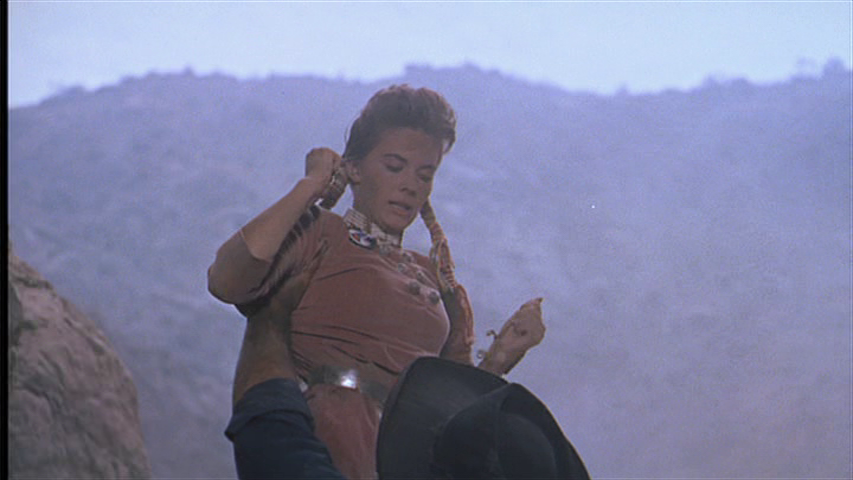
And Ethan catches up with Debbie in front of another cave:
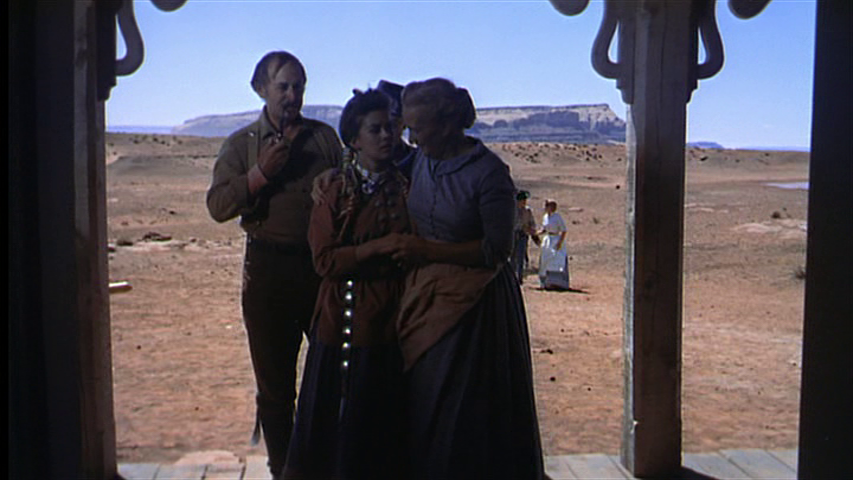
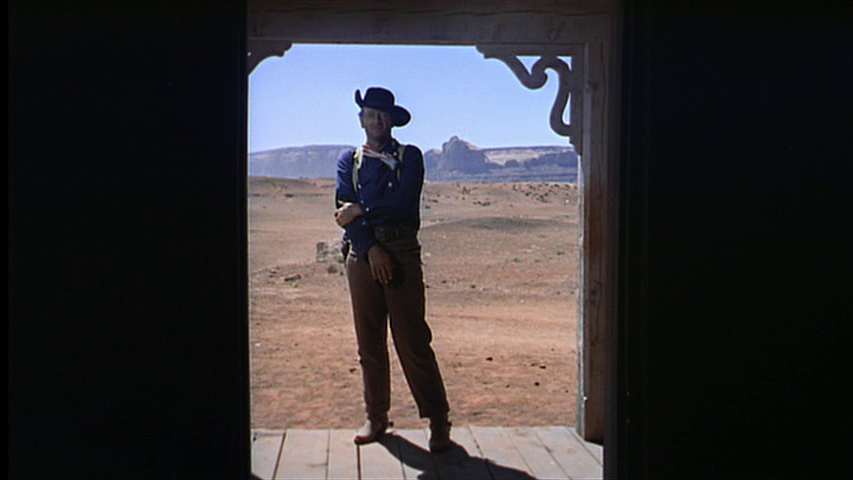
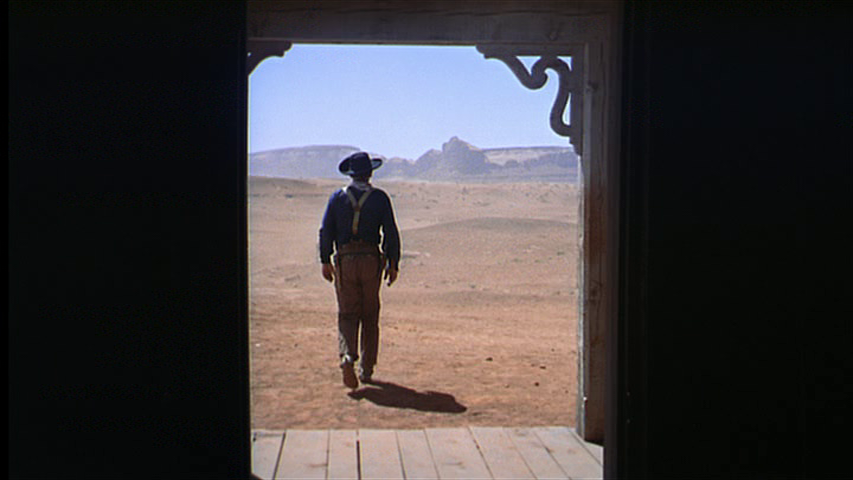
To Glenn Kenny it’s “an unabashed and matter of fact depiction of the mysterious workings of grace” which can’t be parsed in any rational way, while to Pippin “what we and [Ethan] discover is that he did not know his own mind, that he avowed principles that were partly confabulations and fantasy.” Whatever the case may be, and while I find Ethan every bit as compelling a character as I did in my youth when I first discovered this film, what I find myself pondering the most these days is what this scene and the final one that follows it say about America. After all, as Jeffrey Church points out in an article published in the journal Perspectives on Political Science, “the film is not called ‘The Searcher.'” Much ink has been spilled about the way Ethan stands alone in the final scene after Mr. and Mrs. Jorgensen (Olivia Carey) take Debbie inside, then Laurie and Marty push past him:
I think it’s absolutely essential to note that after John Wayne, the actor, clutches his arm in a moving homage to silent film star Harry Carey (father of the actor who plays Brad and husband to the actress who plays Mrs. Jorgensen), Ethan, the character he plays, chooses to turn and walk away:
Girgus reads Marty’s presence as “dramatically [subverting] Ethan’s wish to form a nation of one without any responsibility to anyone outside of himself” by turning their search for Debbie into a social experience that mirrors “the situation of America as a democracy of continued relevance to its own people and for the world during a period of increasing activism by minorities and people of color,” which seems just as true today as it did in 1956 when The Searchers was released or 1998 when Girgus’s book was published. But where he argues that Ethan “cannot (my italics) enter the interior spaces of the house” despite the fact that he “represents steadfast masculine strength, power, and aggression that constitute essentials for the survival of any society, including a democracy,” Pippin emphasizes the absence of a reconciliation scene with Ethan and suggests that he may instead be recusing himself from participating in the one taking place within because it is “while not a complete fantasy, much more fragile than those ‘inside’ are prepared to admit.”
My point with all this is that Ethan is, to borrow some phrases from the film, “a human man.” As are, of course, the Comanches he spends its runtime opposing. And the country built on their bones is indeed “a fine, good place to be.” But it can be even better. So let’s spare a thought for all of them as we gather around the communal punch bowl this Thanksgiving, because those who forget the past are doomed to repeat it.
Cheers!
All original photographs in this post are by Marion Penning, aka My Loving Wife.Links to all of the entries in this series can be found here.



















 The Prodigal Cinephile