What I’m Seeing This Week: I am excited to finally see Universal Language, which I heard great things about as it worked its way across the film festival circuit last year, at Cinemapolis! I am also going to try to catch Mickey 17 there or at the Regal Ithaca Mall on the only other evening I’m free.
Also in Theaters:Cornell Cinema has an absolutely killer lineup this week that my schedule doesn’t permit me to take advantage of, but you should if you can! If I was free on Saturday, I would definitely be going to the “unique Cornell version of Eno,” and if I was free tomorrow I’d probably prioritize Toxic ahead of Mickey 17 and Universal Language. They’re also screening Close Your Eyes, which landed at fifth place on my Top Ten Movies of 2024 list, tomorrow and my August, 2024 “Drink & a Movie” selection Black Narcissus on Sunday. Otherwise, the best new movie now playing Ithaca that I’ve already seen is newly-minted Best Documentary Feature Oscar winner No Other Land, which continues its run at Cinemapolis, as does this year’s Best International Feature Film I’m Still Here. Best Picture Oscar winner Anora is back in local theaters as well at both Cinemapolis and the Regal. Other noteworthy special events include “An Evening with John Cameron Mitchell” at Cornell’s Schwartz Center for the Performing Arts on Friday; free admission to the Streets Alive! Film Festival at Cinemapolis on Sunday, a free screening of Song Lang at Cornell Cinema on Wednesday, and a preview screening of The Friend at Cinemapolis that same evening. Finally, another repertory highlight is The Adventures of Prince Achmed at Cornell Cinema on Sunday.
Home Video: Speaking of my top ten list for 2024, the film that placed sixth on it, All We Imagine as Light, premieres live on the Criterion Channel at 9pm on Sunday! The first film from India to compete in the main competition at the Cannes Film Festival in 30 years, it won the Grand Prix there and placed fourth in theIndieWire Critics Poll, which is definitely the list of this type that I put the most stock in. Looking back on the only “Ithaca Film Journal” post where I actually had occasion to recommend this movie, I realize I didn’t say anything about it because I assumed I already had! Anyway, it’s a sumptuously photographed tale of platonic and romantic love with a delightfully poetic “plot twist” and an outstanding final shot that features a kid absolutely rocking out to headphone music.
Previous “Ithaca Film Journal” posts canbe found here.A running list ofall of my “Home Video” recommendations can be found here.
Last March I celebrated being fully back to “using cinema as a window on the world and a lens through which I can interrogate my thoughts and feelings and refine them into a more consistent and generous philosophy” with my first proper top ten list in many years. In the same post I mentioned the “mixtapes” I’ve been compiling bi-annually for the past decade and started sharing on this blog in 2022, but I didn’t quite make the connection that these are essentially the same activity.
Although I’ve historically been adamant that, as I said in 2021, the songs I include on my mixes “are not necessarily the best songs of the previous six months in my opinion, but rather the ones that gave me the most pleasure and/or affected me the most,” it recently struck me that after more than a decade of listening to hundreds of new albums each year, I likely know more about music than I give myself credit for, at least on an intuitive level; conversely, although I watch hundreds of new movies each year and also spend quite a bit of time immersed in older ones, my knowledge of cinema relative to people who write about it professionally isn’t nearly what it used to be in my 20s when I was fresh out of a film studies program and could afford to live as though I did as well. Even back then I tried to embrace my amateur status: that’s when I came up with the idea of a “movie year” that starts and ends in March instead of January, for instance. Just paying attention isn’t a surefire way to avoid falling into imitative patterns, though, and I recently found myself pondering whether or not this annual list-making exercise serves any purpose for me at all. Delaying its creation makes it a truer representation of my favorites from 2024 by allowing two extra months for many of the most important titles that posterity will label with that year to reach Ithaca and the streaming video services I subscribe to, sure, but is it really worth the time and effort?
To my very great surprise, the answer to this question came from my younger self. Nearly twenty years ago I wrote the following:
I suppose that it’s possible to construct a Top Ten that would satisfy me structured around a list of films numbered from 1-10 that devotes one or two sentences to each movie, with a paragraph-long introduction and conclusion. Possible, but certainly not likely–at any rate, there are better ways. A good list might include scenes from films or lines of dialogue. It can include upcoming films, old films, ideas for films. Buildings. Political scandals. People. Why not? If you’ve explained your goals adequately it can include anything.
At the very least it can include nine films, or eleven. It can include re-releases, short films, and television episodes/seasons/series.
Or. Or the critic can accept all of the limitations of the Top Ten list and simply scribble down ten films and be done with it. Let the readers do the leg work, right? My editor wants a list? Here you go: a list. Because any list of films is interesting, just not necessarily fraught with any particular meaning.
In the 2004 Village Voice year-end poll Lars von Trier’s Dogville (2003) placed third. This did not mean that Dogville was the year’s third best film. It did not mean that it was the year’s third most important, talked about, or divisive film. All that it meant was that Dogville finished third in the Village Voice‘s year-end poll. But by finishing third in this poll Dogville set off a round of discussion about itself, Lars von Trier, the Voice poll, year-end polls in general, and the movies that was important, talked about, and divisive.
What am I saying? I’m suggesting that we don’t need to do away with year-end polls entirely, but that we need to either think more about them or give them less space. That we need to strive to make them relevant and to articulate why we think we’ve succeeded, or that we need to treat them like coffee table books: as conversation starters, and nothing more.
It pains me to see so. many. italics, but I have to admit that the kid has a point. More than one, even! Top ten lists are inherently the kind of endeavor that most people are going to spend either too much time on or too little. Like movie reviews they have value in the aggregate, too, but each individual one of them says more about the person who compiled it than the films they selected, and the list maker can’t just assume that readers already have the necessary context to make sense of their choices–they have to provide it. Professional film critics probably don’t have much say in the matter: they have to deliver whatever the publication they write for wants on deadline with a word count. There’s nothing stopping me, though, from using as much space I need in order to not just explain my picks, but also canvass the entire pool of works I was choosing from and explore how it came to be. What made it to Ithaca . . . and what didn’t? What did I decide not to watch and why? Are there movies that I think the world needs which aren’t even being made?
The problem is that I don’t actually *want* to write this post. I do this for fun, after all, and I’m impatient to move on to Movie Year 2025. And that brings me back to the idea of a playlist. I only recently started providing any commentary at all about the songs on my mixes: initially I just shared the track listing and a Spotify link and called it a day because the idea was for people to actually listen to everything. And that’s true of my favorite films of the year as well! The 13 mentioned below are my answer to the hypothetical question “what should I watch?” They’re the ones I’m most eager to talk about and I can’t resist the urge to add a bit more commentary here, but I’ve already written about everything on Letterboxd and/or this blog at least once, and frankly I’m more interested in having an actual conversation than pontificating further, so please do check them out for yourself and tell me what you think!
Speaking of Letterboxd, one of the main reasons I can barely imagine life without it anymore despite becoming the last cinephile on earth to join little more than 18 months ago is because it makes it super easy to ascertain that I tagged 124 films “Movie Year 2024.” By way of illustrating what does and doesn’t qualify, when I watch Queer after it debuts on Max next month, I won’t tag it “Movie Year 2025” because it played Ithaca in December; however, Universal Language *will* qualify even though it was screened at the 2024 editions of Cannes and TIFF and a bunch of other film festivals because when it opens at Cinemapolis next week, that will be my first opportunity to see it. Anyway, I also saw everything in the Indiewire Critics Poll and CriticsTop10 top 50 lists except Queer and Youth (Hard Times), all of which means that, 1) my local movie theaters are awesome, and 2) this is basically the “top 10% in the class.” Here are the new releases I liked best:
10. Green Border. One of three movies I spent a lot of time thinking about this year as representative of philosophically different takes on the efficacy of depicting horrific acts of injustice. Green Border occupies the optimistic/determined quadrant: director Agnieszka Holland clearly believes that shining a light on the evil deeds desensitized people do in the dark when told enough times that it’s their job and/or their duty will eventually put a stop to them. No Other Land is similarly optimistic, but resigned to the possibility that we the viewers just don’t have the attention span anymore, while Incident is pessimistic but nonetheless keen to continue the fight.
9. Here. Perhaps the most formally audacious and emotionally satisfying film on this list and connected thematically to a number of the rest. Including:
8. La Chimera. Above-ground/beneath-the-surface cantastoria about what it means to live a good life: if your heart’s desire is buried in the dirt under your feet, do you build a shrine on it or dig?
7. About Dry Grasses. When you spend 197 minutes with an unsympathetic character and don’t tire of them, the movie they’re in did something right! Reminded me of college.
5. Close Your Eyes. Do you have to know you’re doing it for your life to be your art? Makes an interesting pairing with my first and maybe always favorite cinematic depiction of Ithaca My First Film in the way it depicts a filmmaker engaging with a work made in their youth.
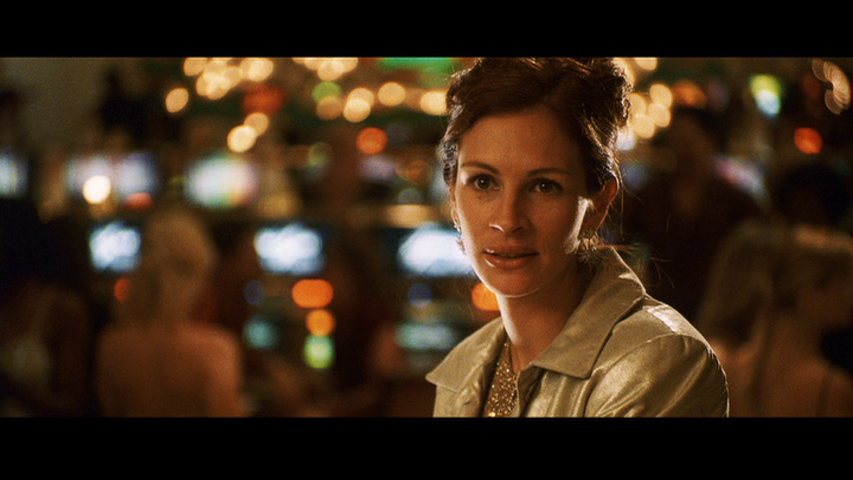
4. Red Rooms. Perhaps the year’s most well-constructed movie. I am planning to write about its poker scenes after my “Drink & a Movie” series wraps in December.
3. Do Not Expect Too Much from the End of the World. History is supposedly written by the victors, but the idea of “winning” is as slippery as quote attribution and the fossil record and racial memory are harder to control than state media and schools, so if you’re thinking in a long enough timeframe, it’s more accurate to say that points will be tallied based on surviving documentation.
2. Evil Does Not Exist. Another film that explores the societal implications of the ideas about personal happiness that appealed to me so much in some of the titles on this list.
I also saw a number of terrific older films for the first time last year. Here are the ones that made the biggest impressions:
5. Whiplash. There are still a number of prominent movies released during my period of self-imposed semi-exile from “the lost continent of cinephilia” that I haven’t caught up with yet, but I’ll be surprised if I enjoy any of them half as much as I did Whiplash!
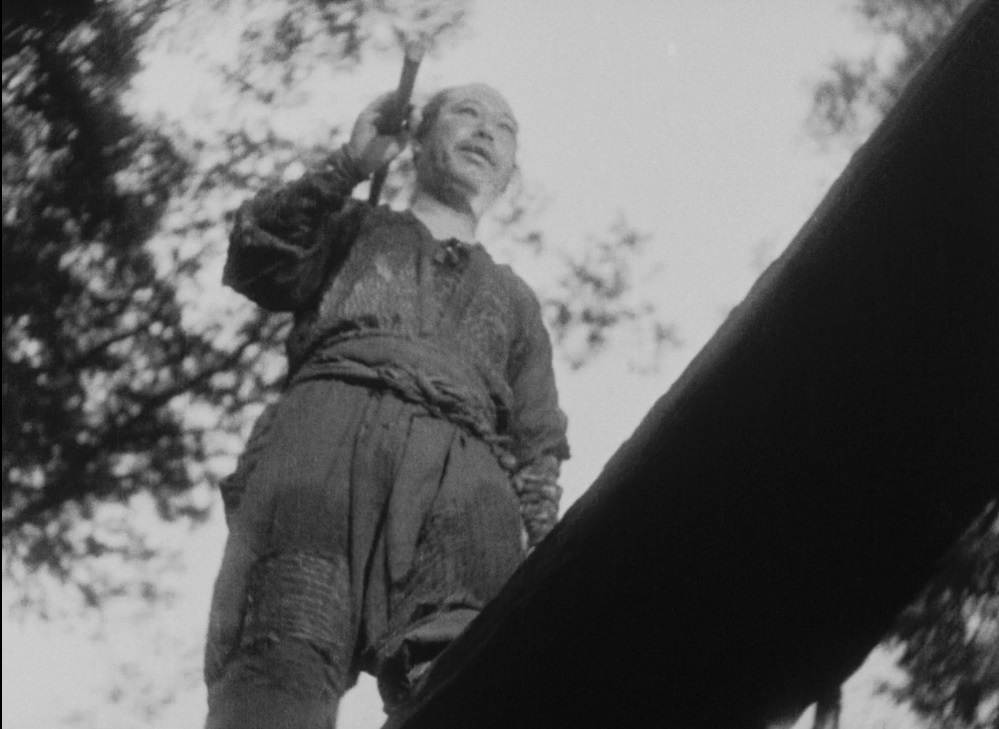
2. The Act of Killing. This is what the pessimistic/resigned quadrant in the framework I started to sketch out when talking about Green Border looks like.
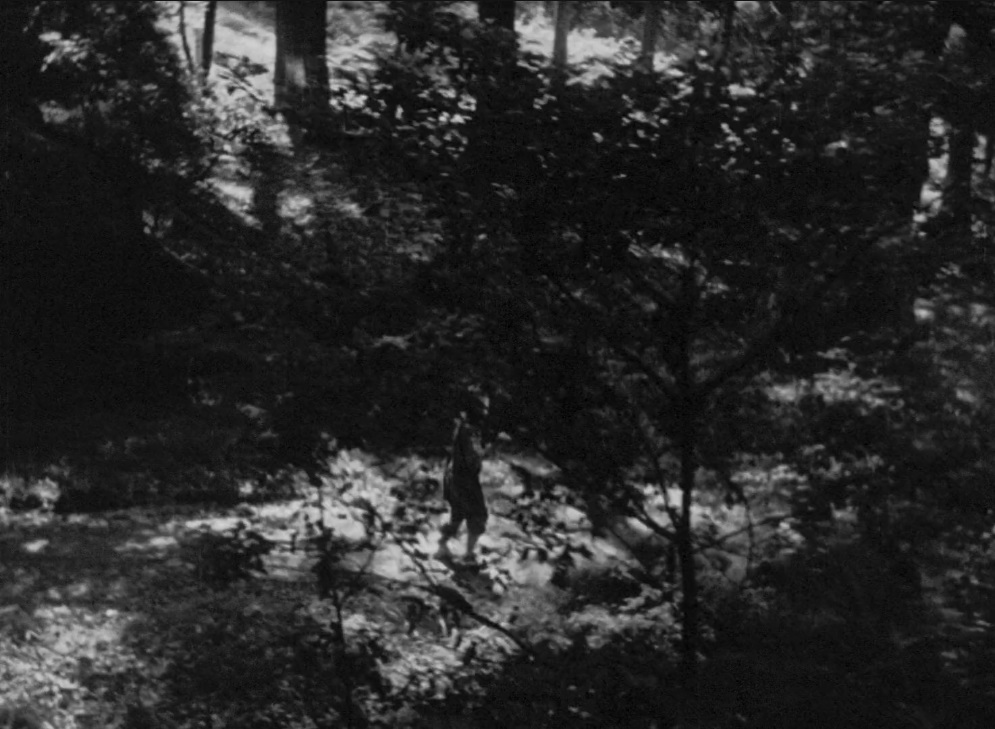
1. The Long Day Closes. A legit contender for my 2032 Sight & Sound “Greatest Films of All Times” ballot!
* * *
Porcelain War played Cinemapolis for one week in January so I definitely did have an opportunity to see *all* of the films up for Oscars tonight! I guess I’ll have to settle for 48 out of 49. As always, these are the films I’m rooting for, not the ones I expect to win.
Actress in a Supporting Role: Ariana Grande – Wicked
Adapted Screenplay: A Complete Unknown.I won’t be at all disappointed if Nickel Boys wins, but I loved Pete Seeger’s strategically ill-advised speech about the “teaspoon brigade” and the placement of Joan Baez’s comment “you’re kind of an asshole, Bob.”
Makeup & Hairstyling: The Substance. Demi Moore’s Elisabeth Sparkle’s first prematurely decrepit finger was one of Movie Year 2024’s standout moments for me.
Documentary Short: Incident. The only way I won’t throw something at the television if it doesn’t win is if Instruments of a Beating Heart does instead.
Documentary Feature: No Other Land
Cinematography: The Brutalist.I’m incredulous that Nickel Boys wasn’t nominated in this category.
What I’m Seeing This Week: As longtime readers of this blog know, I consider the “movie year” to begin and end on Oscar night. The Monkey, which I’m planning to catch at either Cinemapolis or the Regal Ithaca Mall, will therefore be my first theatrical screening of 2025. More about this when I publish my top ten list on Sunday!
Also in Theaters:No Other Land, the film I’ll be rooting for to win this year’s Best Documentary Feature Oscar, continues its run at Cinemapolis and remains the best new movie now playing Ithaca that I’ve already seen. I also recommend Best Picture nominees I’m Still Here and The Substance, which are at Cinemapolis all week, and A Complete Unknown, which closes there today. This week’s special events are highlighted by the Ithaca Experimental Film Festival, which is at Cinemapolis on Saturday and Cornell Cinema on Sunday. There is also a free screening of local filmmaker Ira McKinley’s The Throwaways accompanied by excerpts from his new work A Tale of Two Journeys at Cinemapolis tonight and a free screening of the movie Lilting at Cornell Cinema on Wednesday. Finally, doors open for Cinemapolis’s annual Oscar night fundraising gala at 6:30pm on Sunday. On the repertory front, your best best bets are the screenings of Black Narcissus (which I wrote about last August) and The Annihilation of Fish, the rerelease of which Carlos Valladares recently called “the cinematic event of the year,” at Cornell Cinema on Friday and The Red Shoes on Saturday.
Home Video: If you want to see *all* of this year’s Oscar-nominated shorts, you’ll need to head to Cinemapolis or (in the case of the documentaries) Cornell Cinema. The ones I’ll be rooting for are all available online, though! In the Best Animated Short Film category, my favorite is Wander to Wonder, a tale of survival starring characters from a creepy 70s/80s kids television program that uses Shakespearian quotation and engages with the idea of unfathomably (and therefore “indistinguishable from magic) advanced technology (here: VHS!) in a way that reminds me of Arthur C. Clarke’s classic science fiction novel Rendezvous with Rama. It is available for rental via Vimeo. My pick in the Best Live Action Short Film category is streaming on Vimeo for free: A Lien is a tense, effective Paul Greengrass-style shaky cam thriller about the despicable U.S. Immigration and Customs Enforcement (aka ICE) practice of arresting people at their green card interviews. But the cream of the whole crop is Best Documentary Short Film nominee Incident, which uses stunningly complex and effective split-screen editing to recreate the cacophony and chaos of being on the scene of an “incident” (the almost completely unmotivated killing of a black man by a white police officer) that everyone knows never should have happened and fears will blow up into something even more horrible any second and debunks the proceduralist myth of infallible law enforcement professionalism in the process. It is available via The New Yorker. By way of an honorable mention I also recommend Instruments of a Beating Heart, which I described on Letterboxd as “the Muppet Babies version of Whiplash” and which is probably my second-favorite one of these movies overall. It is available via The New York Times.
Previous “Ithaca Film Journal” posts canbe found here.A running list ofall of my “Home Video” recommendations can be found here.
What I’m Seeing This Week: I decided I didn’t want to risk missing out on No Other Land last week, so I still have one Oscar-nominated shorts program left to go: I’m planning to catch the live action shorts at Cornell Cinema on Saturday, but they’re also playing Cinemapolis all week.
Also in Theaters:No Other Land is a contender for my Movie Year 2024 top ten list (which I’ll publish on Oscar night like usual) and my top new film recommendation. It continues its run at Cinemapolis. Of the two Oscar-nominated shorts programs I’ve already seen, the documentaries are significantly better than the animated shorts. You can see the latter at Cornell Cinema tomorrow, and both are playing Cinemapolis all week. Other first run features I enjoyed include A Complete Unknown and I’m Still Here, both of which are at Cinemapolis. You also have one last chance to see The Brutalist and Nickel Boys, one of which (I still haven’t made up my mind) I’ll be rooting for to win this year’s Best Picture Oscar, there today. On the special events front, the highlights are free screenings of the documentaries The Bomb at Cornell Cinema on Tuesday and of Anonymous Sister and Free For All: The Public Library at Cinemapolis on Saturday and Tuesday respectively. Your best bets for repertory fare are The Life and Death of Colonel Blimp and Fantastic Mr. Fox, which are at Cornell Cinema tonight and Sunday respectively. Finally, I would be remiss if I did not also mention that Twilight, which is beloved of my favorite film scholar who graduated from Cornell Matt Strohl (class of 2003), is screening there on Saturday.
Home Video: Sometimes works of art feel like adaptations even when you know they aren’t. The best example of this for me might be the Beatles song “For No One,” which I always hear as retelling James Joyce’s short story “The Dead.” It is perhaps therefore appropriate that when I finally saw the movie Distant Voices, Still Lives for the first time a couple of weeks ago, the overwhelming impression I got was that it was director Terence Davies’ version of his fellow Liverpudlians’ “In My Life.” I’d have a lot more to say about this movie, which is commonly regarded as both the first and second volumes in a trilogy were it not for the fact that its conclusion, The Long Day Closes, is a straight-up masterpiece. Here’s what I said about it on Letterboxd:
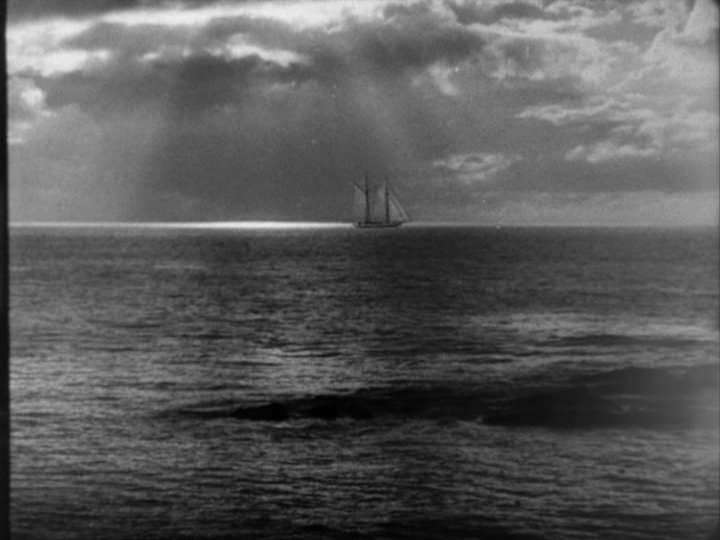
The Christmas dinner interior/exterior mash-up tableau is an all-time great movie image, although the exterior shot of the rowhouse with just the top of a Christmas tree with blinking lights visible through the windows as a drizzly rain falls which follows shortly afterward and the lengthy study of how an old carpet looks at different times of day might resonate with me even more for personal reasons. The opening and closing shots which derive power and meaning from a later string of overhead tracking shots connecting child’s play to cinema to church to school (where the lesson is about the forces of erosion) also rank among the great bookends in cinema history. Finally, if that wasn’t already enough, The Long Day Closes is the best argument I can conceive of for why some (to be clear: not all!) films definitely should have 85-minute runtimes that I can possibly imagine.
The Long Day Closes, which is now streaming on the Criterion Channel, is perfectly intelligible as a standalone work, but it’s totally worth ponying up $2.99 to rent Distant Voices, Still Lives on Prime Video so that you can watch the entire cycle.
Previous “Ithaca Film Journal” posts canbe found here.A running list ofall of my “Home Video” recommendations can be found here.
Between Valentine’s Day in February and Easter in March/April, I think it’s fair to say we’re in the “chocolate quarter” of the calendar year! In honor of such, this is the first of three Drink & a Movie posts in a row that will feature a drink made with one of my favorite underrated heroes of the back bar: crème de cacao. As Paul Clarke notes in The Cocktail Chronicles, its bad reputation is likely attributable “the substandard quality of many chocolate liqueurs” prevalent on the market until Tempus Fugit Spirits’ version became widely available about ten years ago. It and the Giffard white crème de cacao that I prefer in the 20th Century cocktail I wrote about in 2022 for reasons of color are both excellent, though, and there’s no longer any reason to shy away from this ingredient. As described in a post on his blog, Clarke created this month’s drink, the Theobroma, as his version of a chocolate martini. Here’s how to make it:
Stir all ingredients with ice and strain into a chilled cocktail glass. Garnish with an orange twist.
The Theobroma begins with orange on the nose and an impression of sweet and bitter on the sip which quickly comes into focus as agave and chocolate. “Definitely a tequila drink,” said My Loving Wife, and I wouldn’t want to use something much more assertive than Mi Campos, which in my opinion is currently the best value in the reposado category available here in Ithaca, NY. It is rested in wine barrels, which contributes vanilla flavors also prominent in Tempus Fugit’s crème de cacao that come through on the swallow along with spice and more orange. Clarke’s description of his concoction as “a bold, elbow-throwing mixture that’s unafraid to let its chocolate flag fly” is spot-on, and I’m not going to try to improve on it!
Believe it or not, the chocolate martini was created by actors Rock Hudson and Elizabeth Taylor on the set of the movie Giant. The book Rock Hudson: His Story contains the tale:
Rock and Elizabeth stayed in rented houses across from each other, and it was in one of those houses on a Saturday night in 1955 that they invented the chocolate martini. They both loved chocolate and drank martinis. Why not put chocolate liqueur and chocolate syrup in a vodka martini? They thought it tasted terrific and made a great contribution to society until they began to suffer from indigestion. “We were really just kids, we could eat and drink anything and never needed sleep,” Rock said.
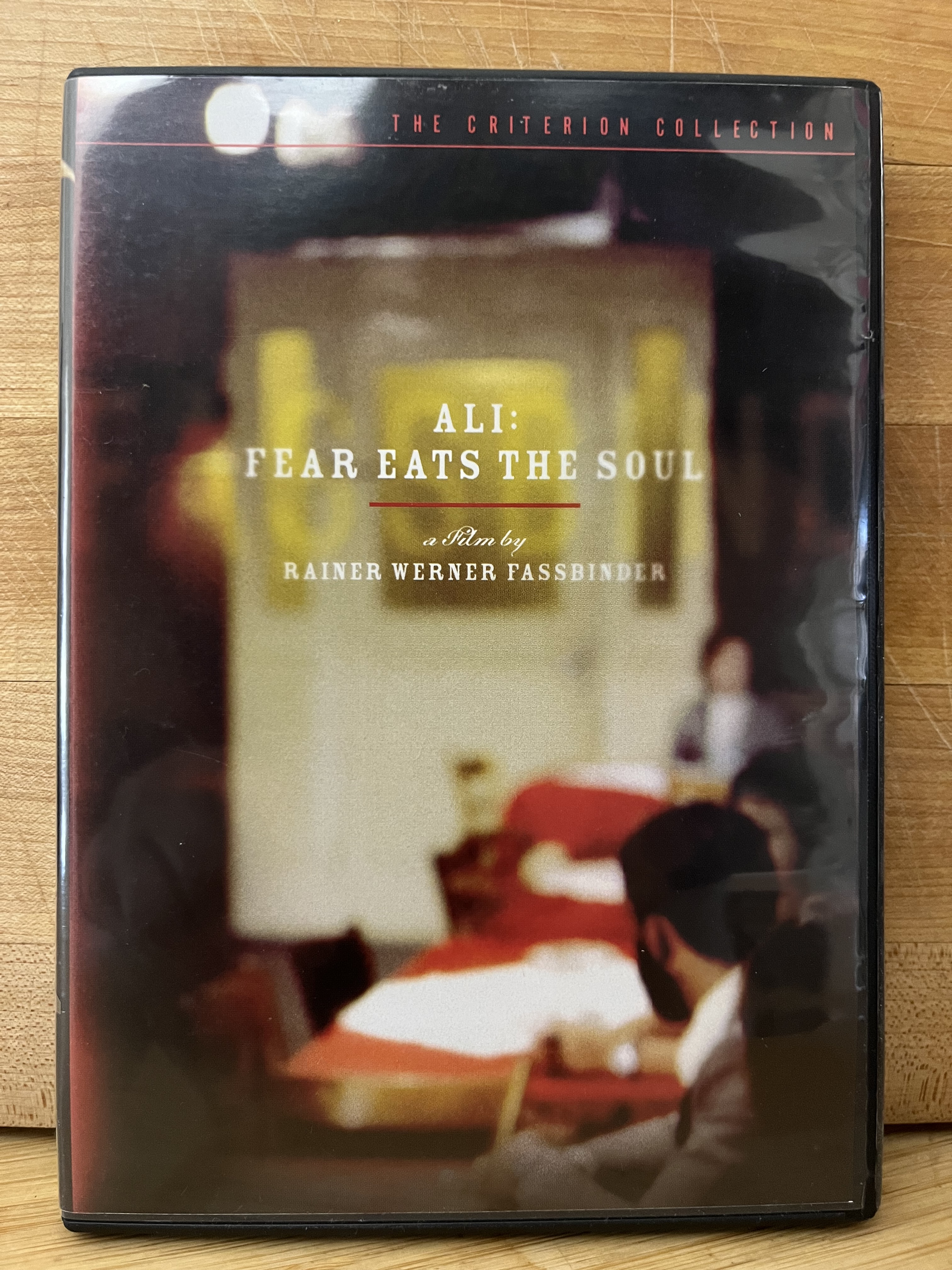
Given these origins, what better film to pair with the Theobroma than a riff on the Rock Hudson vehicle All That Heaven Allows that hails from Germany, “the land of chocolate,” and involves stomach problems as a plot point? I am, of course, referring to Ali: Fear Eats the Soul. Here’s a picture of my Criterion Collection DVD:
It is also streaming on the Criterion Channel and Max with a subscription, can be rented from a variety of other platforms, and some people (including current Cornell University faculty, staff, and students) may have access to it through Kanopy via a license paid for by their local academic or public library as well.
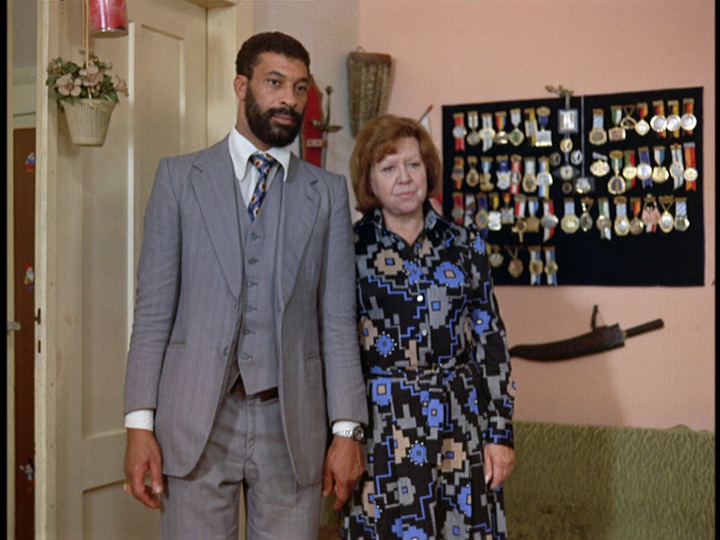
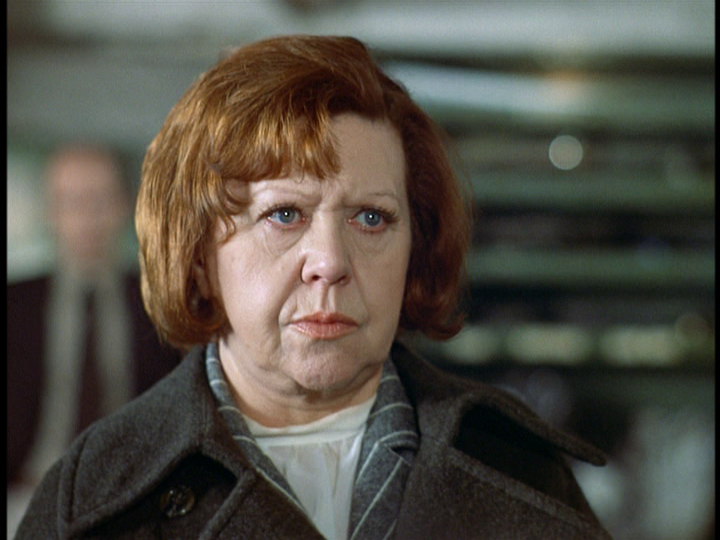
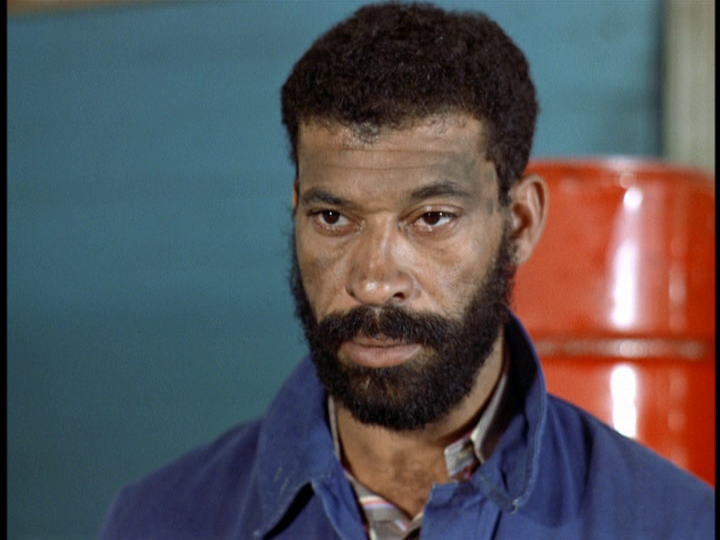
As Klaus Ulrich Militz writes in his book Personal Experience and the Media, the relationship between Ali: Fear Eats the Soul and All That Heaven Allows “is not as clear as it may seem at first.” For starters, although both films revolve around a May-December romance, director Rainer Werner Fassbinder must have conceived of his movie before he encountered its supposed inspiration for the first time in autumn 1970 because “a rough outline of the film’s story-line is told by the chambermaid in the film The American Soldier,” which he shot two months earlier. The fact that his protagonists Emmi (Brigitte Mira) and Ali (El Hedi ben Salem) enter into a relationship with each other at the beginning of it also represents a major structural break with the earlier movie directed by Douglas Sirk, which “largely follows the emancipatory logic of the melodramatic genre because his heroine only gradually manages to overcome her passivity before she eventually commits herself to her lover.” Nonetheless, per Militz, “the fact remains that when Fassbinder eventually made Ali: Fear Eats the Soul in 1973 this was done under the impression of Sirk’s films.”
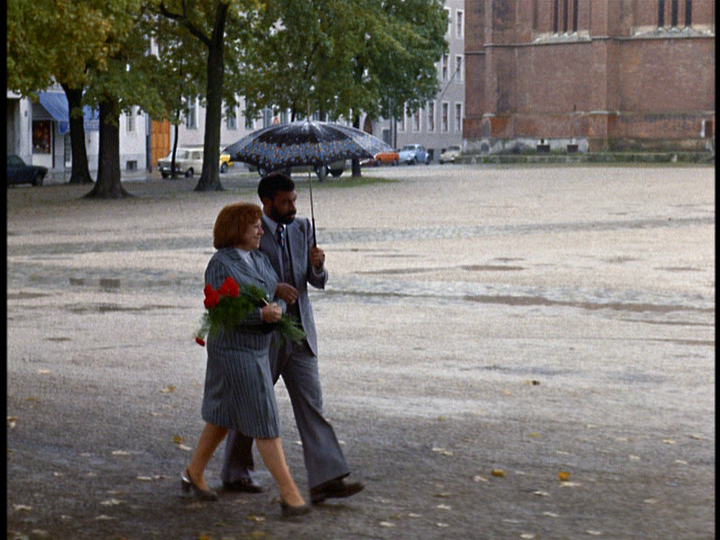
One place many people feel the influence of All That Heaven Allows is in Fassbinder’s use of color. For instance, in her chapter for the book Fassbinder Now: Film and Video Art, Brigitte Peucker observes that the “formal, conformist grey clothing” that Emmi and Ali get married in marks them as “constrained by the social order,” but that it’s offset “by the Sirkian red carnations that emblematize emotion”:
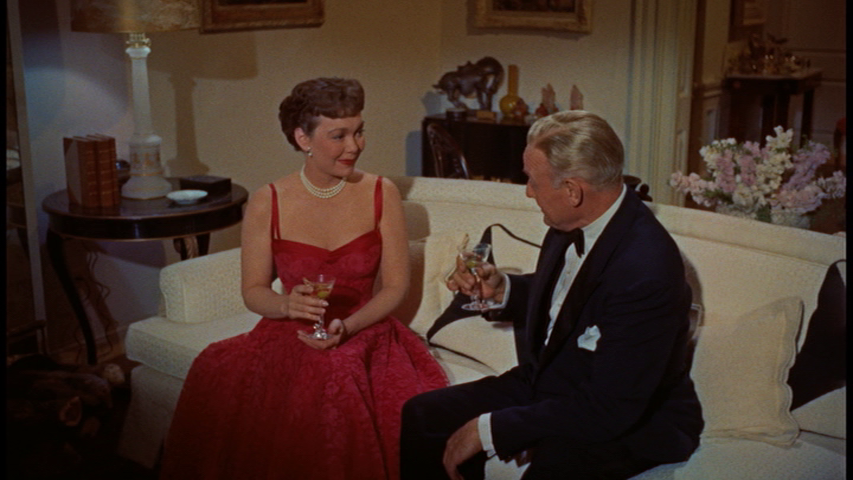
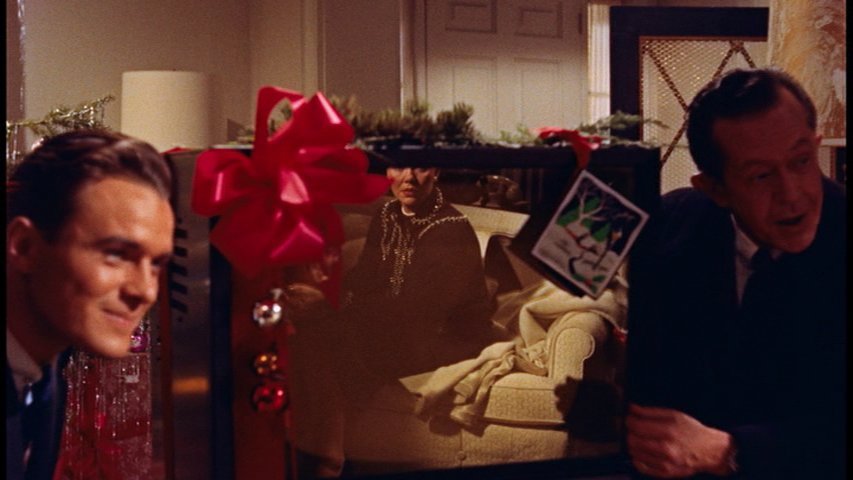
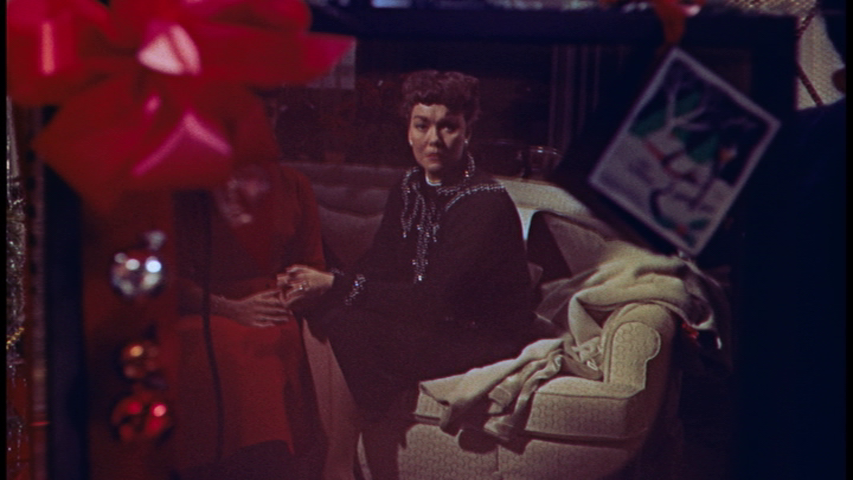
This seems to echo what Brian Price describes in his chapter for the book A Companion to Rainer Werner Fassbinder as the typical reading of the vibrant red dress Jane Wyman’s Cary Scott wears in Heaven to show “what remains inside and–owing to social constraints–invisible.”
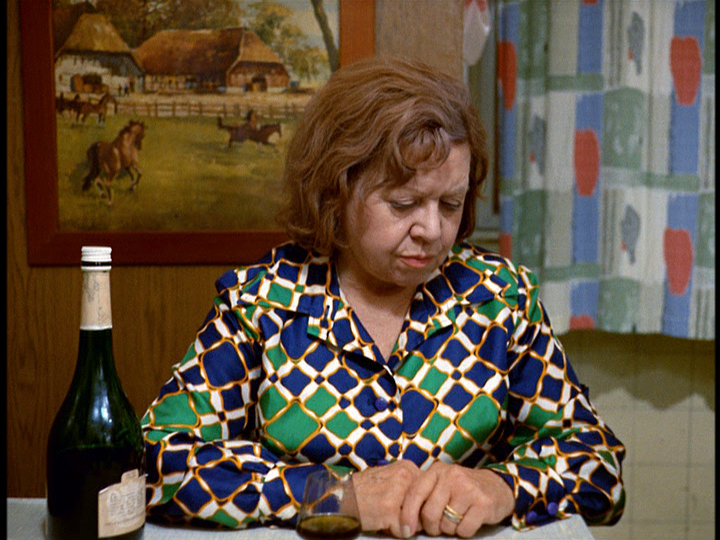
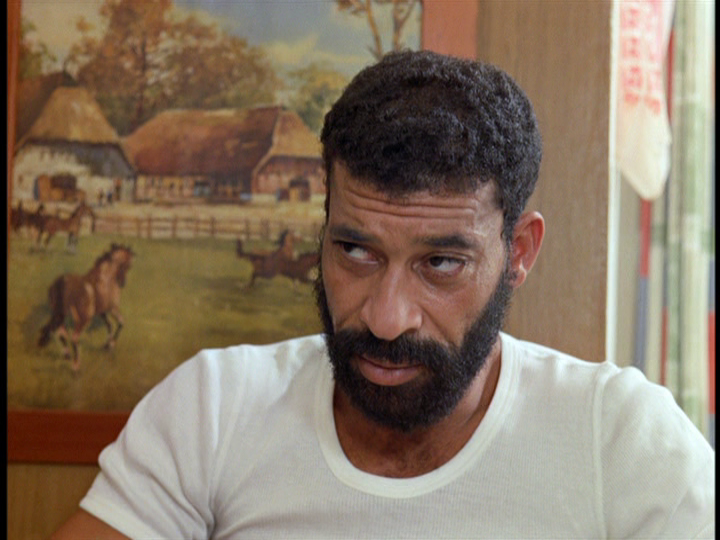
As he notes, though, Emmi’s flowers are different in that “Fassbinder’s colors, unlike Sirk’s, tend toward disharmony and away from the kind of color coordination that makes analogy possible.” Pointing out that the man Cary is with in the image above, Conrad Nagel’s Harvey, is wearing clothing that matches the furniture they are sitting on, Price argues that this provokes a simile: “Harvey, we might say, is like a couch, something to rest on, something solid but soft, immovable–and worst of all for Harvey, something inanimate, or merely functional.” Contrast this with the dresses Emmi favors elsewhere in Ali, such as the one she has on as she sits “in front of an amateur painting of horses running executed in pale yellow gold tones decidedly less bold than the ones Emmi wears” and curtains “which are no less busy than her dress but are nevertheless discordantly situated with respect to it–baby blue instead of navy blue, a dull grayish green instead of the saturated green to which it stands, in the overall composition, in odd contrast”:
To Price “the contrast eludes metaphor” and because “this green is not like that green, then Emmi cannot be defined by the objects and spaces that constitute her on a contingent–and thus reversible–basis.”
My Loving Wife explained to me that this is also a wrap dress like the one designed by Diane von Furstenberg, which per this Time Magazine article she created “for the kind of woman she aspired to be: independent, ambitious, and above all, liberated.” Fascinatingly, it also states that “von Furstenberg was told from a young age that ‘fear is not an option.'” The similarity of that quote to the title of this month’s movie may be just a coincidence, but Emmi’s fashion sense surely isn’t, especially when you consider how many of these garments she has in her wardrobe:
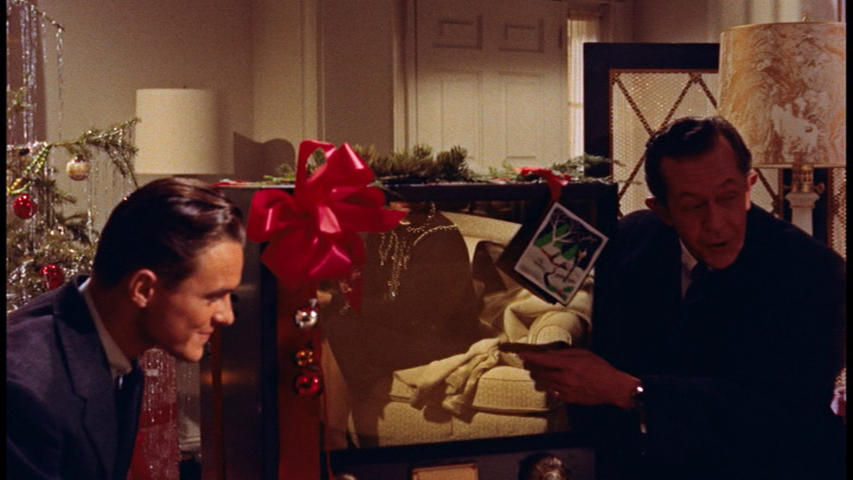
Fassbinder similarly uses the television and frames within frames that appear in Heaven, represented here by a single powerful camera movement:
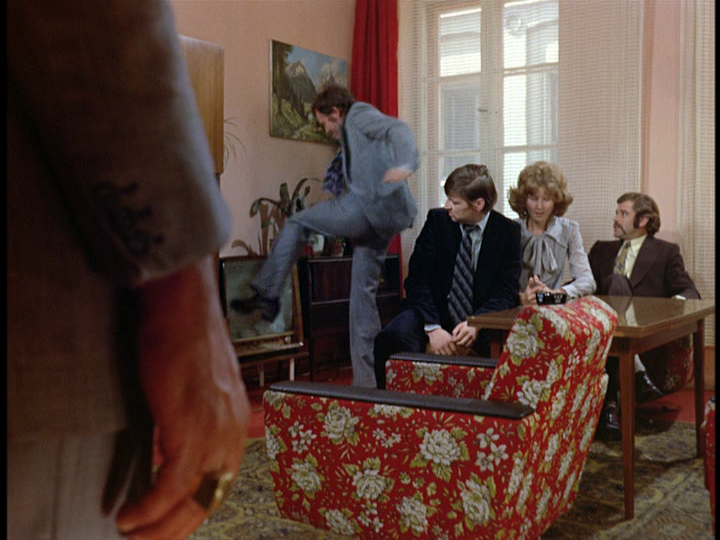
As a launchpad to do his own thing. He transforms the TV from a would-be prison cell into an symbol for the respectable German family that Emmi’s son Bruno (Peter Gauhe) believes she has disgraced with her choice of husband:
Meanwhile, almost every other aspect of the film’s mise-en-scène is a cage. This includes the wedding where Ali and Emmi celebrate their wedding:
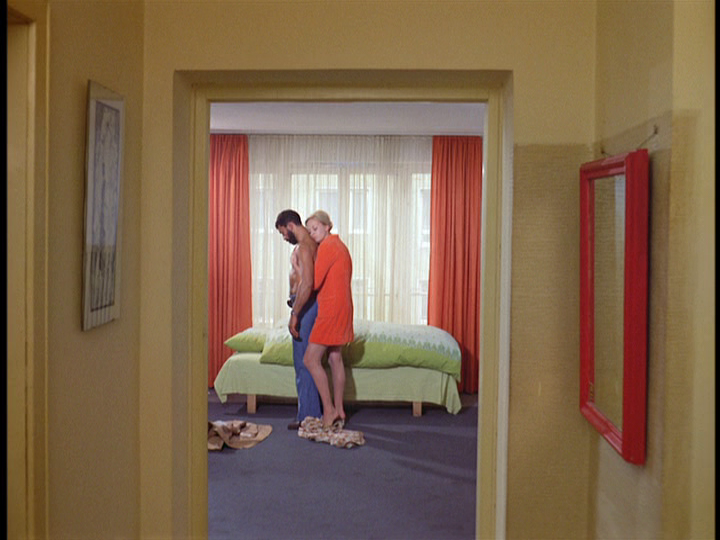
The apartment and bedroom where Ali seeks solace (and couscous!) after his relationship with Emmi calcifies into yet another instrument of exploitation:
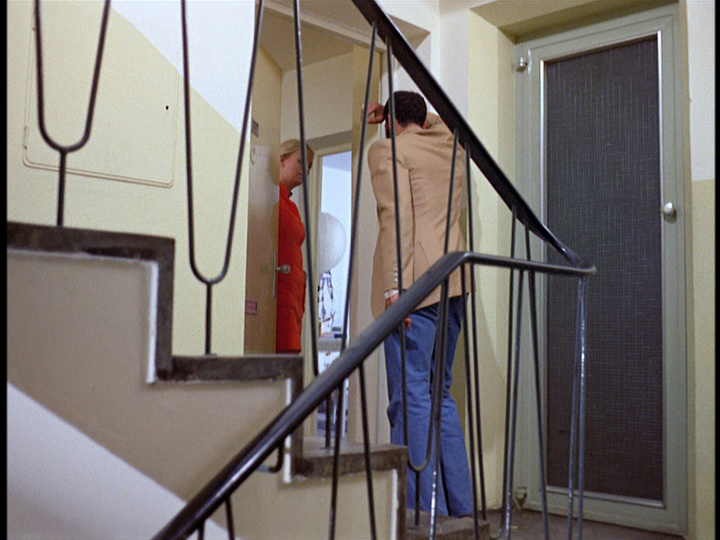
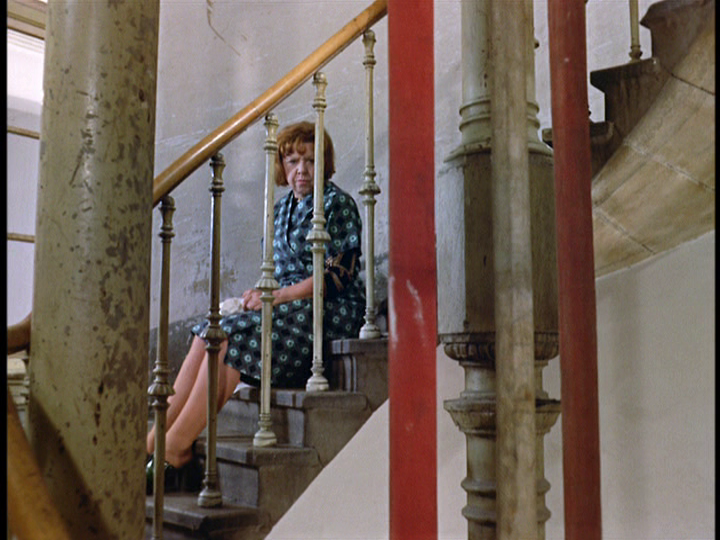
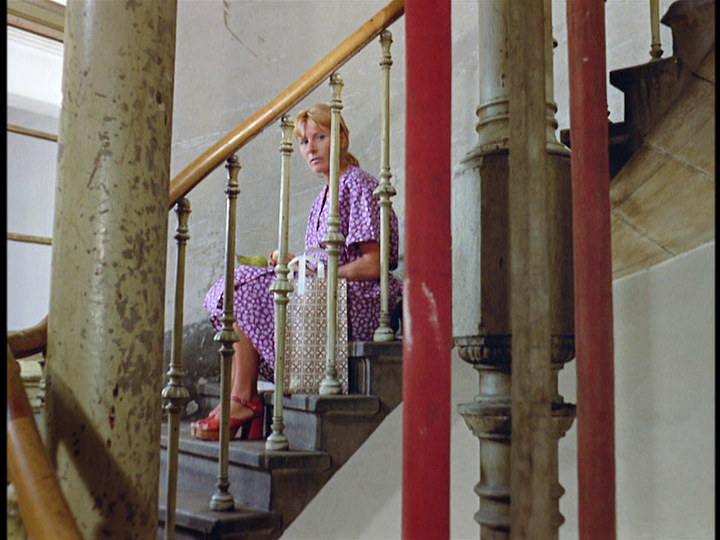
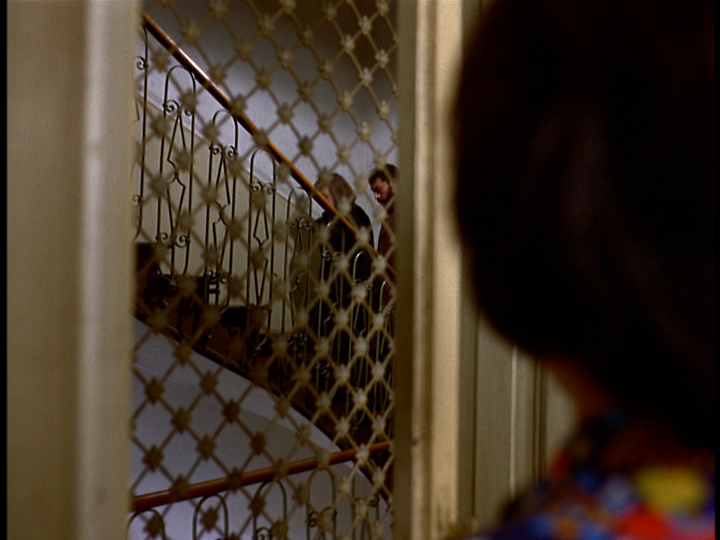
The stairwell where Emmi eats lunch alone after being shunned by her charwomen:
Then, once back in their good graces, joins them in giving the cold shoulder to their new co-worker Yolanda (Helga Ballhaus), a Herzegovinian immigrant:
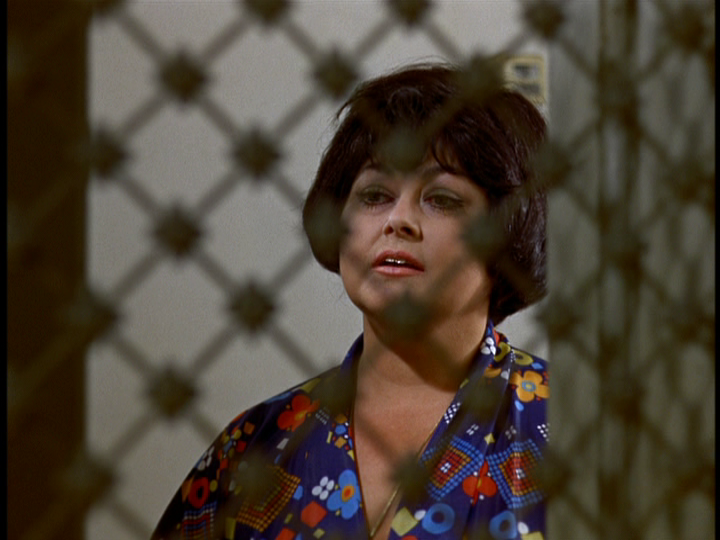
And a shot-reverse shot of a nosy neighbor (Elma Karlowa) watching Ali and Emmi mount the stairs of her building that, Manny Farber writes in an essay collected in the book Negative Space, “suggests all three, like all Fassbinder’s denizens, are caught in a shifting but nevertheless painful power game of top dogs and underdogs”:
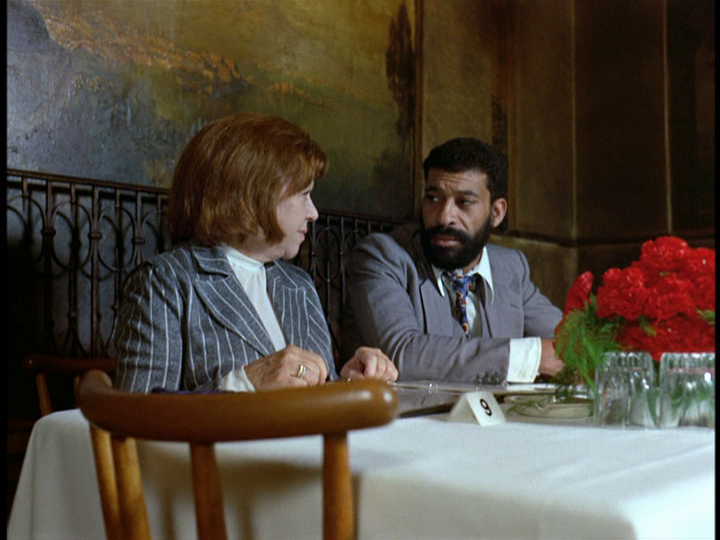
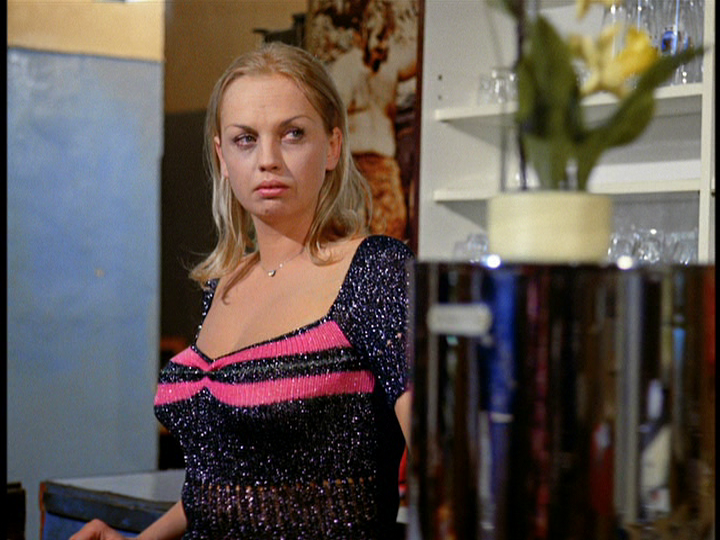
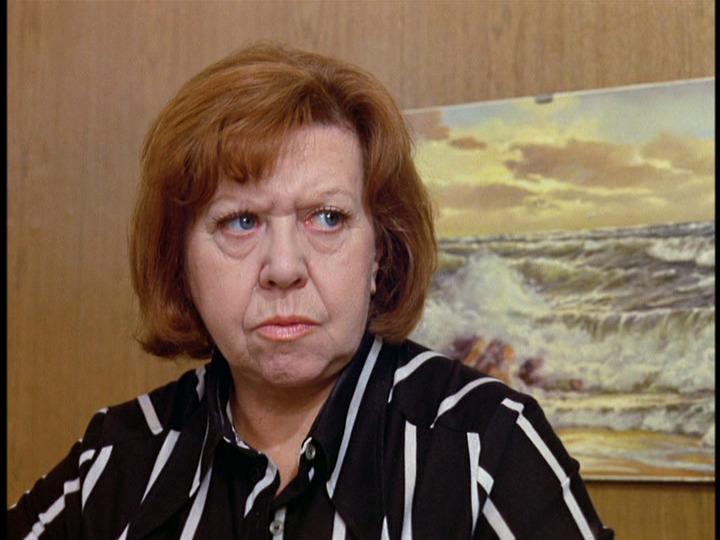
But my favorite aspect of Ali is reminiscent less of Sirk than something Richard Jameson once said about the movie Once Upon a Time in the West. He described it as “an opera in which arias are not sung but stared,” and that’s a perfect fit for this film as well! You can practically hear the thoughts of Asphalt Bar proprietress Barbara (Barbara Valentin) as she sizes up Emmi, who has appeared in her establishment for a second time hoping to find Ali:
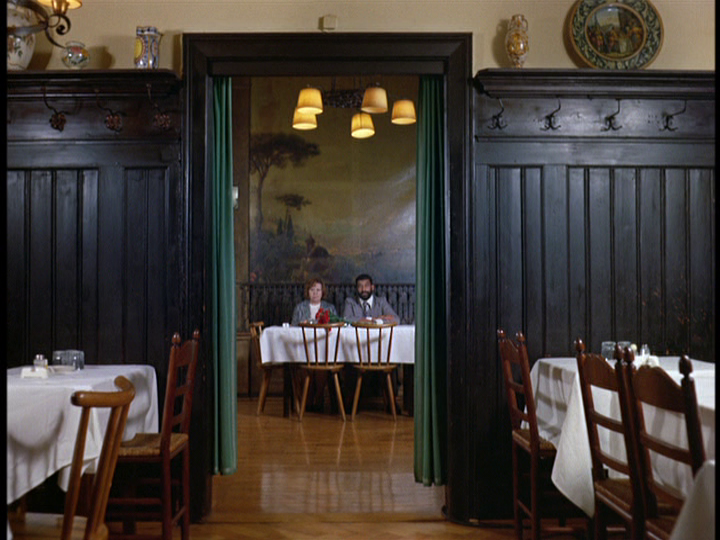
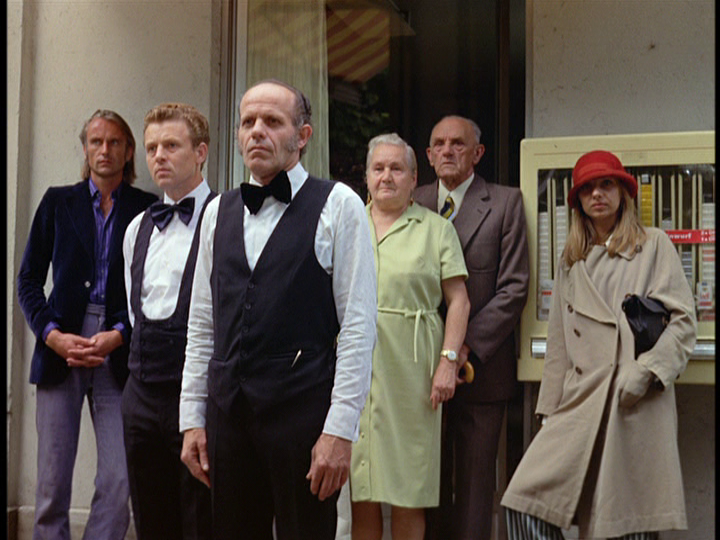
And those of the waiter (Hannes Gromball) at the restaurant “where Hitler used to eat from 1929 to ’33” (!) as he contemplates his unusual customers:
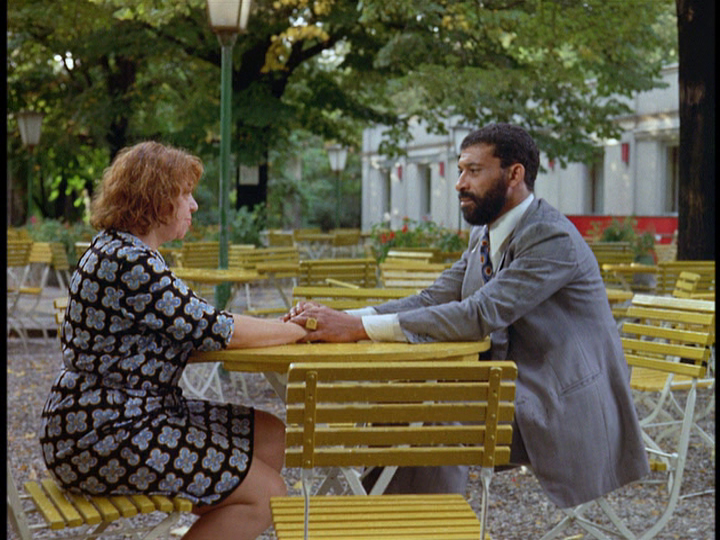
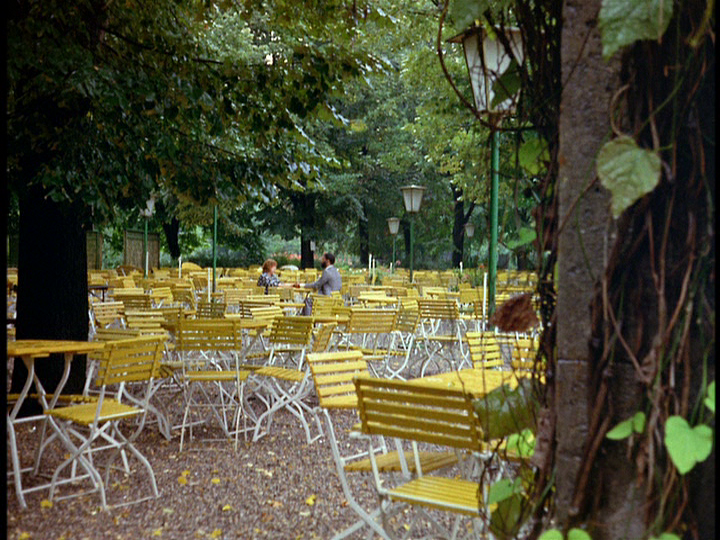
“Sometimes, long silences seem to be an expression of the social hostility encountered by Emmi and Ali, as in the climactic scene in an outdoor cafe immediately before their regenerative vacation,” notes James C. Franklin in a Literature/Film Quarterly article called “Method and Message: Forms of Communication in Fassbinder’s Angst Essen Seele Auf“ (the movie’s German title) where “the interaction of the visual image and the silence creates an atmosphere of utter coldness and hostility”:
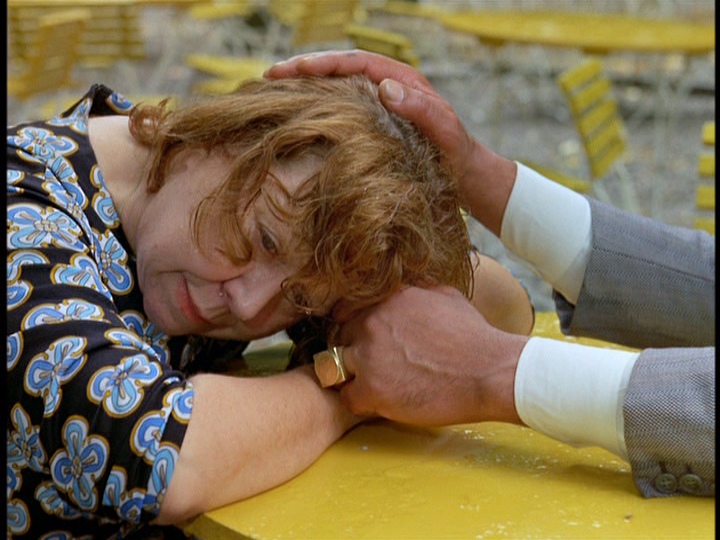
However, my favorite examples of where (as Franklin eloquently puts it) “there is much to be heard in the silence of the soundtrack” are the looks Ali and Emmi give each other the morning after he first comes back from a night out blackout drunk:
And then doesn’t arrive home at all:
The latter occur in the film’s final ten minutes. In a response to a chapter in Robert Pippin’s book Douglas Sirk: Filmmaker and Philosopher for the national meeting of the American Society for Aesthetics that he posted on Letterboxd, Matt Strohl comments on a phenomenon that he calls the “double ending” of subversive melodramas whereby “an ostensible happy ending is subverted by some unsettling element, which might then prompt us to reflect on whether it was really such a happy ending after all and to reinterpret the film in this light.” Although All That Heaven Allows concludes with Cary resolving to “come home” to her lover Ron (Hudson), both scholars argue that we should feel uneasy about this, Pippin (as paraphrased by Strohl) because Cary “did not make the decision to enter into this relationship” but rather “fell into it because of Ron’s newfound need for a caretaker” and Strohl because “Cary has not gotten over her fears and become a full-fledged agent, but rather has slid into a different socially-defined gendered role that she has not actively chosen.”
Ali: Fear Eats the Soul is a different kind of beast. The scene after the second staredown depicted above opens with Ali “gambling away a week’s wages” (as Barbara points out to him) at the Asphalt Bar:
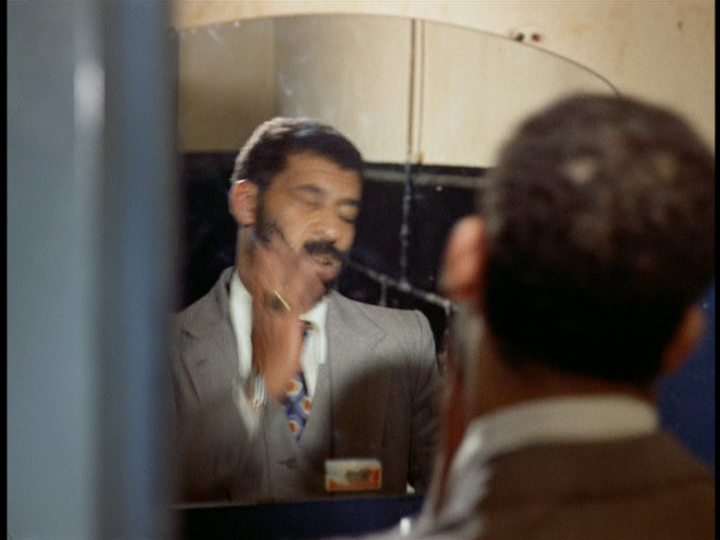
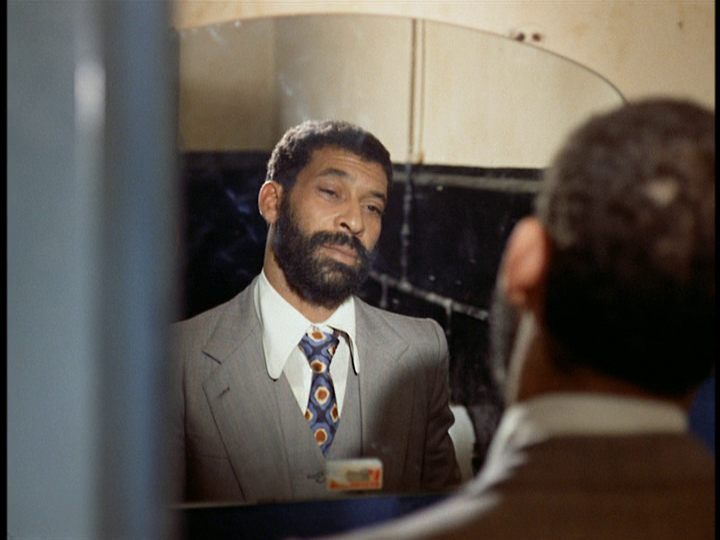
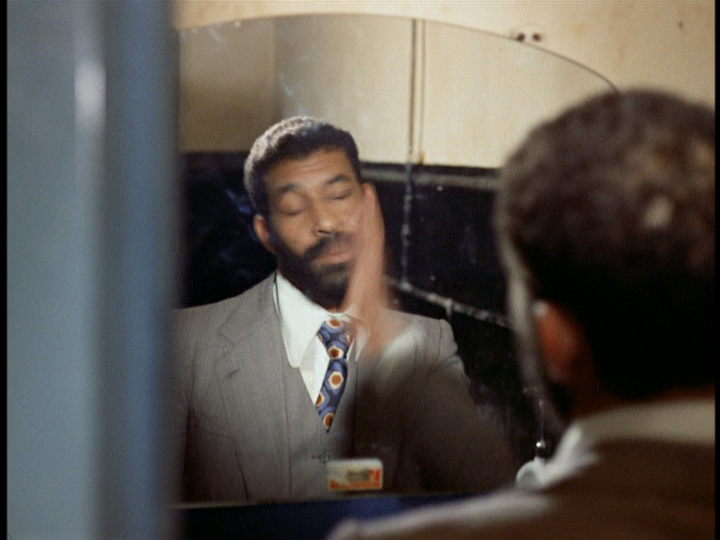
He busts out and sends a friend to his place for 100 more marks. While he waits for the money, Ali goes to the restroom and proceeds to slap himself in the face multiple times in a weird twist on Jackie Gleason’s Minnesota Fats freshening-up routine in The Hustler:
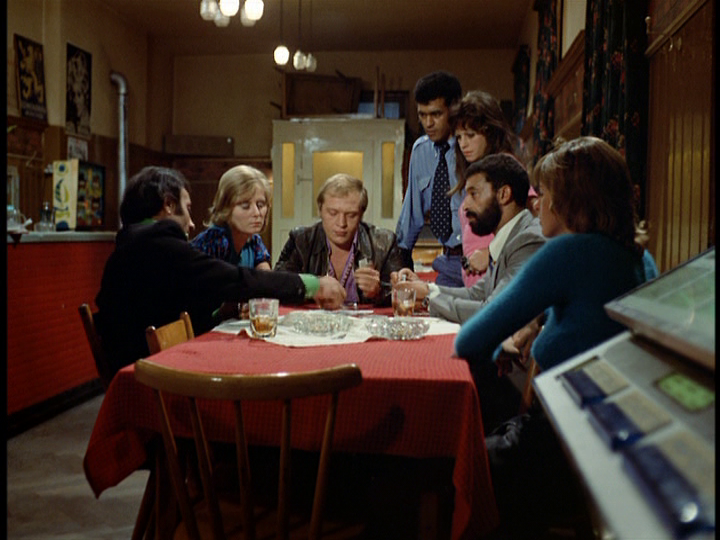
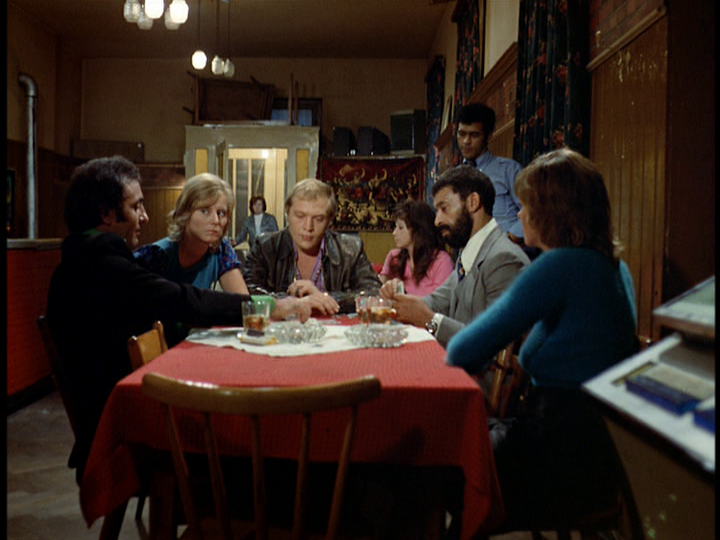
As he sits back down at the table and immediately proceeds to lose a hand, Emmi enters the bar in the background:
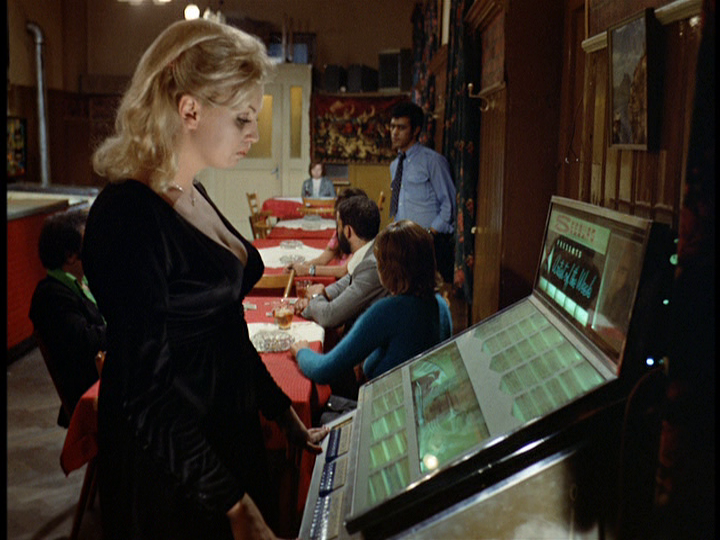
Barbara brings her a Coke, the drink she ordered the night she met Ali, and Emmi asks her to play the tune they later danced to. Ali and his companions stare at Emmi as Barbara selects the song on the jukebox in the foreground of a three-layer composition:
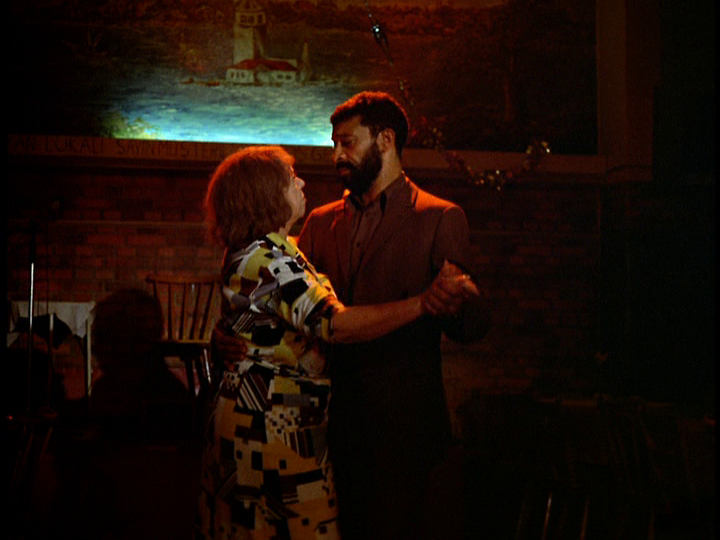
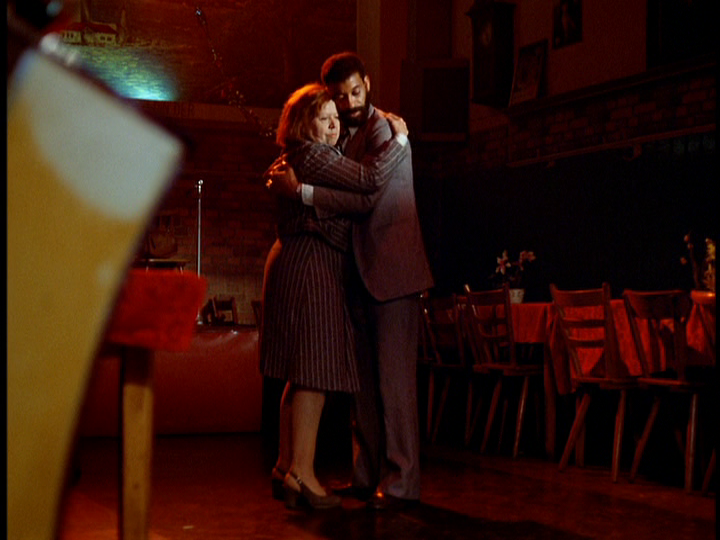
As soon as the music begins playing, Ali stands up and asks Emmi to dance. As the sway back and forth he confesses that he has slept with other women, but she assures him the it isn’t important and that he’s a free man who can do as he likes. “But when we’re together, we must be nice to each other,” she says. “Otherwise, life’s not worth living.”
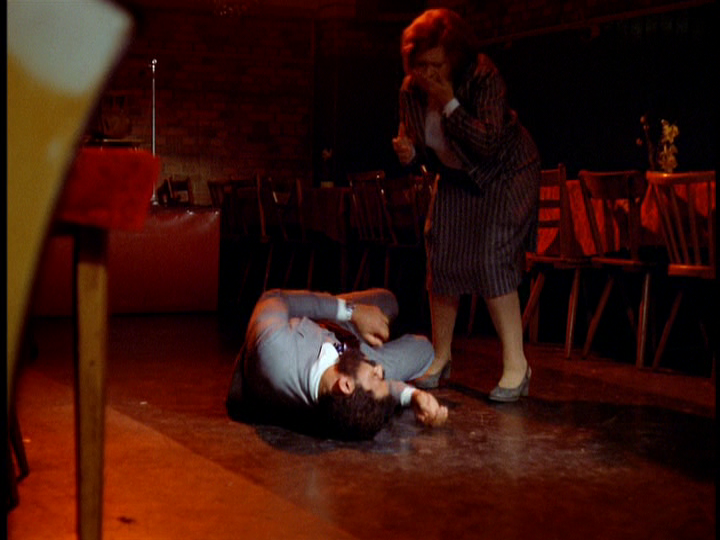
“I don’t want other women,” he responds. “I love only you.” Suddenly, he collapses to the ground, moaning in pain:
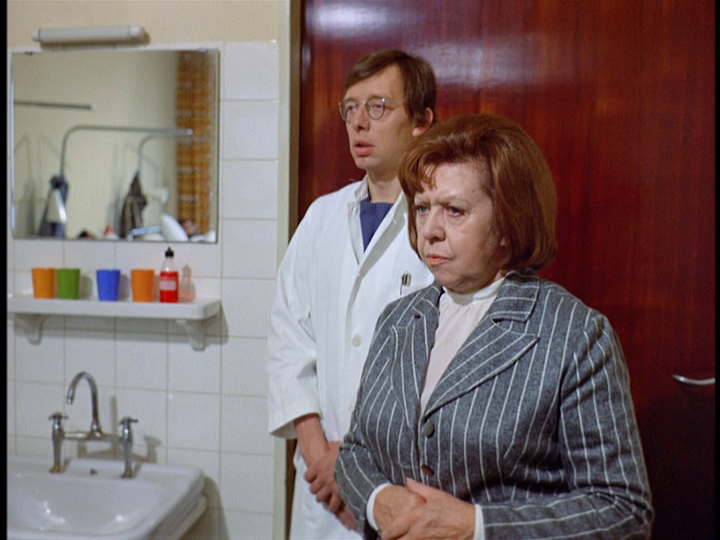
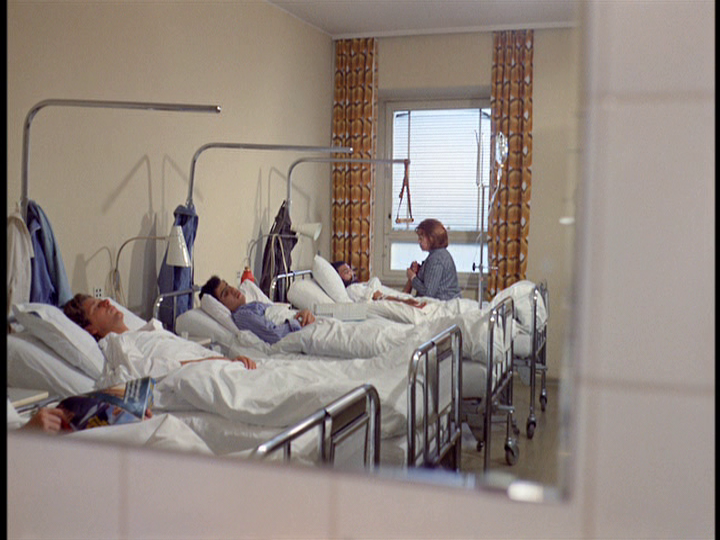
The final scene takes place in a hospital. “He has a perforated stomach ulcer,” a doctor (Hark Bohm) tells Emmi. “It happens a lot with foreign workers. It’s the stress. And there’s not much we can do. We’re not allowed to send them to convalesce. We can only operate. And six months later they have another ulcer.”
“No he won’t,” Emmi insists. “I’ll do everything in my power. . . . ” The clearly skeptical doctor interrupts her: “Well, the best of luck anyway.” Emmi walks over to Ali and the camera tracks in on their reflection in the mirror:
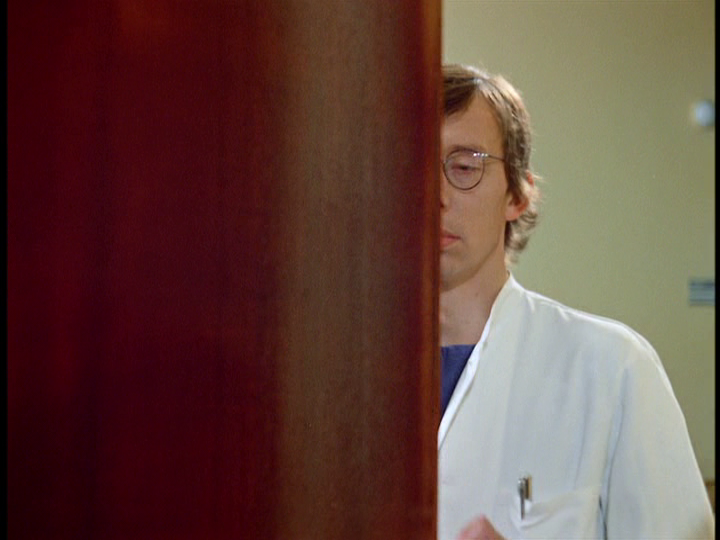
The doctor closes the door:
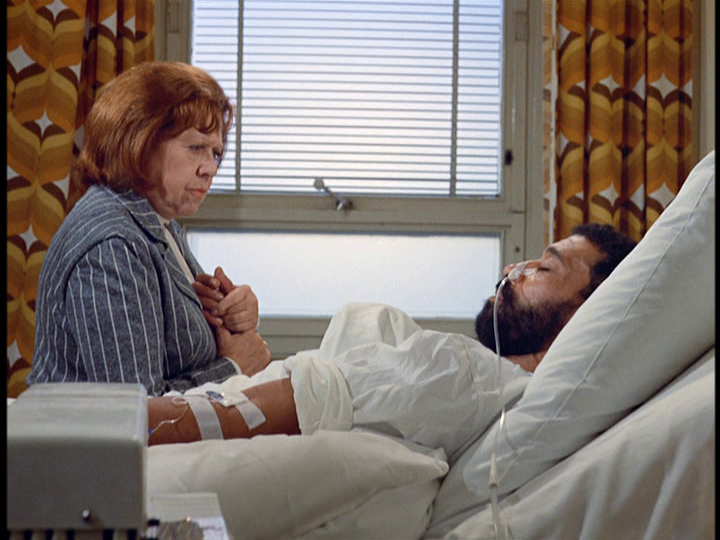
And the film ends with a shot of Emmi crying as she holds an unconscious Ali’s hand:
The utility of the “double ending” for Strohl is that it can explicate an otherwise inchoate sense that “there’s something off” about a Hollywood ending. There’s obviously no need for that here, but if broaden this concept and reinterpret it through the lens of the drink writing idea of a “finish,” it can also give voice to whatever lingers in your mind after the final credits have rolled. Ali‘s finish is the same as the Theobroma’s: they’re both bittersweet, which, if you don’t think that’s appropriate to the Valentine Season, you’ve never really been in love.
Cheers!
All original photographs in this post are by Marion Penning, aka My Loving Wife.Links to all of the entries in this series can be found here.
What I’m Seeing This Week: I didn’t make it to I’m Still Here last week, so I’m going to try to catch it at Cinemapolis after work today, plus I hope to see all three of the Oscar-nominated shorts programs screening there and at Cornell Cinema before next Thursday!
Home Video: If, like me, you were scared away from last Saturday’s Soundtrack to a Coup d’État screening at Cornell Cinema by the weather forecast, fear not! Current Cornell faculty, staff, and students can view this ambitious and stylish found footage documentary about the assassination of Congolese Prime Minister Patrice Lumumba on Kanopy thanks to a license paid for by the Library, and everyone else can rent it from a variety of streaming video platforms. It is edited to the sound and rhythm of the jazz musicians who were unwittingly being used as “cultural ambassadors” to the third world by the same American government that likely killed him until they got wise, and although at 150 minutes it runs a bit long, it’s frequently funny, sometimes shocking, and never dull.
Previous “Ithaca Film Journal” posts canbe found here.A running list ofall of my “Home Video” recommendations can be found here.
Also in Theaters: My favorite new release now playing Ithaca is once again All We Imagine as Light, which screens at Cornell Cinema tonight. The Brutalist, which is at Cinemapolis and the Regal Ithaca Mall, and Nickel Boys, which is at Cinemapolis, are contenders for my Movie Year 2024 top ten list too, and I also enjoyed A Complete Unknown (Cinemapolis + the Regal), Memoir of a Snail (Cinemapolis), Nosferatu (Cinemapolis + the Regal), and The Seed of the Sacred Fig (Cinemapolis). Noteworthy special events include free screenings of I Didn’t See You There (which is directed by Reid Davenport, whose new film Life After just debuted at Sundance to much acclaim) and Oppenheimer at Cornell Cinema on Tuesday and Wednesday respectively and a screening of Bisbee ’17 followed by a conversation with director Robert Greene there on Monday. Finally, your best bets for repertory fare are The Third Man, and The Life and Death of Colonel Blimp, which play Cornell Cinema Friday and Sunday respectively. You can also see Nosferatu the Vampyre there tonight.
Home Video: Speaking of my top ten list, I now know for sure that Evil Does Not Exist, which is currently streaming on the Criterion Channel, will be on it following a second viewing. Oft-described as an eco-fable or -parable, it is more broadly about the concept of balance: although the bare-bones plot revolves around a “glamping” concern descending on a rural farming community, the gutshot deer at the beginning of the film which was dead before they ever arrived demonstrates that the one at the end doesn’t have anything to do with it directly. Playmode (what a great awful name!) employee Takahashi (Ryûji Kosaka) is instead standing next to Hitoshi Omika’s Takumi when they encounter it because he has gotten absurdly carried away with an idea of who he *could* be, which only serves to reveal how little he knows about the man he actually is and the world he’s trying to shoehorn himself into. Evil Does (Not) Exist (which is how the font coloring of the title card suggests it maybe should be written) also features a satisfyingly crisp winter color palette and a frustrating community feedback meeting that I have been on both sides of the table of at least a hundred times in my life.
Previous “Ithaca Film Journal” posts canbe found here.A running list ofall of my “Home Video” recommendations can be found here.
What I’m Seeing This Week: I am going with Hard Truths, which closes at the the Regal Ithaca Mall today but continues its run at Cinemapolis at least through next Thursday, and continuing my quest to see all of this year’s Oscar nominees before the ceremony on March 2, I’m also planning to see The Seed of the Sacred Fig sometime after it opens there tomorrow.
Also in Theaters: Speaking of the Oscars, Best Animated Feature Film nominee Memoir of a Snail (which I’m planning to see next week) also opens at Cinemapolis tomorrow. Other contenders you can see on local big screens include The Brutalist (Cinemapolis + Regal), A Complete Unknown (Cinemapolis + Regal), Nickel Boys (Cinemapolis), Nosferatu (Cinemapolis + Regal), and Wicked (Regal). My favorites are The Brutalist and Nickel Boys, but they’re all worth seeing. The very best new movie now playing Ithaca that I’ve already seen is All We Imagine as Light, which screens at Cornell Cinema Saturday evening. I also enjoyed Babygirl and Presence, both of which are at the Regal. This week’s special events are highlighted by the Ithaca Underground Music Video Festival, which is at Cinemapolis tonight. Your best bets for repertory fare are A Matter of Life and Death, which is at Cornell Cinema tomorrow, and Shadows of Forgotten Ancestors, which is there on Saturday. You can also see last week’s “Home Video” recommendation Mulholland Drive there tonight along with Eraserhead, which is of course also directed by the late, great David Lynch.
Home Video: Six films have basically already clinched spots on the top ten list for Movie Year 2024 I’ll publish in March. All We Imagine as Light is one of them. Another is Close Your Eyes, which recently started streaming on Mubi. I originally thought I was going to present it as tied with La Chimera and write them up together, but while they do have a lot in common thematically, Close Your Eyes has started to differentiate itself in my mind, so we’ll see. Anyway, here’s what I said about it on Letterboxd:
Close Your Eyes begins and ends with excerpts from one of my new favorite films within a film, an unfinished work called The Farewell Gaze, and contains both a diegetic rendition of “My Rife, My Pony and Me” and a load-bearing reference to Carl Theodor Dreyer, but it’s way more than mere cinephile catnip. Rather, like Movie Year 2024’s La Chimera, it’s a thorough and nuanced investigation of the question Is it possible for an aesthete to live a good life in the absence of art? Where that film’s Arthur (Josh O’Connor) is faced with a choice, though, this one’s protagonists Miguel Garay (Manolo Soto) and Julio Arenas (Jose Coronado) have that reality thrust upon them. Or do they? Doubling abounds–even the title is a reference to director Victor Erice’s 1973 magnum opus The Spirit of the Beehive.
Previous “Ithaca Film Journal” posts canbe found here.A running list ofall of my “Home Video” recommendations can be found here.
The San Francisco Nog created at Waltham, Massachusetts bar Deep Ellum has been a favorite in our house ever since Frederic Yarm wrote about it on his Cocktail Virgin Slut blog a few years ago. With Fernet Branca on my mind, it was natural that my thoughts would also turn to San Francisco, since for reasons Grant Marek chronicled for SFGate that spirit is linked to the city “in the same way that Malort is to Chicago and Guinness is to Dublin, Ireland.” This led me to a movie filmed there that I’ve been entranced with ever since I encountered stills from it in David Cook’s A History of Narrative Film as an undergraduate film studies major: The Lady from Shanghai. A dairy-based beverage would be a terrible fit for its hot and sweaty first half, so instead I’m taking a cue from the yacht the Circe which belongs to the titular lady Elsa Bannister (Rita Hayworth) and her husband Arthur (Everett Sloane) and pairing it with the Don’t Give Up the Ship cocktail that most drinks historians agree first appeared by that name (there’s also a concoction called a Napoleon in The Savoy Cocktail Book with the exact same ingredients) in Crosby Gaige’s 1941 Cocktail Guide and Ladies Companion, but which, like the Last Word I wrote about in 2023, owes its present-day popularity to Seattle’s Zig Zag Cafe.
As Jason O’Bryan noted in The Robb Report, there are now two versions of the drink. He favors the rendition made with Cointreau and sweet vermouth, but My Loving Wife and I enjoy the one that features Grand Marnier and Dubonnet Rouge more. He’s actually a fan of both and describes the original as “a lower-toned winter drink,” which is obviously appropriate to the season, and we think it’s a better platform for the fernet as well. Using a movie comparison that I appreciate as a child of the 90s, O’Bryan speculates on his Drinks and Drinking blog that this “may be a Happy Gilmore/Billy Madison situation.” Anyway, the recipe by Zig Zag’s Ben Dougherty which O’Bryan and others link to is no longer on Food & Wine magazine’s website, but you can still find it in their 2007 Annual Cookbook. Here’s how to make it:
1 1/2 ozs. Gin (Junipero) 1/2 oz. Dubonnet Rouge 1/4 oz. Grand Marnier 1/4 oz. Fernet Branca
Stir all ingredients with ice and strain into a chilled glass.
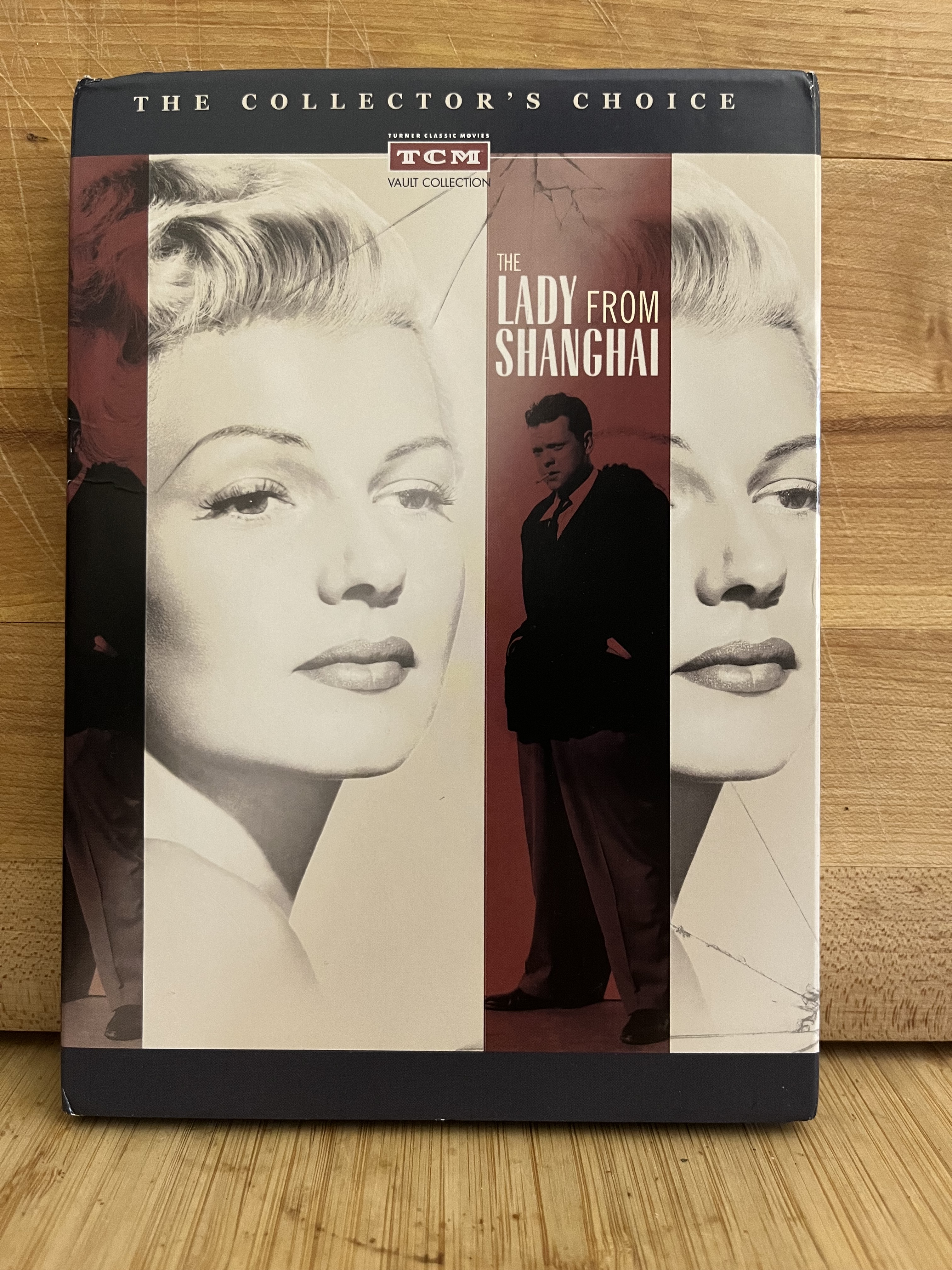
Junipero is ideal here because it’s made in San Francisco and also matches O’Bryan’s call for a “big, robust, juniper-forward” selection. In addition to being delicious, Grand Mariner is also made with a brandy base, which as Eddie Mueller says in his description of the Sailor Beware cocktail he created to pair with The Lady from Shanghai for his Noir Bar book seems “a likely libation for sinister shyster Arthur Bannister.” Both the gin and fernet are very prominent, so steer clear if you aren’t a fan of those ingredients. But if, like us, you love them: full speed ahead! On to the film. Here’s a picture of my TCM Vault Collection Blu-ray/DVD:
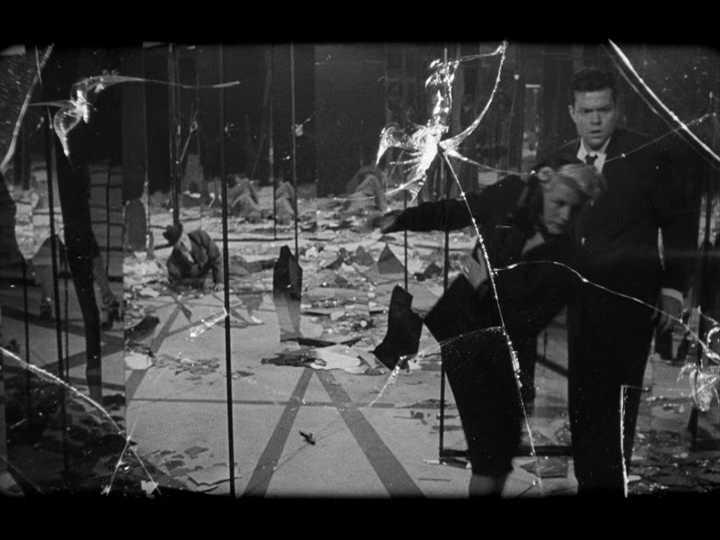
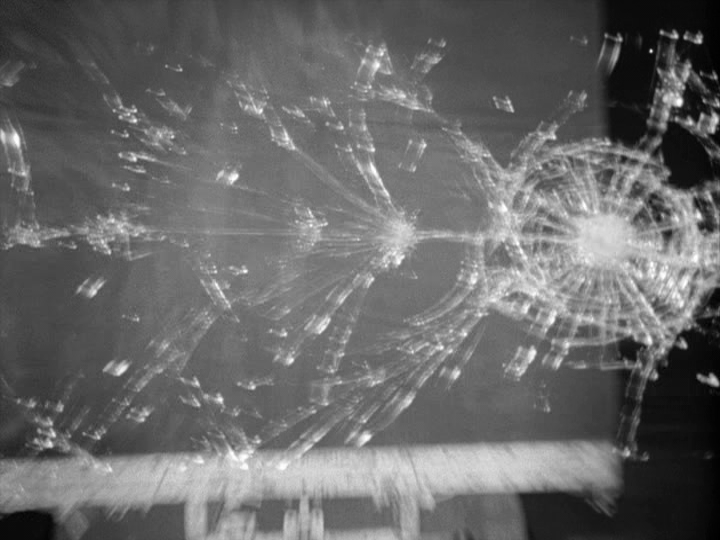
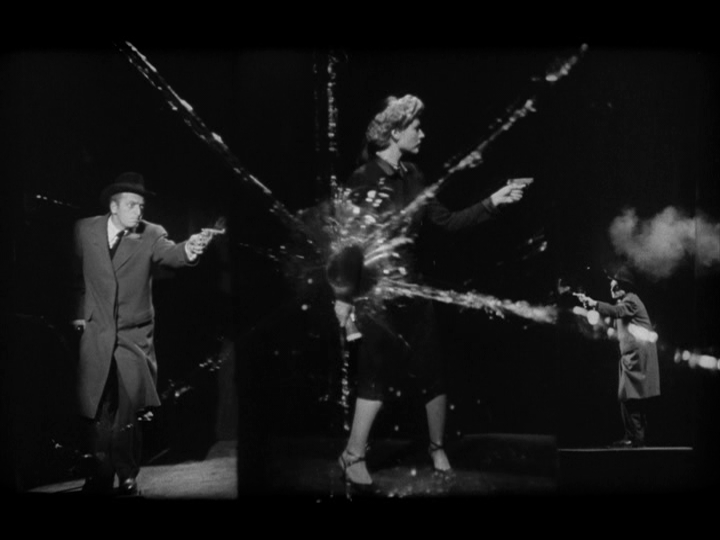
Dave Kehr famously calledThe Lady from Shanghai “the weirdest great movie ever made,” but as James Naremore writes in his book The Magic World of Orson Welles, “its strangeness did not result from an early, deliberate plan.” Instead, he argues that as a result of some combination of interference by Columbia Pictures and the “weariness, contempt, or sheer practical jokery” of its director, “the movie seems to have been made by two different hands.” Naremore points to the fact that it was “reduced by almost an hour from its prerelease form” and “substantially revised” at the behest of studio chief Harry Cohn (who allegedly offered $1,000 to anyone who could explain its plot to him after viewing the rough cut) as his primary evidence for this, but I haven’t read anywhere that Welles ever intended to edit the film himself and it’s hard to know for sure what exactly a finished version that he had more say in might have looked like. Based on the interviews with him that Peter Bogdanovich compiled into the book This Is Orson Welles and reads from on the commentary track on my DVD, for instance, the single-take version of the opening Central Park sequence (which American Cinematographer reported set a record for the longest dolly shot ever filmed) was always destined to be cut apart and down. It’s also not as if every shot overseen by Welles that made the final cut is beyond reproach. As Naremore says about one that I’m unfortunately no longer able to not see, the decision to use a panning movement which causes the jagged edges of glass at the corners of the frame below to move “is clearly a director’s error”:
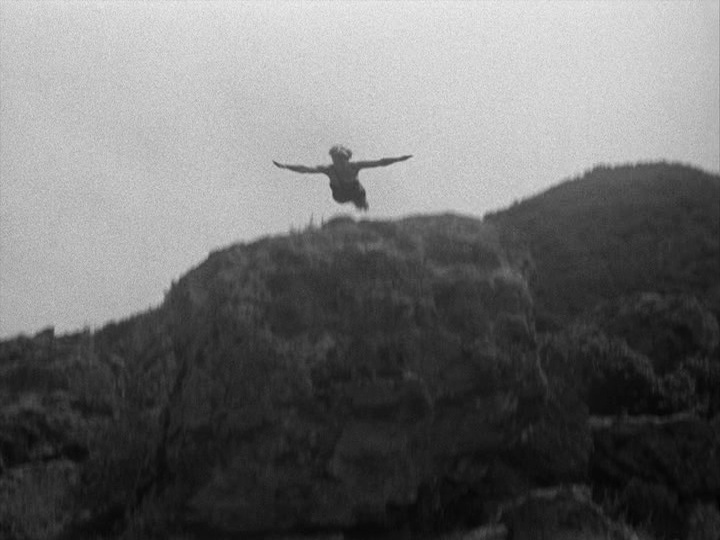
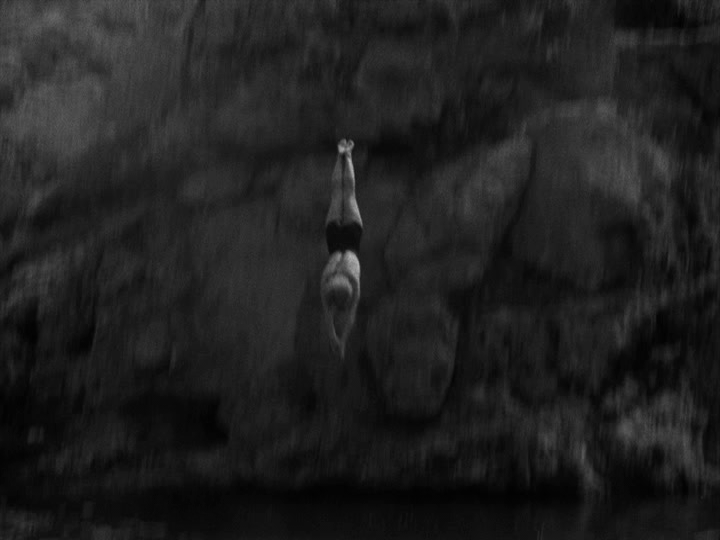
Welles’s biggest objection seems to have been to the music by Heinz Roemheld, exemplified for him by the “Disney”-esque glissando added to this dive:
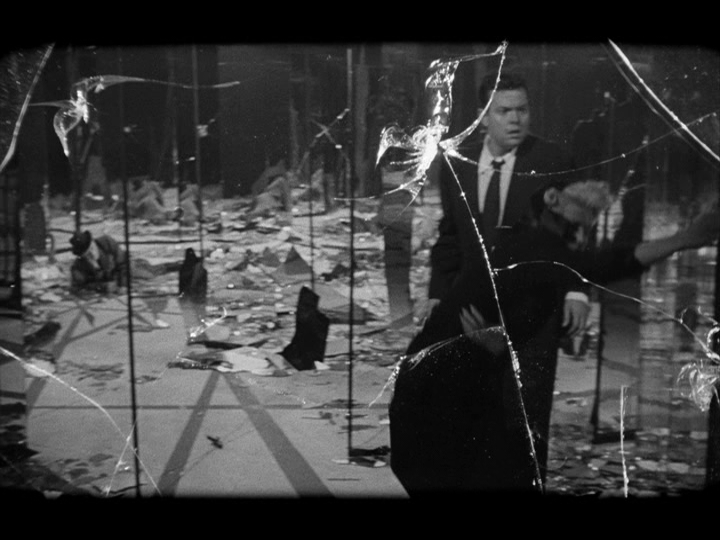
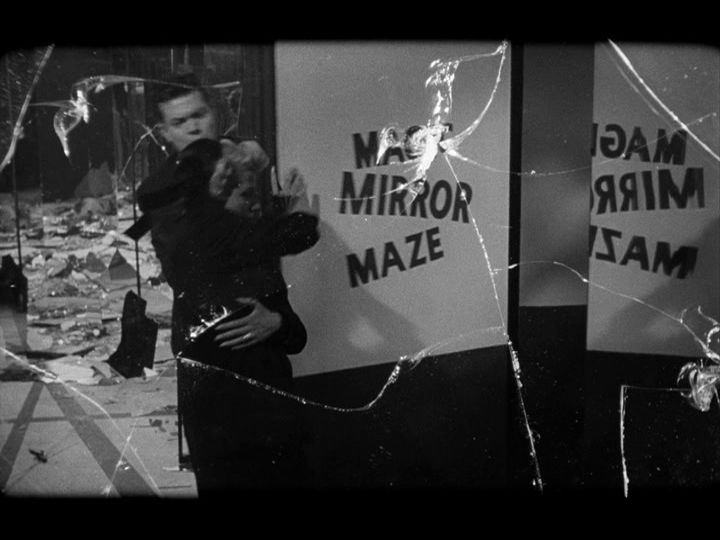
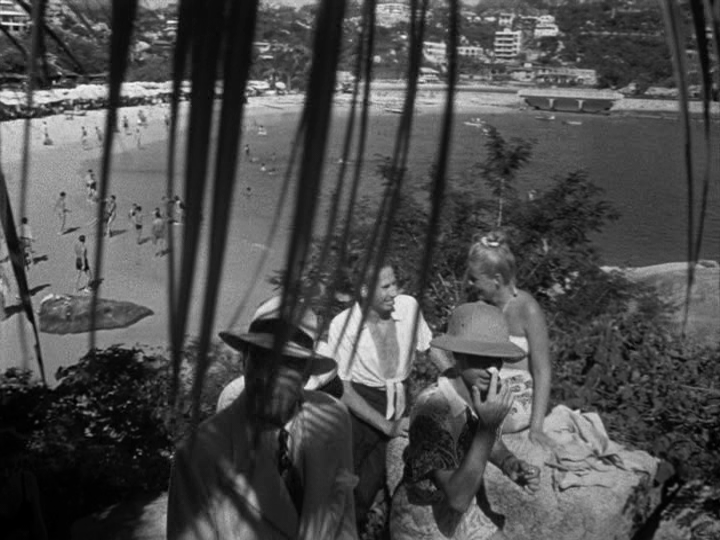
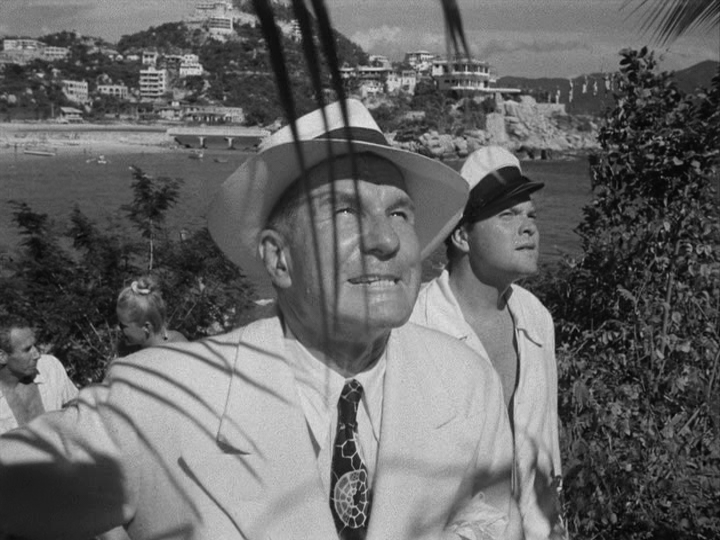
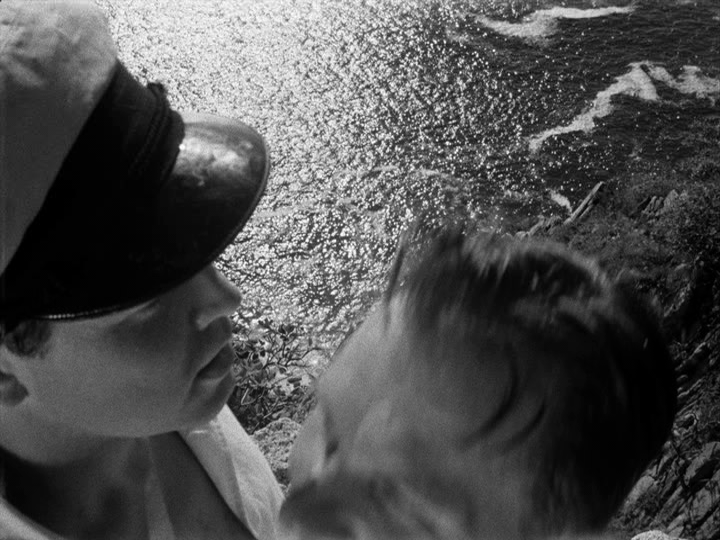
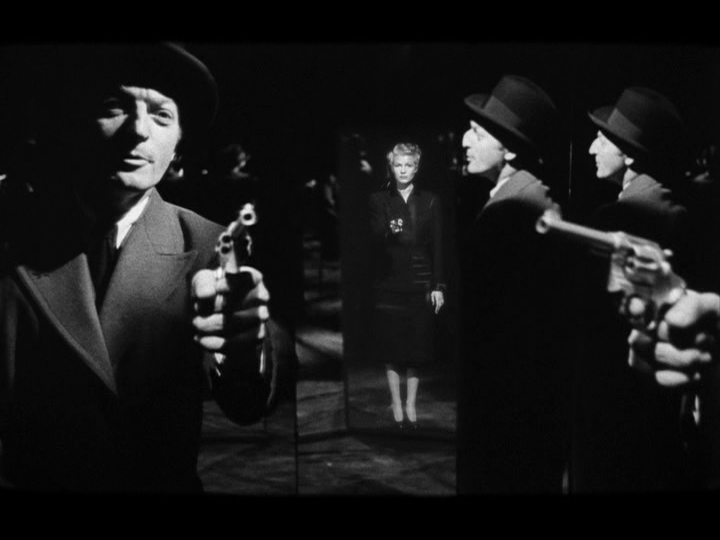
And although I don’t actually have a problem with the way the climactic Magic Mirror Maze shootout sounds today, it’s hard not to be intrigued when Welles tells Bogdanovich that it “should have been absolutely silent except for the crashing glass and ricocheting bullets–like that, it was terrifying.” Even more obviously tragic are the cuts from the final shooting script for the Acapulco sequence which Naremore describes in Biblical terms as depicting Glenn Anders’s George Grisby “tempting” Welles’s Michael O’Hara atop a mountain:
As Grisby and O’Hara stroll up the hillside from the beach, Grisby’s remarks are systematically played off against American tourists in the background, whose conversations about money become obsessive and nightmarish. We see a little girl attempting to get her mother to buy her a fancy drink. “But mommy,” she says, “it ain’t even one dollar!” Then a honeymoon couple walks past. “Sure it’s our honeymoon,” the young man says, “but that’s a two-million dollar account.” An older lady and her husband cross in front of the camera, arguing about taxi fare. “I practically had to pay him by the mile,” the lady complains. A gigolo speaks to a girl seated on a rock. “Fulco made it for her,” he announces. “Diamonds and emeralds–must’ve cost a couple of oil wells. And she only wears it on her bathing suit.” Another young couple walks up the steps from the beach, the man rubbing his nose with zinc oxide as he mutters, “but listen, Edna, you’ve got to realize pesos is real money.” Two girls enter the scene, one of them saying “Heneral–that means General–in the army like. Only this one’s rich.” Meanwhile, through all of this, Grisby babbles about the atomic bomb and the end of the world, ultimately turning and asking O’Hara, “How would you like to make five thousand dollars, fella?”
All that remains of this dialogue are the line from the gentleman afraid of sunburn and the Spanish lesson (although you can also see a couple of the other characters) and as a result all of this meaning is pretty much entirely lost.
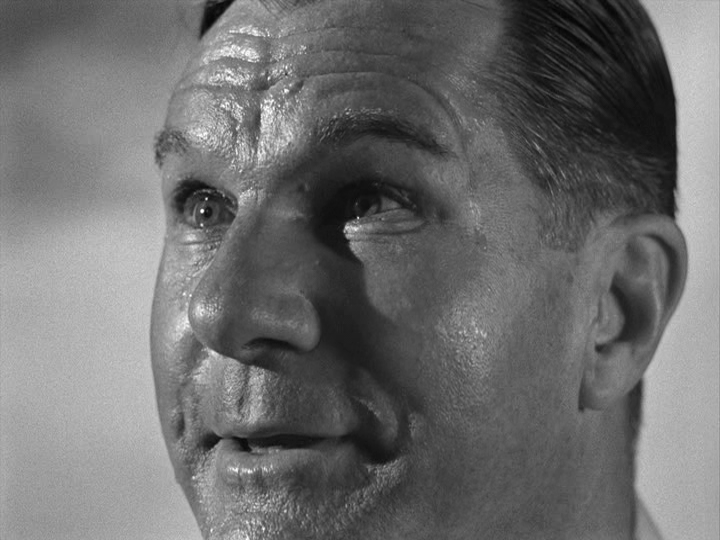
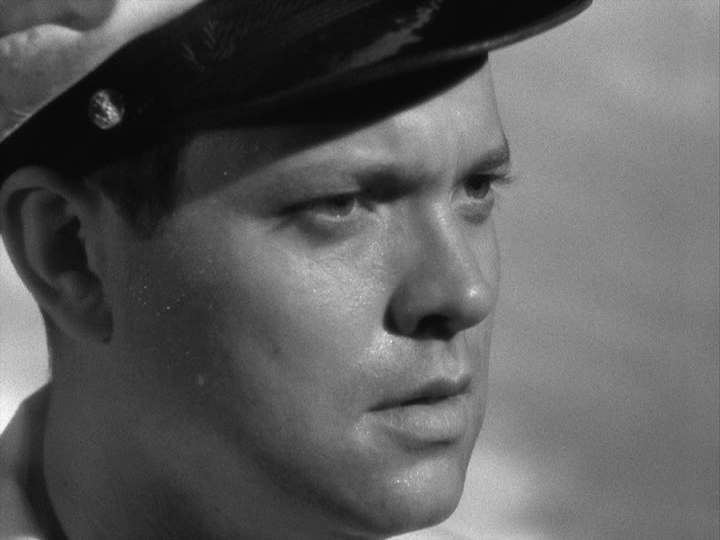
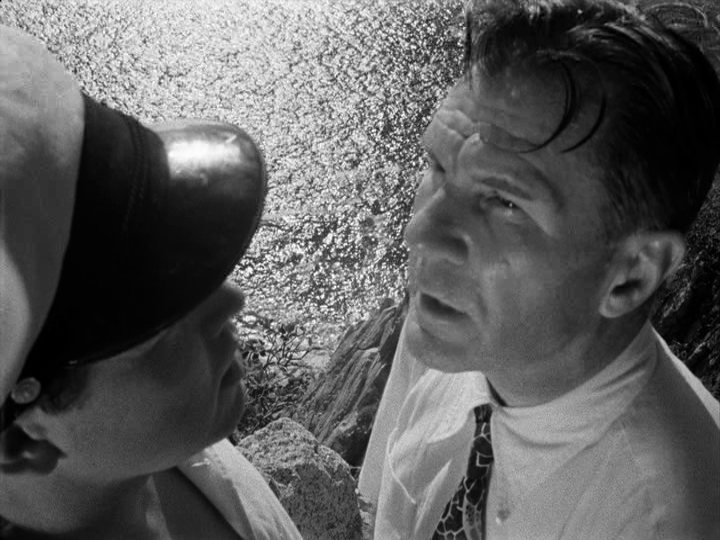
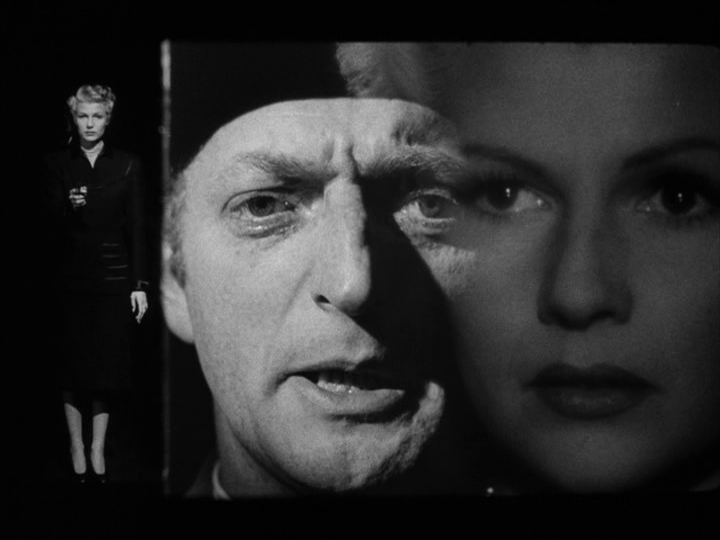
And yet! This scene is nonetheless burned into my memory because it ends with one of my favorite shots in the whole history of cinema. Grisby explains that all Michael needs to do to earn the money he’s offering is to kill someone. “Who, Mr. Grisby?” O’Hara asks. “I’m particular who I murder.” Cut to a sharp-focus close-up of Grisby’s face that contrasts strikingly with a softer one of Michael’s, which Naremore argues is an example of how “glamorous studio portrait photography contributes to the film’s aura of surrealism:
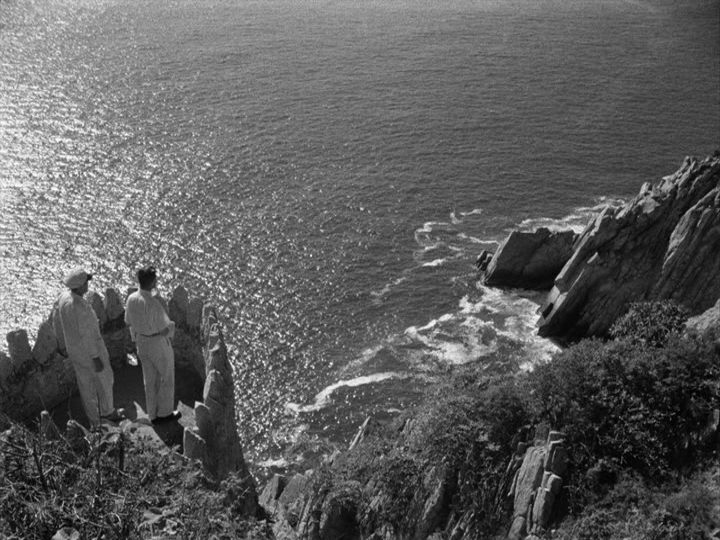
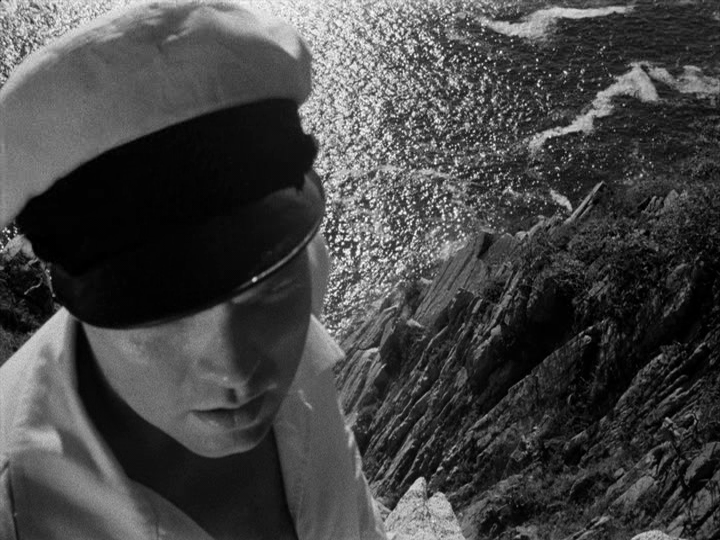
“It’s me,” Grisby says. What follows is brilliantly disorienting because when combined with an earlier establishing shot that places the two men on a sort of parapet:
The high angle perspective makes it look like Grisby is falling off the edge of the frame to his death when he says “so long, fella!” and suddenly steps away:
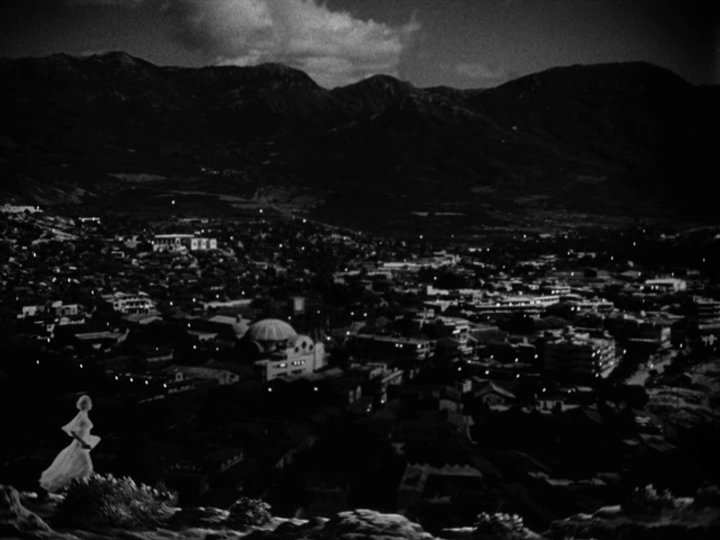
This impression is compounded by the fact that the next scene includes an image of Elsa looking ghostlike as she runs in front of a nighttime cityscape in a white dress:
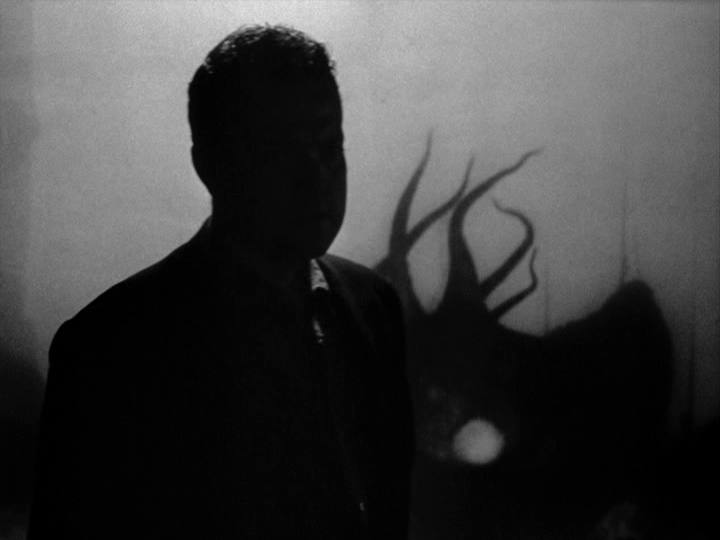
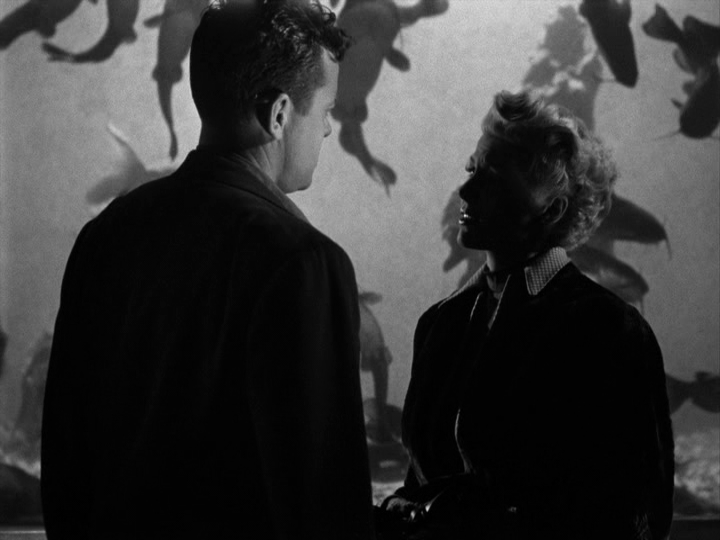
To the point that it’s strange to hear her and Michael talk about Grisby in the present tense. Equally unforgettable is their later meeting in the Steinhart Aquarium, which Brian Darr called “its most striking location shoot” in an article for SFGate, that features them talking in silhouette as sea creatures of symbolic import swim by:
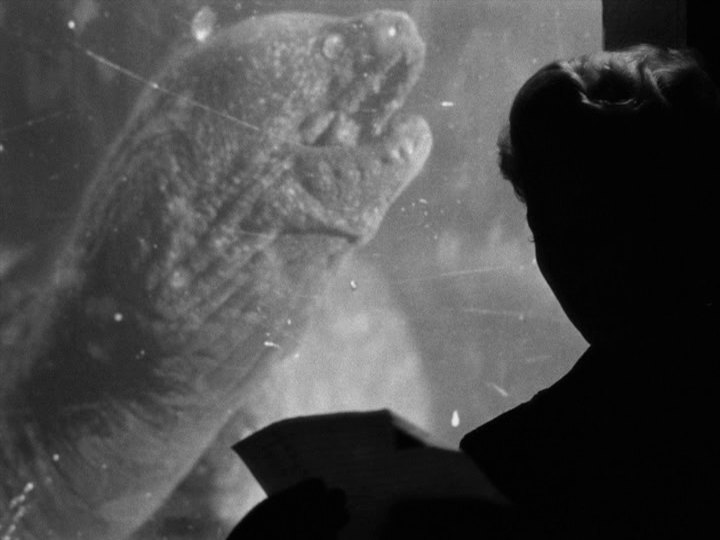
And a moray eel enlarged to monstrous proportions which reminds me of the one at the National Aquarium in Baltimore we visited every snow day when we lived there:
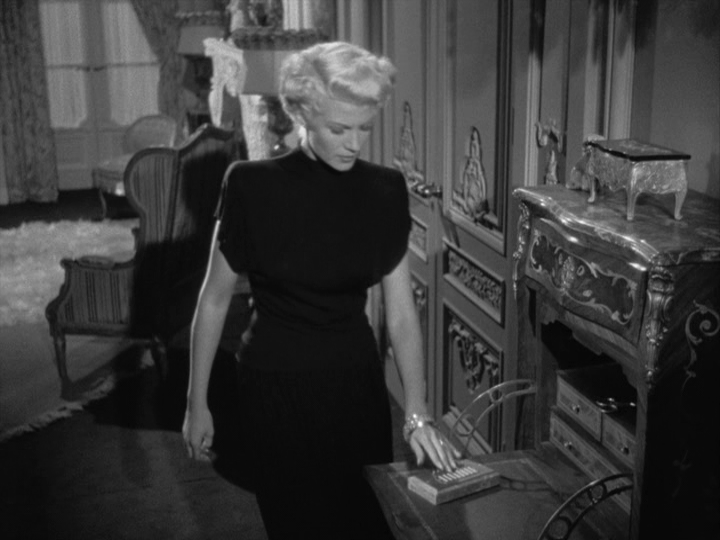
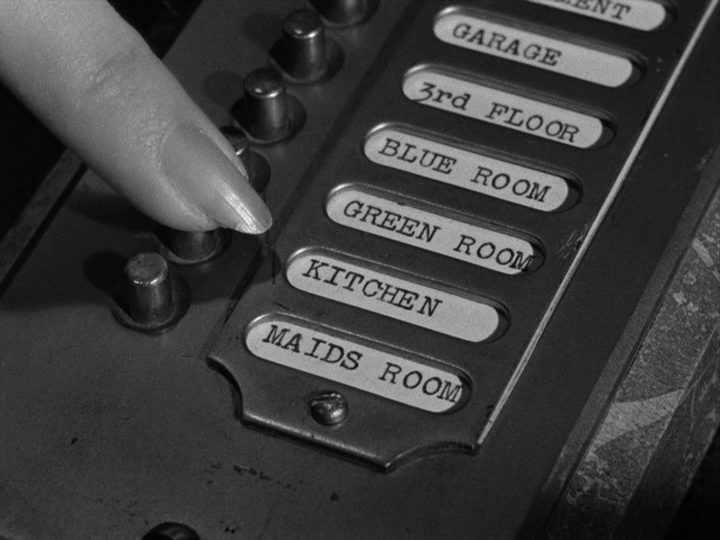
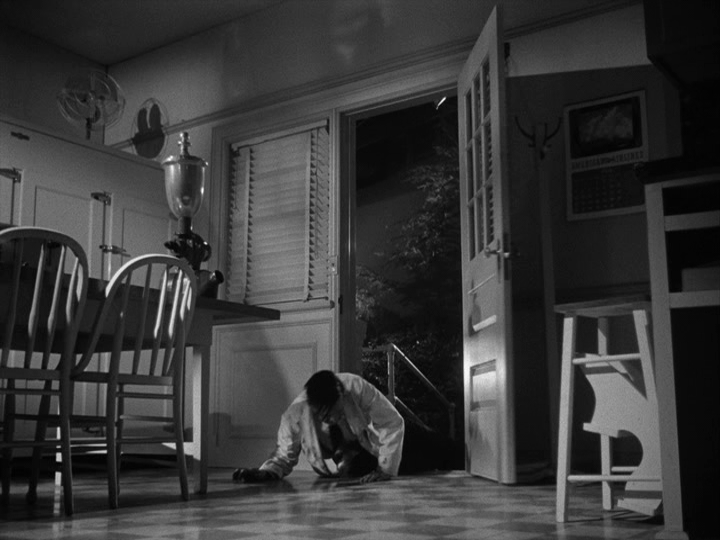
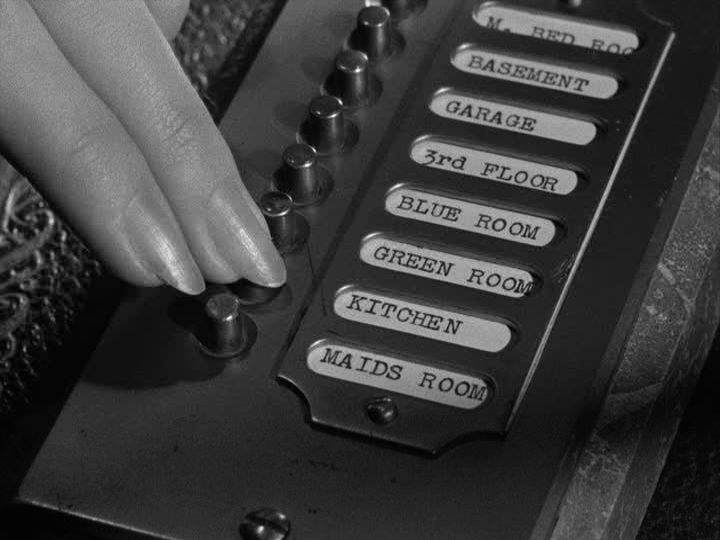
I also love the shots of Elsa stabbing at buttons on an intercom which appear to cause a man who has been shot to burst through a door in another room:
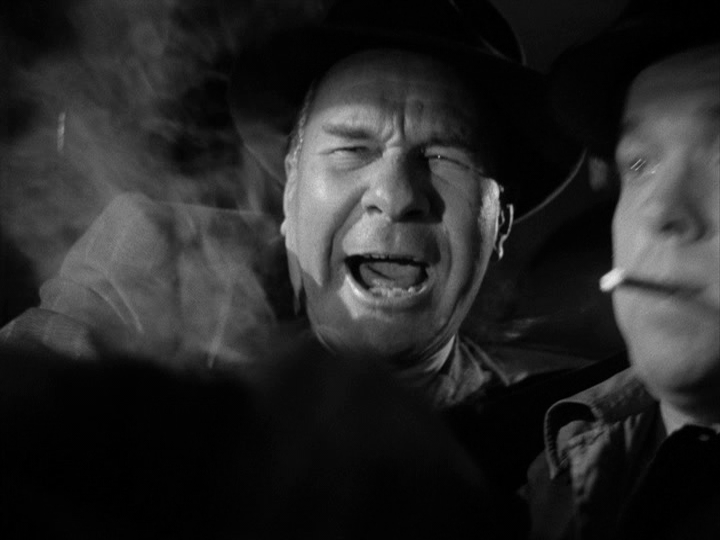
And a car carrying Michael and Grisby to accelerate and collide with the truck in front of it:
Finally, as American Cinematographer amusingly noted, “the climax of the picture, during which the antagonists shoot it out in this mirrored room, is one of those unforgettable cinematic moments that seem to occur all too rarely these days.”
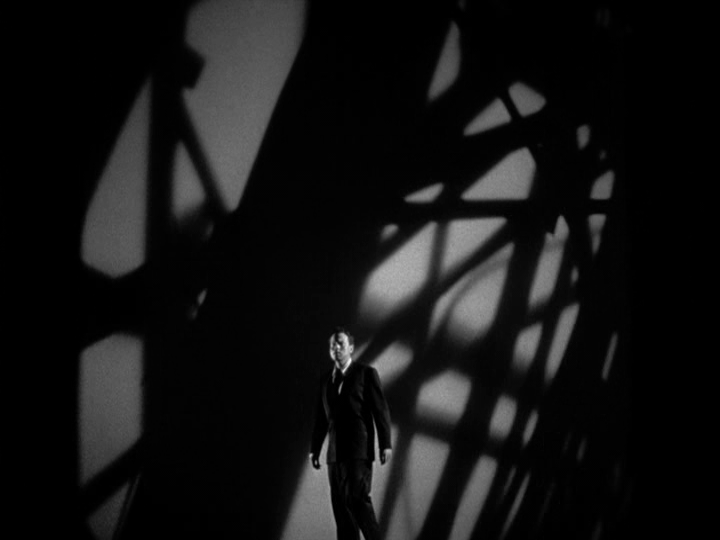
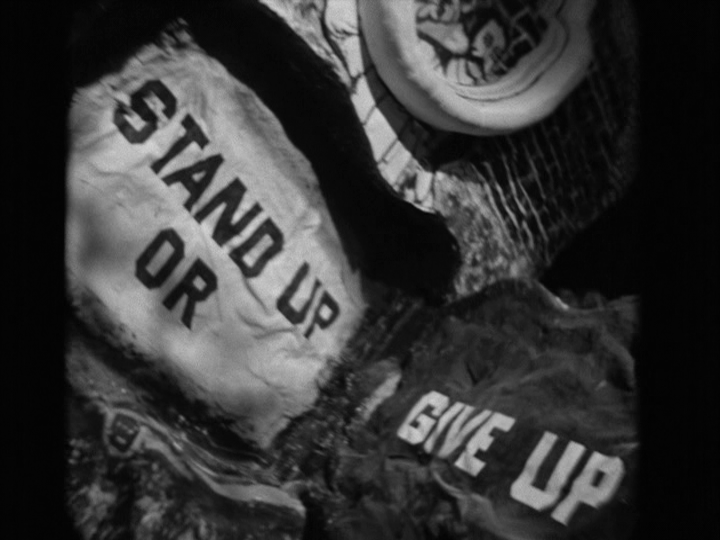
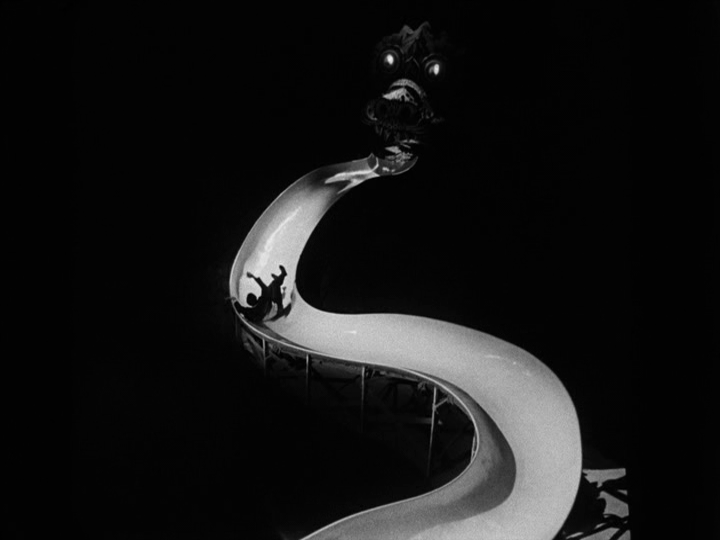
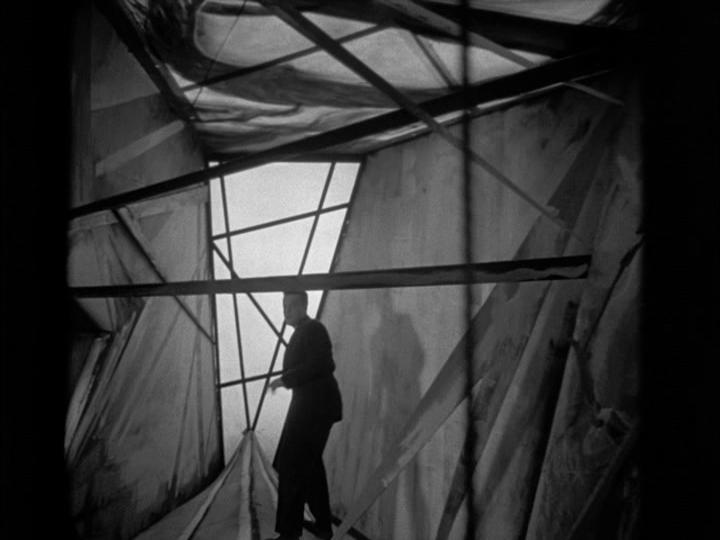
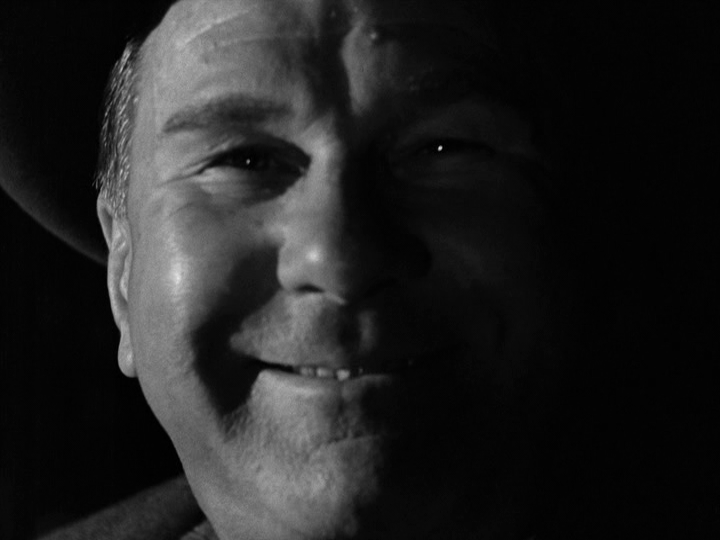
The joke is that those words were written in 1948, not tweeted out yesterday! Sure, the Crazy House sequence that precedes this one, which Welles told Bogdanovich would have been even more acclaimed had it remained intact, is reduced to just 90 seconds of shadows, signs, and slides:
And in the end Naremore concludes that “there is a sense in which all of Columbia’s tampering with the film has not been as disruptive as, say, RKO’s revisions of The Magnificent Ambersons.” To him this is primarily because it is “characterized by a sort of inspired silliness, a grotesquely comic stylization that has moved beyond expressionism toward absurdity.” This certainly is true of Glenn Anders’s performance, which Bogdanovich describes as “free in its eccentricity and eccentric in its freedom.”
I think it’s also because as Robert B. Pippin observes in his book Fatalism in American Film Noir, “Michael plans to be a novelist” and “what we are hearing as the voiceover appears to be the novel he has written after all these events are over,” so the inconsistencies can all be chalked up as bad writing or the sins of an unreliable narrator.
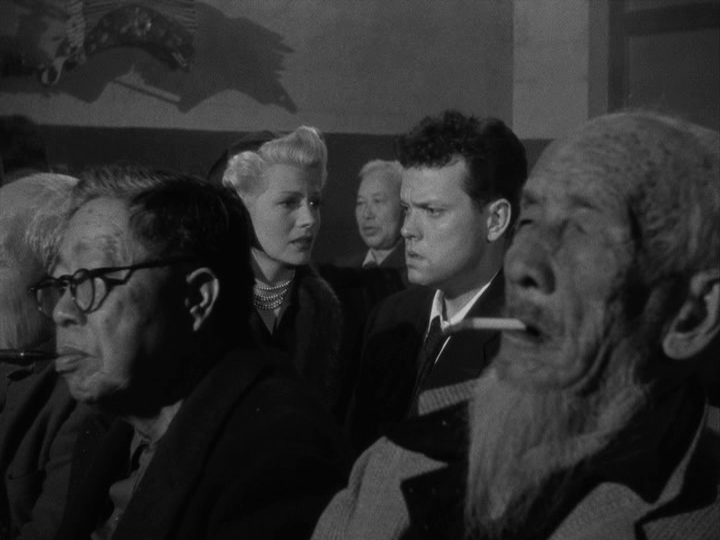
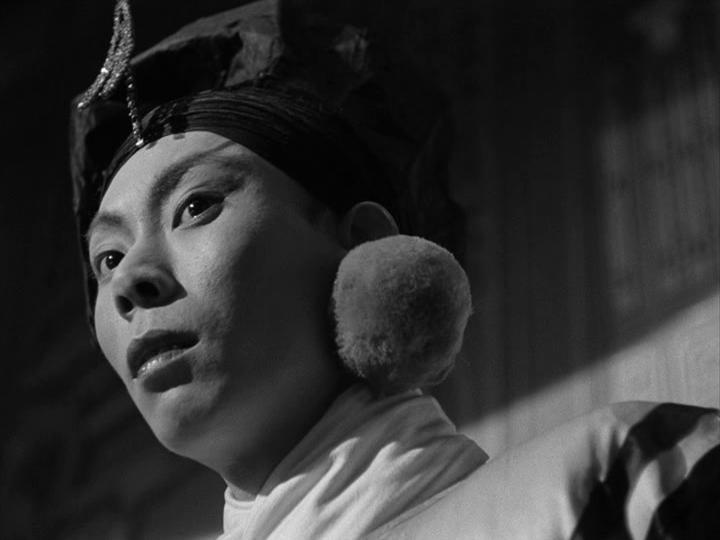
Last but not least Barbara Leaming notes in her biography of Welles that he “read and assimilated [Bertolt] Brecht” shortly before The Lady from Shanghai in preparation for a collaboration that never came to fruition, which to her “explains the peculiar presence of the otherwise incongruous (and hitherto mysterious) Chinese theater sequence toward the end.” Although the translations of the film’s unsubtitled Cantonese dialogue that Kelly Oliver and Benigno Trigo provide in their book Noir Anxiety demonstrate that these scenes are thematically consonant (the opera “performs the trial of a woman accused of being a sinner”) with the rest of the work, her observations that this is also the reason no one in the audience seems bothered by Michael and Elsa talking since “the alienated acting of the Chinese theater is perfectly tolerant of interruptions and disturbances” and that “Brecht writes that the Chinese actor occasionally looks directly at the audience, even as he continues his performance–and so it is in this sequence when the police arrive” remain valid:
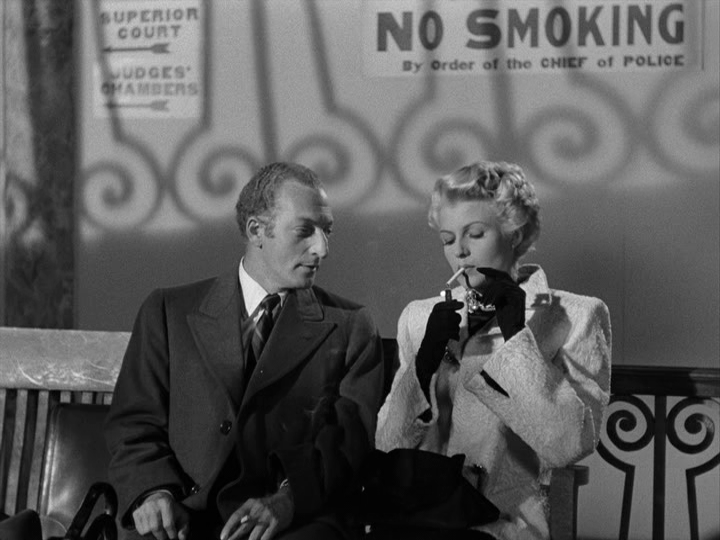
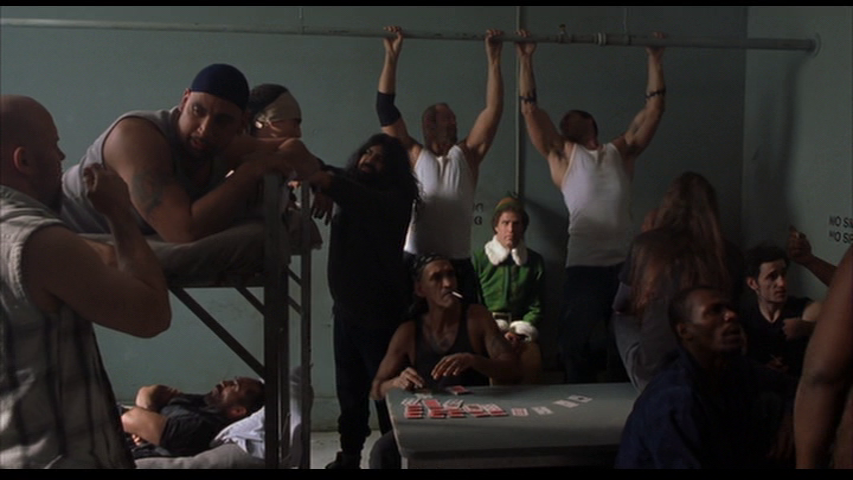
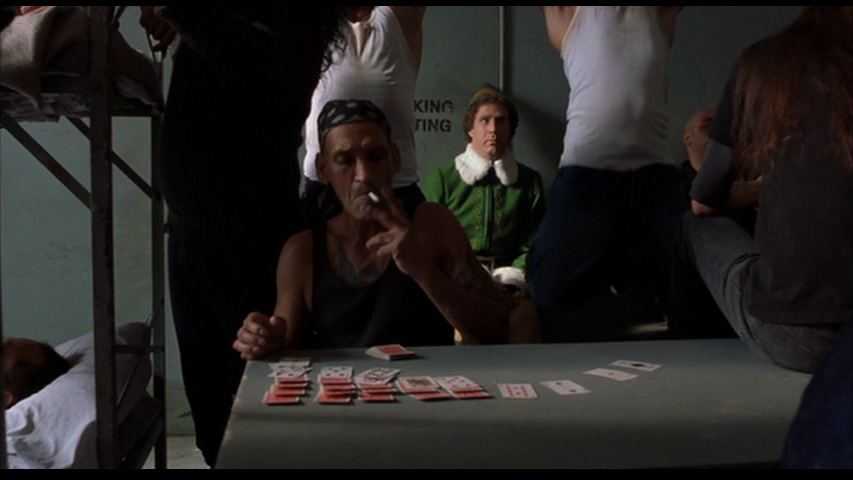
As does her suggestion that “the Chinese theater sequence illuminates the distinctly odd–almost chilly–acting style that permeates the film as a whole.” So, yeah, The Lady from Shanghai is an odd duck of a film! But here’s something even crazier: it also appears to be an inspiration for my December, 2022 Drink & a Movie selection Elf! Compare this shot of two people blatantly flaunting smoking regulations:
With this one:
Which, okay, you’re not convinced. I get it. But consider as well this description of Michael from Joseph McBride’s Welles biography:
Part of what makes Welles’s film so unsettling is the ironic tension between the moral issues and the characters’ apparent lack of interest in them. K.’s whole life in The Trial is changed by his investigation into the principles behind his case, and Quinlan in Touch of Evil spends most of his time rectifying the moral inadequacy of the law; but in The Lady from Shanghai O’Hara treats his legal predicament as only an unpleasant adventure he must get through so he can move on to a more important concern–Elsa Bannister, the lawyer’s wife. Unfortunately, as he discovers, she is the instigator of the whole complex murder plot, and the issues encroach heavily on his fate despite his avoidance of them. At the end he has been forced to formulate a philosophical position similar to the tragic understanding Welles’s other heroes achieve, but of a less definitive nature.
Doesn’t that sound a lot like the exact inverse of the way the contagious goodness of a certain “deranged elf-man” we all know and love teaches a cynical world how to believe again? Something to ponder while you enjoy your drink!
Cheers!
All original photographs in this post are by Marion Penning, aka My Loving Wife.Links to all of the entries in this series can be found here.



 The Prodigal Cinephile