July, 2025 Drink & a Movie: Waltermelon + Crimes of the Future

Happy Canada Day! This month’s post honors that country’s first citizen of cinema, David Cronenberg, and its de facto national cocktail, the Caesar. To begin with the former, here’s a picture of my Neon DVD copy of Crimes of the Future, one of *my* best movies of the 21st century so far:
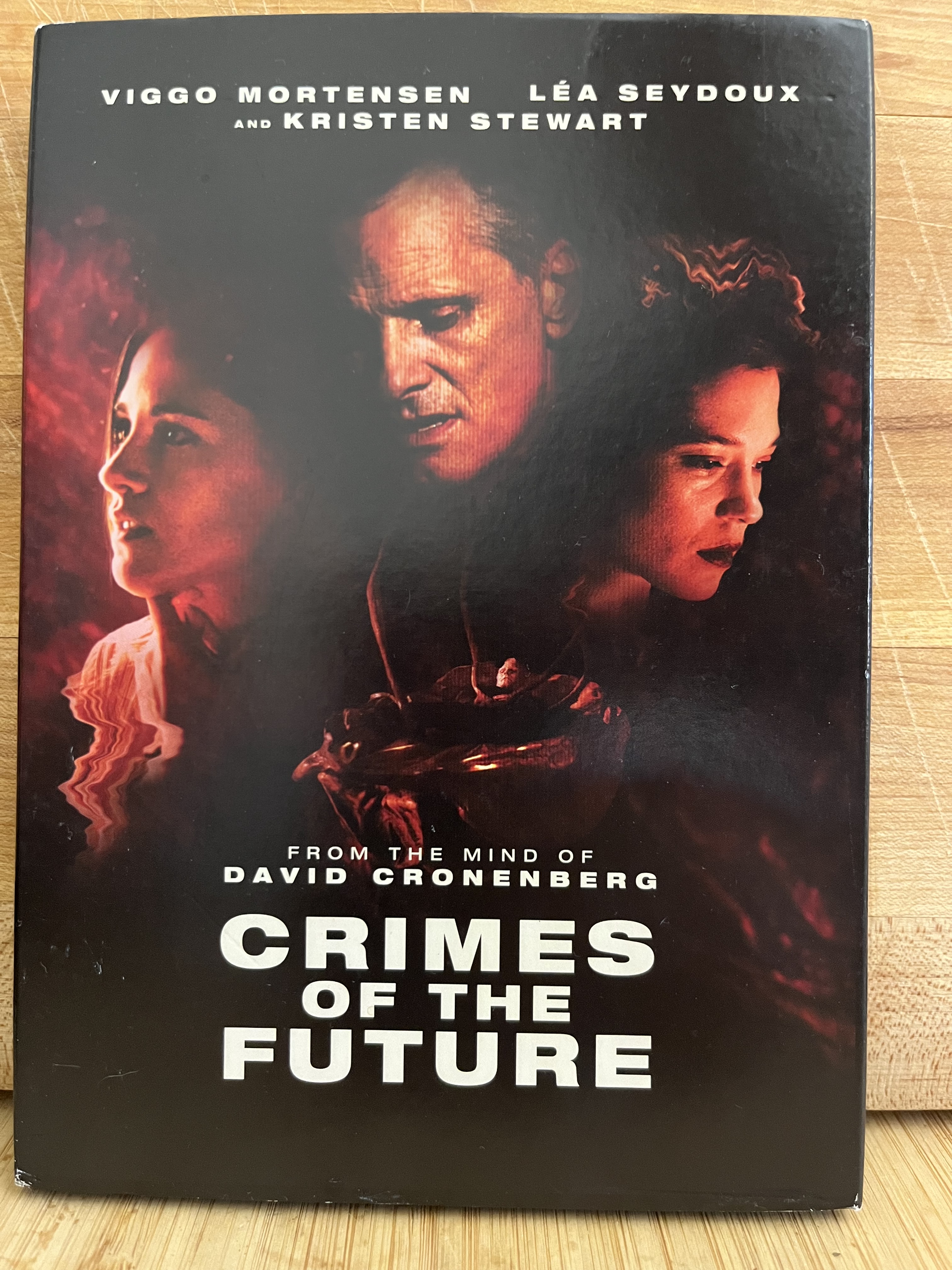
Crimes of the Future DVD case

It’s also currently available on Hulu with a subscription and via a number of other platforms for a rental fee, and some people may have access to it through Kanopy via a license paid for by their local academic or public library as well.

Everyone in my household except me is a Canadian citizen and we spend a lot of time north of the border, so Caesars are a staple of our holiday and other gatherings. I knew that I eventually wanted to write about a drink from the excellent book Caesar Country: Cocktails, Clams & Canada by Aaron Harowitz & Zack Silverman, which was published the same year this series began, and when I settled on Crimes of the Future as the movie I’d be pairing it with the choice became obvious. Here’s how to make our very slightly modified version of their ingenious Waltermelon:

1 1/2 ozs. Reposado tequila (Espolòn)
2 ozs. Watermelon juice
2 ozs. Caesar mix
1/4 oz. Simple syrup
1/4 oz. Lemon juice

Make the Caesar mix by roasting 4 1/2 lbs. halved Roma tomatoes cut-side down on a baking sheet lined with parchment paper or a Silpat mat with a seeded, stemmed, and halved jalapeño chili (skin-side up) and four whole cloves of garlic with their skins left on about 30 minutes until nicely browned. Let cool completely, then remove the skins from the garlic, add everything to a blender with two tablespoons fresh oregano (or two teaspoons dried), and blend until smooth. Add one cup of water, 1/2 cup clam juice, 1/4 cup lemon juice, 1/4 cup simple syrup, and two teaspoons sea salt and blend again to homogenize. Add 1/4 teaspoon cayenne powder, 1/4 teaspoon celery seed, 1/4 teaspoon freshly-ground black pepper, 1/4 teaspoon onion powder, and 1/4 teaspoon paprika and quickly blend again. Strain the mixture through a fine-mesh strainer and cheesecloth (you’ll need to squeeze, which can be messy if you’re not careful) and adjust the consistency with additional water as needed and/or seasoning with more salt. To make the cocktail, stir all of the ingredients with ice and strain into a chilled Collins or highball glass rimmed with kosher salt. Serve on the rocks garnished with cubes of feta cheese and watermelon on a skewer.

Waltermelon in a cocktail glass

This beverage is certain to surprise and delight Caesar fans for sure, but even more so anyone who only knows its cousin the Bloody Mary. Thanks to the addition of watermelon juice, which per Harowitz & Silverman was inspired by an observation by chef José Andrés that “tomatoes with watermelon is a simple, refreshing, and perfectly balanced combination,” it’s sweeter and much lighter in body than the brunch staple you’re familiar with, which I personally find unpleasantly sludgy. Watermelon is also probably the flavor that will dominate your initial impression, but only because it’s unexpected: starting with the second sip, it feels like the world’s most natural companion to the umami-rich Caesar base. Finally, there’s a nice bit of heat on the finish, which is also where you finally pick up agave notes from the tequila and the oregano (one of the ingredients in the original Caesar created by Calgary bartender Walter Chell, as the book notes) we added as a second connection to Greece, where Crimes of the Future was shot. The first is of course the cubed feta garnish, which reminds me a bit of these trapezoidal purple “candy bars”:
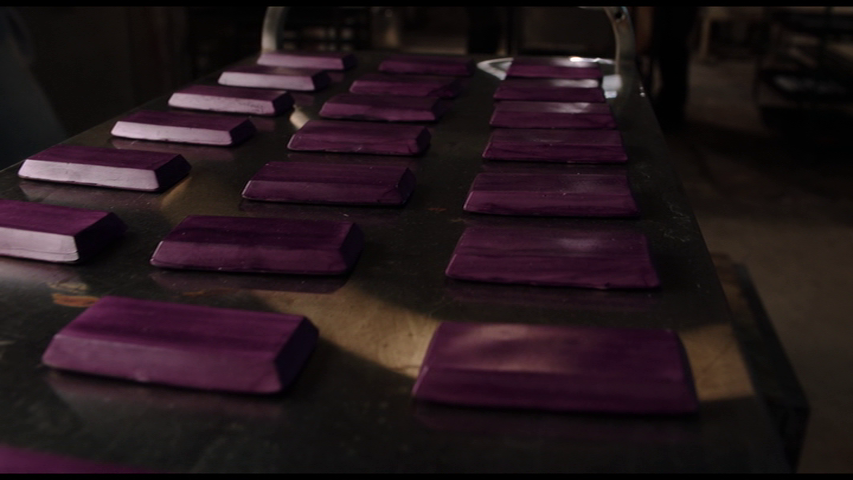
Close-up of purple "candy bars" on an assembly line

They aren’t actually candy, hence the scare quotes: this is, rather, what you eat after you get the elective surgery that leaves these scars:
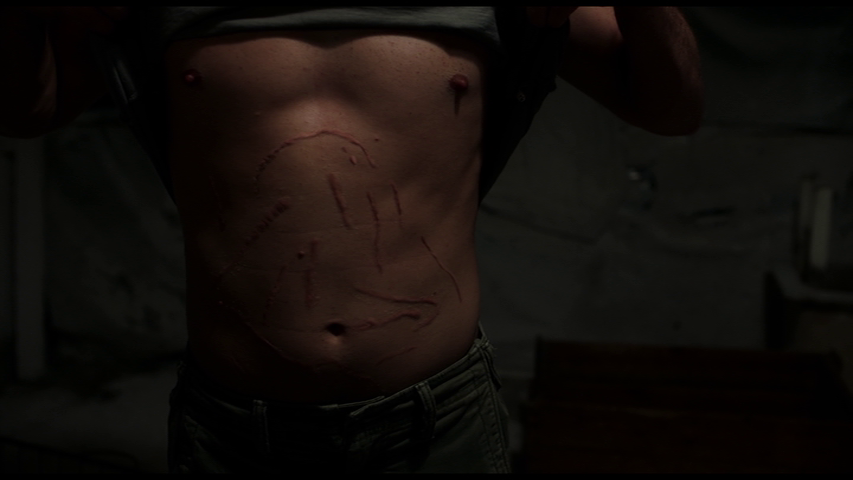
Close-up of a man lifting up his shirt to reveal a torso covered in scars

And replaces your digestive system with one capable of converting reprocessed industrial waste into energy. But we’re getting just a bit ahead of ourselves. Following the opening credits sequence that inspired this month’s drink photo:
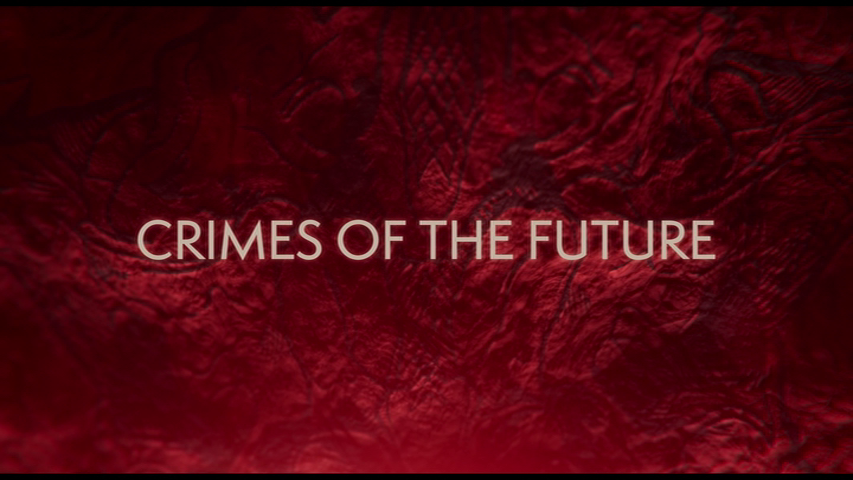
Title card for Crimes of the Future, which features a red background of tattooed internal organs

Crimes of the Future begins with a shot of a structure that looks simultaneously futuristic and decrepit viewed from the shoreline of a rocky beach:
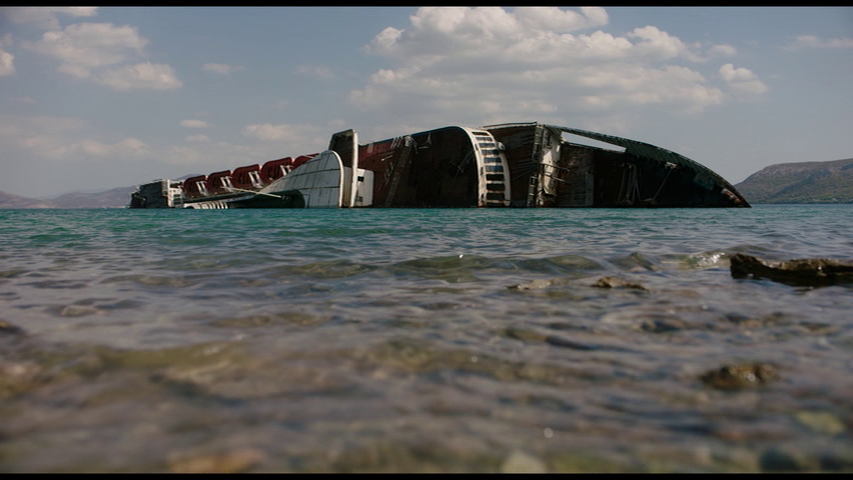
Crimes of the Future's first image

The camera pulls back to reveal a boy (Sotiris Siozos) sitting next to a rusty can and digging in the water with a spoon:
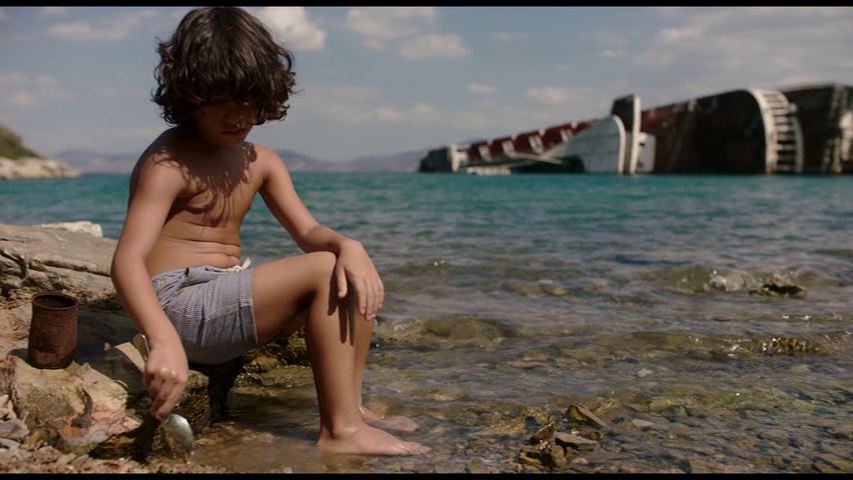
Long shot of the aforementioned boy in the foreground in front of a now out-of-focus structure

Then circles around to the right before tracking in, almost as if were studying him. A woman’s voice says “Brecken” and he looks up:

Medium shot of Brecken, who now occupies the entire left side of the frame

Cut to a long shot of the speaker, his mother Djuna (Lihi Kornowski): “I don’t want you eating anything you find in there, you understand me? I don’t care what it is.”
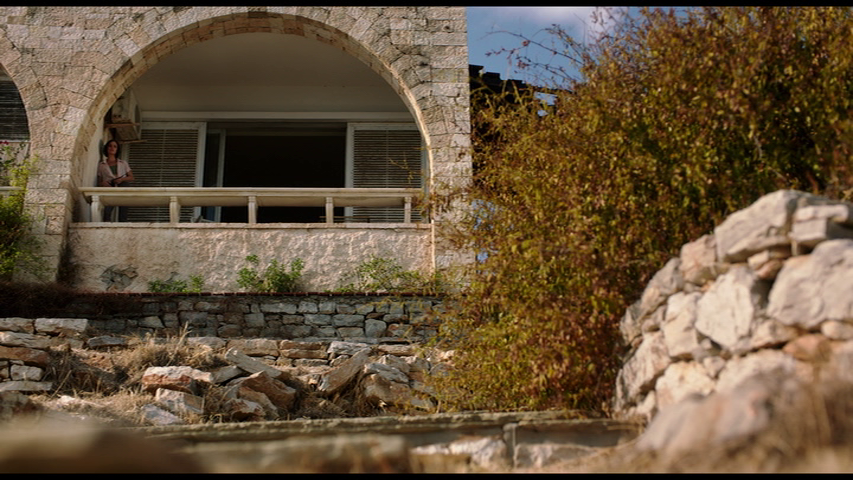
Extreme long shot of Djuna standing on a balcony beneath an archway

Cut back to Brecken, who rises, then back to a medium shot of Djuna as she mutters “I don’t care what it is” to herself a second time, her voice quavering.

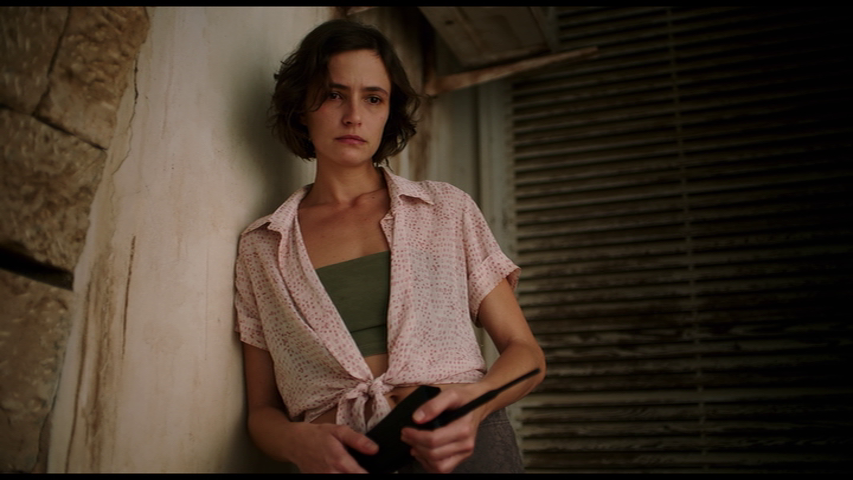
Medium shot of Brecken staring into the distance offscreen left
Medium shot of Djuna holding a cordless phone and looking offscreen to the right

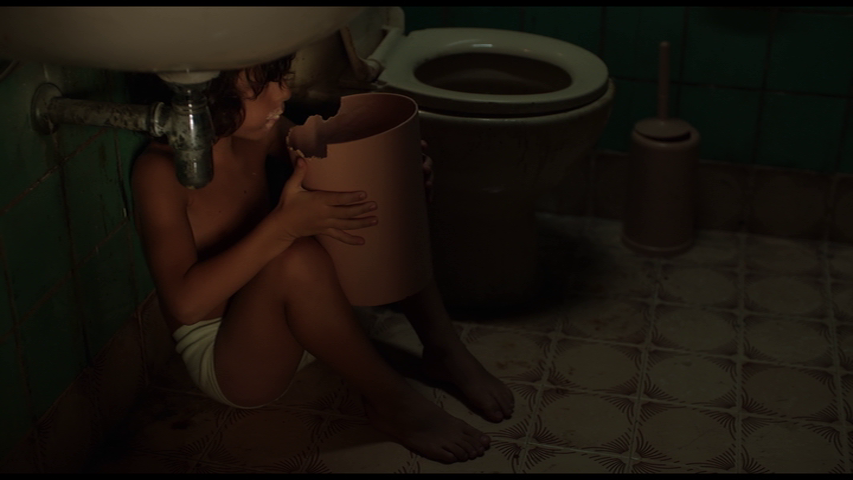
It’s an odd exchange and on a first viewing the logical assumption is that she’s concerned about him consuming marine animals or fish, possibly because the water is polluted? But the real cause of her duress is revealed about 30 seconds later when Brecken finishes brushing his teeth and begins to munch on a plastic wastebasket as Djuna looks on:
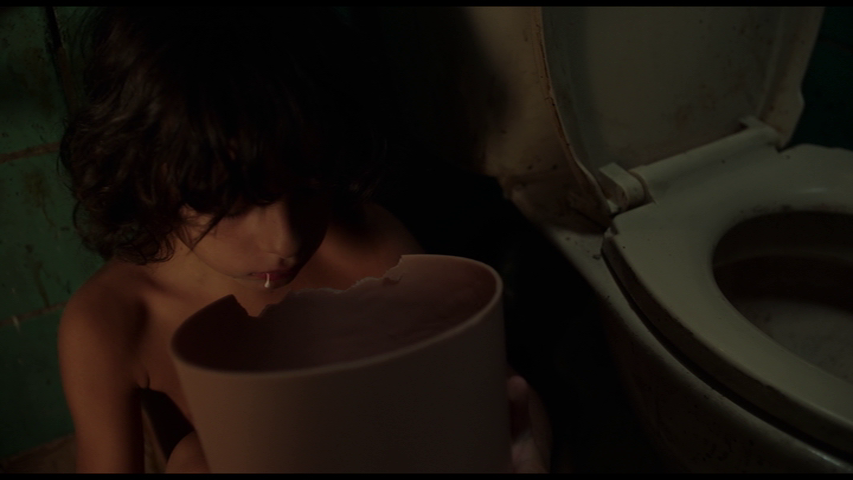
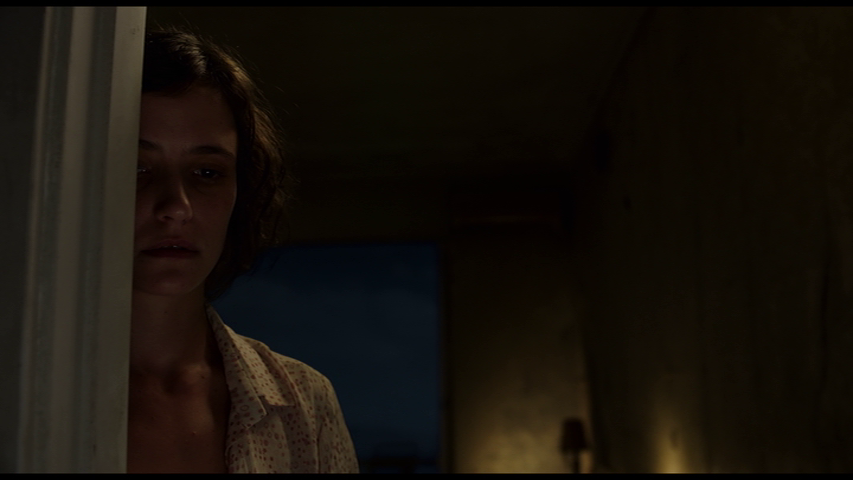
Close up of Brecken sitting on the floor next to a toilet eating the plastic wastebasket as foamy white drool trickles out of the corner of his mouth
Close-up of Djuna watching from the doorway
Long shot of Brecken as he continues to eat

What happens next is even more shocking. As Brecken sleeps, Djuna smothers him with a pillow:
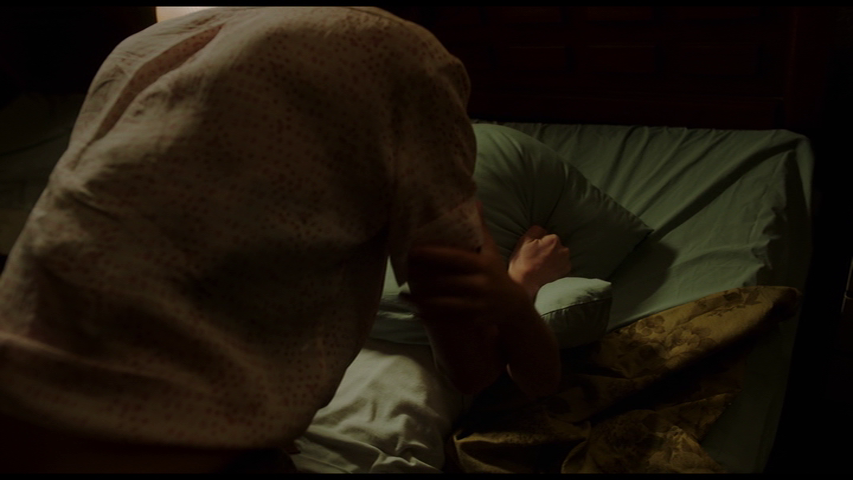
Medium shot of Djuna's back as she holds a pillow over Brecken's face

She confesses her crime over the phone in the scene that follows, and although her words are unrepentant (“yes, yes, I mean the Brecken thing”), there are tears in her eyes when she hangs up:

Close-up of Djuna's tear-stained face, which occupies the entire right side of the screen

The person at the other end of the line is an associate of Djuna’s ex-husband Lang (Scott Speedman), who is understandably also reduced to sobs when he shows up to claim his son’s body:
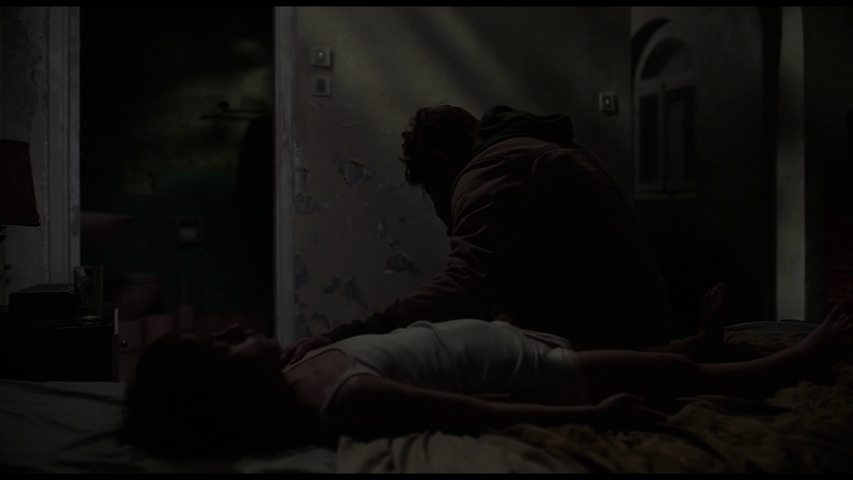
Lang sits on the edge of the bed that Brecken's body is lying on and cries

And with one murder in the books, we’re off. The next shot introduces us to Crimes of the Future‘s protagonists, Saul Tenser (Viggo Mortensen) and his partner Caprice (Léa Seydoux). She awakens him from a restless night in his LifeFormWare OrchidBed with good news: there’s a new hormone in his body!
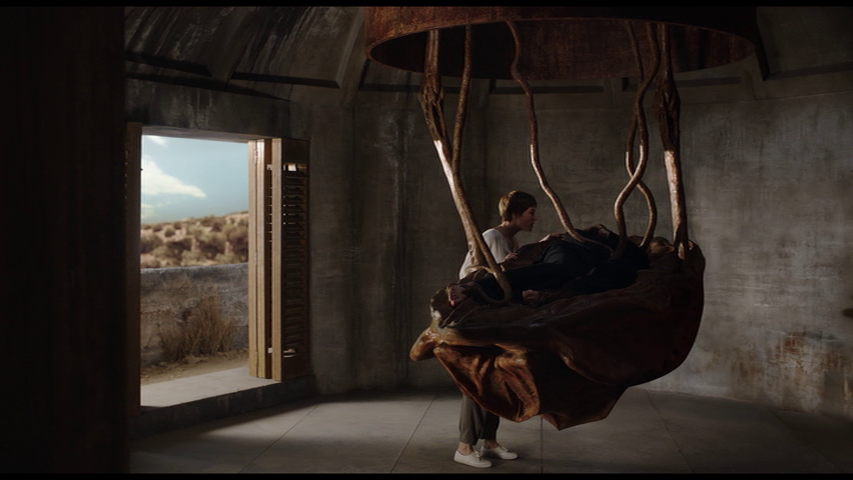
You see, he suffers from a condition called Accelerated Evolution Syndrome whereby his body produces new organs, which Caprice tattoos while they’re still in his body:
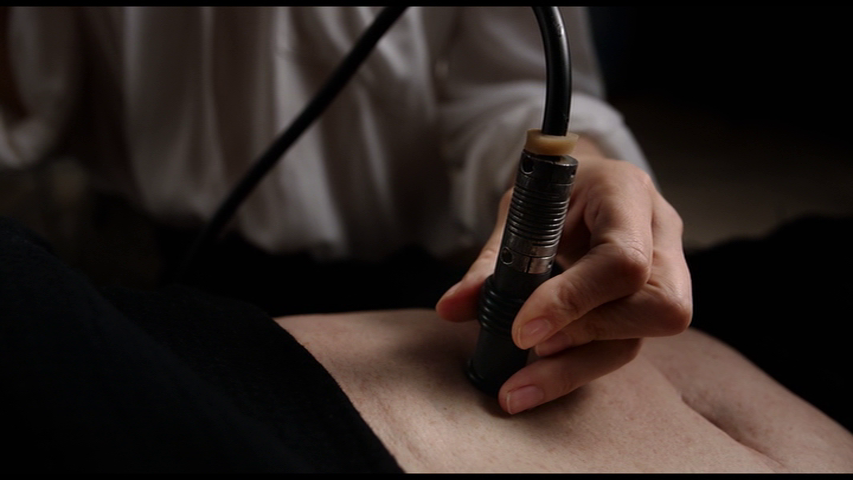
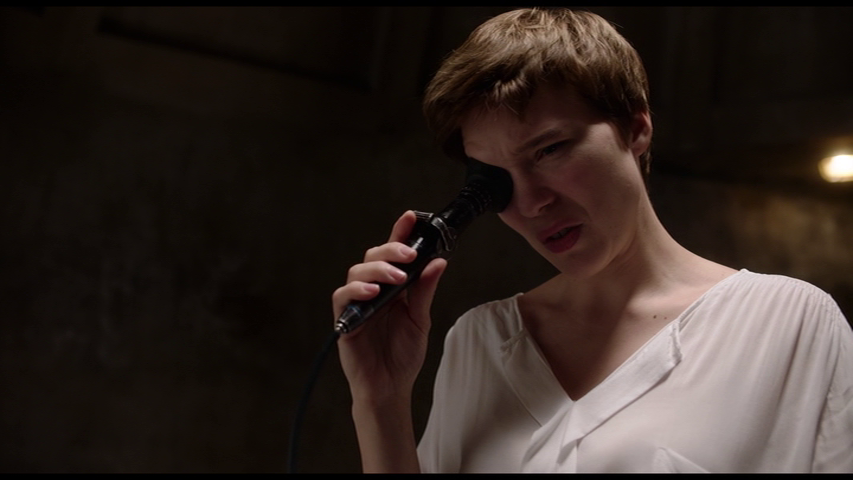
Close up of Caprice's hand as she tattoos Saul's new organ
Medium shot of Clarice looking through an eyepiece

Then removes in front of a live audience using another LifeFormWare product, the Sark autopsy module, which has made them stars of the performance art world:
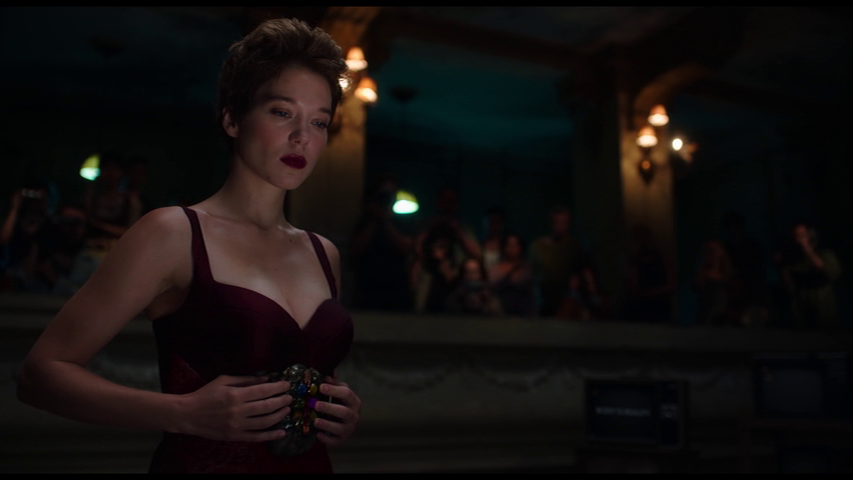
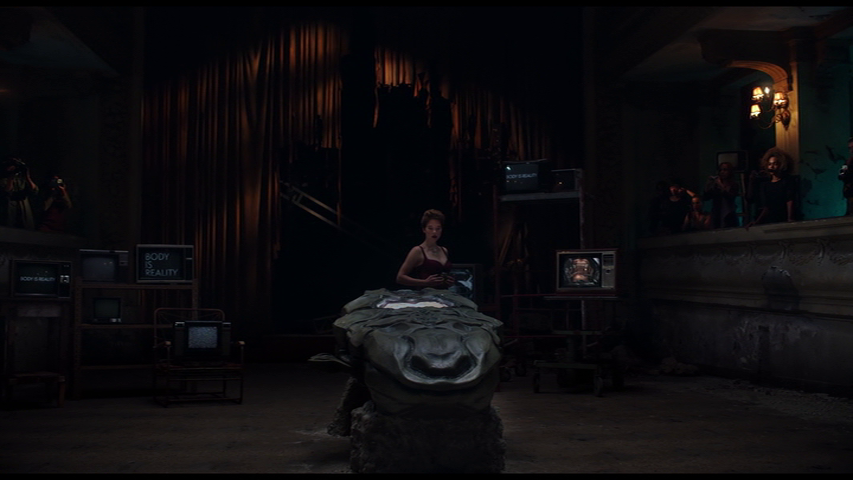
Medium shot of Caprice operating the Sark autopsy module in front of an audience
Extreme long shot of Caprice and the Sark
Close up of the Sark removing Saul's tattooed new organ

There’s no need for anesthesia or sterilization because human beings have ceased to feel pain except in their sleep and infections have disappeared for reasons unknown. People now get their thrills from a new fad called “desktop surgery,” which basically consists of cutting into each other:
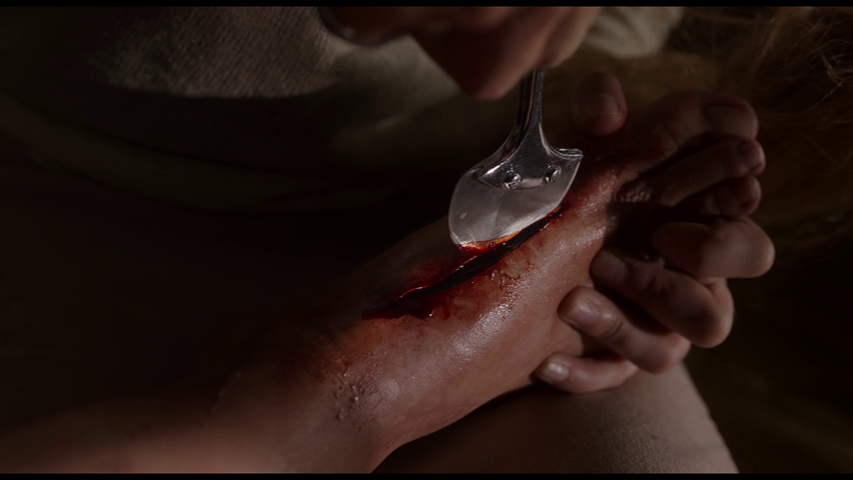
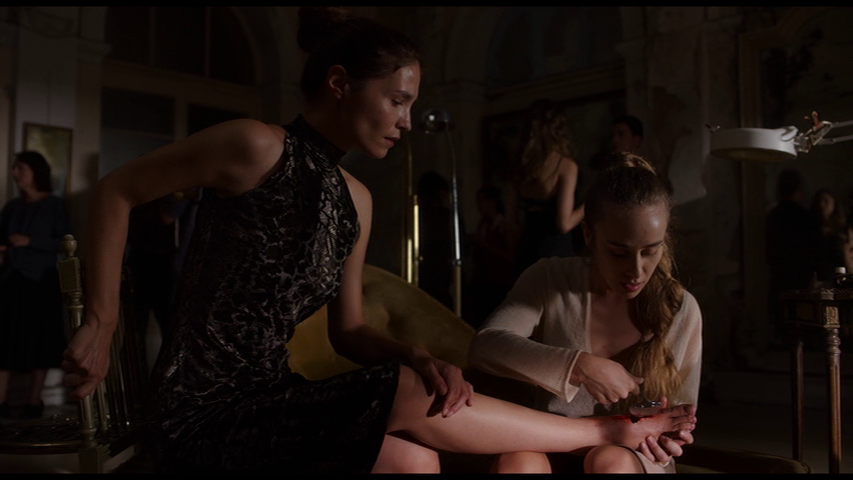
Close up of a blade cutting into a foot
Medium shot of the cutter and cuttee from the previous image

And the entire situation is making the government nervous. As the two bureaucrats who staff the National Organ Registry it establishes in response explain, “human evolution is the concern. That it’s going wrong. That it’s . . . uncontrolled, it’s . . . insurrectional.”
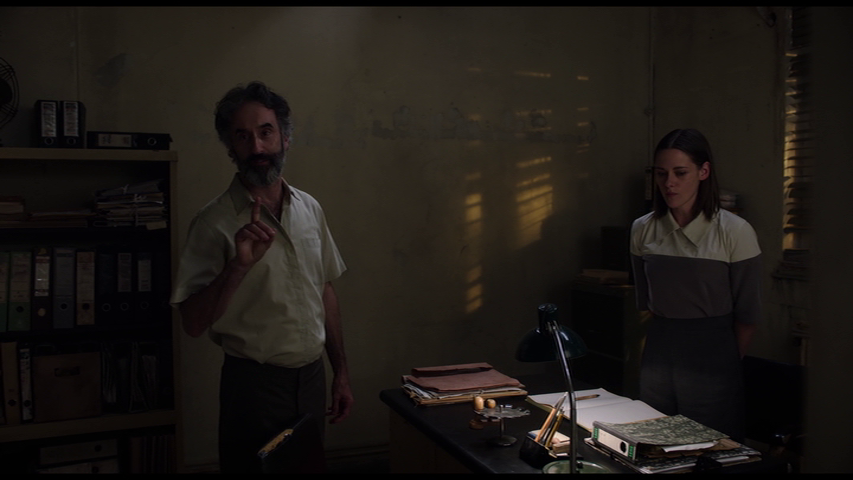
Medium long shot of Don McKellar's Wippet and Kristen Stewart's Timlin in the dimly-lit offices of the NRO

Violet Lucca reads Crimes as being deeply autobiographical in her monograph on Cronenberg, but immediately goes on to note that there’s far more going on here than just taking stock and settling scores:

Saul is Cronenberg himself, performance art is cinema, “body art” is “body horror” (the questionable subgenre Cronenberg supposedly invented), the National Organ Registry stands in for TIFF and Telefilm Canada, and Timlin (Kristen Stewart) and Wippet (Don McKellar), the jittery geeks who work at the NOR, are a heady mix of film fans and people who work in film (critics, archivists, programmers, publicists, or whatever). However, the way in which these parallels are drawn–and Saul’s succinctly croaked objections to the various interpretations of his work, the state of performance art, and to the state of the world–are commentaries that are just as applicable to our reality as they are in the film’s. The government’s endeavors to control both art and body are meant to protect those who are already powerful, going so far as to deny nature and very clear biological warnings.

What takes the movie to the next level and makes it what Neil Bahadur calls on Letterboxd “one of the most visionary works of science fiction in the history of cinema” is how this is accomplished: “it deemphasizes technology for exploring changes in human habit, psychology, and physiology.” Deemphasizes is exactly the word–there’s plenty of tech in the movie, but like LifeFormWare’s Breakfaster Chair it’s shown to be unable to keep pace with the body’s endeavors to heal itself.
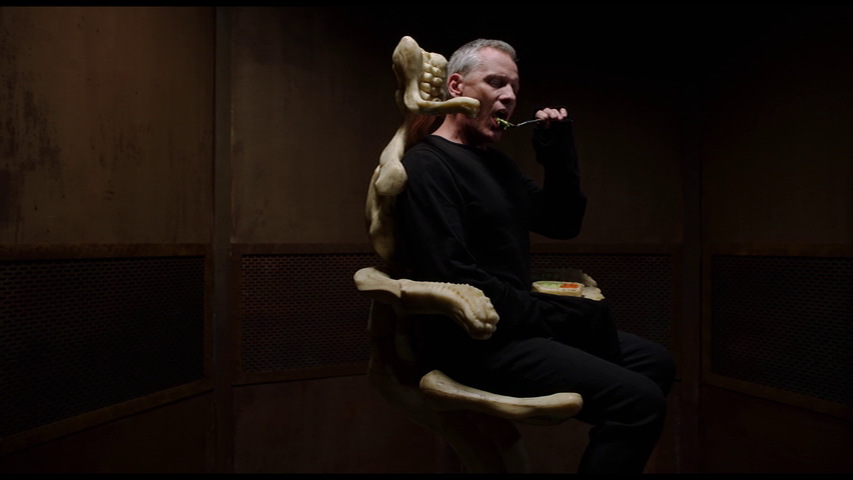
Enter Lang, who is not only Brecken’s father, but also the leader of the “plastic-eaters” mentioned above. He cannot explain how their body modifications came to manifest naturally in a new generation beyond referring to the boy as their “miracle child,” but approaches Saul and Caprice with the idea of performing a public autopsy on his son’s body “to show the world that the future of humanity existed and was good–was at peace and harmony with the techno world that we’ve created.”
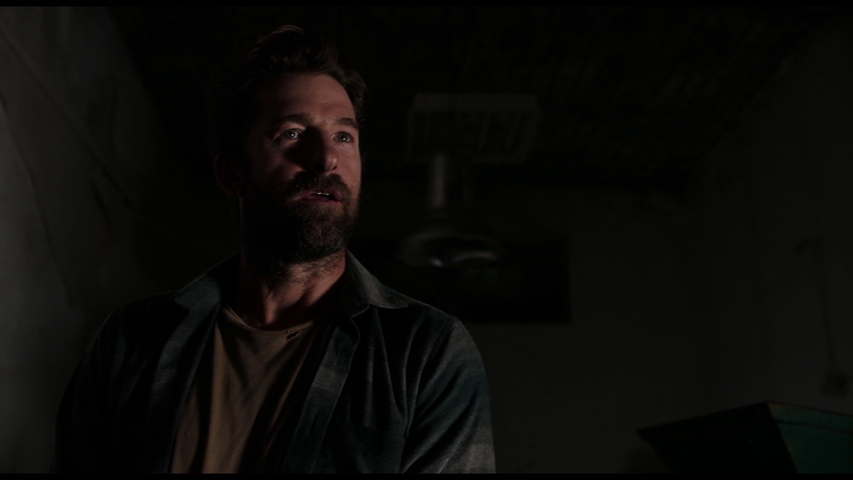
Medium shot of Lang in front of dark background

Saul accepts under orders from his handler in the government’s New Vice Unit, which unbeknownst even to Caprice he works for as an undercover agent, ostensibly to earn Lang’s trust so that he can infiltrate his group, but really because they’ve already gotten to Brecken’s body:
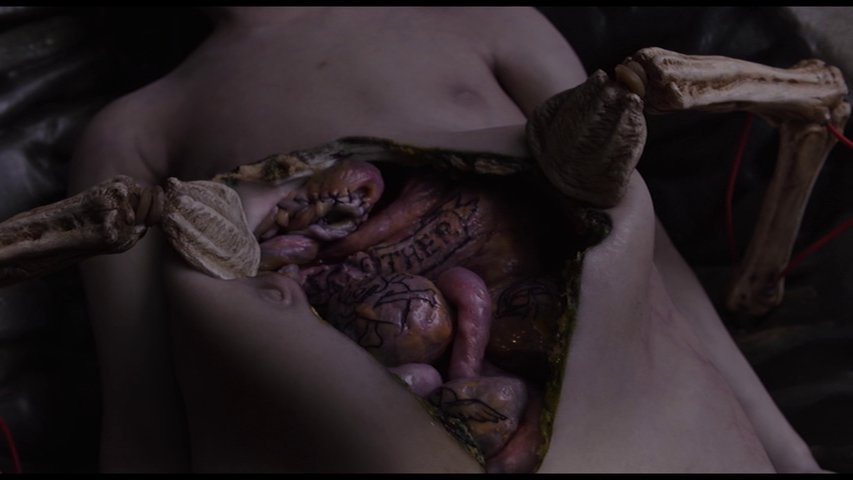
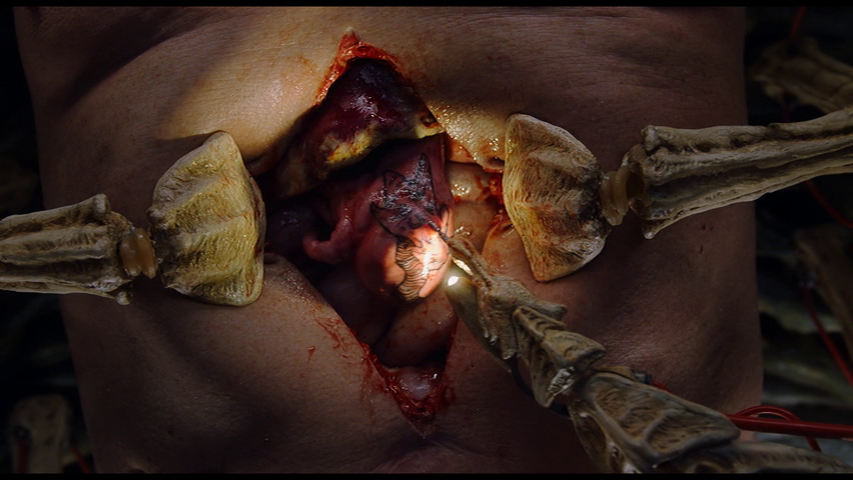
Close-up of the Sark autopsy module opening up Brecken's body to reveal a set of tattooed organs, indicating that whatever was there before has been replaced

Meanwhile, LifeFormWare is making plans of its own to ensure the continued viability of its products:
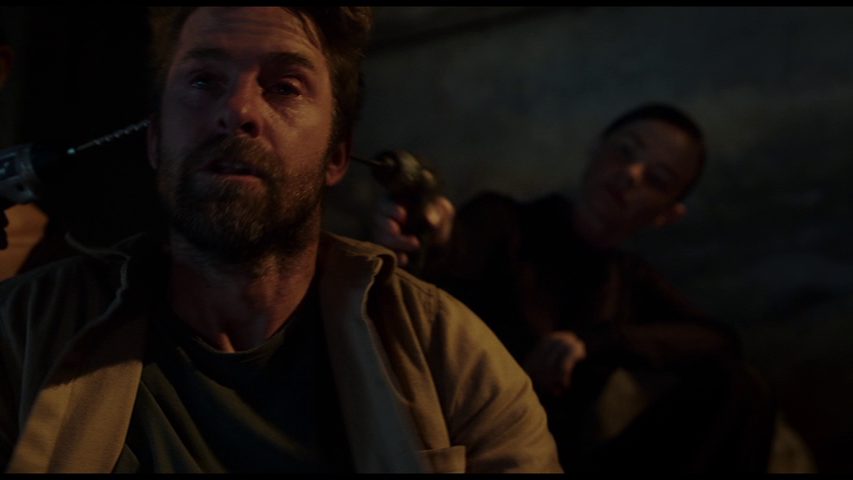
Medium shot of two LifeFormWare agents assassinating Lang by drilling holes in either side of his head

Crimes of the Future is also quite erotic, to the point where the album Pinkerton by Weezer could almost function as an alternative soundtrack to it, especially the tracks “Tired of Sex,” which matches well with this awkward encounter between Saul and Timlin:
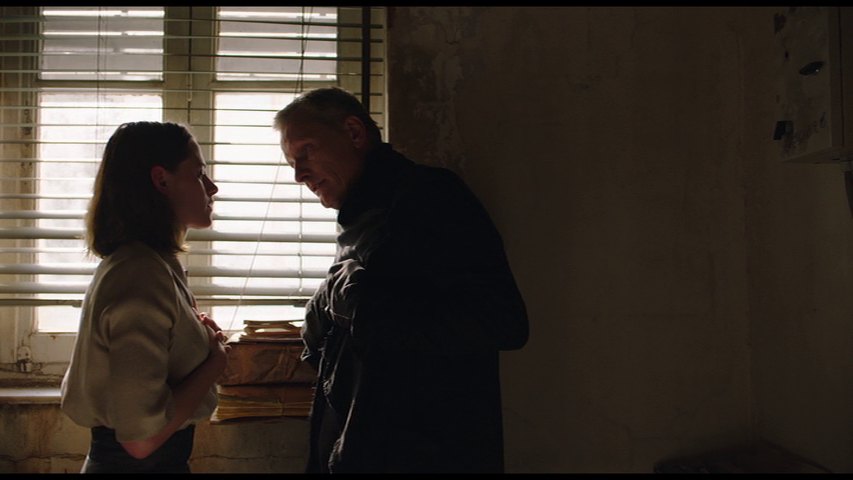
Medium shot of Saul explaining to Timlin that he's "just not very good at the old sex" as they stand in front of a window in the left side of the frame

“The Good Life,” which might as well be all about him, and “Butterfly,” our new accompaniment to the end titles that follow this brilliant final image:
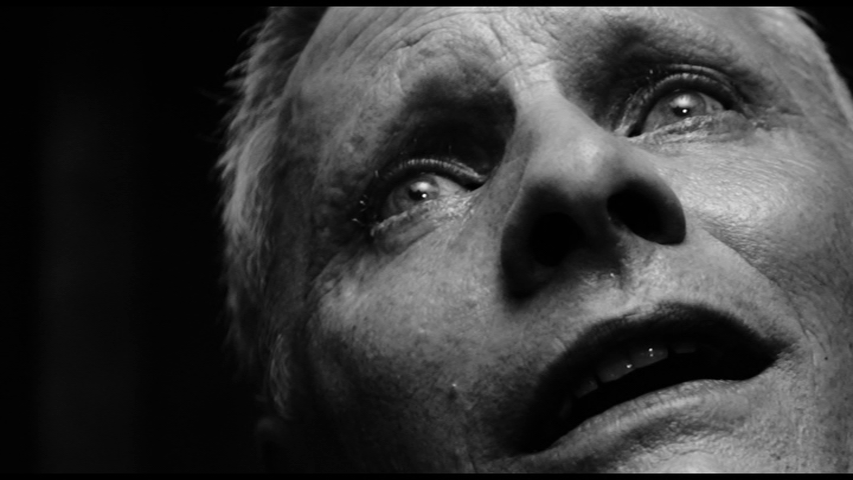
Black and white close-up of Saul's face in ecstasy occupying the entire right two-thirds of the frame as a tear rolls down his cheek

Speaking of which, many critics identify it as a reference to my February, 2023 Drink & a Movie selection The Passion of Joan of Arc, but it also marks the conclusion of a motif that started with the 14th and 15th screengrabs in this post by putting a new twist on it. Djuna and Lang both weep for things lost, in her case the familiar world she knew in her youth, and in his the unexpected delay of long-anticipated future he thought had already arrived. Saul’s tear, on the other hand, is like Joan’s a sign of acceptance. Caprice gives him a bite of Lang’s “modern food”:
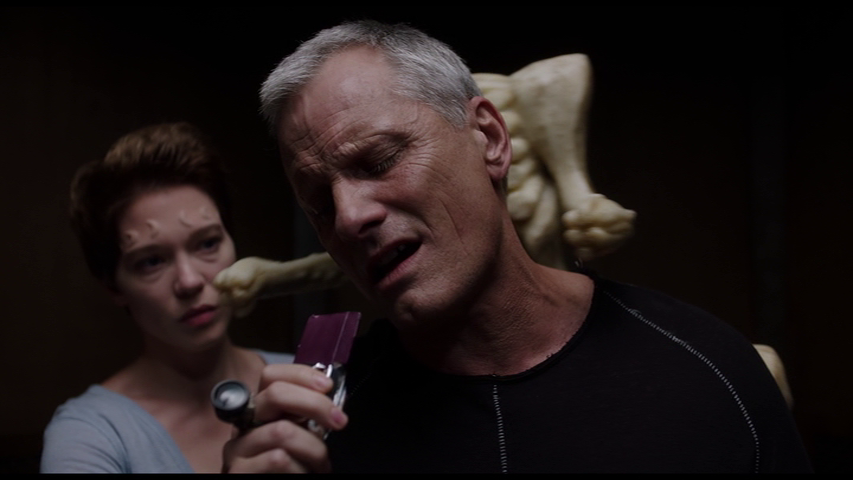
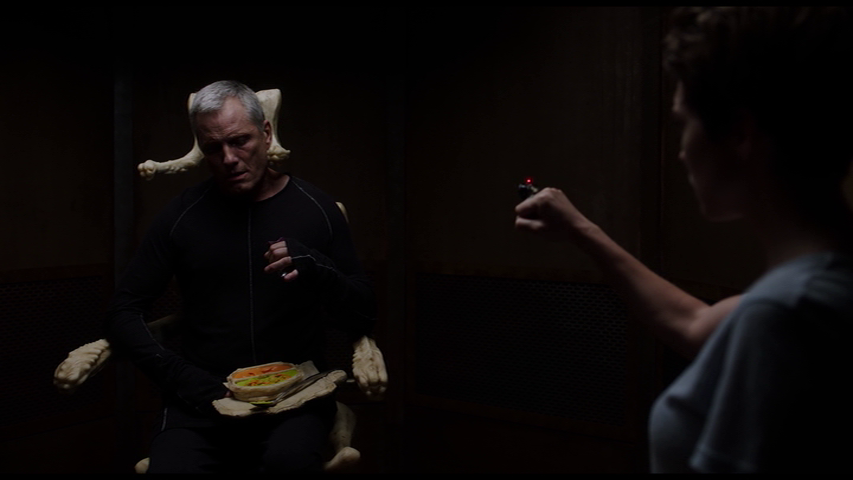
Medium shot of Caprice holding a purple "candy bar" in front of Saul as he sits in his Breakfaster Chair

The Breakfaster Chair stops moving:

Medium-long shot of Saul in his Breakfaster Chair occupying the left side of the frame as an out-of-focus Caprice films him from the right foreground

And to paraphrase a different set of alternative rockers active in the 90s, it’s the end of the world as we know it–but he feels fine. To Bahadur, “Cronenberg’s deep fear here – as it should be to all of us – is of reactionaryism: that those who are deemed different are then deemed subhuman, if not human at all. The title is in reference to this alone: is difference or the new the crime of the future? Is it already the crime of the now?” Noel Vera similarly suggests in a blog post about Crimes that by the end for Saul “the coming apocalypse isn’t so much a calamity as a fascinating new condition to explore and exploit, even embrace.” He also observes in passing that his name might be a reference to Alfred Bester’s classic sci fi novel The Demolished Man, something that occurred to me as well, specifically this nonsense rhyme that Ben Reich learns to prevent his thoughts from being read in a future where telepathy is common:

 Eight, sir; seven, sir;
Six, sir; five, sir;
Four, sir; three, sir;
Two, sir; one!
Tenser, said the Tensor.
Tension, apprehension,
And dissension have begun.

What’s interesting is the way that story ends. It revolves around Reich’s attempts to commit the perfect crime and escape his world’s worst punishment, something with the threatening name of “Demolition.” But it’s not what we think it is, as we finally discover in the final pages:

Reich squalled and twitched.

“How’s the treatment coming?”

“Wonderful. He’s got the stamina to take anything. We’re stepping him up. Ought to be ready for rebirth in a year.”

“I’m waiting for it. We need men like Reich. It would have been a shame to lose him.”

“Lose him? How’s that possible? You think a little fall like that could–“

“No, I mean something else. Three or four hundred years ago, cops used to catch people like Reich just to kill them. Capital punishment, they called it.”

“You’re kidding.”

“Scout’s honor.”

“But it doesn’t make sense. If a man’s got the talent and guts to buck society, he’s obviously above average. You want to hold on to him. You straighten him out and turn him into a plus value. Why throw him away? Do that enough and all you’ve got left are the sheep.”

“I don’t know. Maybe in those days they wanted sheep.”

Harowitz & Silverman argue that a big part of what makes the Caesar a great drink is that it’s infinitely customizable: they define it as “a cocktail (alcoholic or non-alcoholic) made with a base of vegetable juice and an element of the sea.” It thus can be adapted to almost any dietary preference or restriction, so mix yourself up a Watermelon like we recommend or try something different: whether you do or don’t drink, are an omnivore or vegetarian, or even (judging from Crimes‘ first line) eat plastic, Caesar Country is your roadmap to a satisfying Canada Day concoction.

Cheers!

All original photographs in this post are by Marion Penning, aka My Loving Wife. Links to all of the entries in this series can be found here.
2025: The Mixtape, Vol. 1

I was worried that I wasn’t going to have enough material for my 2025: The Mixtape, Vol. 1 Spotify mix before the end of June as recently as just a few weeks ago, but then: bam! Ringo Starr’s latest album Look Up hit me the right way on a third listen, I liked Hayden Pedigo’s I’ll Be Waving as You Drive Away and Alexandre Desplat’s score for The Phoenician Scheme right from the start, and the end credits for The Life of Chuck were set to a creative interpretation of maybe my favorite song ever by Gregory Alan Isakov. Problem solved! Here, then, is an annotated track listing:

1. Nels Cline – Inner Wall

Has a similar ominous vibe to the track “Accident” from Justin Hurwitz’s score for Whiplash, which appears in a scene that isn’t a bad metaphor for what the first half of 2025 felt like at times.

2. Car Seat Headrest – The Catastrophe (Good Luck With That, Man)

A new one by an old favorite.

3. billy woods feat. Preservation – Waterproof Mascara

As I recently said on Bluesky and X, this song is my favorite horror film of Movie Year 2025 so far.

4. Morgan Wallen feat. Post Malone – I Ain’t Comin’ Back

In which Morgan Wallen and Post Malone finally resolve the question of whether or not they are Jesus. Someone needs to introduce these boys to Compass Box’s The Peat Monster!

5. Lucy Dacus – Ankles

Phantom Thread, The Musical.

6. Aesop Rock – Snail Zero

A description of what a breeding pair of black mollies are doing to my fish tank at home right now.

7. Alexandre Desplat – The Jungle Unit of the Intercontinental Radical Freedom Militia Corps

From my favorite original score of Movie Year 2025 so far.

8. These New Puritans – Bells

The songs on this particular mix skew shorter for some reason, so this is a welcome exception.

9. Alan Sparhawke w/ Trampled by Turtles – Stranger

Or: The Blogger’s Dilemma.

10. Takuro Okada – Taco Beach

And if the world does turn, and if London burns/I’ll be standing on the beach with my jazz guitar.

11. Lady Gaga – How Bad Do U Want Me

When I played this for My Loving Wife recently, she said it sounded like the opening credits song from an 80s movie.

12. Ringo Starr feat. Billy Strings – Breathless

Not a film reference . . . or is it?

13. Beirut – Garbo’s Face

Elegantly wistful, like the title says.

14. Tobacco City – Autumn

Features some of the year’s most evocative songwriting: “Jimmy and his niece/Scrambled eggs and country ham/Runnin’ from police/Drink the cream for free with Valerie”

15. Bonnie Prince Billy – Boise, Idaho

The first song to earn a spot on this mix, and still one of my favorites.

16. Salem 66 – Across the Sea

Okay, fine, this isn’t technically “new music.” But it’s new to me and I dig it!

17. Julien Baker & Torres – “Tape Runs Out”

Probably the most predictable selection on this mix?

18. Hayden Pedigo – I’ll Be Waving As You Drive Away

Not all goodbyes need be sorrowful!

19. Sharp Pins – I Can’t Stop

As Pitchfork‘s Shaad D’Souza wrote, “it’s likely to remind you of whatever music felt most romantic to you when you were growing up.”

20. Patterson Hood – Last Hope

Springsteen-esque.

21. Gregory Alan Isakov – The Parting Glass

I discovered “The Parting Glass” through Shaun Davey’s score for Waking Ned Devine and it was fun to encounter it again in a different movie. Isakov’s version is as understated as that one is grand

Links to previous mixes I’ve posted about can be found here.

Ithaca Film Journal: 6/26/25

What I’m Seeing This Week: We will be out of town until Tuesday, but I’m going to try to catch 28 Years Later at Cinemapolis or the Regal Ithaca Mall after we return. I definitely want to see F1: The Movie at one of those theaters before it closes, too, but it probably isn’t going to happen before next Thursday.

Also in Theaters: The Phoenician Scheme, which continues its run at both Cinemapolis and the Regal, remains the best new movie on Ithaca screens that I’ve already seen for the second week in a row. I also enjoyed Ballerina and Mission: Impossible – The Final Reckoning, which are both still playing the Regal. This week’s special events headliner is a screening of the cult classic The Adventures of Priscilla, Queen of the Desert preceded by a drag performance by Tilia Cordata and other local performers at Cinemapolis on Sunday, while your best bets for repertory fare are the 30th anniversary screenings of Clueless at the Regal on Sunday and Monday. Which, wow that makes me feel old! Finally, I should maybe also mention that there are a ton of family-friendly options in local theaters right now, including Elio (Regal), How to Train Your Dragon (Cinemapolis & Regal), Lilo & Stitch (Regal), and two screenings of The Wild Robot at the Regal on Tuesday and Wednesday.

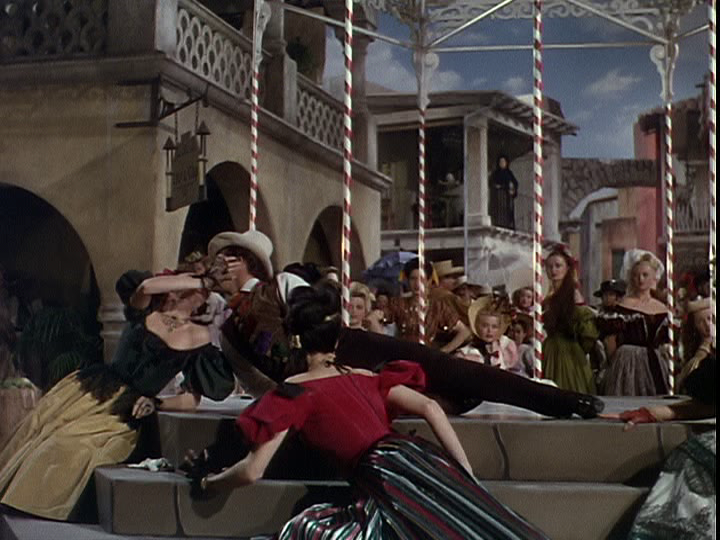
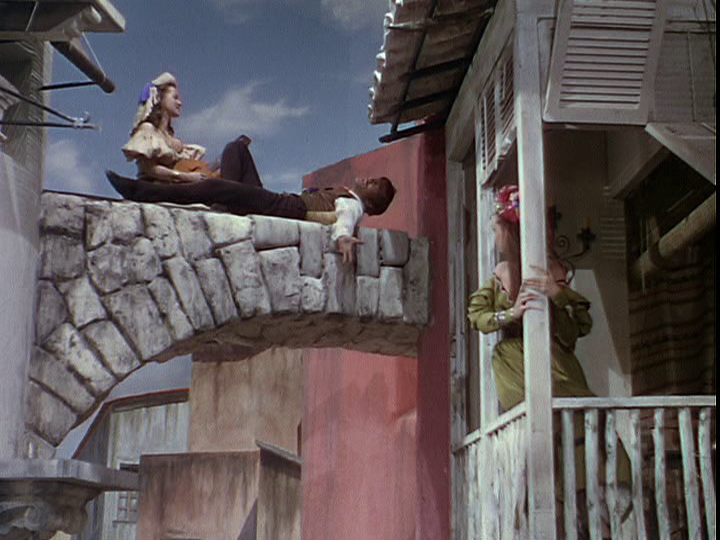
Home Video: Canyon Passage was one of the films I was most looking forward to seeing at this year’s Nitrate Picture Show because I didn’t know that Jacques Tourneur, director of my October Drink & a Movie selection The Leopard Man, made Technicolor westerns. As anyone who read the dispatch from that event I published here last week and/or the Letterboxd review I posted right after the screening no doubt gathered, it didn’t disappoint! While it unfortunately doesn’t appear to be streaming anywhere at present, I’m happy to report that the Blu-ray copy available from Kino Lorber looks great and is well worth the price of $16.59 + shipping.

Previous “Ithaca Film Journal” posts can be found here. A running list of all of my “Home Video” recommendations can be found here.

Dispatch from the 2025 Nitrate Picture Show

Cropped picture of the cover of the program for the 2025 Nitrate Picture Show

The story of the 2025 Nitrate Picture Show begins at the end. Like the eight that preceded it, this year’s festival concluded with a “Blind Date with Nitrate” screening of a film identified in advance only by one single frame enlargement on page 26 of the program, and as the lights went down and the hypnotically lush gold curtains of the Dryden Theatre slowly rose, very few people knew for sure what we were about to see. Although I also attended NPS last year and in 2023, I didn’t stay past Sunday morning either time, so as a novice blind dater the absence of applause or any other kind of reaction when the title card appeared didn’t strike me as all that odd. I noticed it, certainly, but while NPS is one of the few occasions when I operate under the assumption that I’m probably not the smartest person in the room, I have seen a lot of damn movies, and Occam’s razor suggested that this plus the fact that I had never even heard of The Trip to Tilsit before must just mean that it was legit obscure. All of this faded from my mind as the movie continued and I began to analyze what I was seeing with a modified version of the wine tasting steps in Kevin Zraly’s Windows on the World Complete Wine Course that I’ve been trying to discipline myself to use so that I don’t overlook essential attributes of whatever I’m watching. And so: academy ratio, black and white, classical Hollywood editing with a mobile camera, and a sophisticated use of sound. We must be in the mid- to late-30s and this is a studio production from somewhere, presumably Germany based on the language it’s in . . . holy crap, could this thing be from the Third Reich!?

The program notes by festival director Peter Bagrov handed out after the film confirmed that yes, it sure was. I didn’t recognize the name of the director Veit Harlan when it showed up in the credits, but I definitely learned about his follow-up work Jud Süß as an undergraduate film studies major. Bagrov describes it as “arguably the most famous piece of antisemitic propaganda in the history of cinema” and goes on to observe that Harlan was “put on trial twice, charged with crimes against humanity, and, controversially, acquitted both times” after the war. So why screen The Trip to Tilsit? The opening remarks by Bagrov and NPS founder Paolo Cherchi Usai, who told a confusing story about Jewish and Palestinian friends of his who both loved D.W. Griffith, weren’t super helpful, but the last two lines of Bagrov’s program notes are much more illuminating. “Harlan’s reputation besmirched all of his works, even the purest of them. But, as Henri Langlois allegedly said, ‘All films are born free and equal.'”

Langlois was already on my mind because the print of La Ronde that we watched on Friday came from the Cinémathèque française that he founded in 1936 and directed until his death in 1977. This screening was marred by problems with the live subtitles and after a French-language print of Three Little Pigs was shown without them the following day, I found myself wishing that the earlier movie had been presented the same way since its appeal is much more visual than verbal and I could have done without the distraction. After all, it’s my understanding that Langlois regularly programmed unsubtitled foreign language fare; he also didn’t always announce what would be playing on a given night in advance. This is not to say, however, that the experience of those audiences was somehow more pure as a result. Every movie tells the story of its origin and all viewers go through a version of the interpretive process I describe above, even if only unconsciously. Meanwhile, we almost inevitably spend exponentially more time with our memories of the things we watch than we do with the objects themselves, and even if some NPS attendees enjoyed, say, Tilsit‘s scene stealing big fluffy dog or the Katie Ledecky of horses more than they would have had they realized they (or their owners, anyway) were probably Nazis, it’s hard to imagine this fundamentally changing anyone’s relationship to the text.

If you scroll through the recent reviews of this film on Letterboxd, you will find many from people who felt tricked into seeing something they may have preferred to avoid. While I myself am glad to have been present at what I believe will be remembered as a historically significant, if perhaps notorious, screening, I’m also sympathetic to the argument that they should have been given a choice. That said, Americans are living through a period of our country’s history which may well be remembered similarly to Germany 1939, and not knowing for certain if I had called this movie correctly helped bridge these two eras in a more concrete way. In the end I personally found spending 90 minutes with a popular entertainment for “good Germans” more edifying than recent critical darling The Zone of Interest, which was too easy to reject as not actually saying anything about me for reasons I attempted to articulate more fully last April.

The Trip to Tilsit may have been the de facto main event, but when I think back on NPS 2025 the first title that will likely come to mind for me is one from a different future Axis power. Wife! Be Like a Rose! was the first Japanese sound film commercially released in the United States. Ninety years later it began the process of correcting probably my most egregious cinephile blind spot by becoming my official introduction to the work of director Mikio Naruse. Like Tilsit it revolves around a love triangle, but here it’s a truly equilateral one: there’s no Aryan saint or Polish devil, just three-dimensional human beings with virtues and flaws. Protagonist Kimiko (Sachiko Chiba) is the daughter of two of them, and while Etsuko (Toshiko Itô) and Shunsaku (Sadao Maruyama) are technically still married, Wife! captures what it’s like to watch your divorced parents interact with each other as an adult better than any other movie I’ve ever seen, which was not something I was expecting to encounter in one from 1935! The final shots are a masterpiece of hard-won empathetic understanding and they combine with the drawn shades of the opening sequence to make a fascinating set of book ends. A thirty-film Naruse retrospective is currently making its way around the country, and hopefully at least one or two titles will make their way to upstate New York at some point; in the meantime, I look forward to working my way through the “Directed by Mikio Naruse” collection on the Criterion Channel.

In retrospect the comment that “within five years all but German foreign language films were banned as Japan mobilized for war” in James Layton’s program notes for Wife! looks like a clue. So too does the emphasis on the fact that the version of Three Little Pigs screened in the color-themed “Nitrate Shorts” included a joke excised from the version of record premised on the idea that the pigs would let the wolf in if he was dressed as a Jewish (and therefore kosher) peddler. It also featured three animated shorts made in Czechoslovakia between 1935-37, one of which, The Crucial Two Minutes, is an incredible depiction of drunkenness doubling as an advertisement for toothpaste starring a severely depressed man who may or may not say something about the mindset of a nation on the verge of occupation. A highlight of the program was another commercial, Len Lye’s entrancing abstract direct animation Colour Flight, which I appreciated in part because commissioned works are often overlooked by movie snobs despite the fact that they remain an arena for experimentation to this day–the short Snowbird that Sean Baker directed in 2016 for the fashion brand Kenzo is maybe my favorite of his works, for instance. I was also wowed by The Destroyers of Our Gardens, which consisted of four minutes of stencil-colored macro footage of caterpillars that wouldn’t embarrass David Attenborough despite the fact that it was made almost a decade before he was even born accompanied by the legendary Philip Carli on piano. But best of all was director Mary Ellen Bute’s Spook Sport, her follow-up to Synchromy No. 4: Escape, which I was lucky enough to see at NPS 2023. Once again the shapes and colors, especially amorphous red and blue shapes gamboling in front of a receding starscape, moved me in a way that’s hard to explain and certainly can’t be replicated in a home viewing environment.

The 1916 release print of The Destroyers of Our Gardens shown on Saturday was actually the oldest one ever screened at NPS. This year’s festival also pushed boundaries in the opposite direction with Mother Joan of the Angels. As Ken Fox explained in his program notes, “though most of Western Europe and the United States had long since phased out nitrate film stock in favor of acetate safety film, the Soviet Union and some Central and Eastern European countries continued to use it well into the 1960s.” The entertaining Argentinian noir Hardly a Criminal represented another first when it became NPS’s inaugural foray into South America on Friday. Neither blew my mind the way Spook Sport did, but I enjoyed their interrogations of the respective notions of earthly and heavenly rewards thoroughly, and while many people writing about this event wax poetic about the unique properties of nitrate film stock, these three selections exemplify what I have come to think of as the main reason to travel to Rochester each spring: whatever intrinsically superior qualities the format might have, what matters even more is that it’s how everything screened at NPS was originally meant to be seen.

This is particularly relevant in the case of opening night movie Becky Sharp, which apparently defied some attendees’ expectations for what it was “supposed” to look like. Bagrov noted in an introduction the following day that those attributing its muted colors to age were incorrect because Technicolor doesn’t fade and that this instead represented as a conscious decision typical of the era (as I learned at NPS 2023) that has not always been honored by the people responsible for Blu-ray and DVD restorations. It also started things off on an anti-establishment note which I thought would be my primary throughline for this dispatch right up until the final day of the festival. Although Sharp is set in the Napoleonic Era, Miriam Hopkins’s titular heroine is clearly a woman of the 1930s who in hindsight says a lot about how little (or, more cynically, how much) our leaders learned from World War I. You Only Live Once (which I actually skipped at NPS in favor of a nap, unhurried lunch, and writing but caught up with after the festival ended) is even more pessimistic about society’s willingness to cut the wrong sort of person any slack, while It’s in the Bag! is a guerilla film made right under the noses of the French would-be fascist authorities on leftover Pathé sets in a short window of time before they were torn down and tweaks the same appendage with jokes about predatory capitalism, somnambulistic fascist salutes, and populist headgear that the appreciative laughter of my fellow audience members suggests have sadly come back into style.

Other not-quite-as-light-as-it-may appear fare included an old favorite in My Man Godfrey and a new discovery for me in Hue and Cry. The latter’s ragamuffin kids playing air raid games in the bombed out ruins of post-Blitz London make it a fascinating companion to last year’s selection Germany Year Zero, but it might pair even better with No Greater Glory as a pre-/post-war double feature about the affects of militarism on a nation’s youth. The NPS 2025-iest movie of all, though, was probably Canyon Passage, which features a love pentagon, the year’s most breathtaking (salmon) color celluloid sky, and a burgeoning western society marked as corrupt by a poker game that only Dana Andrews’s protagonist Logan Stuart seems to realize or care is fixed. Its naive suggestion that Manifest Destiny could have been a win-win if only white settlers had cooled it a bit with the rape and murder is redeemed by its frank acknowledgement that acts of the latter sort absolutely did take place and a brutal saloon fight that makes it clear that director Jacques Tourneur and company have no illusions about the Wild West being some sort of Garden of Eden.

I headed to NPS in May thinking it might be my last one for awhile because even though the price of a festival pass is extremely reasonable and I’m fortunate enough to live just a short bus ride away, taking three days off from work to stay in a hotel, eat out, and watch movies still strikes me as a questionable extravagance in a time of rising costs. It occurred to me even while I was there that the eve of the tenth anniversary edition was a funny time to duck out, though, and I’ve gotten quite good at economizing by staying just a few blocks further away from the Dryden than most of my fellow attendees and being thoughtful about my meals: a large Italian Assorted sub from Calabresella’s is not only delicious, for instance, but also big enough for two lunches if you have a fridge in your room! I’m planning to give my liver a full year off from booze for services rendered after my “Drink & a Movie” series wraps this December as well, so that’s one more opportunity to save money. Most importantly in light of the uproar surrounding this year’s Blind Date, I want to make it clear that I support this unique annual event as much as ever, so I’m stating now for the record that I intend to return in 2026, hopefully to a reserved seat (a new initiative that from my perspective was an unqualified success) in the first row as close to the middle as possible. I’ve got my fingers crossed that director Frank Borzage will finally make his NPS debut, but otherwise what I’m looking forward to hasn’t changed: I can’t wait to be surprised!

Previous film festival dispatches can be found here.

Ithaca Film Journal: 6/19/25

What I’m Seeing This Week: I’m going with The Life of Chuck at Cinemapolis and I think Prime Minister as well at its one and only screening there on Wednesday at 6pm. I definitely intend to see 28 Years Later either there or at the Regal Ithaca Mall before it closes, too, but probably not this week.

Also in Theaters: My favorite movie now playing Ithaca is The Phoenician Scheme, which continues its run at both Cinemapolis and the Regal. It actually reminds me a bit of its neighbor at the latter Ballerina, my top recommendation last week, in part because it opens with a bit of graphic violence of the sort that I associate more with the World of John Wick than the oeuvre of director Wes Anderson. Its protagonist Zsa-zsa Korda (Benicio Del Toro) is also sort of Baba Yaga of mid-20th century industrialism: undefeated, but not indestructible, as demonstrated by the visibly increasing wear and tear on his body, only he’s trying to stay *in* the game, not get out of it. But the main connection is that the plot of each film is secondary–to imaginative action set pieces in the case of Ballerina, and to the painstakingly-chosen pieces of art and other objects that comprise the set dressing of The Phoenician Scheme. Both could well wind up on my year-end Top Ten list. I also enjoyed Mission: Impossible – The Final Reckoning, which is at the Regal, and Friendship, which is at Cinemapolis. This week’s special events highlights include free screenings of the documentaries It’s All Right To Be Woman and Remembering Roe: Then & Now at Cinemapolis tonight and Monday evening respectively. Finally, your best bet for repertory fare is 2017 Best Picture Oscar winner Moonlight, which plays Cinemapolis on Sunday.

Home Video: The premiere of the latest Spike Lee joint Highest 2 Lowest at the Cannes Film Festival last month reminded me that it has been too long since I last watched High and Low, the 1963 movie it’s based on. Luckily the latter streaming on the Criterion Channel, and if you haven’t checked it out recently or ever you really should, because it’s a true monument to the fundamental allure of cinema. A riveting police procedural can also be a meticulous dissection of society and vice versa–you don’t need to choose between art and entertainment, the very best films are always both! I definitely do see the appeal of turning director Akira Kurosawa’s literal and figurative wide-angle lens on today’s America, but it’s one hell of a hard act to try and follow. Highest 2 Lowest has a release date of August 22, so we will see soon enough for ourselves if the gamble was worth it!

Previous “Ithaca Film Journal” posts can be found here. A running list of all of my “Home Video” recommendations can be found here.

Ithaca Film Journal: 6/12/25

What I’m Seeing This Week: There are tons of movies I want to see in local theaters right now! I’m definitely hoping to catch Pavements before it closes at Cinemapolis today and The Phoenician Scheme and maybe Materialists there or the Regal Ithaca Mall later in the week as well.

Also in Theaters: In addition to the titles above, I’m also intrigued by The Life of Chuck, which opens at the Regal today and Cinemapolis tomorrow. Sticking just to stuff I’ve already seen, my favorite among the first-run fare is Ballerina, a spinoff contemporaneous with the events of John Wick: Chapter 3 – Parabellum that impressed me with colorful, imaginative action sequences that aren’t merely ornamental, but also perform the load-bearing function of advancing character development. I also enjoyed Mission: Impossible – The Final Reckoning, a satisfying farewell to a favorite franchise which makes up for a surfeit of self-aggrandizing fluff with an underwater set piece and bi-plane stunt that can stand toe-to-toe with anything in the previous seven films, and the entertaining dark bromance comedy Friendship, which continue their runs at the Regal and Cinemapolis respectively. Fun repertory options include Bill & Ted’s Excellent Adventure, which you can see for free at Cinemapolis on Sunday as they close out this season of their “Family Classics Picture Show,” and Indiana Jones and the Last Crusade, which plays the Regal on Saturday, Sunday, and Wednesday. Finally, special events highlights include a screening of Marcella at Cinemapolis on Monday followed by a Q&A with director Peter Miller and one of Lost Nation there on Wednesday followed by a Q&A with writer/director Jay Craven and musical score producers Judy Hyman and Jeff Claus.

Home Video: I’m still working on my dispatch from this year’s Nitrate Picture Show. In the meantime, I noticed that Land of the Pharaohs, which as a lover of costume drams and procedurals has always been a favorite of mine, is streaming on Watch TCM until June 29. Upon revisiting it I realized that Jack Hawkins’s Pharaoh Khufu is pretty much exactly who Jorge Salcedo’s José Moran from NPS 2025 selection Hardly a Criminal wants to be–each is even described by a close associate in terms of a virtually identical story about a time when they were greedy in their youth! As such it isn’t a surprise that Moran similarly is so consumed by fears of losing the money he is finally able to accumulate during the course of the movie that he is unable to ever enjoy it. Pharaohs is also basically the perfect CinemaScope movie as famously defined by Fritz Lang in Contempt since it’s essentially a slow build epic funeral for snakes rendered as Orientalist poetry. If none of that sounds like your cup of tea, watch the first few minutes anyway and drink in the site of columns of thousands of real-life human extras receding into the distance: this is one case where it is completely accurate to observe that they really don’t make ’em like they used to!

Previous “Ithaca Film Journal” posts can be found here. A running list of all of my “Home Video” recommendations can be found here.

Ithaca Film Journal: 6/5/25

What I’m Seeing This Week: My Loving Wife and I are finally going to see Mission: Impossible – The Final Reckoning at Cinemapolis or the Regal Ithaca Mall this weekend in celebration of her birthday! I’m also hoping to catch Ballerina at the Regal.

Also in Theaters: I’m excited that The Phoenician Scheme is finally opening at Cinemapolis and the Regal, but we’re saving this for our next date night. As I mentioned last week, our oldest has informed us that she’s going to make Lilo & Stitch, which continues its run at the Regal, her next Family (née Friday) Movie Night selection, and I’m determined not to miss Pavements, which opens at Cinemapolis tomorrow, so I’ve got those films in my near future as well. Sinners, which is still going strong at both Cinemapolis and the Regal, remains my favorite new movie that I’ve already seen for the fourth week in a row; I also enjoyed Friendship, which is at the same two theaters. Finally, your best bet on the special events/repertory front are the two screenings of Trainspotting at Cinemapolis on Tuesday as part of their “Trains, Trains, Trains” staff picks series

Home Video: I’m still working on tying all of my thoughts on this year’s unexpectedly divisive Nitrate Picture Show together into a blog post, but hope to have it up within the next few days. A big what-if involves La Ronde, which was apparently almost picked for the “Blind Date with Nitrate” slot that isn’t announced in advance. We’ll never know for sure whether or not that would have staved off the controversy now raging (stay tuned!) about the programming decision made instead, but I likely would have mentioned it here regardless because the restored version available on DVD from the Criterion Collection and streaming on the Criterion Channel appears to be a cut above most of the other features from this year’s festival available in those formats. It’s also an ethereally suave masterpiece of form which judging from the surprisingly low percentage of people I follow on Letterboxd who have logged it may be weirdly underseen–has director Max Ophüls fallen out of style? Anyway, it’s well worth a look if you haven’t watched it recently or ever!

Previous “Ithaca Film Journal” posts can be found here. A running list of all of my “Home Video” recommendations can be found here.

June, 2025 Drink & a Movie: The Navigator + The Strange Case of Angelica

You’d never know it from this monthly series, but My Loving Wife and I aren’t drinking as much as we used to, and the most common way I discover new cocktails these days is by trying to find novel uses for old bottles which have been languishing in our liquor cabinet and refrigerator for far too long. And so it was that I found myself mixing up The Navigator which Frederic Yarm featured on his blog in 2018 earlier this year with some of the madeira I purchase each December to make bigos, a nod to both my upbringing in Pennsylvania Dutch country where we eat pork and sauerkraut on New Year’s day for good luck and the two years of Polish I took in college. When it proved to be a perfect platform for not just that spirit, but two other household favorites, Bacardí Reserva Ocho and Rothman & Winter’s Orchard Apricot Liqueur, I immediately decided to feature it in one of my last remaining Drink & a Movie posts. Here’s how to make it:

1 oz. Bacardí Reserva Ocho
1 oz. Rainwater Madeira (Leacock’s)
3/4 oz. Lemon juice
1/2 oz. Simple syrup
1/4 oz. Apricot liqueur (Rothman & Winter)

Combine all ingredients with ice and strain into a chilled cocktail glass. Garnish with an edible orchid and a lemon twist.

The Navigator in a cocktail glass

Punch provided a great overview of rainwater Madeira in 2017 for their “Bringing It Back Bar” series. Once considered the most prestigious style in the category in United States, it emerged from Prohibition with a debased reputation but has recently found favor with bartenders who find it “attractive not only for its relatively low price point, but for its subtlety.” It functions in The Navigator the same way as it does in the recipes linked to in that article–as a medium-dry counterpoint to the apricot liqueur and rum, resulting in an easy-drinking concoction which is sweet, but subtle instead of cloying. That’s actually not a terrible way to describe the movie I’m pairing it with, The Strange Case of Angelica, which like Madeira and The Navigator’s presumptive namesake Prince Henry hails from Portugal. Here’s a picture of my Cinema Guild DVD copy:

The Strange Case of Angelica DVD case

It’s also available for rental or purchase on Apple TV+, and some people (including current Cornell University faculty, staff, and students) may have access to it through Kanopy via a license paid for by their local academic or public library as well.

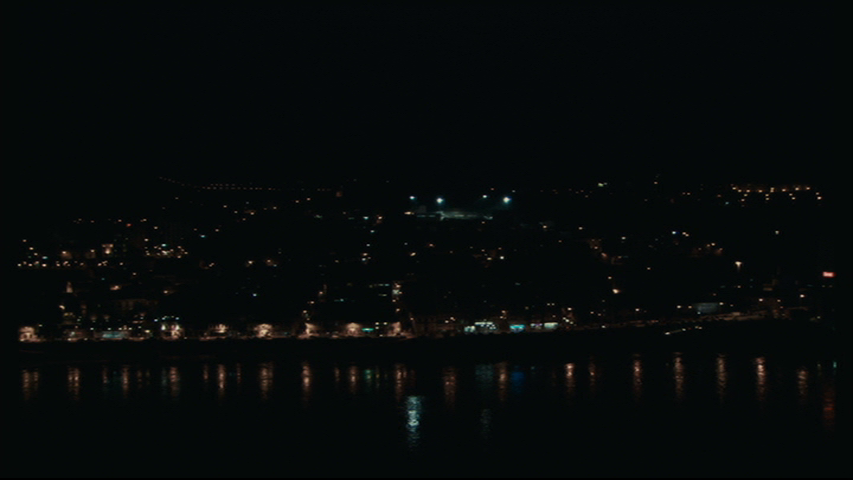
Director Manoel de Oliveira was 101 years old and had 30 features under his belt when The Strange Case of Angelica debuted at Cannes in 2010, and it has a stately mien and pacing befitting such a remarkable resume. The film begins with an epigraph by Antero de Quental: “yonder, lily of celestial valleys, your end shall be their beginning, our loves ne’er more to perish.” This is followed by two languorous minutes of titles accompanied by Portuguese pianist Maria João Pires performing the third movement of Chopin’s Piano Sonata No. 3 in Bi Minor which unspool over a nighttime cityscape of Régua from a vantage point across the Douro River:

Régua cityscape at night

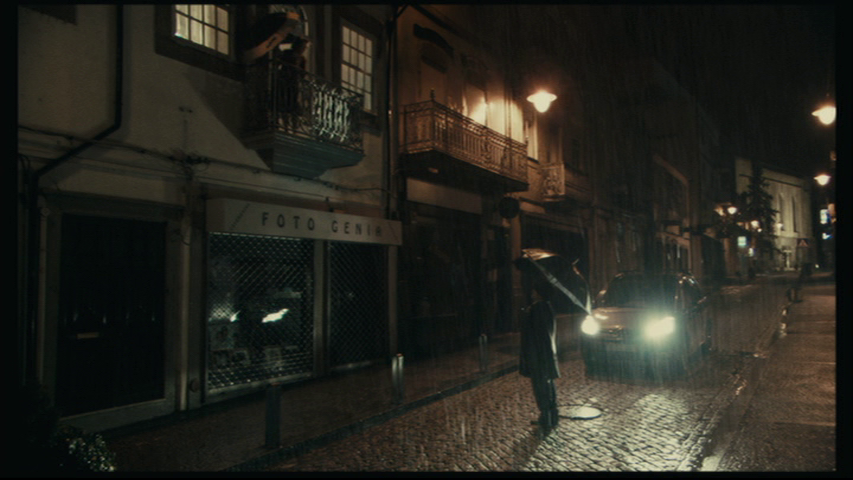
The action begins with a 3:30 single take street scene also shot with a stationary camera and featuring a “strongly diagonal” (per James Quandt on the DVD commentary track) composition that will accrete significance as the movie progresses. A man inquires as to the whereabouts of the photographer who lives above the shop is car has stopped in front of:

And is told that he’s out of town, but a passerby helpfully offers directions to the home of a young “Sephardi emigrant” he knows who “takes photos all over the place.” This turns out to be Isaac (Oliveira’s grandson Ricardo Trêpa), who we meet bent over a malfunctioning wireless in what J. Hoberman identifies as a reference to Jean Cocteau’s Orphée in an essay collected in his book Film After Film:

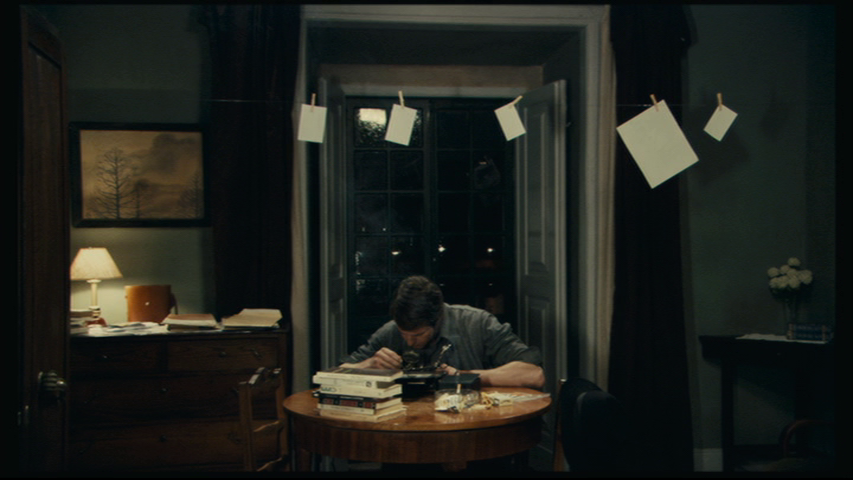
Isaac, framed by a doorway, fiddles with a radio in front of a pile of books

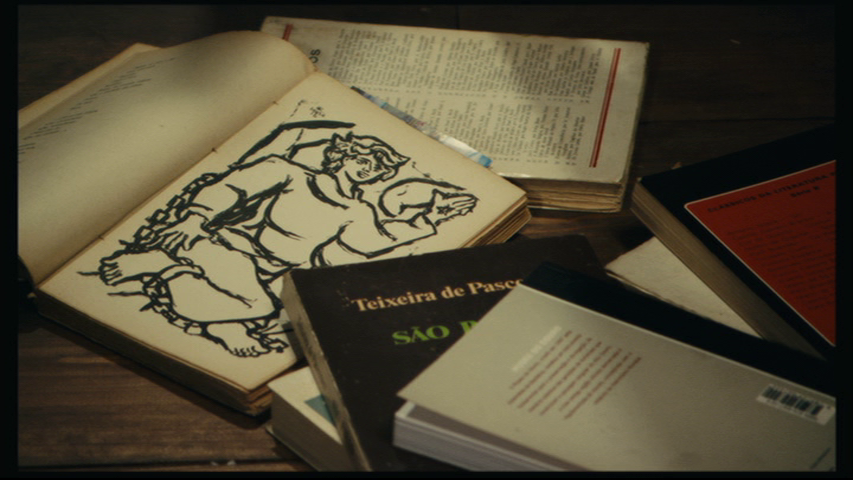
Unable to make the “static-garbled radio transmissions” any clearer, Isaac shoves the device forward in frustration, knocking a pile of books onto the floor. When one volume falls open to this page:

An illustration of an angel in a book lying open on a pile of others, which are closed
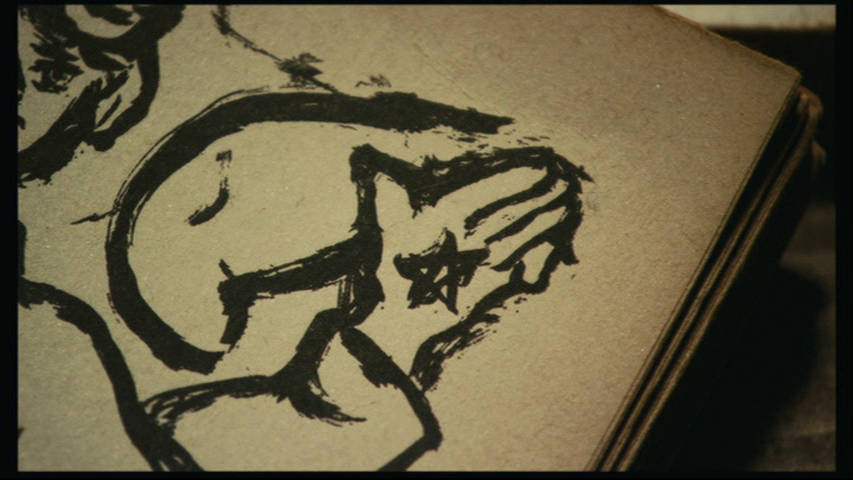
Close-up of a detail of a star in the palm of the angel's hand

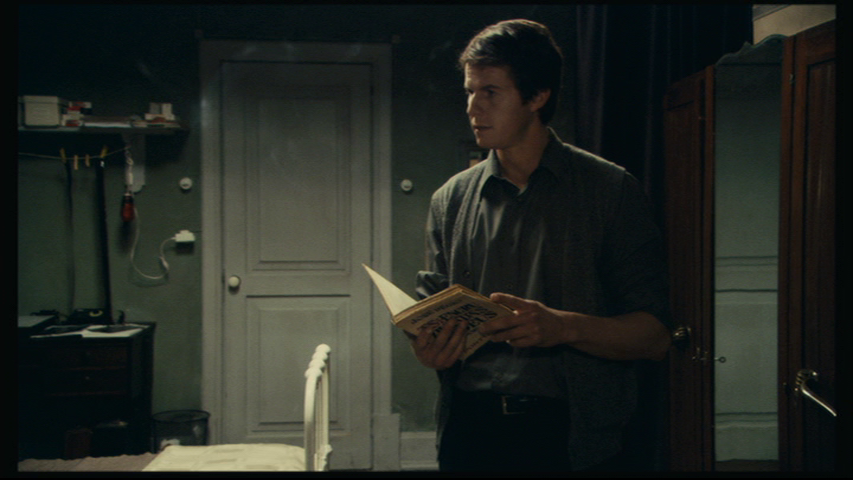
He picks it up and begins to read. “Dance! O stars, that in constant dizzying heights you follow unchanging. Exalt, and escape for an instant the path that you are chained to.” Suddenly, there’s a knock at the door.

Medium shot of Isaac, book in hand, staring off into space

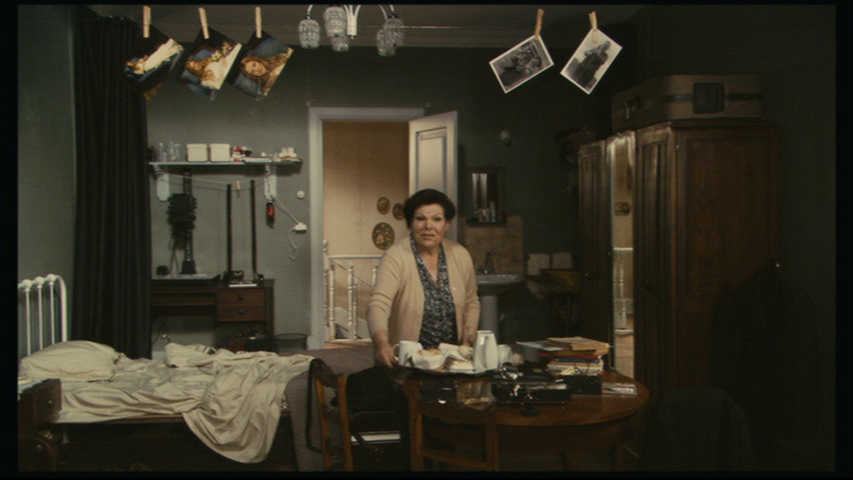
“It’s the angel!” Isaac exclaims and returns to the book. “Time, stand still, and you, former beings, who roam fantastical, celestial ways. Angels, open the gates of heaven, for in my night is day, and in me is God.” As he finishes the passage, there’s another knock, now accompanied by a voice calling his name. Shaken at last from his reverie, Isaac puts the book down and answers the door to find that it’s his landlady Madam Justina (Adelaide Teixeira), who Quandt describes as “like a kind of one-woman Greek chorus,” bearing a message that he has been summoned by a “very important lady” to take pictures of her daughter.

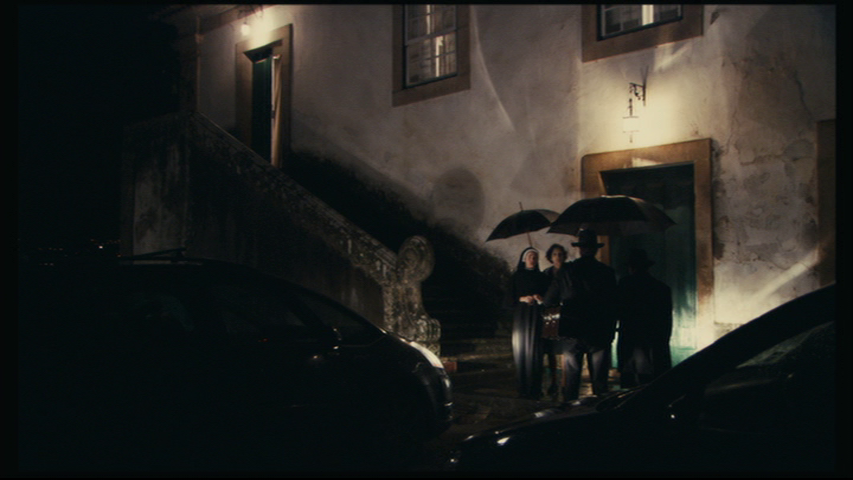
Upon arrival Isaac is greeted outside at the foot of a staircase by a nun (Sara Carinhas) who turns out to be the sister of the woman he is there to photograph (Pilar López de Ayala) and her maid (Isabel Ruth).

Isaac arrives at the Portas estate

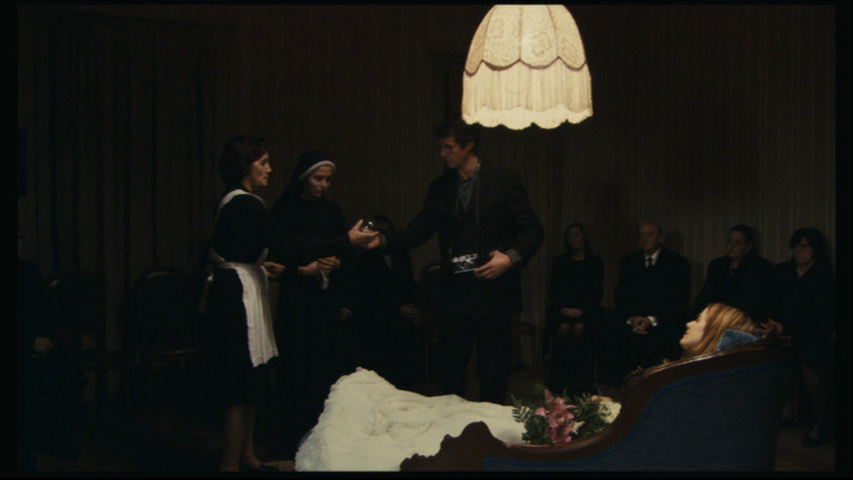
They inform him that his subject Angelica has just passed and that his commission is to create “one last souvenir, even if it is very sad” at the behest of her mother. Isaac asks for a stronger bulb for the room’s only light, which Hajnal Király characterizes as “a historical memento of the Oliveira family, owners, at the beginning of the twentieth century, of a factory manufacturing electric devices” in her book The Cinema of Manoel De Oliveira:

Medium shot of Isaac accepting a lightbulb from Angelica's sister and their maid
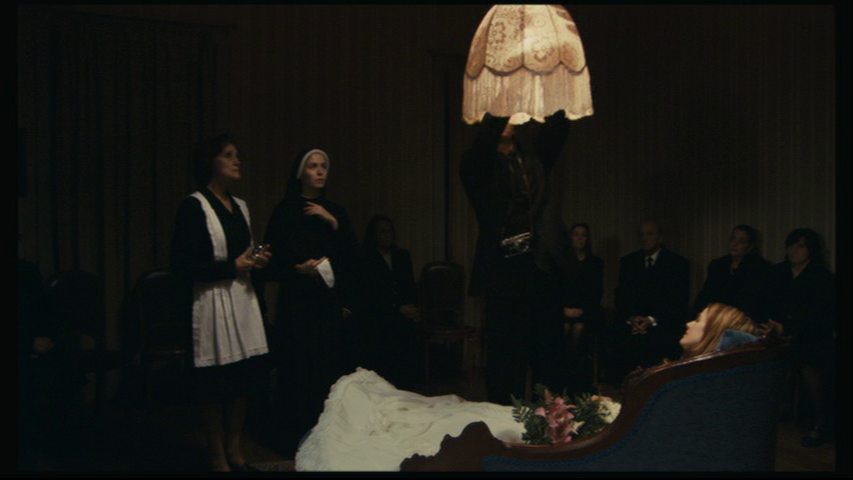
Continuation of previous shot: Isaac changes the bulb in a ceiling lamp that hangs in the center of the room
Continuation of the previous shot: the light is now noticeably brighter

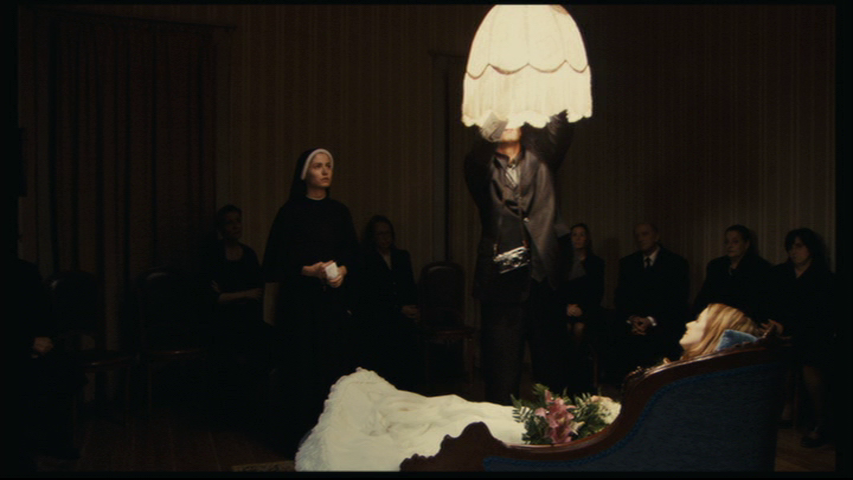
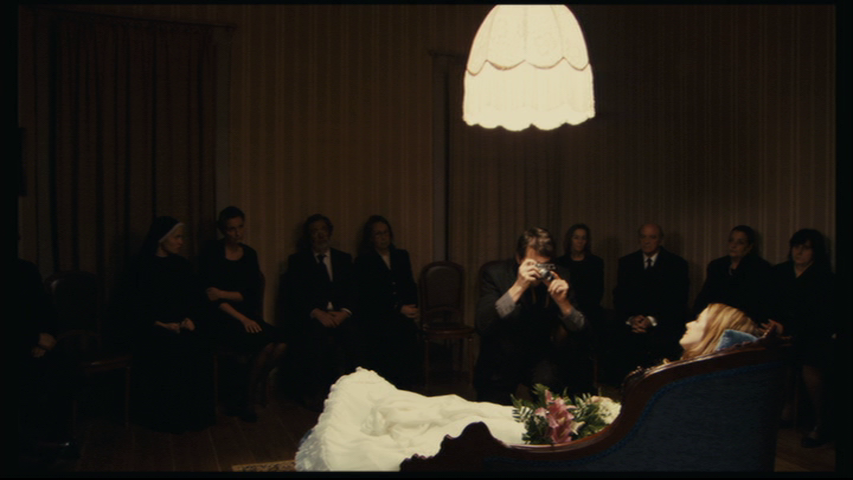
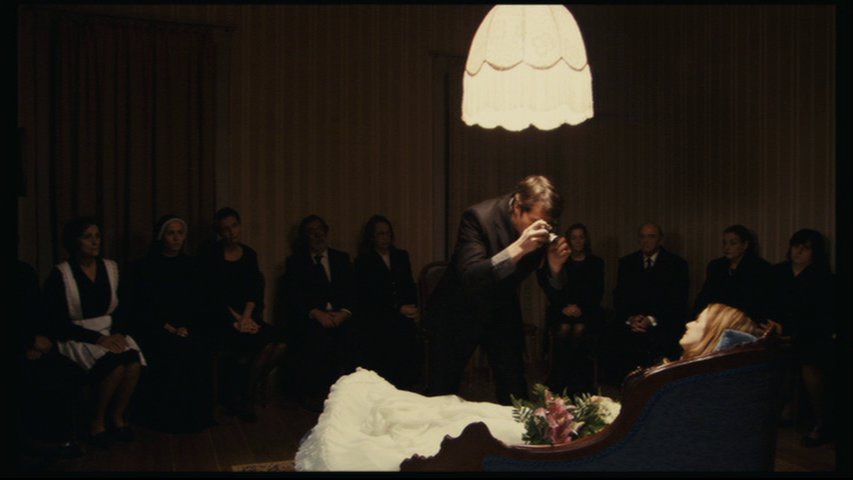
Then sets to work in a photo shoot depicted through a combination of long shots of Isaac:

Isaac crouches in the middle right of the frame and takes a picture of Angelica, whose body lies on a fainting couch in the foreground

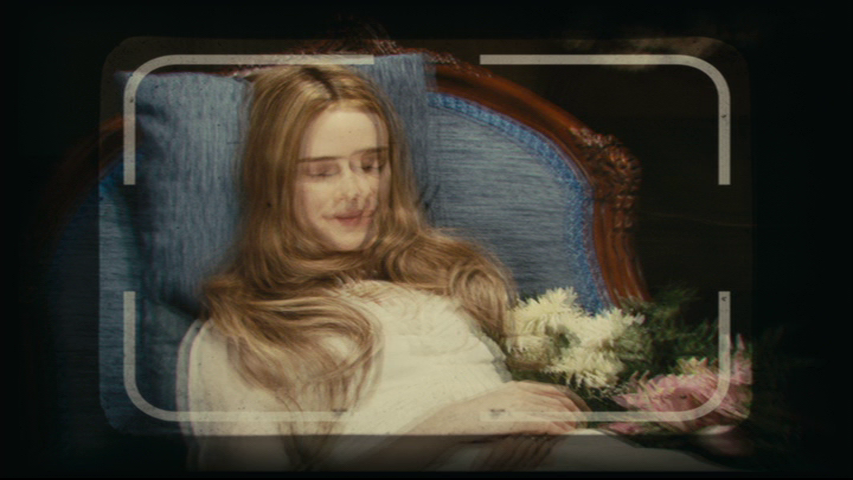
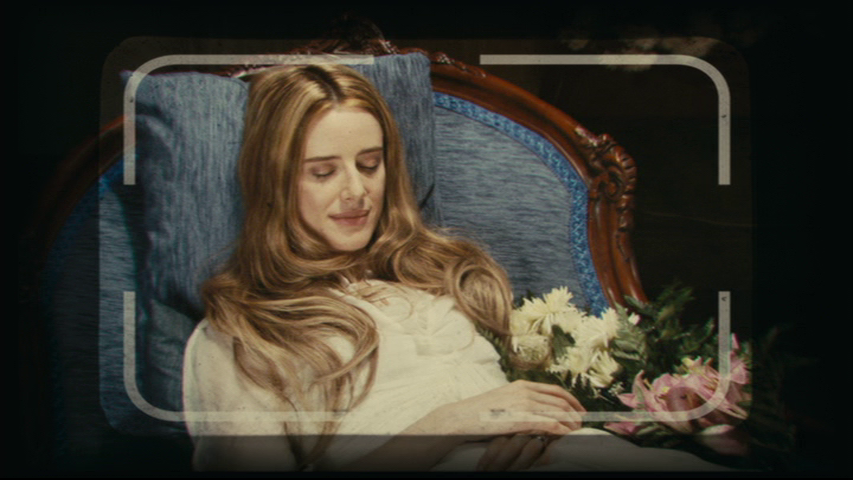
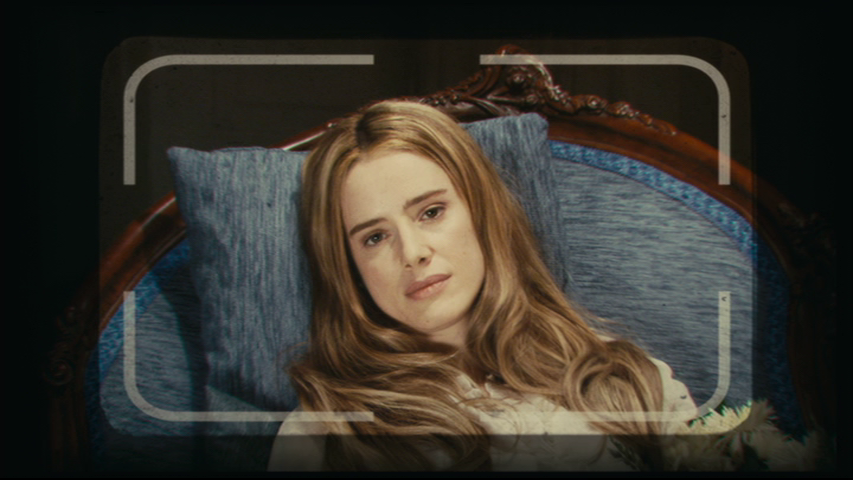
And point-of-view shots complete with frame lines showing us exactly what he’s looking at as he focuses his camera:

Out of focus POV medium shot of Angelica's body with frame lines
In focus POV medium shot of Angelica's body with frame lines

He moves in for a close-up:

Isaac moves in for a close-up of Angelica

When suddenly Angelica appears to open her eyes and smile at him:

Close-up of Angelica as seen through Isaac's camera with her eyes open
Continuation of the previous shot: Angelica is now beaming at the camera

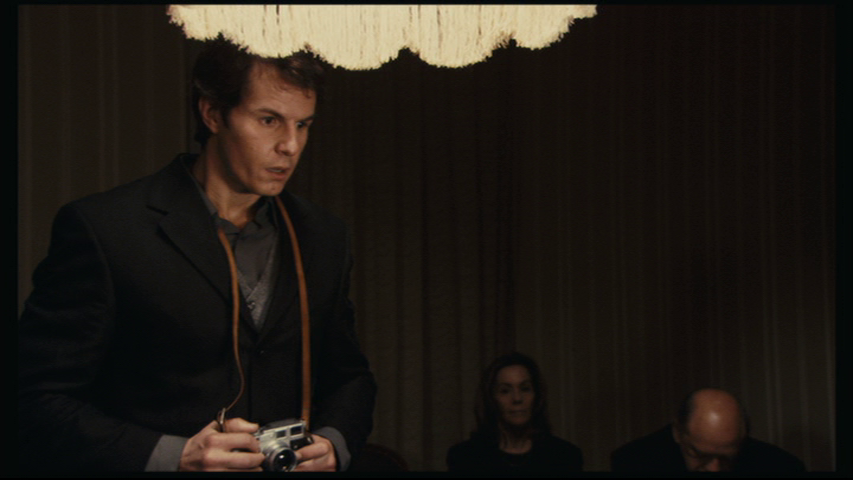
He is obviously shocked:

Medium shot of Isaac in the left third of the frame looking shocked

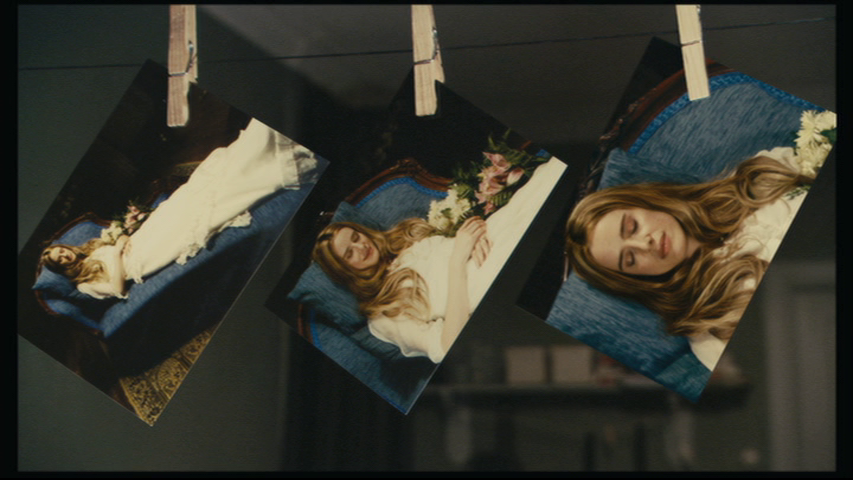
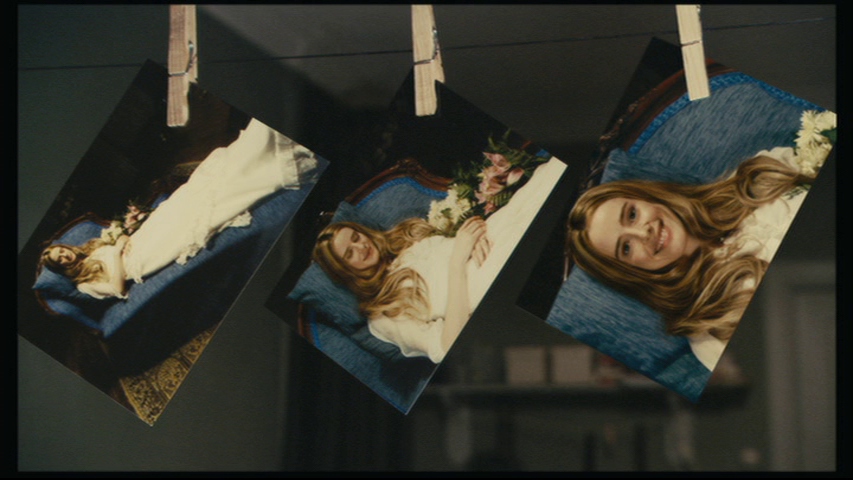
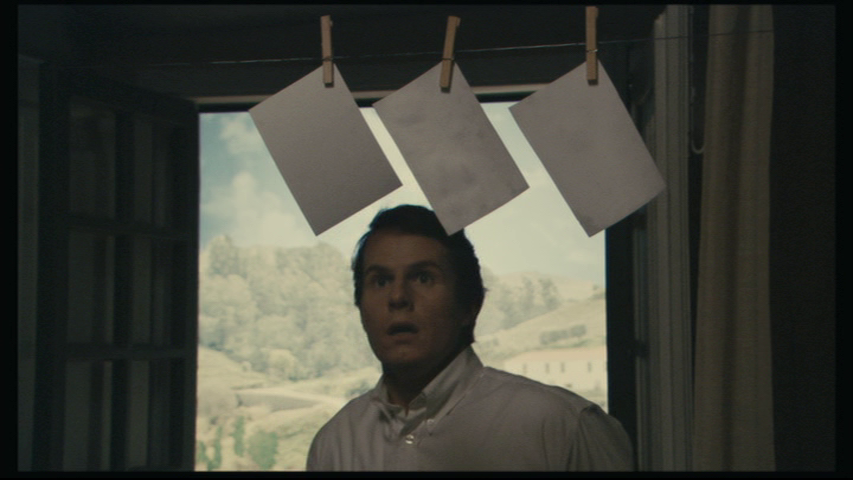
But upon realizing that no one else has noticed anything strange hastily finishes up and departs. The next day as he’s developing the pictures he took, an image of Angelica again comes to life, causing him to once more jump back in surprise:

Close-up of three photos of Angelica
Continuation of the previous shot: in the third photo, Angelica is now smiling
Medium shot of Isaac jumping back from the photos in the previous two images in surprise

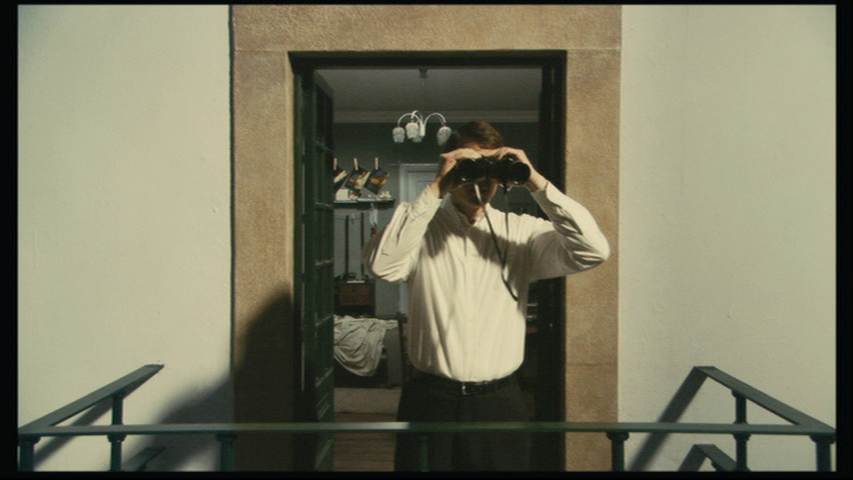
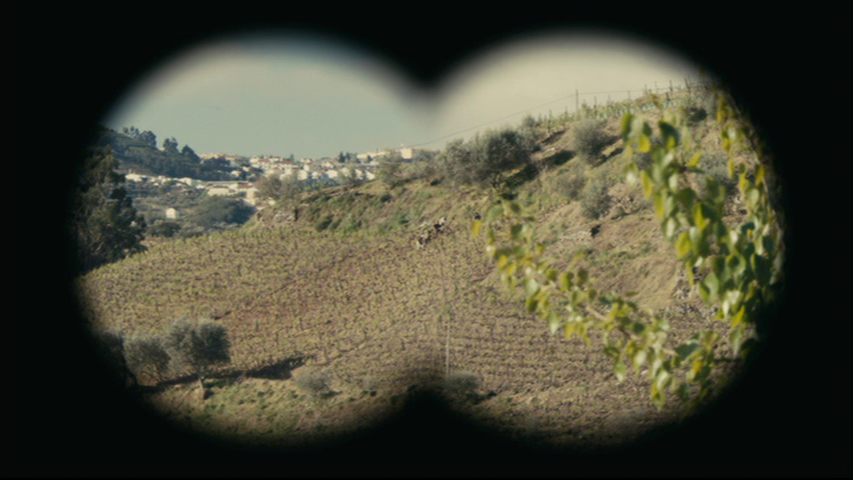
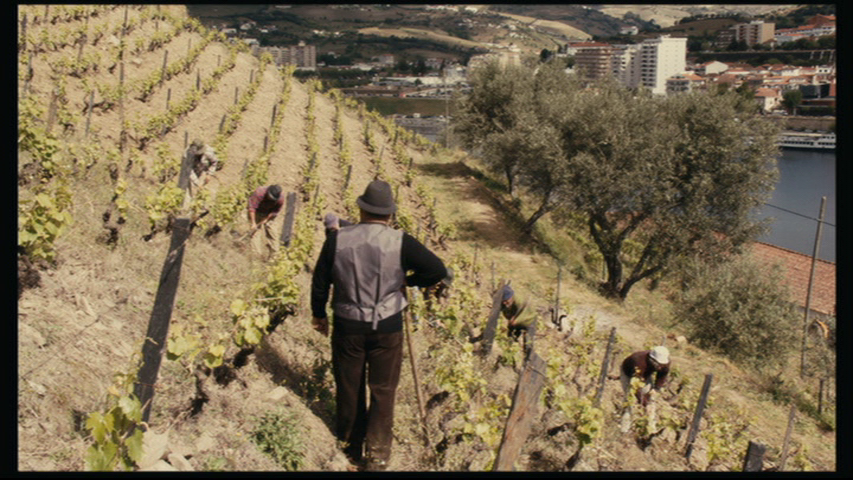
Moments later he spies some laborers tilling the soil in a vineyard across the river:

Medium shot of Isaac with binoculars looking toward the camera
Binoculars-shaped POV shot showing laborers at work

And resolves the photograph them, much to the chagrin of Madam Justina, who laments the fact that “hardly anyone works like that these days”:

Medium long shot of Madam Justina in Isaac's apartment with a tray of breakfast centered in the frame and looking at the camera

As Quandt notes, “Oliveira’s materialist appreciation of sound is wonderfully apparent” in the sequence that follows, which features more slanted lines:

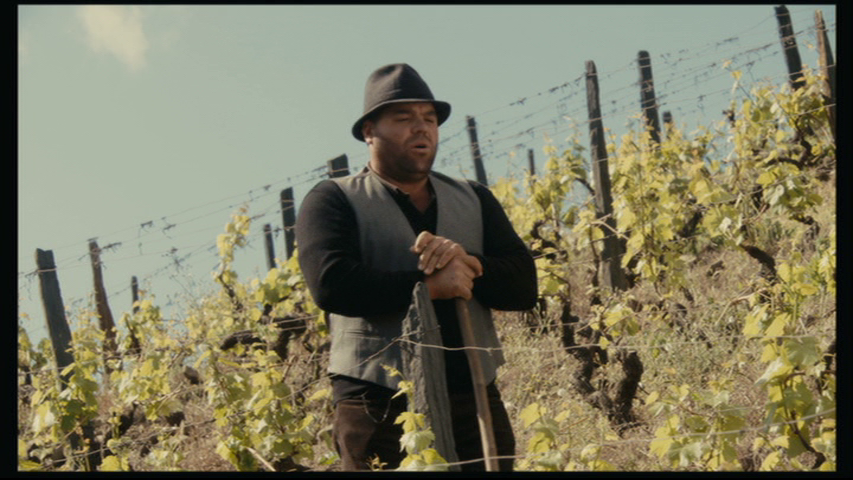
And a charming call-and-response working song about a shabby suit of clothes. It ends with Isaac appearing to hear bells calling mourners to Angelica’s funeral, for he next appears in the church where one of the friends gathered around her coffin comments that “she looks like an angel from heaven”:

Medium shot of Isaac in the right third of the frame listening to church bells
Close-up of Angelica in her coffin
Medium shot of Isaac centered in the frame and flanked by mourners looking at Angelica's body

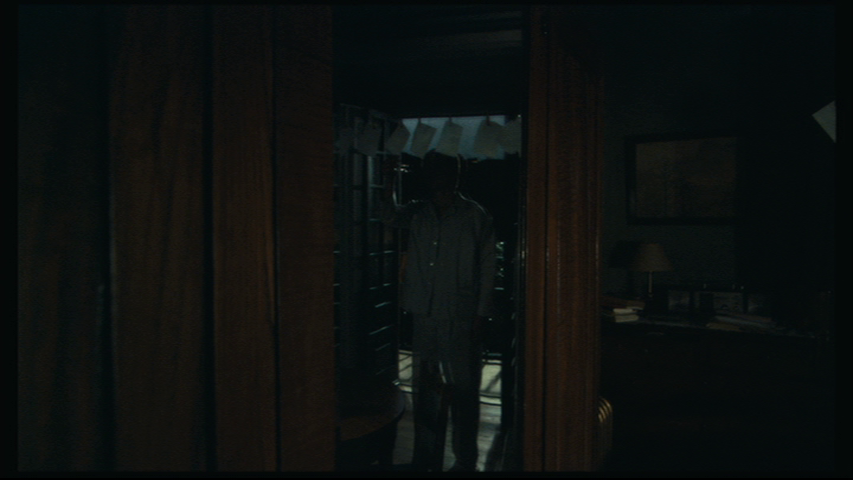
Which inspires him to recite the snippet of poetry he read earlier. That night in a scene which begins with what we soon realize is a shot of his reflection in a mirror, Isaac wakes up and walks over the photos hanging on a line in front of his balcony:

Isaac in bed in the middle of the bottom third of the frame with darkness all around him
Medium shot of Isaac and his reflection in the middle of the frame
Medium shot of Isaac, still reflected in a mirror, looking at the photos hanging on a line in front of his balcony

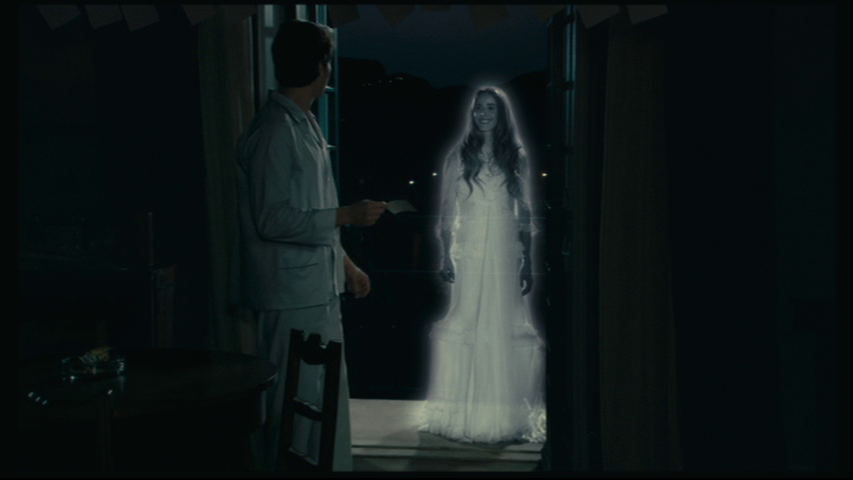
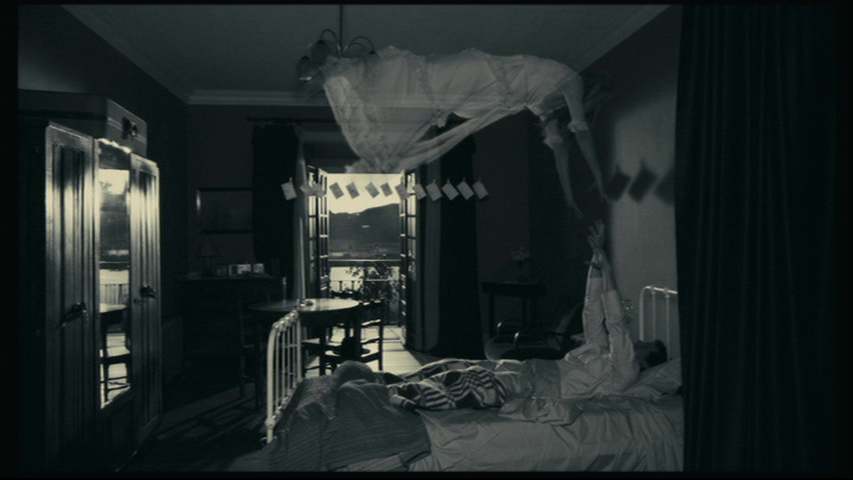
As he stands there an apparition materializes behind him:

Isaac contemplates what appears to be Angelica's ghost

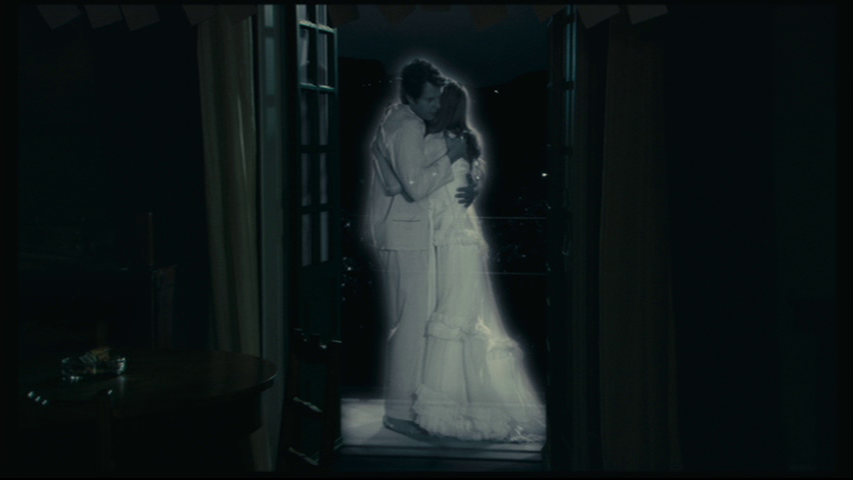
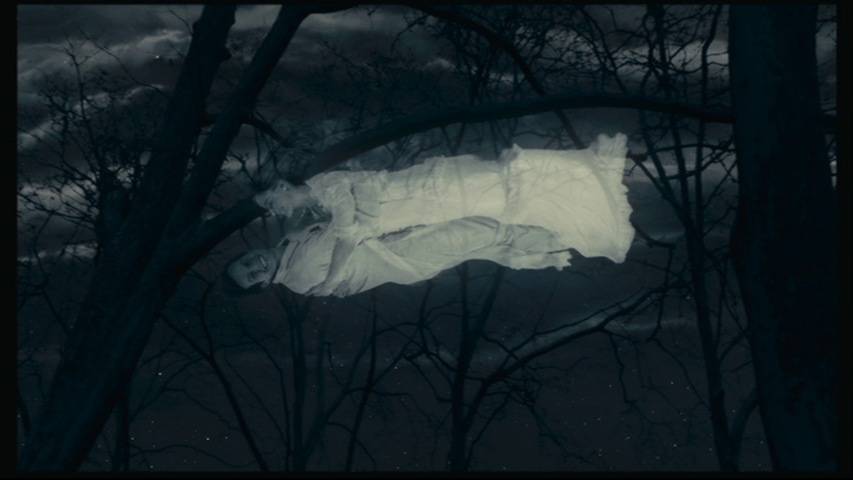
He passes through the doorway and becomes translucent himself. The two of them embrace and rise into the sky:

Medium shot of the spirits of Isaac and Angelica embracing
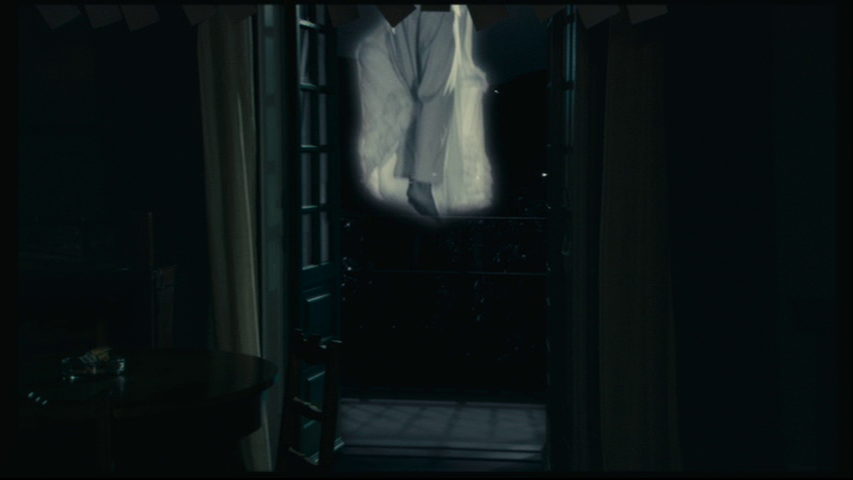
Continuation of the previous shot: the two figures rise off the ground...
...and disappear through the top of the frame

Leading forthwith to my favorite image from this movie, the epically goofy grin plastered on Isaac’s face as he floats supine through the air:

Isaac, still embracing Angelica and now vertical, smiles at the camera

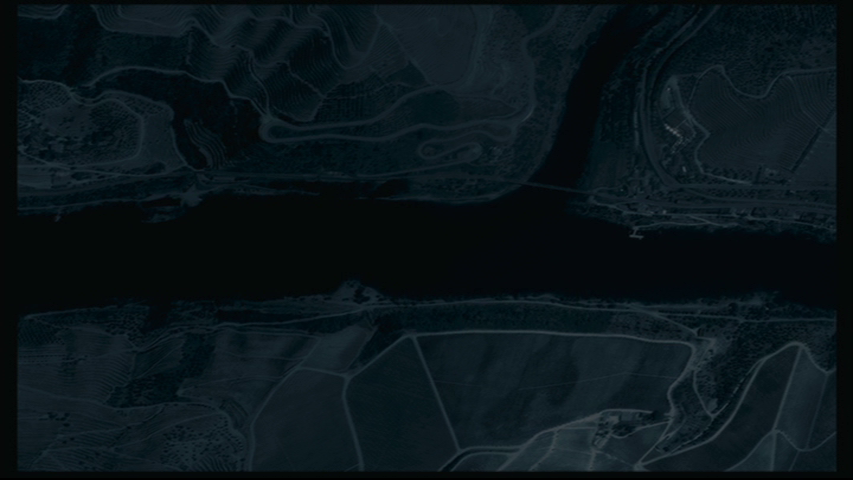
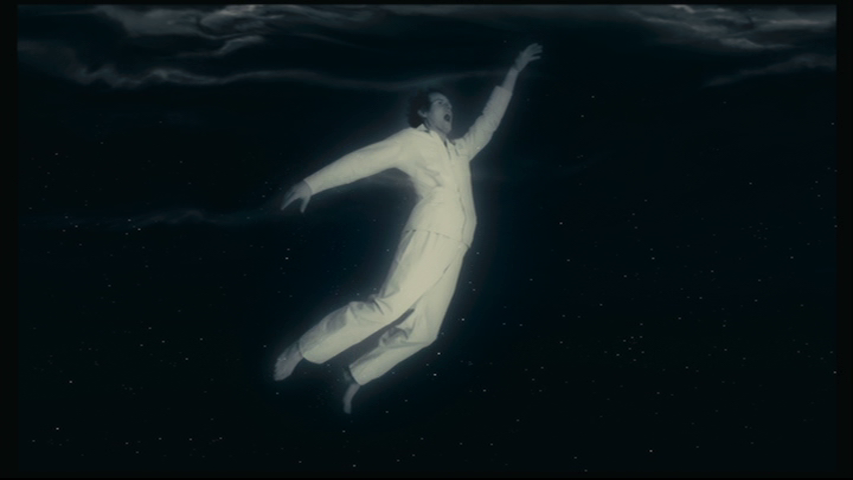
Which he wears right up until the moment when a strikingly topographical overhead shot of the Douro abruptly gives way to one of him in freefall:

Overhead shot of the Douro at night
Long shot of a flailing Isaac tumbling through the air

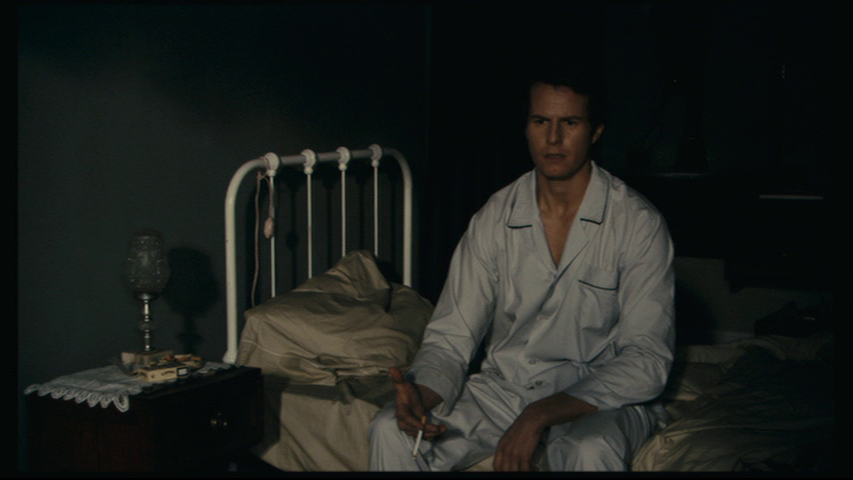
He awakens the next morning with a start and lights a cigarette:

Medium shot of Isaac in night clothes sitting on the edge of his bed smoking a cigarette and talking to himself

“That strange reality . . . perhaps it was just a hallucination? But it was just as real as this. Could I have been to that place of absolute love I’ve heard about?” Then: “I must be out of my mind.” The second half of the film chronicles his self-deportation from the land of the living, which Daniel Kasman read as reminiscent of the director of my September, 2024 Drink & a Movie selection History is Made at Night in a dispatch filed from Cannes 2010: “as in Borzage, escape from the world’s ails to the bliss of an otherworldly love is at once the most cowardly and most heroic of actions.” As part of The Strange Case of Angelica‘s very first wave of viewers, Kasman understandably focuses specifically on the titular character’s role in precipitating Isaac’s withdrawal from his fellow lodgers:

Medium long shot of Isaac in the left third of the frame standing apart from his Madam Justina and her other lodgers, who are congregated around a breakfast table which fills the right 2/3 of the frame

Growing frustration when Angelica remains tantalizingly out of reach even in his dreams::

Long shot of Isaac in bead reaching for Angelica's spirit, which hovers over him out of reach

And increasingly public erratic behavior:

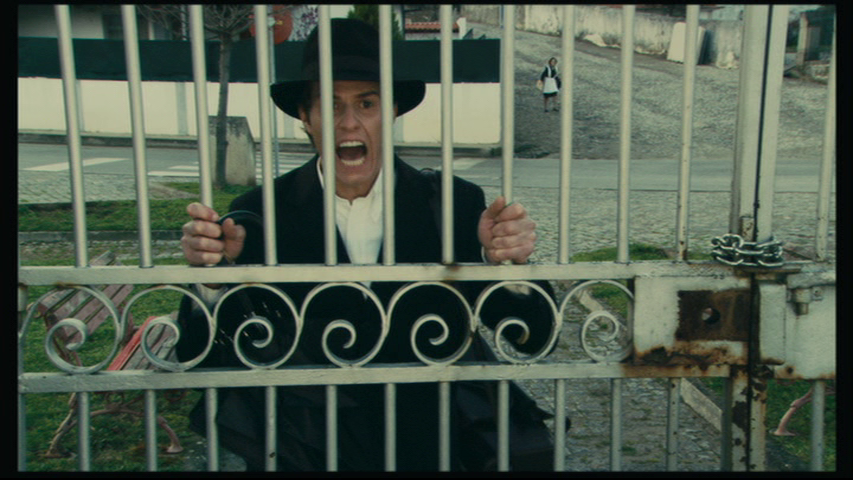
Medium shot of Isaac holding on to the gate to the cemetery where Angelica is buried and shouting her name

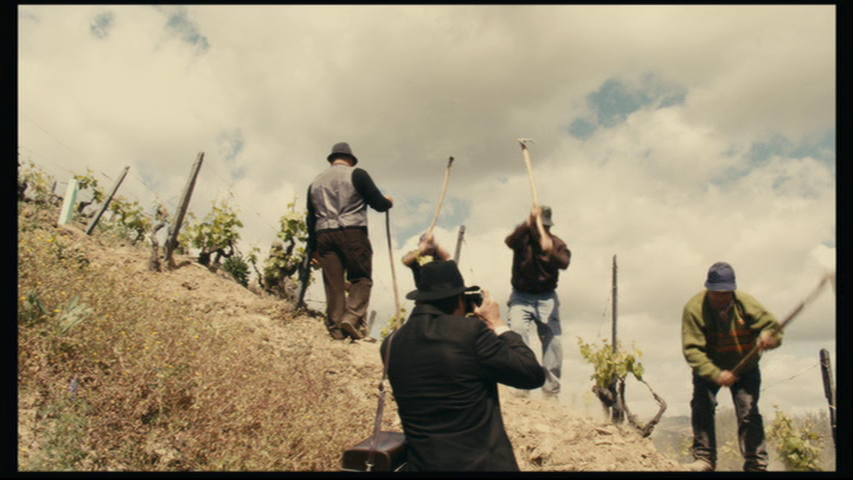
But as Rita Benis notes in a paper collected in the book Fearful Symmetries called “The Abysses of Passion in Manoel de Oliveira’s The Strange Case of Angelica,” the film’s fantastical elements like Isaac’s visions of Angelica are strongly linked to its realist sequences like his efforts to document the “old-fashioned” ways of the vineyard workers visible from his apartment and “their contrast is what generates the real fear implicit in the film,” such as in “the distressing sequence where he desperately follows a tractor working the rocky soil, taking furious snapshots to the fading traces of an ancient world (the connection between man and earth)”:

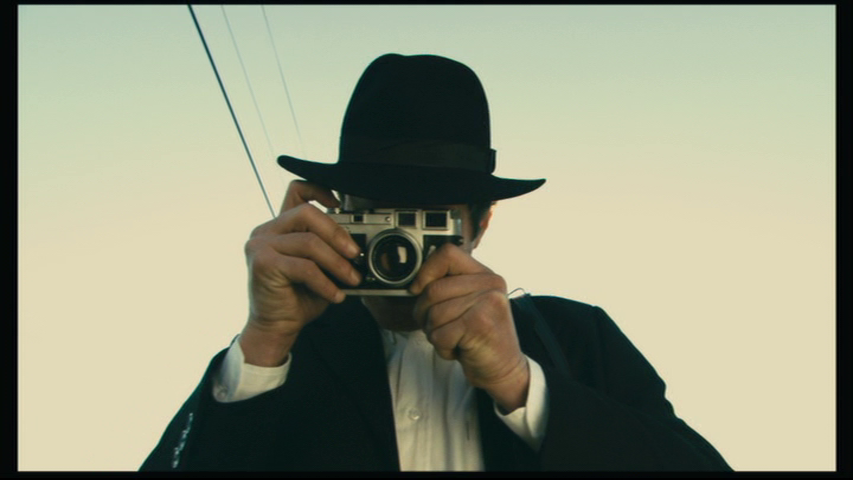
Close-up of Isaac facing the camera and taking a picture
Close up of the back of a tractor
Another close-up of Isaac taking a picture
Another close-up of the back of a tractor

These shots are, of course, immediately followed by one of him thrashing around in his bed, haunted by the sounds of hoes striking the earth over and over again, and they finally unlock the secret to all those diagonals: each of Isaac’s impossible loves are a step on what is ultimately one long stairway to heaven.

J. Hoberman closes his essay on The Strange Case of Angelica with a quote:

The last living filmmaker born during the age of the nickelodeon, Oliveira told an interviewer that cinema today is “the same as it was for Lumiére, for Méliès and Max Linder. There you have realism, the fantastic, and the comic. There’s nothing more to add to that, absolutely nothing.” The great beauty of this love song to the medium is that Oliveira’s eschewal remains absolute. It’s a strange case–pictures move and time stands still.

The other night at dinner we went around the table at the request of my children and all said what we’d eat if we had to subsist on just one food for the rest of our lives. Neither Oliveira’s film nor The Navigator may be the most daringly innovative creation featured in this series, but they both contain everything I’m looking for in a drink and a movie respectively, and while it would be suboptimal (to say the least) to be confined to such a limited diet, I can think of far worse answers to the cinema and cocktail versions of my kids’ question!

Cheers!

All original photographs in this post are by Marion Penning, aka My Loving Wife. Links to all of the entries in this series can be found here.
Ithaca Film Journal: 5/29/25

What I’m Seeing This Week: I’ll be in Rochester for the Nitrate Picture Show today through Sunday, but am hoping to catch Bring Her Back at Cinemapolis or the Regal Ithaca Mall after I return. My Loving Wife and I are also still working on carving out time for a date night outing to Mission: Impossible – The Final Reckoning at one of those two theaters or the IMAX screen at the Regal Destiny USA in Syracuse, and my oldest daughter has informed us that her next Family (née Friday) Movie Night selection will be Lilo & Stitch at the Regal, so I’ve got those two films in my near future as well.

Also in Theaters: Sinners, which continues its runs at Cinemapolis and the Regal, is my top new movie recommendation for the third week in a row and fourth overall. I didn’t love any of the other first run fare that I’ve already seen, although the jury is still out on Friendship, the demented evil twin of one of my favorite American comedies of the past twenty years I Love You, Man which is also at both Cinemapolis and the Regal. That potentially just makes the screenings of The Lady Vanishes at Cinemapolis on Tuesday as part of their train-themed June “Staff Picks” series even more compelling, though! There doesn’t appear to be anything of note happening on the repertory and special events fronts otherwise.

Home Video: NPS’s opening night selection Becky Sharp is new to me, the first time in three visits that this has been the case, which is exciting! It has some big shoes to fill, though, because the last two were bangers. I called Black Narcissus “one of the most transportative films ever shot entirely in a studio” when I wrote about it last August for my Drink & a Movie series, and while there’s no way to recreate the experience of seeing on a “better than very good” (per intro speaker Graham Brown) legendary (it opened the influential 1992 Pacific Film Archive series The Primal Screen) nitrate print, the formal qualities I’m referring to shine through just fine on the Criterion Collection’s Blu-ray and DVD releases; you can also stream it via a number of other commercial platforms. Meanwhile, although I was on the fence when I logged it on Letterboxd last year, I’ve since decided that I would indeed include Intolerance on any all-time Top Ten list I might find myself compelled or moved to create. As I heard someone say on the way out of the Dryden Theatre, even after more than a century it still represents perhaps the most sophisticated use of intertwining narratives in film history, and the lavish Babylon sequences may never be surpassed for sheer monumental grandeur. As a public domain title it’s widely available, so do check it out if you’ve never seen it or if it has been awhile!

Previous “Ithaca Film Journal” posts can be found here. A running list of all of my “Home Video” recommendations can be found here.