Also in Theaters: I’m also intrigued by actress Scarlett Johansson’s feature-length directorial debut Eleanor the Great, which opens at Cinemapolis tomorrow, but I’m not sure I’m going to get to it before it closes. My favorite new movie now playing Ithaca that I’ve already seen is The Baltimorons, a love letter to the city I moved here from with The Holdovers vibes that won me over with its earnestness and persistence. It continues its run at Cinemapolis this week. This week’s special events highlights include the presentation of a 35mm print of The Lady Eve at Cornell Cinema on Sunday and free screenings of La Soledad (which I reviewed a few years back), The Fisherman’s Daughter, and Framing Agnes there on Thursday, Monday, and Tuesday respectively. Finally, other noteworthy repertory options include a screening of The Natural at Cinemapolis on Sunday to “celebrate the life and legacy Robert Redford,” Sisters at Cornell Cinema on Saturday, and three classics at the Regal that every cinephile should see on the big screen at least once: Vertigo (tonight), 2001: A Space Odyssey (tomorrow), and Lawrence of Arabia (Sunday).
Home Video: I mentioned The Happening on this blog in August when I noticed that it has basically the same exact beginning as Groundhog Day, then again last month when I suggested you can read its ending as saying something very similar to the final shots of The Exterminating Angel. Now my oldest daughter’s fifth grade class is working on a version of the number doubling exercise John Leguizamo’s math teacher Julian gives his carmates to distract them from their imminent demise. *This* is obviously just a coincidence, but the multiple recent comparisons to other films aren’t–I think about The Happening, which I consider to be one of the great modern “B movies” and director M. Night Shyamalan’s masterpiece, all the time! Its budget may have been bigger than Val Lewton-produced fare like my October ’24 Drink & a Movie selection The Leopard Man, but the way a quotidian phenomenon like wind rustling leaves is imbued with menace is straight out of his playbook. Reviewers killed it on release and half the folks I follow on Letterboxd who have rated it are still going with scores of one-and-a-half stars or less, but I’m gratified by how many of the people whose opinions I respect the most are at the whole other end of the spectrum, which suggests to me that a critical reappraisal is already in the works. The Happening is currently available on YouTubeTV with a subscription and Prime Video for a rental fee–check it out and join us in the vanguard!
Previous “Ithaca Film Journal” posts canbe found here.A running list ofall of my “Home Video” recommendations can be found here.
Home Video:The Phoenician Scheme, which is now streaming on Peacock, isn’t quite a *lock* to make my year-end Top Ten list, but it was sitting pretty in third place at the halfway point. While Ballerina might pass it on a rewatch, nothing I’ve seen since then has come close. I talked about those two films in the context of one another on Letterboxd in June:
Playing alongside Ballerina in multiplexes nation wide as it is, the main character of director Wes Anderson’s sometimes shockingly (for him) graphically violent new film struck me as the Baba Yaga of mid-20th century industrialism: undefeated, but not indestructible, as demonstrated by the visibly increasing wear and tear on his body, only he’s trying to stay *in* the game, not get out of it. Also as in the World of John Wick, plot is secondary–there to set pieces, here to the pieces which comprise the sets, including a series of artworks on loan to the production called out in the end credits. Anchored by masterfully understated performances by Benicio Del Toro and Mia Threapleton in the lead roles and a brilliantly exaggerated supporting turn by Michael Cera. Alexander Desplat’s Stravinsky-inspired score is my favorite of Movie Year 2025.
But like I said after my second viewing, the thing I find most interesting about it is that it’s “a 2025 movie set in 1950 that treats that era’s titans of business like the European royal families of the first half of the 20th century.”
Previous “Ithaca Film Journal” posts canbe found here.A running list ofall of my “Home Video” recommendations can be found here.
Also in Theaters:Spinal Tap II: The End Continues, which opens at the Regal today and Cinemapolis tomorrow, would probably be listed above, only I promised My Loving Wife I’d save it for a future date night. The best new movie in local theaters that I’ve already seen is Familiar Touch, which screens at Cornell Cinema on Sunday evening. I don’t want to say much about it because I strongly suspect that at least the first scene plays better the less you know, but to pique your interest I will note here (as I did on Letterboxd) that it’s “a great food movie in the same way Spanglish is which also deals well with sensuality and desire in late adulthood + features terrific sound design, a pretty incredible lead performance by Kathleen Chalfant, and H. Jon Benjamin.” Other first-run fare I enjoyed include Caught Stealing and Weapons, which continue their respective runs at both Cinemapolis and the Regal, and The Fantastic Four: First Steps, which is playing just the Regal. This week’s special events highlight is the opening of the third annual Reproductive Rights Film Festival, which features three free screenings at Cinemapolis on Saturday and Sunday. Finally, we are once again blessed with great repertory options at all three Ithaca venues, including screenings of Jaws and The Thing at Cinemapolis and the Regal respectively tonight, The Thin Man at Cornell Cinema on Saturday, Sunset Boulevard at the Regal on Monday, and a free presentation of a new 4k restoration of The Draughtman’s Contract at Cornell Cinema on Tuesday.
Home Video:Love Me Tonight is a wildly creative pre-Code musical directed by Rouben Mamoulian that features music by Rodgers and Hart, “male gaze”-defying beefcake shots of Maurice Chevalier, some of the best music-of-the-streets and catchy-song-catching-on montages of this or any other era, and perhaps the single funniest use of slow motion in moving picture history. And clothes by Edith Head, whom Turner Classic Movies is celebrating this month, including a riding habit that is identified in the diegesis as representing the height of fashion, which strikes me as a particularly daunting challenge for a costume designer. Anyway, this film is a shoo-in for any Best of the 1930s list I might ever find myself moved to make, so check it out on Watch TCM before it leaves next Wednesday!
Previous “Ithaca Film Journal” posts canbe found here.A running list ofall of my “Home Video” recommendations can be found here.
Also in Theaters:Highest 2 Lowest closes at Cinemapolis today, at which time its reign as the best new movie now playing Ithaca that I’ve already seen will end. After that the title belt will pass to, hmm . . . let’s go with Caught Stealing, an entertaining “feature-length proof purporting to demonstrate that actually two wrongs *can* make a right set in 1998 that could be director Darren Aronofsky’s follow-up to Pi which he put in a time capsule for some reason” (as I recently said on Letterboxd) that continues its runs at Cinemapolis and the Regal. I also enjoyed Sorry, Baby, which plays Cornell Cinema on Saturday; The Fantastic Four: First Steps, which is still going strong at the Regal; and Weapons, which remains there and at Cinemapolis. This week’s special events highlights are the encore presentation of a 35mm restoration print of Donnie Darko at Cornell Cinema tonight and a single screening of local favorite My First Film at Cinemapolis tomorrow to help launch The History Center‘s “Tompkins Treasure Hunt” event. Finally, the next seven days feature an embarrassment of repertory riches at all three Ithaca theaters, including 50th anniversary presentations of Jaws at Cinemapolis and the Regal all week, a new 4K restoration of Paris, Texas at Cornell Cinema on Saturday, and a screening of Citizen Kane at the Regal on Sunday. You can also see The Godfather there on Saturday, Goodfellas there on Tuesday, and It Happened One Night at Cornell Cinema on Sunday, among other things.
Home Video: We finally checked out KPop Demon Hunters on Netflix after my youngest daughter got invited to a “KPop Demon Hunters Meets Unicorns and Rainbows”-themed birthday party, which: if you need any additional proof that this is a bona fide phenomenon, there you go! Anyway, this is now the girls’ favorite movie of the year and while it isn’t breaking any narrative or stylistic ground, My Loving Wife and I were pleasantly surprised to find that it’s a sturdy piece of work elevated by clever touches like an OCD demon tiger and catchy musical numbers, including my new clubhouse leader for the Best Original Song Oscar, “Golden.” Now I suppose we’ll find out how many sequels my goodwill can survive. . . .
Previous “Ithaca Film Journal” posts canbe found here.A running list ofall of my “Home Video” recommendations can be found here.
A thought popped into my head awhile back when fresh sweet corn from regions to the south started to appear in local grocery stores: I should make a drink reminiscent of elotes! As J. Kenji López-Alt has written, it is after all “the best way to serve corn, period,” and by enshrining its flavors in a cocktail, I’d be able to enjoy it year-round even when its main ingredient is out of season. So I grabbed a bottle of Finger Lakes Distilling’s Glen Thunder Corn Whiskey out of the pantry, fat-washed it with cotija cheese, mixed it up with some lemon juice to make a sour . . . and went straight back to the drawing board, because the resulting concoction was absolutely terrible. In fact, my first BUNCH of attempts were failures. Among the things I learned from these experiences were that:
Finger Lakes Distilling isn’t even making Glen Thunder any more, as I found out when I drove all the way out to one of their tasting rooms to try in vain to refresh the bottle I had just kicked
Unless handled with an extremely deft hand, cheese-infused spirits risk making the drink you’re using them in taste, to quote My Loving Wife, “vomitous”
You can take corn out of a can, but you can’t take the canned flavor out of that corn pretty much no matter what you do with it
The turning point came when I remembered this Food & Wine article and special ordered a bottle of Nixta Licor de Elote from Ithaca’s Red Feet Wine Market. My pivot to Mellow Corn as a replacement for the Glen Thunder also turned out to be a blessing in disguise when it proved to play much nicer with others, and a few tweaks later I had something that not only tasted the way I wanted to, but also remained distinctive enough from the popular Elote Old-Fashioned I discovered around the same time that I remain comfortable claiming my drink as an original creation. Here’s how you make it:
1 1/2 ozs. Mellow Corn 3/4 oz. Nixta Licor de Elote 1/2 oz. Lime juice 1/2 oz. Ancho Reyes 1 teaspoon 2:1 simple syrup 1 Egg white
Start by rimming a chilled cocktail glass with this mixture (I recommend using a mortal and pestle if you have one) inspired by Trader Joe’s Everything But The Elote seasoning, which you could obviously use as an alternative, but it won’t be nearly as good:
1 Tbsp Grated Parmesan cheese
1/2 tsp Lime zest
1/2 tsp Kosher salt
1/2 tsp Granulated sugar
1/2 tsp Chipotle powder
1/4 tsp Dried cilantro
1/8 tsp Citric acid
Combine all of the cocktail ingredients in a shaker and mix with a immersion blender until frothy. Add ice and shake, then strain into your prepared glass over a large ice cube:
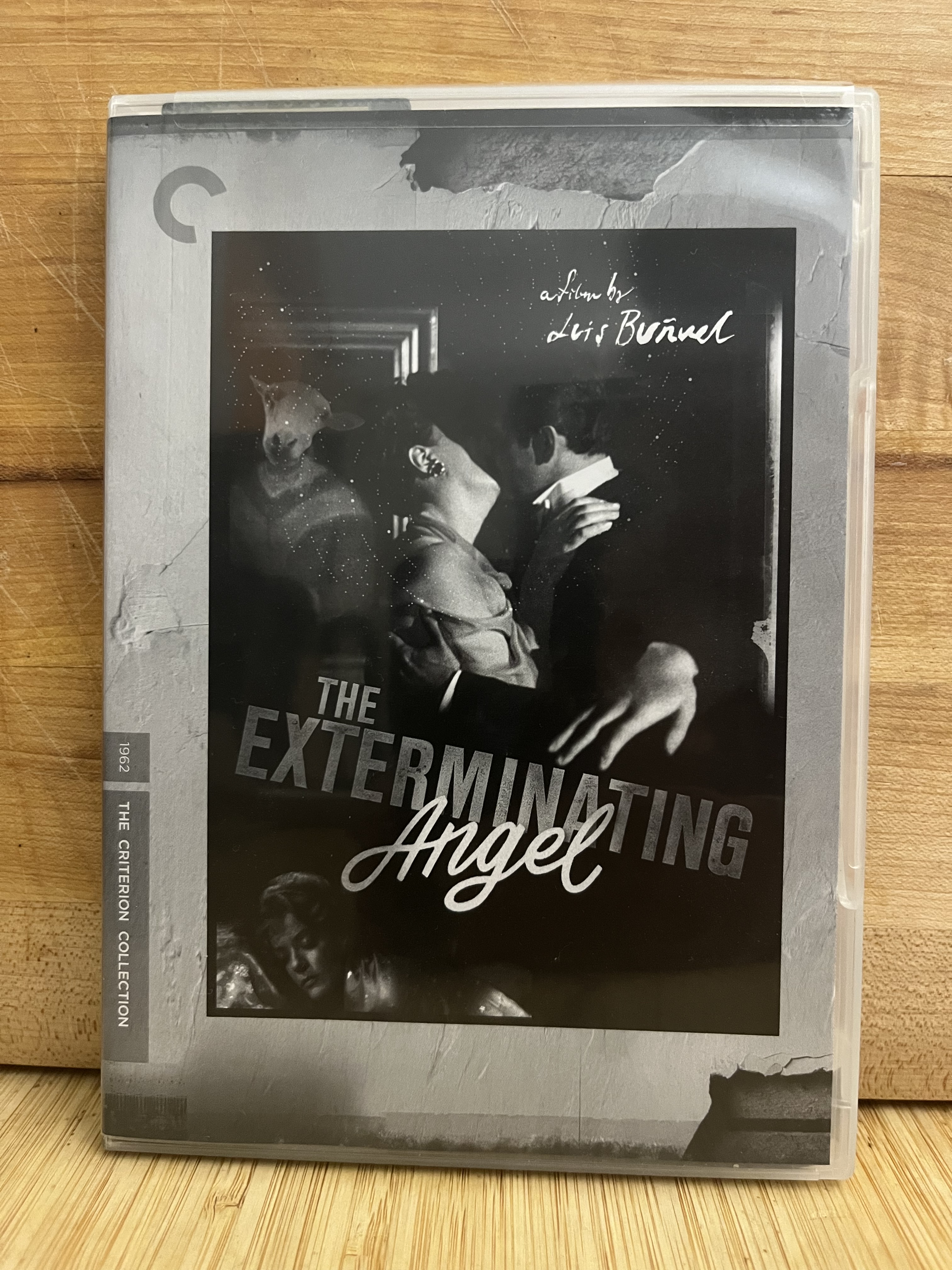
The egg white is essential for achieving the creamy texture I’m going for, so don’t leave it out! If this ingredient makes you squeamish, please note that we usually err on the side of extreme caution by pasteurizing the eggs using an immersion circulator to hold them at 130 degrees in a water bath for 45 minutes to an hour before separating them, which neutralizes the food safety threat without noticeably impacting them otherwise. Cheese, smoke, and heat are the first things you’ll notice, but corn is definitely present on the swallow and even more so on the finish. The drink starts out on the sour side thanks to the citric acid in the spice mixture on the rim, but once your lips stop tingling the balance of the beverage itself is, if I may say so myself, perfect, ensuring that no ingredient overpowers the other and making this more than a novelty cocktail that’s enjoyable for the first few sips but inevitably overstays its welcome. Which is, of course, a reference to the film I’m pairing it with, The Exterminating Angel. Here’s a picture of my Criterion Collection DVD copy:
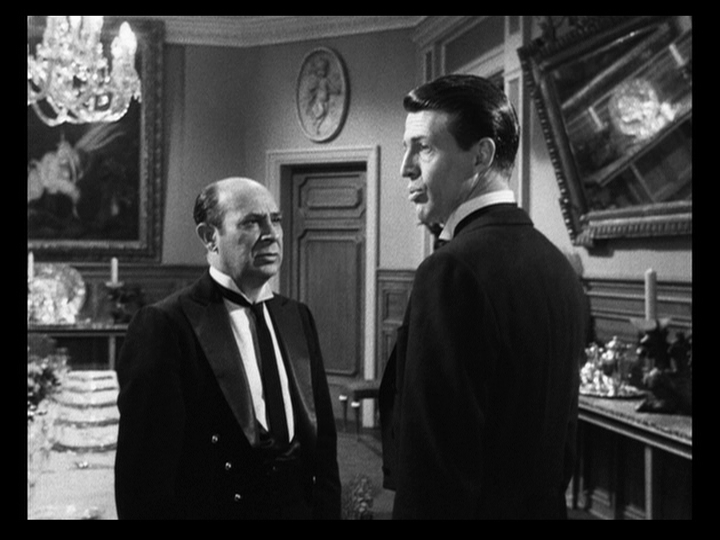
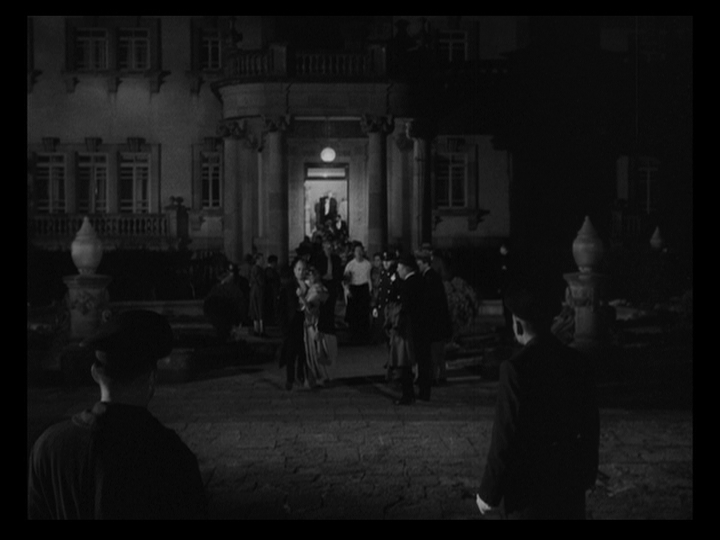
One of my high school English teachers used to say that the hallmark of great literature was a work possessed of both individuality and universality. I can’t think of many movies that better embody this dual standard than The Exterminating Angel, which is to say that I agree with both Seth Colter Walls, who hailed it as “2009’s most indispensable film” in a Newsweek article published shortly after the release of the DVD pictured above, and Mark Harris, who described it in Film Commenteight years later as a “bleak, caustic vision of rich people presiding over the end of civilization” that “does not seem like a movie behind the times so much as a movie of no particular time.” Noting that an opera adaptation by Thomas Adès was set to debut in just a few months and that a musical version by Stephen Sondheim and David Ives was also in the works, the latter went on to suggest that “it can’t be good news that its time may finally have come,” and I believe that’s right, too, for reasons I hope to make clear anon! The Exterminating Angel opens on a household in a flurry of activity. Mexican aristocrats, Edmundo (Enrique Rambal) and Lucía Nobile (Lucy Gallardo) are hosting a dinner for their wealthy friends after a night at the opera, but something is amiss, as we discover when the doorman Lucas (Pancho Córdova. I think–IMDb says Ángel Merino, but the screenplay published by Onion Press in 1969 credits him as “Waiter,” so I’m ruling in favor of Wikipedia) decides to go for a walk even though it means the loss of his job. “Well, if he didn’t like it here, good riddance,” says the majordomo Julio (Claudio Brook)–“there are many Lucases in the world.”
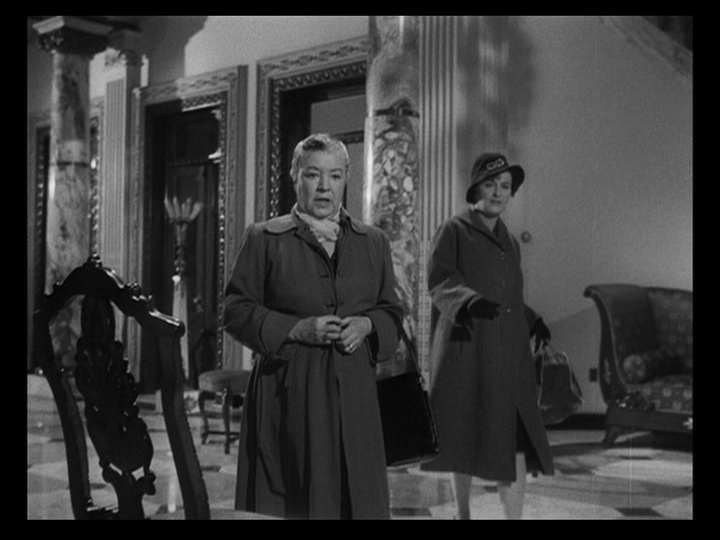
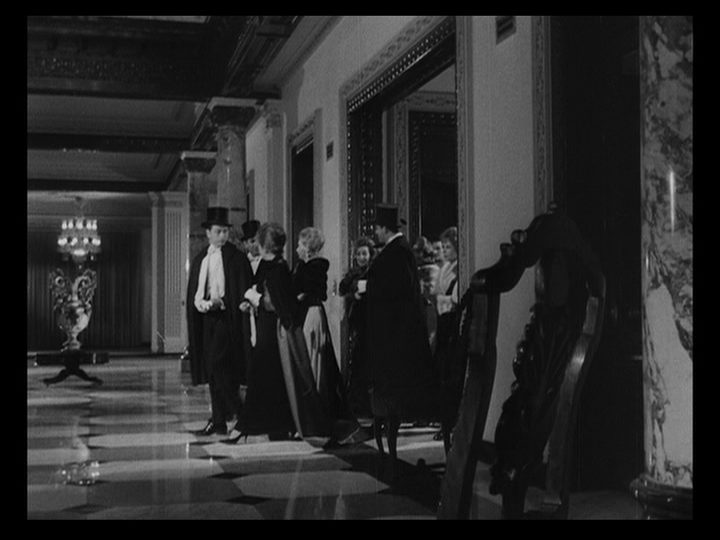
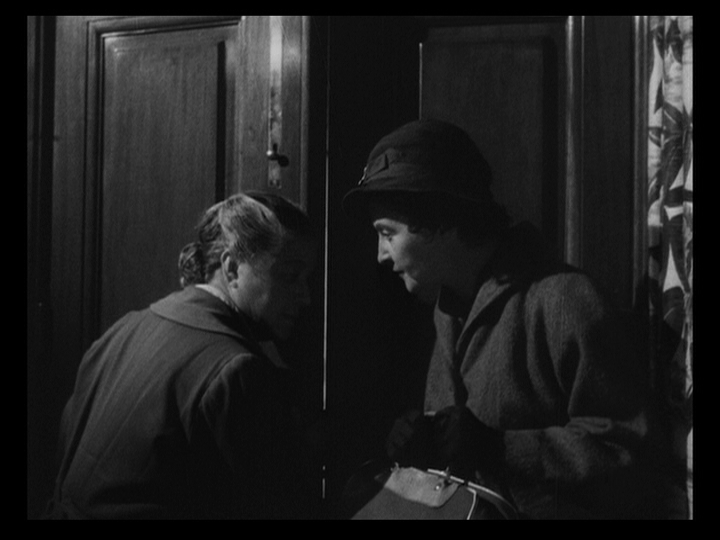
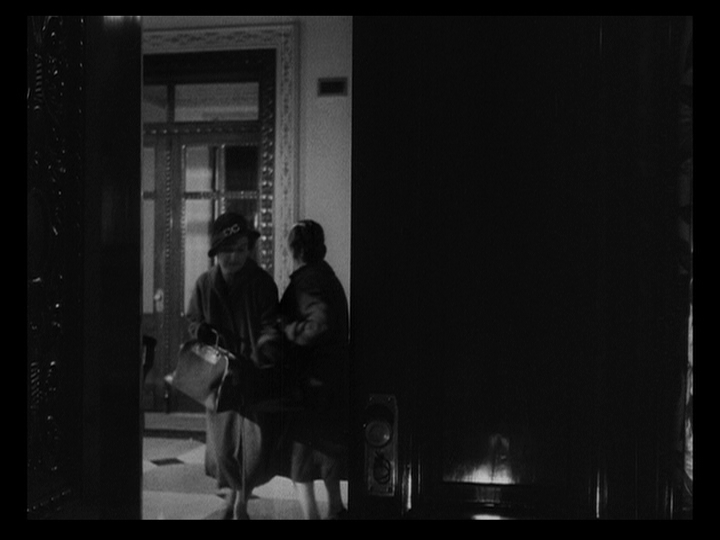
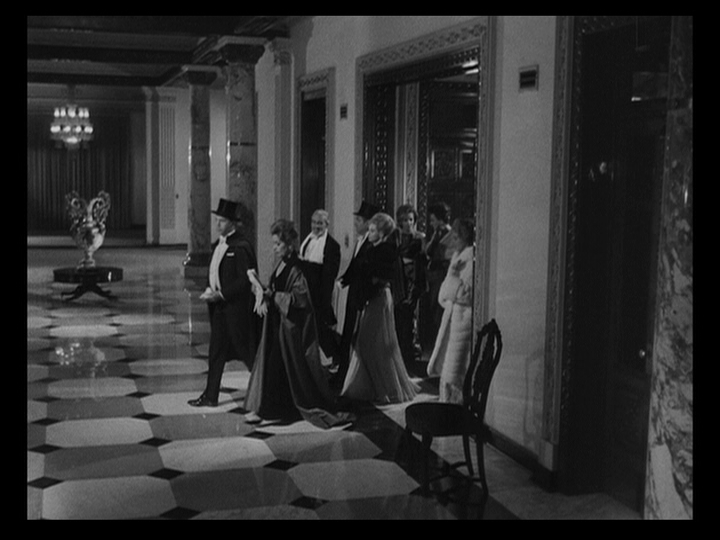
Be that as it may, he isn’t the last to leave and other strange things are afoot at the Casa Nobile, as these two maids discover when their attempt to flee is temporarily thwarted by the untimely arrival of their employers and their guests not just once:
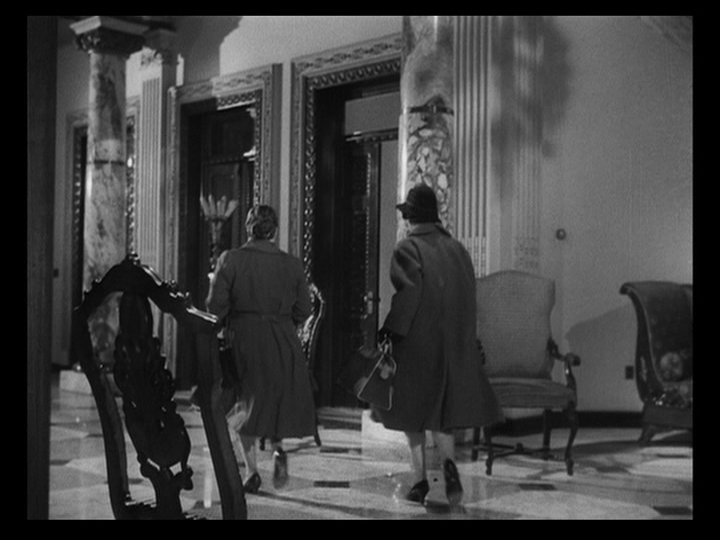
But, inexplicably, twice:
As they sit down to dinner, the repetitions (which director Luis Buñuel suggests he was the first to use this way in a movie in an interview with José de la Colina and Tomás Pérez Turrent collected in their book Objects of Desire) continue as Edmundo gives the same toast a second time:
And the remaining staff follow the maids out the door:
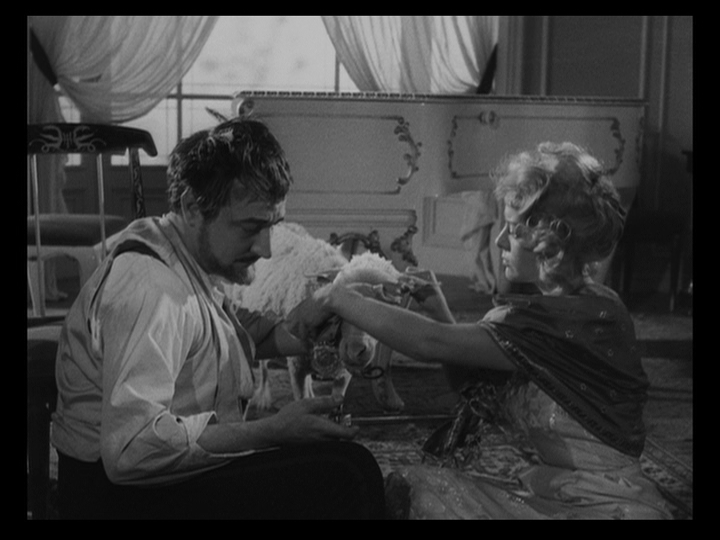
Lucía also decides to abandon a jest involving a bear and some sheep after her guest Mr. Russell (Lucy Gallardo) responds negatively to one whereby a waiter (Merino) deliberately “trips” while serving the first course:
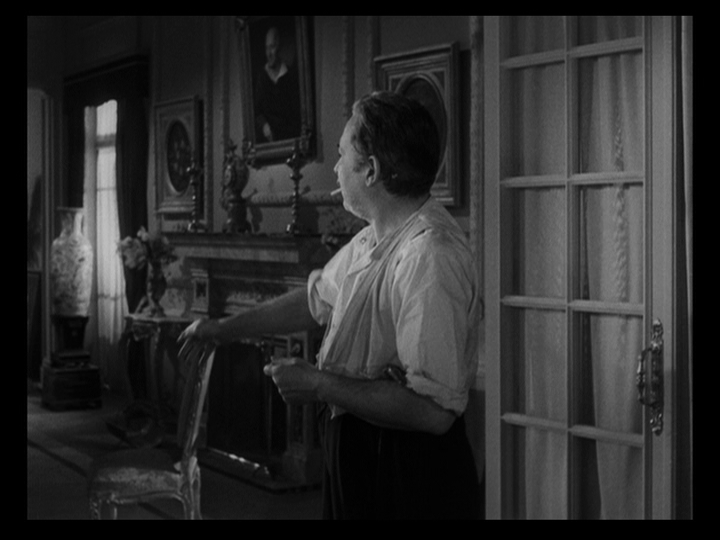
Finally, matters really take a turn toward the surreal after dinner when the guests would normally leave, but find instead that none of them are able to cross the threshold of the drawing room:
So against every rule of etiquette they settle in for the night:
When Julio arrives with leftovers for breakfast the following morning, he discovers that he is now trapped as well:
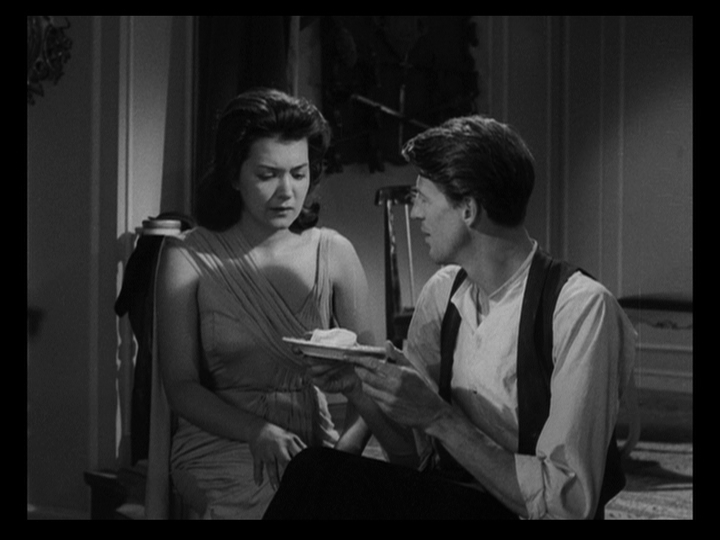
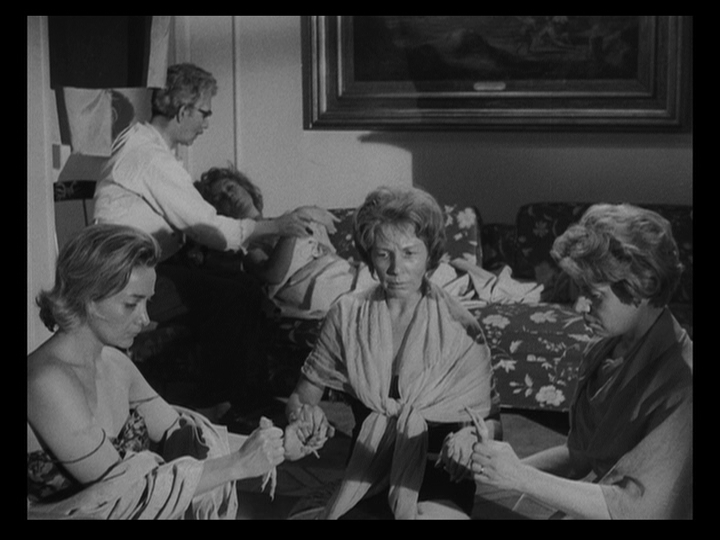
Which brings us to just about exactly 1/3 of the way through the film’s 95-minute runtime. In an interview included with the Criterion DVD as an extra, Silvia Pinal (who plays a guest named Leticia aka “The Valkyrie) quotes a friend of hers as saying that “Buñuel invented reality shows with The Exterminating Angel.” Most of the remaining hour does indeed prove that no one is there to make friends and as the days stretch into weeks the increasingly uncivilized assembly take turns throwing each other under the bus by surreptitiously tossing life-saving medicine where it can’t be reached:
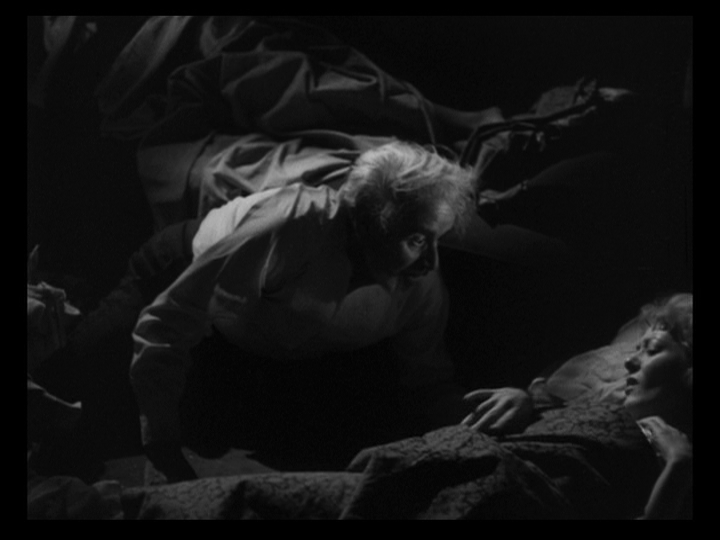
Engaging in sexual abuse under the cover of darkness:
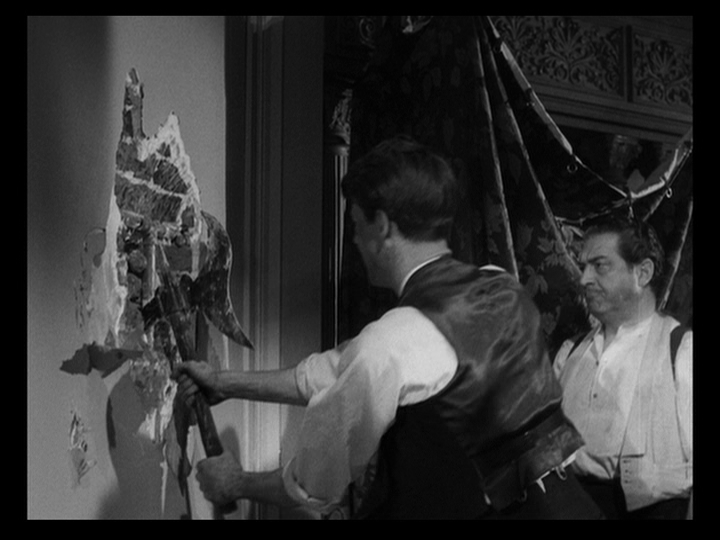
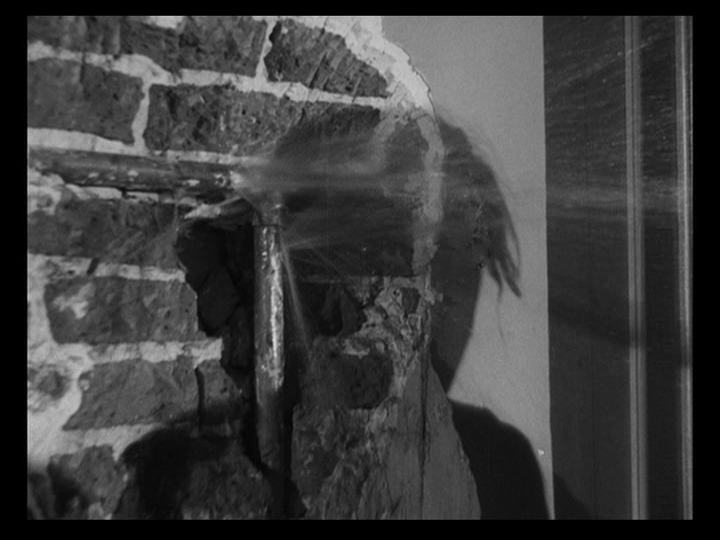
And threatening to resort to human sacrifice despite the total lack of evidence that it would accomplish anything. They break open a pipe in the wall to find water:
But are reduced to eating paper when the leftovers from dinner run out:
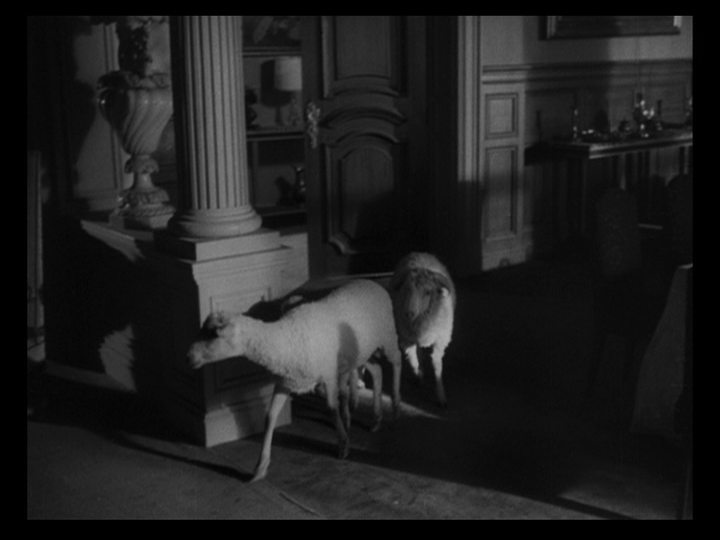
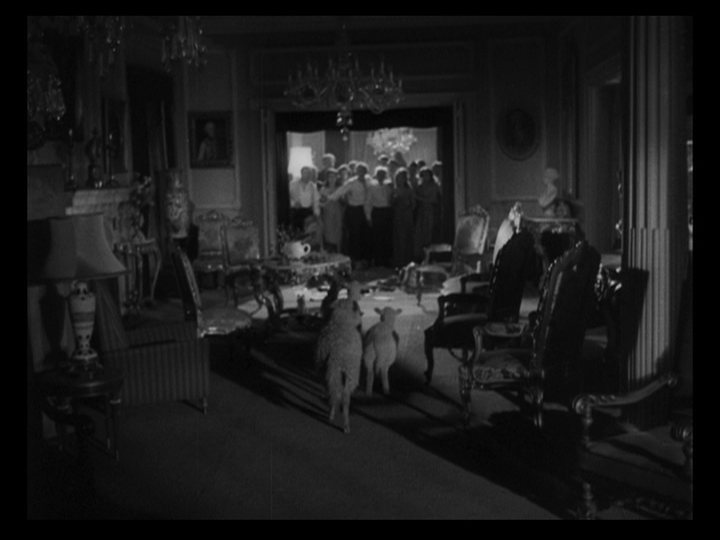
Until the bear from earlier miraculously chases the sheep which were to be part of the same entertainment into the drawing room:
Where they are blindfolded:
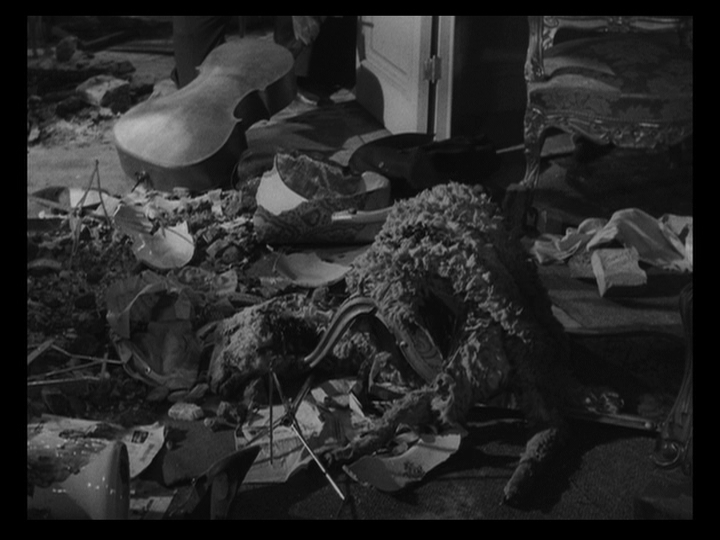
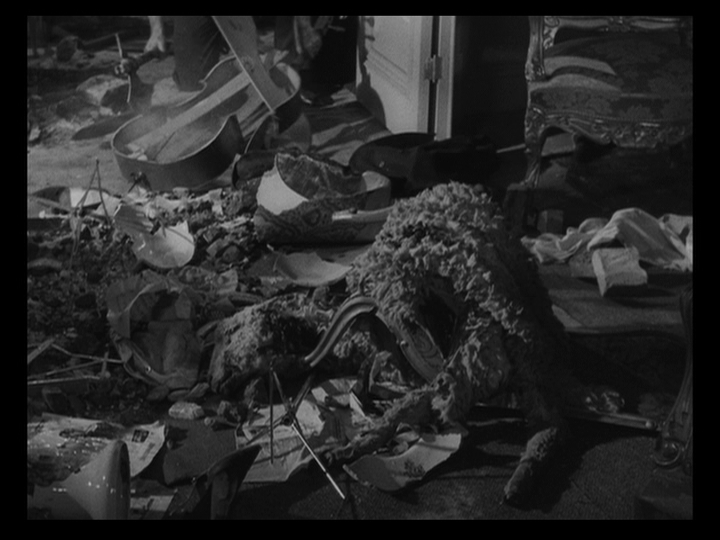
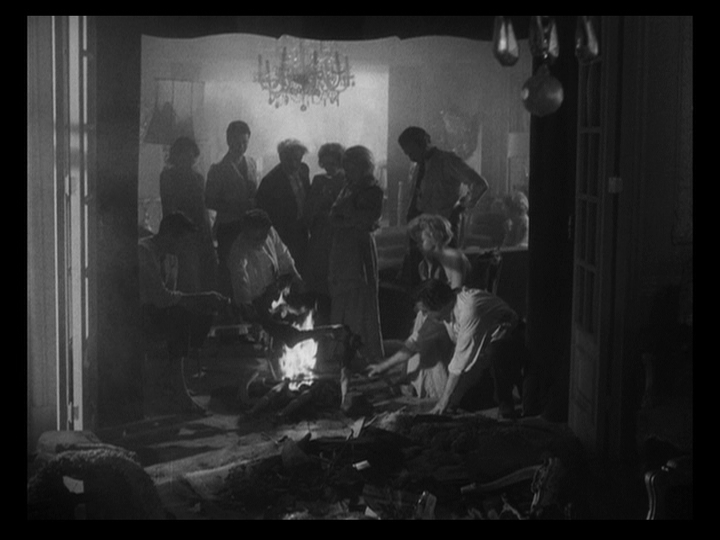
Slaughtered, and cooked over a fire made with wood from a smashed cello:
Bodies nonetheless begin to pile up after Russell expires of natural causes:
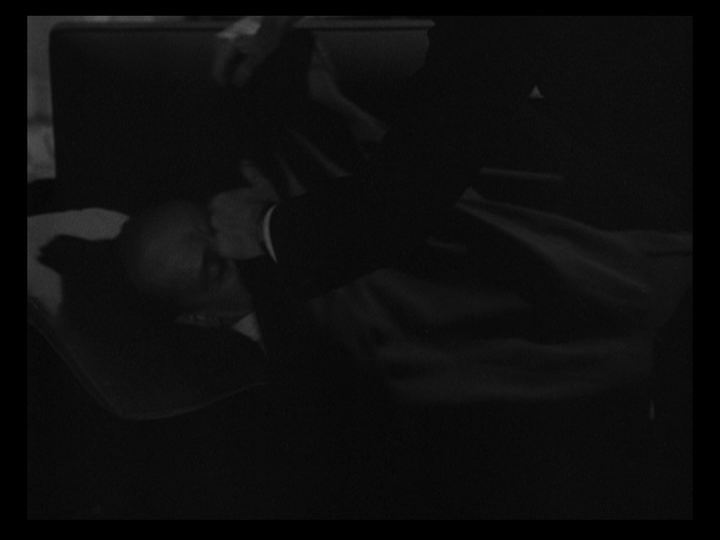
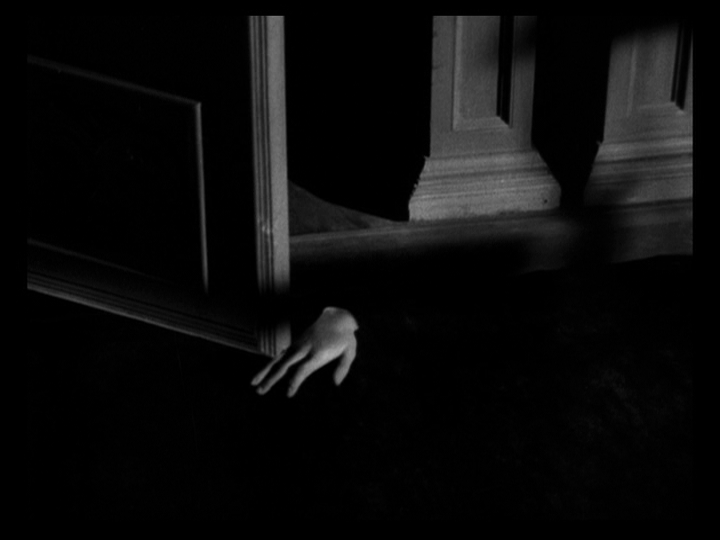
And two of the trapped guests who are having an affair choose a lovers’ suicide over attempting to go on. Haunted by nightmare images like this disembodied hand:
And let down by rituals such as these kabbalistic “keys”:
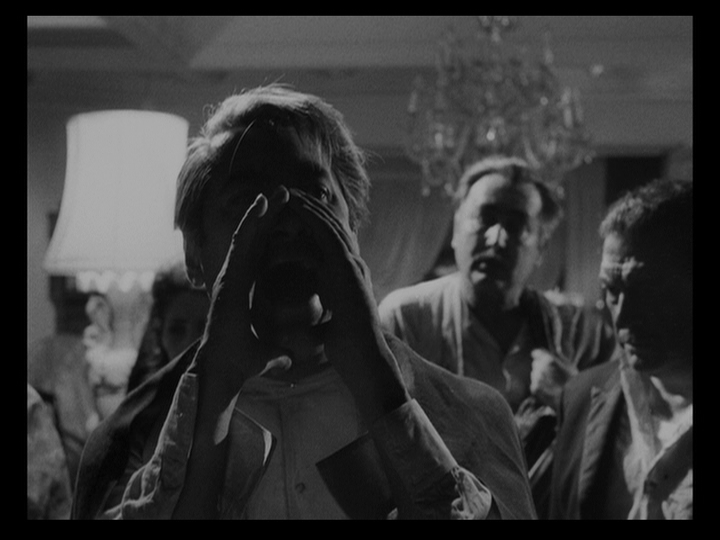
The Masonic cry for help:
And “the unpronounceable word”:
A contingent of the remaining guests indicate that they are determined to go through with their plan to kill Edmundo under the reasoning that “when the spider’s dead, the web unravels.” Dr. Carlos Conde (Augusto Benedico) opposes them saying, “but you’re crazy! It’s ridiculous, completely irrational.”
To which they reply, “we’re not interested in reason: we want to get out of here.” Suddenly, Edmundo appears standing next to Leticia and nobly tells them that “there’s no use fighting something so easily achieved”:
He retrieves a revolver from a cabinet but before he is able to turn it on himself Leticia cries out, “wait!” She announces that she has realized that “like pieces on a chessboard, moved thousands of times” they’ve somehow all returned to the very spots they were standing in the night they got trapped.
They fumblingly repeat the things they said then and follow her out the door, freed just as mysteriously as they were imprisoned:
To Skrikanth Srinivasan, The Exterminating Angel is “the greatest of detective films, since its object is not the discovery of the culprit […] but the discovery of the nature of our human and social condition and its motivations.” He finds the answer in the movie’s two-part structure. The first, which concludes with the scene above, “tells us that man has no escape if he locks himself up in society’s rules, opposed to the imperative rules of nature, which can manifest themselves within society’s rules only in a barbaric and secret form in direct contradiction with the spirit of these social rules.” Where Pinal’s friend sees reality television here, scholar James Ramey finds “a cinematic articulation of what in recent years has been described as a posthumanist attitude towards the human” in his article “Buñuel’s social close-up: An entomological gaze on El ángel exterminador/The Exterminating Angel (1962),” noting that it’s “not unlike an ant colony transferred to a glass casement for entomological observation.”
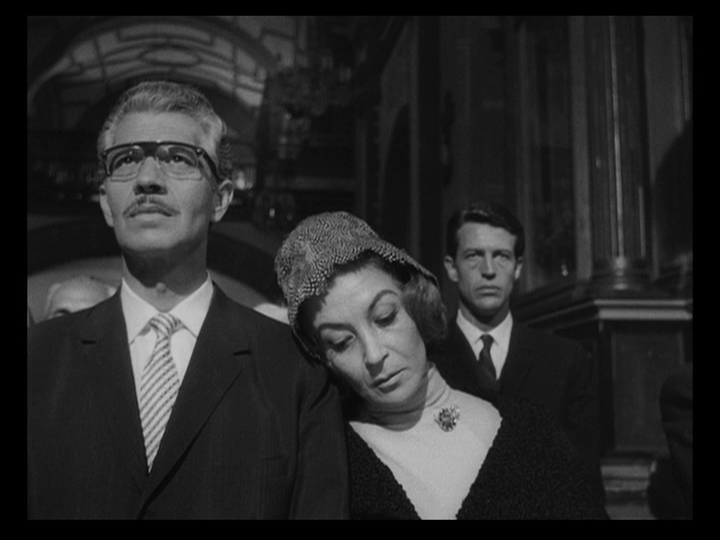
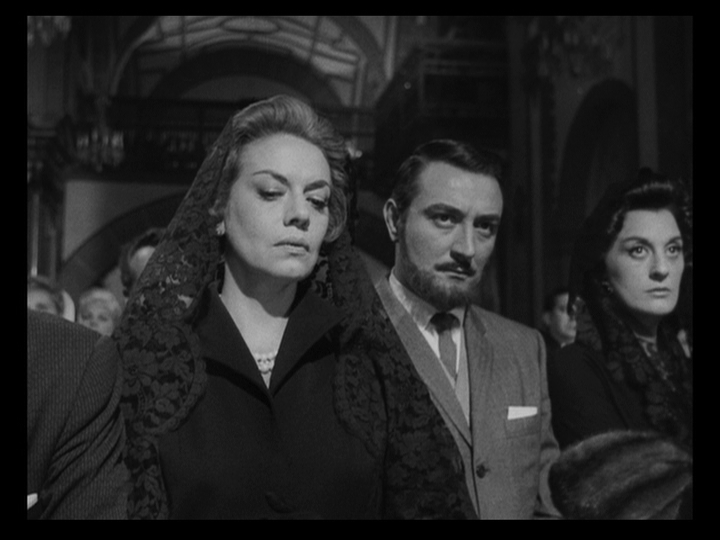
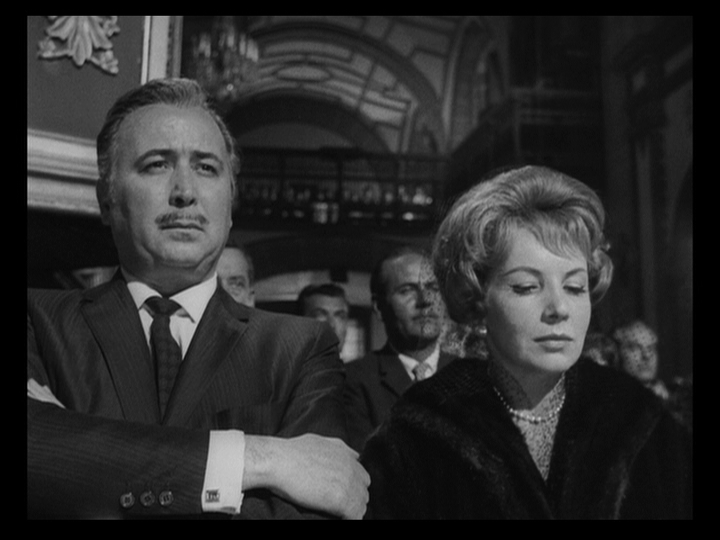
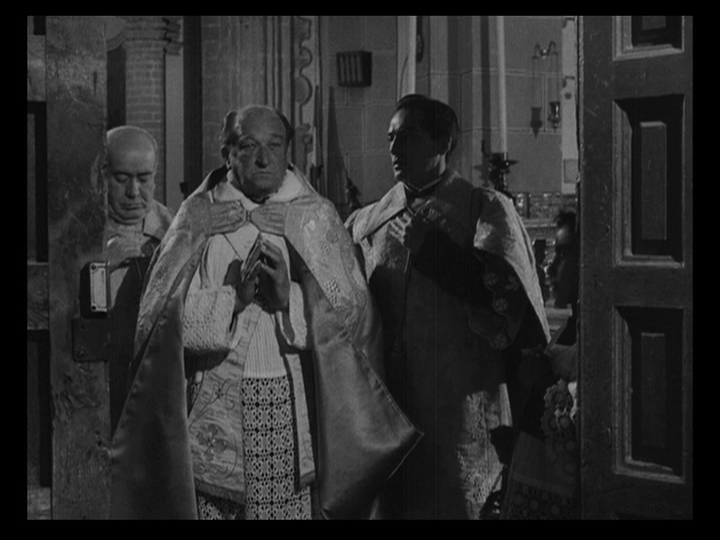
Part two chronicles the tragedy of said colony’s liberation. As Gilles Deleuze observes in Cinema 1: The Movement-Image, “the [Exterminating] Angel’s guests want to commemorate, that is, to repeat the repetition that has saved them; but in this way they fall back into a repetition which ruins them.” And so we find them congregating together once more, this time for a Te Deum at their local cathedral:
As the service ends, the priests stop at the door. “Why don’t we wait until after the faithful have left?” one of them says.
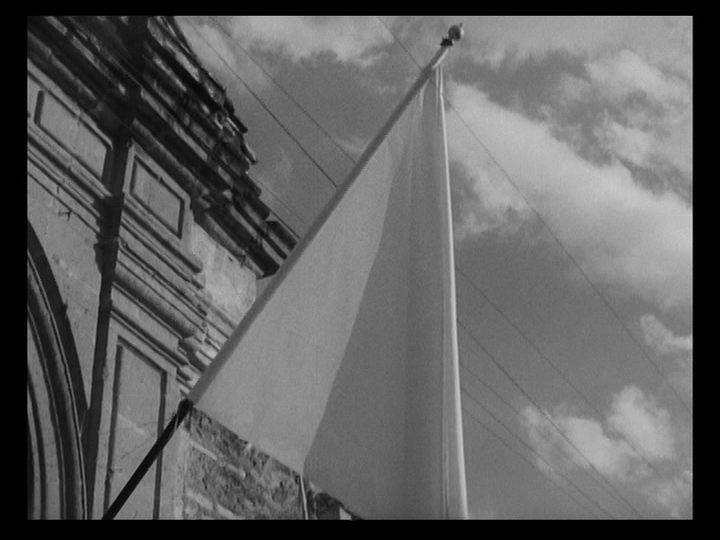
The film ends with a plague flag over the cathedral:
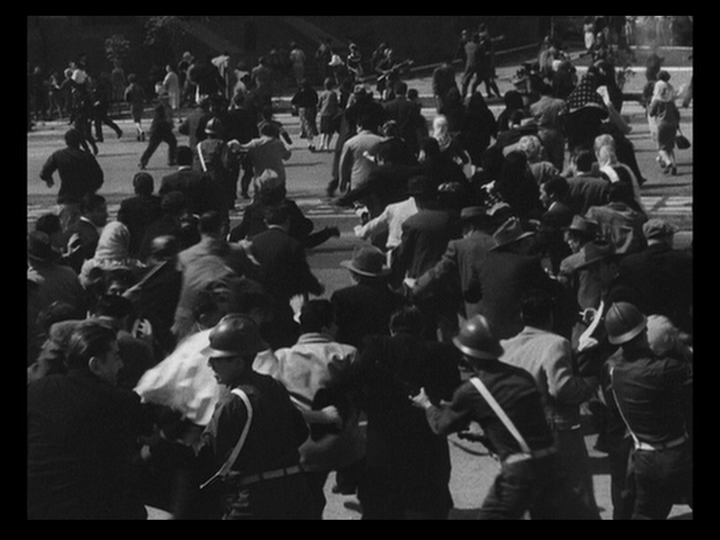
Violence on the adjacent town square:
And another group of sheep offering themselves up as food for the incarcerated:
Per Srinivasan, “the elliptical brutality of the last section and the speed with which we arrive at the renewal of the phenomenon of avolition gives us the impression that it’s going to return with ten or twenty times the force,” which echoes something Buñuel himself says in Objects of Desire and reminds me of the ending to The Happening: “the church will be worse because this time it’s not just twenty people, but two hundred. It’s like an epidemic that extends outwards to infinity.” For Srinivasan the cause of all this is clearly religion, but Wael Khairy found that it echoed something even more immediate in a piece for RogerEbert.com published on April 6, 2020:
Much like COVID-19, an invisible force prevents the visitors from stepping outside the confines of the house. The title suggests that this is the work of an exterminating angel. I would never liken an infectious disease to an angel, but one can’t help but dwell on the eerie similarities of how this invisible force is affecting society as a whole. Like “The Exterminating Angel,” this outbreak feels like a wake-up call. Mother Nature is stepping in and exposing fragility of society and how easily the facade we’ve built around us can collapse.
He concludes by wondering, “What will happen after this global nightmare comes to an end, and millions of families exit their homes? Will we emerge from our homes as changed people with a new awareness of the world, or will we fall back into the same trap?” Sadly, five years later, I think we all know what the answer to this question is. But, hey, when the end comes, at least now you have a new drink to toast it with, right?
Cheers!
All original photographs in this post are by Marion Penning, aka My Loving Wife.Links to all of the entries in this series can be found here.
Also in Theaters: In addition to the titles above, I’m also going to try to catch Honey Don’t! at Cinemapolis and The Roses there or at the Regal before they close. The best new movie now playing Ithaca that I’ve already seen remains Highest 2 Lowest, which continues its run at Cinemapolis. I also enjoyed Weapons, which is there and at the Regal; The Fantastic Four: First Steps, The Naked Gun, and Superman, all of which are just at the Regal; and Sorry, Baby, which plays Cornell Cinema (welcome back!) on Friday. Local screenings of 35mm films are sadly become quite rare, so the presentation of a new restoration print of Donnie Darko at Cornell Cinema on Saturday definitely qualifies as a “special events” highlight! Finally, your best bets for repertory fare are the 50th anniversary screenings of Jaws at Cinemapolis and the Regal all week, It Happened One Night at Cornell Cinema on Sunday, and The Dark Knight at the Regal on Tuesday.
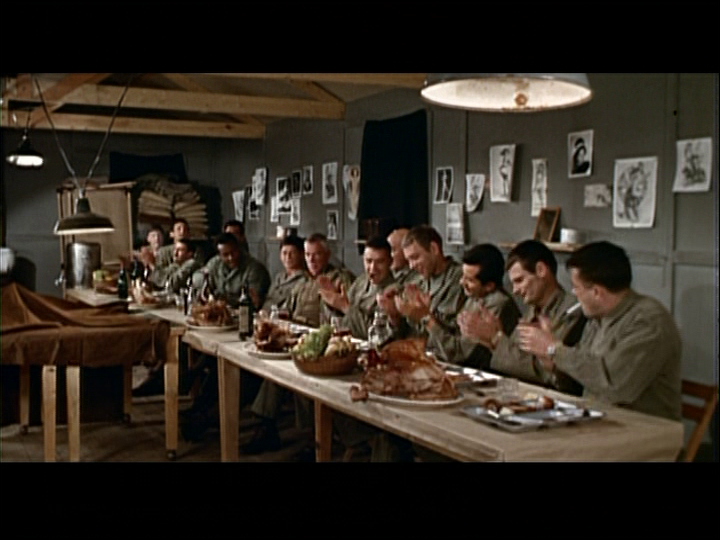
Home Video: If you are drafting a fantasy football team this weekend, consider unwinding afterward the way we did with The Dirty Dozen, which is available on Watch TCM until September 15! I had completely forgotten that I briefly broke down this Last Supper reference back in 2006 until we got to it:
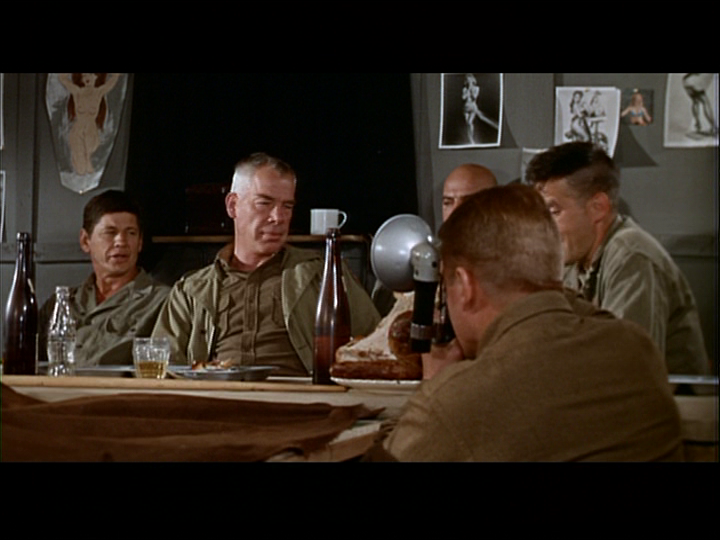
But was glad to be reminded, because although I question my overreliance on reading this as a nod to the mural by Leonardo da Vinci specifically, I think it still contains some good thoughts. First off, the original screengrab is lost to time, but I believe this must be the “joke” I refer to:
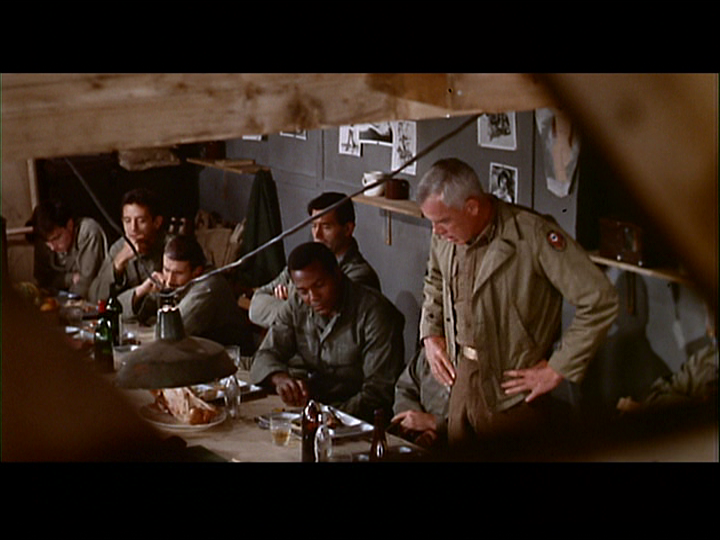
The bit about Telly Savalas’s Maggot not being in the position of Judas is nonsense, but I do like my suggestion that the overhead shots may represent the filmmakers inserting themselves into the scene, especially in the context of an observation in one of My Loving Wife’s old art history textbooks about Tintoretto’s Last Supper, which like Robert Aldrich’s sets the table at a diagonal, that it “used two internal light sources: one real, the other supernatural.” I wonder if this is meant to make us conscious of the presence of studio lights:
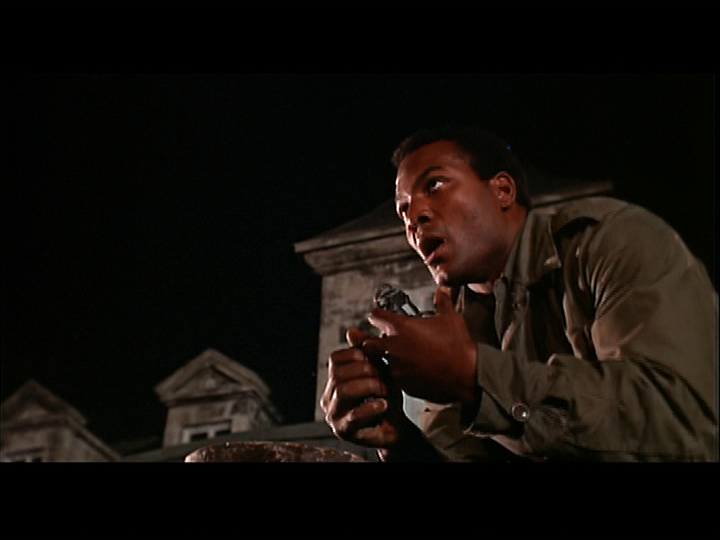
I could write a whole post on the results-oriented leadership style of Lee Marvin’s Major John Reisman in the face of orders from a “someone up there” (another possible reading of the previous image) who is “a raving lunatic,” but it might get me in trouble at work if misinterpreted, so instead I’ll note that the film’s position on capital punishment echoes those of the texts I wrote about in my July, 2025 Drink & a Movie blog post. And, right: football! The connection there is of course running back-cum-actor Jim Brown’s dramatic death scene at the end a heroic first down-length dash through enemy gunfire:
I concede that I may have overstated my case a tiny bit by calling it “the rare World War II film not afraid to acknowledge the sins that we the victors conveniently leave out of most of the rest of our official histories” on Letterboxd, considering that it’s obviously really about Vietnam, but this absolutely is still one of my favorite examples of that genre.
Previous “Ithaca Film Journal” posts canbe found here.A running list ofall of my “Home Video” recommendations can be found here.
Also in Theaters: It seems fitting that a movie year which will see the Criterion Collection release The Beat That My Heart Skipped, one of my favorite remakes ever, also features Spike Lee repatriating Akira Kurosawa’s adaptation of the Ed McBain novel King’s Ransom in Highest 2 Lowest, which continues its run at Cinemapolis. Similar to how director Jacques Audiard ran the plot of Fingersthrough his camera backwards and upside down, Lee relies on our familiarity with High and Low to appreciate the notes he’s not playing, most notably when he switches out Kurosawa’s wide-angle look at Japanese society for a close-up on one record mogul’s relationship with African-American culture. In the battle of new horror films, I prefer Together, which remains at the Regal (although it’s down to just one screening per day), to Weapons, which is both there and at Cinemapolis, but they’re both fun. Other first-run fare at the Regal I enjoyed includes Sketch, The Naked Gun, The Fantastic Four: First Steps, and Superman in approximately that order. I’m also hoping to see Honey Don’t!, which opens at Cinemapolis today, and maybe Ne Zha II, which is there and at the Regal, depending on what I think about the original Ne Zha after I get a chance to check it out on Peacock. This week’s special events highlight is definitely the free “Silent Movie Under the Stars” screening of The Eagle in Upper Robert Treman State Park on Saturday, but the KPop Demon Hunters “Sing-Along Event” at the Regal on Saturday and Sunday may be of even more interest if that’s your thing. Finally, your best bets for repertory fare are Tampopo, which plays Cinemapolis on Wednesday as part of their “Food on Film” August staff picks series, and Ponyo, which has showtimes at the Regal on Saturday, Sunday, and Wednesday.
Home Video: I recently reviewed Youth (Hard Times) and Youth (Homecoming), the second and third installments in a nearly ten-hour-long documentary trilogy directed by Wang Bing, for Educational Media Reviews Online. To my very great surprise, this experience resonated with another time-consuming cinema project I was already in the middle of, working my way through the first decade or so of the Marvel Cinematic Universe with My Loving Wife. Did you know, for instance, that the collective runtime of the first four Avengers movies is almost exactly the same as the Youth cycle? And this isn’t the only thing they have in common! As I said on Letterboxd after re-watching Hard Times, it and Avengers: Endgame are each “more enjoyable if you also watch the movie that preceded it, but both also render that film largely superfluous.” Meanwhile, Homecoming is in a lot of ways an extended coda. The main challenge of “durational” cinema for me isn’t its length per se but rather the opportunity cost it represents, which as I mentioned a few months ago is the reason I don’t go for TV series–after all, including collections, I have almost a hundred films on my Criterion Channel watchlist that I could be watching instead. And so, just as I intend to propose a “cheater’s MCU” as soon as I’m caught up, I’m here today to tell you that if you’re merely *curious* about the Youth trilogy, you can totally get a good sense of what it’s all about just by watching Hard Times! And then, if you really dig it, you can go back and watch all three movies in a row, which even in the absence of definitive testimony from Bing (which might not alter my opinion regardless) is how I think they’re MEANT to be seen. Current Cornell University faculty, staff, and students have access to this film through a subscription to Docuseek paid for by the Library and it’s also available for rental from Prime Video.
Previous “Ithaca Film Journal” posts canbe found here.A running list ofall of my “Home Video” recommendations can be found here.
Also in Theaters: My favorite new movie now playing Ithaca that I’ve already seen remains Sketch, which continues its run at the Regal. I also got a kick out of how much fun Together has with relationship cliches that are quite horrifying when literalized and enjoyed The Naked Gun, a throwback to the immature, laugh-a-minute staples of the sleepovers I attended as a child in the 80s and early 90s that they should totally release on VHS: I’d buy a copy! The former is at both Cinemapolis and the Regal, while the latter is just at the Regal. Other new releases I’m happy to endorse if they sound interesting to you include Eddington (Cinemapolis), Superman (Cinemapolis & the Regal), and The Fantastic Four: First Steps (Regal). It’s another quiet week on the special events and repertory fronts, but things will pick up soon when Cornell Cinema kicks off their Fall 2025 season, so get your All-Access pass today! At just $25 (for grad students) to $40 (general public), it’s the local arts scene’s absolute best value in the opinion of this cinephile. In the meantime, two short documentaries directed by Les Blank will screen at Cinemapolis on Wednesday as part of their “Food on Film” staff picks series: Yum, Yum, Yum! A Taste of Cajun and Creole Cooking and Garlic Is as Good as Ten Mothers.
Home Video: Movie Year 2025 has been just fine so far! I’ve definitely seen at least five Top Ten-worthy films, and that’s all you can really ask for at the halfway point. The highlight of the past six months for me has been the older fare I watched for the first time and absolutely loved, though. One recent example is The Tall Target, which is available on Watch TCM until September 5 and is representative of what is classically regarded as extremely fertile ground for new discoveries: movies by great directors that aren’t typically talked about as their best work. Here’s what I said about it on Letterboxd:
Made in 1951, Anthony Mann directs Dick Powell in a taut thriller that would have done Alfred Hitchcock proud as Detective John Kennedy, who’s trying to save President-elect Lincoln from assassination in 1861, but the film (most of which is set on a train) looks and sounds like something from the 1960s. Yet another example of how the canon is still at least a century or so away from being fully calibrated, because: !
Previous “Ithaca Film Journal” posts canbe found here.A running list ofall of my “Home Video” recommendations can be found here.
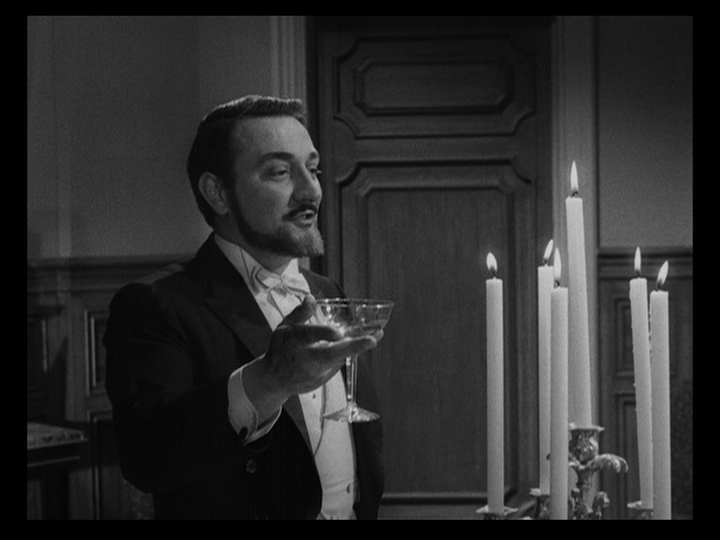
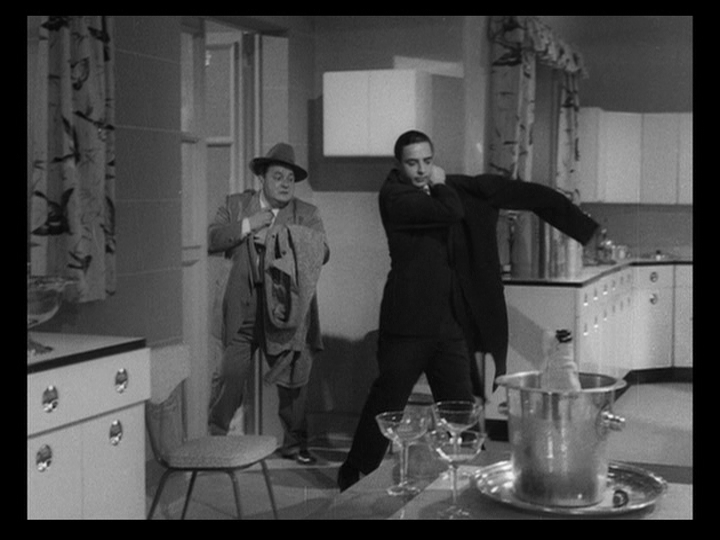
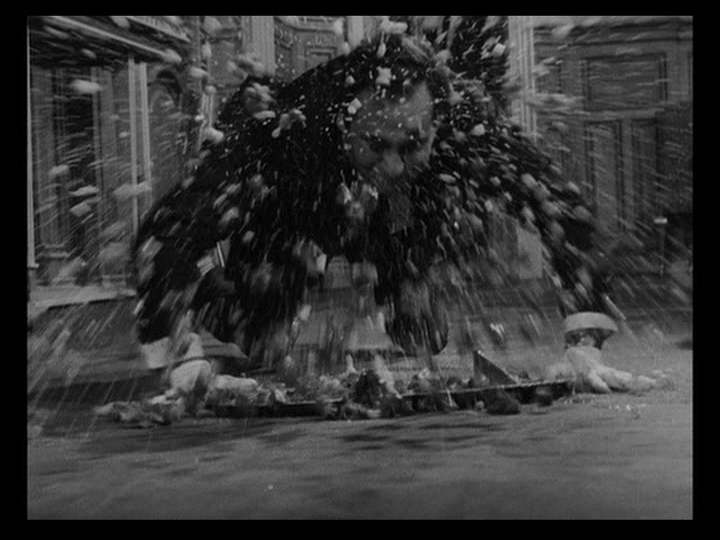
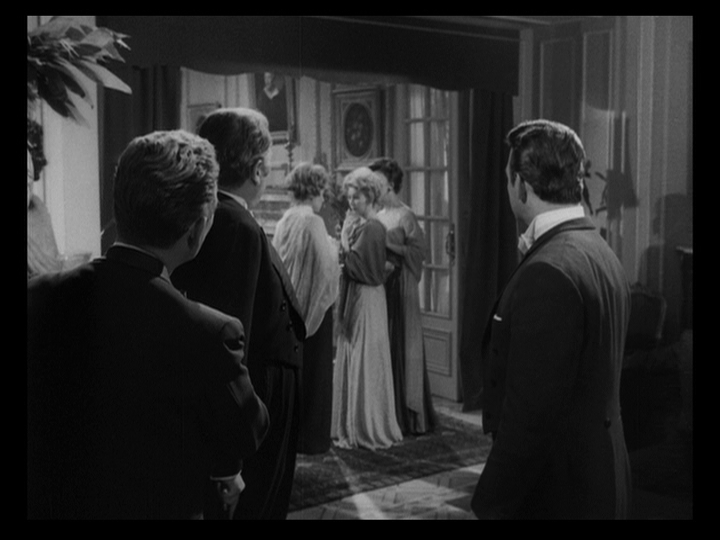
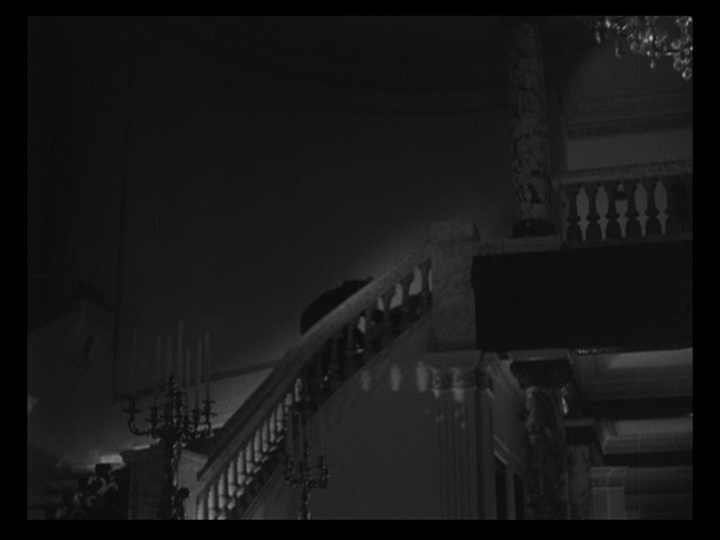
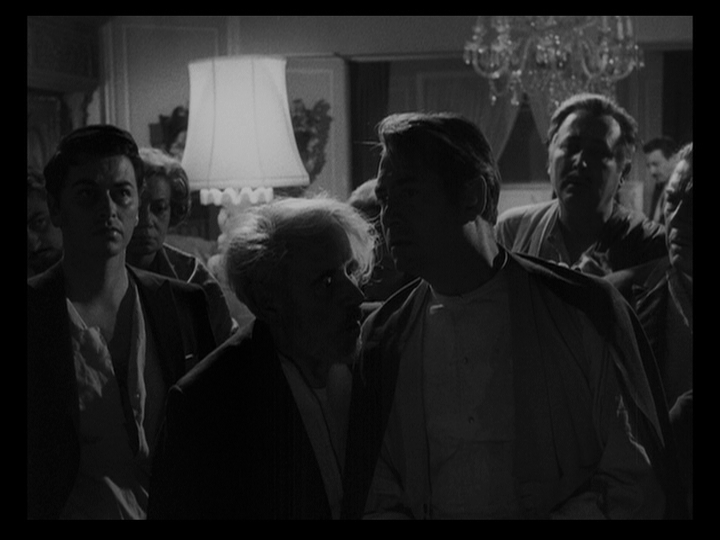
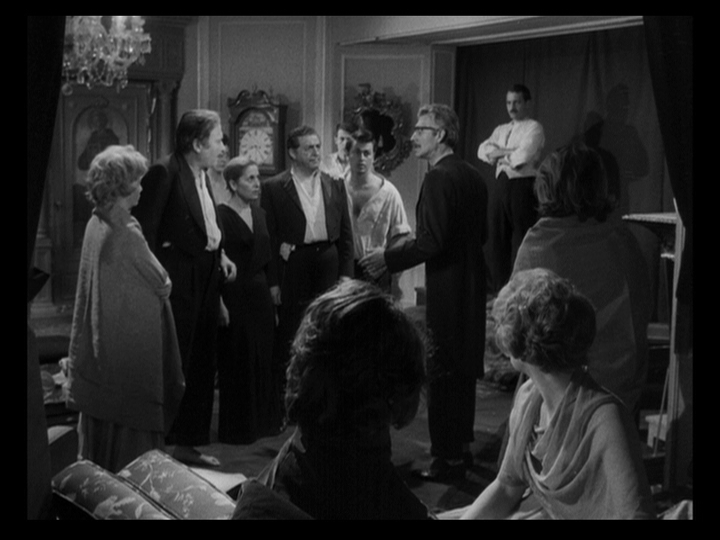
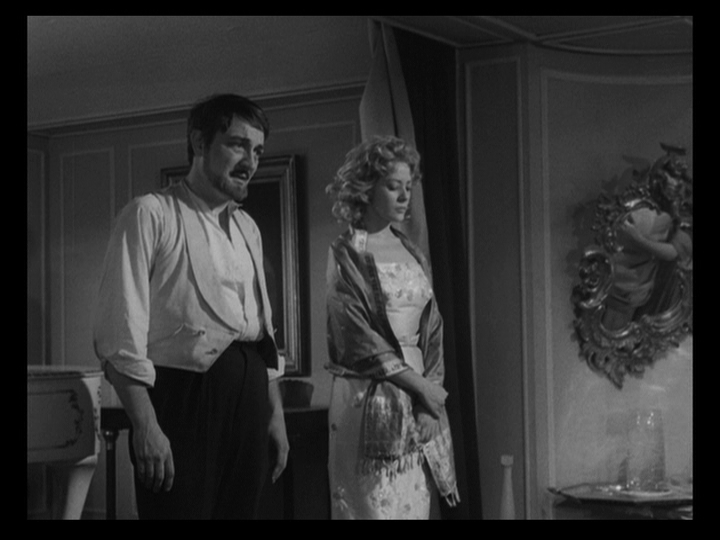
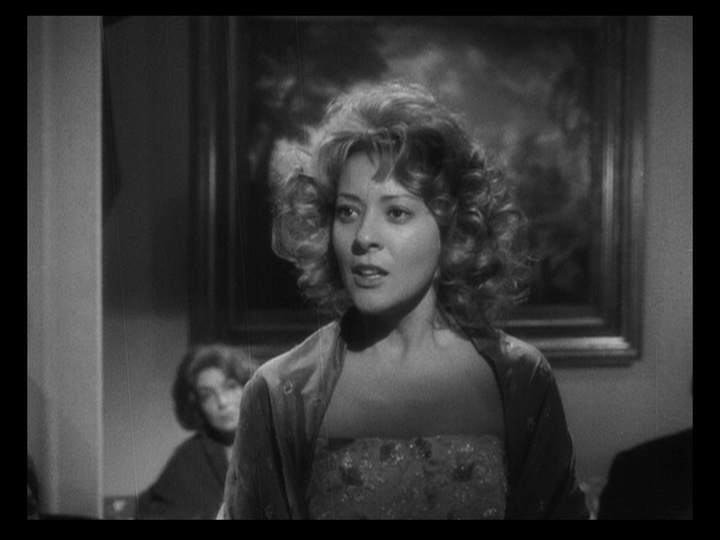
I don’t do this very often, but I unexpectedly find that I all of a sudden know exactly what would be on my hypothetical Sight and Sound Critics Poll ballot and feel compelled to share it:


 The Prodigal Cinephile