
What I’m Seeing This Week: I’m going with After the Hunt at either Cinemapolis or the Regal Ithaca Mall.
Also in Theaters: Ideally I’d also catch Anemone (which I wasn’t able to make it to last week), Good Boy, Good Fortune before they close, but it’s a busy time of year, so we’ll see. Anemone is at Cinemapolis and the other two are at the Regal. One Battle After Another continues its reign as king of the first run fare I *have* seen for a third consecutive week. It’s at both of those venues. I also enjoyed Eleanor the Great and The Smashing Machine, which are just at Cinemapolis. Special events highlights include free screenings of the films E.T. the Extra-Terrestrial and The Big Payback at Cinemapolis on Sunday and Tuesday respectively and of Marwencol at Cornell Cinema on Tuesday. Finally, this week’s noteworthy repertory options include screenings of Spirited Away, which is at the Regal Saturday-Wednesday; a Harold Lloyd double feature of Speedy and Now or Never at Cornell Cinema on Saturday; Meet Me in St. Louis there on Sunday; and Event Horizon at the Regal on Tuesday.
Home Video: I try to always have enough silly projects going to guarantee I’m never bored enough to start contemplating the meaning of life or lack thereof, and recently it occurred to me that I should make sure I’ve actually seen every feature and short I own on physical media. So it was that I found myself systematically working my way through my copy of the Criterion Collection’s By Brakhage anthologies. Old favorites Dog Star Man and Mothlight were every bit as impactful as I remembered and new discovery The Garden of Earthly Delights if anything improves on the latter, but the real revelation for me was The Act of Seeing with One’s Own Eyes. Here’s what I said about it on Letterboxd:
An even more rigorous cinematic rendering of the Holy of Holies than Window Water Baby Moving. This is a humble work, and director Stan Brakhage casts himself as neither High Priest nor the one who tears the temple veil–he is, rather, just the person holding the camera. Extraordinary.
Just in case I’m underselling it, the all-time top ten list I published in August was my first one in probably ten years; I saw Act of Seeing less than a week later and was tempted to immediately make another update to substitute it in for Stalker as my very favorite film of the 1970s! I’m still not *quite* ready to go there two months on, but it’s close, and I’m now thinking about folding this exercise into my annual end of year posts so that I can keep changing my mind back and forth. Anyway, we’re about due for a Criterion Collection flash sale, and if you don’t already own By Brakhage, this one title alone merits adding it to your cart!
Previous “Ithaca Film Journal” posts can be found here. A running list of all of my “Home Video” recommendations can be found here.
What I’m Seeing This Week: I’m going with Anemone at Cinemapolis. I’m also intrigued by Good Boy, which is at the Regal Ithaca Mall, and Kiss of the Spider Woman, which is at both aforementioned theaters, but we’ll be up north for most of the next week celebrating Thanksgiving with our Canadian relatives, so they’re going to have to wait.
Also in Theaters: One Battle After Another, which continues its run at both Cinemapolis and the Regal, remains my favorite new movie now playing Ithaca that I’ve already seen. I also enjoyed The Smashing Machine, which is sort of a remake of The Lusty Men transposed into a mixed martial arts setting, and Scarlett Johansson’s feature-length directorial debut Eleanor the Great, which struck me as the dramatic alter ego of last year’s best pure comedy Ricky Stanicky. Both are at Cinemapolis. This week’s special events highlights include a free screening of the film Santiago De Las Mujeres at Cinemapolis on Sunday and a free screening of RBG at Cornell Cinema tonight which also features free popcorn, as well as a Silent Movie Month in Ithaca presentation of The Flying Scotsman there tomorrow. Finally, your best bets for repertory fare include screenings of After Hours at Cornell Cinema tonight; Battle Royale at the Regal on Sunday, Monday, and Wednesday; and Prince of Darkness there on Wednesday.
Home Video: Speaking of Prince of Darkness, it’s one of the titles in a new Criterion Channel collection called “Directed by John Carpenter,” so if you aren’t free on Wednesday, you can watch it online! I wrote about Thom Bray’s character Etchinson on this blog in 2019.
Previous “Ithaca Film Journal” posts can be found here. A running list of all of my “Home Video” recommendations can be found here.
What I’m Seeing This Week: I’m going with Eleanor the Great at Cinemapolis and The Smashing Machine either there or at the Regal Ithaca Mall.
Also in Theaters: I’m also hoping to see Anemone, which opens at Cinemapolis tomorrow, before it closes. My favorite new movie now playing Ithaca that I’ve already seen is One Battle After Another, which continues its runs at Cinemapolis and the Regal. As I noted on Letterboxd, My Loving Wife and I are currently working our way through the cinematic adventures of Jack Ryan, and this movie struck me as an improved version of Patriot Games during moments like a rooftop shadow play with the moral that revolution is a young man’s game and a high-speed car chase through ember waves of asphalt, which I think might make it a “Democrat dad movie”? This week’s special events highlights include a free screening of the film Simshar followed by a discussion with director Rebecca Crimona at Cornell Cinema on Wednesday, a free screening of Yanuni there tonight, a free screening of Border Dwellers at Cinemapolis on Sunday, and the return of Cat Video Fest to Cornell Cinema this weekend. Finally, noteworthy repertory options include A Nightmare on Elm Street at Cornell Cinema and the Regal on Saturday, His Girl Friday at Cornell Cinema on Sunday, and The General at Cinemapolis on Wednesday.
Home Video: Most of my Family (née Friday) Movie Night selections are old favorites that the girls haven’t yet seen, but every now and again I like to mix things up by choosing something new to me as well. In this spirit I recently went with Dangerous When Wet, which is streaming on Watch TCM until October 16, and am glad I did because we all loved it and have been singing the song “I Got Out Of Bed on the Right Side” ever since! Here’s what I said on Letterboxd:
Esther Williams plays future farmer of America Katie Higgins, who first allows herself to get sweet-talked into swimming the English Channel and then nearly dies in the attempt all because her father (William Demarest) has no idea how to run a business. Positively European in its attitude toward sex, highlights include a sort of color-by-number invitation to imagine Williams in a skimpy bikini, Charlotte Greenwood as Higgin’s mother contorting her body into Slender Man proportions in a solo dance number, and a great group reaction shot to a man answering a knock on a door thought to belong to a single woman.
I also note that because Tom and Jerry appear in an animated/live-action dream sequence, we paired it with the Merrie Melodies short Speedy Gonzales, which features the eponymous mouse squaring off against the Sylvester the Cat and would go well with One Battle After Another, too, for reasons of surprising relevance to current events. We watched it on DVD, but you can also rent it from Prime Video.
Previous “Ithaca Film Journal” posts can be found here. A running list of all of my “Home Video” recommendations can be found here.
Starship Troopers was released on November 7, 1997. Three days later I turned 16. I don’t remember exactly how long after that it took me to earn my driver’s license, but there couldn’t have been much of a pause, because my friends and I saw it four times during its initial theatrical run. And so it was that this special effects extravaganza about an interstellar war against “the Bugs” became forever linked in my mind to both autumn and my childhood home of Lancaster, Pennsylvania. This month’s drink, the Witch’s Kiss cocktail from [Jim] Meehan’s Bartender Manual, honors that connection to the past through the saffron in Liquore Strega–it’s grown in southeastern PA, believe it or not–and updates it to the present via apple butter that I make with fruit from the tree in our backyard prepared à la Simply Recipes. Here’s what else is in the cocktail:
2 ozs. Cinnamon-infused reposado tequila (Espolòn)
3/4 oz. Lemon juice
1/2 oz. Strega
1/2 tsp. Agave syrup
1/2 tsp. Apple butter
To infuse the tequila, add a four-inch cinnamon stick to a one liter bottle and let stand for twenty-four hours, then remove. Shake all ingredients with ice, then fine-strain into a chilled cocktail glass. Garnish with a lemon twist.

Per Meehan, “while tequila shines brightest in a summer Margarita, the aged bottlings mix beautifully with fall fruits and vegetables.” The Witch’s Kiss is case in point. The first impression is all apple-cinnamon with a touch of minerality from the Strega, but the Margarita vibes come through loud and clear on the finish: it’s autumn in a glass, but *early* autumn specifically. I’m not going to pretend that the drink has anything more than a purely associational connection to Starship Troopers, so here’s a picture of my Columbia Tristar DVD copy of the movie, which is still going strong after more than 25 years:

It’s also currently streaming on Netflix with a subscription and is available via a number of other platforms for a rental fee.
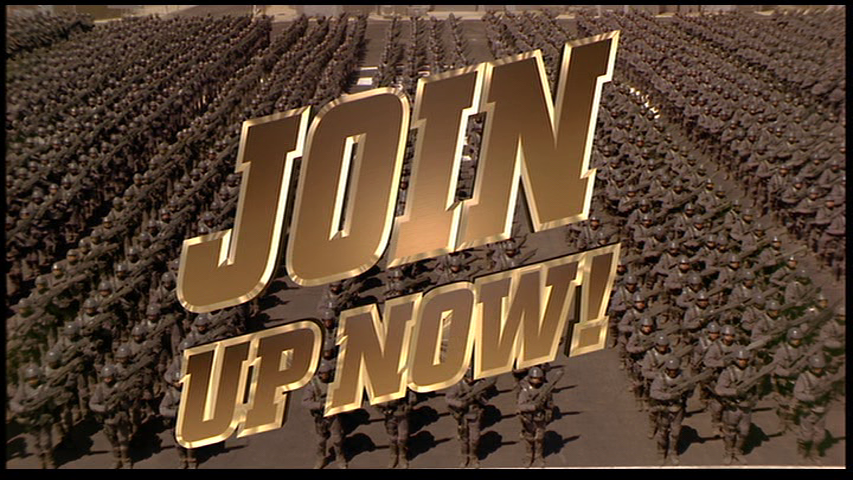
Starship Troopers begins with its most iconic recurring motif, a series of “Federal Network” newsreel-style vignettes which first implore the viewer to “do their part” and enlist:
Then celebrate new planetary defenses against “Bug meteors,” which are described in slightly greater depth when “we” use our cursor to answer the question “do you want to know more?” in the affirmative:

Before finally “breaking Net” to take us live to our adversary’s home planet of Klendathu, where an invasion is underway:

We cut to a reporter (Greg Travis) on the surface who soon gets ripped in half by a Bug warrior:

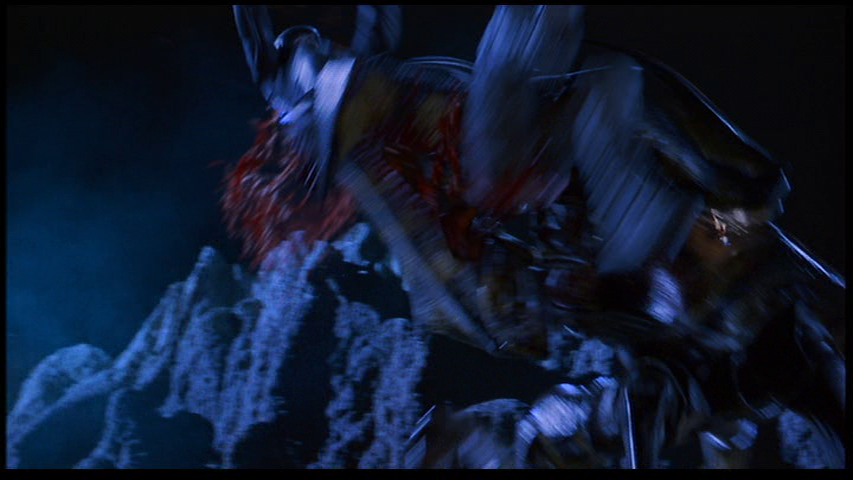

After which a human soldier named Johnny Rico (Casper Van Dien) addresses the camera and tells the person holding it to “get out of here now”:

Then himself appears to die in combat:

Static gives way to a title card reading “one year earlier,” which yields in turn to a shot of Johnny in school in Buenos Aires, where a teacher named Rasczak (Michael Ironside) redirects his attention from amorous doodles:
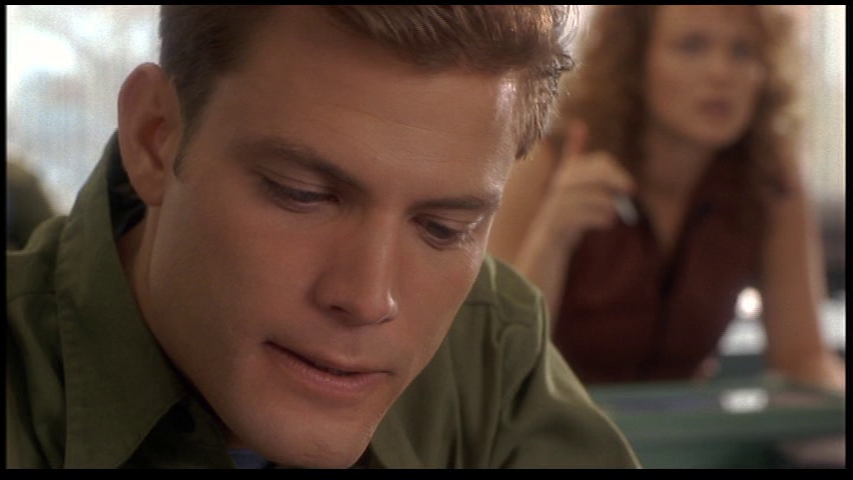
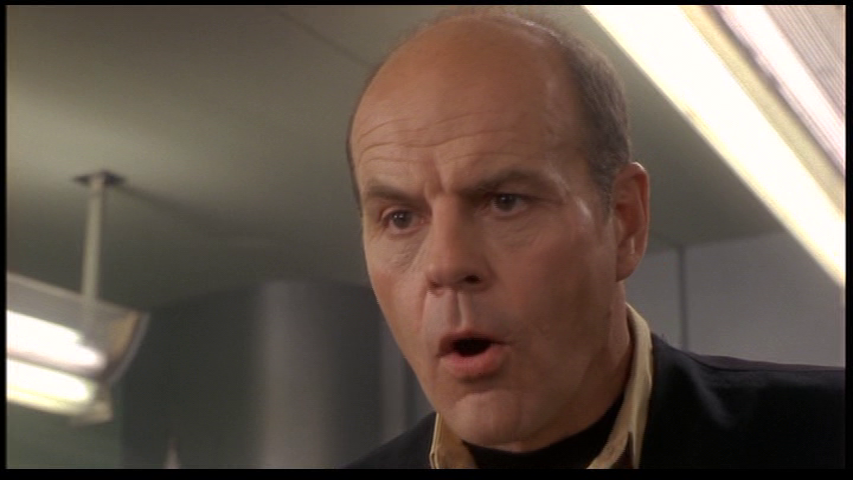
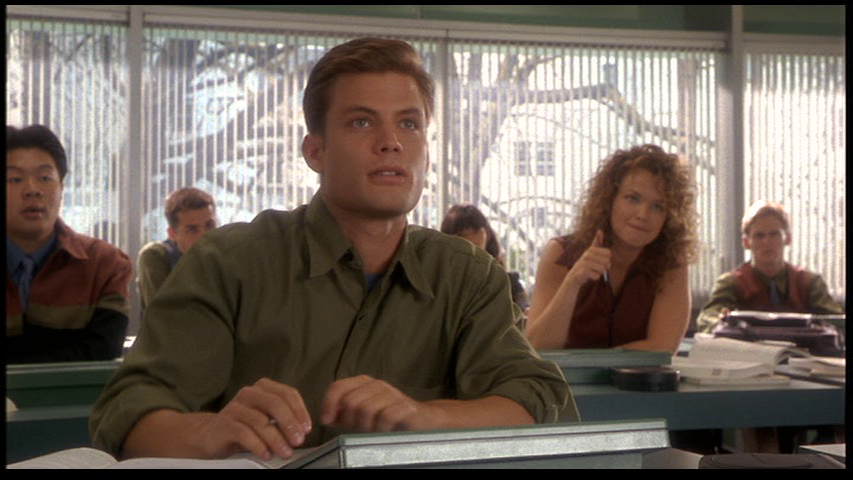
To a lecture summarizing the main points of the History and Moral Philosophy class which is about to conclude in a scene that Todd Berliner argues in his book Hollywood Aesthetic: Pleasure in American Cinema “contains perverse elements that complicate its genre identity and garble its ideological position.” As he explicates further:
The ideological perversity of the scene results from the fact that Rasczak is lecturing his students about the failure of democracy. He says that the present governing state, which separates people into “civilians” and “citizens,” has restored peace after years of strife caused by “social scientists of the 21st century.” He is describing, in short, a fascist utopia, a military state that affords citizenship only to those who serve in the armed forces.
No straightforward ideological proposition can make sense of the classroom scene because genre cues point in two opposing directions–making Rasczak look alternately like a liberal educator or a fascist ideologue.
After the final bell rings, Johnny participates in a federally-funded research study testing for psychic abilities conducted by his best friend Carl (Neil Patrick Harris):



Wins the big game with this teammate Dizzy Flores (Dina Meyer), who has a crush on him:

And goes to the prom with his girlfriend Carmen Ibanez (Denise Richards), an aspiring pilot who responds to him telling her that he, too, has decided to enlist even though it means his wealthy family will disown him by whispering “my father’s not home tonight” in his ear:

A long shot of them kissing during the last dance dissolves into a close-up of the flag of the Terran Federation, then the camera tilts down to show Johnny, Carl, and Carmen taking an oath:

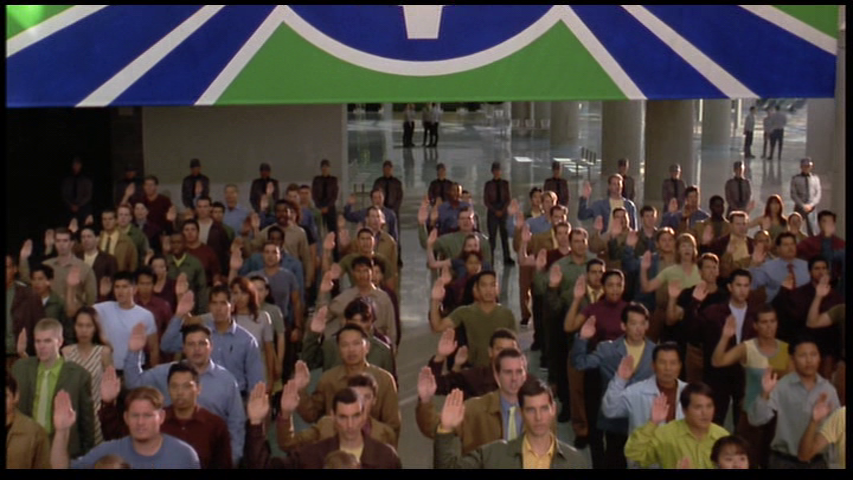
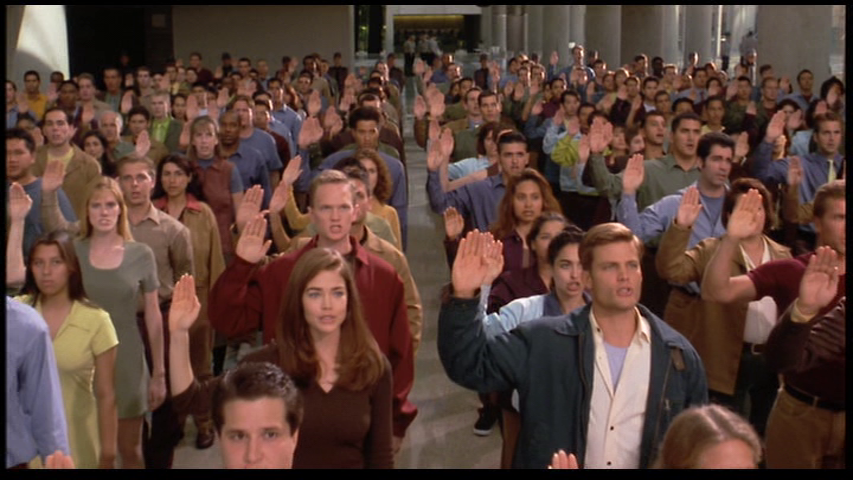
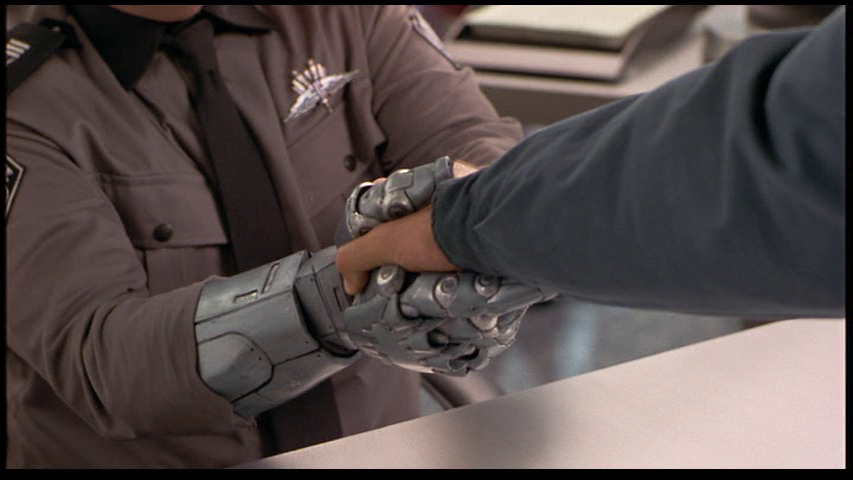
When a recruiting sergeant (Robert David Hall) with a robotic arm asks for their orders, we learn that Carmen has been assigned to Fleet like she hoped. Carl says he has been selected for Games & Theory aka military intelligence, to which the officer says, “next time we meet, I’ll probably have to salute you!”

However, he reserves his strongest reaction for Johnny. “Good for you!” he exclaims when he finds out what branch Johnny will be going into, gripping his hand. “Mobile Infantry made me the man I am today.” Then he pushes his chair back to reveal that he’s also missing both of his legs.

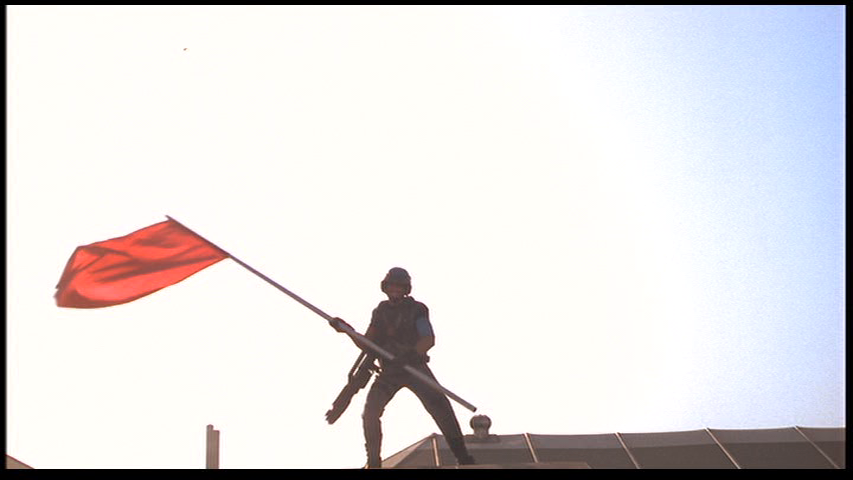
Dizzy winds up at the same boot camp as Johnny and helps him earn the coveted title of squad leader by suggesting that they run one of their old football plays in a scene screenwriter Ed Neumeier identifies as an homage to The Dirty Dozen (which also featured war games between a blue team and a red team) on his DVD commentary track with director Paul Verhoeven:


But Carmen dumps him in a video Dear Johnny (!) letter in the very next scene because she has decided to “go career”:

Then he is relieved of command of his squad following the death of a team member in a training accident and sentenced to “administrative punishment”:



After which he resolves to quit despite Dizzy telling him that it only proves he doesn’t “have what it takes to be a citizen.” His phone call home to deliver the good (from their perspective) news to his parents (Lenore Kasdorf & Christopher Curry) gets disconnected, though:
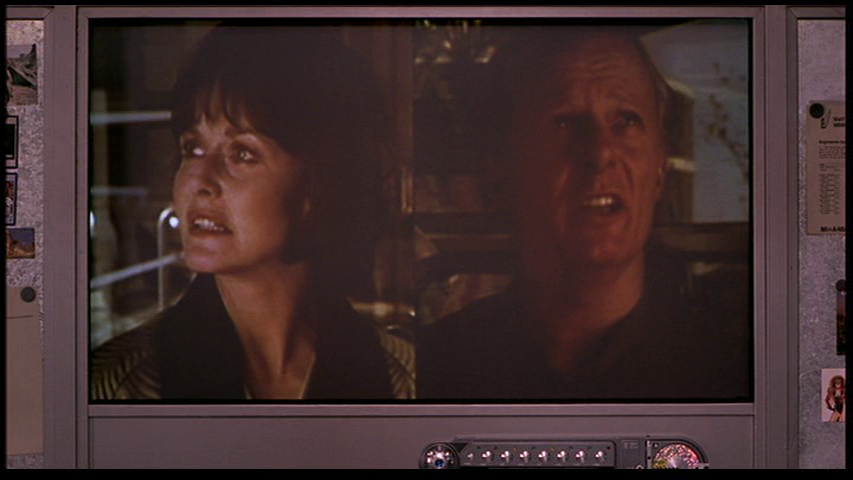

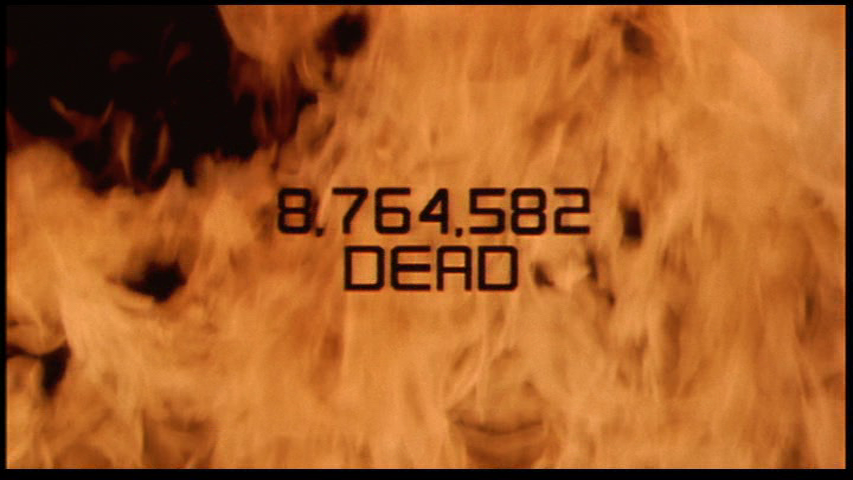
Moments later he learns why: Buenos Aires has been destroyed by one of those meteors we heard about earlier and the Federation is going to war.


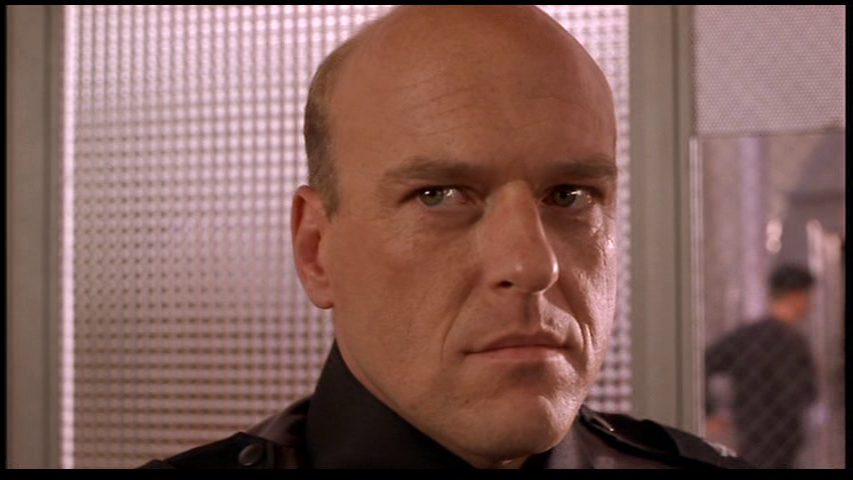
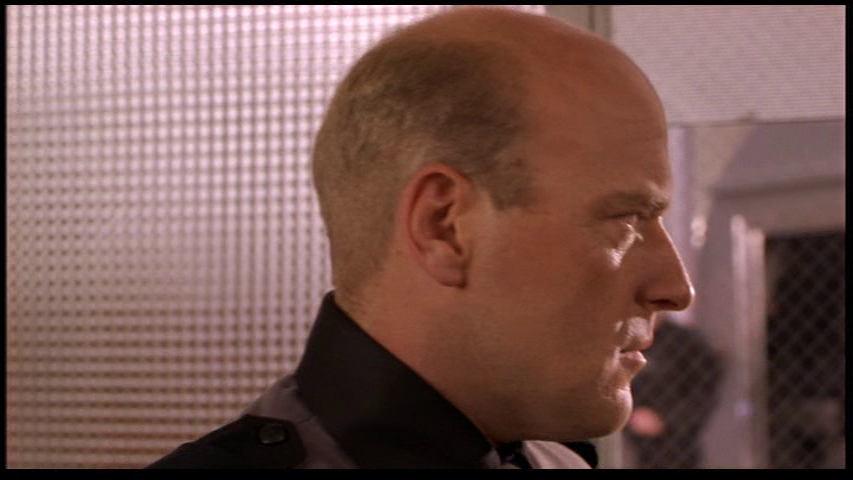
Johnny’s commanding officer (Dean Norris) looks the other way as his drill instructor Sergeant Zim (Clancy Brown) tears up his letter of resignation:
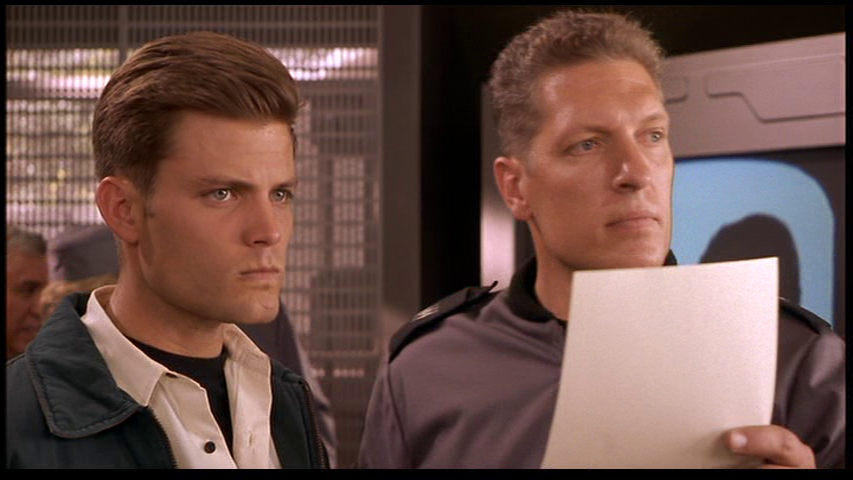

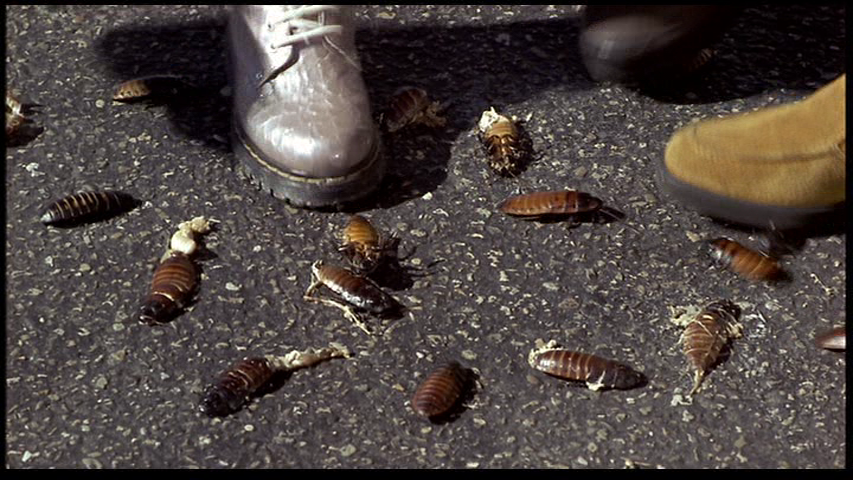
And following a FedNet sequence featuring a woman giddily clapping her hands and cheering as a group of children “do their part” by stomping on a bunch of presumably innocent insects:


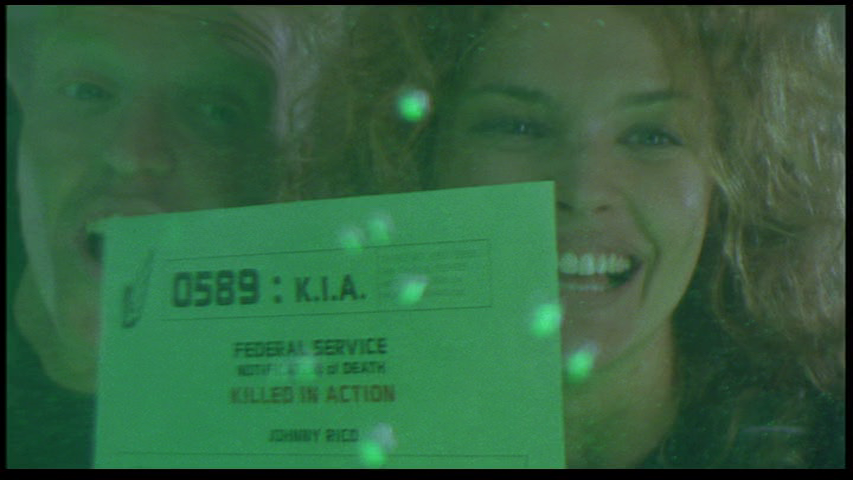
We find ourselves on “Fleet Battle Station Ticonderoga, deep inside the Arachnid Quarantine Zone,” where the men and women of the Federal Armed Services prepare to attack.” This is where we came in, as the fella says. Johnny survives, of course, even though official records list him as killed in action:

And the second half of the film chronicles the completion of his and his former classmates’ transformation from teen magazine idols into something harder and, especially in the case of Carl, who we last see decked out in garb that would clearly identify him as one of the bad guys if this was a World War II movie, verging on sinister.

In a chapter in the book The Literature/Film Reader: Issues of Adaptation, J. P. Telotte contends that a key difference between Starship Troopers the movie and the novel by Robert Heinlein it’s based on is that while the latter “is a first-person narrative told from Johnny Rico’s vantage point, Verhoeven’s film unfolds, not from the perspective of any individual, but rather from the point of view offered by the audiovisual culture itself,” which enables it to “establish a rather different authoritarian voice, and indeed a subtly tyrannical power, one that is the real heart of its satiric vision.” Andrew O’Hehir said something very similar in his remarkably astute contemporaneous review for Sight & Sound, noting that while Heinlein’s “fascist-flavored Utopia” was “a deadly earnest prescription,” in Verhoeven’s hands “it becomes an aesthetic and ideological field of play.” They’re thinking not just about the FedNet sidebars which explicitly reference historical propaganda pieces:
And are also, as Neumeier explains in his DVD commentary, “meant to evoke CNN coverage of the Gulf War,” but the rest of the film as well. I think it only really works if you sincerely enjoy it on its own merits for the amazingly undated special effects in scenes like the wreck of Carmen’s ship the Rodger Young:

And the attack on Planet P which surely must have been inspired by the movie Zulu:


Action sequences like Johnny single-handedly taking out a giant “Tanker” Bug with a grenade:




And endlessly-quotable lines like a panelist on a Crossfire-like program (Timothy McNeil) declaring, “frankly I find the idea of a bug that thinks offensive”:

And Sergeant Zim answering a question from Johnny’s skeptical fellow trooper Ace Levy (Jake Busey), about the utility of hand-to-hand combat in an age of nuclear weapons by pinning his hand to a wall with an expertly-thrown knife and declaring, “if you disable the enemy’s hand, he cannot push a button!”

I do, obviously, and that’s why, like Jamelle Bouie, I’m able to read it as an artifact “made by the human government of the film to rally the populace in a losing war against the Bugs” (which a footnote in this 2001 journal article by Lene Hansen indicates was supported by the film’s no-longer-extant late-90s website) or, as O’Hehir suggests, a fable from an alternate universe in which Hitler won. I am genuinely moved by Johnny and Dizzy’s surprise when they discover that their new Lieutenant is their old teacher:



Johnny’s eulogy for Dizzy after she dies in his arms:

And his reaction to hearing his unit described as “Rico’s Roughnecks” for the first time after he assumes command when Rasczak also dies in combat:

Because I am moved, I am also disturbed; because I am disturbed, I am on my guard against being manipulated by these same techniques in other contexts.
Telotte notes that for all its deviations from the book it’s adapted from, “the film still follows the Heinlein pattern of youthful education, in large part because, the movie implies, we have all become very much like juveniles in the process of being molded by today’s media culture.” This strikes me as similar to Neumeier’s commentary track observation that “Carl has become like an insect here” when the image above of him placing his hand on the “Brain Bug” Sergeant Zim has captured to read its mind appears on the screen. Early in the film, Carmen pushes back against a teacher’s (Rue McClanahan) statement that insects are superior to us in many ways on the grounds that “humans have created art, mathematics, and interstellar travel.”

The rebuttal focuses just on the third item on this list, but as O’Hehir points out, “for all the movie’s humans know, there are arachnid poets greater than Milton.” This is where Starship Troopers *really* starts to get interesting for me. While also still in school, Carl refers to his psychic abilities as “a new stage in human evolution,” which reminds me of two of my previous Drink & a Movie selections: Crimes of the Future, which regards such a possibility in a positive light, and Stalker, which is more circumspect. Neumeier means to criticize Carl by comparing him to an insect, but as Ed Howard observes in a 2009 blog post, his director “focuses equally on the casualties of humans and aliens alike” and “keeps subtly reminding his audience that the aliens are not simply expendable cannon fodder,” for instance in this scene where “Verhoeven’s composition deliberately recalls popular representations of the Pearl Harbor attack and of American napalm bombing raids in Vietnam”:



Similarly, although O’Hehir is right that “of course, we’ll root for the human race against a teeming hive of insects,” scenes like this:
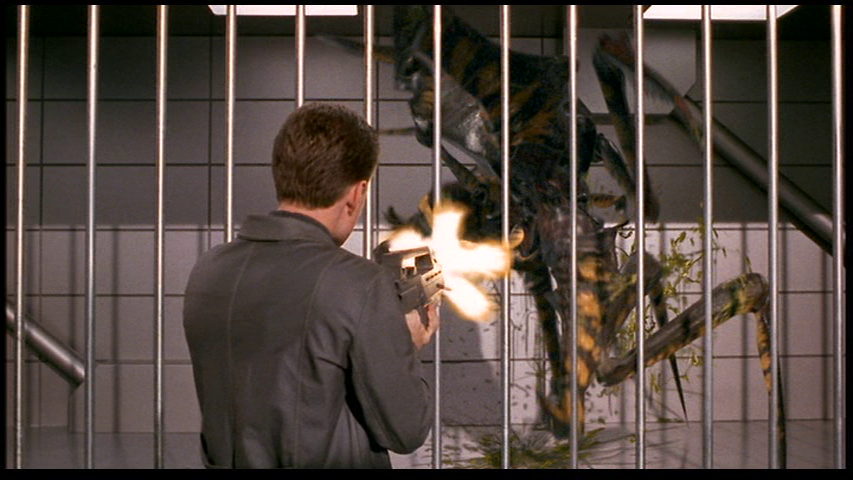
And this:

Nonetheless inarguably constitute torturing prisoners of war, and our species’ reaction to Carl’s triumphant announcement that the captured Brain Bug is afraid is also shameful:


Heinlein obviously intends insect society as a metaphor for America’s Cold War Communist enemies; Neumeier and Verhoeven flip this around and equate the Bugs with fascism. More important than specific ideologies, though, is the universal truth that the harder you try to vilify a supposed enemy, the likelier it is that you will come to embody their “worst” tendencies yourself. Or to quote another movie I saw in high school, 8MM, “if you dance with the devil, the devil don’t change–the devil changes you.”
Cheers!
All original photographs in this post are by Marion Penning, aka My Loving Wife. Links to all of the entries in this series can be found here.
What I’m Seeing This Week: I’m excited to finally see One Battle After Another at either Cinemapolis or the Regal Ithaca Mall and to watch a 35mm print of Bringing Up Baby on the big screen at Cornell Cinema on Saturday!
Also in Theaters: I’m also intrigued by actress Scarlett Johansson’s feature-length directorial debut Eleanor the Great, which opens at Cinemapolis tomorrow, but I’m not sure I’m going to get to it before it closes. My favorite new movie now playing Ithaca that I’ve already seen is The Baltimorons, a love letter to the city I moved here from with The Holdovers vibes that won me over with its earnestness and persistence. It continues its run at Cinemapolis this week. This week’s special events highlights include the presentation of a 35mm print of The Lady Eve at Cornell Cinema on Sunday and free screenings of La Soledad (which I reviewed a few years back), The Fisherman’s Daughter, and Framing Agnes there on Thursday, Monday, and Tuesday respectively. Finally, other noteworthy repertory options include a screening of The Natural at Cinemapolis on Sunday to “celebrate the life and legacy Robert Redford,” Sisters at Cornell Cinema on Saturday, and three classics at the Regal that every cinephile should see on the big screen at least once: Vertigo (tonight), 2001: A Space Odyssey (tomorrow), and Lawrence of Arabia (Sunday).
Home Video: I mentioned The Happening on this blog in August when I noticed that it has basically the same exact beginning as Groundhog Day, then again last month when I suggested you can read its ending as saying something very similar to the final shots of The Exterminating Angel. Now my oldest daughter’s fifth grade class is working on a version of the number doubling exercise John Leguizamo’s math teacher Julian gives his carmates to distract them from their imminent demise. *This* is obviously just a coincidence, but the multiple recent comparisons to other films aren’t–I think about The Happening, which I consider to be one of the great modern “B movies” and director M. Night Shyamalan’s masterpiece, all the time! Its budget may have been bigger than Val Lewton-produced fare like my October ’24 Drink & a Movie selection The Leopard Man, but the way a quotidian phenomenon like wind rustling leaves is imbued with menace is straight out of his playbook. Reviewers killed it on release and half the folks I follow on Letterboxd who have rated it are still going with scores of one-and-a-half stars or less, but I’m gratified by how many of the people whose opinions I respect the most are at the whole other end of the spectrum, which suggests to me that a critical reappraisal is already in the works. The Happening is currently available on YouTubeTV with a subscription and Prime Video for a rental fee–check it out and join us in the vanguard!
Previous “Ithaca Film Journal” posts can be found here. A running list of all of my “Home Video” recommendations can be found here.
What I’m Seeing This Week: I’m going with The Baltimorons at Cinemapolis and maybe Him at the Regal Ithaca Mall depending on what kind of reviews it gets.
Also in Theaters: I’m not crazy about any of the first run fare playing Ithaca right now that I’ve already seen. Luckily, there’s plenty happening on the special events and repertory fronts! One highlight in both categories are the screenings of 35mm prints of Bringing Up Baby and The Lady Eve at Cornell Cinema tomorrow and Sunday respectively. There are also three free movies there this week: Memories of a Burning Body on Saturday, Cocote on Monday, and El Norte on Wednesday. There are quite a few free events at Cinemapolis as well, including the final four screenings in the third annual Reproductive Rights Film Festival and a “Family Classics Picture Show” presentation of The Wizard of Oz on Sunday, along with a concert film featuring local band Microbes Mostly on Tuesday. Finally, this week’s repertory offerings at the Regal include Do the Right Thing tonight, Psycho tomorrow, A Clockwork Orange on Sunday, and Casablanca on Wednesday, while Dead Man plays Cornell Cinema on Saturday.
Home Video: The Phoenician Scheme, which is now streaming on Peacock, isn’t quite a *lock* to make my year-end Top Ten list, but it was sitting pretty in third place at the halfway point. While Ballerina might pass it on a rewatch, nothing I’ve seen since then has come close. I talked about those two films in the context of one another on Letterboxd in June:
Playing alongside Ballerina in multiplexes nation wide as it is, the main character of director Wes Anderson’s sometimes shockingly (for him) graphically violent new film struck me as the Baba Yaga of mid-20th century industrialism: undefeated, but not indestructible, as demonstrated by the visibly increasing wear and tear on his body, only he’s trying to stay *in* the game, not get out of it. Also as in the World of John Wick, plot is secondary–there to set pieces, here to the pieces which comprise the sets, including a series of artworks on loan to the production called out in the end credits. Anchored by masterfully understated performances by Benicio Del Toro and Mia Threapleton in the lead roles and a brilliantly exaggerated supporting turn by Michael Cera. Alexander Desplat’s Stravinsky-inspired score is my favorite of Movie Year 2025.
But like I said after my second viewing, the thing I find most interesting about it is that it’s “a 2025 movie set in 1950 that treats that era’s titans of business like the European royal families of the first half of the 20th century.”
Previous “Ithaca Film Journal” posts can be found here. A running list of all of my “Home Video” recommendations can be found here.
What I’m Seeing This Week: Memories of Underdevelopment is the eleventh-greatest film I’ve never seen according to the 2022 Sight and Sound Critics Poll, so the free screening at Cornell Cinema on Monday is my top priority! I’m also going to try to catch The Long Walk at the Regal Ithaca Mall.
Also in Theaters: Spinal Tap II: The End Continues, which opens at the Regal today and Cinemapolis tomorrow, would probably be listed above, only I promised My Loving Wife I’d save it for a future date night. The best new movie in local theaters that I’ve already seen is Familiar Touch, which screens at Cornell Cinema on Sunday evening. I don’t want to say much about it because I strongly suspect that at least the first scene plays better the less you know, but to pique your interest I will note here (as I did on Letterboxd) that it’s “a great food movie in the same way Spanglish is which also deals well with sensuality and desire in late adulthood + features terrific sound design, a pretty incredible lead performance by Kathleen Chalfant, and H. Jon Benjamin.” Other first-run fare I enjoyed include Caught Stealing and Weapons, which continue their respective runs at both Cinemapolis and the Regal, and The Fantastic Four: First Steps, which is playing just the Regal. This week’s special events highlight is the opening of the third annual Reproductive Rights Film Festival, which features three free screenings at Cinemapolis on Saturday and Sunday. Finally, we are once again blessed with great repertory options at all three Ithaca venues, including screenings of Jaws and The Thing at Cinemapolis and the Regal respectively tonight, The Thin Man at Cornell Cinema on Saturday, Sunset Boulevard at the Regal on Monday, and a free presentation of a new 4k restoration of The Draughtman’s Contract at Cornell Cinema on Tuesday.
Home Video: Love Me Tonight is a wildly creative pre-Code musical directed by Rouben Mamoulian that features music by Rodgers and Hart, “male gaze”-defying beefcake shots of Maurice Chevalier, some of the best music-of-the-streets and catchy-song-catching-on montages of this or any other era, and perhaps the single funniest use of slow motion in moving picture history. And clothes by Edith Head, whom Turner Classic Movies is celebrating this month, including a riding habit that is identified in the diegesis as representing the height of fashion, which strikes me as a particularly daunting challenge for a costume designer. Anyway, this film is a shoo-in for any Best of the 1930s list I might ever find myself moved to make, so check it out on Watch TCM before it leaves next Wednesday!
Previous “Ithaca Film Journal” posts can be found here. A running list of all of my “Home Video” recommendations can be found here.
What I’m Seeing This Week: I’m going with Familiar Touch at Cornell Cinema tonight and Splitsville at either Cinemapolis or the Regal Ithaca Mall on Tuesday.
Also in Theaters: Highest 2 Lowest closes at Cinemapolis today, at which time its reign as the best new movie now playing Ithaca that I’ve already seen will end. After that the title belt will pass to, hmm . . . let’s go with Caught Stealing, an entertaining “feature-length proof purporting to demonstrate that actually two wrongs *can* make a right set in 1998 that could be director Darren Aronofsky’s follow-up to Pi which he put in a time capsule for some reason” (as I recently said on Letterboxd) that continues its runs at Cinemapolis and the Regal. I also enjoyed Sorry, Baby, which plays Cornell Cinema on Saturday; The Fantastic Four: First Steps, which is still going strong at the Regal; and Weapons, which remains there and at Cinemapolis. This week’s special events highlights are the encore presentation of a 35mm restoration print of Donnie Darko at Cornell Cinema tonight and a single screening of local favorite My First Film at Cinemapolis tomorrow to help launch The History Center‘s “Tompkins Treasure Hunt” event. Finally, the next seven days feature an embarrassment of repertory riches at all three Ithaca theaters, including 50th anniversary presentations of Jaws at Cinemapolis and the Regal all week, a new 4K restoration of Paris, Texas at Cornell Cinema on Saturday, and a screening of Citizen Kane at the Regal on Sunday. You can also see The Godfather there on Saturday, Goodfellas there on Tuesday, and It Happened One Night at Cornell Cinema on Sunday, among other things.
Home Video: We finally checked out KPop Demon Hunters on Netflix after my youngest daughter got invited to a “KPop Demon Hunters Meets Unicorns and Rainbows”-themed birthday party, which: if you need any additional proof that this is a bona fide phenomenon, there you go! Anyway, this is now the girls’ favorite movie of the year and while it isn’t breaking any narrative or stylistic ground, My Loving Wife and I were pleasantly surprised to find that it’s a sturdy piece of work elevated by clever touches like an OCD demon tiger and catchy musical numbers, including my new clubhouse leader for the Best Original Song Oscar, “Golden.” Now I suppose we’ll find out how many sequels my goodwill can survive. . . .
Previous “Ithaca Film Journal” posts can be found here. A running list of all of my “Home Video” recommendations can be found here.
A thought popped into my head awhile back when fresh sweet corn from regions to the south started to appear in local grocery stores: I should make a drink reminiscent of elotes! As J. Kenji López-Alt has written, it is after all “the best way to serve corn, period,” and by enshrining its flavors in a cocktail, I’d be able to enjoy it year-round even when its main ingredient is out of season. So I grabbed a bottle of Finger Lakes Distilling’s Glen Thunder Corn Whiskey out of the pantry, fat-washed it with cotija cheese, mixed it up with some lemon juice to make a sour . . . and went straight back to the drawing board, because the resulting concoction was absolutely terrible. In fact, my first BUNCH of attempts were failures. Among the things I learned from these experiences were that:
The turning point came when I remembered this Food & Wine article and special ordered a bottle of Nixta Licor de Elote from Ithaca’s Red Feet Wine Market. My pivot to Mellow Corn as a replacement for the Glen Thunder also turned out to be a blessing in disguise when it proved to play much nicer with others, and a few tweaks later I had something that not only tasted the way I wanted to, but also remained distinctive enough from the popular Elote Old-Fashioned I discovered around the same time that I remain comfortable claiming my drink as an original creation. Here’s how you make it:
1 1/2 ozs. Mellow Corn
3/4 oz. Nixta Licor de Elote
1/2 oz. Lime juice
1/2 oz. Ancho Reyes
1 teaspoon 2:1 simple syrup
1 Egg white
Start by rimming a chilled cocktail glass with this mixture (I recommend using a mortal and pestle if you have one) inspired by Trader Joe’s Everything But The Elote seasoning, which you could obviously use as an alternative, but it won’t be nearly as good:
Combine all of the cocktail ingredients in a shaker and mix with a immersion blender until frothy. Add ice and shake, then strain into your prepared glass over a large ice cube:

The egg white is essential for achieving the creamy texture I’m going for, so don’t leave it out! If this ingredient makes you squeamish, please note that we usually err on the side of extreme caution by pasteurizing the eggs using an immersion circulator to hold them at 130 degrees in a water bath for 45 minutes to an hour before separating them, which neutralizes the food safety threat without noticeably impacting them otherwise. Cheese, smoke, and heat are the first things you’ll notice, but corn is definitely present on the swallow and even more so on the finish. The drink starts out on the sour side thanks to the citric acid in the spice mixture on the rim, but once your lips stop tingling the balance of the beverage itself is, if I may say so myself, perfect, ensuring that no ingredient overpowers the other and making this more than a novelty cocktail that’s enjoyable for the first few sips but inevitably overstays its welcome. Which is, of course, a reference to the film I’m pairing it with, The Exterminating Angel. Here’s a picture of my Criterion Collection DVD copy:

It’s also currently streaming on the Criterion Channel with a subscription and is available via a number of other platforms for a rental fee.
One of my high school English teachers used to say that the hallmark of great literature was a work possessed of both individuality and universality. I can’t think of many movies that better embody this dual standard than The Exterminating Angel, which is to say that I agree with both Seth Colter Walls, who hailed it as “2009’s most indispensable film” in a Newsweek article published shortly after the release of the DVD pictured above, and Mark Harris, who described it in Film Comment eight years later as a “bleak, caustic vision of rich people presiding over the end of civilization” that “does not seem like a movie behind the times so much as a movie of no particular time.” Noting that an opera adaptation by Thomas Adès was set to debut in just a few months and that a musical version by Stephen Sondheim and David Ives was also in the works, the latter went on to suggest that “it can’t be good news that its time may finally have come,” and I believe that’s right, too, for reasons I hope to make clear anon! The Exterminating Angel opens on a household in a flurry of activity. Mexican aristocrats, Edmundo (Enrique Rambal) and Lucía Nobile (Lucy Gallardo) are hosting a dinner for their wealthy friends after a night at the opera, but something is amiss, as we discover when the doorman Lucas (Pancho Córdova. I think–IMDb says Ángel Merino, but the screenplay published by Onion Press in 1969 credits him as “Waiter,” so I’m ruling in favor of Wikipedia) decides to go for a walk even though it means the loss of his job. “Well, if he didn’t like it here, good riddance,” says the majordomo Julio (Claudio Brook)–“there are many Lucases in the world.”
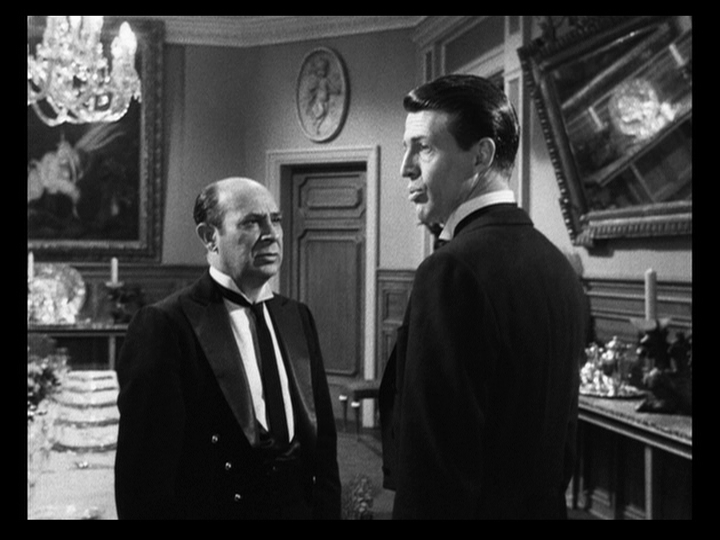
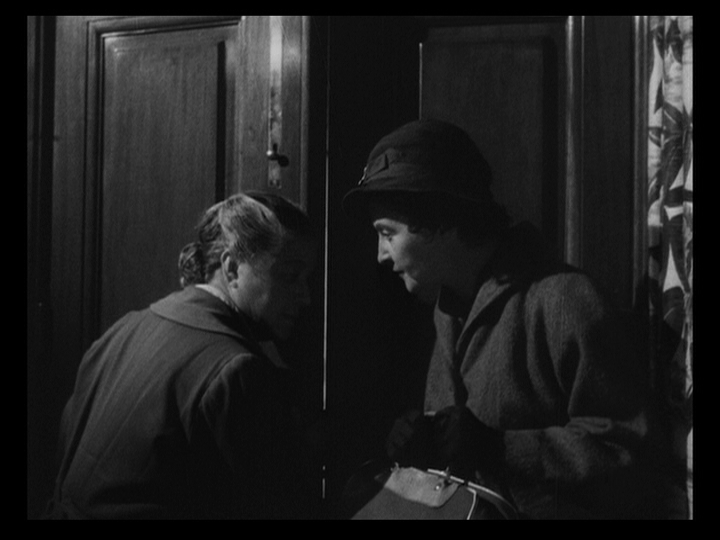
Be that as it may, he isn’t the last to leave and other strange things are afoot at the Casa Nobile, as these two maids discover when their attempt to flee is temporarily thwarted by the untimely arrival of their employers and their guests not just once:

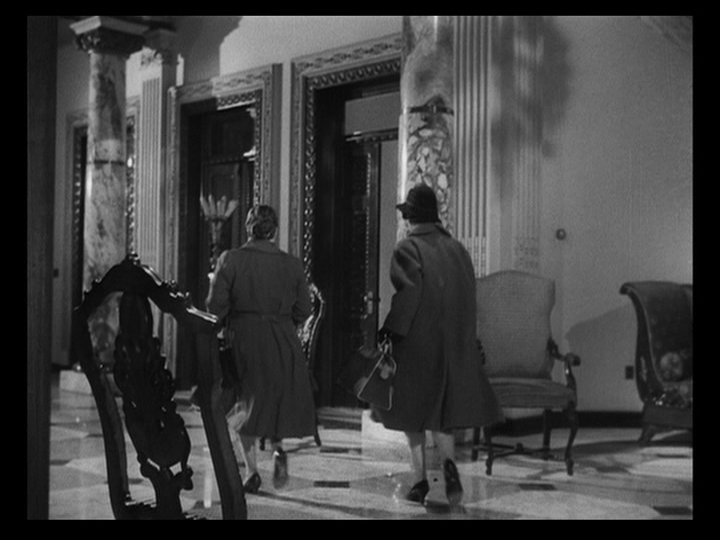
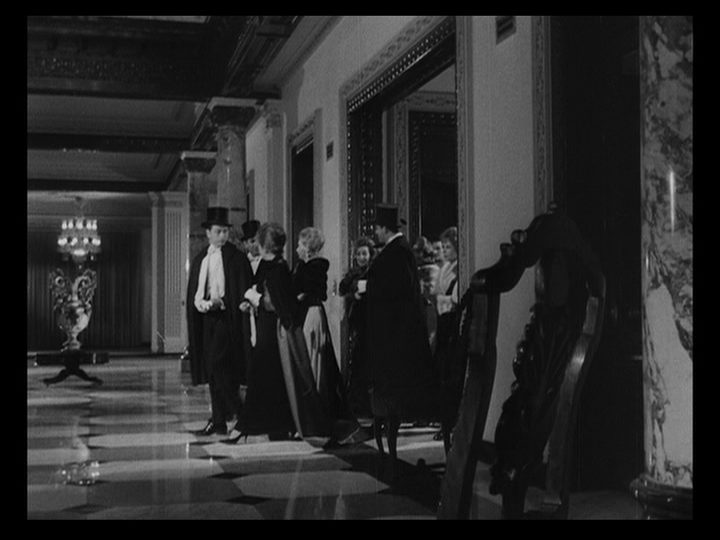
But, inexplicably, twice:

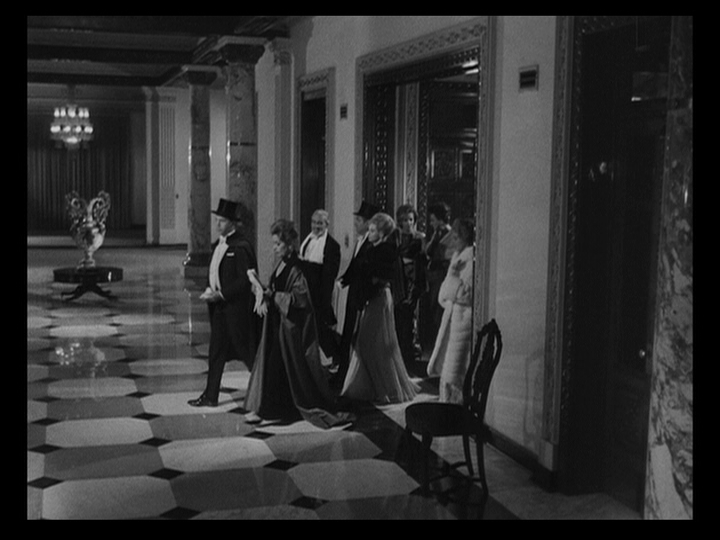
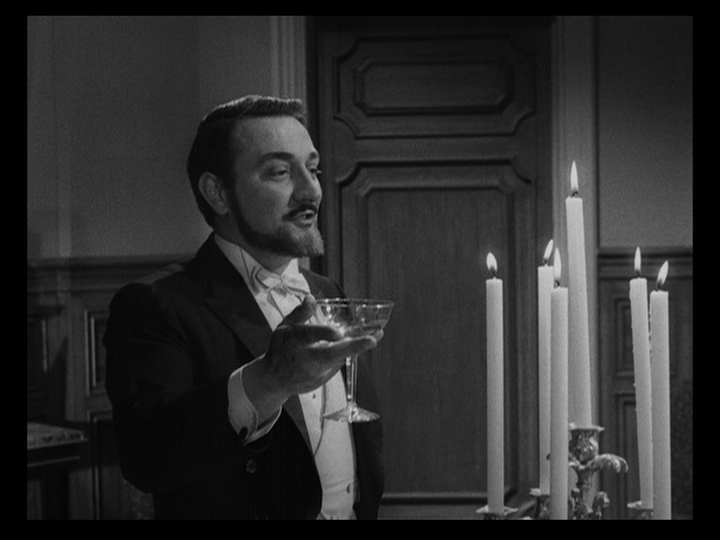
As they sit down to dinner, the repetitions (which director Luis Buñuel suggests he was the first to use this way in a movie in an interview with José de la Colina and Tomás Pérez Turrent collected in their book Objects of Desire) continue as Edmundo gives the same toast a second time:
And the remaining staff follow the maids out the door:

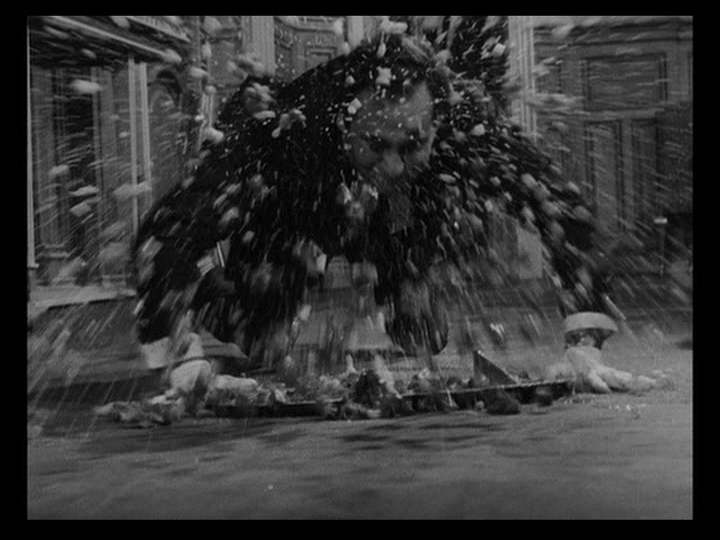
Lucía also decides to abandon a jest involving a bear and some sheep after her guest Mr. Russell (Lucy Gallardo) responds negatively to one whereby a waiter (Merino) deliberately “trips” while serving the first course:
Finally, matters really take a turn toward the surreal after dinner when the guests would normally leave, but find instead that none of them are able to cross the threshold of the drawing room:
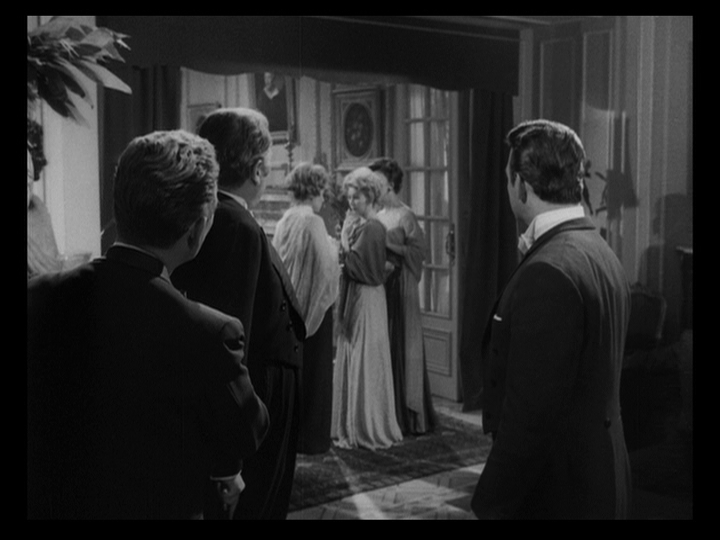
So against every rule of etiquette they settle in for the night:



When Julio arrives with leftovers for breakfast the following morning, he discovers that he is now trapped as well:

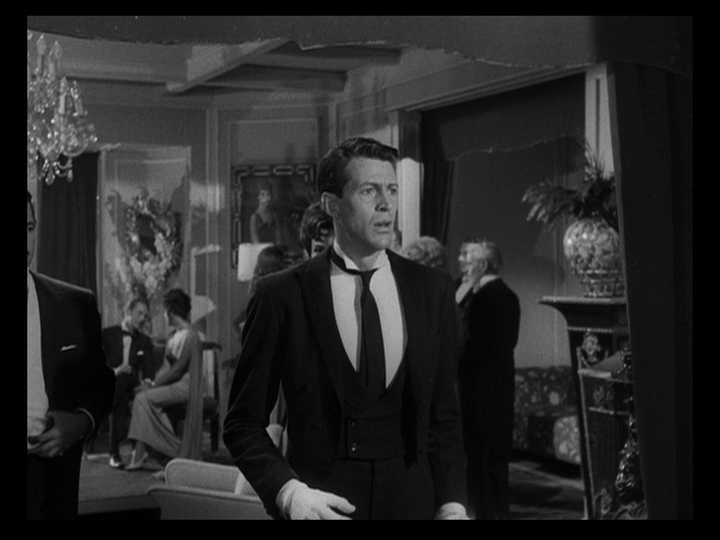

Which brings us to just about exactly 1/3 of the way through the film’s 95-minute runtime. In an interview included with the Criterion DVD as an extra, Silvia Pinal (who plays a guest named Leticia aka “The Valkyrie) quotes a friend of hers as saying that “Buñuel invented reality shows with The Exterminating Angel.” Most of the remaining hour does indeed prove that no one is there to make friends and as the days stretch into weeks the increasingly uncivilized assembly take turns throwing each other under the bus by surreptitiously tossing life-saving medicine where it can’t be reached:

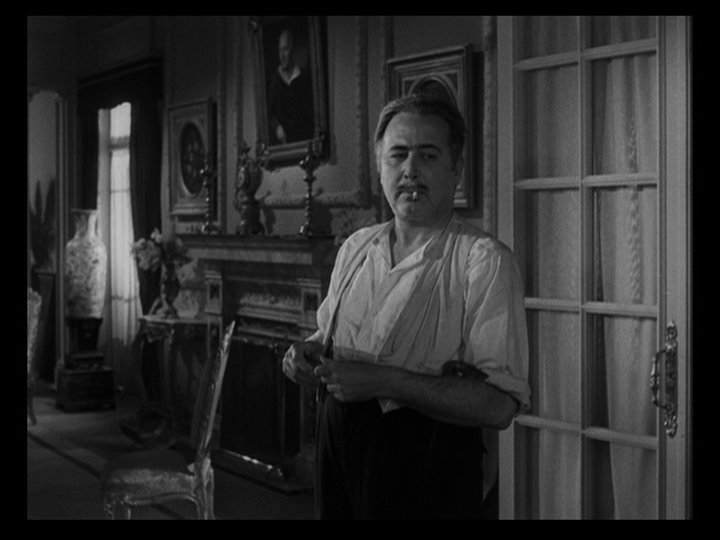

Engaging in sexual abuse under the cover of darkness:
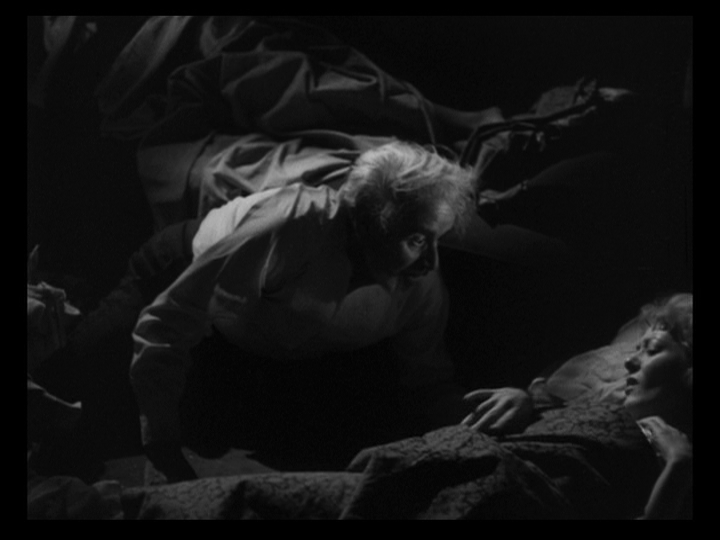
And threatening to resort to human sacrifice despite the total lack of evidence that it would accomplish anything. They break open a pipe in the wall to find water:
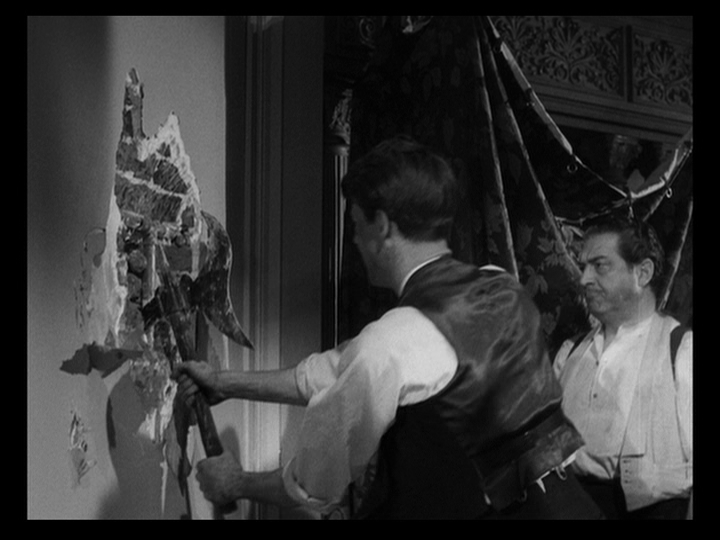
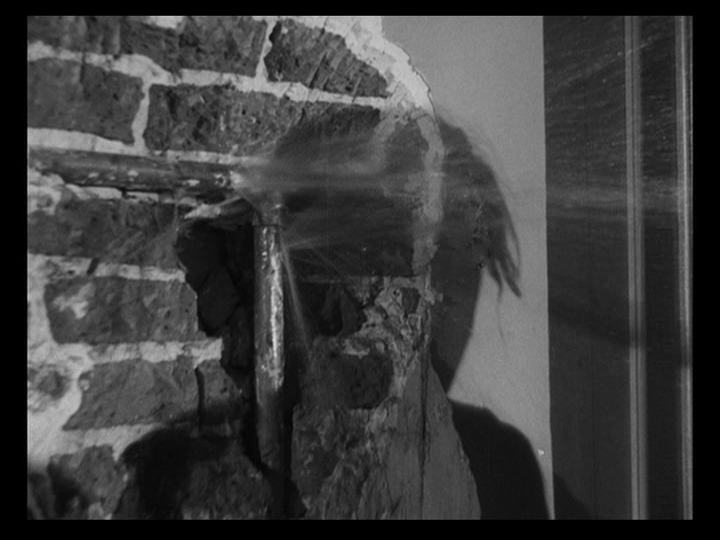
But are reduced to eating paper when the leftovers from dinner run out:
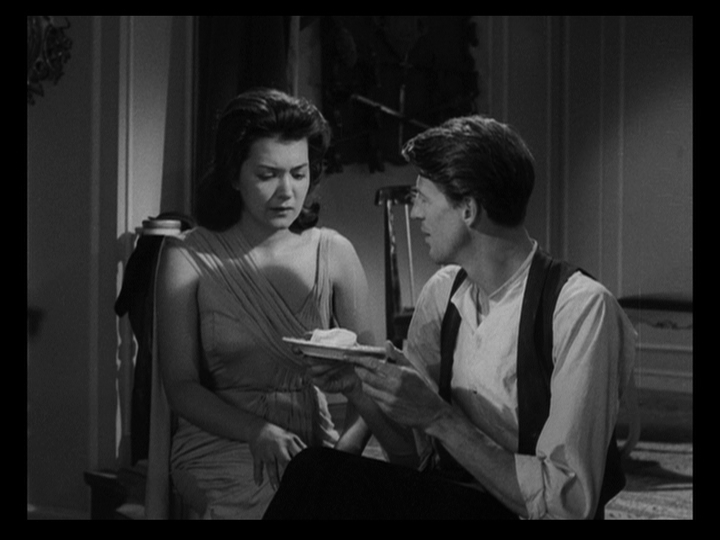
Until the bear from earlier miraculously chases the sheep which were to be part of the same entertainment into the drawing room:
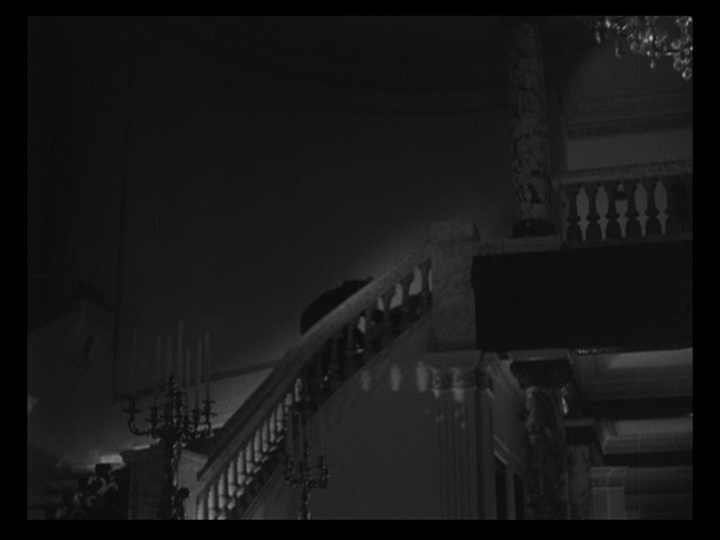
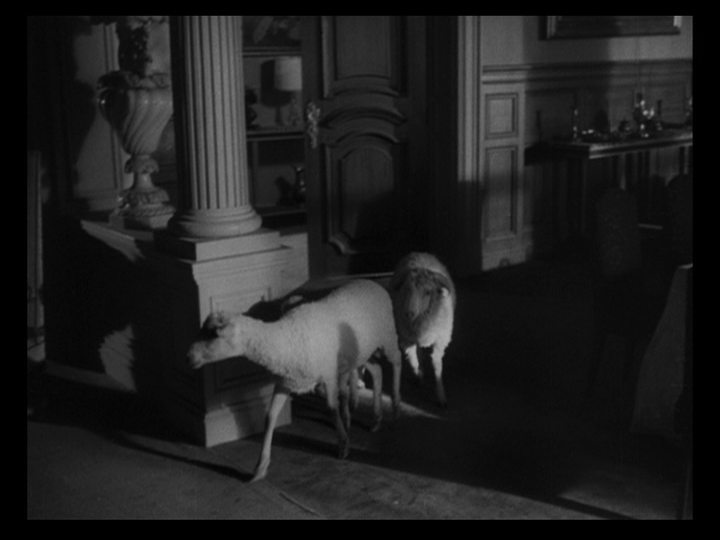
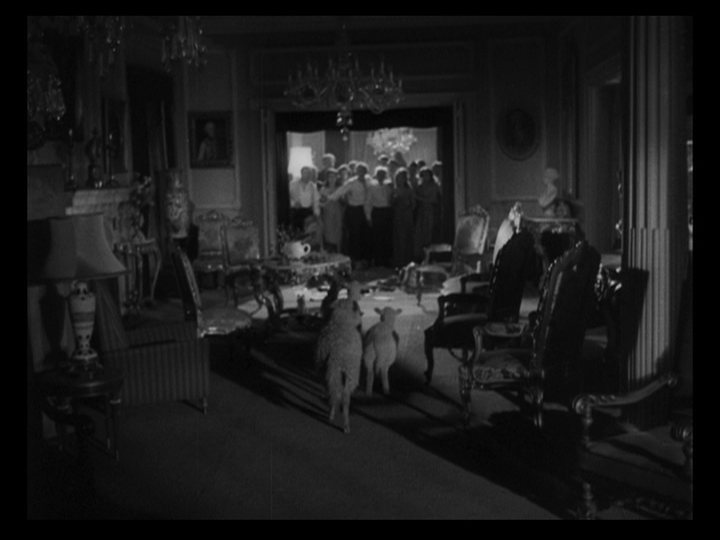
Where they are blindfolded:

Slaughtered, and cooked over a fire made with wood from a smashed cello:

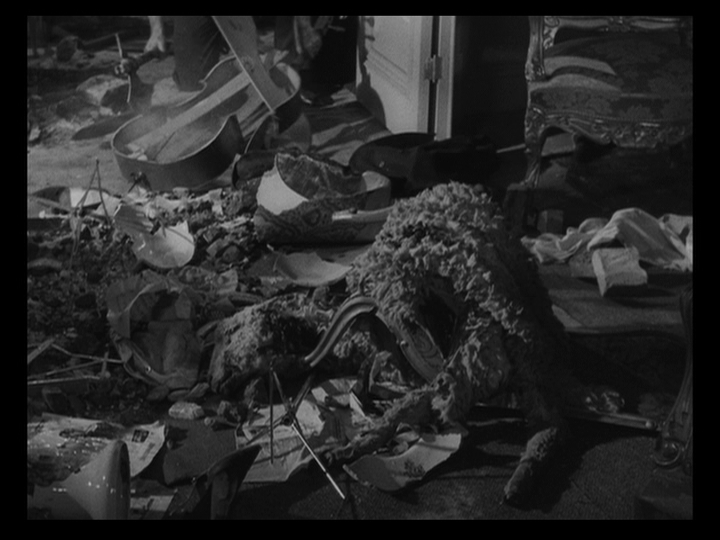
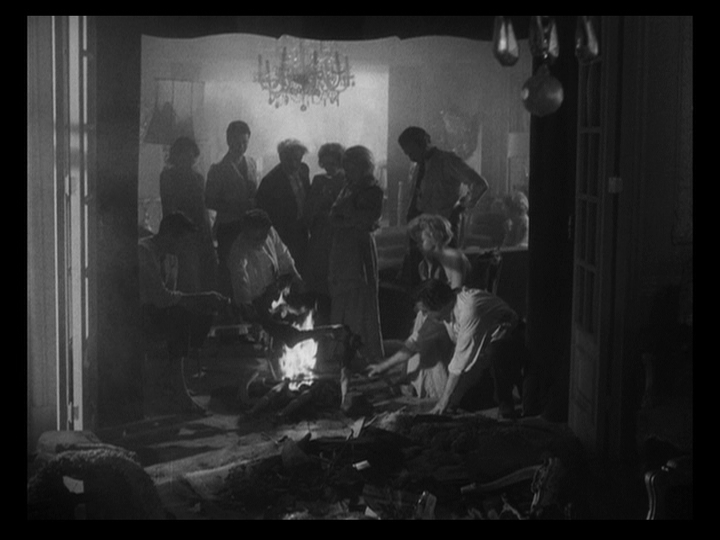
Bodies nonetheless begin to pile up after Russell expires of natural causes:
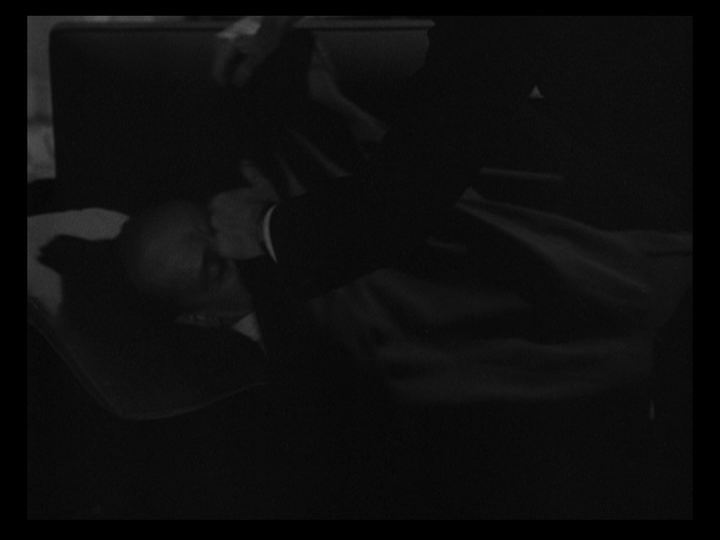
And two of the trapped guests who are having an affair choose a lovers’ suicide over attempting to go on. Haunted by nightmare images like this disembodied hand:

And let down by rituals such as these kabbalistic “keys”:
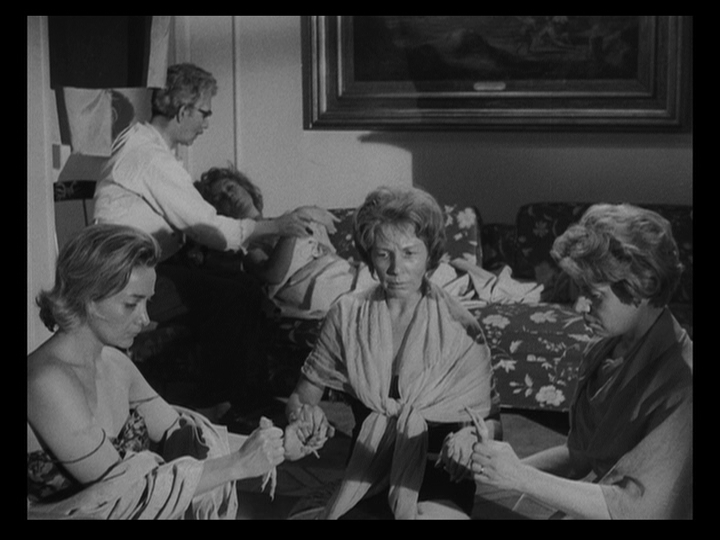
The Masonic cry for help:
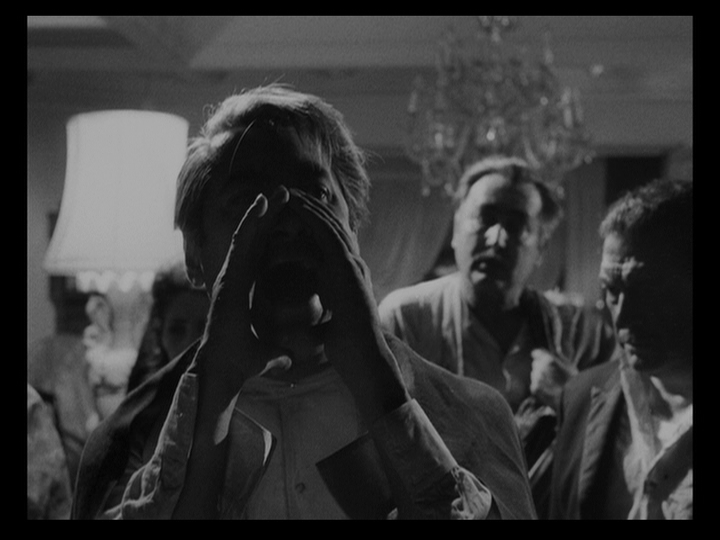
And “the unpronounceable word”:
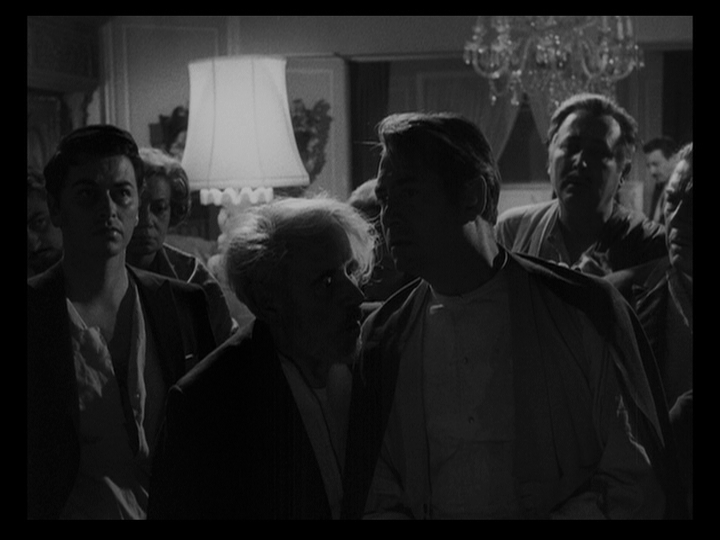
A contingent of the remaining guests indicate that they are determined to go through with their plan to kill Edmundo under the reasoning that “when the spider’s dead, the web unravels.” Dr. Carlos Conde (Augusto Benedico) opposes them saying, “but you’re crazy! It’s ridiculous, completely irrational.”
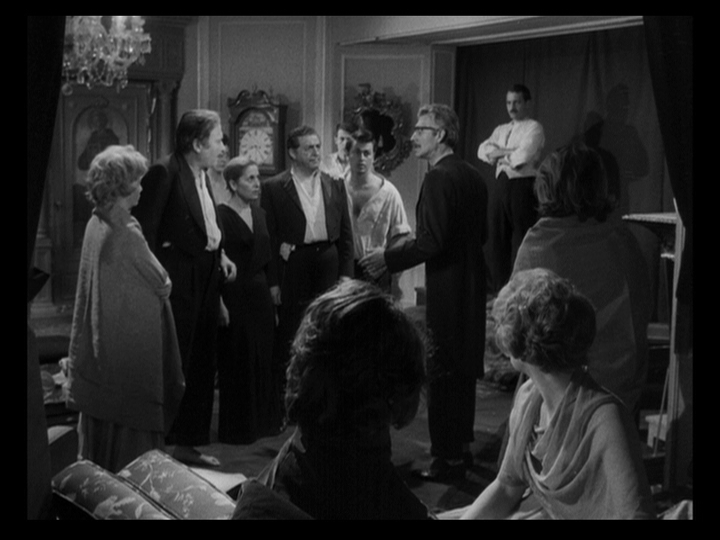
To which they reply, “we’re not interested in reason: we want to get out of here.” Suddenly, Edmundo appears standing next to Leticia and nobly tells them that “there’s no use fighting something so easily achieved”:
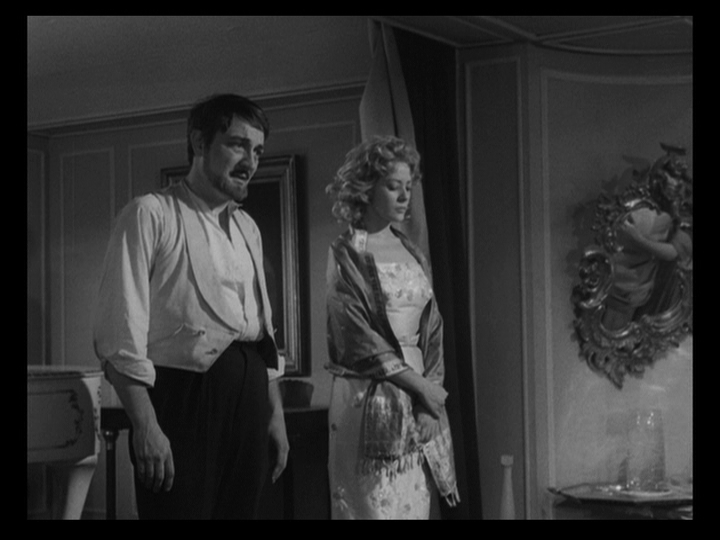
He retrieves a revolver from a cabinet but before he is able to turn it on himself Leticia cries out, “wait!” She announces that she has realized that “like pieces on a chessboard, moved thousands of times” they’ve somehow all returned to the very spots they were standing in the night they got trapped.

They fumblingly repeat the things they said then and follow her out the door, freed just as mysteriously as they were imprisoned:
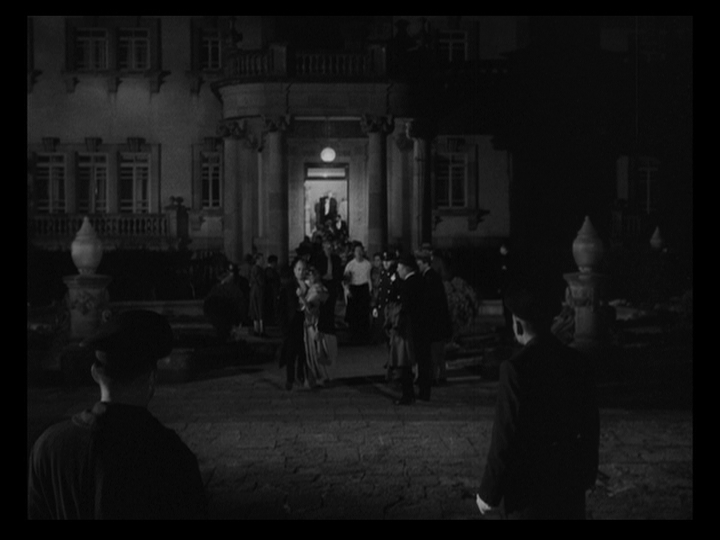
To Skrikanth Srinivasan, The Exterminating Angel is “the greatest of detective films, since its object is not the discovery of the culprit […] but the discovery of the nature of our human and social condition and its motivations.” He finds the answer in the movie’s two-part structure. The first, which concludes with the scene above, “tells us that man has no escape if he locks himself up in society’s rules, opposed to the imperative rules of nature, which can manifest themselves within society’s rules only in a barbaric and secret form in direct contradiction with the spirit of these social rules.” Where Pinal’s friend sees reality television here, scholar James Ramey finds “a cinematic articulation of what in recent years has been described as a posthumanist attitude towards the human” in his article “Buñuel’s social close-up: An entomological gaze on El ángel exterminador/The Exterminating Angel (1962),” noting that it’s “not unlike an ant colony transferred to a glass casement for entomological observation.”
Part two chronicles the tragedy of said colony’s liberation. As Gilles Deleuze observes in Cinema 1: The Movement-Image, “the [Exterminating] Angel’s guests want to commemorate, that is, to repeat the repetition that has saved them; but in this way they fall back into a repetition which ruins them.” And so we find them congregating together once more, this time for a Te Deum at their local cathedral:
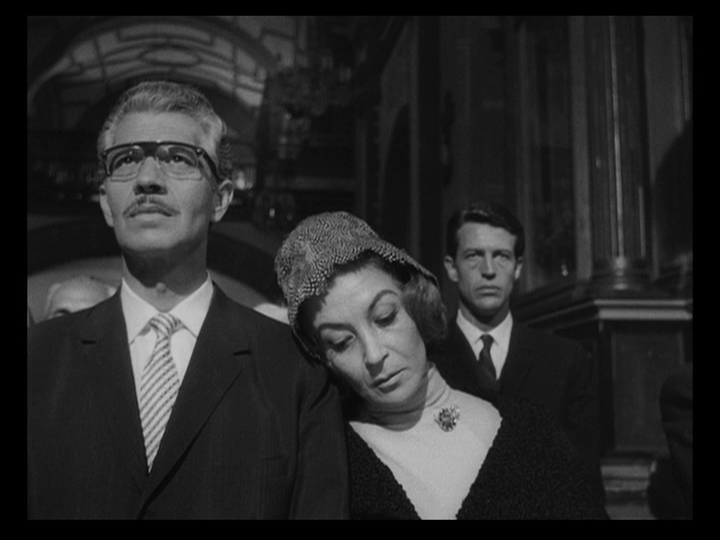
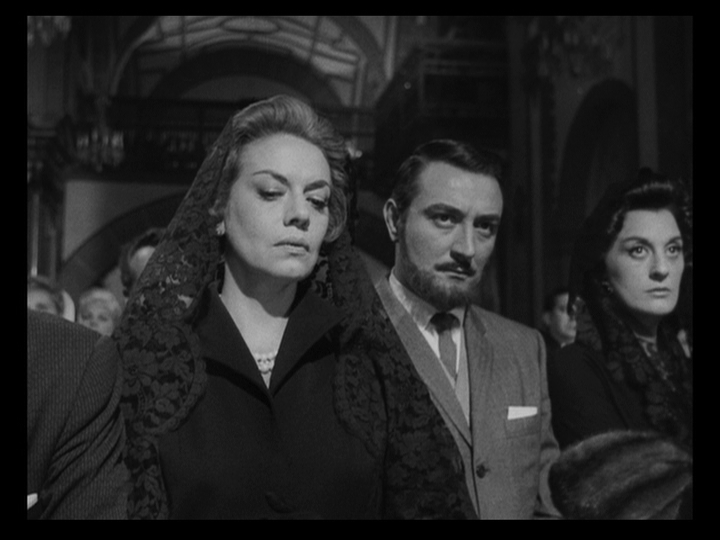
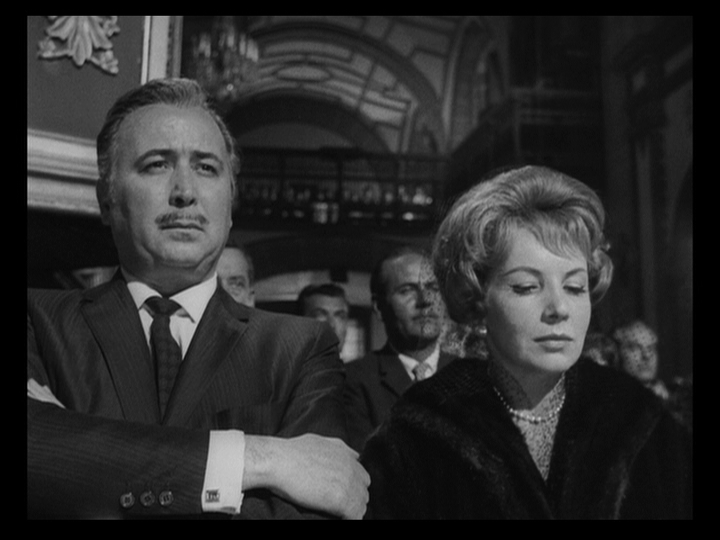
As the service ends, the priests stop at the door. “Why don’t we wait until after the faithful have left?” one of them says.

The film ends with a plague flag over the cathedral:

Violence on the adjacent town square:

And another group of sheep offering themselves up as food for the incarcerated:

Per Srinivasan, “the elliptical brutality of the last section and the speed with which we arrive at the renewal of the phenomenon of avolition gives us the impression that it’s going to return with ten or twenty times the force,” which echoes something Buñuel himself says in Objects of Desire and reminds me of the ending to The Happening: “the church will be worse because this time it’s not just twenty people, but two hundred. It’s like an epidemic that extends outwards to infinity.” For Srinivasan the cause of all this is clearly religion, but Wael Khairy found that it echoed something even more immediate in a piece for RogerEbert.com published on April 6, 2020:
Much like COVID-19, an invisible force prevents the visitors from stepping outside the confines of the house. The title suggests that this is the work of an exterminating angel. I would never liken an infectious disease to an angel, but one can’t help but dwell on the eerie similarities of how this invisible force is affecting society as a whole. Like “The Exterminating Angel,” this outbreak feels like a wake-up call. Mother Nature is stepping in and exposing fragility of society and how easily the facade we’ve built around us can collapse.
He concludes by wondering, “What will happen after this global nightmare comes to an end, and millions of families exit their homes? Will we emerge from our homes as changed people with a new awareness of the world, or will we fall back into the same trap?” Sadly, five years later, I think we all know what the answer to this question is. But, hey, when the end comes, at least now you have a new drink to toast it with, right?
Cheers!
All original photographs in this post are by Marion Penning, aka My Loving Wife. Links to all of the entries in this series can be found here.
 The Prodigal Cinephile