May, 2023 Drink & a Movie: Rio Bravo + Bacurau

Bacurau is one of my favorite movies from the past few years, so it was always a candidate for a “Drink & a Movie” post, but it became a mortal lock a couple of months ago when I was flipping through the PDT Cocktail Book. I could hardly have failed to notice the drink called a Rio Bravo before because that’s also the name of a Howard Hawks film I love. It never jumped out at me as something to make, though, because while I’ve been a fan of the Brazilian spirit cachaça since my friend Thiago introduced me to it in college, it isn’t something I typically stock. This time, however, I was struck by an amazing coincidence. Hawks is one of the chief influences on John Carpenter, who was such a big inspiration to the makers of Bacurau that they named a school after him:

Sign for John Carpenter Elementary School

And cachaça is, of course, the national spirit of Brazil, so I picked up a bottle of Novo Fogo Silver and started mixing. When the Rio Bravo unsurprisingly turned out to be delicious (everything in PDT is!) the only thing left to do was to get writing. The drink, which was created by Nidal Ramini in 2006 while he was working at the London bar Dusk, is made thusly:

2 ozs. Cachaça (Novo Fogo Silver)
3/4 ozs. Lime juice
1/2 oz. Orgeat
3 quarter-sized slices freshly peeled ginger

Muddle the ginger and orgeat in a mixing glass. Add remaining ingredients, shake with ice, and strain into a vessel like the one Lunga (Silvero Pereira) drinks out of in Bacurau. We call them “pizza glasses” since we usually have red wine in them when that’s what is on the menu.

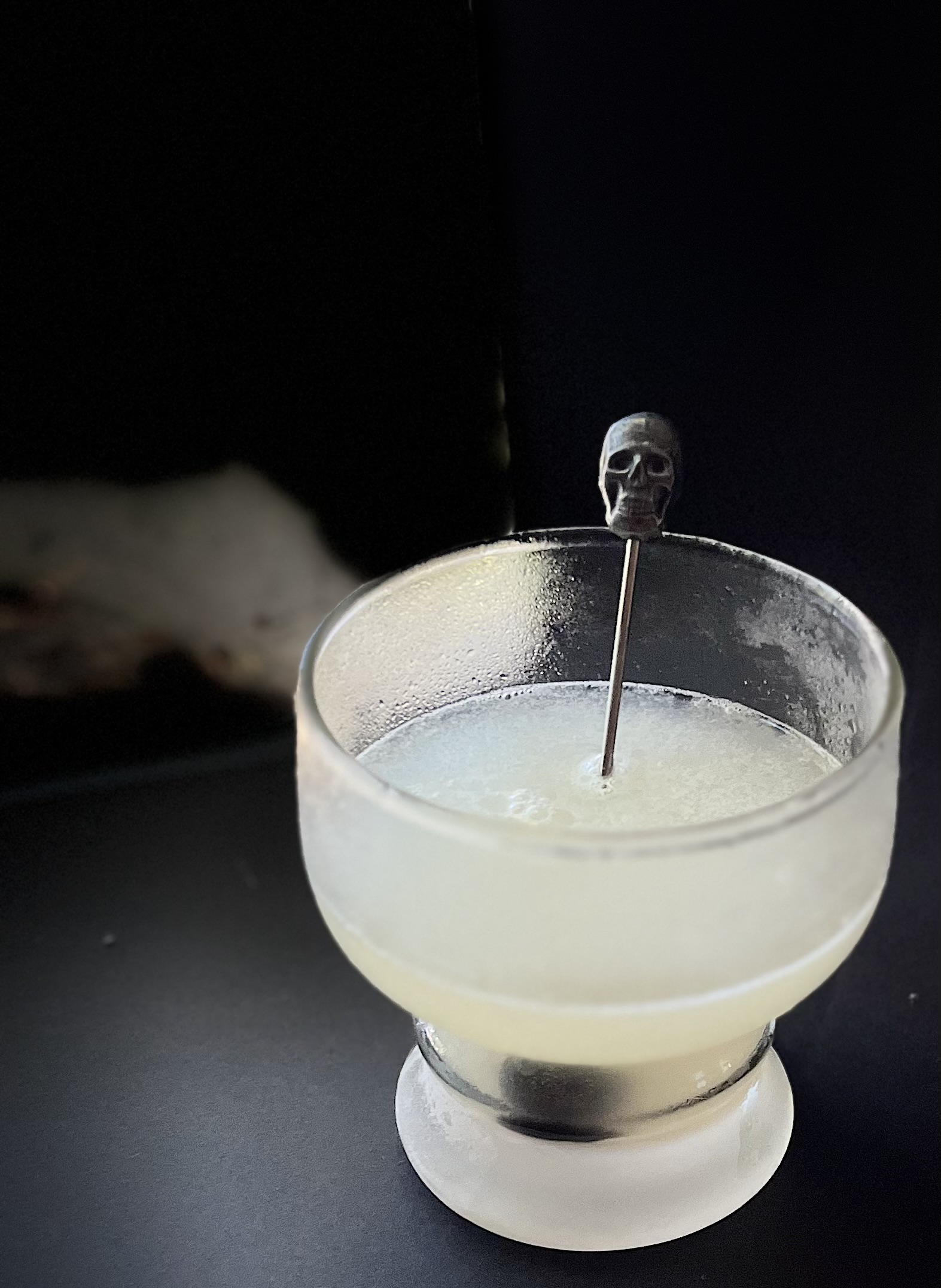
Rio Bravo in a "pizza glass"

In addition to serving his rendition in a chilled coupe, Ramini also employs an orange twist garnish, but we omitted both to better match this image:

Lunga drinking from a glass similar to the one we serve Rio Bravos (and red wine) in

The glassware is pretty close, yeah? The orgeat in the drink also evokes the cashew milk that Domingas (Sonia Braga) serves Michael (Udo Kier) later in the film:

Domingas offering a glass of cashew milk to Michael in a shot from his POV

Anyway, my favorite thing about the Rio Bravo is probably the ginger, which gives the drink a real kick. This is a great showcase for orgeat as well. We use a recipe from Smuggler’s Cove that contains both orange flower and rose water, which complement the floral notes in the cachaça. The orgeat contributes sweetness and a creamy texture to balance out the acid from the lime juice and vegetal qualities of the spirit as well. Overall, the Rio Bravo is a refreshing, invigorating concoction that is perfect for sipping outside on a spring or summer afternoon. Or inside while watching a movie! Speaking of which, here’s a picture of my Kino Lorber DVD release of Bacurau:

Bacurau DVD case

It can also be streamed via most major platforms for a rental fee, and some people may have access to it through Kanopy via a license paid for by their local academic or public library.

In addition to the school, John Carpenter is also directly referenced in Bacurau via the song “Night” from his excellent Lost Themes album which plays over a capoeira scene in advance of the film’s climactic showdown:

Capoeira dancers, who are accompanied by John Carpenter's song "Night"

His presence can be felt all throughout the movie, though, most interestingly to me in its setting “a few years from now.” Carpenter’s Escape from New York, which was made in 1981, begins with a title informing us that in 1988 “the crime rate in the United States rises four hundred percent.” That film’s action takes place about a decade later after the American government has responded by turning the island of Manhattan into a giant prison, but the plot of Bacurau seems to be unfolding *during* society’s dystopian transformation. There are a few overtly sci fi touches, such as its opening in space:

Satellite orbiting Earth over Brazil

The retinal scanner which corrupt mayor Tony Jr. (Thardelly Lima) offers as an alternative to going to the polls to vote for him in person:

Tony Jr. brandishes a retinal scanner

Or a UFO-shaped drone:

A UFO-shaped drone follows a man on a motorcycle

Mostly, though, this mood is created via small touches at the edge of the frame like this television news broadcast about public executions resuming in São Paulo:

A man with a gun stands in front of a television

Bacurau culminates in a bloody confrontation between the inhabitants of the eponymous village and a band of foreigners led by Michael who have apparently paid Tony Jr. for the right to hunt them down as part of some sort of twisted “The Most Dangerous Game” fantasy camp. In typical ugly American fashion, everything they see and hear only confirms their preconceived notions about the place they are visiting. Thus, they fail to correctly interpret things like this bullet-riddled police car as signs of Bacurau’s rebellious past until it’s too late:

Close up of a rusty police car

This leads to one of the movie’s most darkly humorous moments when Tony Jr. comes to collect them. He knows that they have literally wiped Bacurau off the map, as teacher Plinio (Wilson Rabelo) and his students discovered when they attempt to locate themselves using Google Maps:

Plinio and his students huddled over a tablet computer

I love the kid on the left who is staring directly at the camera! Anyway, Tony Jr. arrives in a luxury van complete with complementary bottles of spring water:

Close up of an empty van with bottles of spring water on each seat

But instead of thirsty “gringo tourists” eager to return home after a massacre, he encounters the wrath of a populace which is still very much alive led by Lunga and his no-longer-former comrade in arms Pacote (Thomas Aquino), who Manohla Dargis memorably describes as having “bedroom eyes”:

Medium shot of Lunga and Pacote confronting Tony Jr.

This does not end well for Tony Jr.:

Medium shot of a naked Tony Jr. being run out of town on a donkey

The most enjoyable part of Bacurau are the glimpses into the town’s unusual social dynamics and traditions, including funeral rituals like singing Cinema Novo director/composer Sérgio Ricardo’s haunting “Bichos Da Noite” during the procession:

Funeral procession in long shot

Or waiving white handkerchiefs in unison during the burial:

Funeral attendees waving white handkerchiefs

A museum celebrating the village’s defiant history which gets a new permanent exhibit to commemorate its most recent violent episode:

Bloody handprint on the wall of Bacurau's museum

And of course the psychotropic seed they all consume:

Extreme close up of Damiano administering a psychotropic seed to Teresa

As a librarian I applaud this film for making the shabby treatment of books synonymous with villainy:

Books being dumped out of a truck

And as someone who has a deep, decades-long relationship with The Searchers, I feel compelled to call out the startling three-shot sequence in which Joshua (Brian Townes) appears out of the darkness, which directors Kleber Mendonça Filho and Juliano Dornelles have confirmed is a deliberate reference to Scar abducting Debbie:

Medium shot of Joshua
Medium shot of Rivaldo
Another medium shot of Joshua, this time lit by the flash of his gun

Speaking of westerns, I very much hope this dog received hazard pay for being placed directly in the path of stampeding horses:

A dog tries to get out of the way of a stampede of horses

And whoever designed these outfits hopefully saw an enormous uptick in sales following the release of this movie:

Medium shot of two bikers from the south in garish outfits

Finally, I’m an absolute sucker for beautiful sunrises and sunsets, so I’d be remiss if I didn’t highlight two additional three-shot sequences, this one:

Shot of the sky
Shot of the sky
Shot of the sky

And this one:

Shot of the sky
Shot of the sky
Shot of the sky

Above I talk about some of the affinities that I think a Rio Bravo has with Bacurau. One thing I did not mention is that homemade orgeat doesn’t like to STAY mixed with things. You probably won’t have problems with it separating unless you, too, are trying to get a perfect photograph of whatever you put it in. But this definitely is a cocktail to drink, in the immortal words of Harry Craddock, “quickly, while it’s laughing at you!” In this it is quite *unlike* Bacurau, which only gets better the longer you spend with it.

Cheers!

All original photographs in this post are by Marion Penning, aka My Loving Wife. Other entries in this series can be found here.
Dispatch from the 2023 Finger Lakes Environmental Film Festival

The first two Finger Lakes Environmental Film Festivals that took place during my time as a resident of Ithaca, New York were online-only affairs thanks to the COVID-19 pandemic. Last year’s festival did feature in-person events, but all films were still screened virtually. Although FLEFF provided me with a number of great movie memories prior to this year, including my favorite film of 2021 in Ahed’s Knee, I definitely didn’t feel like I ever got anywhere near the full festival experience and was therefore excited to dive into this year’s program!

As Girish Shambu noted in his blog post about attending FLEFF in 2019, event organizers define the word “environmental” so broadly that “the purview of the festival turns out to be all-encompassing.” The two films I was most eager to see, recent documentaries by Ukrainian director Sergei Loznitsa, are good examples of this. Neither Babi Yar. Context nor The Natural History of Destruction (despite its name) takes nature (which I would normally assume to be the focus of an event like this) as its subject, but the way they each combine restored footage found in archives across Europe with original audio and portray the same events from different vantage points perfectly embodies the festival’s theme of “polyphonies,” which as the FLEFF website explains “offer an embrace of the many, the multiple, and the diverse into a more energized whole, rejecting the singular, the mono, and the linear.”

Babi Yar. Context is about a ravine in the vicinity of Kiev where tens of thousands of Jewish and other inhabitants of the city were massacred during World War II, but wasn’t commemorated in any way until decades later. The Natural History of Destruction is essentially a history of the war narrowly focused on bombing and missile attacks on non-military targets. Both are harrowing depictions of humanity at its absolute worst which use their too-perfect soundtracks to shift our attention from the fact that they are historical, i.e. about events that actually happened, to the idea that people are responsible for these things and might do them again. This was further underscored by festival Patricia Zimmerman’s introduction for Babi Yar, during which she noted that Loznitsa originally intended to come to Ithaca in person, then planned to answer audience questions via Zoom, but couldn’t ultimately do either because he’s in the field making a new film about the war currently raging in Ukraine.

A munitions factory sequence in The Natural History of Destruction is reminiscent of my favorite movie from this year’s festival, Matter Out of Place, which travels around the world to show how the inhabitants of a variety of far-flung locales solve their common problem of what to do with their trash. The film’s title is borrowed from a euphemism used by the volunteers who clean up after the Burning Man festival in Nevada, and just as director Nikolaus Geyrhalter’s Our Daily Bread forever changed the way I look at the food I eat, I suspect this film has permanently altered the way I think about the concept of “waste.” Some particularly unforgettable moments include the opening, which cuts from a pristine mountain lake to a close up of a beach covered in plastic, and a dump in Kathmandu where garbage trucks can only navigate the narrow, muddy path that leads to it with the aid of bulldozers to push them along when they get stuck.

Less obviously connected to the festival’s themes, but in keeping with one of its longstanding traditions, were the silent films I saw, both of which are celebrating their hundredth birthdays this year. Introductory speaker Michael Richardson encouraged us to ponder about what lessons the German Expressionist Warning Shadows, which was accompanied by local ensemble Cloud Chamber Orchestra, might offer for the present day. With a timeless extended shadow puppet dream sequence and a plot that could easily be described in terms of “toxic masculinity,” this wasn’t hard to do. The Harold Lloyd vehicle Safety Last!, which screened on an absolutely gorgeous spring day and was accompanied by “deep groove zydeco” band Li’l Anne and Hot Cayenne, is a trickier case. Looking back on it with Richardson’s challenge in mind, I believe that it does perhaps train the viewer’s eye to look differently at the built landscape? There is, of course, Lloyd’s famously effects-free scaling of the Bolton Building, but also a POV shot from an ambulance and enough ingenious techniques for avoiding detection by bosses, landlords, and police officers to make a how-to manual.

My final FLEFF film was No Bears, which somewhat embarrassingly is the first one I’ve ever seen by director Jafar Panahi, although I did catch his son Panah’s latest Hit the Road at Cinemapolis (where all the screenings mentioned in this blog post took place, by the way) last year. Like that movie, No Bears is set near the border between Iran and Turkey. In fact, the character played by Panahi inadvertently crosses it at one point despite the fact that, like his real-life doppelgänger (although thankfully not any more, apparently), he has been forbidden by the Iranian government to travel abroad. I loved the film’s strangely (at first) artificial opening shot, which doubles as the beginning of a docudrama that the fictional Panahi is making. The latter takes a tragic turn late in No Bears just as things also fall apart in the small village that the director is staying in to be closer to his film shoot as the result of a controversy over a picture he may or may not have taken of two star-crossed lovers. Much of the discussion during “Talk Back” session which followed the film focused on its humorous and political aspects and how they play against and with each other, but I think I’ll remember this primarily as a master class by one who would know on the many ways in which making movies about “real issues,” which sounds so noble, can be horrifyingly costly for the people both in front of and behind the camera.

My biggest regret about this year’s FLEFF was that my schedule got in the way of all the free screenings I was targeting, which also means I didn’t catch anything with an Ithaca connection. Looking ahead to the future, I’d also like to try to attend at least one or two roundtable discussions or other events not tethered to a screening. But that’s the nice thing about a local film festival, isn’t it? You always do have next year!

April, 2023 Drink & a Movie: El Oso + Grizzly Man

The night I moved in with My Loving Wife (then girlfriend) Marion in Baltimore in 2011 we went out to dinner at a place down the street called B&O American Brasserie. I don’t remember what anyone ate, but I’ll never forget my first sip of a concoction called a B&O Manhattan, an original creation by bartender Brendan Dorr (now co-owner of Dutch Courage, which I hear raves about and am determined to visit the next time I’m in town) that contained maple syrup and port in place of the traditional sweet vermouth, or the clever dehydrated orange wheel garnishes. I knew immediately that I had probably lucked upon the city’s best cocktails and I never went anywhere in the subsequent eight years I lived there that came close to changing my mind.

I can’t swear that Dorr’s El Oso was on the menu that evening, but I’m certain I had it there more than once. I found myself thinking about this drink the other day and was pleased to discover that it appears in Gregory and Nicole Priebe’s book Forgotten Maryland Cocktails: A History of Drinking in the Free State, so I bought a copy and whipped a couple up. The Priebes note that El Oso was created for the 2010 U.S. National Bärenjäger competition and that the judges who awarded it first prize called it “perfectly balanced” and “an instant classic.” We very much concur! Here’s how you make it:

1 3/4 ozs. Añejo tequila (Espolón)
3/4 ozs. Bärenjäger
1/3 ozs. Maraschino liqueur
2 dashes Jerry Thomas’ Own Decanter bitters
Dehydrated orange wheel (we used this recipe by Martha Stewart)

Stir all ingredients with ice and strain into a rocks glass which contains the orange wheel and one big ice cube.

El Oso cocktail from an overhead angle

Maraschino is to me the flavor of sophistication, but only if you don’t overdo it. Here, as in a Martinez made with barreled gin (my favorite is Ransom Old Tom), the warm and lively base spirit and distinctive bitters keep it in its place. The drink has a great texture as well.

El Oso is Spanish for “bear,” and between that name and the fact that Bärenjäger hails from Germany, it felt obvious what movie I should pair with this drink. Here, then, is a picture of my Lions Gate Home Entertainment DVD release of Werner Herzog’s Grizzly Man:

Grizzly Man DVD case

It can also be streamed via most major platforms for a rental fee.

Grizzly Man‘s most famous scene is without doubt the one in which Herzog listens to audio tape of the film’s subject Timothy Treadwell and his girlfriend Amie Huguenard being mauled to death by the bears they visited Alaska each summer to study and protect:

MS of Werner Herzog listening to something with headphones while a woman holding a video camera looks on

The person holding the camera in this screengrab is Jewel Palovak, Treadwell’s friend and collaborator and an executive producer of Grizzly Man. “Jewel, you must never listen to this,” Herzog says as he puts down his headphones. “I’m never going to,” she replies. It’s tempting to read this scene, which is positioned halfway through the film, and this extreme close-up of a bear which appears near the end as comprising a thesis statement of sorts.

Extreme close-up of a bear's eyes

“What haunts me is in that in all the faces of all the bears that Treadwell ever filmed I discover no kinship, no understanding, no mercy,” Herzog says in voiceover during the latter. “I see only the overwhelming indifference of nature.” These moments seem to hearken back to beginning of the movie and suggest that the “story of astonishing beauty and depth” that Herzog found in the 100+ hours of footage that Treadwell shot during his last five summers in Alaska before his death is, to paraphrase Herzog’s “Minnesota Declaration,” a mysterious and elusive one that cannot simply be shown straight-on, but only fully apprehended via imagination.

Upon revisiting Grizzly Man, though, I found myself thinking that Herzog is perfectly serious when he suggests the part of his mission is to defend Treadwell “not as an ecologist, but as a filmmaker.” A comment that his footage contains “such glorious improvised moments the likes of which the studio directors with their union crews can never dream of” is accompanied by this delightfully abstract shot of the inside of a tent while a fox climbs on top of it:

Shot of a blue tent with a black splotch that a hand is reaching toward

Herzog includes others criticizing Treadwell in Grizzly Man on the grounds that “he was acting like he was working with people wearing bear costumes” and didn’t sufficiently respect nature, but also demonstrates that however rightfully or wrongfully distraught Treadwell was by the violent acts that occurred around him, he didn’t shy away from filming things like the skull of a cub that starved to death which had been picked clean by its fellow bears in a matter of days:

Medium shot of a bear skull

Or the severed limb of one killed by a male that wanted its mother to stop lactating so that he could “fornicate” (Herzog’s word) with her:

Treadwell clearly intended to eventually assemble his videos into a cohesive work. Herzog calls him “methodical” as a filmmaker and reports that he often repeated takes up to fifteen times. Some of this footage presumably wasn’t meant to be included in this project, such as a lengthy tirade against the National Park Service:

Medium shot of an angry Timothy Treadwell giving the finger to his camera

Treadwell may have filmed the dead bears just for himself as well, but he was always going to have to work with a professional editor and it’s not at all hard to picture this material finding its way into whatever they created together. In fact, Jewel Palovak’s comment in Eric Kohn’s 2020 oral history of Grizzly Man that “Timmy would’ve really liked the movie” invites one to imagine a world in which the person Treadwell collaborated with somehow turned out to be Werner Herzog, who presumably would have insisted on it. And maybe scenes like the one in which Treadwell turns his ire on the gods (“Let’s have some water, Jesus boy! Let’s have some water, Christ man or Allah or Hindu floaty thing. Let’s have some fucking water for these animals!”) as well:

Medium shot of Treadwell looking deranged and yelling

Meanwhile, the bear fight that Treadwell captures is every bit as astonishing and dramatic as anything you will ever see in any nature documentary ever:

Two bears fighting
Two bears fighting
Two bears fighting

I always thought of Grizzly Man as a great film that Werner Herzog made out of Timothy Treadwell’s footage, but now it seems to me more of a sincere attempt by the former to finish the latter’s work. Of Herzog’s original content, my favorite is probably this interview with Willy Fulton, the pilot who dropped Treadwell off at Katmai National Park at the beginning of each summer and picked him up again in the fall. What appear to be flashes of light in this screengrab are actually flies:

Willy Fulton addressing the camera

The air is thick with them and as they flit about the camera they make little pinging noises. Maybe more than anything else in the film, this constant sound and motion illustrates just how uncomfortable the life Timothy Treadwell chose was.

Also deserving of mention is the music improvised by an ensemble led by Richard Thompson and the excellent DVD extra In the Edges: The “Grizzly Man” Session which documents its creation. By drawing my attention more explicitly to touches like the ominous cello tones present during this scene it increased my appreciation for how music shapes our perception of Treadwell’s footage and elevates it:

Treadwell in the water with a swimming bear

I would be remiss if I didn’t note that Timothy Treadwell is wearing a Cornell t-shirt in a photograph from his youth:

Photograph of a young Timothy Treadwell wearing a Cornell t-shirt

Finally, Grizzly Man contains some terrific landscapes including these aerial shots of the areas where Treadwell camped at the beginning and end of each summer respectively which are effective at establishing a sense of space. Here’s the plain he called the Sanctuary:

Aerial shot of the Sanctuary

And here’s the “densely-overgrown” Grizzly Maze:

Aerial shot of the Grizzly Maze

But even better is this nearby glacier “in turmoil” which Herzog calls a metaphor for Treadwell’s soul:

Aerial shot of a "landscape in turmoil"

Which kind of reminds me of the album cover for Joy Division’s Unknown Pleasures? Normally I’d conclude this post by circling back to the drink and talking a bit more about why I think it pairs well with the movie I chose, but this month it really isn’t any more complicated than just “bears.” I’ll therefore instead leave you with this image of coroner Franc G. Fallico:

Franc G. Fallico addressing the camera

Cheers!

All original photographs in this post are by Marion Penning, aka My Loving Wife. Other entries in this series can be found here.
March, 2023 Drink & a Movie: Hurricane + The Wind Will Carry Us

I started my Drink & a Movie series last January as motivation to write more. I quickly discovered another reason to keep it going, which was as a convenient excuse to spend time with films I love but haven’t seen recently. I’m happy to report that thus far not a single one has disappointed! In fact, I’ve been discovering all sorts of new things to admire about them. Case in point is this month’s selection, Abbas Kiarostami’s The Wind Will Carry Us. I remembered it for Behzad Dorani’s madcap (Kent Jones described him as “looking as if he had been drawn by Chuck Jones” in a 2000 Film Comment review) dashes through the streets and alleyways of the Kurdish village of Siah Dareh:

Behzad sprinting full speed across open ground
Behzad ducking down an alleyway
Behad running up a hill

These scenes are some of the cinema’s finest dramatizations of how technology is simultaneously liberating (Behzad never would have traveled to such a remote place if he wasn’t able to remain in contact with his home base of Tehran) and binding (but every time his phone rings he needs to drop what he’s doing, run to his car, and drive to a place where he has better reception), but they’re far from the only reason to watch this film. First things first: the drink I’m pairing it with is the Hurricane, which has a surprisingly murky provenance. It is popularly believed to have been invented at the New Orleans stalwart Pat O’Brien’s in the 1940s in order to put their excess quantities of rum to good use and named after the lamp-shaped glass it was served in. Others trace its origin to the 1939 World’s Fair in Queens, New York where there was an establishment called the Hurricane Bar. The problem with both of these theories is that a drink called a Hurricane was apparently served in a 1939 movie I haven’t seen called Naughty but Nice which per IMDb was in production from October-December, 1938. Whatever it’s origins, one thing is for certain: the Hurricane is a delicious cocktail! The ingredients and proportions below are taken from Beachbum Berry’s Grog Log by Jeff Berry and Annene Kay, but can be found reprinted in all sorts of other books including Smuggler’s Cove, whose passion fruit syrup recipe (equal parts passion fruit puree and 2:1 simple syrup) is just about perfect in my opinion. Here’s how we make this drink:

2 oz. Dark rum (Gosling’s Black Seal)
1 oz. Lemon juice
1 oz. Passion fruit syrup

Fill a 10 ounce hurricane glass with crushed (use of a “Schmallet” is highly recommended!) ice, add all ingredients, and gently stir a few times to combine. Garnish with a lemon slice.

Hurricane cocktail and lemon with dramatic lighting

Most Hurricane recipes call for at least four ounces of spirits (according to Wikipedia the one in Naughty but Nice uses a whopping six!), but that’s a bit much for a single serving under normal circumstances, yeah? You’ll also find recipes for it which include additional ingredients like fassionola and Galliano, but for me it’s all about the brilliantly simple combination of passion fruit (a personal favorite), a bit more tartness from lemon juice, and the molasses and vanilla notes of a good dark rum. Our go-to in this category is Gosling’s Black Seal, which we keep on hand for Dark and Stormys.

The screengrabs in this blog post come from my trusty 2002 New Yorker Video release of The Wind Will Carry Us:

The Wind Will Carry Us New Yorker Films DVD case

Gary Tooze and Jordan Cronk both say the version you want is the 2014 Cohen Media Group Blu-ray, though. Sadly, both are out of print, but the film can be streamed via Amazon Prime for a rental fee.

The Wind Will Carry us opens with an extreme long shot of a car traversing a winding road as the inhabitants argue over directions.

Shot of the aforementioned car and road

This may not resonate with anyone else, but revelation number one for me was that this sequence ties The Wind Will Carry Us to another one of my all-time favorite movies, Groundhog Day. Here’s how Ryan Gilbey describes the beginning of that film in his BFI Modern Classics monograph on it:

The first thing we see is a completely blue screen. Phil’s opening line gives a hint of what lies in store for him. ‘Somebody asked me today: “Phil, if you could be anywhere in the world, where would you like to be?” And I said to them, “Probably right here.”‘

On ‘here’, his hand moves into view. He is gesturing at the middle of the vast blue void. The place where he would most like to be is in that void: the middle of nowhere, off the map.

Now consider the opening dialogue from The Wind Will Carry Us:

BEHZAD: Where’s the tunnel then?
CREW MEMBER: We’ve passed it.
BEHZAD: When?
CREW MEMBER: Someone’s been sleeping!
BEHZAD: Where is it?
CREW MEMBER: We’ve passed it, back near Biston.
BEHZAD: We’re heading nowhere.

The two films are similar in the way they depict the repetitious events that comprise the core of their respective narratives. Just as we only need to see Phil Connor’s morning routine once in its entirety to understand the subsequent reappearance of bits and pieces of it to mean that he’s living the same day over and over again, so too is Kiarostami able to rely just on shots this increasingly well-traveled road to depict Behzad’s second through fifth phone calls:

Behzad's car on the increasingly familiar road to the cemetery where he talks on the phone

Both films also advance their plots at crucial moments via characters quoting poetry, and even their endings have the same bittersweet flavor. Despite everything they’ve learned, Phil’s final line is “we’ll rent to start” and Behzad snaps a few photos of the mourning ritual he came to Siah Dareh to film on his way out of town:

Medium close-up of Behzad taking a picture

More relevant to this month’s pairing is the cellar scene which takes place just over halfway through the film. Behzad goes looking for the home of the woman he has spied bringing milk to the ditchdigger named Yossef he has befriended from afar, ostensibly because he wants some for himself and his crew, but more likely in the hope of seeing her close up. Upon arriving at the correct house, he is directed by an offscreen voice to go down to the cellar.

Behzad at the entrance to a cellar

“Why is it so dark here?” he asks. “There’s a hurricane lamp (Ed: !), it’s not dark,” the voice answers. “Is there someone down there?” Behzad asks. “Yes, Miss Zeynab,” is the reply. “Zeynab, come here, this gentleman needs milk,” the voice continues. Despite what the voice (which we will soon learn belongs to Zeynab’s mother) says, it is dark in the cellar: in fact, the screen goes completely black for about fifteen seconds after Behzad enters it. But then we hear a cow low and the same woman Behzad glimpsed earlier appears holding a lamp:

Zeynab in a dark cellar holding a lamp

“Can you milk the cow for me?” Behzad asks. Then: “It’s so dark. How can you milk in here?” Zeynab replies, “I’m used to it. I work here.” He asks her age (16), whether or not she has been to school, and if she knows the poet Forugh Farrokhzad. Then, as Zeynab milks the cow, he flirtatiously recites one of Forugh’s poems, stopping occasionally to offer unsolicited interpretations of its meaning.

Zeynab milking a cow by lamplight

The poem concludes with the line, “the wind will carry us!” Behzad tells Zeynab that he is Yossef’s boss and attempts to command her to raise the lamp so that he can see her face. She freezes. After a few seconds pass, Behzad says, “at least light the ground so I don’t trip.” She rises and they exit the cellar together. As they walk, she asks how long Forugh studied. “You know, writing poetry has nothing to do with diplomas,” Behzad tells her. “If you have talent, you can do it too.” When they reach the door he asks how much he owes her. “Pay my mother,” she says, but as he walks away after completing the transaction she calls to her mother, “why did you take the money? Go and give it back to him.” She briefly peeks around the corner to make sure he turns to come back:

Zeynab peeking around the corner as her mother calls Behzad back to return his money

Scholar Hamid Dabashi famously called this scene “one of the most violent rape scenes in all cinema” in his 2001 book Close Up: Iranian Cinema, Past, Present and Future but this is difficult for me to square with the fact that it’s tonally very similar to a later one in which a frustrated Behzad kicks over a tortoise:

Close-up of Behzad's foot kicking a tortoise
Continuation of Behzad kicking a tortoise in long shot

That scene ends with the tortoise righting itself with little effort as Behzad drives away, and in a 2009 Journal of Film and Video article scholar Chris Lippard argues about the cellar scene that “[i]f there is much of the feel of a seduction here, there is also, to extend the metaphor, a firm and decisive no.” To me Behzad’s admittedly aggressive behavior is reminiscent of the petulant outbursts of a bored child. Because he does not appear to cause any lasting damage, it seems fair to say no harm, no foul.

Zeynab’s job as a basement milkmaid is just plain bizarre, but in other moments The Wind Will Carry Us definitely seems to have something to say about gender roles in Iran at the turn of the millennium. A spirited argument breaks out in a café when the proprietor Tajdolat observes that “[a]ll women serve. They have three trades: by day, they’re workers. In the evening, they serve and at night they work.”

Medium shot of Tajdolat

To which her husband offers the rejoinder, “don’t men have a third job, too?” Later, Behzad’s hostess resumes her waiting on him and his crew one day after giving birth to her tenth child:

Long shot of Behzad's hostess hanging up laundry

It also absolutely must be noted that the village of Siah Dareh is a character in its own right and looks fabulous in shots such as this night/morning dissolve:

Establishing shot of Siah Dareh at night
Establishing shot of Siah Dareh the following morning

Finally, another reason to pair this film with a Hurricane is because the color of the drink closely matches the amber hues of the barley fields that Behzad rides through on the back of the motorcycle of the doctor who attends to Yossef when the hole he is digging caves in:

Behzad and the doctor riding a motorcycle through fields of barley in extreme long shot

The Wind Will Carry Us ends with Behzad washing the windshield of his car, then throwing a femur bone from a nearby ancient cemetery that he has been carrying around on his dashboard since the beginning of the film into a creek:

Behzad washing his windshield
Behzad throwing a femur bone into a creek

The final images follow the bone as it floats downstream accompanied by the film’s first non-diegetic music:

Close-up of the femur bone floating downstream

I mentioned a number of similarities between The Wind Will Carry Us and Groundhog Day above, but left out the most obvious one. Behzad and Phil Connor both work in television, travel from the city to the sticks, get stuck there much longer than they intended to, and leave transformed. How exactly and to what extent they are different is largely left to viewers to decide for themselves, which is one of my favorite things about both movies. The universe holds Behzad and Phil in place until they start to truly see what’s all around them. We can learn from their example to do so of our own accord and reap the same rewards. No one trip or cocktail is likely to change your life, but each has the potential to make it better as long as you’re paying attention. So, in the doubly apropos words of Omar Khayyam as quoted in The Wind Will Carry Us:

They tell me she is as as beautiful as a houri from heaven!
Yet I say that the juice of the vine is better.
Prefer the present to these fine promises.
Even a drum sounds melodious from afar.

Cheers!

All original photographs in this post are by Marion Penning, aka My Loving Wife. Other entries in this series can be found here.
Reflections on Movie Year 2022

“Movie Year” is a concept I came up with about 15 years ago when I was living in Pittsburgh, Pennsylvania. The idea was that even as a person who saw multiple films in theaters each week, I still couldn’t catch all of the year’s most important movies by December 31 because a significant number wouldn’t be released locally until weeks or even months later. This is even more true now that I live in an even smaller city, as demonstrated by the fact that seven Academy Award nominees and a number of other critical favorites have opened in Ithaca, New York since January 1. The Oscars are, in fact, a driver of what makes it to places like here and for good reason–the screening of The Quiet Girl that I attended yesterday was one of the biggest crowds I’ve been part of in awhile, presumably because anyone planning to watch the awards ceremony wants to see as many nominated films as they can before it starts.

Given all this, I think Oscar night makes much more sense than New Year’s Day as a time for someone like me to publish a Top Ten list. Which, for the record, I still find such lists to be useful, especially in aggregate! I peruse IndieWire’s annual critics poll for titles I missed or never got a chance to see to keep an eye out for because they’re likely to be referenced in articles and reviews I read in the future. There is absolutely no reason why someone needs to be a professional critic to publish such a list, but it is important for amateurs to provide context. To say “these are the ten best movies of the year” is to imply that one has seen every film that deserves to be considered for such an honor. A professional critic can fairly be assumed either to have viewed or to have made an informed decision not to view every movie that has opened in the geographic area that the publication they write for covers. Similarly, someone with a “beat” like documentary or science fiction film can fairly be assumed to have seen everything in their area of specialization. When it isn’t obvious what a film’s inclusion or absence on a list means, that list becomes hard to rely on.

My tweets from the past year indicate that I have currently seen approximately 75 movies that opened in the United States in 2022. That’s not a huge number, but it might be interesting to explore why I chose these films and not others, and this could well yield a definition of “best” that would result in a credible list. But to do it right, I’d likely want to watch many of these movies again because I don’t like to rely on my memory when making qualitative judgements. Which, this is actually crucial to my personal relationship with cinema–I don’t necessarily remember films clearly! Not in their entirety, anyway. Specific lines of dialogue, camera movements, and shot compositions stay with me, as do impressions of color, mood, and sound. This is why I like close reading: it’s a way of pinning down things which would otherwise remain elusive. It’s also why I doubt I could hack it as a daily or weekly reviewer. I watch everything I review for Educational Media Reviews Online or write about on this blog at least twice, which obviously takes time. I regard the concepts of “receiving” and “evaluating” works of art that C.S. Lewis describes in An Experiment in Criticism as the origin of my method, such as it is: I try to open myself up to the film as much as possible during the first viewing, then open up my notebook for the second one. Make no mistake about it, though: without those notes, I wouldn’t be able to say very much at all with confidence!

Anyway, like I said I could put a lot of work into developing a framework which enables me to deliver a verdict on Movie Year 2022. But it would be far easier and much more fun to simply look back on what I watched to see what still stands out in my mind, so I’m going to do that instead. Without further ado, here are my most memorable films of the year:

  • Crimes of the Future: My favorite movie of the year by a country mile. Absolutely chock full of unforgettable ideas and images, including the first and last scenes, a post-infection and pain world, first Nadia Litz and Tanaya Beatty and then Viggo Mortensen and Léa Seydoux naked in a device called “Sark autopsy module,” and most especially for me another product by the same manufacturer known as the “breakfasting chair.” I loved every minute of it.
  • Nope: I thought this would be up for at least seven or eight Oscars! Shows what I know. The “creature” shots at the end are absolutely breathtaking.
  • Petite Maman: You will likely notice, as I did, that this list contains multiple films about parents and parenting, which I hope is forgivable from a father of two young children. This was my favorite.
  • The Northman and Maverick: Top Gun: My Loving Wife and I only got three date nights out at the movies this year and these were two of the films we saw on them. Both were entertaining and fun to talk about afterward. This is not nothing!
  • The Menu: Date night movie number three and my favorite of the lot! I had actually already seen it myself one week prior, making this the only film I saw in theaters twice last year. I spent way too much time squaring the reference to “heirloom masa” with the fact that Hawthorn’s homage to Taco Tuesday looked to me to be made with FLOUR tortillas (I eventually decided they must be “half and half” tortillas), which, please be assured that my poker buddies have already raked me over the coals for this! Anyway, I liked it enough to retroactively add it to one of my Drink & a Movie posts!
  • Aftersun and The Quiet Girl: Wow, those endings! It’s hard for me to objectively assess the latter because I only saw it yesterday, but right now it feels like it belongs here.
  • Happening and Tár: Movies of and for our historical moment.
  • The Forgiven: Because I write about booze and movies and it contains a scene in which Ralph Fiennes’ David Henninger attacks pint of beer with the urgency of a drowning man gasping for air that has everything good and bad about drinking wrapped up in it. Also a more fully-realized use of Tár‘s maneuver of beginning with the end titles. Three Billboards Outside Ebbing, Missouri remains a major contemporary blind spot of mine, but based on the films I have seen I think John Michael might be my favorite McDonagh brother?
  • The Banshees of Inisherin: Which, I mean no disrespect to Martin! The key to this film is that Brendan Gleeson’s character isn’t actually a great musician and thus chooses becoming a folk legend as an alternative path to immortality, right?
  • You Won’t Be Alone: Which, I’m fascinated by the idea of *actually* living forever, too, which is what I was talking about when I referred to this film as “an art house version of the Anne Rice vampire novels I grew up with” on Twitter.
  • Athena: For the virtuoso long takes and my sudden realization that, oh! If this was another era, this would be a tale of dynasties and kings!
  • The Whale: I see this film as the tale of a dying writer trying to author his own redemption story and therefore a companion piece of sorts to Mother! Brendan Fraser is outstanding.
  • Puss in Boots: The Last Wish, Roald Dahl’s Matilda the Musical, and Turning Red: My family’s consensus favorite movies of the year.
  • God’s Country and Master: For their hiring and tenure committee deliberation scenes because I’m a higher ed lifer. The latter also resonates with me as someone who currently works at an Ivy League institution.

* * *

I’m not sure I see a ton of value in logging which “old” movies I see in a given year, especially those I watch at home. For what it’s worth, though, my biggest revelations were as follows:

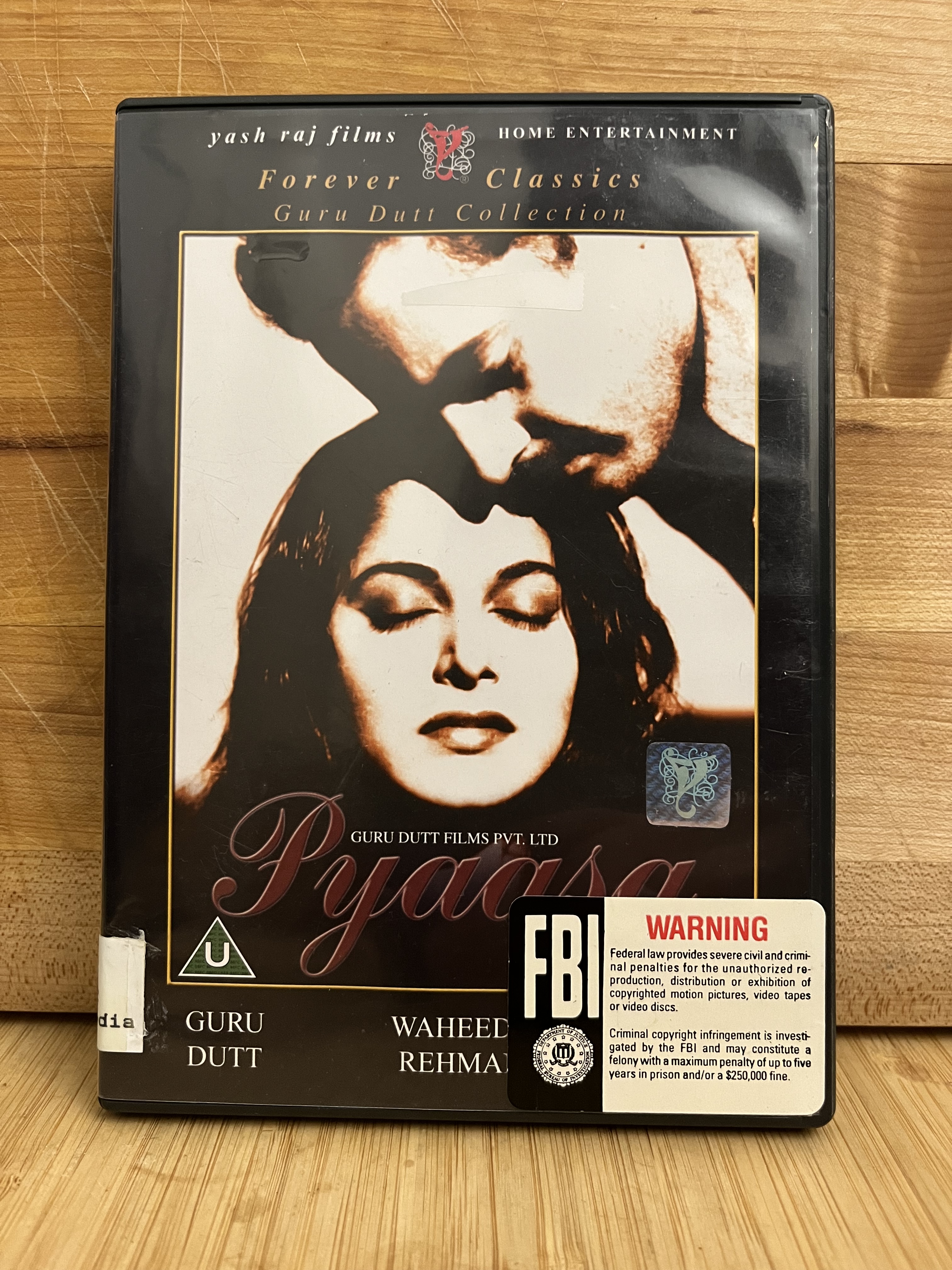
  • Pyaasa and Kaagaz Ke Phool: Both contain some of the most emotionally-charged camera movements and musical numbers of I’ve seen in any movie ever. I’m embarrassed that it took me this long to discover Guru Dutt! I’m currently planning to write about Pyaasa in my October Drink & a Movie post.
  • RR: I am a former rail commuter and train whistles in the distance have always been one of my favorite sounds, so seeing this at Cornell Cinema was a terrific experience!
  • Ahed’s Knee, Memoria, and Neptune Frost: All three would have been among my favorite films of 2021 had had they opened here on time.
  • The Ring: Like The Passion of Joan of Arc and Sunrise: Song of Two Humans, which I also spent time with last year but had seen before, it is a testament to the expressive powers of silent cinema at the dawn of the sound era. Another possible future Drink & a Movie selection.

Also, I doubt anyone else cares, but here’s a procedural note for the sake of posterity: I am hoping (if Twitter survives and remains free) to use the hashtag #onetweettake to quickly identify films eligible for future posts like this one. As such, starting today I will only use it when writing about films from Movie Year 2023 until Oscar night next year, when I’ll begin only using it for films from Movie Year 2024.

* * *

Speaking of the Oscars, they don’t matter to me much when I’m watching tons of movies, because who cares what Academy voters think, or when I’m not seeing very many at all, because what fun is an awards ceremony when you haven’t seen any of the nominated films? When I’m living somewhere in between like I am now, though, they serve as a convenient guide to which film to choose for my weekly theatrical screening and what to do with my weeknight evenings. As a result I managed to see 34 of 39 nominated features and 10 of 15 nominated shorts, which I think is a pretty healthy total! My Loving Wife and I definitely are planning to watch and here’s what I’ll be rooting for, with the number of nominees I saw in parentheses:

Actor in a Leading Role (5/5): Brendan Fraser, The Whale.

Actor in a Supporting Role (5/5): Brendan Gleeson, The Banshees of Inisherin. This was the hardest category for me to pick by far. For MONTHS I thought I was going to pick Ke Huy Quan, then strongly considered Brian Tyree Henry, but in the end I couldn’t go against a great performance by one of my favorite actors.

Actress in a Leading Role (4/5): Michelle Yeoh, Everything Everywhere All at Once. Full disclosure: I have no problem whatsoever with so-called “legacy picks.”

Actress in a Supporting Role (5/5): Angela Bassett, Black Panther: Wakanda Forever.

Animated Feature Film (5/5): Turning Red.

Cinematography (5/5): Darius Khondji, Bardo: False Chronicle of a Handful of Truths.

Costume Design (5/5): Ruth Carter, Black Panther: Wakanda Forever.

Directing (5/5): Todd Field, Tár. I see the controversies of content and form that this film has generated as testaments to its effectiveness.

Documentary Feature Film (3/5): All That Breathes. I’m sorry that I didn’t get to see All the Beauty and the Bloodshed before making this pick!

Documentary Short Film (4/5): Haulout.

Film Editing (4/5): Eddie Hamilton, Top Gun: Maverick.

International Feature Film (5/5): The Quiet Girl.

Makeup and Hairstyling (4/5): Adrien Morot, Judy Chin and Annemarie Bradley, The Whale.

Original Score (5/5): Justin Hurwitz, Babylon. This would have been harder to pick if Empire of Light or The Northman had gotten nominations, but I may well have made the same choice.

Original Song (4/5): “Naatu Naatu” from RRR.

Best Picture (10/10): Tár.

Production Design (5/5): Florencia Martin and Anthony Carlino, Babylon.

Animated Short Film (4/5): Ice Merchants. I’m sorry that I didn’t get to see An Ostrich Told Me the World Is Fake and I Think I Believe It before making this pick!

Live Action Short Film (2/5): Le Pupille.

Sound (4/5): Mark Weingarten, James H. Mather, Al Nelson, Chris Burdon and Mark Taylor, Top Gun: Maverick.

Visual Effects (4/5): Joe Letteri, Richard Baneham, Eric Saindon and Daniel Barrett, Avatar: The Way of Water.

Adapted Screenplay (5/5): Sarah Polley, Women Talking.

Original Screenplay (5/5): Todd Field, Tár.

February, 2023 Drink & a Movie: Massagrand + The Passion of Joan of Arc

The Dead Rabbit Drinks Manual credits a recipe in Louis Muckensturm’s Louis’ Mixed Drinks as the inspiration for bartender Jack McGarry’s Massagrand:

When Jack first read Muckensturm’s recipe, he was reminded of the famed Café Brûlot, a postprandial staple of the grand French-Creole restaurants of New Orleans. Consisting of coffee, spices, sugar, and cognac, that drink is ignited tableside and ladled from a silver bowl.

The Massagrand has similar constituents, but is not intended to combust. The flavor structure is the same, but with stone fruit notes from eaux de vie and liqueurs, plus calamus, an interesting botanical that combines the qualities of cinnamon, nutmeg, and ginger.

Which, cool! But I happen to own a copy of Louis’ Mixed Drinks. Here’s what it lists as the ingredients for a Massagrand:

  • Take one teaspoon of sugar,
  • One-half a bar-glass of Kirschwasser, and
  • One breakfast-cup of strong black coffee

That’s it! But in McGarry’s hands this simple concoction became a cocktail with no less than nine ingredients including the (two) garnishes and a calamus tincture that needs to be prepared at least three days in advance. This is simultaneously exactly why I dig Dead Rabbit and why I don’t make drinks from it all that often: although it’s frequently the first place I turn when preparing for a special occasion, it isn’t a volume I reach for when I’m mixing just for My Loving Wife and me. The Massagrand may turn out to be an exception that proves the rule, though. Here’s how we make it:

1 1/2 ozs. Caffè Americano
1 1/2 ozs. Cognac (Rémy Martin VSOP)
1/2 oz. Cherry Heering
1/2 oz. Kirsch Eau de Vie (Alfred Schladerer Black Forest Kirschwasser)
1/2 oz. Mirabelle Eau de Vie (Trimbach Grande Réserve)
2 dashes Bittermens Transatlantic Bitters
2 dashes Angostura Bitters

Stir all ingredients with ice and strain into a chilled wine glass. Garnish with freshly grated nutmeg and the oils from an orange twist.

Massagrand in a wine glass

I was originally drawn to this drink by the combination of coffee, cherry liqueur, and bitters which I enjoyed in Rafa García Febles’s Dale Cooper. According to Dead Rabbit, “[i]f espresso for caffè americano is not available, your favorite strong coffee will do,” but it seems hard for me to believe that someone able to source all the other ingredients wouldn’t also have access to a Starbucks! One thing that really might be hard for you to come by is the Mirabelle eau de vie, which we had to special order.

The Massagrand is impressively balanced considering how many assertive components it has. Coffee and kirsch in particular tend to take over a drink, but play together nicely here. The word which immediately springs to mind as soon as I take a sip is “sophisticated”: you can tell that the Massagrand has been around, but it isn’t desperate to show off. And it isn’t nearly as hard to make as the long ingredient list might imply, either, especially assuming you’re substituting something else for the calamus tincture, which is classified as a “substance generally prohibited from direct addition or use as human food” by the FDA and thus isn’t easy to obtain in the United States. The team at Dead Rabbit responded to an email I sent them inquiring about alternatives within 24 hours (!) to recommend Bittermens’ Transatlantic bitters, a neat product that their website describes as follows:

We’ve merged the great bitters of the world to create an aromatic bitter that is useful in such a wide array of drinks.

  • From the most classic Aromatic bitters of Venezuela and Trinidad, we created a base that includes gentian, clove, allspice and cinnamon
  • From New Orleans style bitters, we blend in angelica and anise seed
  • From the iconic Italian Fernet, we fortify the bitterness in a touch of aloe and chicory
  • From the Alpine Amaro tradition, we add in chamomile and dandelion
  • From the tradition of German digestives, we incorporate cherry bark and licorice

In total, sixteen botanicals make up this unique aromatic offering.

If I had any doubts about what movie to select for this month’s pairing, this substitution clinched it. Dead Rabbit actually specifies eaux de vie by F. Meyer, a distillery in France, which is also of course where cognac hails from. The addition of Cherry Heering reminded me of The Passion of Joan of Arc, a French movie with a Danish director (Carl Theodor Dreyer) that also figures prominently in Jenny Hval’s song “American Coffee”! As if that wasn’t already enough, here’s how scholar David Bordwell describes the film in a 1973 monograph: “[i]n the context of film history, then, La Passion de Jeanne d’Arc becomes significant as a summation of many major film styles of the silent era.” Sounds like the movie version of Transatlantic bitters, right? What could be more perfect?

Anyway, here’s a picture of my Criterion Collection DVD release of The Passion of Joan of Arc:

The Passion of Joan of Arc DVD

It can also can also be streamed via both the Criterion Channel and HBO Max with a subscription and on most other major streaming video platforms for a rental fee. Some people may have access to it through Kanopy via a license paid for by their local academic or public library as well. It will be interesting to see how many more places it might pop up next year when it enters the public domain (along with Steamboat Willie, by the way!) in the United States on January 1.

The Passion of Joan of Arc is one of just a handful of films that I know for certain I would have included on my hypothetical Sight & Sound Critics Poll ballot. In the book I quote from above, David Bordwell also notes that “[m]any viewers erroneously remember Jeanne d’Arc as a film composed entirely of close-ups,” which: this was definitely true for me for a long time! And to be sure, there are many such shots. Of Joan (Maria Falconetti), “suffering in black and white” (to quote Hval):

Close-up of Joan's tear-streaked face

The priests and soldiers who sit in judgement over her:

Extreme close-up of a judges face

And the people of France who watch her burn at the stake then rise up afterward:

Close-up of a peasant watching Joan burn at the stake

The latter are almost exclusively shown as part of camera movements which include more than one person, whereas Joan and her tormenters are frequently depicted in single shots. These images are powerfully moving and/or disturbing, especially when faces seem to lunge at Joan like this soldier (whose uniform, according to scholar Stephen Larson, bore enough of a resemblance to those worn by British soldiers during World War I to upset that country’s censor) does:

Close-up of an English soldier

Following my last few viewings, though, I’ve found myself thinking more about shots like the one of these mismatched windows:

Shot of three differently-sized windows

Or this warped doorway, both of which show the influence of German Expressionism:

Shot of Joan entering a doorway which isn't perfectly rectangular

The Passion of Joan of Arc might be the most thorough application of the advice that John Ford (David Lynch) gives Sammy (Gabriel LaBelle) in The Fabelmans that when the horizon is at the bottom or top of the frame, it’s interesting, but “[w]hen the horizon’s in the middle, it’s boring as shit.” The fate of the lone priest who dares to defend Joan, for instance, is depicted by alternating shots of just the helmets and spears of the soldiers leading him away and the horrified reactions of his fellow judges:

Shot of a soldier's helmet and the tip of their spear
Close-up of a judge's horrified
Another shot of a soldier's helmet and the tip of their spear
Close-up of another judge's horrified face

Or behold this shot of onlookers with Catherine Wheel:

Shot of onlookers at the bottom of the frame with a Catherine Wheel behind them

There are interesting anachronisms like this fella’s glasses:

Shot of a priest wearing glasses which had not yet been invented when Joan of Arc was alive

And this cannon which swivels not because 15th-century cannons were actually able to do that, but rather because the ones in Battleship Potemkin could:

Shot of a canon which swivels like the ones in Battleship Potemkin

We are also occasionally treated to multi-level compositions like this one which shows off the skills of legendary cinematographer Rudolph Maté as well as anything else in the film:

Multi-level composition showing a judge watching as Joan is given communion

Finally, for my money the film’s most haunting moments of all are images like this one:

Shot of Joan burning in silhouette

Now of course none of this is to say that The Passion of Joan of Arc‘s close-ups aren’t every bit deserving of their legendary status! Here are the lyrics from the “American Coffee” verse about the film:

I give you that time at the cinematheque (Give you that time)
I was watching La Passion de Jeanne d’Arc
While I was having a UTI
I stared into Jeanne’s face, suffering in black and white
I’m sure I saw her wink at me
Then I peed blood in the lobby bathroom
The blood color seemed so insanely alive
Too alive, too alive to be just mine

Like Anna Karina’s Nana in Vivre Sa Vie, Hval feels connected to Falconetti’s Joan (who is also the subject of her earlier song “Renée Falconetti of Orléans”). I think the wink she imagines is interesting because this is how the characters in The Passion of Joan of Arc communicate with one another throughout Joan’s trial, with winks and nods and other small gestures:

Shot of a judge cautioning Joan to be careful by placing a finger to his lips

One of the things that keeps me coming back to this film again and again is the mystery of when exactly the narrative shifts. Is this the precise moment when Joan realizes that Loyseleur (Maurice Shultz) is not really her ally or is the Kuleshov effect just doing its thing?

Joan maybe realizing that Loseleur is not her ally, or maybe not

But here’s the verse from “American Coffee” which immediately precedes the one excerpted above:

I wonder who I’d been if I never got to go
Get a fine arts degree and American coffee
With irrelevant quotes from French philosophy
And we’d meet in the climax of a clever sci-fi movie
But that would just be, but that would just be, be stupid

The Passion of Joan of Arc is often described as an emotional experience, but it’s an intellectual one, too. One doesn’t really happen upon a silent film in this day and age–you have to seek them out. Part of what makes The Passion of Joan of Arc great is that it provides a lot of bang for your buck. It’s a master class in the film traditions of the early 20th century, just like Transatlantic bitters are a world tour in a bottle. But your initial reaction to it is liable to be the same one-word sentence I predict you’ll speak after you try a Massagrand for the first time: “wow.”

Cheers!

All original photographs in this post are by Marion Penning, aka My Loving Wife. Other entries in this series can be found here.
Friday Movie Night

Friday Movie Night drawing

I found this poster hanging in the office/art room the other day. Friday Movie Night is the brainchild of Lucy Horbal, age seven. When asked in an interview why she decided to let me and My Loving Wife choose the first two screenings, she replied, “because me and my sister need to learn patience even though I don’t want to learn patience.” I’m planning to go with Roald Dahl’s Matilda the Musical for my inaugural selection in the spirit of the series themes of “family” and “cooperate” because although I haven’t seen it yet, everyone else has and they all like it.

January, 2023 Drink & a Movie: Finger Lakes Kir Royale + The Clock

The subject of my first Drink & a Movie post of 2023 is brought to you by a character in Vincente Minnelli’s The Clock identified simply as The Drunk:

Played by Keenan Wynn, he appears in a single long take positioned halfway through the film. Our heroes Corporal Joe Allen (Robert Walker) and Alice Maybery (Judy Garland) and their milkman friend Al (James Gleason) encounter him in a lunch room that they’ve ducked into to call for help with a flat tire. “Would you care to join me in a vermouth, cassis, or champagne cocktail?” he asks despite the fact that alcoholic beverages aren’t actually served in this establishment. This makes his suggestion inappropriate for their setting, but the latter two ingredients go together perfectly in one of my favorite cocktails for January, a very slightly original drink made entirely with local spirits that I call a Finger Lakes Kir Royale. Here’s how you make it:

1/2 oz. Finger Lakes Distilling Cassis Liqueur
4 oz. Dr. Konstantin Frank Winery Célèbre Rosé

Add the cassis to a chilled champagne coupe and top with the sparkling rosé. Garnish with a lemon twist cut (we use linzer cookie cutters) in the shape of a fireworks burst.

Finger Lakes Kir Royale in a champagne coupe

Célèbre Rosé was part of a case of local wines handpicked for us by David Sparrow shortly after we moved to Ithaca and has been a staple in our house ever since. It’s quite delicious, and together with the cassis it gives this drink a lovely pink color, but any good dry sparkling wine you have left over from the holidays will do just fine. This drink doesn’t necessarily improve upon a glass of plain bubbly, but it does take it in a bit of a different direction, which can be nice in the days and weeks after New Year’s Eve. Anyway, my screengrabs from The Clock are taken from my copy of the Warner Archives Collection DVD release of the film:

The Clock DVD case

It can also be streamed via Amazon Prime and Apple TV for a rental or purchase fee.

Joe is a soldier from Indiana spending a two-day leave in New York City before he ships out to Europe who reacts to the Empire State Building a bit differently from Buddy the Elf:

Screengrab from The Clock

Specific references and impressively accurate studio sets aside, the New York of The Clock is more of a generic Big City than a specific place and unlike Buddy, Joe doesn’t know what he’s looking for when he arrives there. He soon discovers that it’s Alice after she trips over his foot and loses the heel of her shoe:

Screengrab from The Clock

He convinces a cobbler to keep his shop open late to fix it:

Screengrab from The Clock

And she agrees to show him the sights in a sequence that features some pretty impressive back projection work:

Screengrab from The Clock

Joe spends the first third of the film’s ninety-minute run time being just charming enough to convince Alice to make and keep (over the warnings of her roommate about the dangers of being “picked up”) a date with him “under the clock at the Astor at seven.” They spend the next fifteen minutes falling in love, culminating in a kiss that Sheila O’Malley describes as having World War II in it:

Screengrab from The Clock

Frightened by what she is feeling, Alice hesitates. “I don’t know whether we ought to see each other again at all,” she tells Joe. Enter The Drunk. Alice and Joe realized that they’ve inadvertently stayed out past midnight and that the buses have stopped running. Luckily, Al appears and offers to give Alice a ride home in his milk truck. Alas, no good deed goes unpunished, and he winds up getting smacked in the face:

Screengrab from The Clock

As described by Emmanuel Burdeau (via a translation by Bill Krohn) in Joe McElhaney’s book Vincente Minnelli: The Art of Entertainment, Keenan Wynn’s main function in the film is to provide Joe and Alice with an opportunity to “act as a team to save Al”: with him grappling with the effects of what in 2023 is obviously a concussion, they decide to work together to complete his shift. What makes The Drunk and to a large extent The Clock itself memorable, though, is Vincente Minnelli and company’s decision to give him three whole minutes of screen time to build up to this moment. Just for good measure, much of his rambling discourse is delivered around or to this lady (played by Moyna Macgill) who could care less because she is utterly lost in her own thoughts and rapturous enjoyment of her plate of food:

Screengrab from The Clock

The scenes which follow the one in the lunch counter are some of my favorites in the entire film. As the city’s working class bemusedly look on, Alice and Joe deliver milk:

Screengrab from The Clock

Per Burdeau, by the time the sun rises they will have shown “what they could be as a man-and-wife team performing a job together, making money, being economically grounded.” With their hearts and heads now in alignment, they decide to spend Joe’s final day of leave together, which is when the city that has brought them together conspires to show them what life apart would now feel like. Over breakfast with Al and his wife, both Joe and Alice express skepticism about servicemen getting married immediately prior to a tour of duty:

Screengrab from The Clock

This all changes after they get separated on the subway a little while later:

Screengrab from The Clock

Joe tries to meet Alice at her next stop, but mistakenly boards an express instead of a local train. She is trying to find him as well and has left by the time he gets there. Joe’s face records his horror at what has befallen them:

Screengrab from The Clock

A window display proudly announcing the population of New York as 7,454,995 underscores the odds against them ever finding each other again:

Screengrab from The Clock

Especially when, as Alice humiliatingly admits to the USO official she seeks help from, they don’t even know each other’s last names:

Screengrab from The Clock

They finally do rediscover each other at the spot where they first met and realize that they already have all the information they need to decide to spend the rest of their lives together. The next six minutes of the film are another reason it reminds me of New Year’s Eve, featuring as it does shots of at least five different clocks, with one appearing in a shot every 30 seconds or so on average. Alice and Joe race all over town to successfully navigate a thicket of red tape and secure all the paperwork they need to officially wed at literally the last possible moment–the city clerk who performs their ceremony is getting into the elevator to leave for the day when they arrive.

The Clock concludes with Joe and Alice enjoying their first morning together as man and wife. The scene is nearly two and half minutes old before either of them speaks a word, which is not to say they aren’t communicating the entire time:

Screengrab from The Clock

This sequence, too, is another reason The Clock strikes me as a perfect movie with which to ring in the new year. It’s a time both for making bold, potentially life-changing resolutions, and for coming up with a plan to keep them; for marrying the man of your dreams, and for figuring out how he likes his coffee. Or, if I may, both for stocking up on champagne, and for finding creative uses for the bottles you don’t drink.

Cheers!

All original photographs in this post are by Marion Penning, aka My Loving Wife. Other entries in this series can be found here.
Film Criticism: What Is It Good For?

Lately I’ve been pondering just what exactly I use film criticism for and what implications, if any, this has for what I do here at this blog. I came up with the following eight functions that it performs for me:

  1. To help me select movies to watch. I try to see one film in theaters each week, and when deciding which one to choose I find it helpful to quickly scan festival dispatches and reviews to get a sense for how everything playing in Ithaca has been received. What I’m looking for here is evidence of quality and significance: which of them are the most likely to contain something I’ve never seen or heard before and/or open my mind to new ideas and feelings? Positive indicators include strong opinions by critics whose opinions I respect, success on the festival circuit, and association with national cinemas, film movements, etc. that I want to know more about. Capsule reviews and articles that mention multiple titles work just fine for this, and I don’t usually need or want to read anything closely at this point, so the ratings provided by review aggregators like Metacritic or Rotten Tomatoes are useful here for identifying example positive and negative reactions. My other go-to tool for this kind of research is the Film Blogs, Etc. 2.0 Google Custom Search Engine I created a few years ago. The main thing I need is to be able to search by title, which makes text superior to formats like podcasts and video essays, except where the latter are well-indexed so that I can identify where they talk about the film I’m interested in. This all goes for new movies I watch at home via streaming video or physical media as well either because they never screened theatrically in Ithaca or because I missed them. Here, though, it’s also helpful here when people clearly state “see this movie now playing on platform x!” like Bilge Ebiri did on Twitter with Athena or like Manohla Dargis did by including Kimi in her “Best Films of 2022, So Far” selections for the New York Times, since I might not otherwise know to go looking for them.
  2. To check my own impressions of a film I just watched against that of the critical community. Sometimes, but not always, I seek out reviews immediately after I see a movie. The question I’m trying to answer here is typically “what am I missing?” because I’m curious about either why I haven’t heard more about a movie I liked or what others valued in one I didn’t. Capsule reviews and festival dispatches still work just fine here (the Chicago Reader‘s capsule reviews from the Dave Kehr/Jonathan Rosenbaum era, which are discoverable via Film Blogs, Etc. 2.0, are great for this for older films), but this is a situation where I will read longer reviews closely and where I’d be happy to spend time listening to a podcast episode or watching a video essay. Again, though, I need to be able to find them in the first place, so searchability remains key. In addition to the tools I use for category one research, I will also consult the indexes of the film books I own in the case of older titles as well.
  3. To conduct more in-depth research into specific directors, film movements, movies, etc. When I am moved to learn more about a specific film topic in order to write about it myself or just because, I supplement all the resources I use for category one and two research with the books and databases I have access to as an employee of Cornell University. Which: I definitely think I take the fact that I’ve worked somewhere I can pop up- or downstairs to grab a book out of the PN 1995 range of a library’s stacks pretty much continually since 2000 for granted! While these types of works are often written by critics, this is where we cross into the domain of academic film studies. In any event, my overarching goal here is to gain an understanding of what has been published on a given topic. I’m also always glad to come across pieces like Kristin Thompson’s recent deep dive into Men and Dan Kois’s discussion of the supernatural elements of Tár when doing this kind of research.
  4. To learn more about how movies WORK. There is a theoretical aspect to this category which is again often the domain of film studies, but lately I’ve found myself consulting videos that I find on YouTube and elsewhere which describe how to execute specific filmmaking techniques by way of better practical understanding what I’m seeing in my viewing adventures and so that I can write about movies accurately. This is particularly important to me when working on something for Educational Media Reviews Online or another “real” publication (i.e. not this blog). To cite a point of confusion I see fairly regularly, I don’t want to be guilty of mislabeling a dolly shot as a zoom or vice versa. As with the categories above, I’m typically researching specific topics here and it would be lovely if someone created a handbook specifically for people like me who write about film, but would there actually be a market for such a thing? Or is this something like the snapshot button for screengrabs that I want on all streaming video platforms, but which the vendor community assures me no one else does?
  5. To stay informed about what’s going on in the world of film generally. I try to keep up with what’s happening on the festival circuit and the hot topics du jour by subscribing to film magazines like Cineaste and Cinema Scope, newsletters like Film Comment (which I hope will be a magazine again someday soon), and blogs like David Hudson’s invaluable Criterion Daily and MUBI’s Notebook. This category is unique from the ones above in that I’m NOT looking for anything in particular here initially, but it’s adjacent to category one in that these resources are often how I learn about films available via streaming. All of this is why I listen to podcasts which cover current films such as The Cinematologists and The Film Comment Podcast, too.
  6. To help me improve my own film writing. I happily acknowledge that my writing has plenty of room for growth, and I try to make time for re-reading books like Negative Space: Manny Farber on the Movies expressly to learn from them. There are also many critics whose reviews I’ll read closely from start to finish even if I’m just figuring out what to see or if I’ve already answered the question that inspired me to read more about something I just watched because I enjoy the way they think and write.
  7. For pleasure. One of the reasons I consume film criticism is of course because I enjoy it! I read many books about movies just because they sound interesting, and podcasts like Karina Longworth’s You Must Remember This and Rico Gagliano’s MUBI Podcast are my favorite things to listen to while walking to and from work.
  8. To be part of a community. I really should make more of an effort to engage with my fellow cinephiles! After all, there is absolutely no substitute for seeing a movie, then repairing to a diner or bar to talk about it, and the virtual equivalent of this is better than nothing. Even if there’s likely to be a limit on how many people I can convince to accompany me to any given screening at my beloved local theaters Cinemapolis and Cornell Cinema, plenty of people are willing to travel to upstate New York for events like the Finger Lakes Environmental Film Festival and the Nitrate Picture Show and I want them to drop me a line when they do.

Now comes the tricky part: so what? First off, it’s now obvious to me that my personal brand of cinephile still has theatrical moviegoing at its core. I may spend way more hours watching things on the TV in my own living room than I do on the big screen with other people, but as a child of the home video era, that has always been true for me. In the meantime, I think the time I spend picking out one film each week to see after work and trying to formulate intelligent thoughts about it afterward is probably what makes cinephile more of a PURSUIT for me than just a proclivity. Take that away, and maybe this blog ceases to exist: see by way of evidence the apparently direct correlation between how many movies I see in theaters and how much I post here.

I am reminded by this exercise just how valuable it is to talk about what I’m listening to and reading! The only reason I know about the Slate article by Dan Kois I mention above, for instance, is because Glenn Kenny mentioned it in his “Notable Films of 2022” blog post. I obviously believe that film blogs still have a place in the world of 2023, but they need care and feeding. Hopefully this post is a step in that direction. On a related note, I fully expected one of my conclusions to be that maybe the time has come to finally check out Letterboxd. I’m still not sure I see a void that it would fill, though, at least not as long as Twitter continues to exist in more or less its current form and people like Glenn, the other folks mentioned in this post, and additional denizens of my RSS feed like Zach Campbell continue to plug away at their blogs. I don’t personally feel the need to catalog EVERYTHING I’m seeing, and if I have other ways to plug into the film community outside of Ithaca, what would it do for me? What would be great is if one of the review aggregators would start including “top critics” from Letterboxd on their platform or if someone else would perform a similar service.

Last but not least, one important through-line I see here is the utility of specialization. Although I was surprised to see how many uses I identified for podcasts, the distinguishing feature of all the ones I listen to is that they are film-specific. This kind of focus is also what differentiates, for instance, the people I follow on Twitter and/or add to my Film Crickets list from the ones I don’t. I absolutely do not think that film writers need to restrict themselves just to talking about movies, but for a feed to be useful, the majority of content on it has to be on topic. Ditto for search results, which: this is something that I very much hope the creators of podcasts and video essays are thinking about! Sometimes I’m waiting for the next episode, but usually I’m looking for information about a title, person, or technique. Full-text transcripts with timestamps would be ideal for this, but failing that a good index is essential.

2022: The Mixtape, Vol. 2 + Year-End Musings

As mentioned previously on this blog, I have been creating mixtape-length (no more than 80 minutes each) Spotify playlists of new music I’ve been enjoying semi-annually since 2011. I’ve been posting links to them on Twitter since 2019, but in keeping with one of my New Year’s resolutions (see below), I’m going to begin spinning them into blog posts starting with this one. One of my favorite things about this project is the evidence it provides of just exactly how my music tastes are evolving. Previous trends I’ve noticed are the increasing prominence of country music (especially as written and performed by women) and jazz. Lately, more and more film music is creeping in to these mixes as well, which makes sense considering that I’m seeing more movies in theaters than I have in a decade. It has also been interesting to me to see how emo has continued to have a place in my life thanks to bands like The Wonder Years whose preoccupations are changing apace with my own. Where we used to spend way too much time mooning over crushes, now we fret about parenting in an age of global warming and gun violence. Anyway, without further ado, here’s a link to my 2022: The Mixtape, Vol. 2 playlist followed by the tracks included on it:

  1. Colin Stetson – Our Side or Theirs
  2. $ilkMoney – I Ate 14gs of Mushrooms and Bwoy Oh Bwoy
  3. quinn – you don’t gotta be here if you don’t wone’a
  4. Hildur Guðnadóttir – For Petra (vocal version)
  5. Hedvig Mollestad / Trondheim Jazz Orchestra – Do Re Mi Ma Ma
  6. The Wonder Years – You’re the Reason I Don’t Want the World to End
  7. Duval Timothy feat. Yu Su – Wood
  8. Taylor Swift feat. Lana Del Rey – Snow On The Beach
  9. Camp Cope – Running with the Hurricane
  10. Saul Williams – Pensent Comme Leurs Livres Disent (Think Like They Book Say)
  11. Alex G – Mission
  12. The Mountain Goats – Extraction Point
  13. Doja Cat – Vegas
  14. Porridge Radio – Back To The Radio
  15. Grace Ives – Shelly
  16. Craig Finn – The Amarillo Kid
  17. Carter Burwell – The Mystery of Inisherin
  18. Amanda Shires – Lonely At Night
  19. Sofie Royer – Feeling Bad Forsyth Street
  20. Weyes Blood – Children of the Empire

* * *

All over the world people are publishing lists of their favorite movies of 2022. For the first time in a decade, I’ve actually seen enough new films (I posted about ~40 on Twitter) to contemplate doing the same myself, which means it’s time to resurrect one of the better ideas I had during my first go-round as a film blogger, the movie year. You’ve heard of calendar and academic years, yes? This is the same basic concept. If you live in Los Angeles or New York, by now you’ve had an opportunity to see most of the year’s major releases, especially if you’ve also attended a few film festivals or regularly receive screeners. None of this applies to me or most of the other people I know who live in what the trades may or may not still refer to as “flyover country.” I’ve seen many of the most significant films of 2022, sure, but quite a few more will arrive in Ithaca between now and March, in part because distributors time their releases around the Academy Award nominations they hope to receive. At the risk of according too much significance to the ceremony itself, Oscar night therefore makes MUCH more sense as a time to look back on the previous year for someone like me than New Year’s Day or Eve, so that’s what I’m gonna do. I’ll share my thoughts on how appropriate the the Top Ten List format is for non-professional film writers (spoiler alert: it ain’t) at that time as well. Stay tuned!

* * *

What I will post now are a few New Year’s resolutions. As announced in July, I’ve decided to keep my Drink & a Movie series going four full years because I’m having loads of fun and there’s stuff I want to do with it after I have enough posts for a 52-week-long film series. This idea started as a way of achieving last year’s New Year’s resolution to blog more, and part of the way I accomplished it was by pushing myself to get each month’s post up by the first or second Saturday of each month. Now that I’ve successfully gotten back into the habit of writing regularly, though, I’m going to be less rigid with the timing and concentrate on trying to say something original about each film I tackle. On the drink front, My Loving Wife and I are also going to focus more on presentation, including garnishes.

That’s all intentionally somewhat vague. More concretely, I hereby resolve to follow up the tweets I’ve been posting announcing which screenings I’m planning to attend (which are intended to promote my local theaters, help me keep track of what I’ve seen, and give people a chance to say “I’ll meet you there!”) with a “one tweet take” on everything by way of becoming more comfortable sharing my opinions on things I haven’t yet had an opportunity to think deeply about and hopefully engaging in more conversations about them. Last but not least, I’m going to sprinkle more additional content like this in amongst my Drink & a Movie posts. On that same note, I’ve actually got a post about film criticism (a topic that I hope to revisit a few times in 2023) about half finished, so it’s not inconceivable that I could be back tomorrow or Saturday. I’m not going to rush, though, so: Happy New Year, and thanks for reading!