What I’m Seeing This Week: I am going with Hard Truths, which closes at the the Regal Ithaca Mall today but continues its run at Cinemapolis at least through next Thursday, and continuing my quest to see all of this year’s Oscar nominees before the ceremony on March 2, I’m also planning to see The Seed of the Sacred Fig sometime after it opens there tomorrow.
Also in Theaters: Speaking of the Oscars, Best Animated Feature Film nominee Memoir of a Snail (which I’m planning to see next week) also opens at Cinemapolis tomorrow. Other contenders you can see on local big screens include The Brutalist (Cinemapolis + Regal), A Complete Unknown (Cinemapolis + Regal), Nickel Boys (Cinemapolis), Nosferatu (Cinemapolis + Regal), and Wicked (Regal). My favorites are The Brutalist and Nickel Boys, but they’re all worth seeing. The very best new movie now playing Ithaca that I’ve already seen is All We Imagine as Light, which screens at Cornell Cinema Saturday evening. I also enjoyed Babygirl and Presence, both of which are at the Regal. This week’s special events are highlighted by the Ithaca Underground Music Video Festival, which is at Cinemapolis tonight. Your best bets for repertory fare are A Matter of Life and Death, which is at Cornell Cinema tomorrow, and Shadows of Forgotten Ancestors, which is there on Saturday. You can also see last week’s “Home Video” recommendation Mulholland Drive there tonight along with Eraserhead, which is of course also directed by the late, great David Lynch.
Home Video: Six films have basically already clinched spots on the top ten list for Movie Year 2024 I’ll publish in March. All We Imagine as Light is one of them. Another is Close Your Eyes, which recently started streaming on Mubi. I originally thought I was going to present it as tied with La Chimera and write them up together, but while they do have a lot in common thematically, Close Your Eyes has started to differentiate itself in my mind, so we’ll see. Anyway, here’s what I said about it on Letterboxd:
Close Your Eyes begins and ends with excerpts from one of my new favorite films within a film, an unfinished work called The Farewell Gaze, and contains both a diegetic rendition of “My Rife, My Pony and Me” and a load-bearing reference to Carl Theodor Dreyer, but it’s way more than mere cinephile catnip. Rather, like Movie Year 2024’s La Chimera, it’s a thorough and nuanced investigation of the question Is it possible for an aesthete to live a good life in the absence of art? Where that film’s Arthur (Josh O’Connor) is faced with a choice, though, this one’s protagonists Miguel Garay (Manolo Soto) and Julio Arenas (Jose Coronado) have that reality thrust upon them. Or do they? Doubling abounds–even the title is a reference to director Victor Erice’s 1973 magnum opus The Spirit of the Beehive.
Previous “Ithaca Film Journal” posts canbe found here.A running list ofall of my “Home Video” recommendations can be found here.
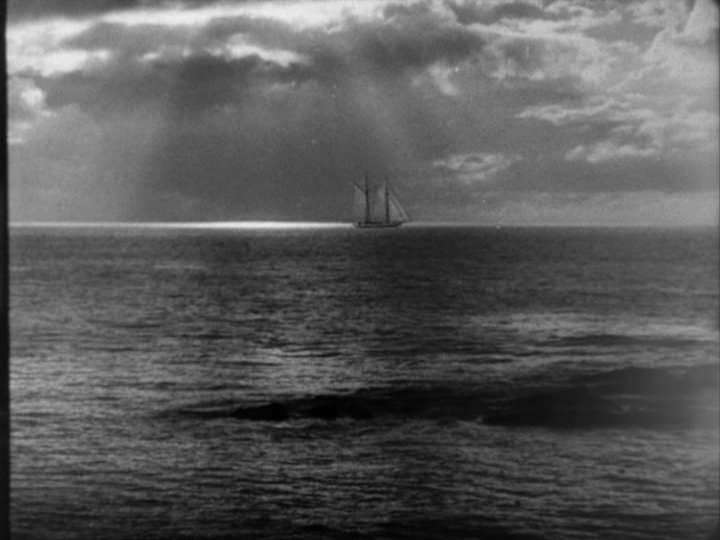
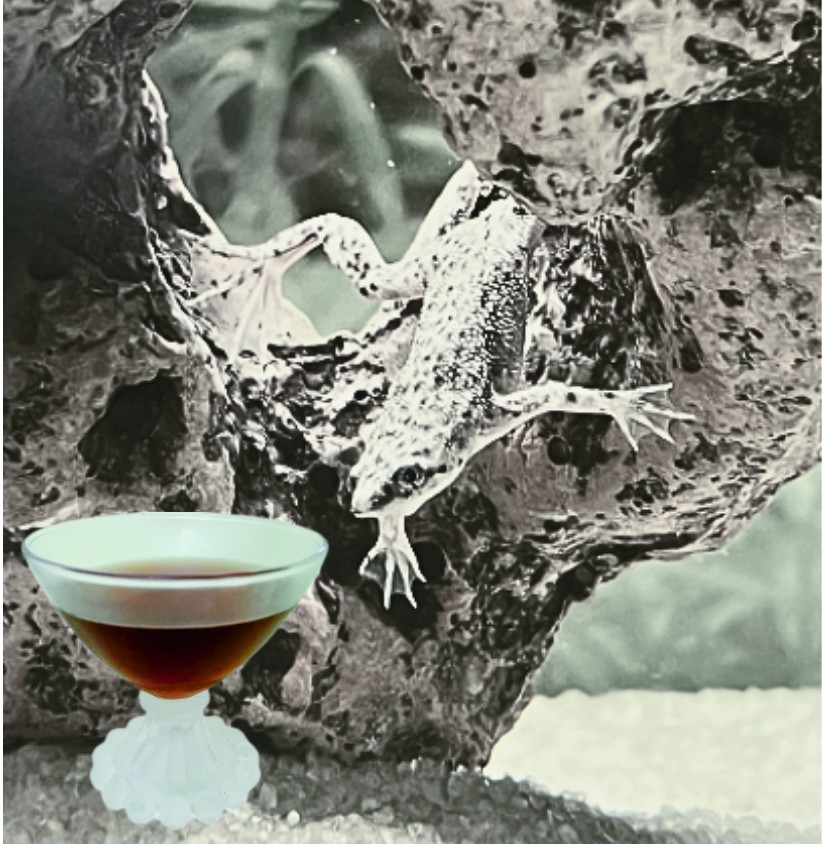
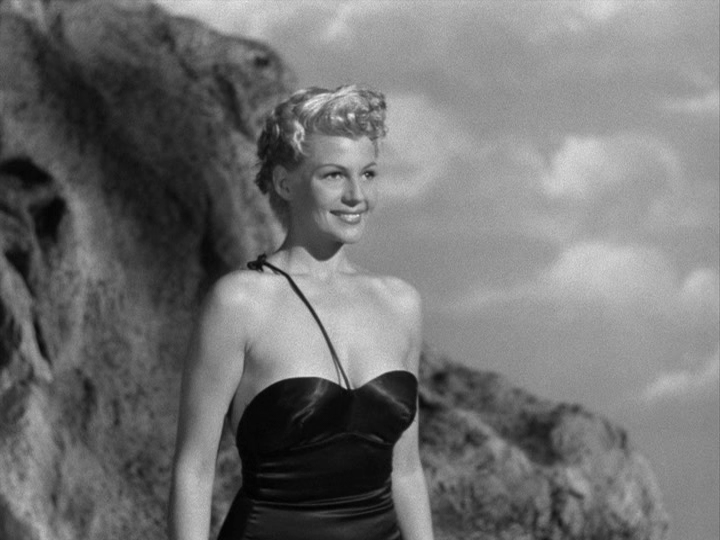
The San Francisco Nog created at Waltham, Massachusetts bar Deep Ellum has been a favorite in our house ever since Frederic Yarm wrote about it on his Cocktail Virgin Slut blog a few years ago. With Fernet Branca on my mind, it was natural that my thoughts would also turn to San Francisco, since for reasons Grant Marek chronicled for SFGate that spirit is linked to the city “in the same way that Malort is to Chicago and Guinness is to Dublin, Ireland.” This led me to a movie filmed there that I’ve been entranced with ever since I encountered stills from it in David Cook’s A History of Narrative Film as an undergraduate film studies major: The Lady from Shanghai. A dairy-based beverage would be a terrible fit for its hot and sweaty first half, so instead I’m taking a cue from the yacht the Circe which belongs to the titular lady Elsa Bannister (Rita Hayworth) and her husband Arthur (Everett Sloane) and pairing it with the Don’t Give Up the Ship cocktail that most drinks historians agree first appeared by that name (there’s also a concoction called a Napoleon in The Savoy Cocktail Book with the exact same ingredients) in Crosby Gaige’s 1941 Cocktail Guide and Ladies Companion, but which, like the Last Word I wrote about in 2023, owes its present-day popularity to Seattle’s Zig Zag Cafe.
As Jason O’Bryan noted in The Robb Report, there are now two versions of the drink. He favors the rendition made with Cointreau and sweet vermouth, but My Loving Wife and I enjoy the one that features Grand Marnier and Dubonnet Rouge more. He’s actually a fan of both and describes the original as “a lower-toned winter drink,” which is obviously appropriate to the season, and we think it’s a better platform for the fernet as well. Using a movie comparison that I appreciate as a child of the 90s, O’Bryan speculates on his Drinks and Drinking blog that this “may be a Happy Gilmore/Billy Madison situation.” Anyway, the recipe by Zig Zag’s Ben Dougherty which O’Bryan and others link to is no longer on Food & Wine magazine’s website, but you can still find it in their 2007 Annual Cookbook. Here’s how to make it:
1 1/2 ozs. Gin (Junipero) 1/2 oz. Dubonnet Rouge 1/4 oz. Grand Marnier 1/4 oz. Fernet Branca
Stir all ingredients with ice and strain into a chilled glass.
Junipero is ideal here because it’s made in San Francisco and also matches O’Bryan’s call for a “big, robust, juniper-forward” selection. In addition to being delicious, Grand Mariner is also made with a brandy base, which as Eddie Mueller says in his description of the Sailor Beware cocktail he created to pair with The Lady from Shanghai for his Noir Bar book seems “a likely libation for sinister shyster Arthur Bannister.” Both the gin and fernet are very prominent, so steer clear if you aren’t a fan of those ingredients. But if, like us, you love them: full speed ahead! On to the film. Here’s a picture of my TCM Vault Collection Blu-ray/DVD:
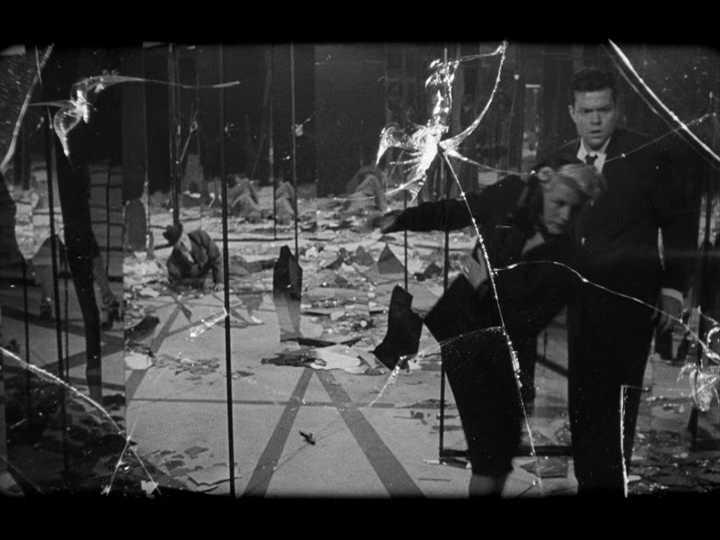
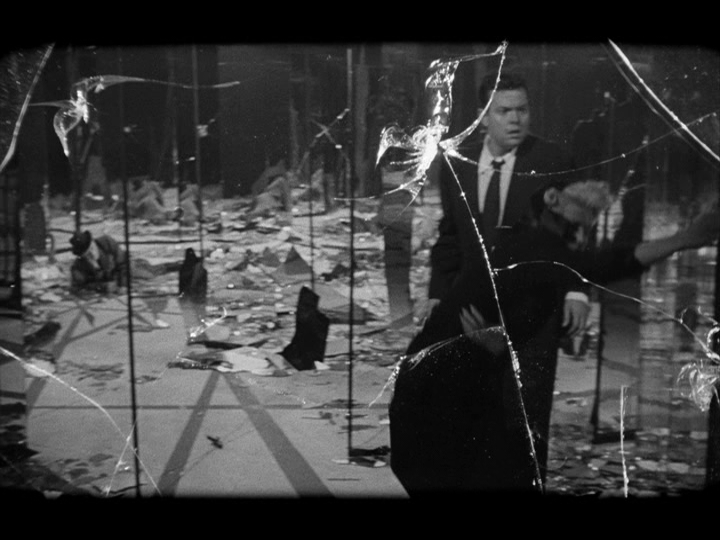
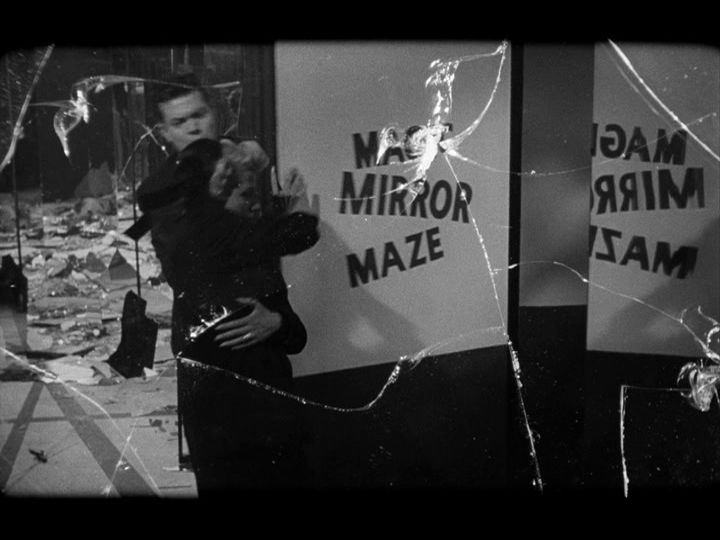
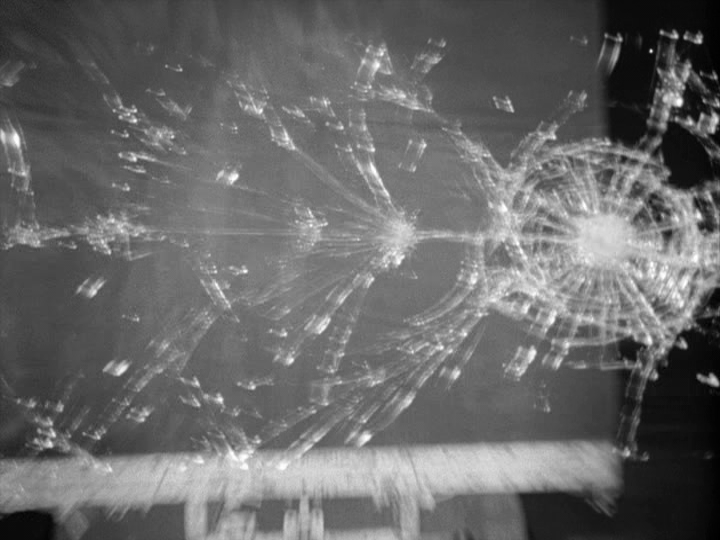
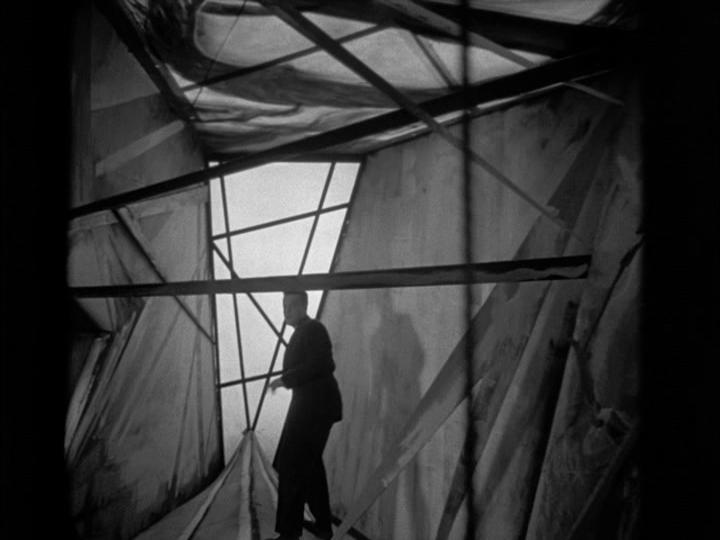
Dave Kehr famously calledThe Lady from Shanghai “the weirdest great movie ever made,” but as James Naremore writes in his book The Magic World of Orson Welles, “its strangeness did not result from an early, deliberate plan.” Instead, he argues that as a result of some combination of interference by Columbia Pictures and the “weariness, contempt, or sheer practical jokery” of its director, “the movie seems to have been made by two different hands.” Naremore points to the fact that it was “reduced by almost an hour from its prerelease form” and “substantially revised” at the behest of studio chief Harry Cohn (who allegedly offered $1,000 to anyone who could explain its plot to him after viewing the rough cut) as his primary evidence for this, but I haven’t read anywhere that Welles ever intended to edit the film himself and it’s hard to know for sure what exactly a finished version that he had more say in might have looked like. Based on the interviews with him that Peter Bogdanovich compiled into the book This Is Orson Welles and reads from on the commentary track on my DVD, for instance, the single-take version of the opening Central Park sequence (which American Cinematographer reported set a record for the longest dolly shot ever filmed) was always destined to be cut apart and down. It’s also not as if every shot overseen by Welles that made the final cut is beyond reproach. As Naremore says about one that I’m unfortunately no longer able to not see, the decision to use a panning movement which causes the jagged edges of glass at the corners of the frame below to move “is clearly a director’s error”:
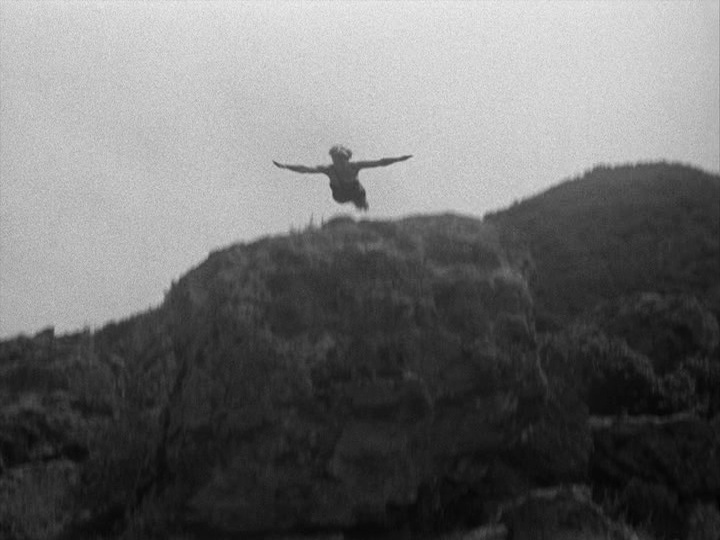
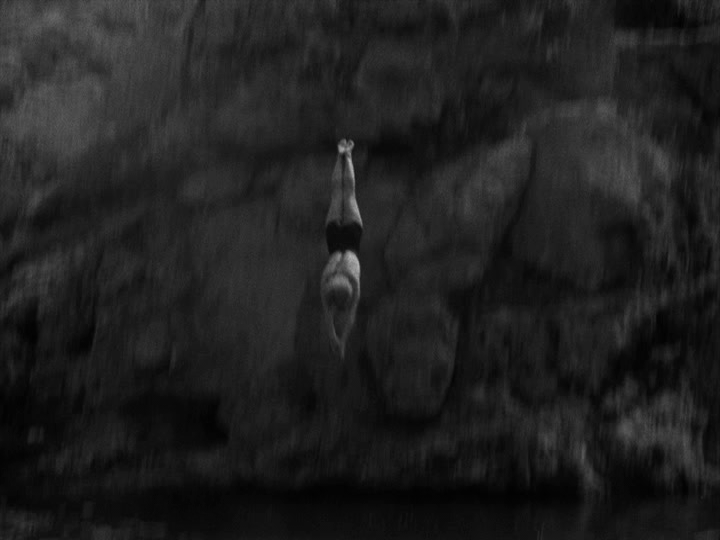
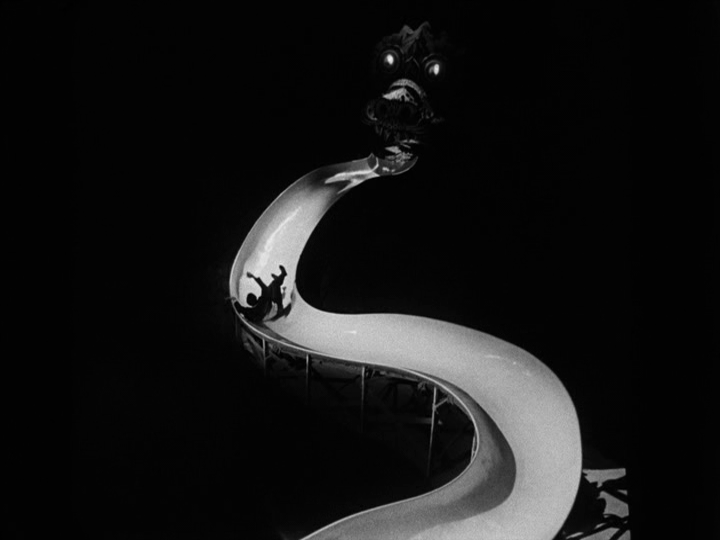
Welles’s biggest objection seems to have been to the music by Heinz Roemheld, exemplified for him by the “Disney”-esque glissando added to this dive:
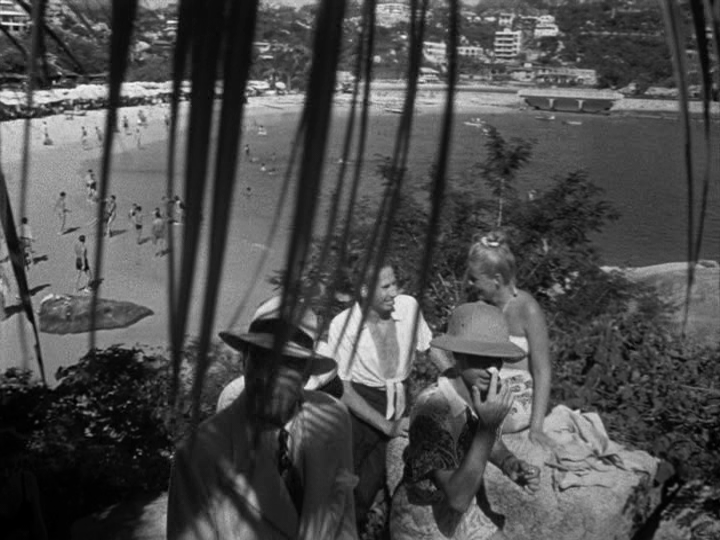
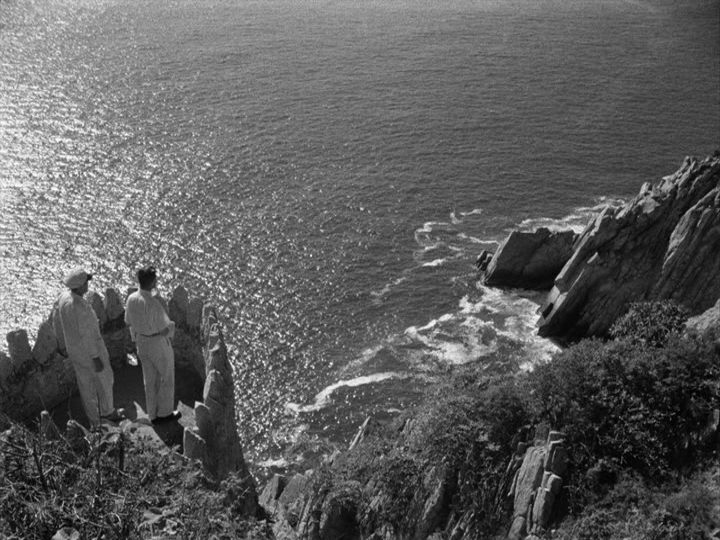
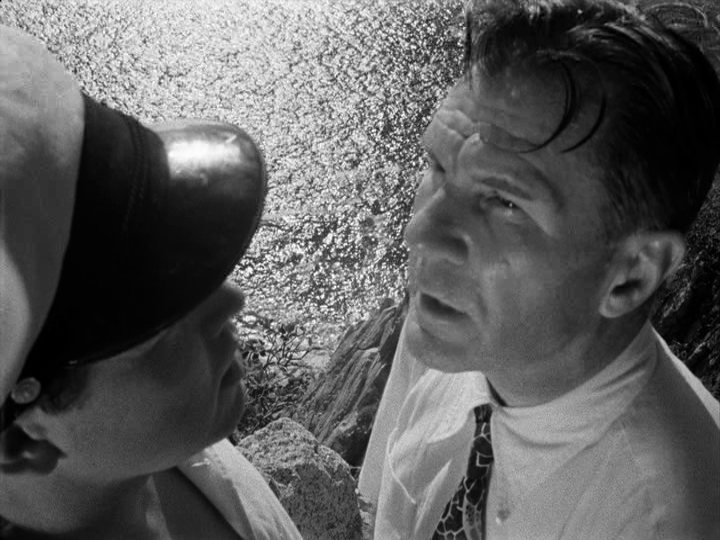
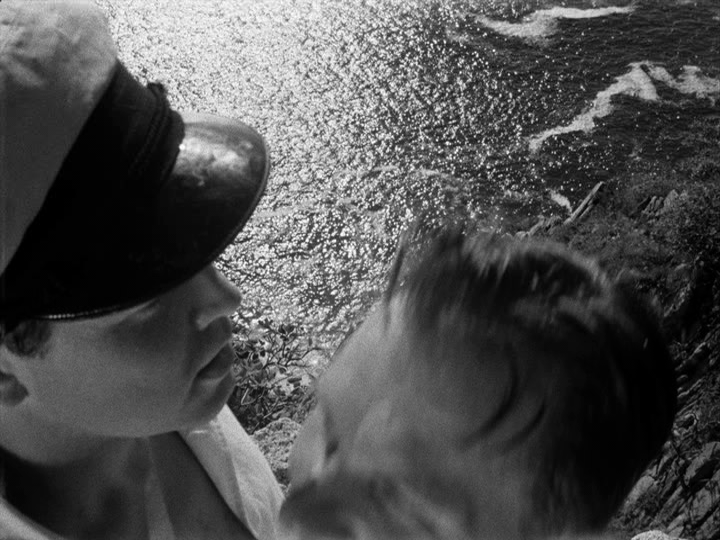
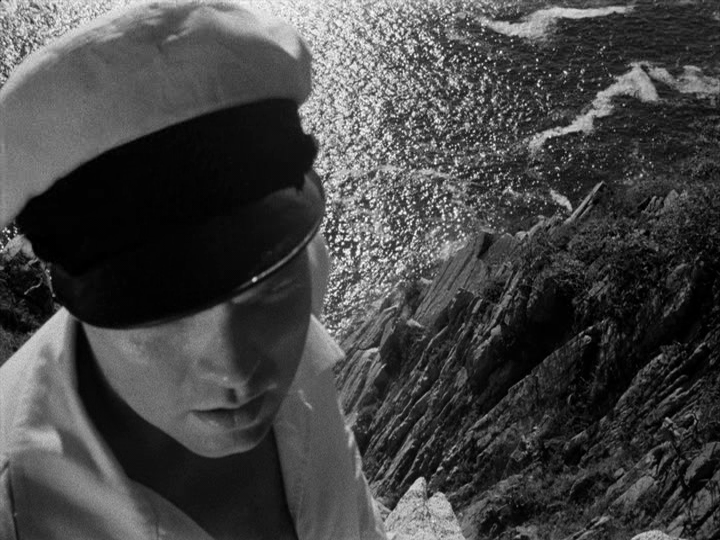
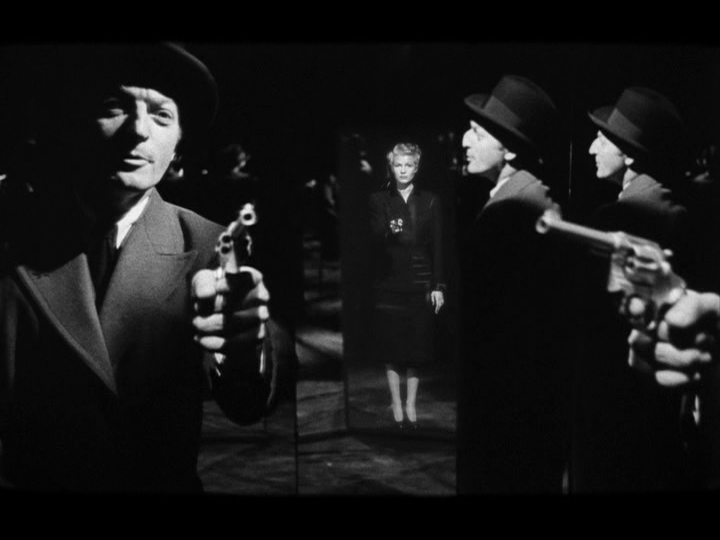
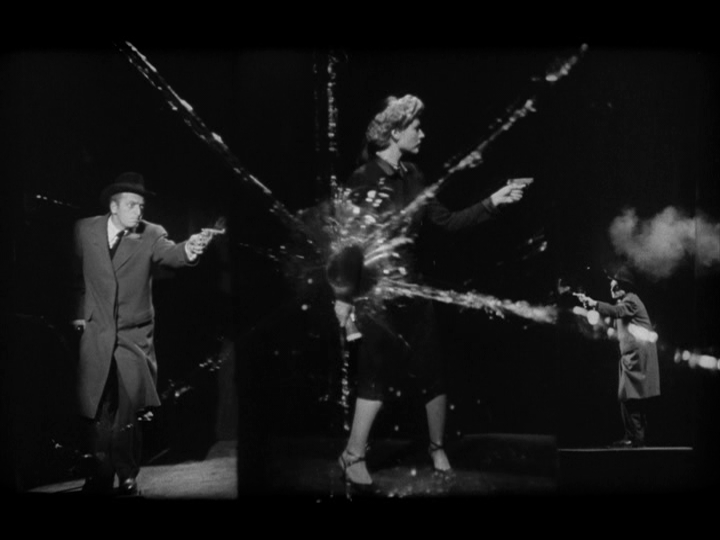
And although I don’t actually have a problem with the way the climactic Magic Mirror Maze shootout sounds today, it’s hard not to be intrigued when Welles tells Bogdanovich that it “should have been absolutely silent except for the crashing glass and ricocheting bullets–like that, it was terrifying.” Even more obviously tragic are the cuts from the final shooting script for the Acapulco sequence which Naremore describes in Biblical terms as depicting Glenn Anders’s George Grisby “tempting” Welles’s Michael O’Hara atop a mountain:
As Grisby and O’Hara stroll up the hillside from the beach, Grisby’s remarks are systematically played off against American tourists in the background, whose conversations about money become obsessive and nightmarish. We see a little girl attempting to get her mother to buy her a fancy drink. “But mommy,” she says, “it ain’t even one dollar!” Then a honeymoon couple walks past. “Sure it’s our honeymoon,” the young man says, “but that’s a two-million dollar account.” An older lady and her husband cross in front of the camera, arguing about taxi fare. “I practically had to pay him by the mile,” the lady complains. A gigolo speaks to a girl seated on a rock. “Fulco made it for her,” he announces. “Diamonds and emeralds–must’ve cost a couple of oil wells. And she only wears it on her bathing suit.” Another young couple walks up the steps from the beach, the man rubbing his nose with zinc oxide as he mutters, “but listen, Edna, you’ve got to realize pesos is real money.” Two girls enter the scene, one of them saying “Heneral–that means General–in the army like. Only this one’s rich.” Meanwhile, through all of this, Grisby babbles about the atomic bomb and the end of the world, ultimately turning and asking O’Hara, “How would you like to make five thousand dollars, fella?”
All that remains of this dialogue are the line from the gentleman afraid of sunburn and the Spanish lesson (although you can also see a couple of the other characters) and as a result all of this meaning is pretty much entirely lost.
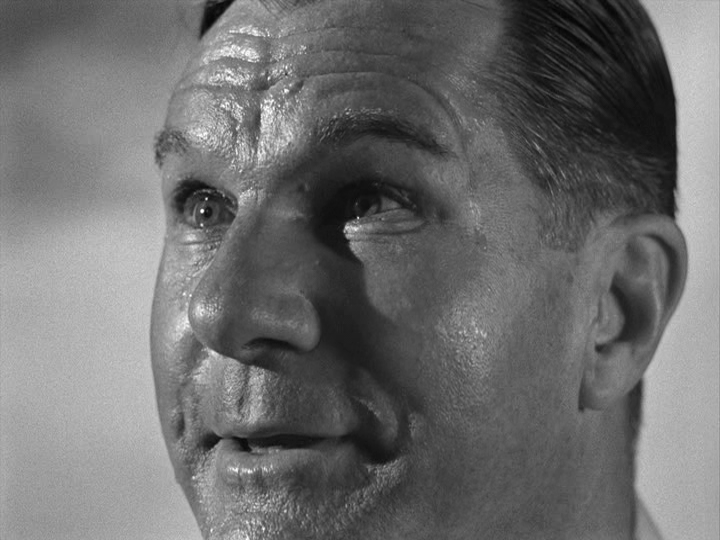
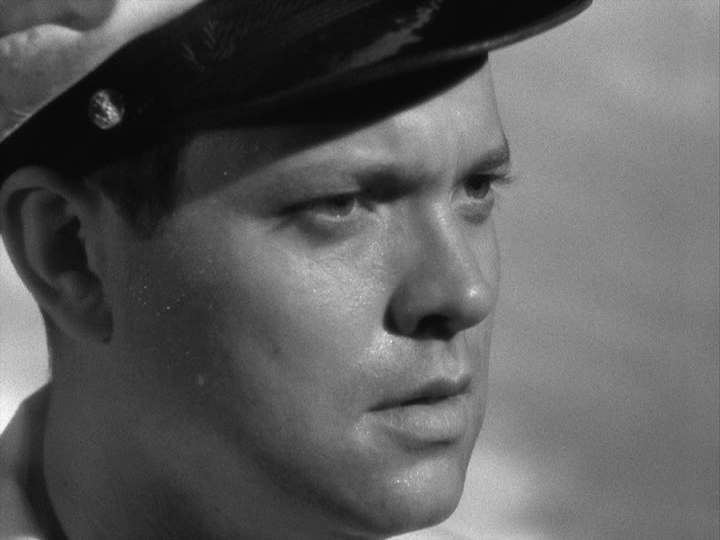
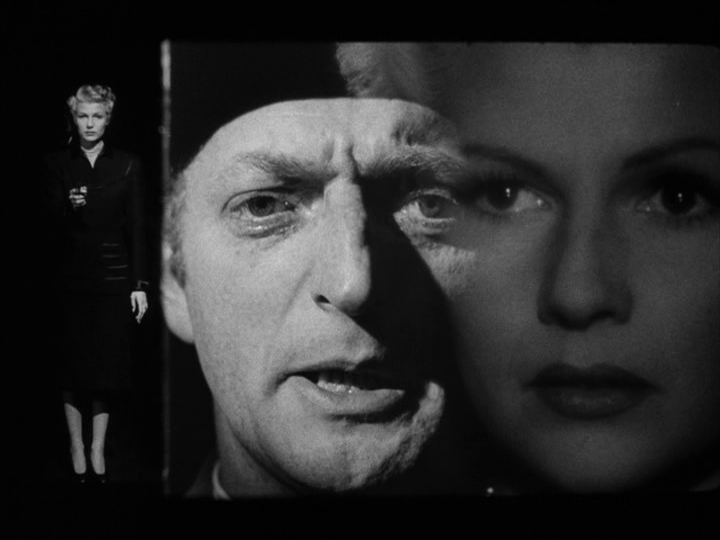
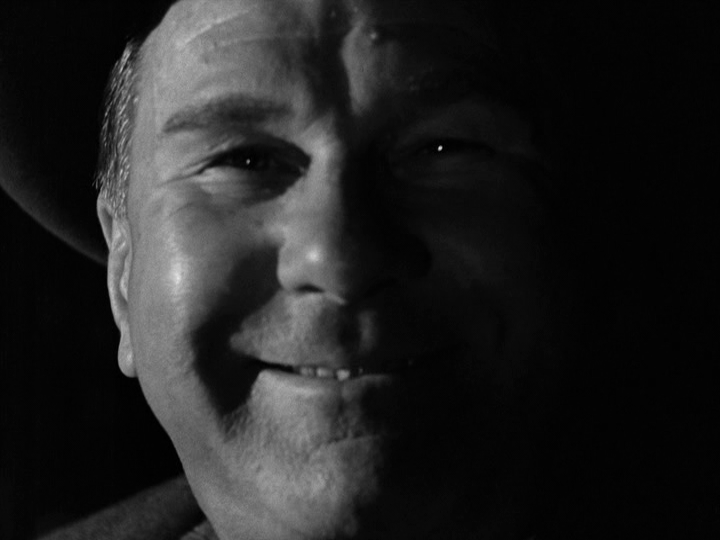
And yet! This scene is nonetheless burned into my memory because it ends with one of my favorite shots in the whole history of cinema. Grisby explains that all Michael needs to do to earn the money he’s offering is to kill someone. “Who, Mr. Grisby?” O’Hara asks. “I’m particular who I murder.” Cut to a sharp-focus close-up of Grisby’s face that contrasts strikingly with a softer one of Michael’s, which Naremore argues is an example of how “glamorous studio portrait photography contributes to the film’s aura of surrealism:
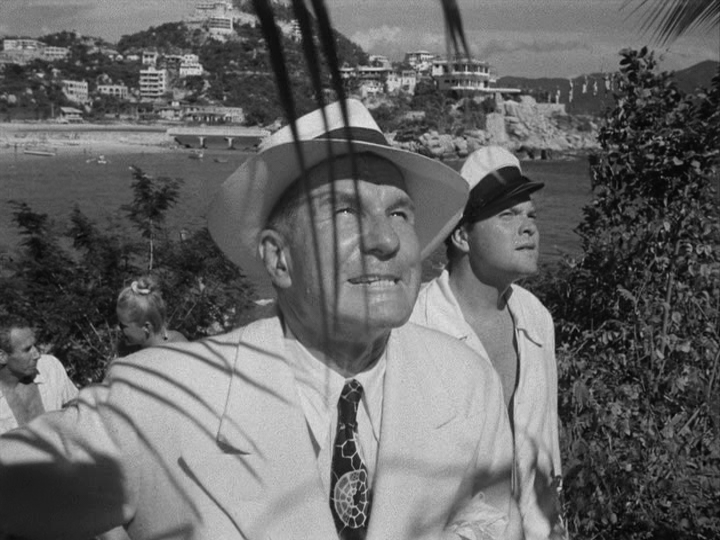
“It’s me,” Grisby says. What follows is brilliantly disorienting because when combined with an earlier establishing shot that places the two men on a sort of parapet:
The high angle perspective makes it look like Grisby is falling off the edge of the frame to his death when he says “so long, fella!” and suddenly steps away:
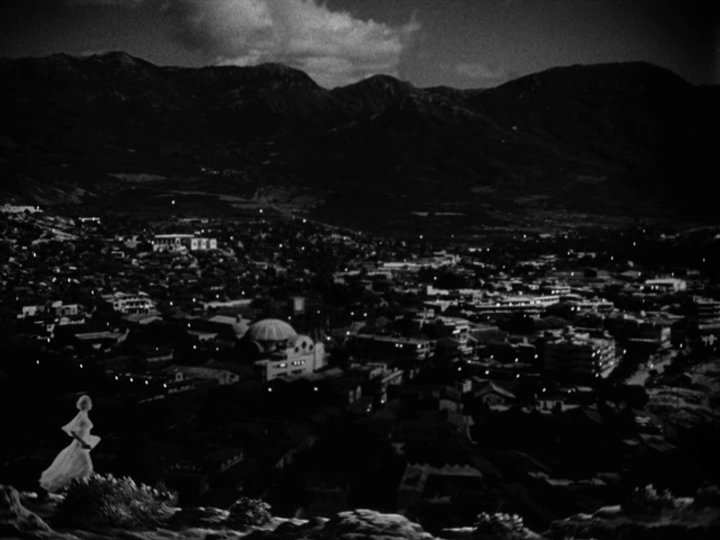
This impression is compounded by the fact that the next scene includes an image of Elsa looking ghostlike as she runs in front of a nighttime cityscape in a white dress:
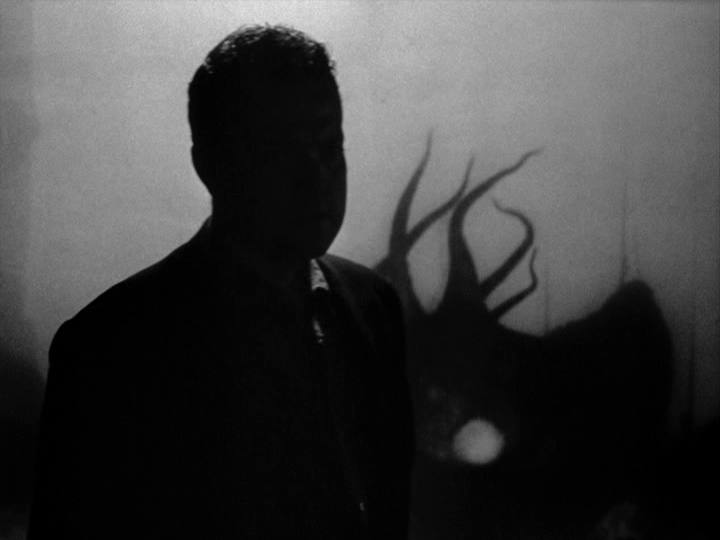
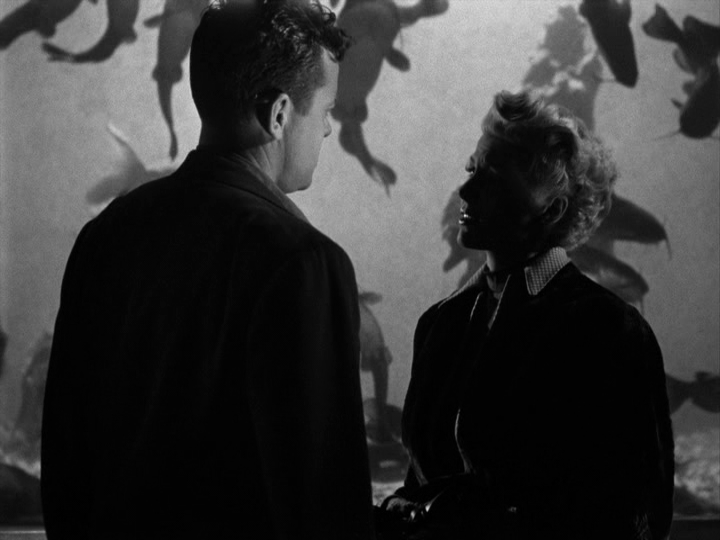
To the point that it’s strange to hear her and Michael talk about Grisby in the present tense. Equally unforgettable is their later meeting in the Steinhart Aquarium, which Brian Darr called “its most striking location shoot” in an article for SFGate, that features them talking in silhouette as sea creatures of symbolic import swim by:
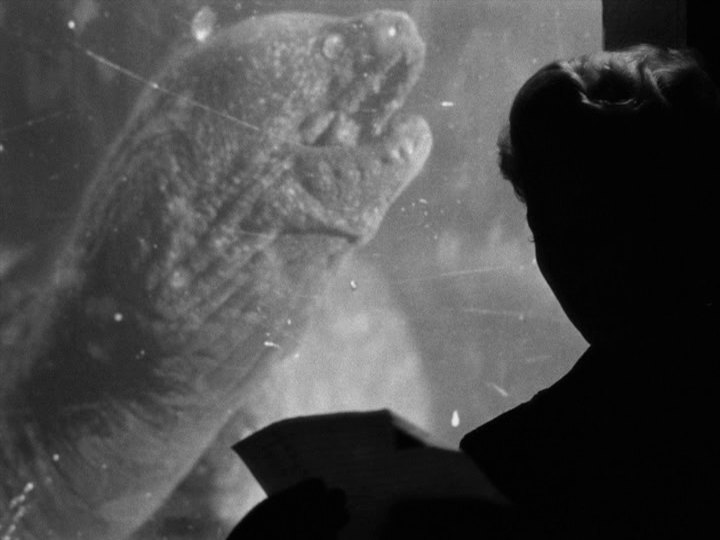
And a moray eel enlarged to monstrous proportions which reminds me of the one at the National Aquarium in Baltimore we visited every snow day when we lived there:
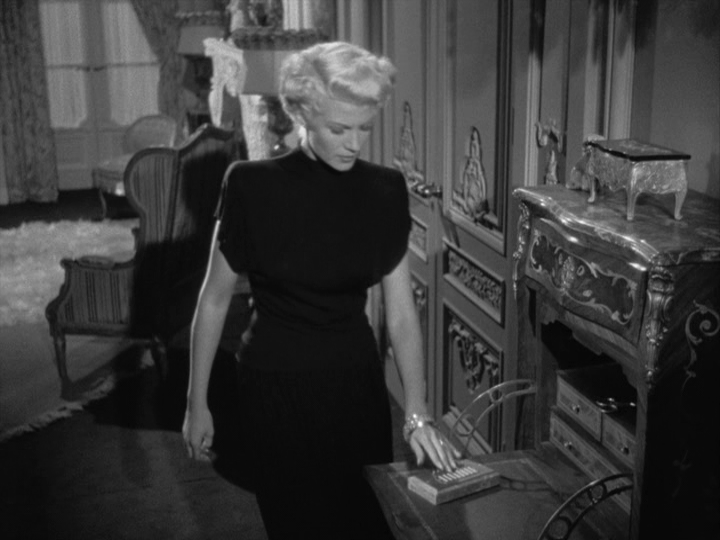
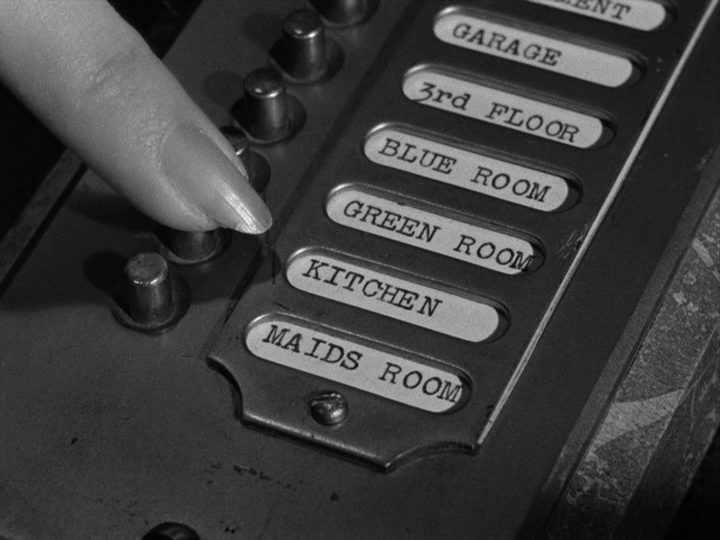
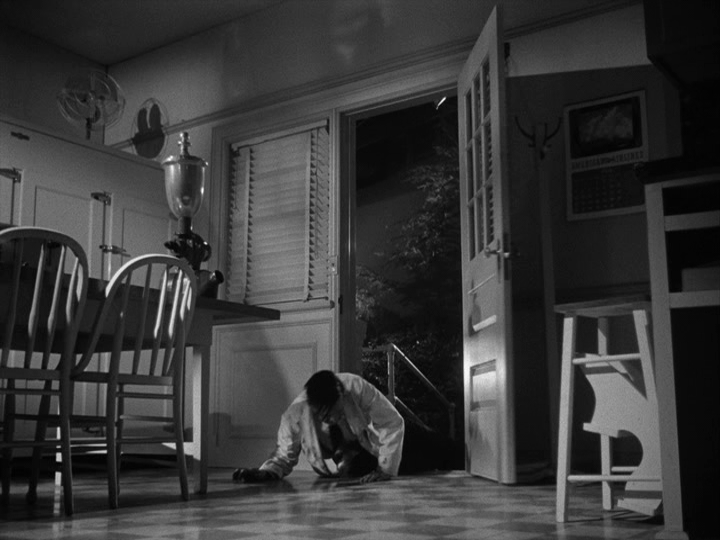
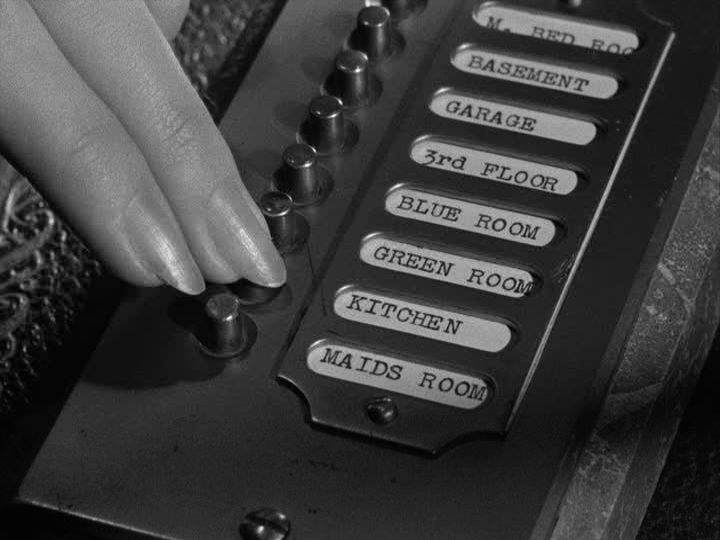
I also love the shots of Elsa stabbing at buttons on an intercom which appear to cause a man who has been shot to burst through a door in another room:
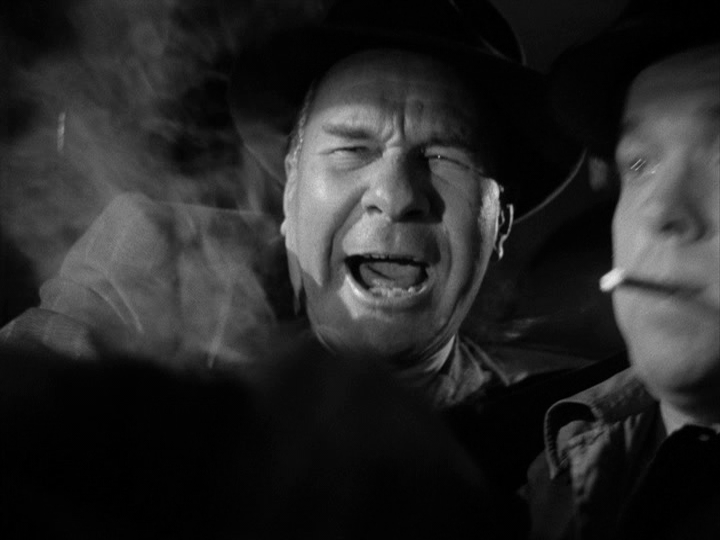
And a car carrying Michael and Grisby to accelerate and collide with the truck in front of it:
Finally, as American Cinematographer amusingly noted, “the climax of the picture, during which the antagonists shoot it out in this mirrored room, is one of those unforgettable cinematic moments that seem to occur all too rarely these days.”
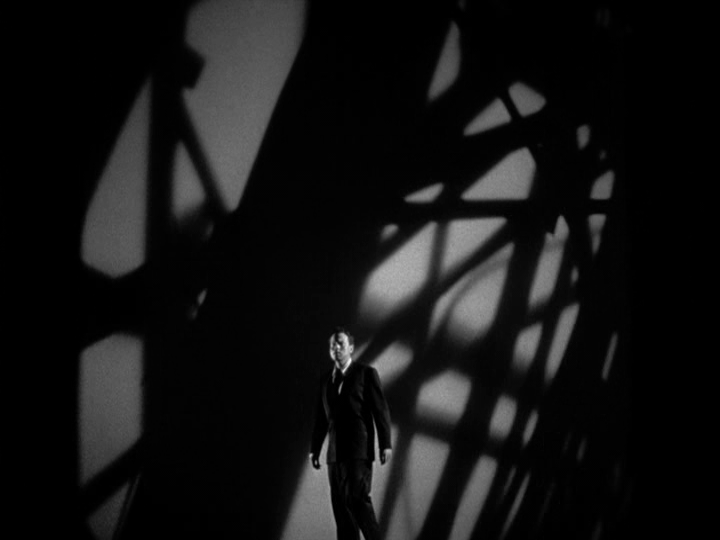
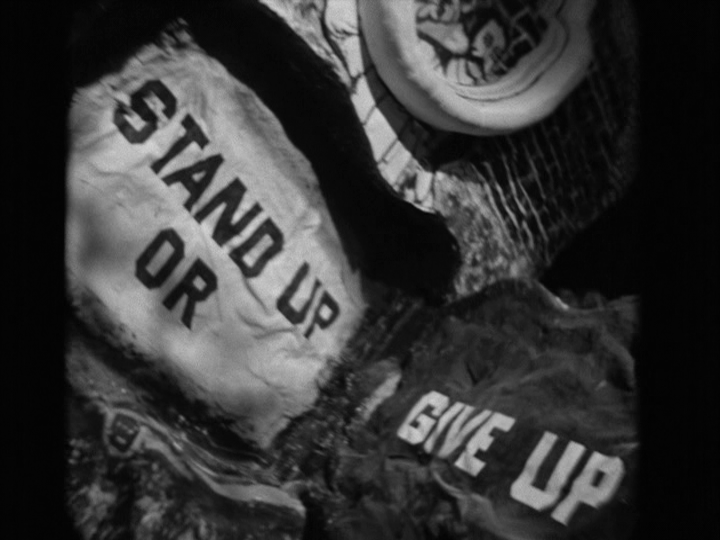
The joke is that those words were written in 1948, not tweeted out yesterday! Sure, the Crazy House sequence that precedes this one, which Welles told Bogdanovich would have been even more acclaimed had it remained intact, is reduced to just 90 seconds of shadows, signs, and slides:
And in the end Naremore concludes that “there is a sense in which all of Columbia’s tampering with the film has not been as disruptive as, say, RKO’s revisions of The Magnificent Ambersons.” To him this is primarily because it is “characterized by a sort of inspired silliness, a grotesquely comic stylization that has moved beyond expressionism toward absurdity.” This certainly is true of Glenn Anders’s performance, which Bogdanovich describes as “free in its eccentricity and eccentric in its freedom.”
I think it’s also because as Robert B. Pippin observes in his book Fatalism in American Film Noir, “Michael plans to be a novelist” and “what we are hearing as the voiceover appears to be the novel he has written after all these events are over,” so the inconsistencies can all be chalked up as bad writing or the sins of an unreliable narrator.
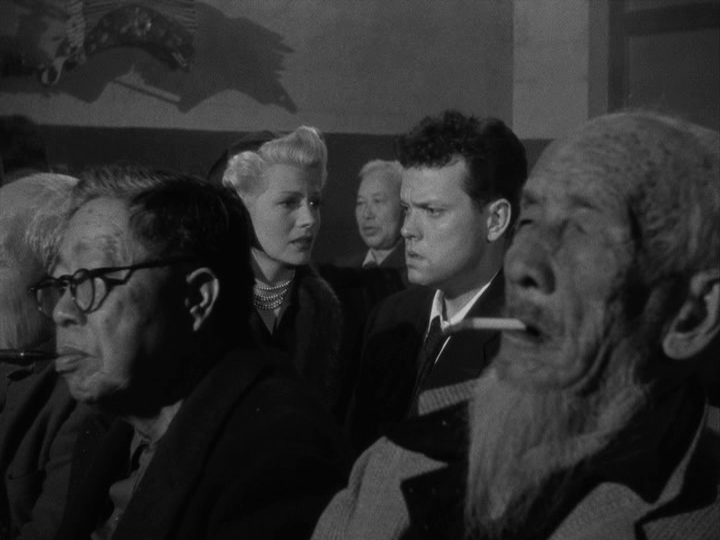
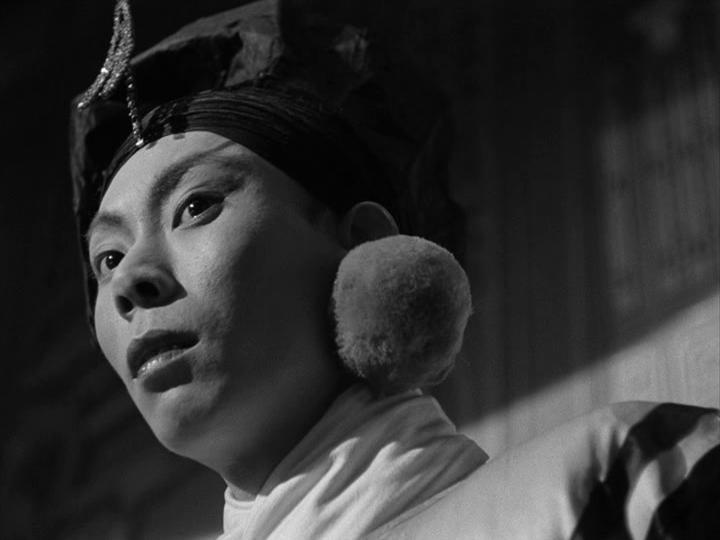
Last but not least Barbara Leaming notes in her biography of Welles that he “read and assimilated [Bertolt] Brecht” shortly before The Lady from Shanghai in preparation for a collaboration that never came to fruition, which to her “explains the peculiar presence of the otherwise incongruous (and hitherto mysterious) Chinese theater sequence toward the end.” Although the translations of the film’s unsubtitled Cantonese dialogue that Kelly Oliver and Benigno Trigo provide in their book Noir Anxiety demonstrate that these scenes are thematically consonant (the opera “performs the trial of a woman accused of being a sinner”) with the rest of the work, her observations that this is also the reason no one in the audience seems bothered by Michael and Elsa talking since “the alienated acting of the Chinese theater is perfectly tolerant of interruptions and disturbances” and that “Brecht writes that the Chinese actor occasionally looks directly at the audience, even as he continues his performance–and so it is in this sequence when the police arrive” remain valid:
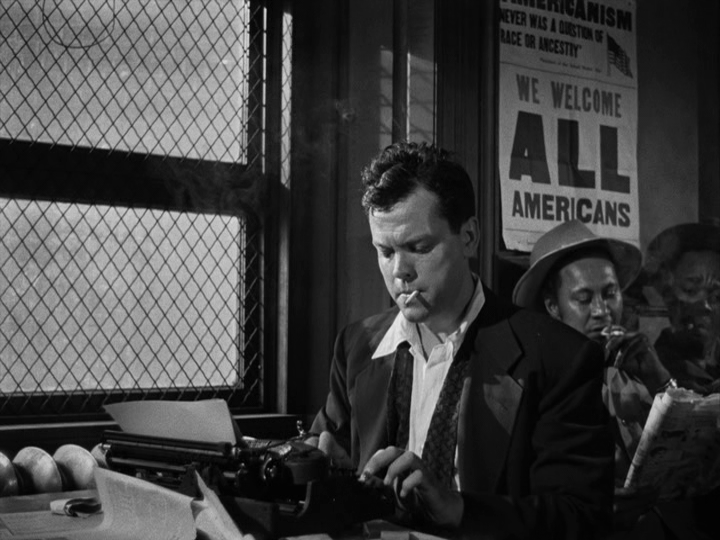
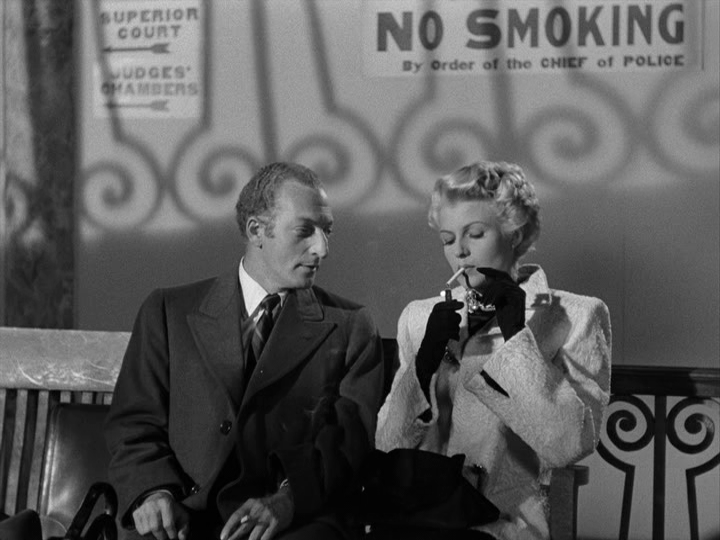
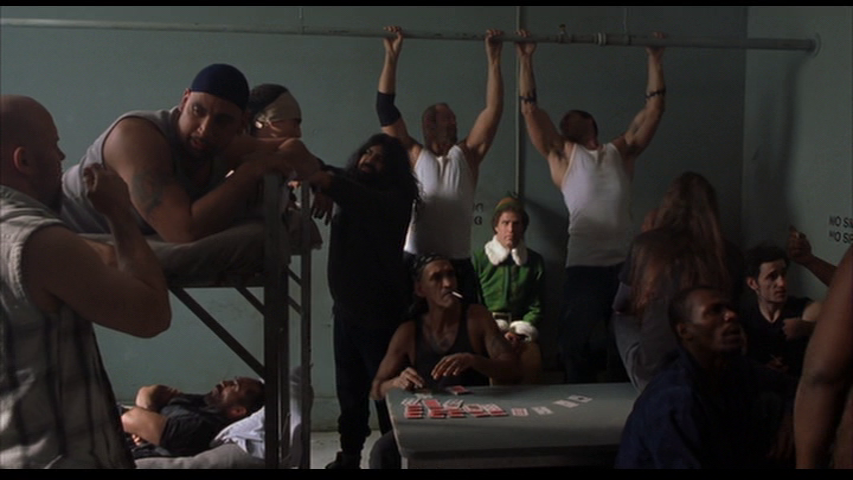
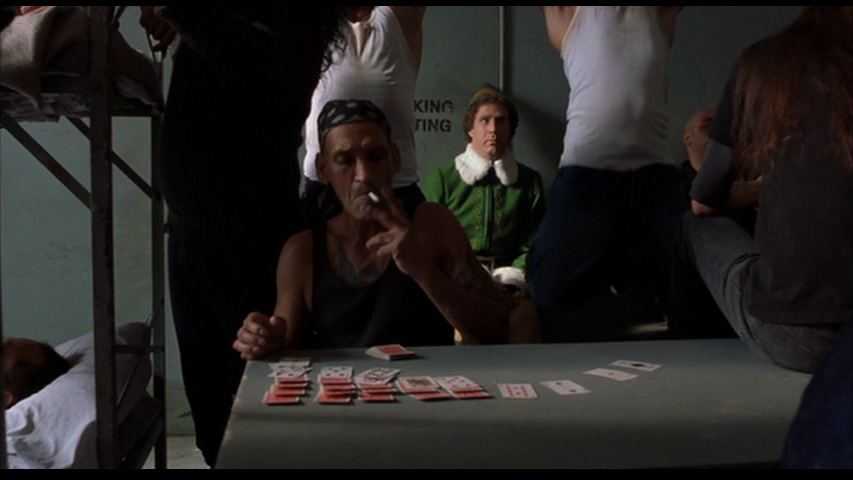
As does her suggestion that “the Chinese theater sequence illuminates the distinctly odd–almost chilly–acting style that permeates the film as a whole.” So, yeah, The Lady from Shanghai is an odd duck of a film! But here’s something even crazier: it also appears to be an inspiration for my December, 2022 Drink & a Movie selection Elf! Compare this shot of two people blatantly flaunting smoking regulations:
With this one:
Which, okay, you’re not convinced. I get it. But consider as well this description of Michael from Joseph McBride’s Welles biography:
Part of what makes Welles’s film so unsettling is the ironic tension between the moral issues and the characters’ apparent lack of interest in them. K.’s whole life in The Trial is changed by his investigation into the principles behind his case, and Quinlan in Touch of Evil spends most of his time rectifying the moral inadequacy of the law; but in The Lady from Shanghai O’Hara treats his legal predicament as only an unpleasant adventure he must get through so he can move on to a more important concern–Elsa Bannister, the lawyer’s wife. Unfortunately, as he discovers, she is the instigator of the whole complex murder plot, and the issues encroach heavily on his fate despite his avoidance of them. At the end he has been forced to formulate a philosophical position similar to the tragic understanding Welles’s other heroes achieve, but of a less definitive nature.
Doesn’t that sound a lot like the exact inverse of the way the contagious goodness of a certain “deranged elf-man” we all know and love teaches a cynical world how to believe again? Something to ponder while you enjoy your drink!
Cheers!
All original photographs in this post are by Marion Penning, aka My Loving Wife.Links to all of the entries in this series can be found here.
What I’m Seeing This Week: My Loving Wife and I are dropping the kids off at a playdate and seeing The Brutalist at Cinemapolis on Sunday, and I’m going to try to see Presence at the Regal Ithaca Mall as well.
Also in Theaters: Although we’re prioritizing The Brutalist for scheduling reasons, I’m actually more excited to see Hard Truths, which opens at both Cinemapolis and the Regal today. Soundtrack to a Coup d’État and Inside the Yellow Cocoon Shell, which screen at Cornell Cinema tonight and tomorrow respectively, have each appeared on at least 30 Best Movies of 2024 lists according to the website CriticsTop10. I fear that I’m going to have to give the latter a miss, but I’m planning to catch the former when it returns to town on February 8. My top recommendations among first-run options that I’ve already seen are Nickel Boys, a formally audacious requiem for those whom the arc of the moral universe didn’t bend fast enough toward justice to save that I anticipate will be my rooting interest for any number of Oscars which continues its run at Cinemapolis, and Flow, my favorite animated film of Movie Year 2024 which plays Cornell Cinema on Saturday and Sunday. Other new movies I enjoyed include Babygirl (the Regal), A Complete Unknown (Cinemapolis & the Regal), Nosferatu (Cinemapolis & the Regal), and The Room Next Door (Cinemapolis). Your best bet for repertory fare is Wild at Heart, which screens at Cinemapolis on Monday in memory of director David Lynch, who passed last Wednesday, but other great options include A Matter of Life and Death and Shadows of Forgotten Ancestors, which are at Cornell Cinema tomorrow and Sunday respectively.
Home Video: Speaking of David Lynch, My Loving Wife and I both chose to celebrate his life by finally watching movies directed by him which we’d never seen before. I was lucky enough to first encounterMulholland Drive at the Squirrel Hill Theater (RIP) during its original theatrical run with a bunch of other members of the University of Pittsburgh’s Twin Peaks Club , but she somehow never got around to it. Although Blue Velvet was my first love and Dune will always hold a special place in my heart, this is probably the David Lynch film I’d pick as my favorite. Meanwhile, I’d always understood The Straight Story to be a skippable aberration in his filmography, but this is not at all the case: for all of his weirdness, Lynch also valued sincerity, and this film is as pure a distillation of that aspect of his sensibility as the eighth episode of Twin Peaks: The Return is of another. Both are highly recommended, as is everything else Esther Zuckerman mentions in her New York Times article “12 Cryptic Titles From David Lynch and Where You Can Stream Them.”
Previous “Ithaca Film Journal” posts canbe found here.A running list ofall of my “Home Video” recommendations can be found here.
Also in Theaters: It’s officially awards season at the Regal Ithaca Mall! Oscar nominations were originally scheduled to be announced tomorrow, and although this has been pushed back to next Thursday because of the devastating wildfires in California, contenders have started to reappear on the Regal’s screens. My top recommendation among the first batch is Anora, which screens Friday-Saturday and Tuesday-Wednesday. Additional titles returning to town this week include Conclave, The Substance, and The Wild Robot. Other new movies that I enjoyed include Babygirl (Regal), Nosferatu (Cinemapolis + the Regal), and A Complete Unknown (Cinemapolis + the Regal) in that order. I also hear good things about Better Man, so hopefully it will stick around at the Regal for at least another week. You have one last chance to see The Umbrellas of Cherbourg at Cinemapolis this evening, and that definitely should be your highest priority for repertory fare, but there’s also a free screening of the Marx Brothers vehicle A Night at the Opera there on Sunday as part of their “Family Classics Picture Show” series. Another fine choice would be The Goonies, which has 40th anniversary (typing that made me feel SO old) screenings at the Regal on Sunday and Monday. On the special events front, there will be a free screening of the documentary Move When the Spirit Says Move at Cinemapolis on Monday followed by a panel discussion about subject Dorothy Foreman Cotton.
Home Video:Green Border, one of the candidates for my top ten list for Movie Year 2024 (which as always I’ll publish in March), is currently available on Kanopy to all current Cornell University faculty, students, and staff thanks to a license paid for by the library. As a multifaceted view of the Belarus-Poland border crisis which began in 2021 when the government of Belarus disingenuously began offering refugees free passage into the European Union, it is topical, but seeing it shortly after Come and See underscored for me the extent to which it, too, is an anti-war film. As I wrote on Letterboxd:
Although it tragically comes at the cost of thousands of innocent lives, the path out of Green Border‘s hellscape is littered with less and less bodies as it progresses. People who are not desperately fighting for their own survival retain the capacity to be shocked into action by exposure to violent acts that their citizenship makes them complicit in, whereas war inevitably breeds future conflicts: the earlier film’s Belarusian victims of Nazi atrocities are themselves the instigators of this one’s new cycle of dehumanization.
It also contains powerful individual moments like the image of a mother squeezing a meager harvest of water droplets from the branches of an evergreen into the mouth of her child and a sickening thud that you’ll recognize when you hear it which I won’t soon forget.
Previous “Ithaca Film Journal” posts canbe found here.A running list ofall of my “Home Video” recommendations can be found here.
What I’m Seeing This Week: My Loving Wife and I have a babysitter and are going to go see Nosferatuat either Cinemapolis or the Regal Ithaca Mall this weekend!
Also in Theaters: My favorite new film now playing Ithaca is Babygirl, which as Alexis Soloski recently noted in the New York Times is part of a bumper crop of “age-gap romances centered on women in midlife” that also includes this week’s home video recommendation. Its final scenes literalize the notion that a failure to communicate is the root of all interpersonal conflicts a bit too much for my tastes, but you can easily imagine Nicole Kidman’s Romy Mathis ending up someplace very different, and the film absolutely gets credit for that. She and male co-lead Harris Dickinson are terrific, as is Antonio Banderas in a supporting role. Babygirl closes at Cinemapolis today but continues its run at the Regal at least through Thursday. I also enjoyed A Complete Unknown, which is at Cinemapolis and the Regal all week. I’m intrigued by The Last Showgirl, which opens at both of those theaters this week, and Better Man, which opens at the Regal, but alas my schedule only permits me to see one movie. On the repertory front, the 4k restoration of The Umbrellas of Cherbourg at Cinemapolis for one week only should be your top choice if you’ve never seen it. I wrote about director Jacques Demy’s next film The Young Girls of Rochefort last February if you’d like some sense of what you’re in for. But seriously: just go!
Home Video: Last Summer, which is now streaming on the Criterion Channel, is similar to Babygirl in that it also features a female protagonist in her 50s who is depicted as sexy and a plot that revolves around implications and after effects of her having sex with a much younger man. Or boy, maybe, in this case. Here she’s named Anne and played by Léa Drucker, who in the words of David Ehrlich (speaking of The Umbrellas of Cherbourg and The Young Girls of Rochefort) “still faintly resembles a young Catherine Deneuve” and he’s played by Samuel Kircher, a 21-year-old in real life whose character Théo is still in high school in the film. Oh yeah, and he’s Anne’s stepson. But while that may sound lurid and sensational, where Babygirl is specifically about the difficulty of achieving both personal and professional fulfillment when the deck is stacked against your gender, Last Summer is about the even more general disturbing urge to throw it all away that I suspect many people who “have it all” will identify with.
Previous “Ithaca Film Journal” posts canbe found here.A running list ofall of my “Home Video” recommendations can be found here.
Also in Theaters: The best new movie now playing in Ithaca that I’ve already seen is A Complete Unknown, which is at both Cinemapolis and the Regal Ithaca Mall. Timothée Chalamet’s Bob Dylan turning the members of the “teaspoon brigade” of Edward Norton’s Pete Seeger against themselves is a destined to be a great movie metaphor for the comeuppance of whatever holier-than-thou movement you think is only getting what they deserved, I enjoyed its depiction of early 60s Greenwich Village (played here by Jersey City) as a place with ambient crackling energy, and the music is of course excellent. Nosferatu, which is also at both Cinemapolis and the Regal, would be what I’m seeing this week, but I’m saving it for a date night with My Loving Wife. Gladiator II (Regal), Moana 2 (Regal), and Wicked (Cinemapolis & the Regal) are all fine. Your best bet for repertory fare is the classic anime film Paprika, which screens at the Regal on Wednesday, although I’m not sure how 2025 qualifies as its “15th anniversary.”
Home Video: La Chimera, which is now streaming on Hulu, will appear on my year-end top ten list on the strength of its treatment of the theme that there’s more to a good life than just being happy and a bevy of brilliant little touches like the list the smile Alba Rohrwacher’s Spartaco gives Josh O’Connor’s Arthur after he takes capricious action to temporarily (she will, of course, be back) resolve the question of how a certain piece of statue is worth, the disheveled suit Arthur wears at the beginning of the movie, Valentino Santagati and Piero Crucitti’s cantastorie, and a shot from inside an Etruscan tomb which is about to be unsealed for the first time in thousands of years. If you aren’t yet sick of Christmas movies, director Alice Rohrwacher’s 2022 short film Le pupille, which is available on Disney+, is also very much worth checking out.
Previous “Ithaca Film Journal” posts canbe found here.A running list ofall of my “Home Video” recommendations can be found here.
I’m going to wait until closer to Oscar night like I always do to pick my ten favorite movies of the year, since many of the top contenders (including The Brutalist, Hard Truths, and Nickel Boys) haven’t made it to Ithaca yet. I am, however, happy to usher in 2025 by sharing my 2024: The Mixtape, Vol. 2 Spotify playlist and new year’s resolutions for the blog! As usual, the songs which made it on the former shouldn’t *necessarily* be regarded as my choices for the “best” new music that has been released since I published Vol. 1 in June, but this is what I’ve been listing to on heavy rotation, so there’s a lot of overlap with any such list I might make. Here’s the track listing:
Miranda Lambert – “Ain’t In Kansas Anymore”
Osees – “Earthling”
Mount Eerie – “I Saw Another Bird”
Jamie xx feat. The Avalanches – “All You Children”
Gillian Welch & David Rawlings – “The Day The Mississippi Died”
Dame Area – “Si No Es Hoy Cuándo Es”
Johnny Blue Skies – “Right Kind of Dream”
Been Stellar – “I Have the Answer”
Billy Strings – “In the Clear”
Toro y Moi feat. Kevin Abstract & Lev – “Heaven”
Father John Misty – “I Guess Time Just Makes Fools of Us All”
Charley Crockett – “Ain’t Done Losing Yet”
Kim Dracula & Alex Boniello – “Going Down”
Los Campesinos! – “Feast of Tongues”
Fucked Up – “Paternal Instinct”
Doechii – “BOILED PEANUTS”
Anna McClellan – “Like a Painting”
Being Dead – “Ballerina”
Jessica Pratt – “Life Is”
Luke Combs – “Ain’t No Love in Oklahoma”
The mix begins and ends with songs from the soundtrack for Twisters, which I still think is the year’s best, and I’m using them to try to set up a rough double narrative: tracks 1-10 have an otherworldly The Wizard of Oz/The Man Who Fell to Earth vibe, while tracks 11-20 chart a path from disillusionment and anger to acceptance and determination.
As far as new year’s resolutions go, my ones for 2025 are pretty straightforward. If I publish thirteen Drink & a Movie posts over the upcoming twelve months like I’m planning to, I’ll be just one away from my ultimate goal of 54, so that’s my top priority. I’d also like to figure out a long-overdue social media strategy of some sort which preserves my desire to not spend too much time online, but exposes me to content from the people I want to follow who have migrated from X to Bluesky, Threads, and other platforms. On the personal front I’m boringly going to try to run more, drink less, and not fiddle so much with my fantasy football team. In other words, I’m fortunate enough to be in a pretty good spot in my life right now and am hoping to keep on keeping on!
Thanks for reading, and Happy New Year!
Links to previous mixes I’ve posted about can be found here.
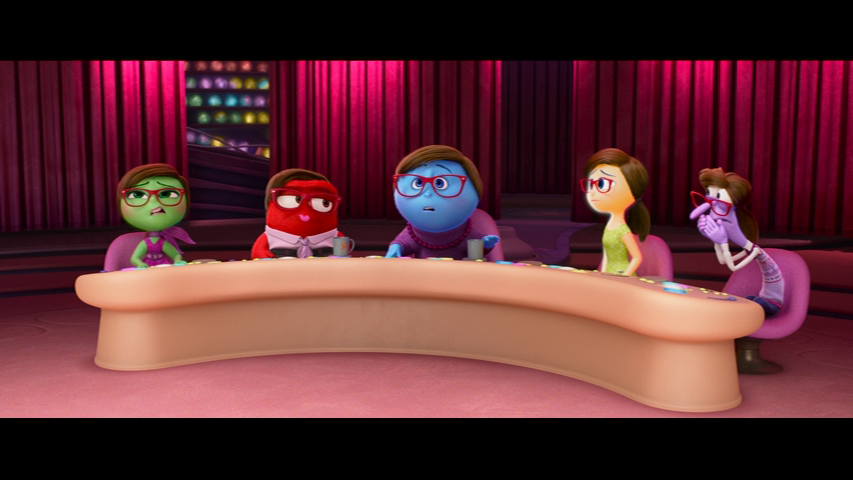
I can’t help but wonder what determines which emotion is ascendent. Is it just whichever one appears first? If so, this would justify Phillips’ support for the fact that in the Inside Out universe controlling your anxiety looks like “sitting her down in a cozy recliner with a cup of tea.” But could a person who isn’t anxious all the time have a mind where Anxiety is in the driver’s seat but takes advice from other emotions in much the same way that Sadness and Anger do in the case of her parents? Suddenly I find myself eager to spend some time with Inside Out 2 after it comes out on DVD (hence the “Part One” in the title of this post) to see if it offers any hints!
Unfortunately, a second viewing of the sequel didn’t shed much light on the matter. We get just brief glimpses into the command centers of only four characters other than Riley. “Well, we all knew this day would come,” says Riley’s mom’s Anger (Paula Pell) the morning after Riley enters puberty, in reply to which her Sadness (Lori Allen), who is in the driver’s seat, reminds everyone to remain calm and “stick to the prepared script.” She then pushes a button that causes Riley’s mom (Diane Lane) to launch into a speech about a “beautiful butterfly”:
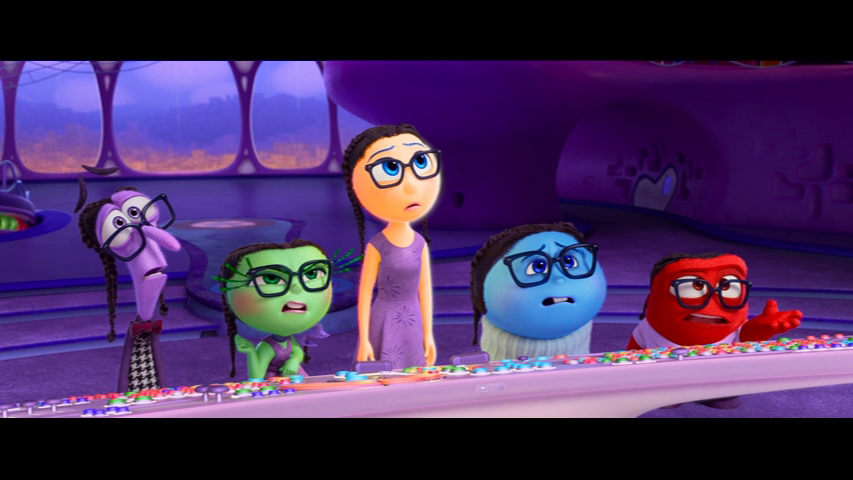
Next, we see the emotions of Riley’s friends Bree (Sumayyah Nuriddin-Green) and Grace (Grace Lu) during a conversation that ends with Riley discovering they won’t all be going to the same high school like she thought:
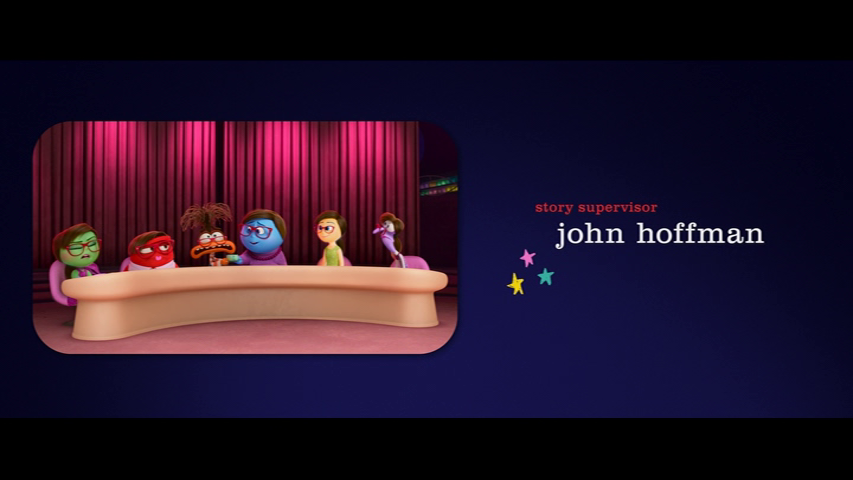
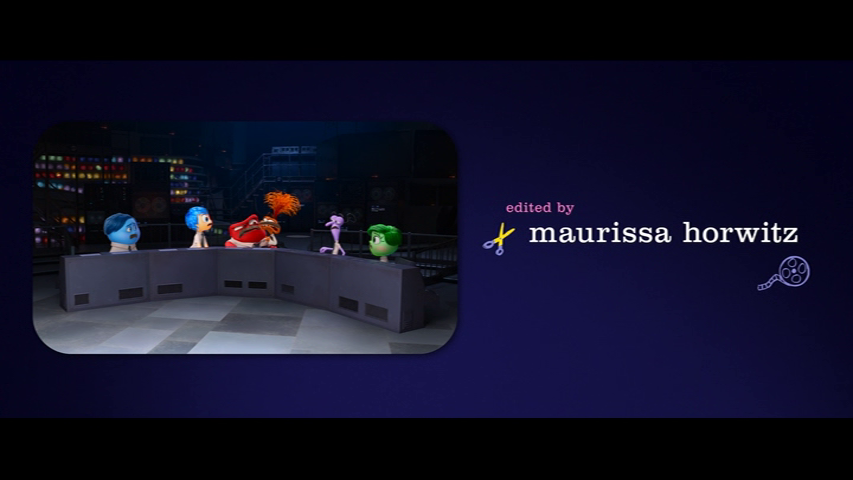
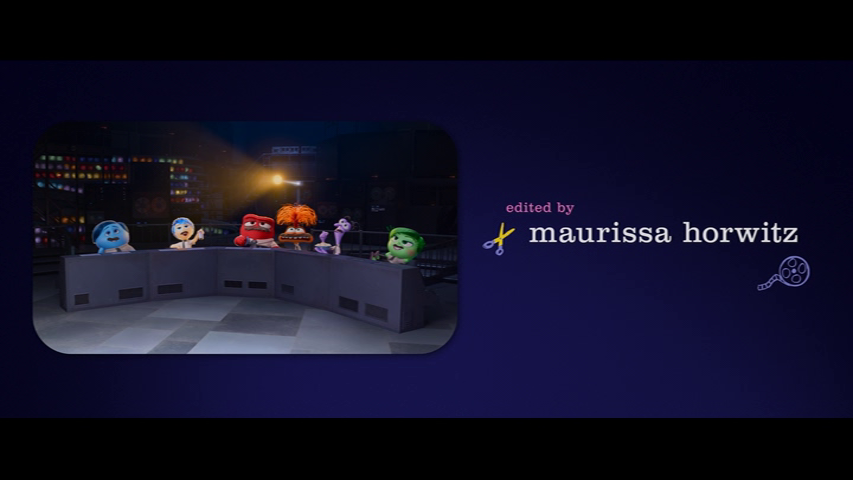
Their positioning suggests that Joy is in charge of Bree’s emotions (left) and Fear is in charge of Grace’s (right), which seems to match what little we know about each girl, but this is obviously inconclusive. Finally, we meet someone else’s new (since the last film) emotion for the first time when Riley’s mom and dad (Kyle MacLachlan) react to her terse (“it was good”) response to a question about how the sleep-away hockey camp she just got back from was during the end credits. “What about the red in her hair? Did she join a gang?” worries her mom’s Anxiety (Mona Marshall), to which her Sadness replies, “welcome back” and hands her a cup of tea:
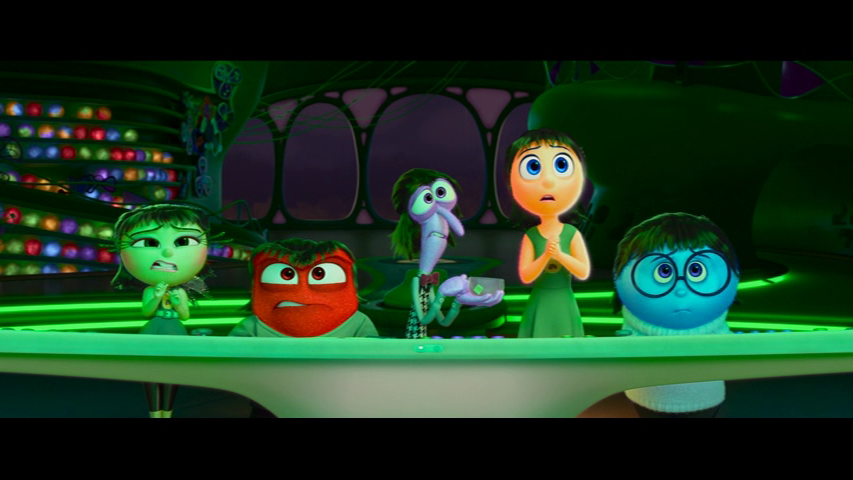
Then Riley’s dad’s Anxiety (Roger Craig Smith) bursts into his command center and cries, “she goes away for three days and all we get is ‘good’?”
“Yeah, sounds right, back to the game,” says his Anger (Pete Docter):
Interestingly, a popping can sound effect indicates that at least one of his emotions (Joy?) may be drinking a beer, which connects his response to Anxiety to that of his wife and daughter. As mentioned by Phillips, a calming beverage is also how Riley’s emotions control their Anxiety:
That’s it for new evidence, though, so I guess we’ll have to wait for a third installment in the franchise to learn whether a peaceful coup is possible in the Inside Out universe or if the only minds dominated by Anxiety are unhealthy ones.
Also in Theaters: The new releases mentioned above account for most of our local big screen real estate, but holdovers worth considering if you’re in the mood for something different include the sequels Gladiator II and Moana 2, which continue their respective runs at the Regal, and Wicked, which is at both the Regal and Cinemapolis. It’s understandably a light week for special events and repertory fare, but there *is* a “sing-along” screening of Wicked at the Regal every day at 11:10am if that sounds like your thing.
Home Video: The greatest New Year’s Eve movie of all time is indisputably (I assume) The Phantom Carriage, but I already recommended it in this space last October. Number two on my list is the first Coen brothers film I ever fell in love with, The Hudsucker Proxy which can be streamed on the Criterion Channel through the end of the month/year. It’s a particularly great choice if you’re ready to move on from whatever other winter holiday(s) you celebrate, since it’s set in a universe in which none of them seem to exist. If you aren’t a Criterion Channel subscriber, you can also watch it on Tubi if you don’t mind ads.
Previous “Ithaca Film Journal” posts canbe found here.A running list ofall of my “Home Video” recommendations can be found here.
Thanksgiving dinner was one of the first meals I ever taught myself to cook. My roommates and I moved off campus prior to our sophomore year at the University of Pittsburgh, and to our delight we learned that we could earn a free turkey by accruing points when we did our grocery shopping at the local Giant Eagle. Thus was born an annual “Friendsgiving” tradition which became my earliest foray into wine pairing when I turned 21. Having no real idea what I was looking for, it’s little wonder that I gravitated toward the endcaps laden with colorfully-labeled Beaujolais nouveau. Although it’s no longer a fixture on my holiday table, I usually can’t resist the urge to pick up a bottle or two every year for old time’s sake. Most (including this year’s selection, the Clos du Fief Beaujolais-Villages Nouveau La Roche 2024 I purchased from Northside Wine & Spirits) are genuinely enjoyable on their own, but my preferred use for them is in Jim Meehan’s Nouveau Sangaree from The PDT Cocktail Book. Here’s how to make it:
2 ozs. Beaujolais nouveau (Clos du Fief Beaujolais-Villages Nouveau La Roche 2024) 1 1/2 ozs. Bonded apple brandy (Laird’s 10th Generation) 1/2 oz. Sloe gin (Hayman’s) 1/4 oz. Maple syrup 2 dashes Angostura bitters
Stir all ingredients with ice and strain into a chilled cocktail glass. Garnish with grated cinnamon.
As Robert Simonson said when writing about this drink for the New York Times, “sloe gin and maple syrup remind you that life should be sweet during the holidays.” The former amplifies the floral and fruity notes of the wine, while the latter creates a creamy texture and combines with the caramel and vanilla flavors of the applejack to linger on the palate. The overall impression is something like a poached pear. Meehan’s recipe specifically calls for “Grade B” maple syrup, but as I mentioned back in August, 2022 that rating no longer exists, so use “Grade A Dark Robust” or just the best stuff you can find. Finally, he employs an apple fan garnish, which probably would announce the presence of the brandy more clearly, but this is a bit fussy for us and we’re happy with just grated cinnamon.
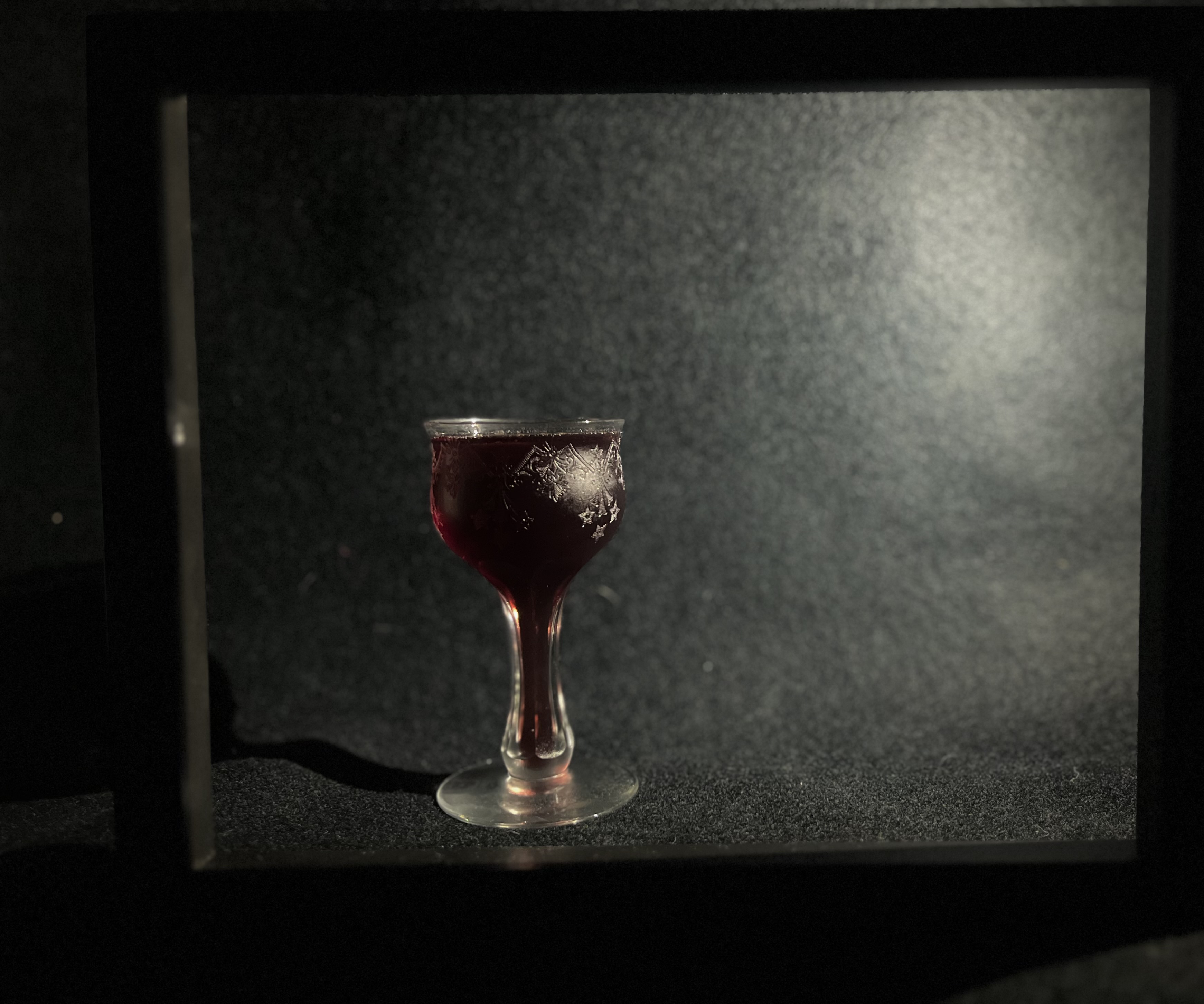
The movie Playtime is a perfect match for this beverage because its centerpiece Royal Garden sequence embodies the celebratory and improvisational nature of the celebrations from my 20s I want to commemorate. They’re also both great fits for the month of December. In the case of the cocktail that’s because it can help use up leftover bottles of wine, while the movie employs a seasonally-appropriate green and red color scheme to great effect. Here’s a picture of my Criterion Collection DVD copy of the latter:
It can also be streamed on the Criterion Channel with a subscription and rented from a variety of other platforms, and some people (including current Cornell University faculty, staff, and students) may have access to it through Kanopy via a license paid for by their local academic or public library as well.
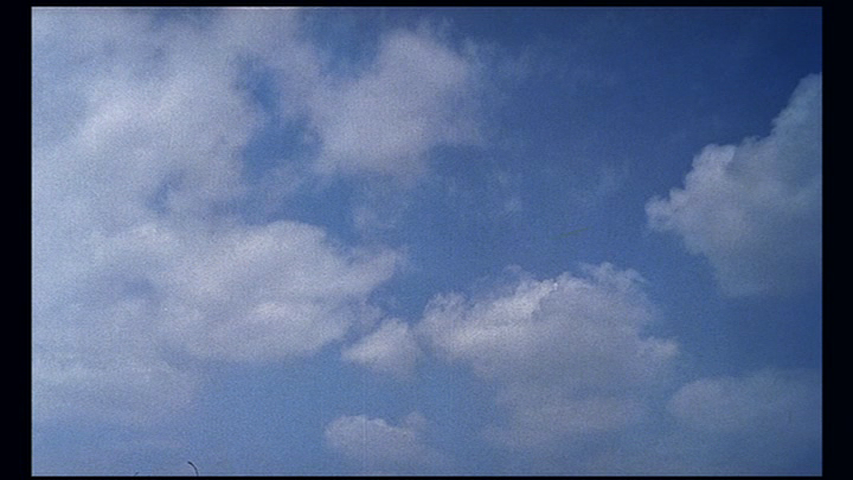
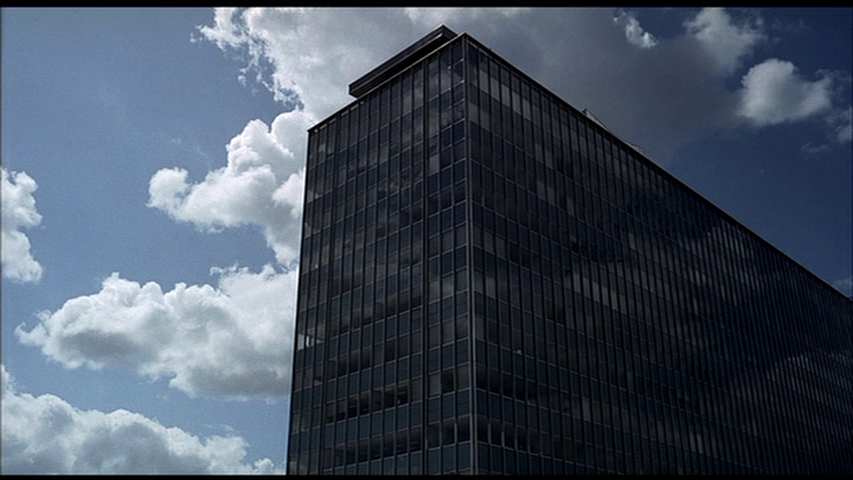
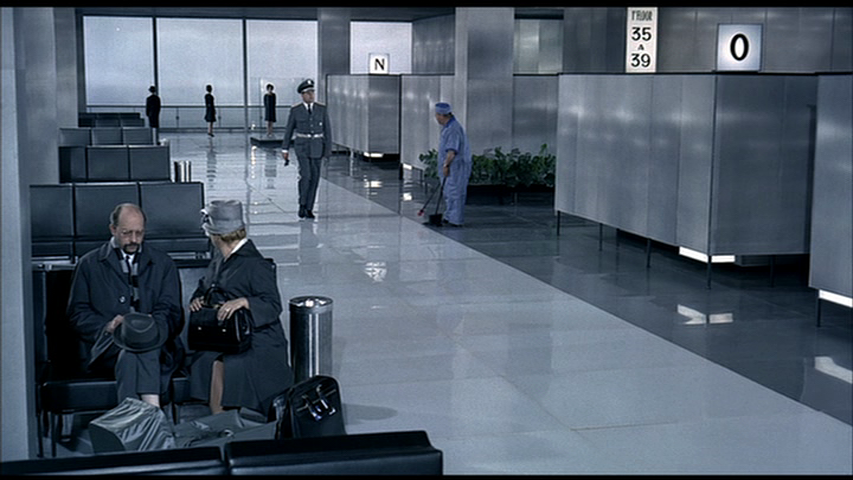
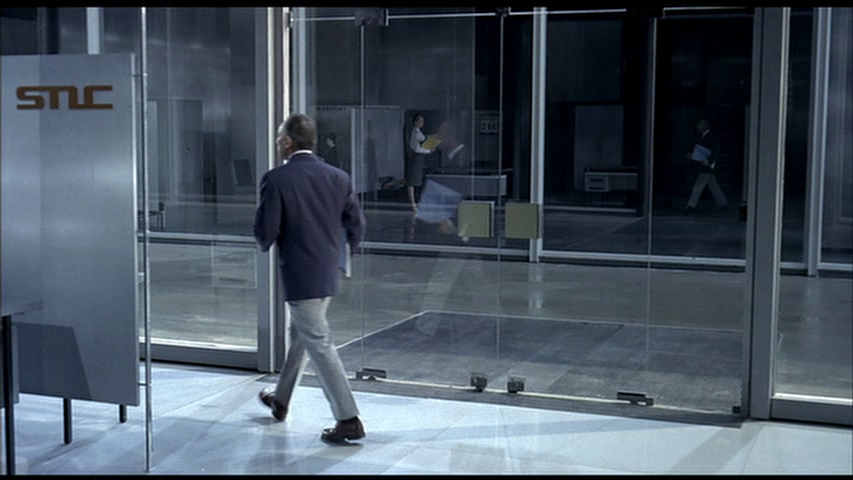
Playtime begins in a place that My Loving Wife, watching it for the first time, assumed was some sort of anteroom to the afterlife, a reading that I imagine director Jacques Tati would have loved. An opening credits sequence featuring clouds, which ties it to some of my other favorite movies, gives way to an establishing shot of a glass and steel skyscraper:
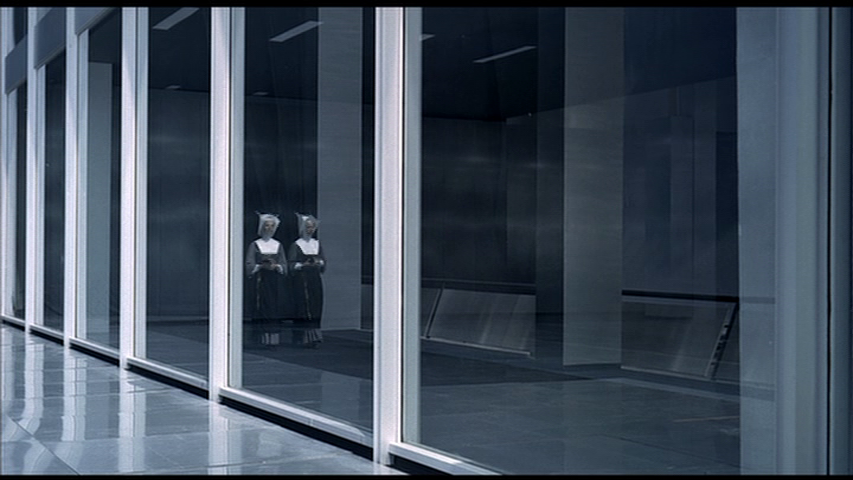
The first human beings we see are two nuns:
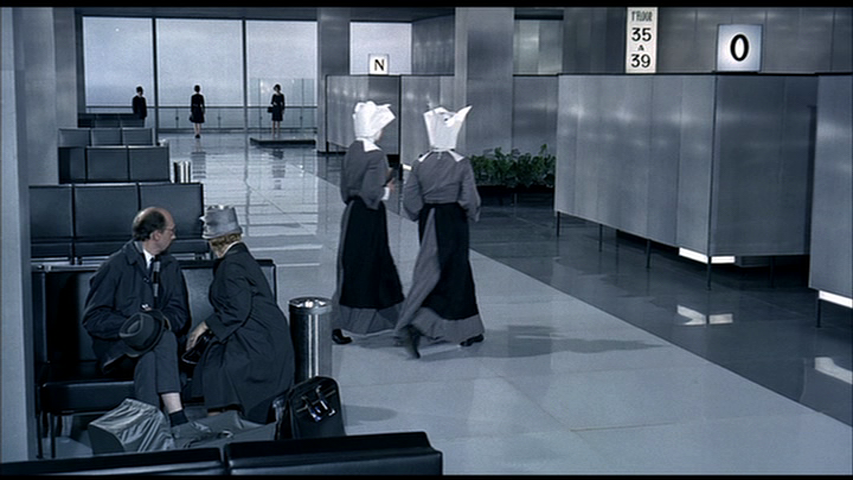
And a cut on motion sets up the film’s first gag. Two people, a man and a woman, talk in the foreground.
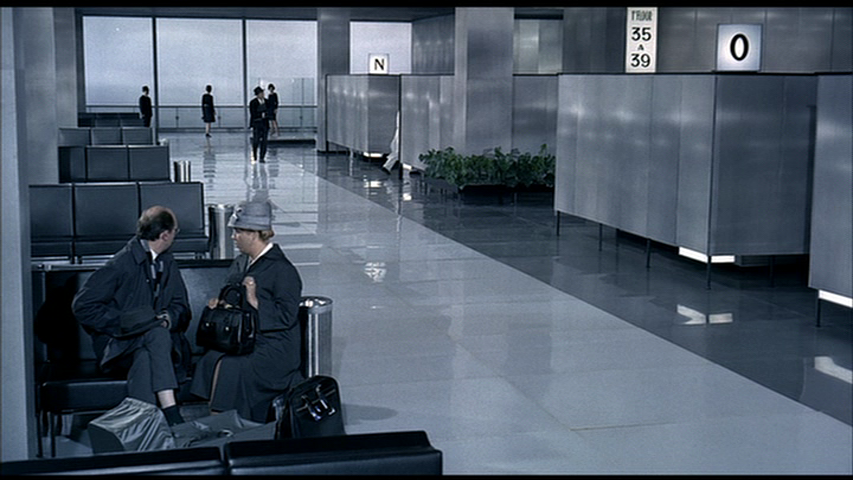
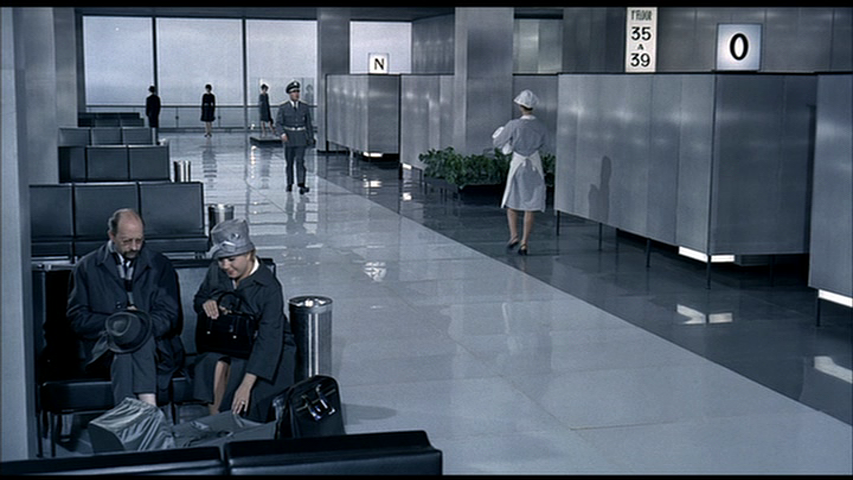
We can tell from their conversation that he’s going somewhere: “wrap your scarf around so you don’t catch cold,” his companion tells him, and “take care of yourself.” They also talk about the other people who appear in the frame with them, including first a man who “looks important” and then “an officer”:
It’s only when a woman who looks like she could be a nurse carrying a bundle of towels that resemble an infant in swaddling clothes appears accompanied by the sound of a baby crying that we notice the gray stroller in front of them which up until this point had completely blended into its surroundings:
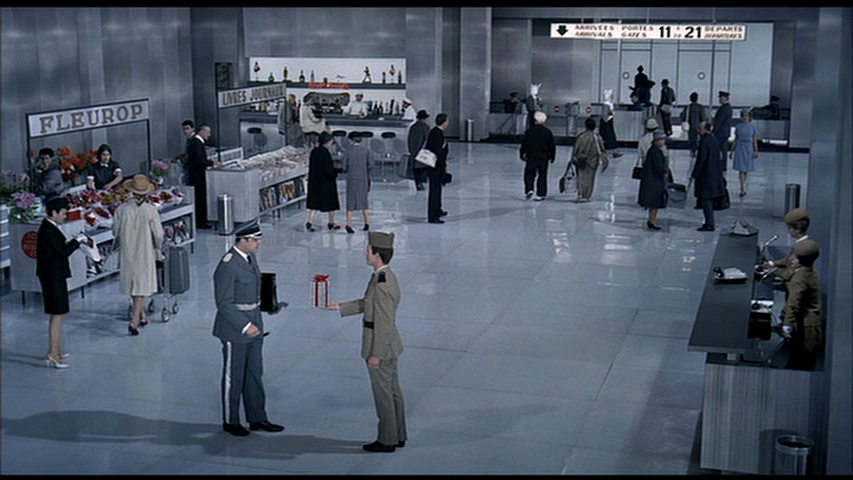
This is just the first of many instances of what Lucy Fischer (who was chair of the film studies department at Pitt when I was a student there) calls “one of the major functions of Tati’s remarkable soundtracks” in a Sight & Sound article called “‘Beyond Freedom & Dignity’: An Analysis of Jacques Tati’s Playtime“–the way they “provide aural cues to guide our visual perception.” As Fischer notes, he uses color the same way, beginning with the elaborate presentation of a gift which we pick out from a crowded monochrome mise-en-scène in large part because of its bright red bow:
It’s also an early example of what Lisa Landrum identifies as Tati’s use of color to “symbolically to reveal narrative and allegorical meaning” in her chapter in the book Filming the City, here as a “crimson reminders of life’s more sensual pleasures.”
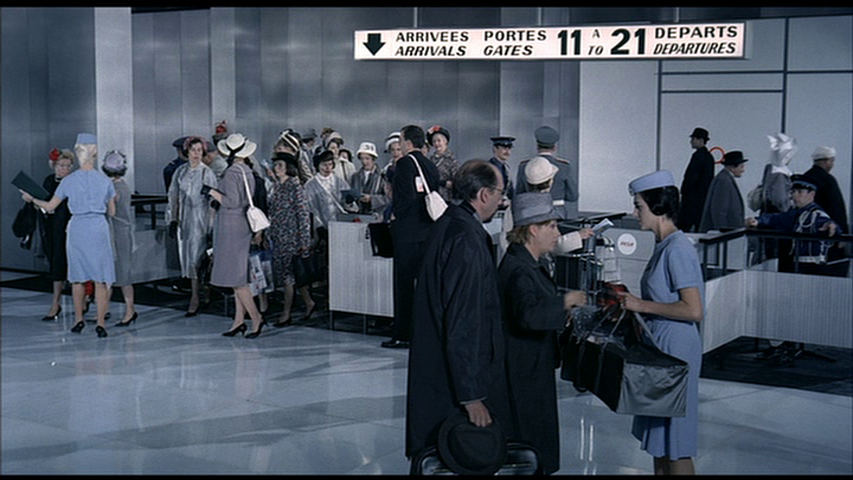
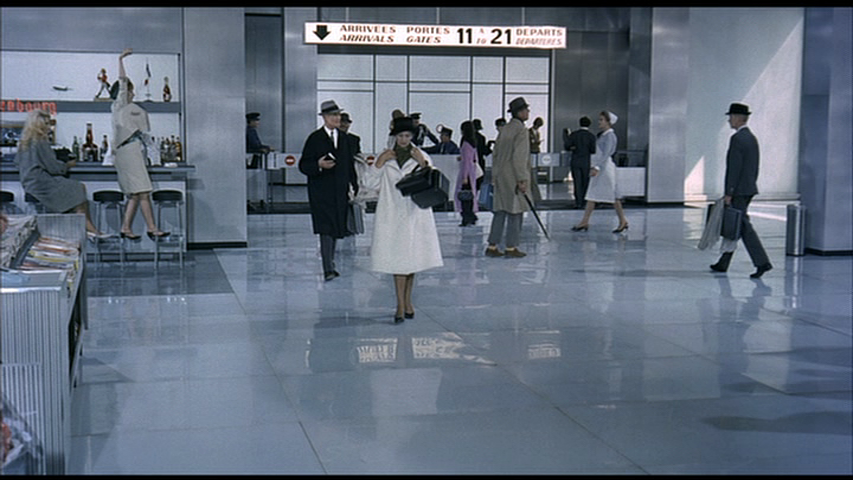
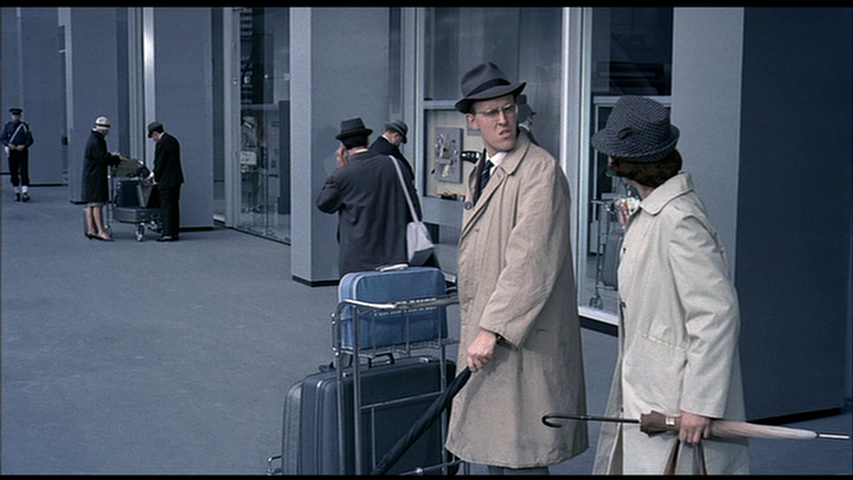
We next encounter a gaggle of American tourists who will eventually lead us out of what by now we realize is an airport:
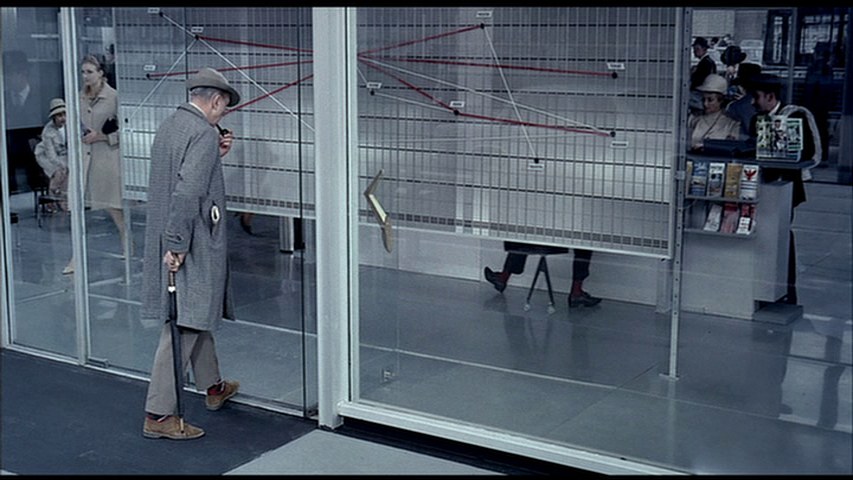
Followed by the introductory appearance of our ostensible protagonist Monsieur Hulot (Tati) with his signature hat, overcoat, and umbrella in the background of the same scene:
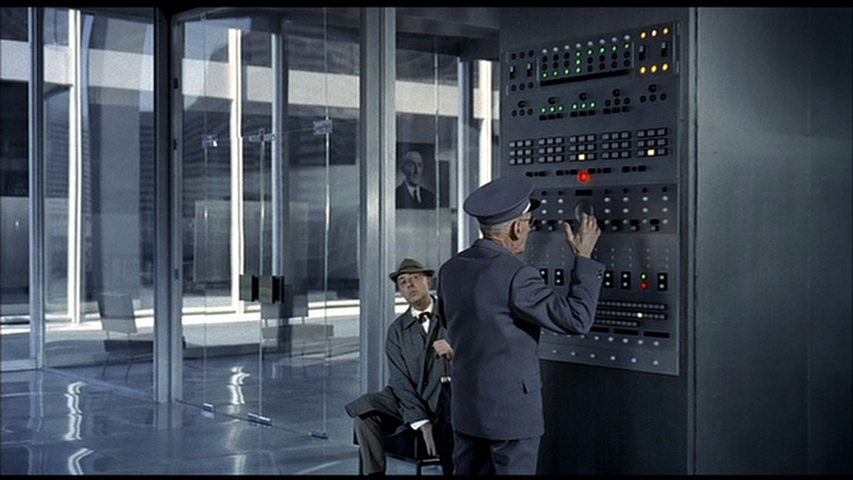
It’s unclear (and completely irrelevant) what Hulot is doing at the airport, but we next encounter him making his way to an appointment in another modern high-rise, where he is announced via the most over-engineered intercom system on this side of Toontown:
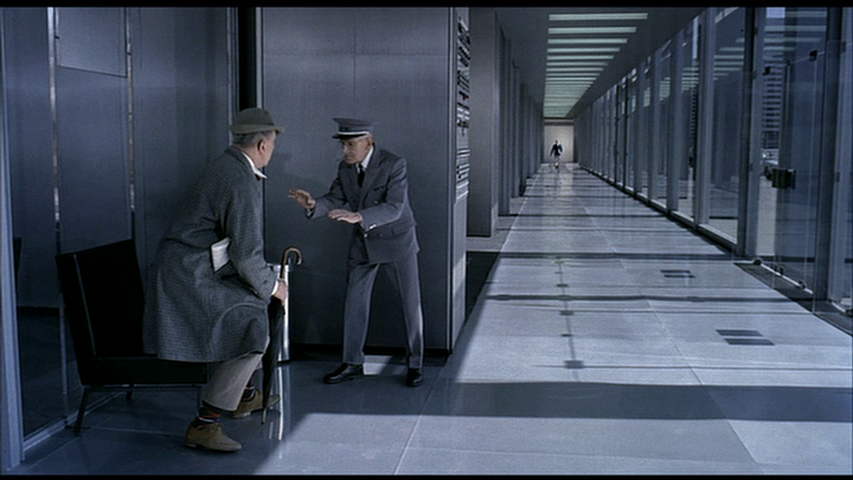
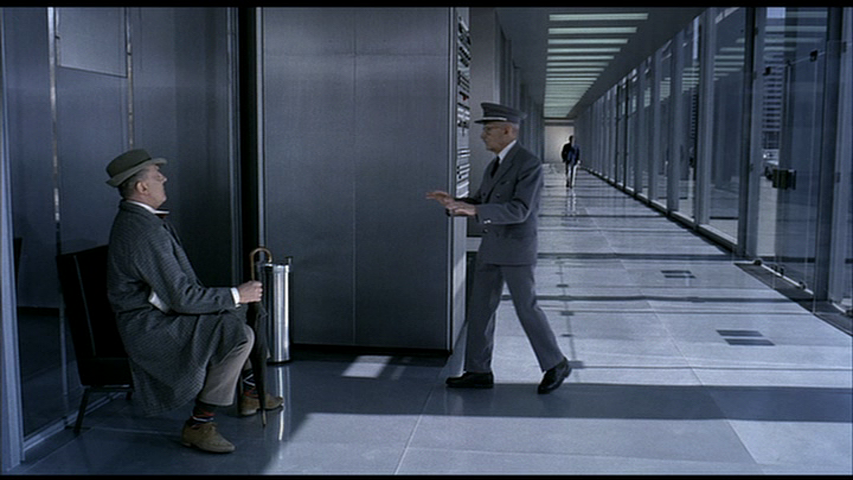
We hear the footsteps of the man he’s there to meet, Monsieur Giffard (Georges Montant), before we see him approaching down a deep focus corridor so long that the doorman (Léon Doyen) tells Hulot to sit back down twice:
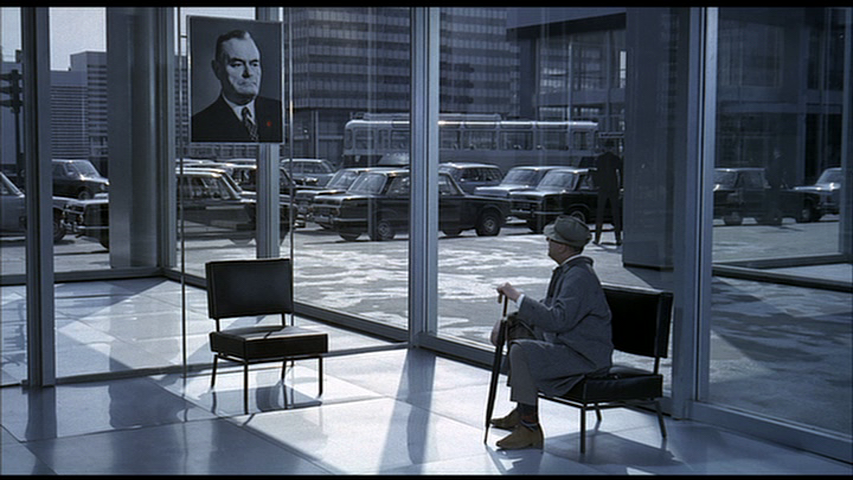
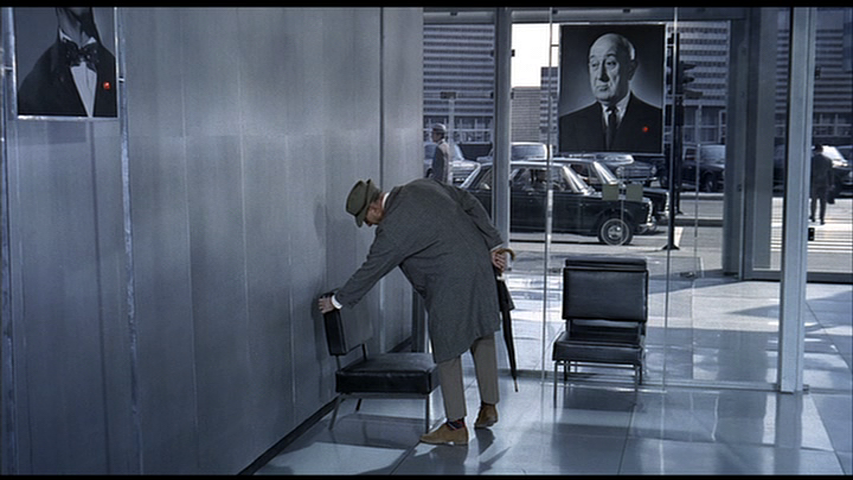
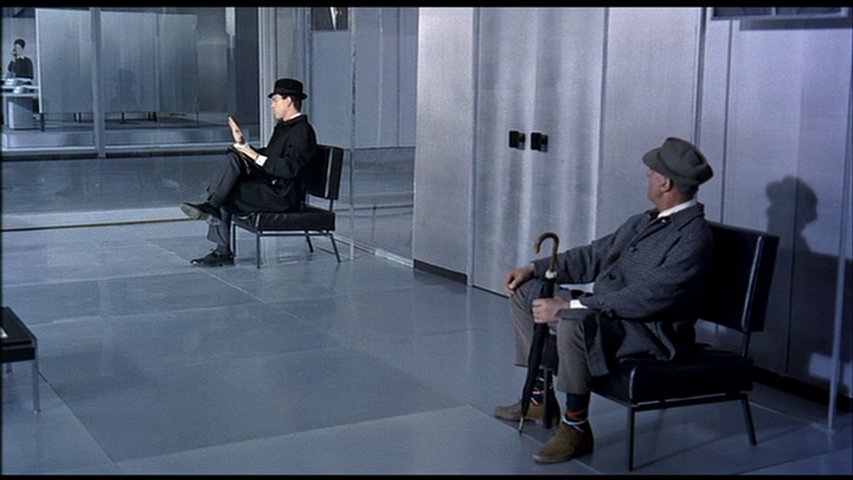
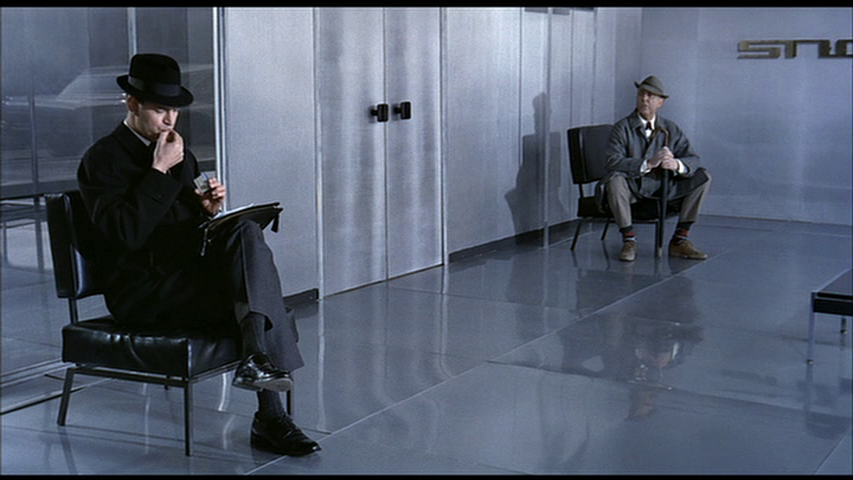
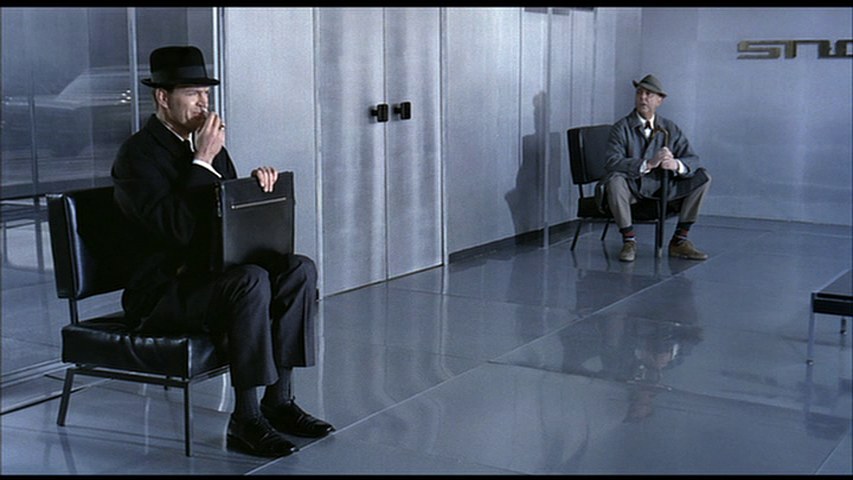
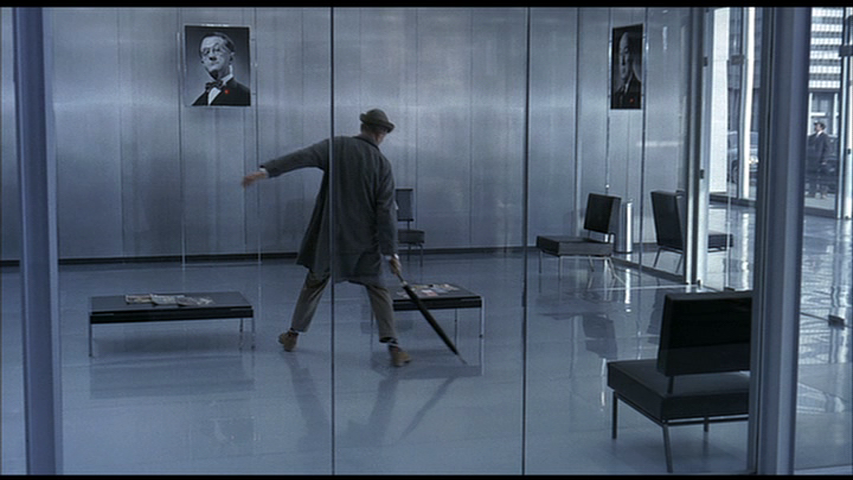
When Giffard finally arrives, he ushers Hulot into a display case-like waiting room filled with portraits that seem to disapprovingly watch his every move:
A man with fascinatingly robotic habits that seem to mark him as a natural inhabitant of this sterile environment:
And a slippery floor that causes what Rosenbaum describes as “the first significant curve in the film that undermines all the straight lines and right angles dictated by the architecture and echoed by all the human movements”:
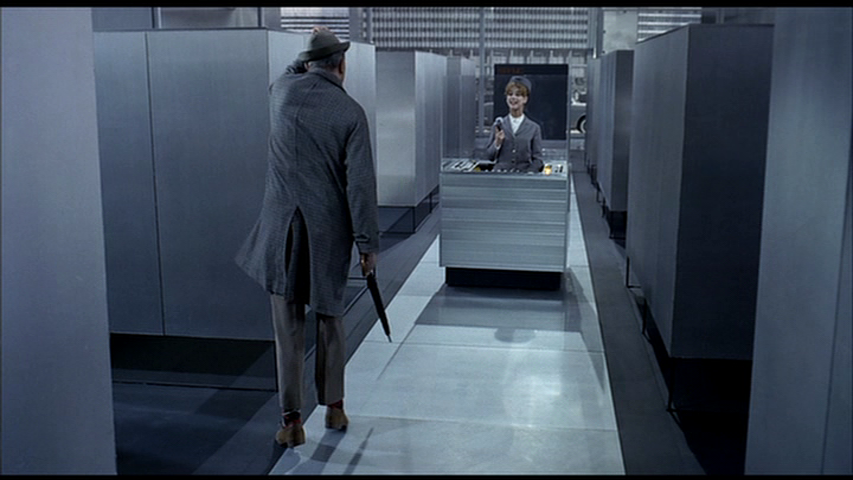
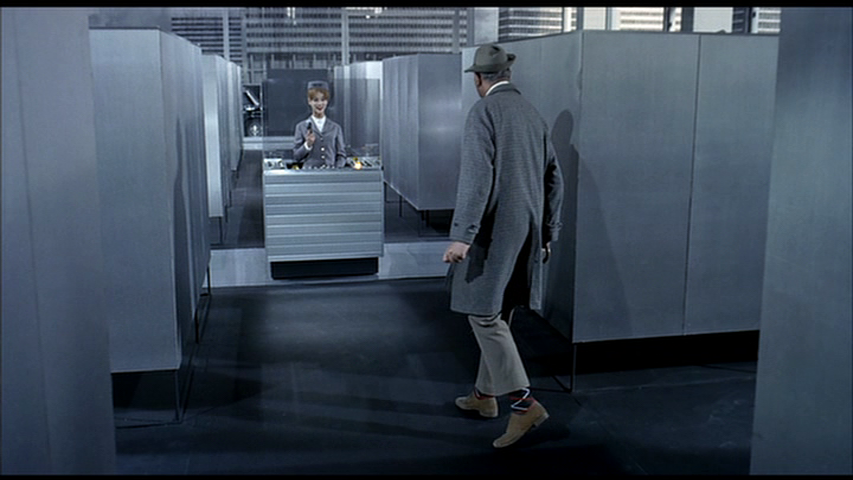
Giffard and Hulot wind up chasing each other through a maze of cubicles in which a receptionist’s rotating chair creates the impression of turning a corner and getting nowhere:
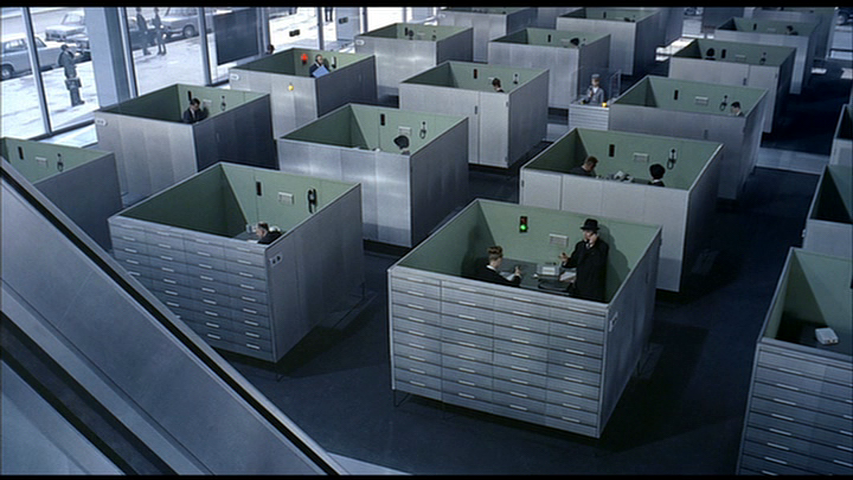
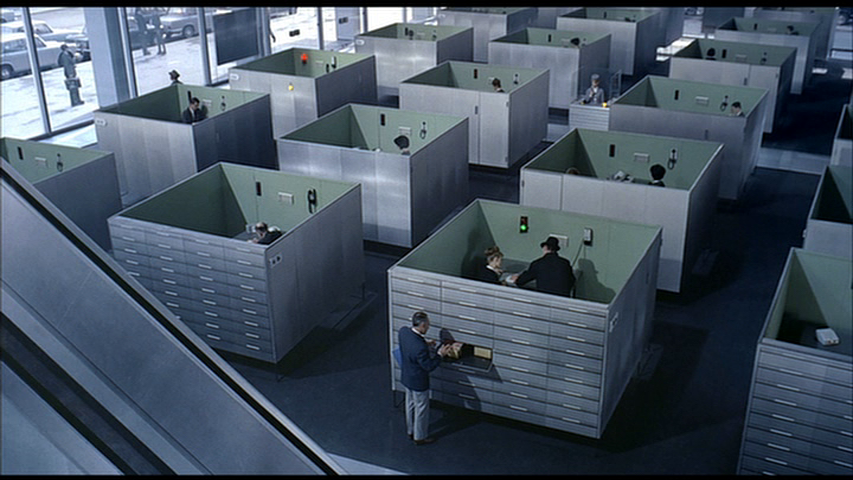
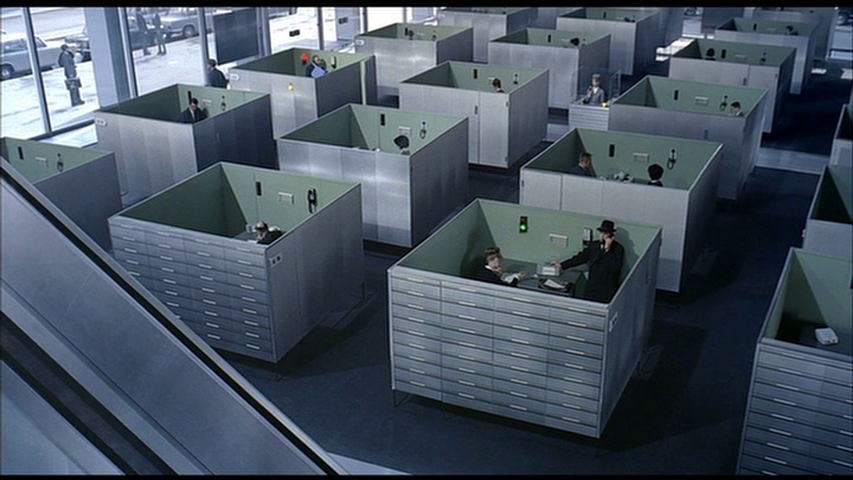
Green (bottom right of frame) and red lights (top left) draw our attention to two people who don’t realize they’re standing right next to each other talking on the phone:
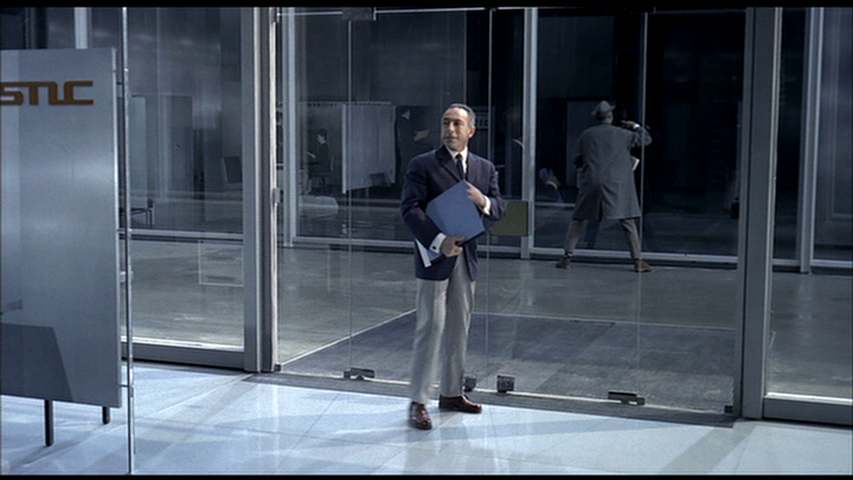
And Giffard’s reflection results in them losing each other for good when Hulot leaves the building they’re both in for the identical one next door:
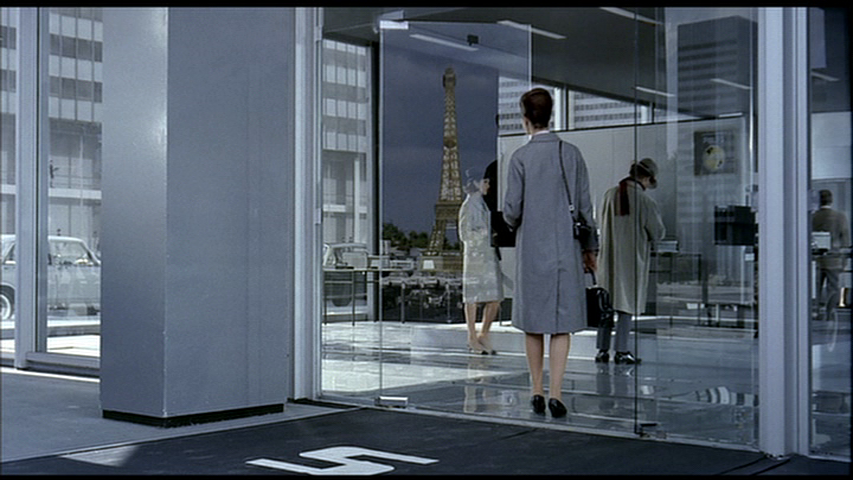
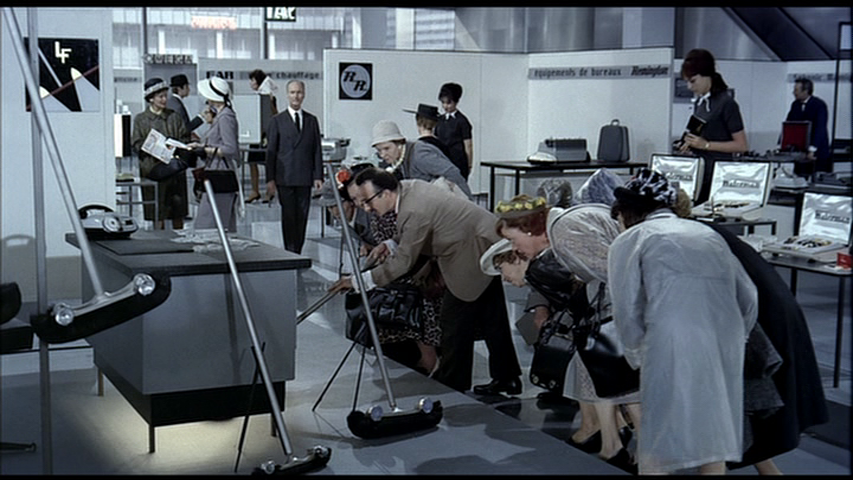
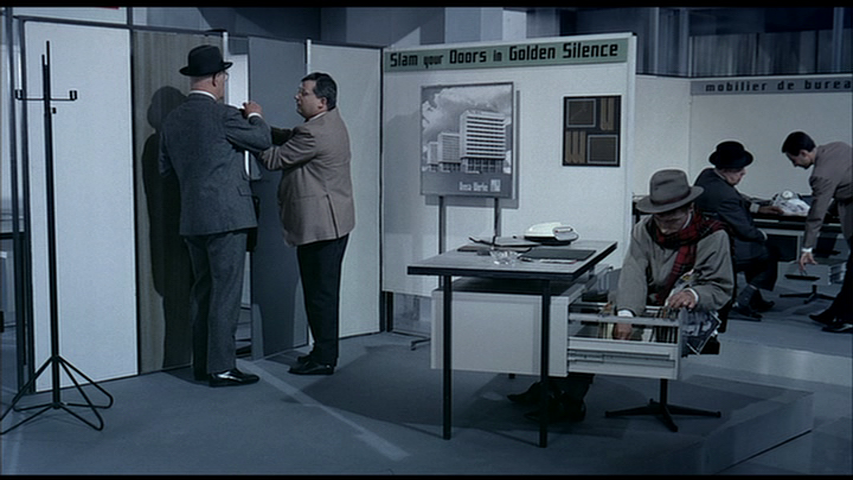
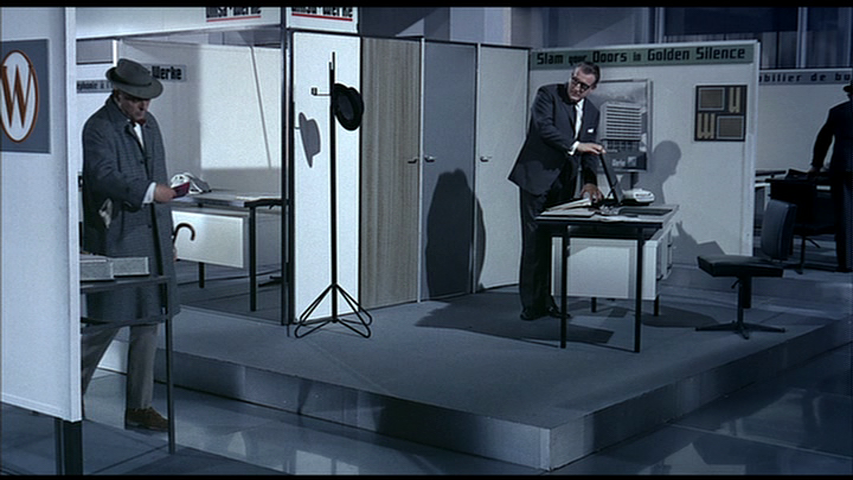
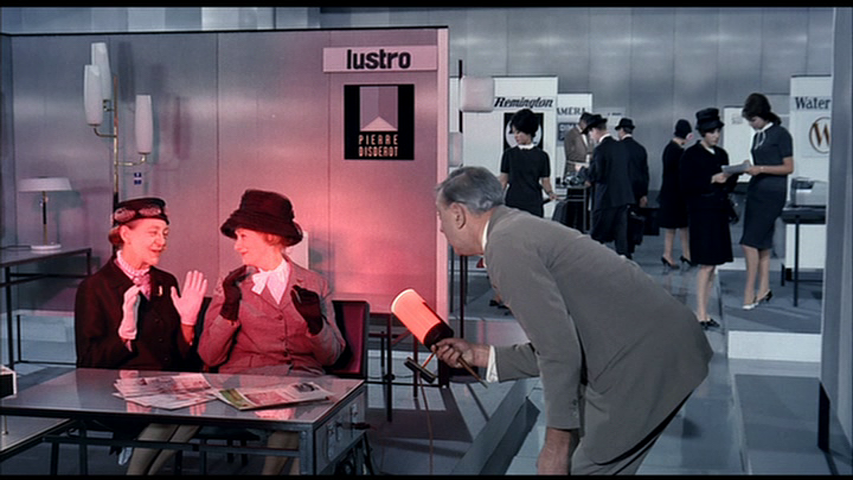
The next 20 minutes or so of the film unfold during a business exposition that both Hulot and the Americans from the airport find themselves attending, him by accident and them on purpose. One tourist named Barbara (Barbara Dennek) pursues an illusive “real Paris” that she’s only able to glimpse in reflections while her companions ooh and aah over a broom with headlights:
Meanwhile, Hulot is mistaken (due to confusion with another false Hulot) for first a corporate spy by a German businessman whose company’s motto is “Slam your Doors in Golden Silence,” then a lamp salesman when he loses his trademark outerwear:
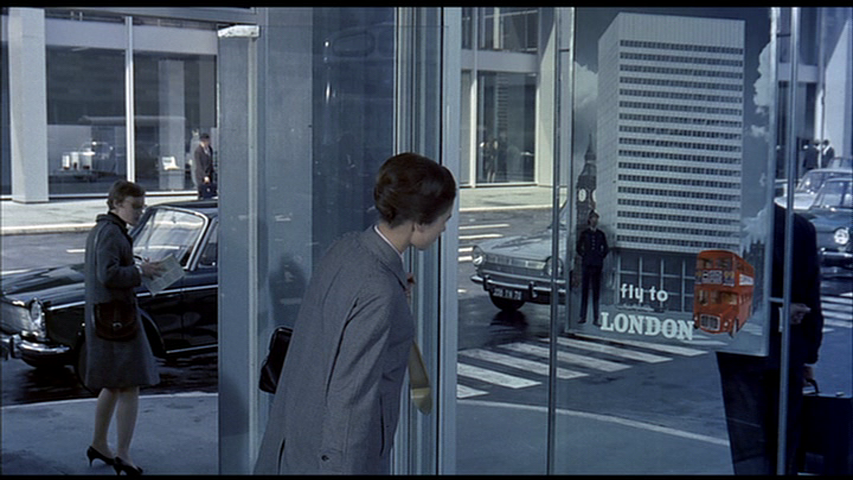
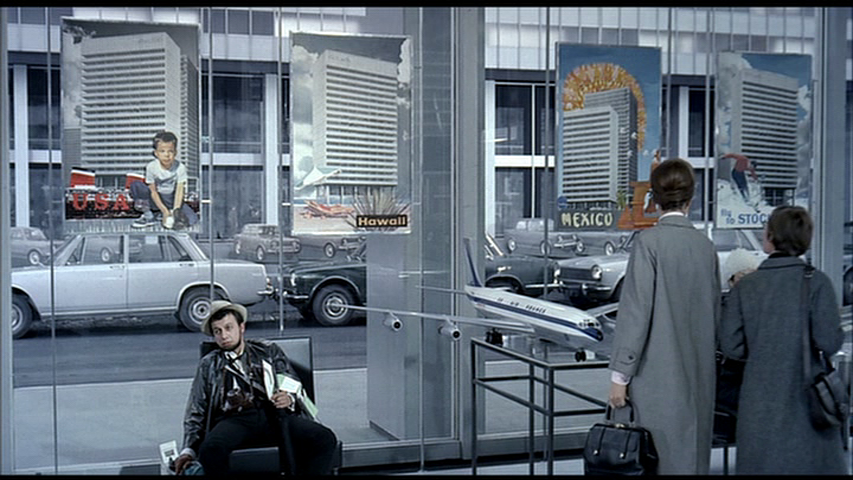
The sequence ends with Tati making his critique of the sameness of contemporary architecture more explicit via a set of travel agency posters:
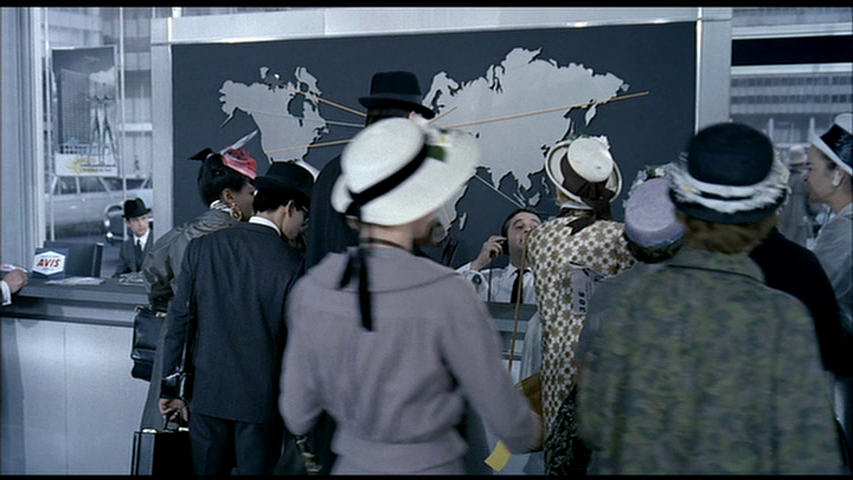
Hulot watching the appearance of a disembodied pair of dancing feet created by a busy travel agent on a stool with wheels when viewed from behind:
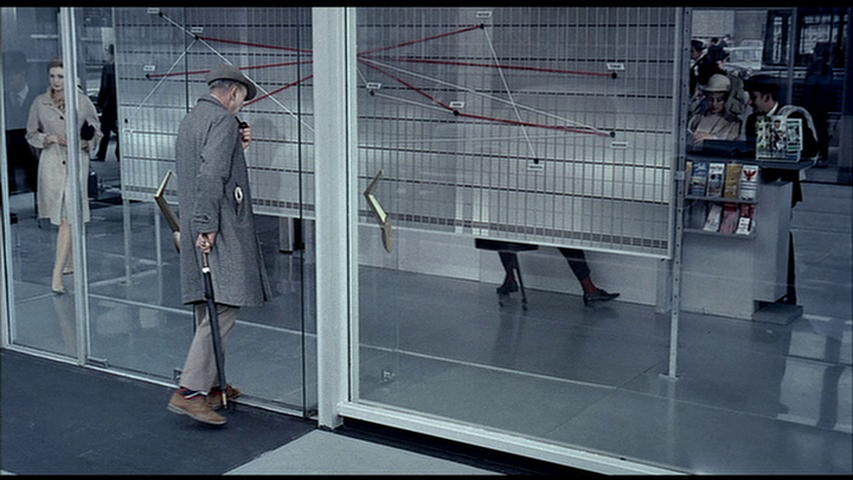
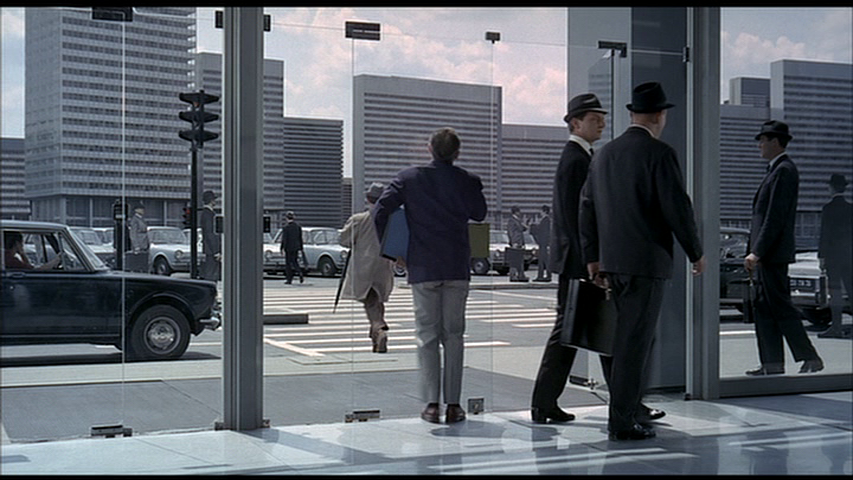
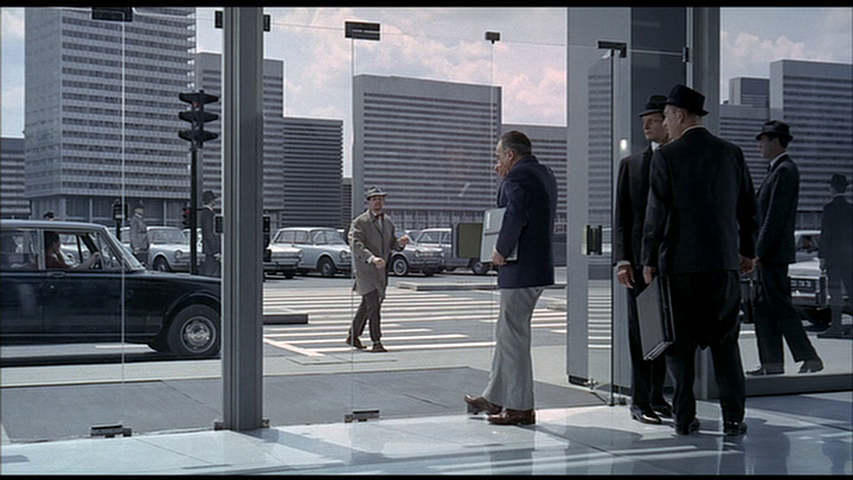
And Giffard bumping his nose when he attempts to wave down yet another false Hulot through yet another pane of glass:
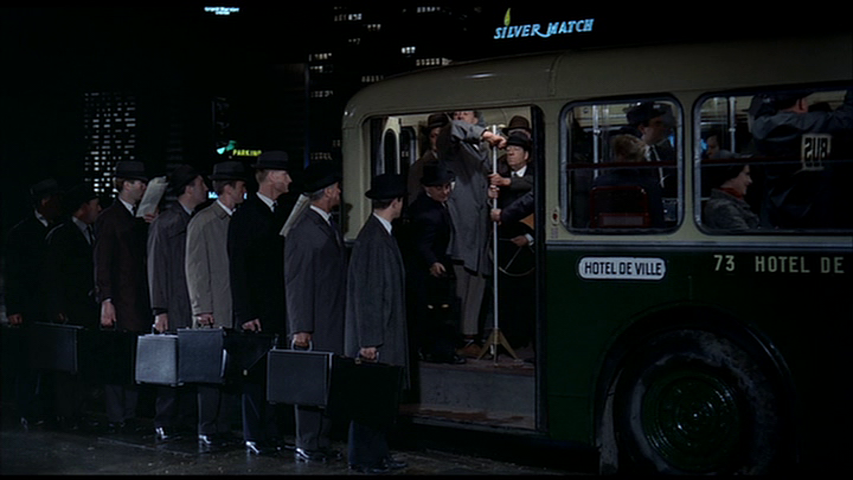
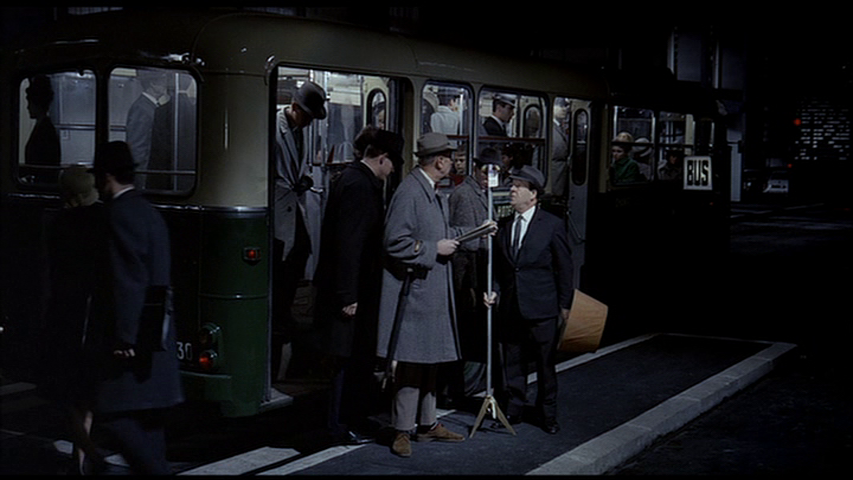
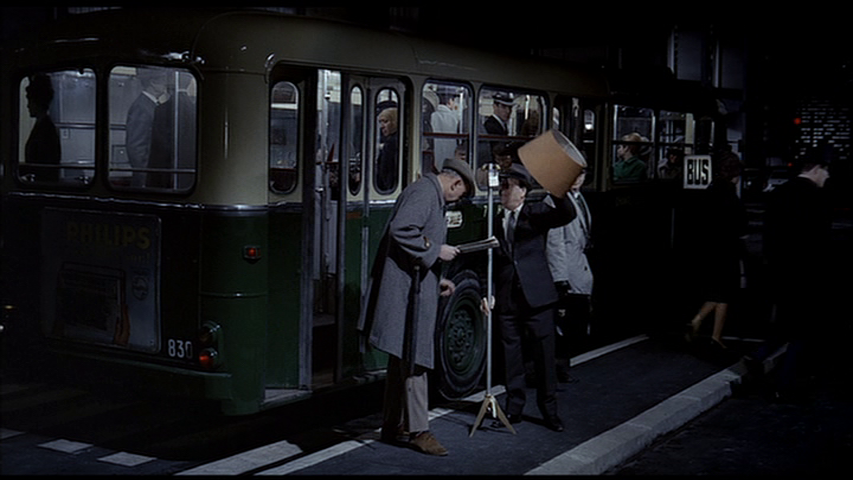
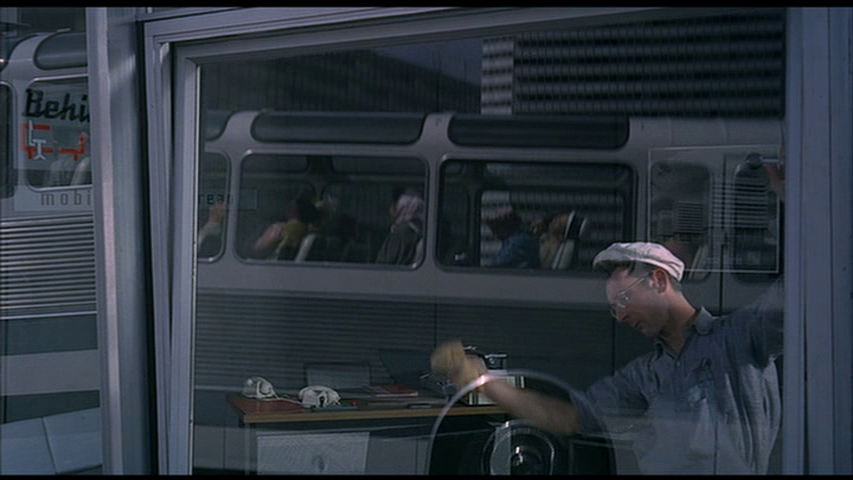
The gap to the three set pieces that are the reason Playtime rates as one of cinema’s all-time great comedies in my book is bridged by a transition featuring a nice bit of business whereby Hulot holds onto a lamp thinking it’s part of the bus he’s riding:
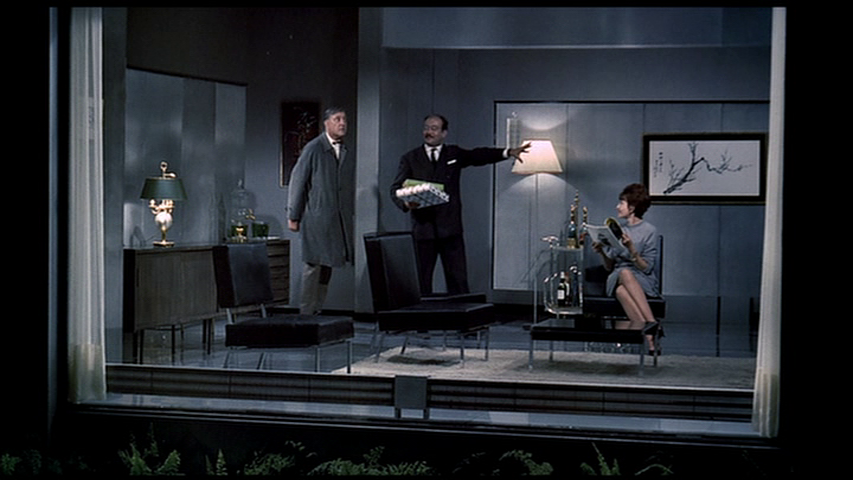
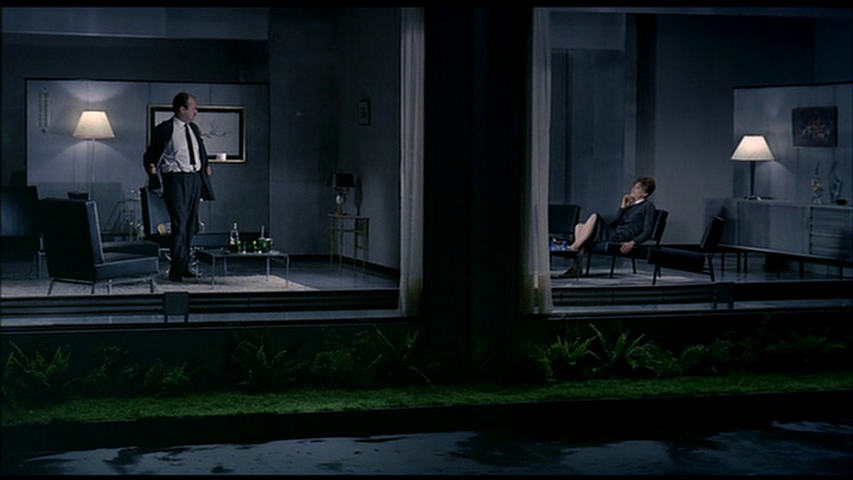
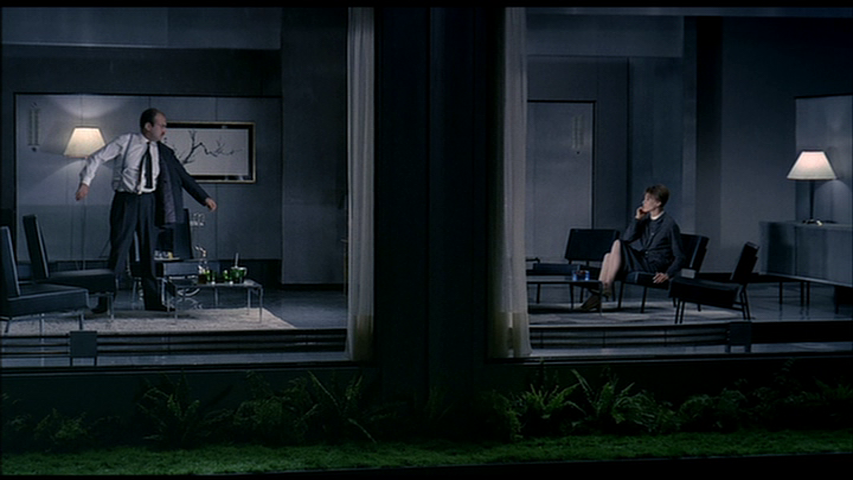
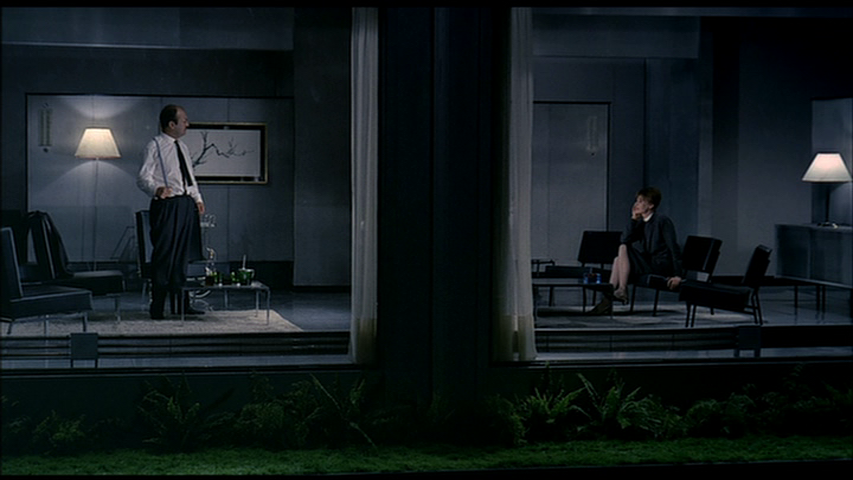
As soon as he disembarks, he is hailed by an old army buddy named Schneider (Yves Barsacq) who invites him to the apartment that inspired this month’s drink photo:
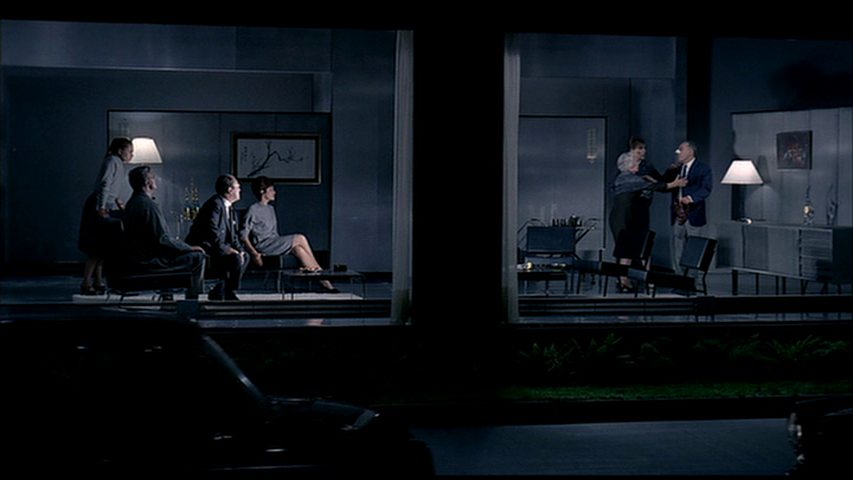
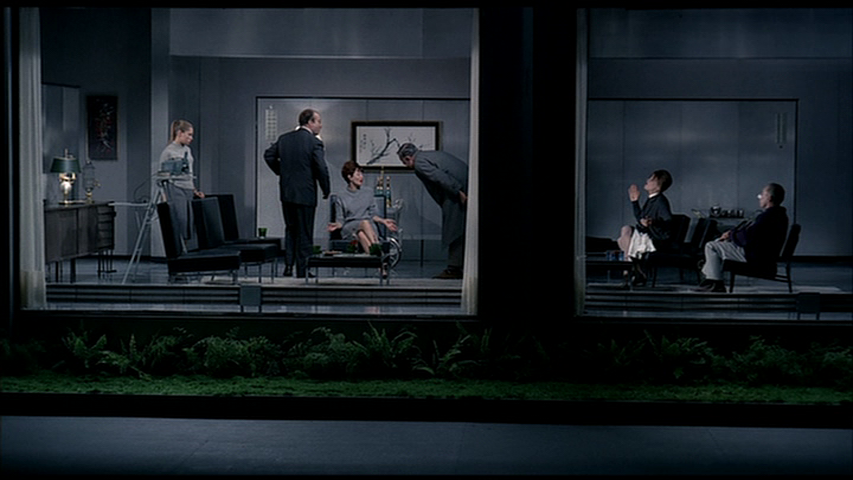
We view everything that transpires over the subsequent ten minutes from this same outside view, and when the camera pulls back to also show the neighbors’ living room as well, characters who can’t really see each other seem to be interacting. The apartment next door turns out to belong to Giffard, and the Schneiders and Hulot appear to stare in surprise when he comes inside with a bandaged nose:
The sequence also includes what look to us like offended reactions to rude gestures:
And, best of all, a striptease:
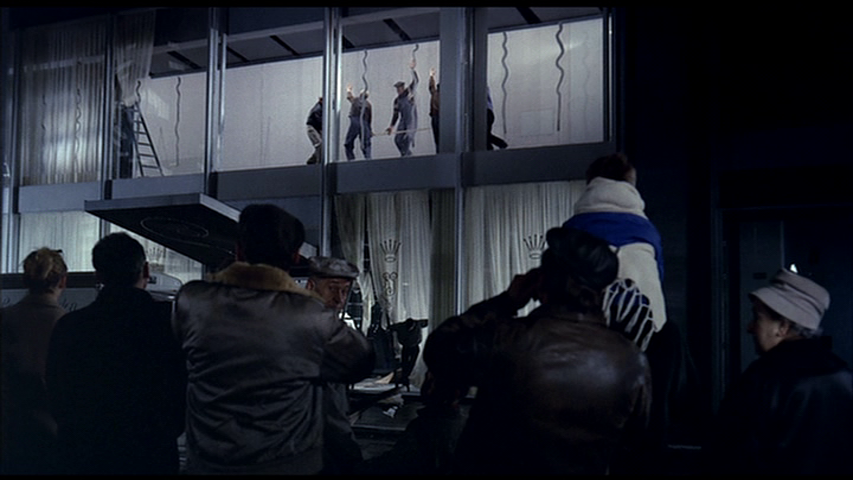
After departing, Hulot finally meets up with Giffard in a crowd of bystanders watching some construction workers who look like they’re performing a vaudeville routine:
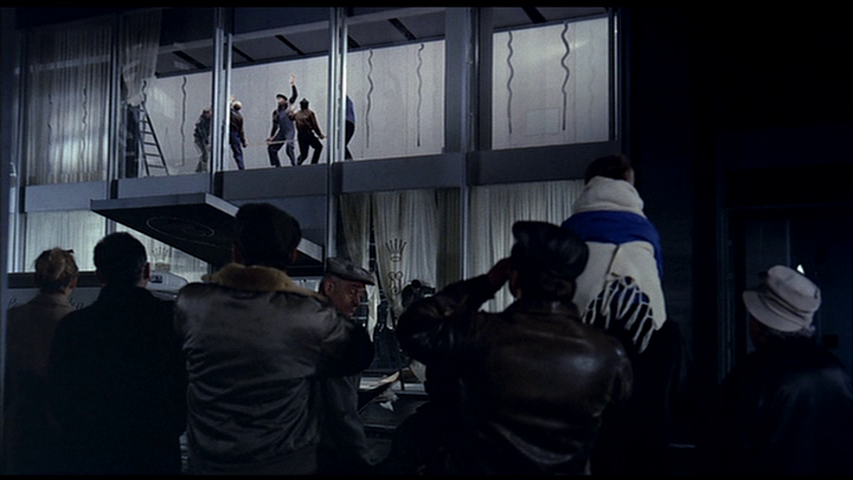
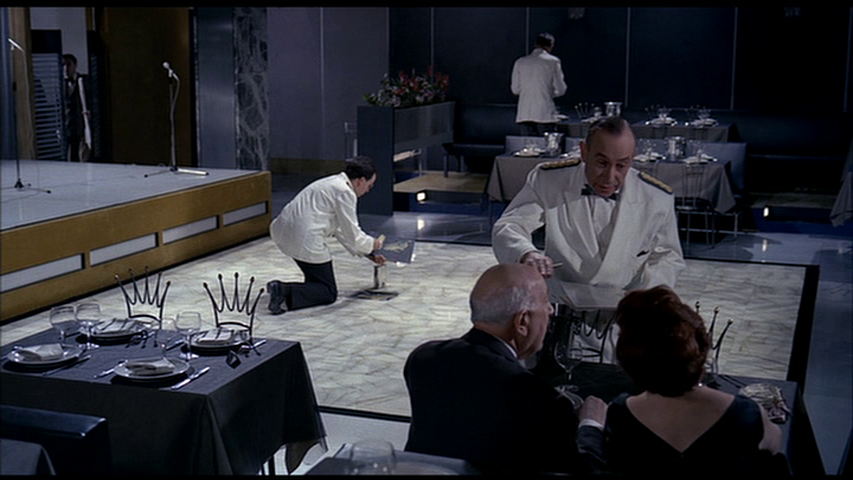
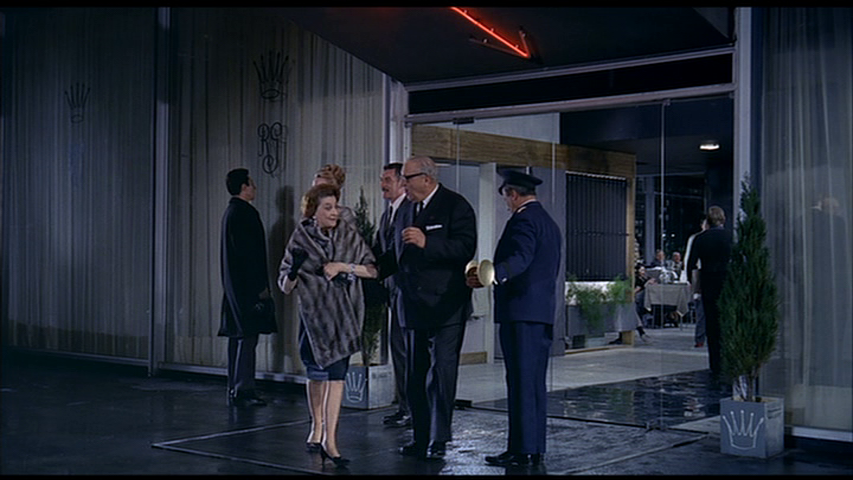
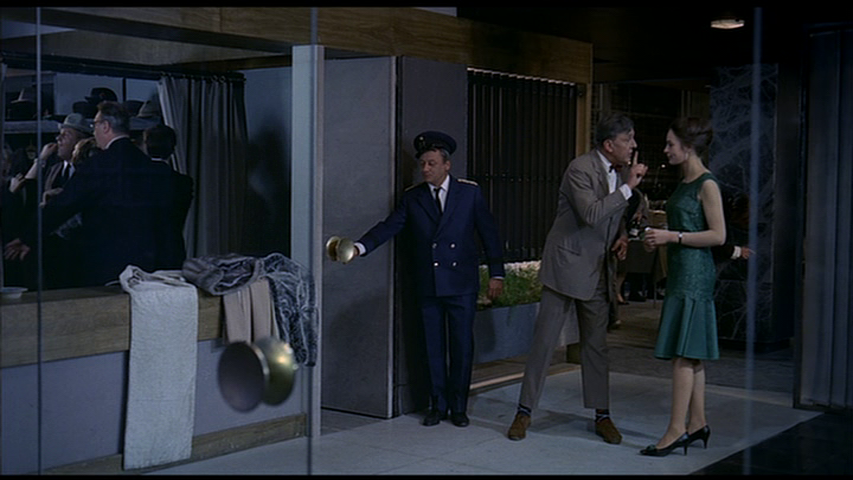
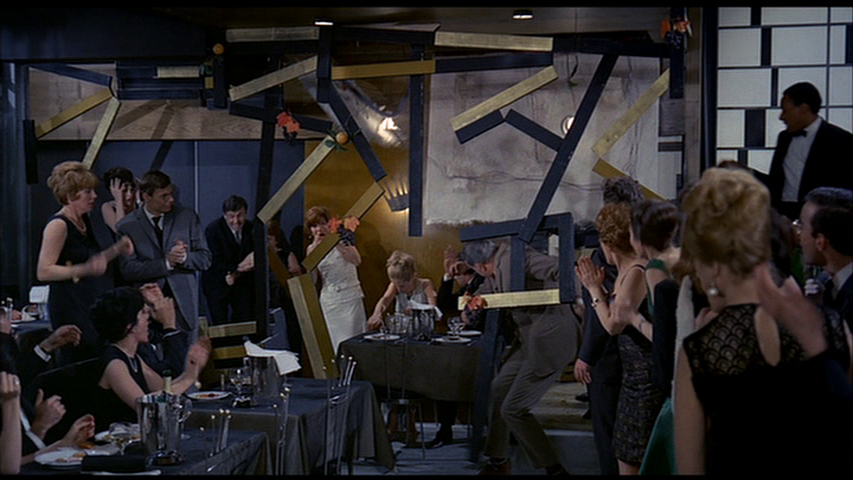
Before finding himself at the soft opening of an establishment called the Royal Garden at the invitation of the doorman (Tony Andal), another friend from his military days. Of course, this tour-de-force, nearly hour-long sequence has been going on for twenty minutes by the time he arrives, which is about par for the course according to Malcom Turvey, who calculates in his book Play Time: Jacques Tati and Comedic Modernism that Hulot is on screen less than 50% of the movie up to this point. I’d need a whole separate post to do justice to the way the nightclub basically falls apart over the course of a single service to the delight of its guests, who have more and more fun as the evening spirals further and further out of control, but highlights include a waiter fixing a broken tile in the background while another pantomimes saucing a fish in the foreground using the exact same motions:
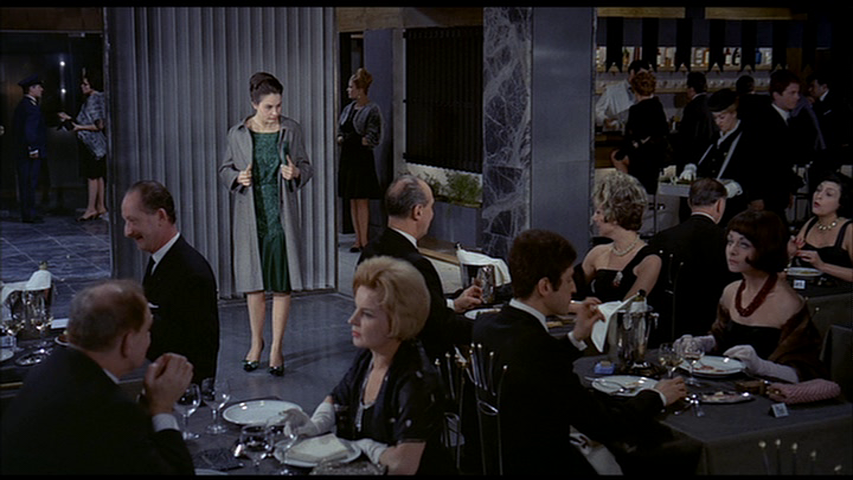
Barbara and her companions arriving to complaints from the locals that they’re “so tourist,” but also admiring comments about how chic her outfit is, which solidifies a theme running throughout the film that there’s actually very little we can do to control how other see us and that this is neither inherently positive or negative:
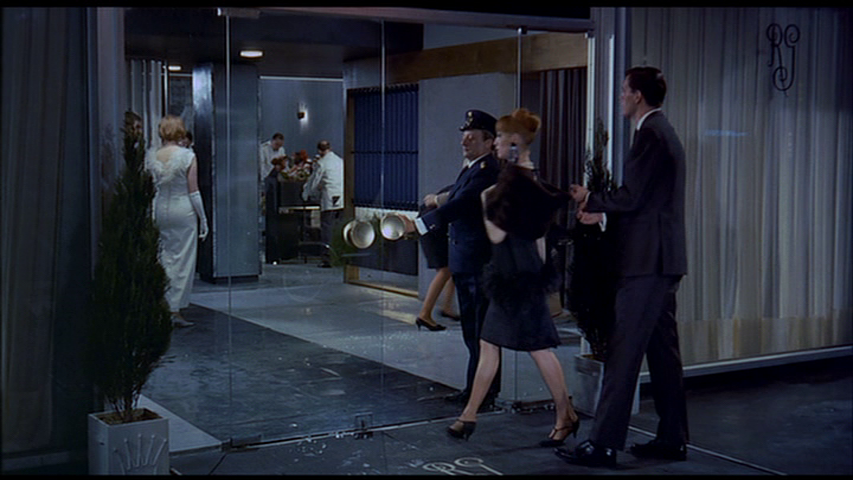
Hulot’s friend letting people in and out of a mobile invisible door after Hulot walks into it and shatters the glass:
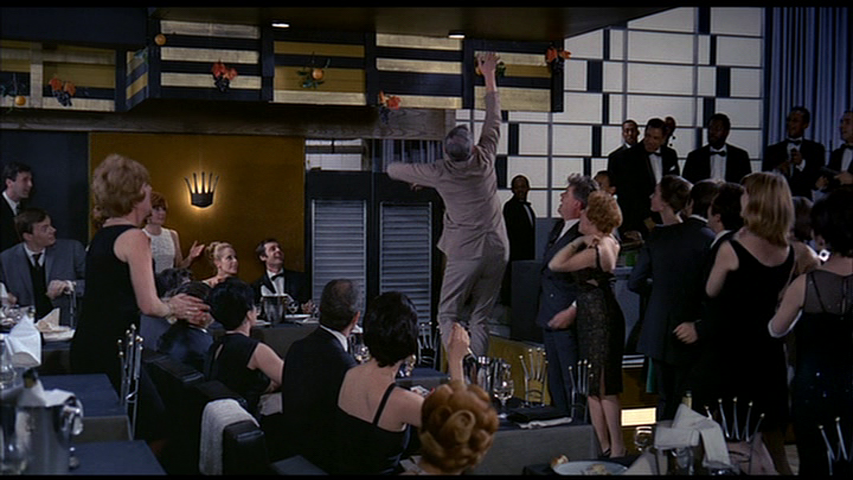
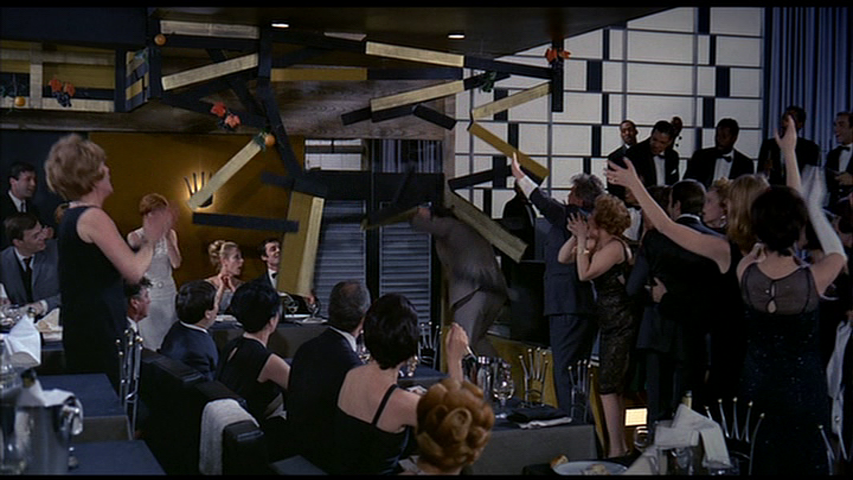
A ceiling that comes tumbling down when Hulot leaps for a golden apple decoration at the behest of a wealthy customer named Schultz (Billy Kearns), whose nationality Turvey finds significant because “it is Americans and American culture that disrupt the homogeneity of the modern environment, thereby allowing for the carnivalesque, utopian moments of communal enjoyment,” and which further ties the movie to the drink I’m pairing it with via the Laird’s:
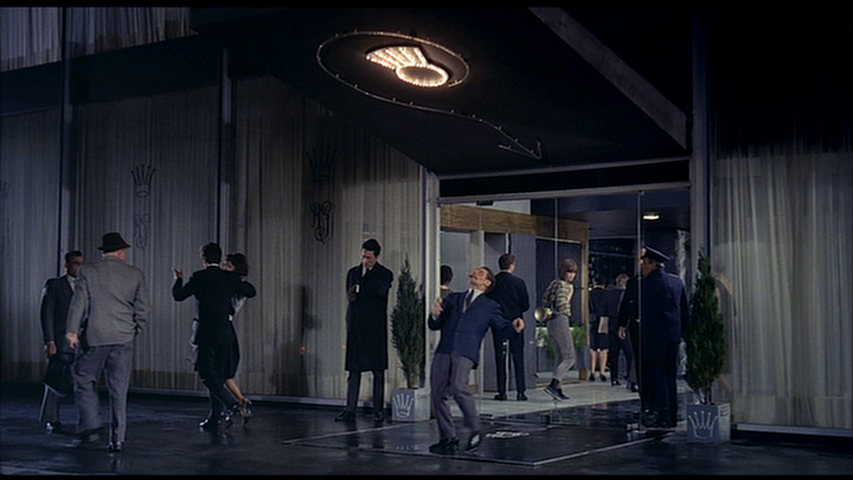
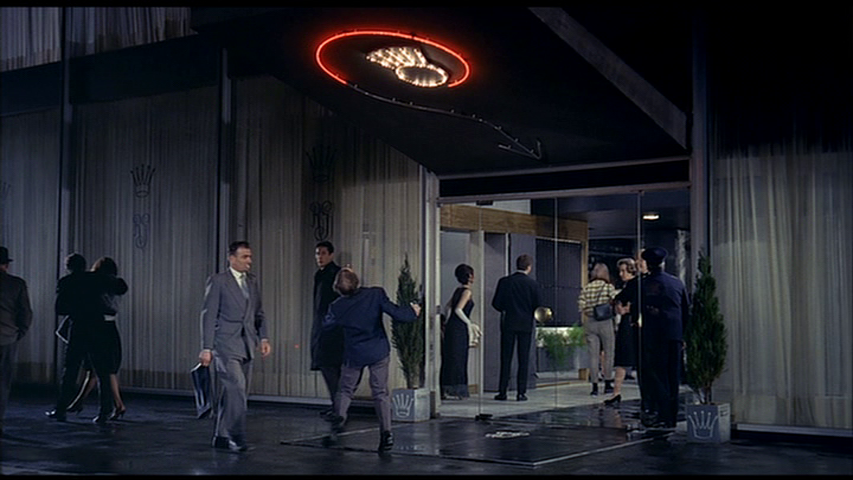
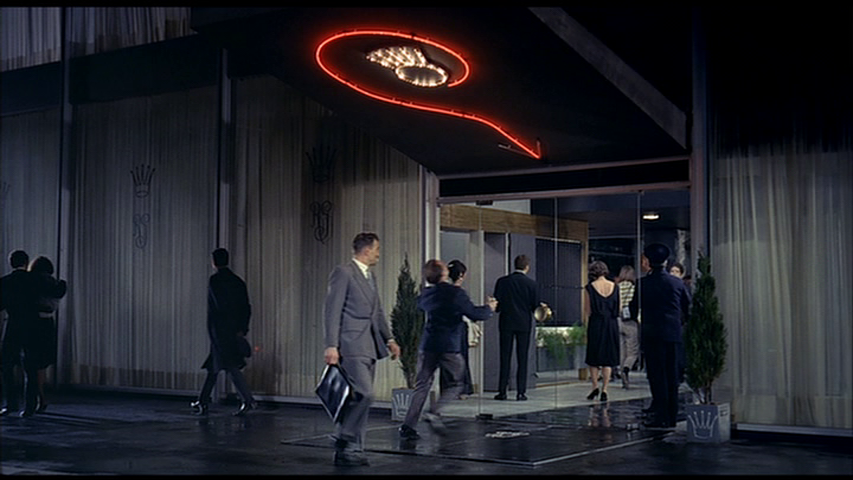
A drunk who has just been kicked out of the Royal Garden following its neon arrow sign back inside:
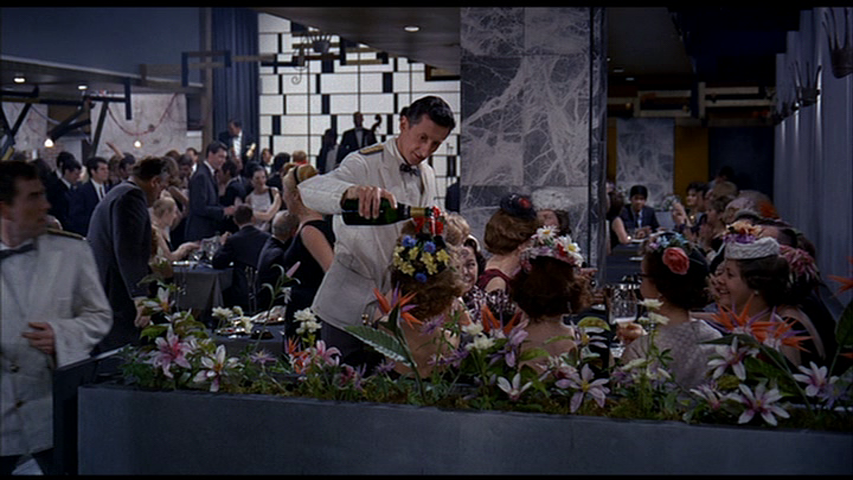
Flowers that look like they’re being watered with champagne:
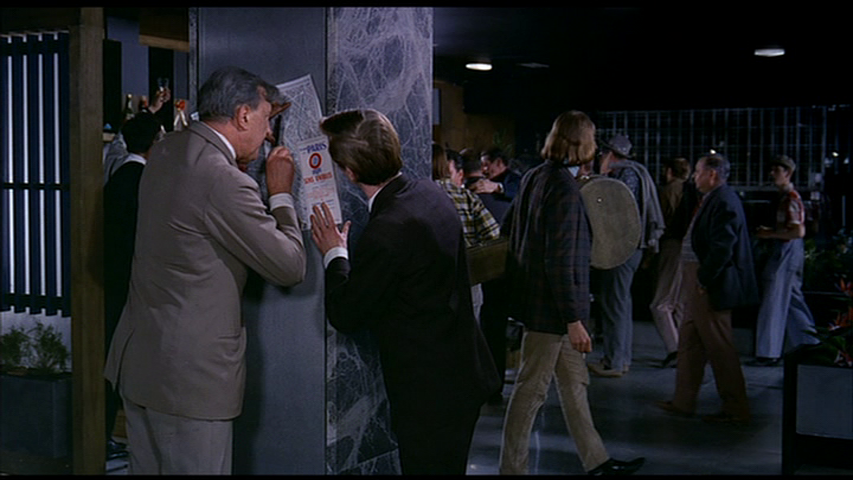
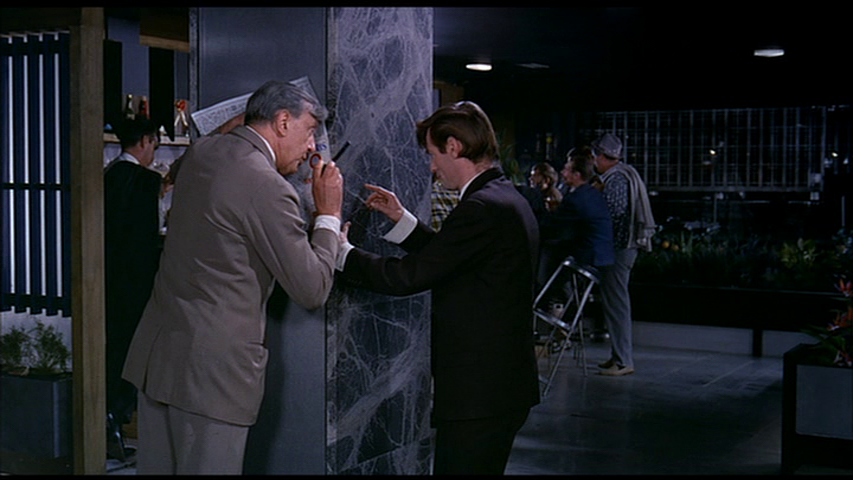
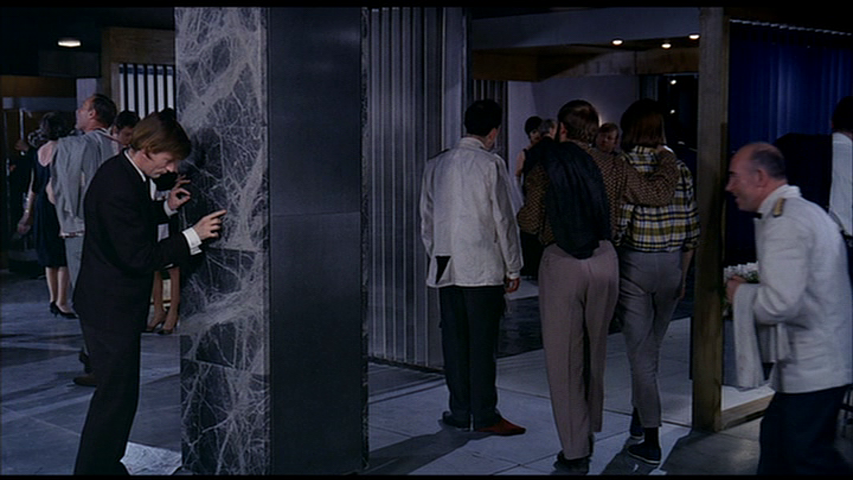
And another drunk confusing the lines on a marble pillar for a map:
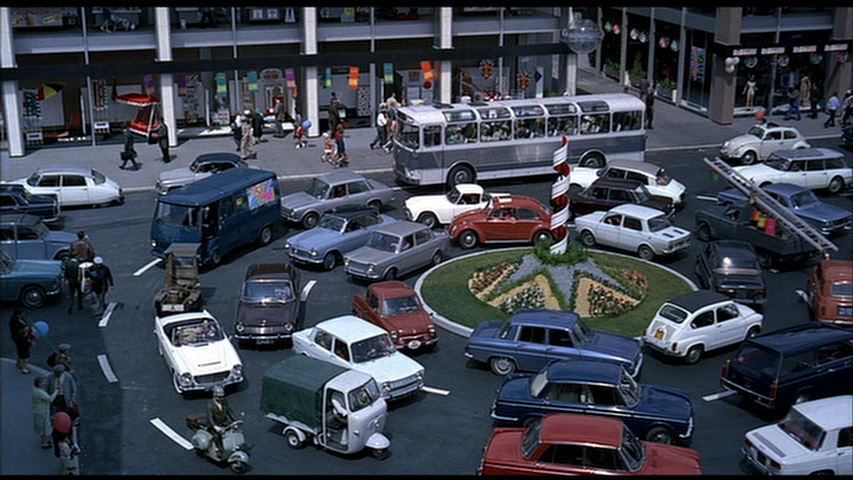
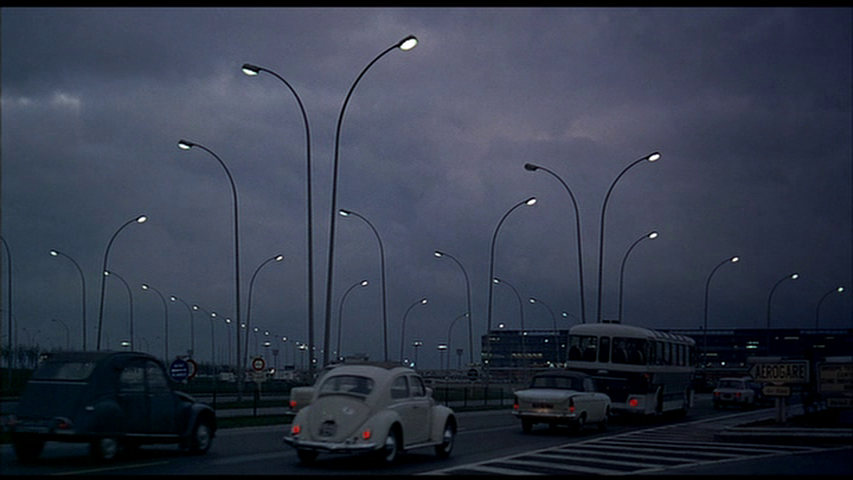
But for all the joyful anarchy of this scene, my favorite part of Playtime is definitely its ending. As Barbara and her tour group make their way back to the airport the following morning, Paris transforms into a carnival, complete with a traffic circle carousel that stops and restarts when a man puts a coin in a parking meter:
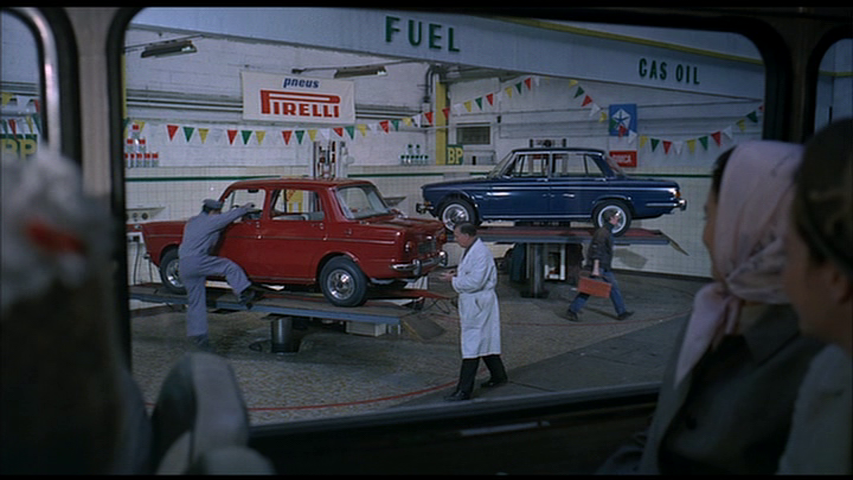
A hydraulic lift ride:
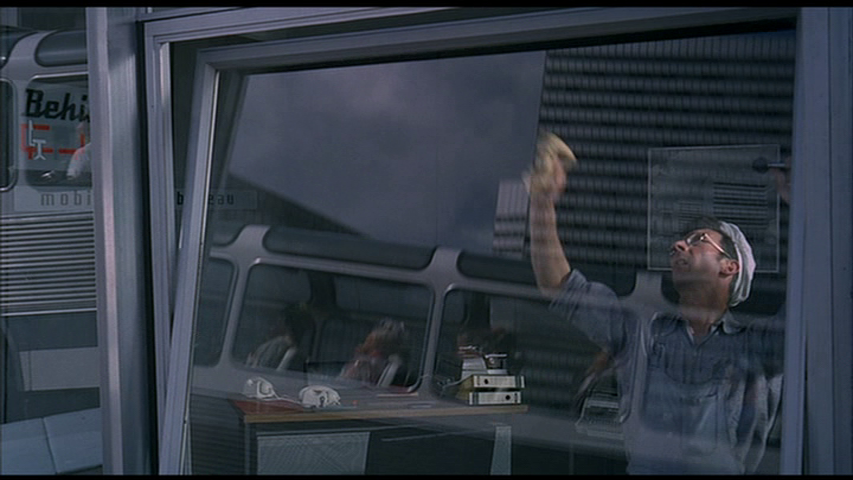
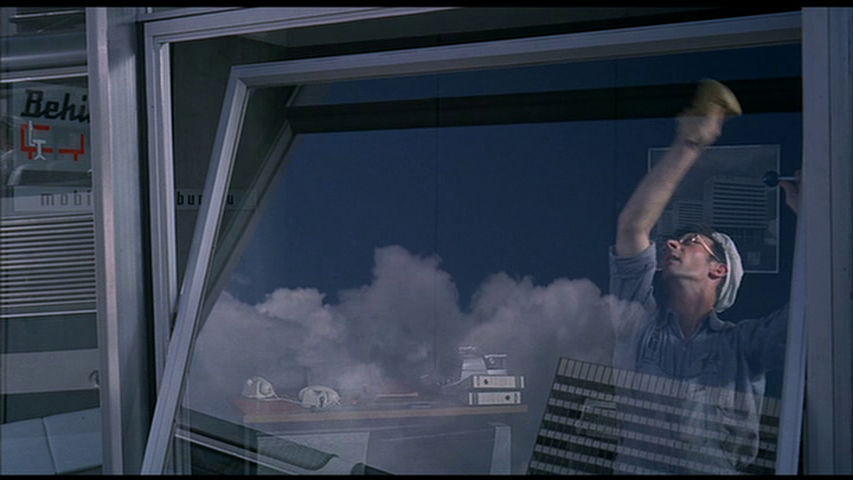
A vertiginous effect created by a tilted window:
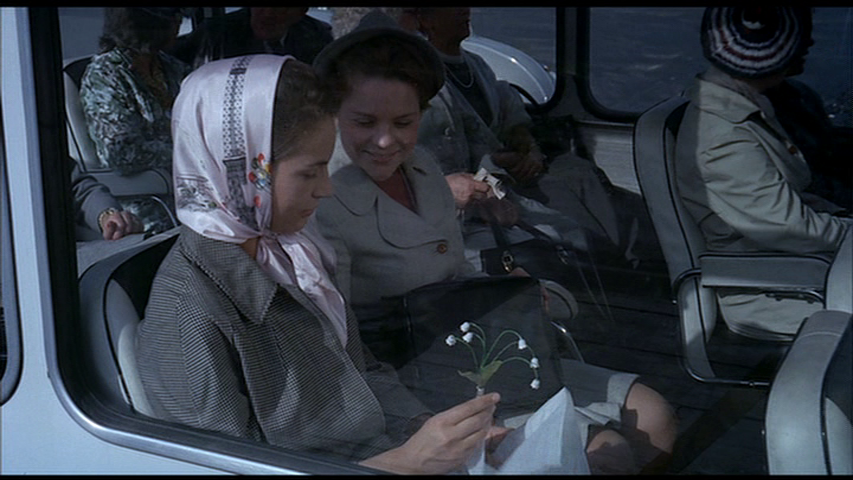
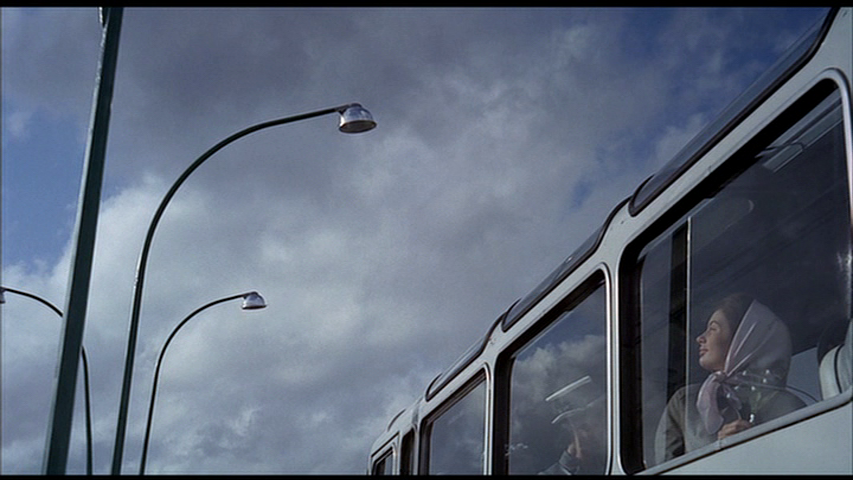
And streetlights that will now forever remind you of lilies of the valley thanks to a thoughtful parting gift that Hulot gives Barbara:
As Sheila O’Malley writes in a blog post about the movie, “if urban alienation is portrayed in Playtime (and it is), it is portrayed in a way that is distinctly absurdist, turning the mundane into the surreal. It does not bemoan the fate of modern man, it does not say, ‘Oh, look at how we are all cogs in a giant wheel, and isn’t it so sad?’ It says, ‘Look at how we behave. Look at how insane it is. We need to notice how insane it is, because it’s hilarious.’” While you absolutely can read the film as a critique of what automation and commercialism have done to the world of the 1960s and today, I prefer to treat it the same way O’Malley does, as a how to guide to finding pleasure in it: keep your eyes open, use your imagination, and don’t take yourself to seriously. Which is pretty good advice for stress-free hosting and family dinners, too, so: happy holidays!
Cheers!
All original photographs in this post are by Marion Penning, aka My Loving Wife.Links to all of the entries in this series can be found here.





 The Prodigal Cinephile