Not at All What We Had in Mind

Screengrab from Prince of Darkness #2

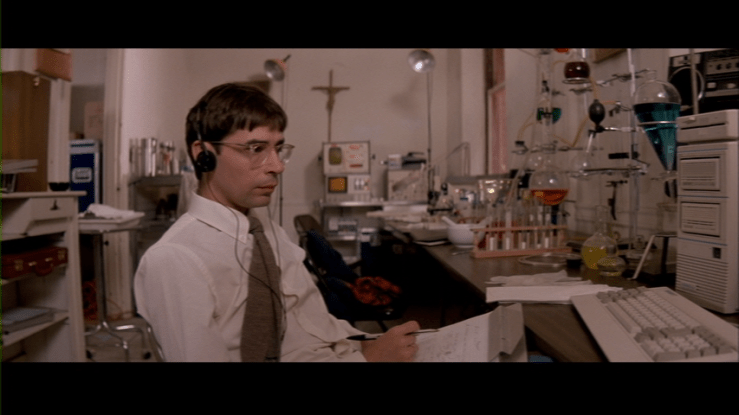
I’ve been thinking a lot about this character in John Carpenter’s Prince of Darkness lately. His name is Etchinson (not that anyone ever addresses him as such–we have to wait until the end credits to find this out) and he’s played by the actor Thom Bray. He is on screen for 4:08 total in a film with a 102 minute runtime (~3% of the whole), and all of his appearances are confined to the 11 minutes (~9%) between the 26:36 and 37:38 marks. We know that he is a graduate student, and that his discipline is biochemistry. That’s about it, though.

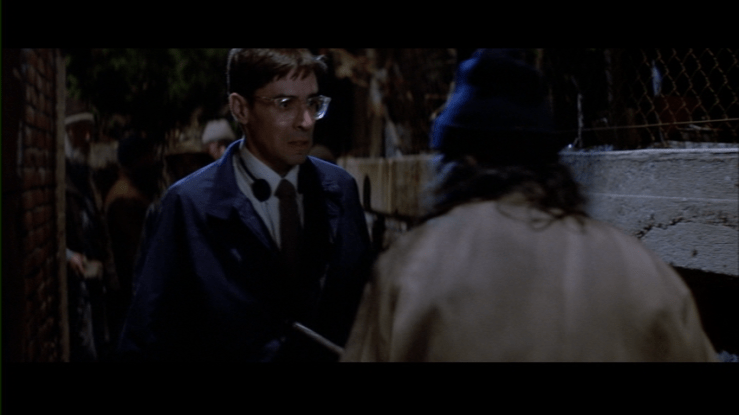
His chief claim to fame is, of course, being the first person in the film to be killed:
Screengrab from Prince of Darkness #3

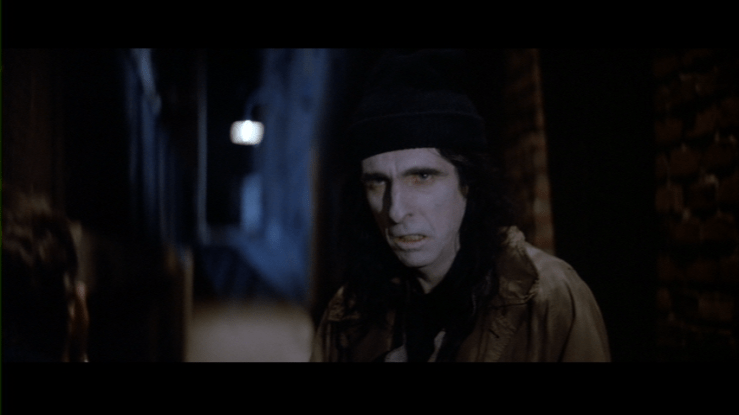
Part of what makes him memorable is how he goes, impaled on a bicycle in an impressive stunt borrowed from Alice Cooper’s stage show (per Gilles Boulenger’s John Carpenter: The Prince of Darkness, p. 204) by a “street schizo” played by Cooper himself:
Screengrab from Prince of Darkness #4

It’s a sudden, brutal death to be sure, but so are many others in the film: why is this the one that stuck with me? First, at the risk of being obvious, the scene is well done. In addition to the stunt work mentioned above, this is a good example of the director’s mastery of what Michelle Le Blanc and Colin Odell call “the act of depicting nothing” in their book John Carpenter. As they note, “[a]n empty room is ominous because cinema is generally concerned with action–emptiness represents suspicion or disruption of order” (p. 19). In the case of Prince of Darkness, anticipation is created by the inaction of the homeless people who have been arriving at Saint Godard’s (the church where the bulk of the film’s action is set) in greater and greater numbers since Etchinson and his colleagues began appearing, and who are described thusly seconds before Etchinson exits the film:

KELLY: Now, a friend of mine at UCLA did a study of chronic schizophrenics. They’re supposed to have stereotyped routines that they repeat every 20 minutes or so, you know, like a stuck record in their brains repeating the same phrase over and over. Well, I have been watching them on and off all day, and they don’t seem to be making any movements. They just stand there.

Second, the scene remains effective even after you’ve seen the rest of the movie; in fact, if anything, it’s more surprising in retrospect than it is in the moment. A viewer familiar with Robin Wood’s ideas about the horror genre and the “return of the repressed” (as articulated in his book Hollywood from Vietnam to Reagan and elsewhere) or the rules for surviving a horror movie presented in Scream could be forgiven for assuming that Etchinson was chosen as the first victim as punishment for the promiscuity implied by his one memorable line: “how married?” he asks after being told that the attractive young woman he has just inquired after is spoken for. The subsequent carnage doesn’t follow anything like this pattern, however, and in the end it seems that Etchinson is guilty of nothing more than being in the wrong place at the wrong time (and possibly of being a graduate student, who are, as we know, the worst).

More than just being random, though, this points to the most disturbing aspect of what Etchinson’s demise implies. John Carpenter is famously enamored of the work of Howard Hawks: his second full-length feature Assault on Precinct 13, for instance, is essentially a remake of Hawks’s Rio Bravo. In a Hawksian universe, survival depends on being “good enough” or, if you’re not, understanding your limitations and staying within them. Etchinson’s murder is our first clear indication that, unlike other Carpenter movies, Prince of Darkness is not set in such a universe. To quote the film’s Professor Birack (Victor Wong), “while order does exist in the universe, it is not at all what we had in mind!” In other words, being good enough might not be good enough to make it out alive.

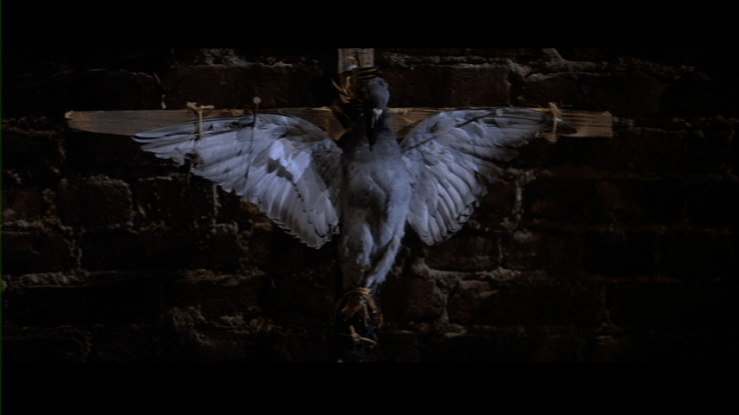
Writing in Film Comment, Kent Jones observed that John Carpenter is “one of the few modern artists whose subject is the contemplation of true evil” and that in contrast to Hawks, “where all the energy goes into the beauty of people in action,” Carpenter’s films “are filled with moments of paralyzing immobility, of dry-mouthed discomfort brought about by the realization that there is something new and awful in the world.” Etchinson actually freezes three times in his final scene: once when he sees this crucified pigeon:
Screengrab from Prince of Darkness #5

Once when he realizes he’s surrounded, and one last time the moment he understands he’s about to die. This is, I think, exactly what Jones was talking about, and that’s what makes Etchinson such a memorable character despite his limited screen time: he’s a perfect example of some of the most interesting and original aspects of Carpenter’s artistic vision.


Juxtaposition #2

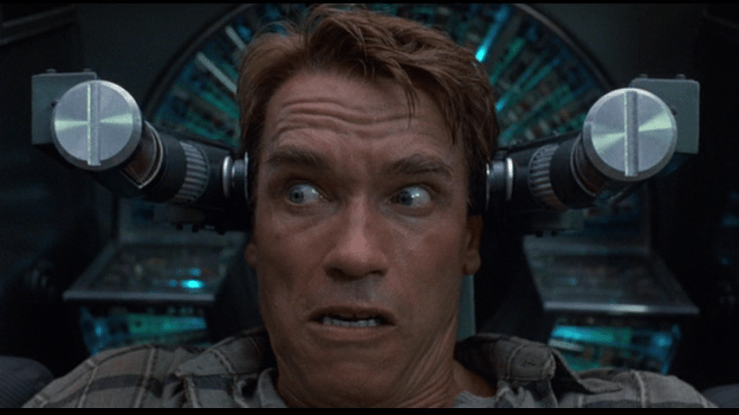
From Total Recall:

Screengrab from Total Recall 1

COHAAGEN: Relax, Quaid. You’ll like being Hauser.

QUAID: The guy’s a fucking asshole!

From The Demolished Man by Alfred Bester:

“No. I mean something else. Three or four hundred years ago, cops used to catch people like Reich just to kill them. Capital punishment, they called it.”

“You’re kidding.”

“Scout’s honor.”

“But it doesn’t make sense. If a man’s got the talent and guts to buck society, he’s obviously above average. You want to hold on to him. You straighten him out and turn him into a plus value. Why throw him away? Do that enough and all you’ve got left are the sheep.”

“I don’t know. Maybe in those days they wanted sheep.”

Previous “Juxtaposition” posts can be found here.

Juxtaposition #1

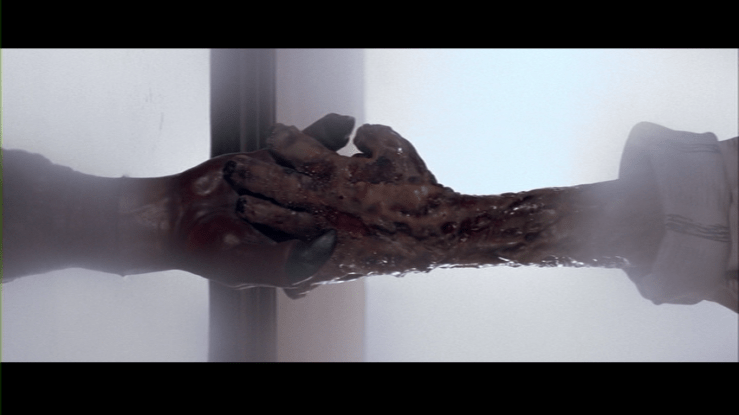
From Prince of Darkness:

Screengrab from Prince of Darkness #1

From Childhood’s End by Arthur C. Clarke:

A vast silence lay over the whole world for the space of twenty seconds–though, afterward, no one could believe that the time had been so short. Then the darkness of the great opening seemed to move forward, and Karellen came forth into the sunlight. The boy was sitting on his left arm, the girl on his right. They were both too busy playing with Karellen’s wings to take any notice of the watching multitude.

It was a tribute to the Overlords’ psychology, and to their careful years of preparation, that only a few people fainted. Yet there could have been fewer still, anywhere in the world, who did not feel the ancient terror brush for one awful instant against their minds before reason banished it forever.

There was no mistake. The leathery wings, the little horns, the barbed tail–all were there. The most terrible of all legends had come to life, out of the unknown past. Yet now it stood smiling, in ebon majesty, with the sunlight gleaming upon its tremendous body, and with a human child resting trustfully on either arm.

Additional “Juxtaposition” posts can be found here.

When the Child Was a Child . . .

When I started my first film blog in 2006, I was 24 years old. I was less than two years removed from finishing a film studies major, and although I had not succeeded in convincing myself to pursue a graduate degree in the subject, I didn’t have any idea what else I might want to do with my life instead. What I did know, or what I thought I knew, was that I was getting rusty: all the critical analysis muscles I had developed in college were atrophying, and unless I started writing about movies again soon, I’d be back where I started in high school, capable of nothing more sophisticated than complaining about how The Mummy  wasn’t enough like Raiders of the Lost Ark. And so one evening I came home from a screening of Brokeback Mountain and started a LiveJournal. This turned into a blog, which surprisingly began to attract a growing audience of regular readers and commenters.

Things rolled along smoothly for a year or so, but then it all started to fall apart. I shuttered the blog to focus on an overly ambitious website at a different URL that no one read, and which soon fizzled out. I was awarded a more-prestigious-than-I-realized fellowship and burned a few important bridges when I failed to deliver on expectations that I didn’t even know people had for me until it was too late. I landed a gig as a DVD reviewer for a fairly prominent online publication and quit in a moment of panic when I realized I had bitten off more than I could chew instead of just asking for less assignments. Most significantly, I realized one night just how awful my financial situation was and finally took steps to fix it, which was a great life decision, but bad for my writing, since I suddenly had much less time for it.

I never quite made an affirmative decision to quit blogging, but as the years went by I did less and less of it. Meanwhile, I got a job I loved working with an academic library media collection, which led to my first professional position at McDaniel College in Westminster, Maryland in 2011, which led to another librarian job at the University of Maryland in 2013, where I still work today. I moved to my current hometown of Baltimore in 2012, bought a house and got married in 2014, and became a father in 2015 (a second daughter arrived earlier this year). I even returned to film criticism in the form of regular Blu-Ray/DVD reviews for the publications Library Journal, which I began contributing to in 2011, and Educational Media Reviews Online, which I started writing for a few years later. One day I looked around and realized that I couldn’t see a void in my life that a blog would fill, and that was that.

Except, obviously, that it wasn’t: it turns out that I do have itches that review work can’t scratch. Take my most recent capsule review for Library Journal (which is mostly behind a paywall, alas), of Kino Lorber’s release of Emir Kusturica’s Underground. In order to write it, I read two book-length works on the director and watched about 10 hours of movies by or about him–it feels like I should have more to show for all this effort than 175 words! Or what about Groundhog Day, my favorite movie? I’ve seen it 50 times, easy, and I’ve read just about every word ever written on it, so I know for a fact that I have original insights to add to the conversation. I don’t have a good place to put them, though! Then there are the things I never got around to back in the day, such a series of video essays. The main purpose of this blog is to provide a platform for sharing projects like this with people other than my wife, and in doing so to (hopefully) motivate me to undertake more of them.

My specific goal is to produce six to eight long-form essays each year supplemented by shorter content as the mood strikes me. For the most part, I am planning to write just about movies, but I may occasionally tackle books, music, TV, and other media. Although I added a link to my CV to the “About” page, I likely will only talk about librarianship when it directly intersects with the topics listed above, which, depending on the path my career takes, could be anywhere from never to all the time. I am planning to stay away from posts dedicated to my other interests like food, politics, and sports, except when they clearly relate to the site’s main topic.

More poetically, this blog is intended to chronicle my return to what the film critic Dave Kehr used to call “the lost continent of cinephilia” after many years away, hence the name.  Unless you count individual episodes of my older daughter’s favorite animated series Spirit Riding Free, my days of watching 650 movies a year (no joke: that was my tally for 2006, including 120+ films in the theater!) are long gone. Film still plays a major role in my life, though, which is definitely worthy of celebration and interrogation. Ideally, my musings on the importance of a 20th century art form to a 21st century man will be of interest to others, but I will happily settle for something to do after the kids are in bed which helps me organize my thoughts. Either way it feels good to be back!