MOON: Why are you in the middle of the road? Let me tell you why you’re in the middle of the road. Once, a long, long time ago, there was a tiny molecule riding the surface of the sea.
Our molecule was thrown about. The water was rough, and it had to adapt or break. But then a storm came up, and our molecule was struck by lightning. This charged it with a strange energy. This was the origin of life, or Ool.
So there was our molecule in the sea. Our sea was soupy, warm and dense, with a bloom of oily bubbles in the crest of the waves. Our molecule sealed itself inside one of these bubbles, and that was the first body.
The whole world was coming to pieces molecule by molecule now and swimming like grease bubbles in a cup of coffee, disappearing into the intergalactic ooze and gasses all around–including his own body. He lost his skin, his skeleton, his pulmonary veins–sneaking out into the ooze like eels, they are, reeking phosphorus, his neural ganglia–unraveling like hot worms and wiggling down the galactic drain, his whole substance dissolving into gaseous nothingness until finally he was down to one cell. One human cell: his; that was all that was left of the entire known world, and if he lost control of that one cell, there would be nothing left. The world would be, like, over. He has to rebuild himself and the entire world from that one cell with a gigantic act of will–too overwhelming. Where does a man start? With California Route 1 so he can get out of here in his car? or will it turn out to be merely the filthy Rue Ventru with the Bastille mobs waiting? or start with the car? the differential? how do they make the bastards? or the beach? all those freaking grains of sand? the marsh grass? the tourist cabins? got to put every blue door back? or the ocean? or leave it dry? save making all those filthy blind bathosphere black animals down there . . . or the sky? how far does it go? the Big Dipper? the Ursa Minor? the Delphinium? suppose it is really infinite concentric spheres of crystal making infinite gelatinous submarinal vibrations? the Dead? the Pranksters? Kesey, Kesey’s out for good, Kesey and the bathosphere brutes–but with a superheroic effort he begins. But by the time he gets himself remade, it is too much. It is overwhelming. He makes his car. He makes the parking lot and the beginning of the road out. He’ll make the rest of it as he goes along. Freak it! Split! Leave the rest of the known world to its own devices, out in the gasses. He jumped into the car and gunned off; and smashed it into a tree. A tree he hadn’t even put back yet. But the crash somehow pops the whole world back. There it is; back from the fat-bubbling ooze. The car is smashed, but he has survived. Survived!
All of the Duncan Idahos, original and the serial gholas flowed into his mind. They were like bursting seedpods denying all other existence except themselves. He saw himself crushed beneath a great worm with a human face.
“Damn you, Leto!”
Crushed and crushed and crushed . . . time and again.
“Damn you! Damn you! Damn you! . . .”
He died under a Sardaukar sword. Pain exploded into a bright glare swallowed by darkness.
He died in a ’thopter crash. He died under the knife of a Fish Speaker assassin. He died and died and died.
Religion stopped working for me sometime between the age of ten and eleven. Born and raised in a part of Pennsylvania that my father used to refer to derogatorily as “fundy country,” it took me that long to realize Christianity wasn’t the only game in town; as soon as I did, I started to have trouble sleeping. Everyone seemed to agree that admission into heaven was dependent on living a good life, but how was it possible to determine which system of keeping score was the right one? Eventually I decided that it wasn’t, labeled myself agnostic, and haven’t had any issues getting eight hours a night ever since.
This is also when I discovered that my family owned a VHS copy of the original Star Wars trilogy taped off the television by someone who occasionally forgot to hit the “stop” button during commercials like this one. By the dawn of the day I piled into a friend’s mom’s car to wait in line for an hour to buy tickets to the theatrical premiere of the “special edition” of A New Hope in 1997, I must have watched it 150 times easy. Although I distinctly remember declaring that “this was the closest thing to a religious experience I’ve ever had!” afterward, I don’t think I connected these two events until just last year when I read Lauren Jackson’s New York Times article “Americans Haven’t Found a Satisfying Alternative to Religion.” Upon doing so I immediately made a note to myself to explore whether or not George Lucas’s tale from a long time ago in a galaxy far, far away functioned for me as a sort of dietary supplement that supplied the “three B’s” Jackson mentions (belief, belonging and behaviors) which otherwise would have been missing from my life.
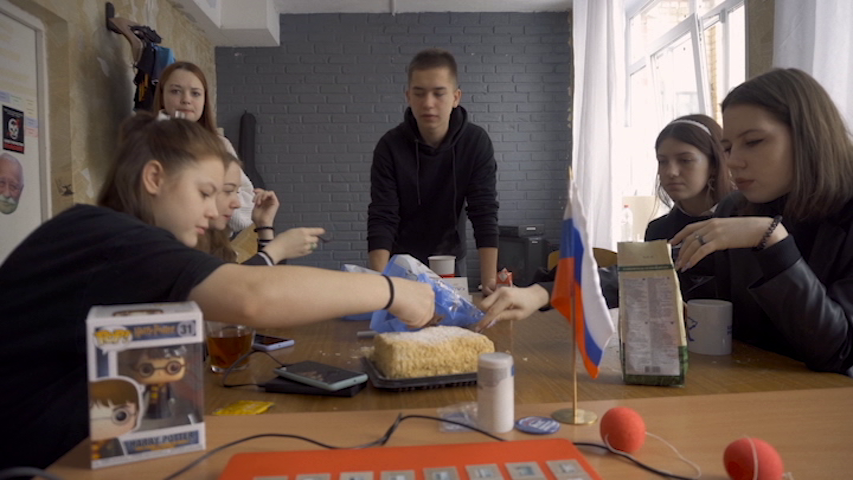
That prospective blog post was still languishing on the back burner when I saw My Undesirable Friends: Part I – Last Air in Moscow at Cornell Cinema last year and was struck by how often its characters mention Harry Potter. A few weeks later I watched Best Documentary Feature Oscar nominee (and eventual winner) Mr. Nobody Against Putin, which includes shots featuring this toy in the foreground:
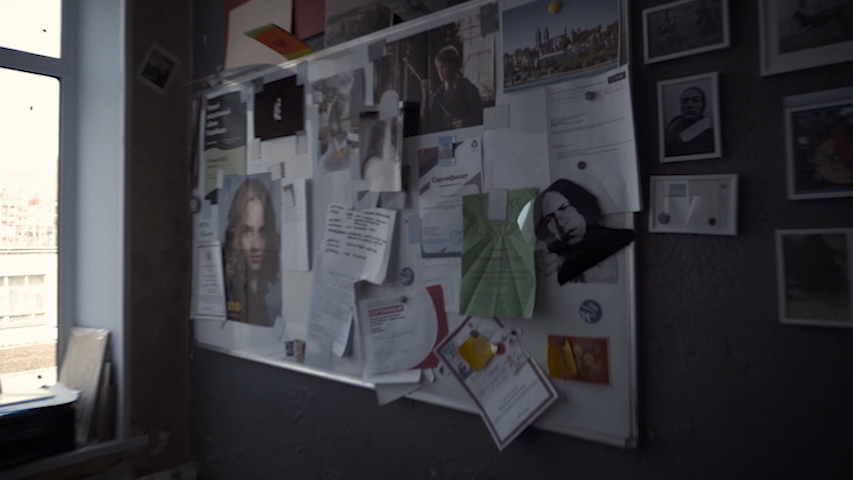
And of these posters adorning director/narrator/subject Pavel Talankin’s office:
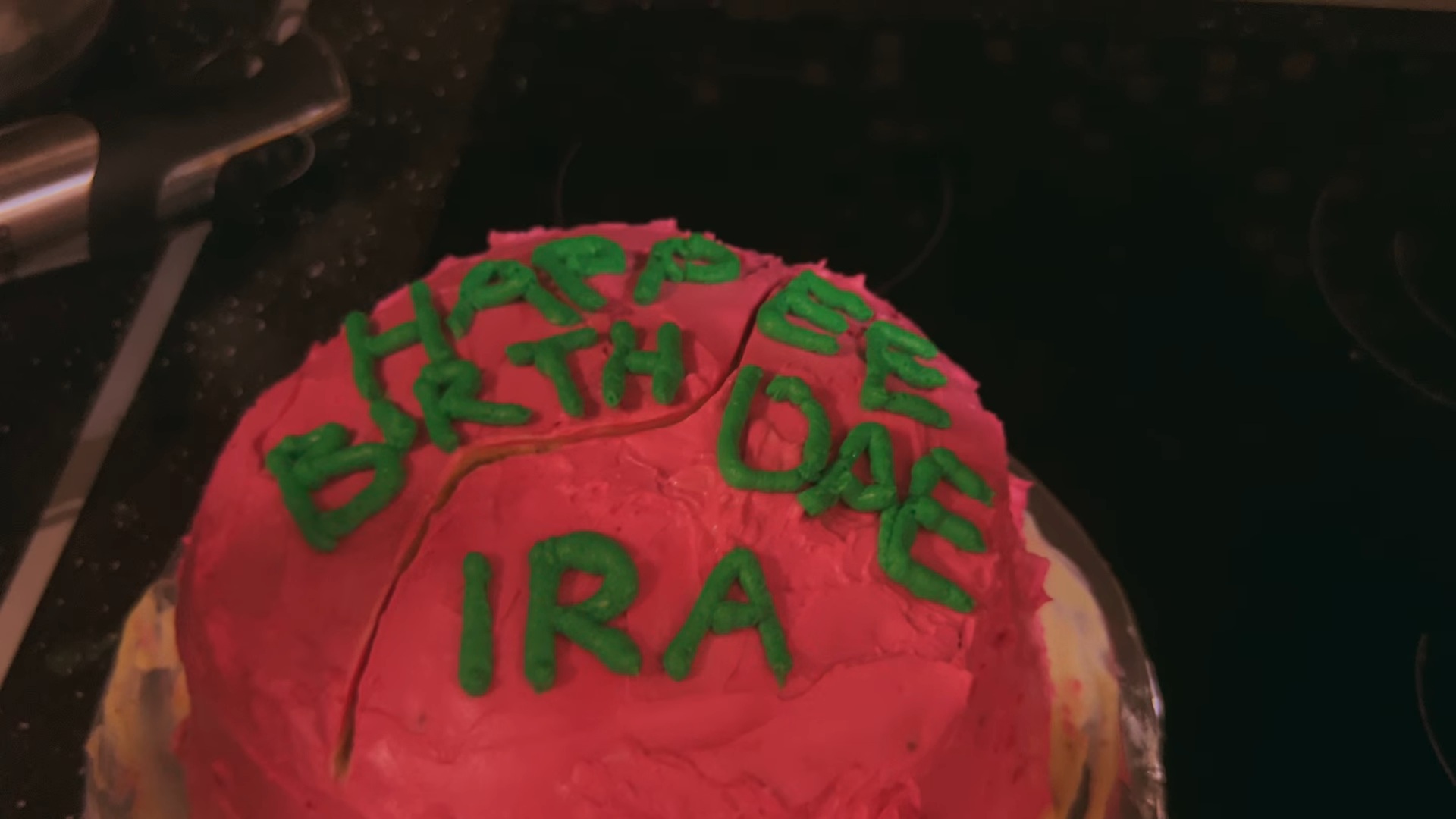
There are, in fact, a total of 12-15 Harry Potter references in My Undesirable Friends depending on how you count, beginning with Joker James performing a song live on TV Rain that contains lyrics about “deaf dementors” near the start of chapter one “The Lives of Foreign Agents.” About ten minutes later the children of primary subject Anna Nemzer ask to watch one of the movies, there’s a Harry Potter advent calendar at the beginning of chapter two “The Town Crazies,” and toward the end of it Alesya Marokhovskaya and her girlfriend prepare a birthday cake for their friend Ira Dolinina modeled after the one Hagrid makes Harry:
Ksenia Mironova displays a picture she paid to have taken with Tom Felton, the actor who plays Draco Malfoy, in chapter three “The Holiday Special,” then she mentions “a lecture about why Putin’s Russia is like Harry Potter” about two-thirds of the way through chapter four “The Expected Impossible.” There’s a close-up of a paperback edition of Harry Potter and the Philosopher’s Stone about ten minutes later, and Olya Churakova listens to a voicemail from her podcast partner Sonya Groysman a few seconds after that in which she describes feeling like “this whole time we’ve been in some Harry Potter book and now it’s the moment when the Ministry has fallen and Ron, Hermione, and Harry leave school to look for Horcruxes”:
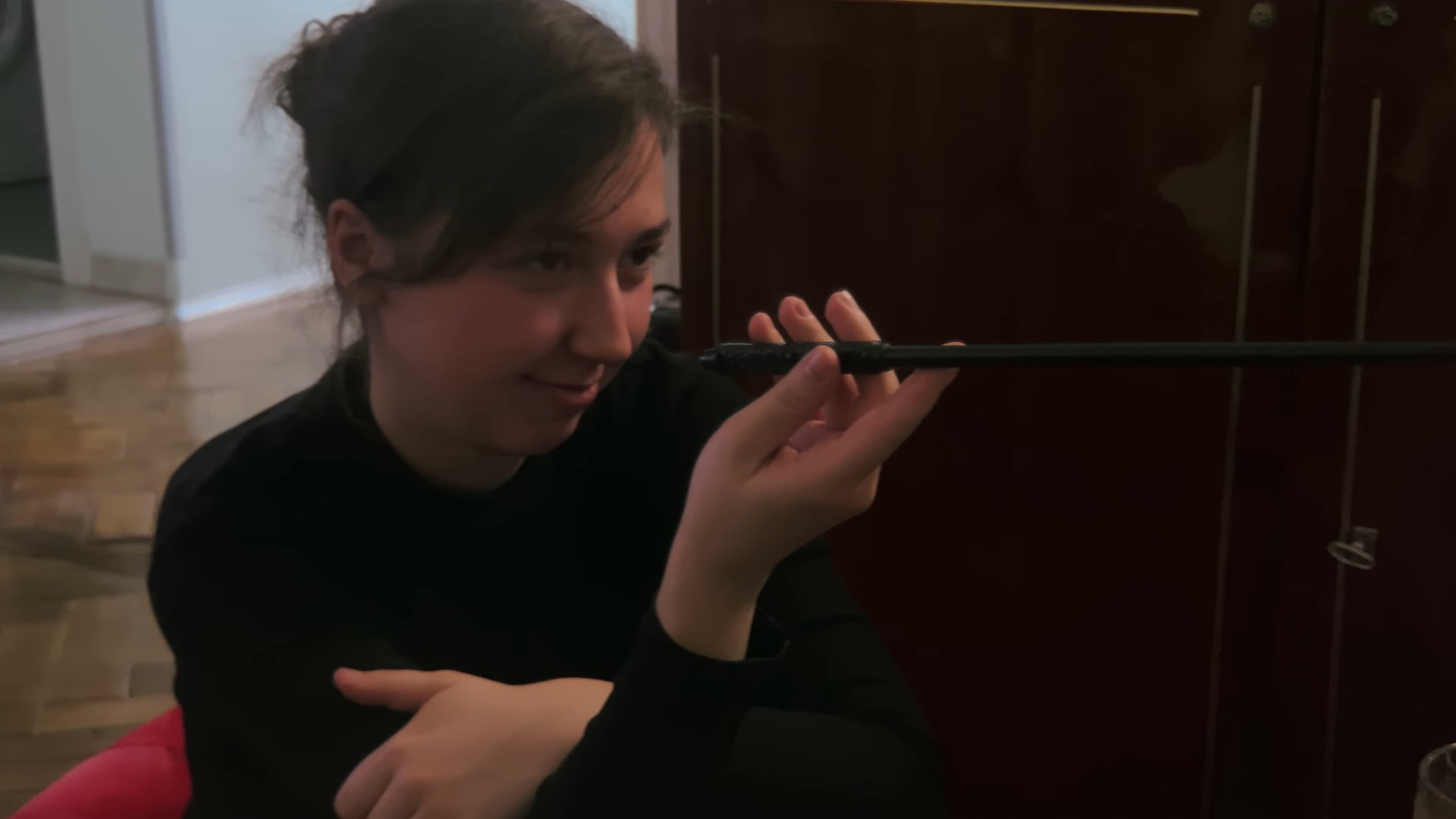
About ten minutes into chapter five “Don’t Say War” there’s a sequence in which Ksenia notes that her TikTok “is filled with comparisons between Harry Potter and Russia,” followed by a suggestion that “Harry Potter is [opposition leader Alexei] Navalny,” followed by a note that “I watched Harry Potter as a kid and couldn’t understand why so many people can’t overthrow one bald guy who’s been ruling for 20 years but now I get it,” followed by an observation that “Navalny is always quoting Harry Potter in court,” and concluding with her friend holding up a wand bought in London:
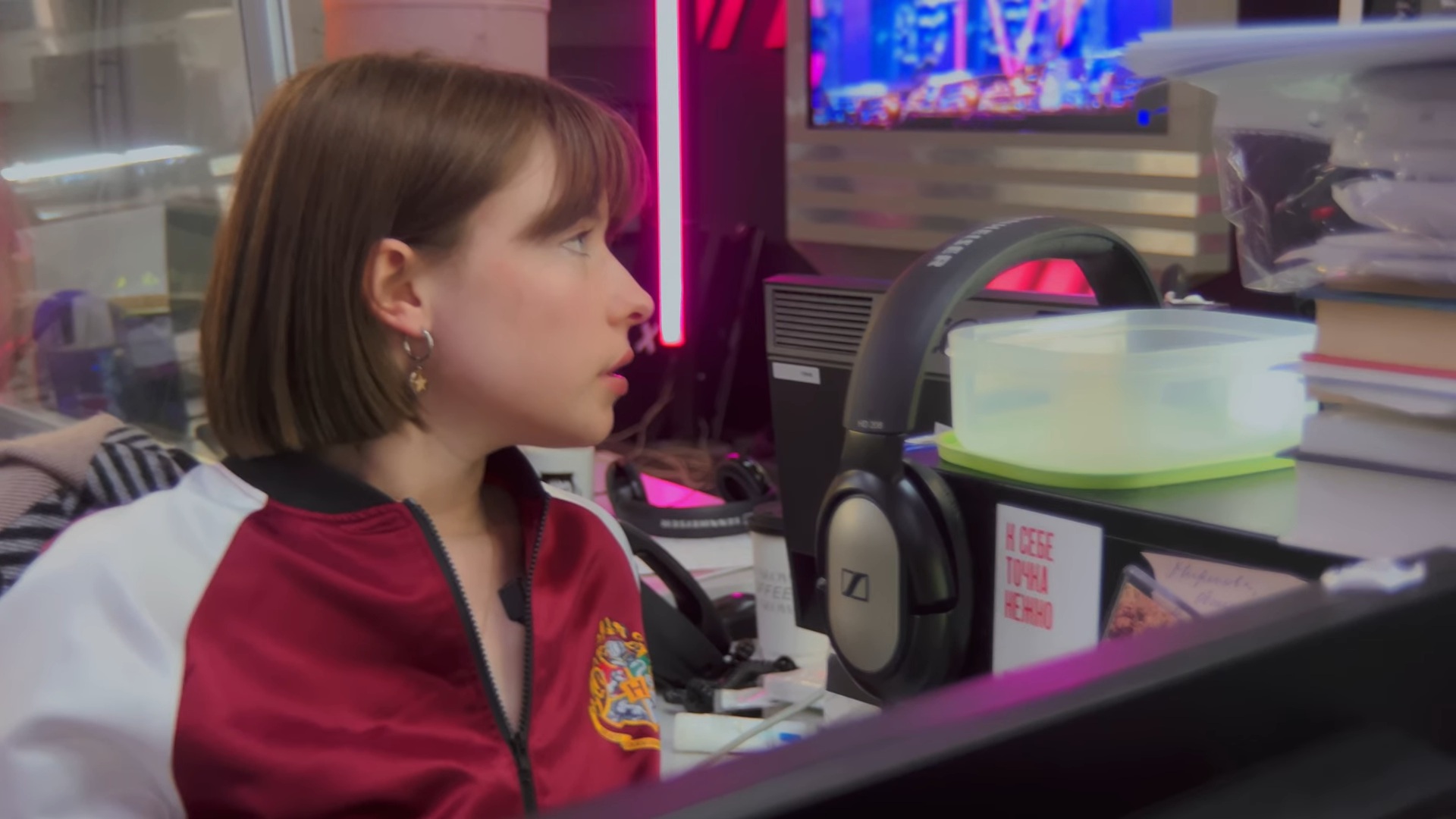
A few minutes later her friend says that she has lots of foreign friends who write her, “you can stop this: go out and protest!” and laments the fact that “clearly [they] haven’t lived in Russia, especially recently,” to which Ksenia replies, “let’s go back to talking about Harry Potter.” She makes another reference to how her social media feed consists of “nonstop Harry Potter” about ten minutes after that while waiting for a colleague arrested at a protest to be released from prison, and finally appears wearing this Hogwarts jacket about 30 minutes before the end of the film:
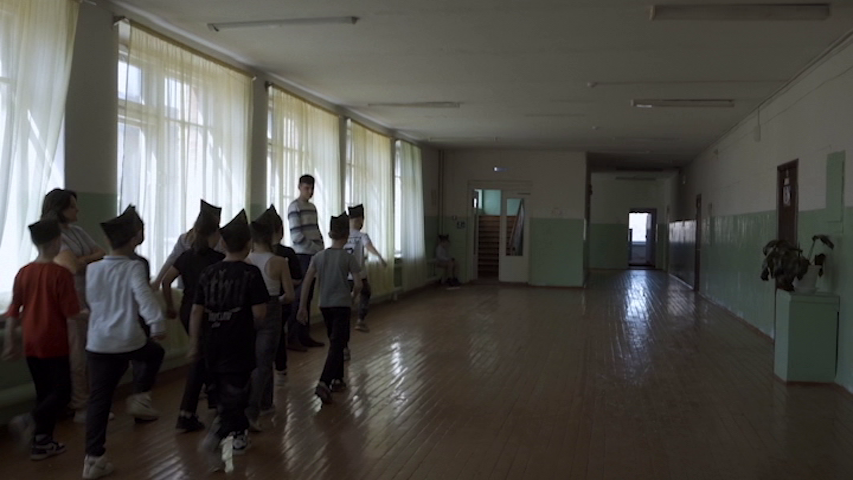
Meanwhile, while there’s only one additional Harry Potter reference in Mr. Nobody when Pavel rhetorically asks, “is Severus Snape our new headmaster?” after stumbling upon students marching through the hallway:
Shots of the posters above reappear multiple times. So what’s going on here? To start with the obvious, My Undesirable Friends director Julia Loktev observed in a 2025 interview with Michael Sicinski for In Review Online that for her characters, “Harry Potter is a framework for understanding good and evil and a framework for understanding Putin’s Russia.” Jackson (who interestingly notes that she first encountered the work of Richard Dawkins at a Barnes & Noble in middle school when she went there “to buy the latest Harry Potter”) supplies a possible reason why in the form of a long-term study that found “women who attended religious services once a week were 33 percent less likely to die prematurely than women who never attended.” She quotes one of its authors, Tyler J. VanderWeele, as explaining that this was because “they had higher levels of social support, better health behaviors and greater optimism about the future,” which sounds a lot like the advice Navalny gave his fellow citizens in a speech appealing his conviction for violating the terms of a previous suspended sentence. “It’s important not to feel lonely, because if I were Voldemort I would like you to feel lonely,” he said. “Obviously, our ‘Voldemort’ in his palace also wants it.” He quoted the Bible in the same speech: “blessed are those who hunger and thirst for righteousness, for they will be satisfied.”
The Church of Dumbledore actually isn’t the only secular religion My Undesirable Friends proposes for Russia. Anya calls New Year’s Eve the country’s “one religious holiday” in chapter three and TV Rain’s lawyer Dima laughingly suggests that “Russia’s real religion is, what’s that Phoenician religion, the cult of Baal” in chapter five:
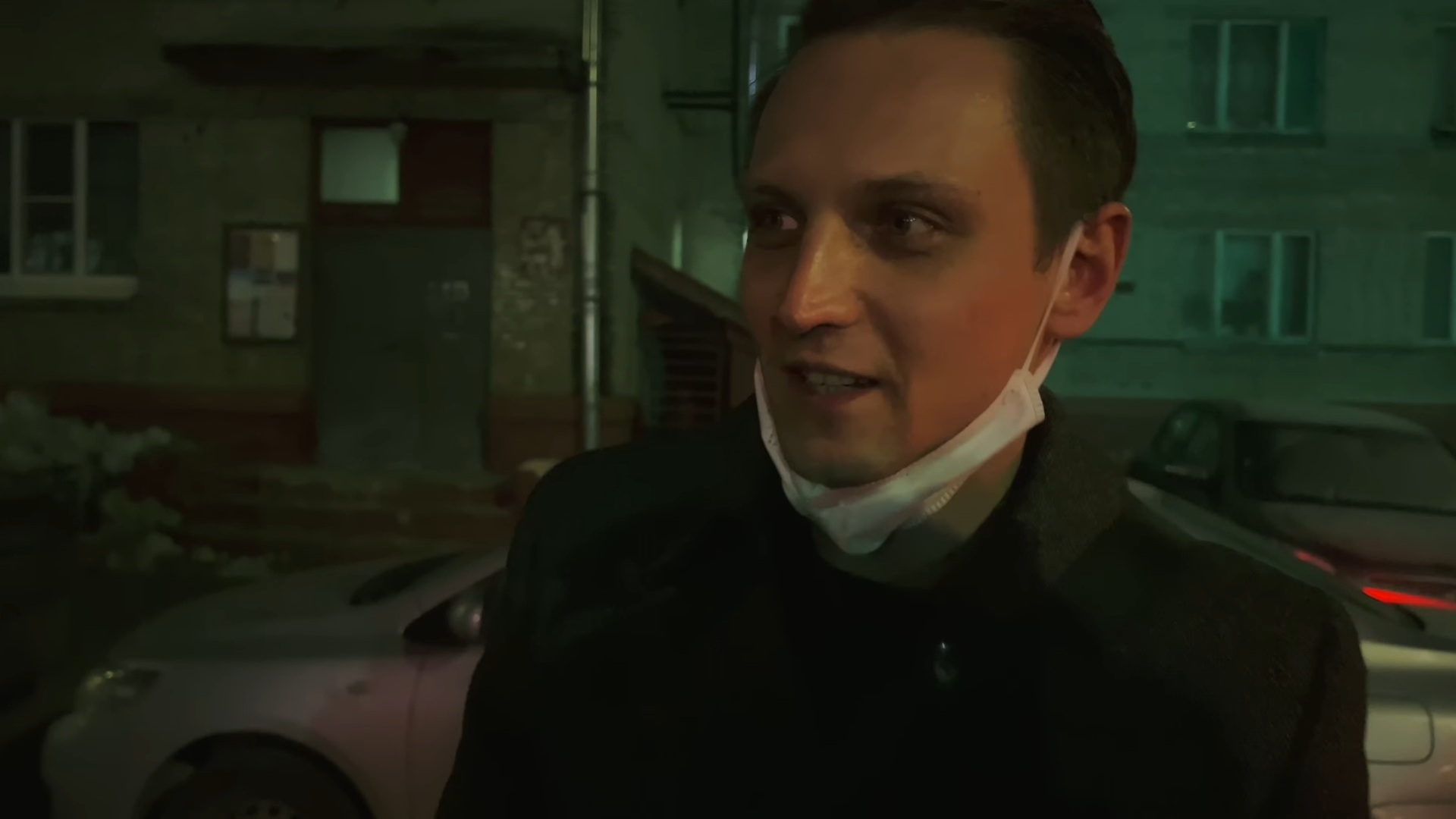
“There is some divine boss whom no one has ever seen,” he explains, and “it’s always, ‘I don’t make decisions, the boss does.'” The punchline: “Baal in Phoenician just means ‘boss.'” They are, of course, both joking, but there are also three other references that I find significant. The first comes just six minutes into chapter one: “this is really Mordor,” Anya says about a building that to her embodies the worst tendencies of the Putin regime:
“Where else can you find a Mordor like ours?” Lena Kostyuchenko asks about halfway through chapter two. “We have the most Mordorous Mordor!”
Finally, in a cab home from an airport with Lena and her newly-arrived American girlfriend, Loktev herself asks, “how is it ‘Mordor’ in English?” from offscreen as they pass the Kremlin, and is answered with solemn nods.
Whatever comfort and community Harry Potter provides for Loktev’s subjects and Talankin, I can’t help but wonder if they all wouldn’t have been better served by The Lord of the Rings. Consider Ksenia and her friend. “We have a Harry Potter but he’s in prison,” they lament in chapter five.
J.K. Rowling’s tale is just as much a product of the “John the Baptist complex” I wrote about in my Movie Year 2025 top ten (percent) list entry for L’Empire as Star Wars. I have no doubt that My Undesirable Friends‘ dissident journalists knew exactly what they were fighting for and I can’t imagine it would have made a whit of difference in the end, but it seems to me that humble, persistent Frodo Baggins and steadfast Samwise Gamgee would have made for more empowering role models than “The Boy Who Lived.”
TARAN: They’re dreaming of two stories now. You were successful! You set them all on their feet.
NEETA: Father!
TARAN: Why stay any longer? Now they just pity you. You weren’t up to carrying the burden, yet you were forced to. Now you yourself have become the burden.
“‘But surely you must have heard of Captain Loosestrife? He was an officer of the Owsla in the fighting.’
“‘What fighting?’ asked another buck.
“‘The fighting against King Darzin,’ replied Rabscuttle.
“‘Here, do me a favor, old fellow, will you?’ said the buck. ‘That fighting–I wasn’t born when it finished.’
“‘But surely you know the Owsla captains who were?’ said Rabscuttle.
“‘I wouldn’t be seen dead with them,’ said the buck. ‘What, that white-whiskered old bunch? What do we want to know about them?’
“‘What they did,’ said Rabscuttle.
“‘That war lark, old fellow?’ said the first buck. ‘That’s all finished now. That’s got nothing to do with us.’
“If this Loosestrife fought King What’s-His-Name, that’s his business,’ said one of the does. ‘It’s not our business, is it?’
“It was all a very wicked thing,’ said another doe. ‘Shameful, really. If nobody fought in wars, there wouldn’t be any, would there? But you can’t get old rabbits to see that.’
“‘My father was in it,’ said the second buck. ‘He gets on about it sometimes. I always go out quick. “They did this and then we did that” and all that caper. Makes you curl up, honest. Poor old geezer, you’d think he’d want to forget about it. I reckon he makes half of it up. And where did it get him, tell me that?”
Thanks to Raquel Stecher’s Out of the Past blog, I recently became aware of two books published by Turner Classic Movies based on the same premise as my Drink & a Movie series: that cocktails and movies are natural partners! The first, Eddie Muller’s Noir Bar by TCM personality Eddie Muller aka “The Czar of Noir,” came out last fall and features a selection of movies from the titular genre paired with a combination of classic and modern cocktails as well as a handful created by the author, a former bartender turned “professional drinker,” which he defines in the introduction as “somebody who imbibes every day but never gets drunk. Well, almost never.” This is a pretty good label for me, too, and I appreciate Muller’s emphasis on accessible ingredients and recipes which can be easily adapted to a variety of circumstances over obscure spirits and elaborate techniques. It lends itself to smart pairings, too, as in the case of The Breaking Point, which he calls “the finest film ever made from a Hemingway book” and matches with the famous novelist’s “personal spin on a Caribbean classic,” the Hemingway Daiquiri. Although it may seem like an obvious choice, Muller justifies it with a suggestion to either substitute mezcal as the base spirit to better connect with the film’s Baja California setting or use Captain Morgan white rum as an homage to the character played by John Garfield.
Other thoughtful combinations include pairing The Big Sleep with a Gimlet because they feature prominently in another work by Raymond Chandler, the author of the novel that the film is based on; Force of Evil with a drink by Los Angeles bartender Paul Sanguinetti called The Blacklisted by way of acknowledging the “political imbroglio” that impacted key noir figures like the movie’s screenwriter Abraham Polonsky; and Side Street with San Francisco bartender Todd Smith’s Black Manhattan for the poetic reason that it’s a worthy companion to the film that Muller lauds as “the best New York noir.” I love the decision to use director Luis Buñuel’s personal Martini recipe in the pairing with Sweet Smell of Success, and I enjoyed both of Muller’s inventions that I tried, the Sailor Beware paired with The Lady from Shanghai and the Hammett Martini paired with The Maltese Falcon, which features a split-base spirit combination of vodka and rum that was new to me.
Noir Bar is organized alphabetically by movie title, which makes sense, and features ephemera from Muller’s personal collection like a prop “Wanted” poster from The Hitch-Hiker that reminds me of Ted Haigh’s Vintage Spirits and Forgotten Cocktails, which I intend as a high compliment! It also contains some of the most stylish (the black backgrounds were a great choice) and creative drink photography I’ve ever seen. I don’t endorse *every* aspect of Muller’s philosophy: I tend to agree with Toby Maloney’s statement in The Bartender’s Manifesto that “it’s gauche, it’s gross” to rub expressed citrus peels over the rim of a glass, for instance. All of them reflect Muller’s years of experience behind the stick, though, and represent a definite point of view, and I’d love to come over to the “full-scale cocktail lounge” in his garage for happy hour sometime!
André Darlington’s Forbidden Cocktails, which features “libations inspired by the world of pre-Code Hollywood,” unfortunately doesn’t stand up well to a side-by-side comparison. To lead with the positives, many of the film descriptions are quite good, such as the analysis of which “paradise cocktail” exactly we’re watching someone prepare in One Way Passage, and I like how it consists entirely of original creations made from ingredients from that period of film history, which stretched from roughly 1930 when the Motion Picture Producers and Distributors of America adopted the Hays Code to 1934 when they actually began enforcing it. But I wish it would have gone further in this direction by telling you in detail how to set up and stock an early 1930s bar and then offering a curated library of drinks that could be made with those ingredients which includes both classics and original creations along with the movie pairings. The main problem with going all-in on the latter is that Darlington’s recipes are mostly just slight variations on existing drinks, which would be fine were it not for the fact that they don’t always represent an improvement over the original. The My Pal Rye which accompanies Night Nurse, for instance, is a perfectly credible riff on an Old Pal, only it isn’t at all clear to me why this rather edgy film calls for a variation which “takes things in a softer direction” by switching out dry vermouth for Lillet Blanc. A more successful example is the Rose-Colored Glasses paired with 42nd Street, which replaces the creme de cacao in an Alexander cocktail with raspberry syrup to give it an attractive pink hue that evokes a line from the movie, but even this seems like only half an idea: why not add a floral component as well? The book also isn’t organized in any logical fashion, contains far less appealing pictures, and seems impersonal next to Muller’s guided tour of his sometimes delightfully idiosyncratic noir canon.
I applaud the fact that both books are available in spiral-bound editions and feature indexes organized around ingredients to make it easier to find and flip to a recipe you can make with the bottles you have on hand, and I’m going to enjoy having each of them in my collection–there are still a number of recipes in Forbidden Cocktails that I want to try! But Noir Bar is clearly my top recommendation. It would make a fabulous gift for lovers of that genre who also enjoy an occasional drink, drinkers who also like movies, or anyone who throws parties for people from either of the aforementioned groups who might enjoy picking it up off a coffee table and flipping through it.
JUAN: Alright, first things first. You can’t sit at my table like that. You can’t sit with your back to the door. C’mon. [Juan slides Little’s chair around the table.] How you gonna know if somebody creepin’ up on you? Alright, see that? Now you can see everything.
Thufir Hawat slipped into the training room of Castle Caladan, closed the door softly. He stood there a moment, feeling old and tired and storm-leathered. His left leg ached where it had been slashed once in the service of the Old Duke.
Three generations of themnow, he thought.
He stared across the big room bright with the light of noon pouring through the skylights, saw the boy seated with back to the door, intent on papers and charts spread across an ell table.
How many times must I tell that lad never to settle himself with his back to a door? Hawat cleared his throat.
Paul remained bent over his studies.
A cloud passed over the skylights. Again, Hawat cleared his throat.
Paul straightened, spoke without turning: “I know. I’m sitting with my back to a door.”
“No. I mean something else. Three or four hundred years ago, cops used to catch people like Reich just to kill them. Capital punishment, they called it.”
“You’re kidding.”
“Scout’s honor.”
“But it doesn’t make sense. If a man’s got the talent and guts to buck society, he’s obviously above average. You want to hold on to him. You straighten him out and turn him into a plus value. Why throw him away? Do that enough and all you’ve got left are the sheep.”
“I don’t know. Maybe in those days they wanted sheep.”
A vast silence lay over the whole world for the space of twenty seconds–though, afterward, no one could believe that the time had been so short. Then the darkness of the great opening seemed to move forward, and Karellen came forth into the sunlight. The boy was sitting on his left arm, the girl on his right. They were both too busy playing with Karellen’s wings to take any notice of the watching multitude.
It was a tribute to the Overlords’ psychology, and to their careful years of preparation, that only a few people fainted. Yet there could have been fewer still, anywhere in the world, who did not feel the ancient terror brush for one awful instant against their minds before reason banished it forever.
There was no mistake. The leathery wings, the little horns, the barbed tail–all were there. The most terrible of all legends had come to life, out of the unknown past. Yet now it stood smiling, in ebon majesty, with the sunlight gleaming upon its tremendous body, and with a human child resting trustfully on either arm.
Additional “Juxtaposition” posts canbe found here.