On Kanopy’s “Free” Streaming Video Service

On December 13 I tweeted about an interesting conversation that media librarians were having on the Videolib listserv about a Wired article by Brian Raftery called “The Best (Free) Streaming Service You’ve Never Heard Of”:

Untitled

Also mentioned in this thread were an IndieWire piece by Chris O’Falt called “Free Streaming Nirvana: How to Access a Collection of the Greatest Movies Using Your Library Card” and the fact that Kanopy’s website touts its product as “streaming now for free with your library card.” On January 29, a Videolib poster drew attention to an Entertainment Weekly article by Maureen Lee Lenker called “What You Need to Know About (Free!) Streaming Video Service Kanopy,” and a few days later the following tweet by writer Jonah Wiener appeared on my timeline:

JW Tweet

Both the Wired and IndieWire articles, like Weiner’s tweet, hail Kanopy as an alternative to the subscription streaming video service FilmStruck, which ceased operations in November, 2018. To be fair, the IndieWire article does accurately describe Kanopy as a company which sells a product to a market that consists primarily of libraries, schools, and other non-profit organizations; the Entertainment Weekly article dips briefly into discussion of Kanopy’s business model as well, although it also refers to libraries and academic institutions as Kanopy’s “partners,” which obscures the fact that this is a vendor-customer relationship.

I have been reluctant to say much on this topic because I have very little firsthand experience with Kanopy aside from a few brief conversations with their representatives at National Media Market circa 2013-14. I am on the record as suggesting (on page 185) that use-driven acquisitions or UDA (which also goes by other names and acronyms including DDA, for demand-driven acquisitions, and PDA, for patron-driven acquisitions) plans like the one Kanopy offers might represent a better value for libraries than curated streaming video collections, so I’m not hostile toward their business model, but I call for more research on the subject later in the same article (on page 187), so I’m probably best described as a skeptic. That’s not really what worries me about articles and tweets like the ones I link to above, though. My concerns came into better focus as I was flipping through Rick Anderson’s recent book Scholarly Communication: What Everyone Needs to Know the other day. Here’s the passage that caught my eye:

In reality, of course, no library does anything for free. Library patrons are most assuredly paying for the services they receive–but since the payments are made indirectly (usually in the form of property taxes, tuition, or student fees) and since payment is separated in both time and space from the experience of library services, those services can easily give the false impression of being offered at no charge. In other words, the fact that you can walk into a library, select five books, and take them home with you without money changing hands during the transaction makes the transaction feel as if it came without cost. In reality, however, the money changed hands earlier, and made its way indirectly from your picket to the library’s budget.

Why is this point worth making? Because the proposition that libraries offer “free services” poses two risks that are mirror images of each other. First, it poses the risk that library services will be undervalued by those whose financial support is essential to their survival. It is a common rule of thumb in economics that we tend to value least those things in which we have the least invested, and for this reason alone it is unwise for any library to pretend that its patrons have not made concrete monetary investments in the library and its services.

More subtly, the claim that libraries provide “free services” is risky because it simply does not pass the smell test. Anyone who hears that claim and takes even a few moments to consider it will immediately recognize its falsity and may then start to wonder whether other things said by librarians (and their supporters) are actually trustworthy.

For libraries and their boosters who want to encourage better and more widespread use of the library, a more accurate and effective message might be: “Come see how we are making wise and effective use of the money you have entrusted us with.”

Presumably, Raftery, Lenker, and Weiner all chose to write about Kanopy out of a genuine desire to draw attention to the great films available through its streaming video service to patrons of the libraries and other institutions that subscribe to it. By failing to delve into the details of exactly how this happens, though, they may be contributing to a situation whereby the films are only free “until it’s unsustainable and your library has to switch to mediated access,” as one Videolib poster put it. After all, Kanopy is every bit as much of a commercial entity as FilmStruck was. I’d like to see more articles like O’Falt’s (headline aside) and this one that Glenn Kenny wrote for the New York Times called “Library Cards Unlock Film Vaults,” which are every bit as enthusiastic about the opportunity Kanopy represents for movie lovers, but without neglecting to express curiosity about what’s going on behind the scenes. Otherwise, the history of disappointment associated with FilmStruck might be doomed to repeat itself.

Sweet Vermouth on the Rocks with a Twist

Eighteen minutes into Groundhog Day, weatherman Phil Connors (Bill Murray) sits in the bar of the Pennsylvanian Hotel and orders “one more of these with some booze in it”:

Screengrab from Groundhog Day #1

Judging from its appearance and subsequent scenes, the drink in question is most likely Jim Beam on the rocks with a splash of water, which Phil orders from the same bar later in the movie, using his fingers to indicate exactly how much of each component he wants:

Screengrab from Groundhog Day #2

It might also be Jack Daniels, which I think is what he is swigging from the bottle in this scene:

Screengrab from Groundhog Day #3

Either way, Phil seems to be partial to whiskey. His producer Rita (Andie MacDowell) is not: her tipple of choice, as we learn from her first drink order, is “sweet vermouth on the rocks with a twist.” Upon discovering that he is stuck in Punxsutawney, Pennsylvania living the same day over and over, Phil decides to seduce Rita to pass the time. His plan begins back in the bar at the Pennsylvanian. “Can I buy you a drink?” he asks her. When she says yes, he not-so-innocently requests “sweet vermouth, rocks, with a twist, please.” After telling the bartender (John Watson Sr.) she wants the same, Rita turns to him with a smile. “That’s my favorite drink!” she exclaims. “Mine, too!” he replies with mock astonishment. “It always makes me think of Rome, the way the sun hits the buildings in the afternoon.” He proposes a toast to the groundhog, but it falls flat (more on this in a bit):

Screengrab from Groundhog Day #4

So he takes a sip of his drink. It’s the face he makes next that I want to talk about first:

Screengrab from Groundhog Day #5

Obviously, he’s not a fan. But why not, and what does it tell us? A good starting point is to try to determine what exactly they’re drinking. Unfortunately, the film itself is of little help in this regard. There’s only one good shot of the backbar at the Pennsylvanian:

Screengrab from Groundhog Day #6

You actually can make out quite a few labels: I see Jose Cuervo Especial, Bushmills Irish Whiskey, Kahlua, Glenlivit, and Absolut Peppar, for instance, but nothing clearly identifiable as sweet vermouth. There’s another shot in the film that theoretically could tell us something about what brands were available in Punxsutawney at the time, of the backbar at the German restaurant where Phil and Rita eat dinner later that evening, but it’s similarly unhelpful:

Screengrab from Groundhog Day #8

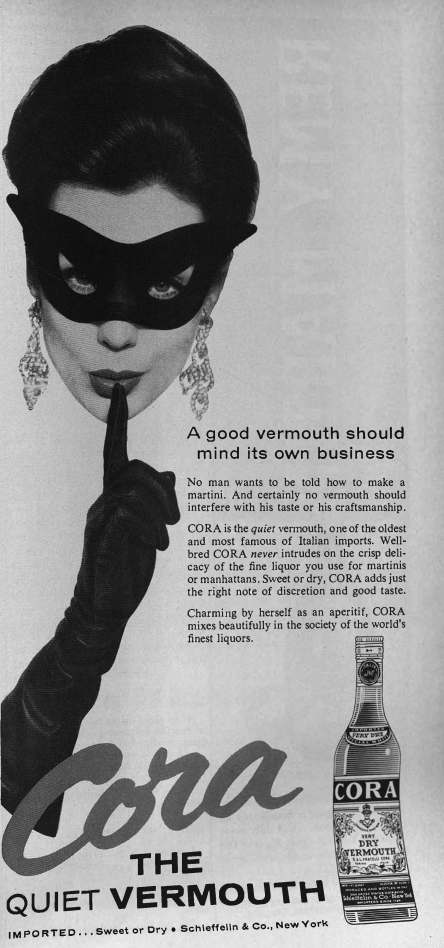
I see Maker’s Mark, J&B Scotch Whisky, Tanqueray, Frangelico, and a few other things here, but again, no vermouth. Even lacking a smoking gun, though, I think we can make some strong inferences. As chronicled by Adam Ford in his book Vermouth: The Revival of the Spirit that Created America’s Cocktail Culture, vermouth had its heyday in the United States in the 1930s and 40s. While Helen Weaver describes drinking “sweet vermouth on the rocks with a twist of lemon” at a Greenwich Village lesbian bar called The Bagatelle as late as 1955 in The Awakener: A Memoir of Jack Kerouac and the Fifties, according to Ford the spirit had been in decline since the end of World War II, and its fall from grace was expedited shortly afterward when foreign producers began reformulating the vermouths they exported to the United States into less flavorful styles marketed as a perfect complementary ingredient in cocktails like the martini and manhattan. The reason? “As men returned from the war and found women in increasingly powerful roles, a faux-masculinity appeared, which resulted in men demanding ‘stronger’ drinks” (Vermouth, p. 110). This advertisement for Cora vermouth in the March 12, 1960 edition of The New Yorker (one of two brands of vermouth with ads in the issue!) cited by Ford says it all:

Advertisement for Cora Vermouth

Bill Murray was born in 1950. If Phil is approximately the same age, then he would have grown up surrounded by messages like this one about how he should act and drink. Is it any wonder that he prefers reading Hustler to attending Punxsutawney’s annual Groundhog Dinner, that he’s incredulous at the idea that a man would cry in front of a woman, or that one of the ways he chooses to spend immortality is by living out this fantasy?

Screengrab from Groundhog Day #8

Is it any surprise that he would be disgusted by a weak, “girlie” drink like unadulterated sweet vermouth? In an article in the journal Critical Studies in Mass Communication called “The Spiritual Power of Repetitive Form: Steps Toward Transcendence in Groundhog Day,” Suzanne M. Daughton argues that the film “presents one man’s metaphorical journey away from the stereotypically masculine pursuit of Power and Agency” and toward “acceptance of Spirit and communion” by subverting “the traditional masculine theme of the romantic quest, where the hero must travel far away to meet his challenges” and replacing it with “a feminine initiation ritual” (p. 143). Proponents of this reading could plausibly see Phil’s reaction as one of the pivotal moments in the film: he recoils from its bitter taste, but his medicine has been taken.

A more charitable explanation for Phil’s reaction is suggested by his reference to Rome. Adam Ford begins his history of vermouth by talking about how he came to be interested in it:

When we got back down into the Aosta Valley about a week later, in the serene mountain town of Courmayeur, we rewarded ourselves with a fancy hotel room and an expensive dinner at a small side-street café, a little bit off the main town square. During dinner, my wife noticed that others in the restaurant were drinking vermouth, and of course she ordered a glass. We had never seen the brand before. She took it cellar temperature in a classic Italian wine glass, like everyone else, and loved it.

For the first time I tried it too, and found it unlike anything I’d ever drunk before. The flavors were intriguing, enigmatic, and distended. I asked the bartender (in Spanish) what the ingredients were and he told us (in Italian) that–as with all vermouths–it was a highly guarded secret, but that everyone had their opinions as to some of the ingredients. An Israeli couple next to us overheard and suggested a few possibilities: Maybe gentian? Or angelica? Certainly some cinnamon. The night ended with a list of almost a dozen potential candidates that I wrote down on the back of a napkin, sadly long since lost.

We closed out the restaurant, and despite the amount we had drunk, we walked back to our hotel room still sober and excited, holding hands like a couple of junior-high kids. While I looked at her and she looked toward the stars, I asked Glynis what she wanted to do when we got back to America. She said she wanted more nights like the one we just had.

Ford goes on to note that when they returned to the United States, they did start drinking more vermouth, but that the only ones they were able to find paled in comparison to what they had consumed in Europe: “[t]hey were like buying a suit off the rack after years of having tailor-made; it was fine, but you didn’t feel like you were at the top of the food chain.” An experience like this is plausibly how Rita and the real-life inspiration for her drink order (as described in the director’s commentary on the special edition DVD), Harold Ramis’s wife, came to develop their preferences for vermouth as well. If we assume that, like Bill Murray’s character in Scrooged, Phil wasn’t always a jerk, maybe he, too, has a memory that the drink he is served at the Pennsylvanian just can’t live up to.

The most likely solution may be the simplest one, though. Good vermouths like Punt e Mes, a personal favorite which is mentioned in a New York Times article dated November 1, 1992, definitely were being exported to the United States in the early 1990s when Groundhog Day is set, but it’s unclear whether or not they would have been available in rural Pennsylvania. It seems far more probable that Phil and Rita would have been served a major global brand like Martini & Rossi (which was acquired by Bacardi Ltd. just a few months before the film was released in a move that the Wall Street Journal reported created the world’s fifth-largest wine and spirits company) or a bottom-shelf American label like Tribuno, which I remember collecting dust on my parents’ home bar in Lancaster, Pennsylvania. That bottle from my youth was almost certainly purchased from a state store supplied by the same Pennsylvania Liquor Control Board that the commercial establishments in Punxsutawney would have been legally required to buy their spirits from. In other words, the drink may just not have been very good. And that, finally, brings me back to Phil’s toast.

Recall that Phil and Rita are sitting in a bar in the hometown of Punxsutawney Phil, “the world’s most famous weatherman,” on Groundhog Day. Phil offers to buy Rita a drink. She accepts. She asks him, “well, what should we drink to?” He responds, “to the groundhog!” This is entirely appropriate under the circumstances, but what does Rita do? She gives him a disappointed look:

Screengrab from Groundhog Day #4

And says, “I always drink to world peace.” Maybe the film makes a joke out of Rita’s bad taste in booze, maybe it doesn’t: I don’t think it’s saying anything significant about her either way. But what are we supposed to make of a person who reacts this way to a perfectly respectable toast?

To quote Adam Ford one last time, the genius of the inventor of vermouth, Antonio Benedetto Carpano, was that he “perfected a drink that hit upon the two most popular flavors at the time: sweet and bitter” (p. 66). There are beautiful scenes in Groundhog Day. Here’s one I’m particularly fond of:

Screengrab from Groundhog Day #10

But treacle needs to be cut, as Danny Thomas once said to Time magazine, and that’s what moments like Rita’s reaction to Phil’s toast accomplish. After all, she may look like an angel when she stands in the snow, but she isn’t one: she’s a human being with flaws, and however well Phil knows Rita by the end of February 2, February 3 is a new day and only the second one she’s ever spent with him. And so, “let’s live here!” Phil says at the end of the film. But then, immediately afterward: “we’ll rent to start.” To quote the Nat King Cole song which plays over the credits with a slight change in emphasis, it’s almost like being in love.

Not at All What We Had in Mind

Screengrab from Prince of Darkness #2

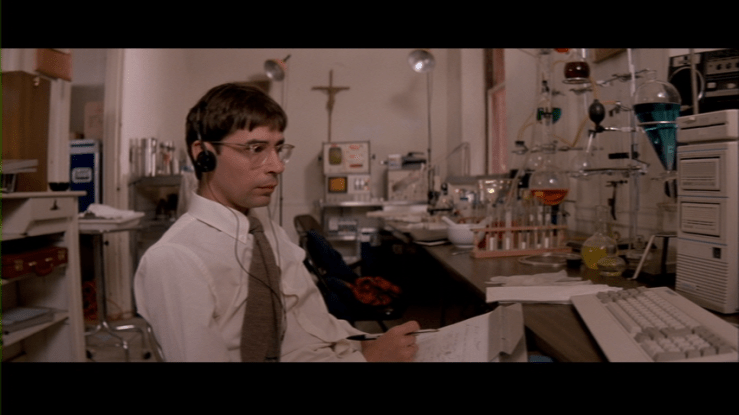
I’ve been thinking a lot about this character in John Carpenter’s Prince of Darkness lately. His name is Etchinson (not that anyone ever addresses him as such–we have to wait until the end credits to find this out) and he’s played by the actor Thom Bray. He is on screen for 4:08 total in a film with a 102 minute runtime (~3% of the whole), and all of his appearances are confined to the 11 minutes (~9%) between the 26:36 and 37:38 marks. We know that he is a graduate student, and that his discipline is biochemistry. That’s about it, though.

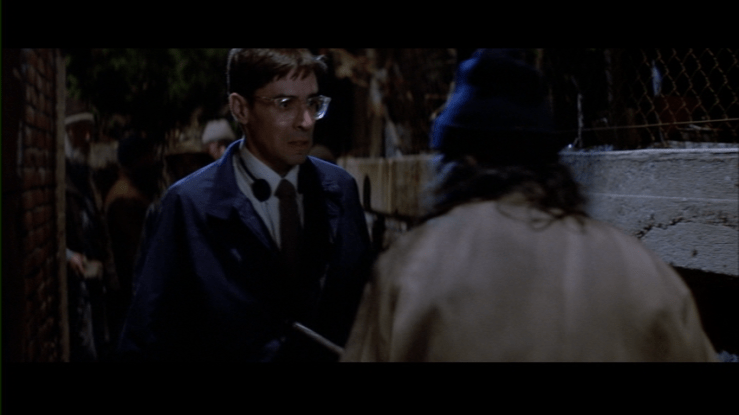
His chief claim to fame is, of course, being the first person in the film to be killed:

Screengrab from Prince of Darkness #3

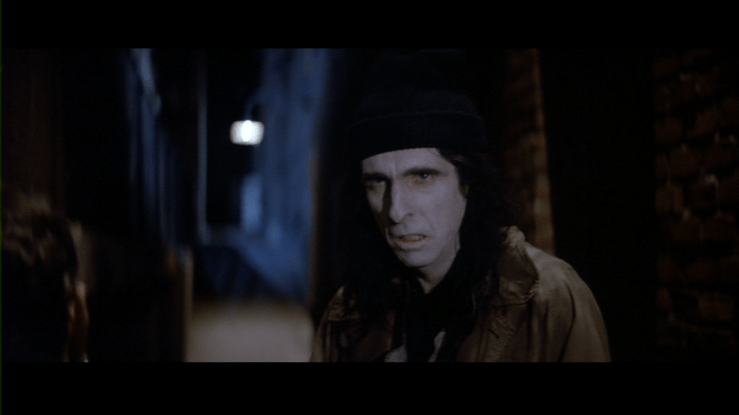
Part of what makes him memorable is how he goes, impaled on a bicycle in an impressive stunt borrowed from Alice Cooper’s stage show (per Gilles Boulenger’s John Carpenter: The Prince of Darkness, p. 204) by a “street schizo” played by Cooper himself:

Screengrab from Prince of Darkness #4

It’s a sudden, brutal death to be sure, but so are many others in the film: why is this the one that stuck with me? First, at the risk of being obvious, the scene is well done. In addition to the stunt work mentioned above, this is a good example of the director’s mastery of what Michelle Le Blanc and Colin Odell call “the act of depicting nothing” in their book John Carpenter. As they note, “[a]n empty room is ominous because cinema is generally concerned with action–emptiness represents suspicion or disruption of order” (p. 19). In the case of Prince of Darkness, anticipation is created by the inaction of the homeless people who have been arriving at Saint Godard’s (the church where the bulk of the film’s action is set) in greater and greater numbers since Etchinson and his colleagues began appearing, and who are described thusly seconds before Etchinson exits the film:

KELLY: Now, a friend of mine at UCLA did a study of chronic schizophrenics. They’re supposed to have stereotyped routines that they repeat every 20 minutes or so, you know, like a stuck record in their brains repeating the same phrase over and over. Well, I have been watching them on and off all day, and they don’t seem to be making any movements. They just stand there.

Second, the scene remains effective even after you’ve seen the rest of the movie; in fact, if anything, it’s more surprising in retrospect than it is in the moment. A viewer familiar with Robin Wood’s ideas about the horror genre and the “return of the repressed” (as articulated in his book Hollywood from Vietnam to Reagan and elsewhere) or the rules for surviving a horror movie presented in Scream could be forgiven for assuming that Etchinson was chosen as the first victim as punishment for the promiscuity implied by his one memorable line: “how married?” he asks after being told that the attractive young woman he has just inquired after is spoken for. The subsequent carnage doesn’t follow anything like this pattern, however, and in the end it seems that Etchinson is guilty of nothing more than being in the wrong place at the wrong time (and possibly of being a graduate student, who are, as we know, the worst).

More than just being random, though, this points to the most disturbing aspect of what Etchinson’s demise implies. John Carpenter is famously enamored of the work of Howard Hawks: his second full-length feature Assault on Precinct 13, for instance, is essentially a remake of Hawks’s Rio Bravo. In a Hawksian universe, survival depends on being “good enough” or, if you’re not, understanding your limitations and staying within them. Etchinson’s murder is our first clear indication that, unlike other Carpenter movies, Prince of Darkness is not set in such a universe. To quote the film’s Professor Birack (Victor Wong), “while order does exist in the universe, it is not at all what we had in mind!” In other words, being good enough might not be good enough to make it out alive.

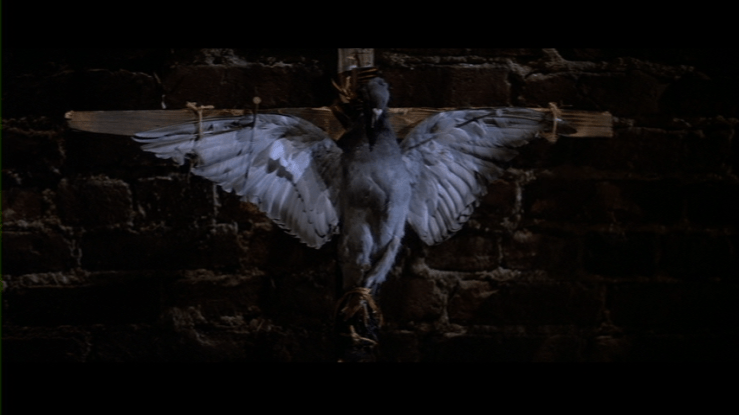
Writing in Film Comment, Kent Jones observed that John Carpenter is “one of the few modern artists whose subject is the contemplation of true evil” and that in contrast to Hawks, “where all the energy goes into the beauty of people in action,” Carpenter’s films “are filled with moments of paralyzing immobility, of dry-mouthed discomfort brought about by the realization that there is something new and awful in the world.” Etchinson actually freezes three times in his final scene: once when he sees this crucified pigeon:

Screengrab from Prince of Darkness #5

Once when he realizes he’s surrounded, and one last time the moment he understands he’s about to die. This is, I think, exactly what Jones was talking about, and that’s what makes Etchinson such a memorable character despite his limited screen time: he’s a perfect example of some of the most interesting and original aspects of Carpenter’s artistic vision.


Juxtaposition #2

From Total Recall:

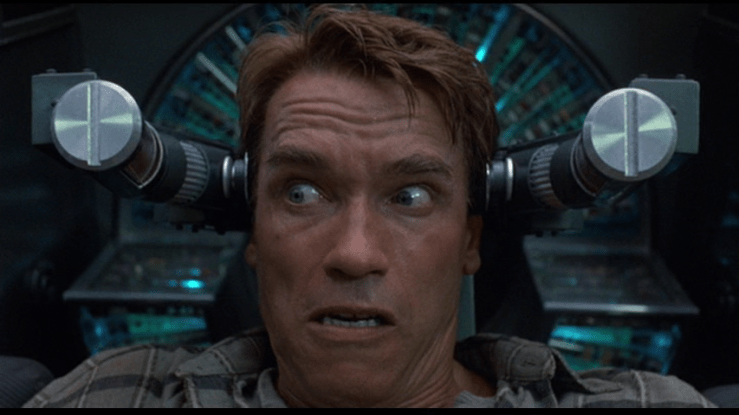
Screengrab from Total Recall 1

COHAAGEN: Relax, Quaid. You’ll like being Hauser.

QUAID: The guy’s a fucking asshole!

From The Demolished Man by Alfred Bester:

“No. I mean something else. Three or four hundred years ago, cops used to catch people like Reich just to kill them. Capital punishment, they called it.”

“You’re kidding.”

“Scout’s honor.”

“But it doesn’t make sense. If a man’s got the talent and guts to buck society, he’s obviously above average. You want to hold on to him. You straighten him out and turn him into a plus value. Why throw him away? Do that enough and all you’ve got left are the sheep.”

“I don’t know. Maybe in those days they wanted sheep.”

Previous “Juxtaposition” posts can be found here.

Juxtaposition #1

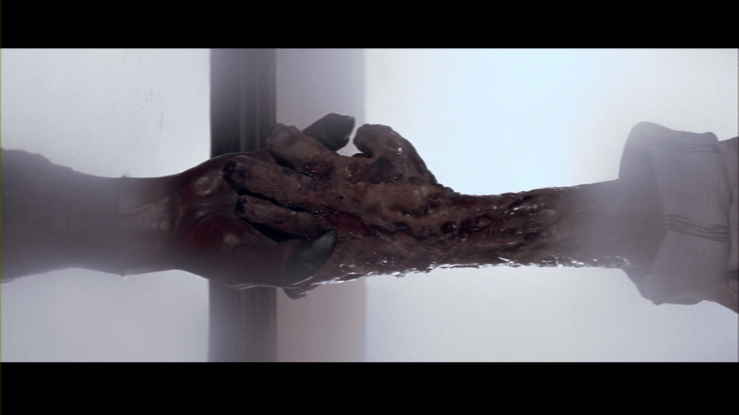
From Prince of Darkness:

Screengrab from Prince of Darkness #1

From Childhood’s End by Arthur C. Clarke:

A vast silence lay over the whole world for the space of twenty seconds–though, afterward, no one could believe that the time had been so short. Then the darkness of the great opening seemed to move forward, and Karellen came forth into the sunlight. The boy was sitting on his left arm, the girl on his right. They were both too busy playing with Karellen’s wings to take any notice of the watching multitude.

It was a tribute to the Overlords’ psychology, and to their careful years of preparation, that only a few people fainted. Yet there could have been fewer still, anywhere in the world, who did not feel the ancient terror brush for one awful instant against their minds before reason banished it forever.

There was no mistake. The leathery wings, the little horns, the barbed tail–all were there. The most terrible of all legends had come to life, out of the unknown past. Yet now it stood smiling, in ebon majesty, with the sunlight gleaming upon its tremendous body, and with a human child resting trustfully on either arm.

Additional “Juxtaposition” posts can be found here.

When the Child Was a Child . . .

When I started my first film blog in 2006, I was 24 years old. I was less than two years removed from finishing a film studies major, and although I had not succeeded in convincing myself to pursue a graduate degree in the subject, I didn’t have any idea what else I might want to do with my life instead. What I did know, or what I thought I knew, was that I was getting rusty: all the critical analysis muscles I had developed in college were atrophying, and unless I started writing about movies again soon, I’d be back where I started in high school, capable of nothing more sophisticated than complaining about how The Mummy  wasn’t enough like Raiders of the Lost Ark. And so one evening I came home from a screening of Brokeback Mountain and started a LiveJournal. This turned into a blog, which surprisingly began to attract a growing audience of regular readers and commenters.

Things rolled along smoothly for a year or so, but then it all started to fall apart. I shuttered the blog to focus on an overly ambitious website at a different URL that no one read, and which soon fizzled out. I was awarded a more-prestigious-than-I-realized fellowship and burned a few important bridges when I failed to deliver on expectations that I didn’t even know people had for me until it was too late. I landed a gig as a DVD reviewer for a fairly prominent online publication and quit in a moment of panic when I realized I had bitten off more than I could chew instead of just asking for less assignments. Most significantly, I realized one night just how awful my financial situation was and finally took steps to fix it, which was a great life decision, but bad for my writing, since I suddenly had much less time for it.

I never quite made an affirmative decision to quit blogging, but as the years went by I did less and less of it. Meanwhile, I got a job I loved working with an academic library media collection, which led to my first professional position at McDaniel College in Westminster, Maryland in 2011, which led to another librarian job at the University of Maryland in 2013, where I still work today. I moved to my current hometown of Baltimore in 2012, bought a house and got married in 2014, and became a father in 2015 (a second daughter arrived earlier this year). I even returned to film criticism in the form of regular Blu-Ray/DVD reviews for the publications Library Journal, which I began contributing to in 2011, and Educational Media Reviews Online, which I started writing for a few years later. One day I looked around and realized that I couldn’t see a void in my life that a blog would fill, and that was that.

Except, obviously, that it wasn’t: it turns out that I do have itches that review work can’t scratch. Take my most recent capsule review for Library Journal (which is mostly behind a paywall, alas), of Kino Lorber’s release of Emir Kusturica’s Underground. In order to write it, I read two book-length works on the director and watched about 10 hours of movies by or about him–it feels like I should have more to show for all this effort than 175 words! Or what about Groundhog Day, my favorite movie? I’ve seen it 50 times, easy, and I’ve read just about every word ever written on it, so I know for a fact that I have original insights to add to the conversation. I don’t have a good place to put them, though! Then there are the things I never got around to back in the day, such a series of video essays. The main purpose of this blog is to provide a platform for sharing projects like this with people other than my wife, and in doing so to (hopefully) motivate me to undertake more of them.

My specific goal is to produce six to eight long-form essays each year supplemented by shorter content as the mood strikes me. For the most part, I am planning to write just about movies, but I may occasionally tackle books, music, TV, and other media. Although I added a link to my CV to the “About” page, I likely will only talk about librarianship when it directly intersects with the topics listed above, which, depending on the path my career takes, could be anywhere from never to all the time. I am planning to stay away from posts dedicated to my other interests like food, politics, and sports, except when they clearly relate to the site’s main topic.

More poetically, this blog is intended to chronicle my return to what the film critic Dave Kehr used to call “the lost continent of cinephilia” after many years away, hence the name.  Unless you count individual episodes of my older daughter’s favorite animated series Spirit Riding Freemy days of watching 650 movies a year (no joke: that was my tally for 2006, including 120+ films in the theater!) are long gone. Film still plays a major role in my life, though, which is definitely worthy of celebration and interrogation. Ideally, my musings on the importance of a 20th century art form to a 21st century man will be of interest to others, but I will happily settle for something to do after the kids are in bed which helps me organize my thoughts. Either way it feels good to be back!