What I’m Seeing This Week: It’s basically a coin flip for me between American Fiction and All of Us Strangers, both of which open at Cinemapolis today. At the moment I’m leaning toward the former because the showtimes are slightly more compatible with my schedule, but I definitely reserve the right to change my mind and I’m almost certainly going to see the other one next week, so it doesn’t really matter anyway.
Also in Theaters: For the third week in a row, The Boy and the Heron and Poor Things rule the roost as the best new films I’ve seen currently screening in Ithaca. You can see the former at Cinemapolis in both its dubbed and subtitled versions and at the Regal Ithaca Mall with subtitles only; the latter is also now playing at both locations. I haven’t mentioned Wonka, which continues its run at the Regal this week, in this space previously because I almost certainly won’t end up seeing it in theaters, but it’s probably the next-best-reviewed option after these two and American Fiction/All of Us Strangers. Unless, that is, you count Pixar’s Soul, which is also now playing at the Regal once a day. You can see Cowboy Bebop: The Movie there as well with subtitles on Sunday and Tuesday and dubbed on Monday.
Home Video: I’m extremely late to this party, but the four shorts directed by Wes Anderson based on Roald Dahal stories that Netflix released a few months ago are pretty great! However, while I liked The Swan, The Rat Catcher, and most especially The Wonderful Story of Henry Sugar, my favorite is definitely Poison. Not necessarily because it represents the purest expression of Anderson’s style or a spur track into previously uncharted territory (which it may or may not), but simply because it’s a nearly flawless adaptation and one of the best films I’ve seen in Movie Year 2023, full stop. One fine moment is when Ben Kingsley’s Dr. Ganderbai administers serum to Benedict Cumberbatch’s Harry Pope, who supposedly has a highly venomous krait sleeping on his stomach. He holds up to the camera in turn a piece of rubber tubing, a bottle of alcohol, and a syringe as Dev Patel’s Timber Woods narrates in rapid-fire staccato on from the other half of a split-screen composition. The effect is neither specifically theatrical or cinematic, but something else. In a play we probably wouldn’t be able to see these objects, and in a more traditional filmic presentation they’d be expected to speak for themselves, but in this movie they function to draw attention to Dahl’s choice of words. Ditto Benoît Herlin’s stagehand spritzing water on Dr. Ganderbai’s forehead to simulate sweat. There are also a number of places where Poison departs from its source material to salutary effect, such as by giving Woods an implied backstory involving a hospital stay as a child, his memories of which are triggered by the smell of chloroform, or by manipulating the beats of everything from the moment he and Ganderbai begin the pull down the sheet covering Pope to the original final line: “you can’t be.” Another highlight is the lighting in the scene in which Pope bares his fangs. Outstanding across the board.
Previous “Ithaca Film Journal” posts canbe found here.
We tend to have a lot of egg whites on hand during the months of December and January as a result of nog making and my absolute favorite way to use them up is in Jeffrey Morgenthaler’s amaretto sour, which Imbibe notes has effectively become the standard way of making it. And for good reason! He boasts that it’s “the best Amaretto Sour you’ve ever had in your life,” and although I can’t claim to have verified this claim through extensive testing, that’s mostly because I haven’t felt the need to try another recipe since discovering this one. Here’s how you make it:
1 1/2 ozs. Amaretto (Disaronno) 3/4 oz. Cask-proof bourbon (1792) 1 oz. Lemon juice 1 tsp. 2:1 Simple syrup 1/2 oz. Egg white, lightly beaten
Dry shake all ingredients, then add ice and shake again. Strain into a chilled rocks glass with one big ice cube, making sure to get as much froth out of the shaker as you can, and garish with a cherry and a lemon twist.
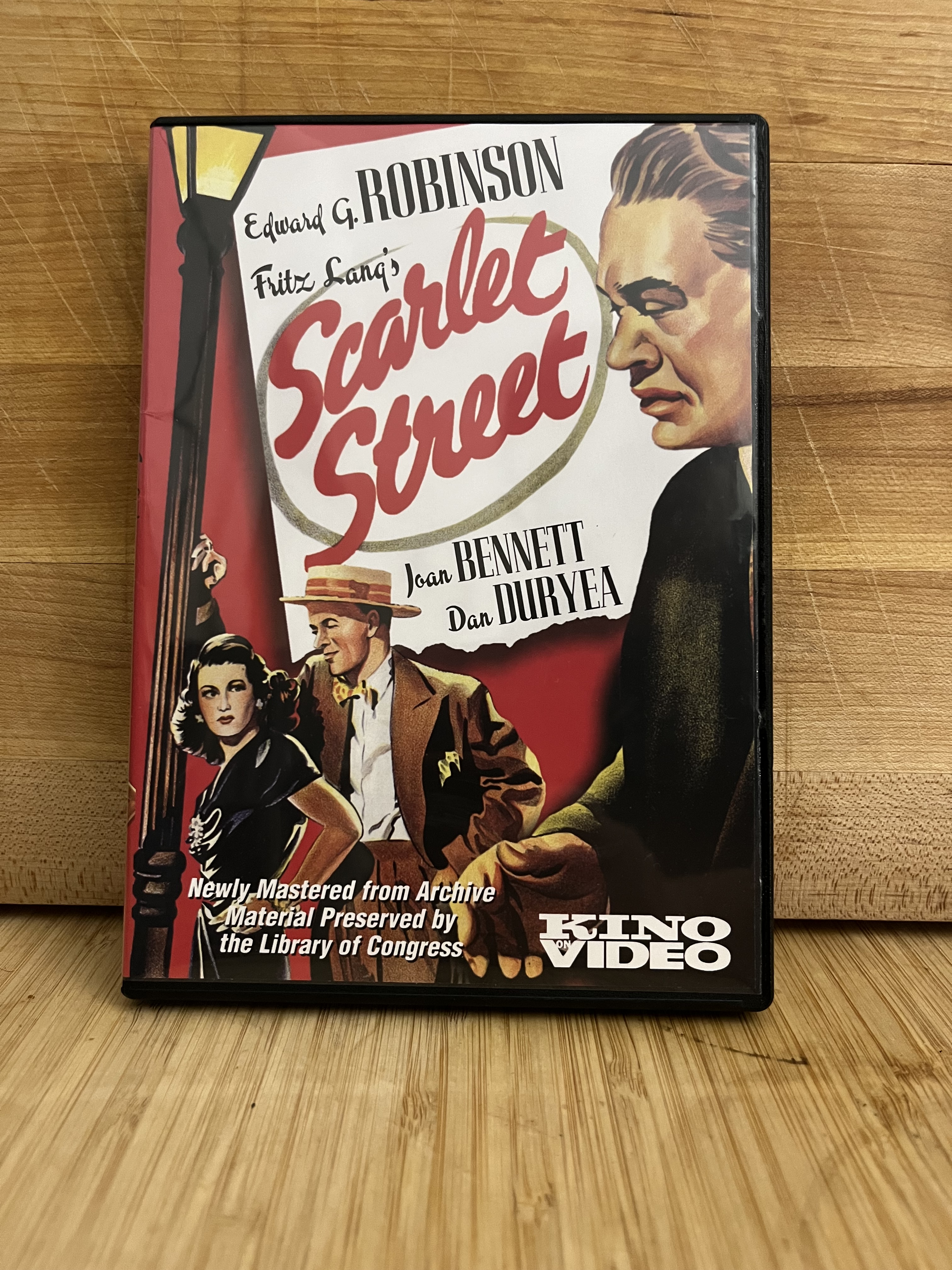
My go-to bourbon for this drink is Maker’s Mark Cask Strength, but they make the spirit I featured in last month’s aged eggnog and I wanted to mix things up a bit. I’m glad I did: 1792 is just about as good of a value and contributes an even higher ABV, which is essential for cutting the sweetness of the amaretto and creating the “warm glowing warming glow” I’m looking for in the dead of winter. It results in a richer texture as well, and you definitely want to use 2:1 simple syrup for the same reason. Disaronno is delicious and easy to find and also has a great origin story: according to the company’s website, the woman the artist Bernardino Luini (a pupil of Leonardo di Vinci) chose as a model for the Madonna in one of his frescoes created it as a thank you gift. And so it was that this month’s pairing suggested itself, because when I think about painting and the winter holidays, one movie immediately springs to mind: Scarlet Street, which ends with perhaps the most cynical use of Christmas music in the history of cinema. Here’s a picture of my Kino Video DVD release:
It can also be streamed on Prime Video with a subscription or on Apple TV+ for a rental fee, and some people may have access to it via Kanopy through a license paid for by their local academic or public library as well.
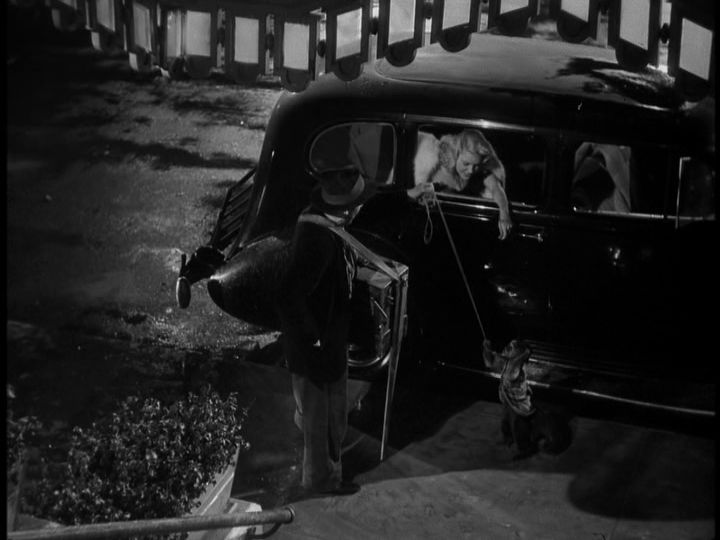
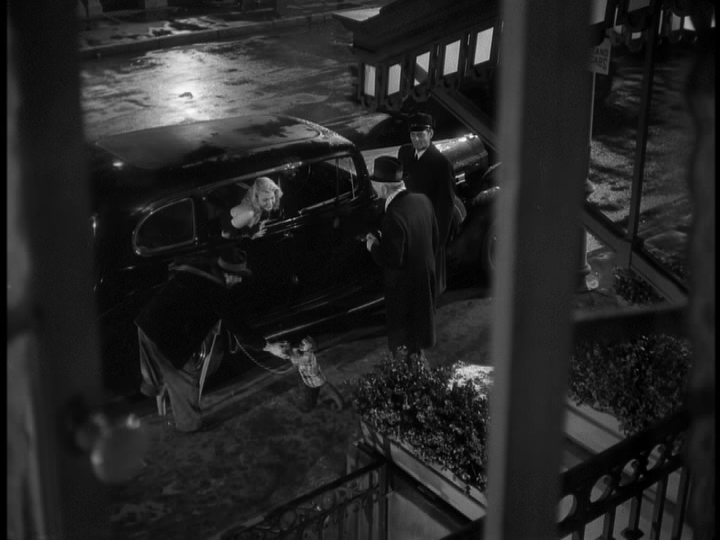
Scarlet Street begins with a flurry of symbolism. An expensive-looking car pulls up to a building. As an organ grinder entertains its glamorous passenger:
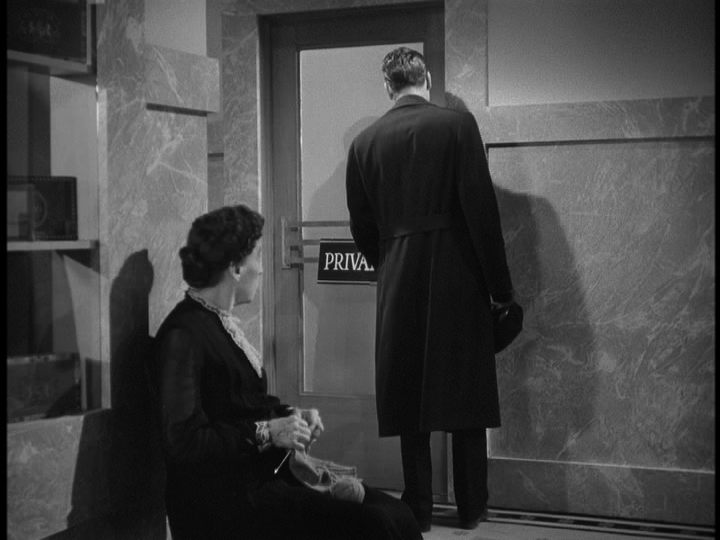
The chauffeur ascends a set of stairs, walks past a woman knitting, and knocks on a door marked “private”:
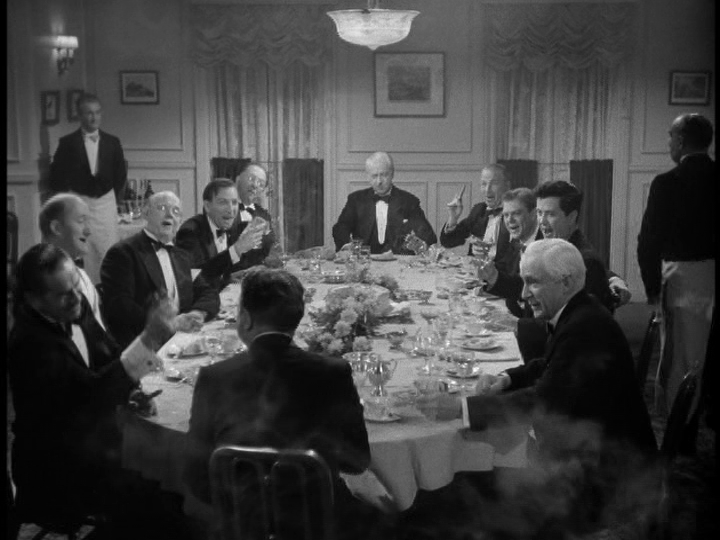
Inside the men of J.J. Hogarth & Company celebrate Christopher Cross’s (Edward G. Robinson) 25 years with the firm as (hat tip: Joseph Gibson) cigar smoke rises unmotivated from the bottom of the frame:
The boss (Russell Hicks) quiets them and stands to make a speech:
Well boys, I hate to break up a good party, but you can’t keep a woman waiting, can you? You know how it is, boys. I can see you all understand, alright! Well, believe you me boys, I’ve had the time of my life tonight. And speaking of time, I have here a 14-karat, 17-jewel timepiece. And that’s only right because the man I’m giving it to is a 14-karat, 17-jewel cashier.
Cross reads the engraving and stammers out a brief speech of gratitude. Everyone belts the refrain of “For He’s a Jolly Good Fellow,” then J.J. treats Chris and his co-worker Charlie (Samuel S. Hinds) to fancy (“it’s made special for me, a dollar apiece”) cigar before excusing himself. As the others rush to the window to ogle the “dame” he can’t keep waiting:
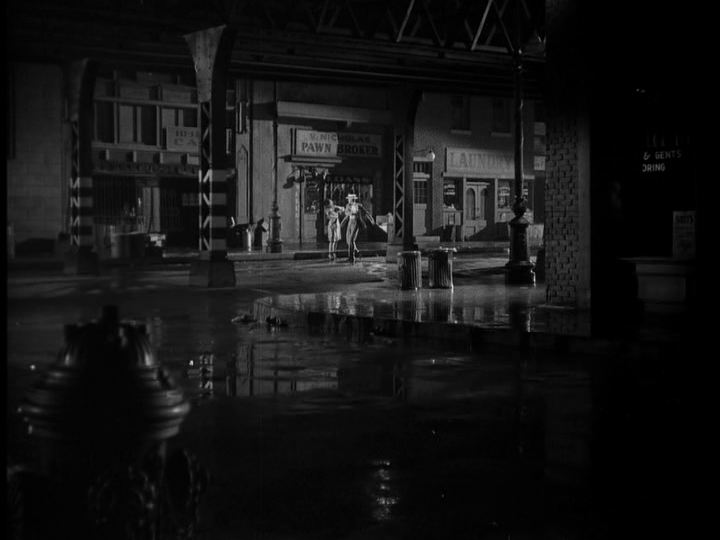
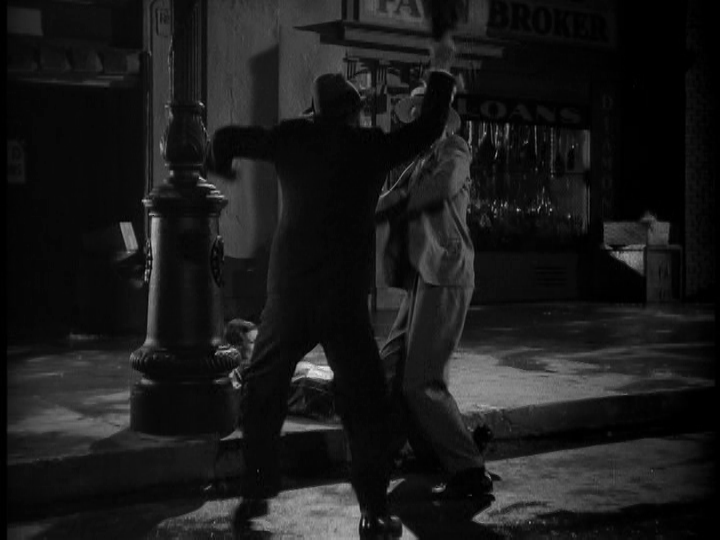
Chris and Charlie quietly make their own exit. Charlie doesn’t have an umbrella, so Chris sees him to his bus. As they stand waiting for it, Chris tells Charlie that he wonders what it’s like to be loved by a young girl like the one their boss is seeing and that he dreamt of being an artist and still paints every Sunday. “Well, that’s one way to kill time,” Charlie replies. Chris invites Charlie to come see him the next day when the bus arrives, then goes looking for the East Side subway. Lost among the “mixed up” streets of Greenwich Village, he witnesses what he believes to be a mugging:
Emboldened by drink, Chris charges forward to defend the damsel in distress, then braces for an answering blow that never comes:
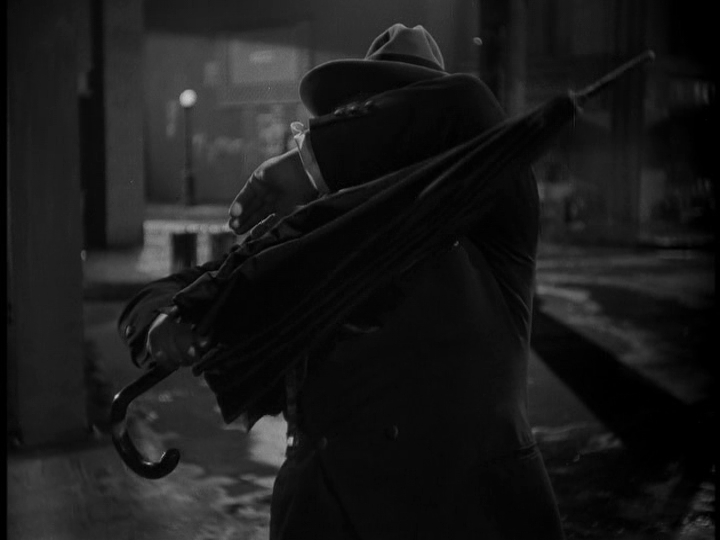
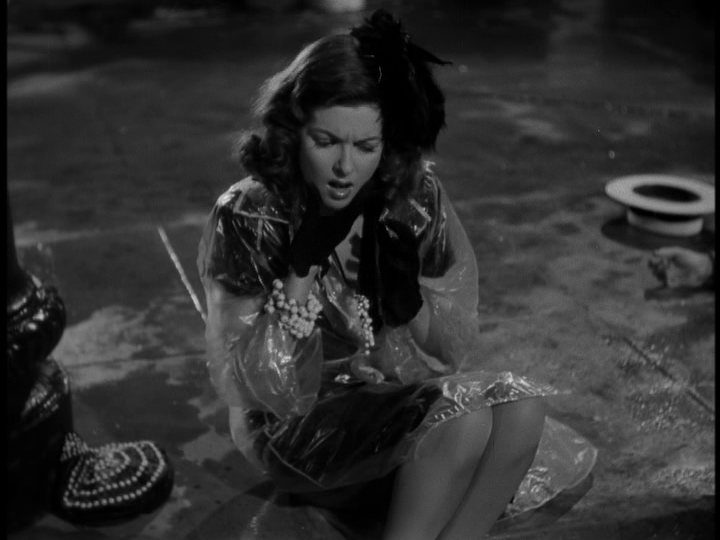
The woman (Joan Bennett) he has “saved,” who is wrapped in a cellophane raincoat, first tests her jaw:
Then checks on her assailant. Chris runs off to find a policeman. When they return, the man is gone. The woman, whose name we will soon learn is Kitty March, tells the cop he went thataway, then says to Chris, “let’s get out of here.” He consents to take her home, and with that his fate is sealed. We are barely ten minutes into a film with a runtime of 102.
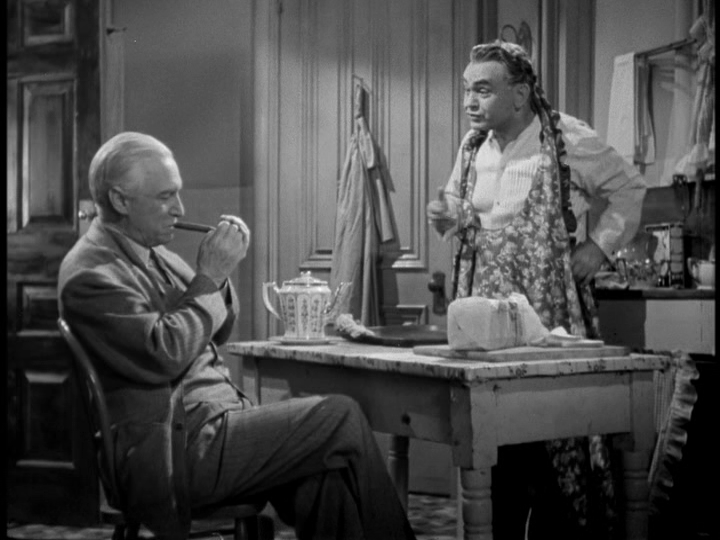
A major topic of debate among film scholars and critics is whether or not Chris is too pathetic to be someone audiences can identify with. And to be sure, if you’re going to put an apron like this on, it really should be to make a statement, not just to prevent your clothes from getting dirty!
But I agree with Kino’s DVD commentator David Kalat that Edward G. Robinson’s performance is “extraordinarily warm and humane” and recognize a great many things in the character he brings to life, especially his struggle to find a sustainable balance between the hobby that brings him happiness and the career that pays his bills. In a book-length interview with Peter Bogdanovich, director Fritz Lang claims that “Robinson’s fate in the picture is the fate of an artist who cares much more for his paintings than for gaining money.” He then specifically references the scene in which Chris discovers that Kitty has been signing her name to his paintings so that she can sell them and instead of getting mad at her, acquiesces to the scheme: “it’s just like we were married, only I take your name,” he says.
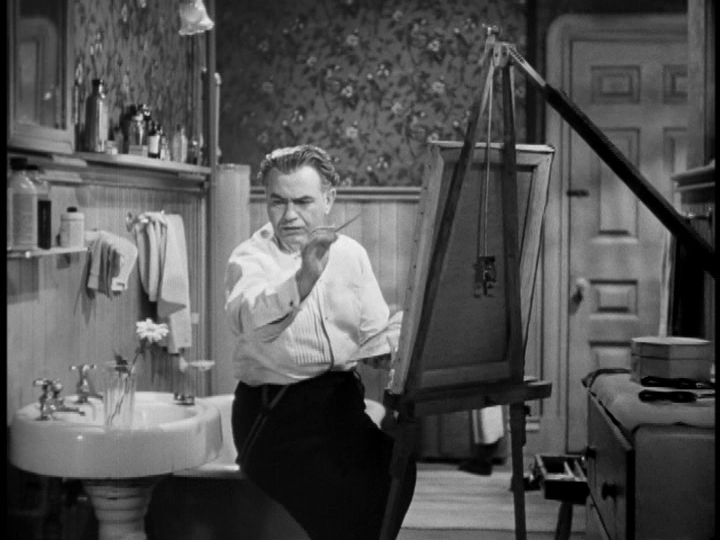
In a chapter for Joe McElhaney’s A Companion to Fritz Lang, Vinzenz Hediger argues that for Chris, “the realization of his dream to be recognized as an artist, even though it only happens through the intermediary of the woman he loves, in combination with that woman’s attention, appears to be the only moment of genuine happiness he has experienced in life.” This is consonant with Jeanne Hall’s observation in a Film Criticism article called “‘A Little Trouble With Perspective’: Art and Authorship in Fritz Lang’s Scarlet Street“ that far from painting being his escape from a loveless marriage like many scholars claim, Chris’s hobby was what brought him to his wife Adele (Rosalind Ivan) in the first place when he rented a room from her in order to save money for paint. Chris describes what happened next to Charlie thusly: “oh she was sweet–butter wouldn’t melt in her mouth. And, uh, well, you know how these things go.” To translate this into (somewhat) contemporary terms, yada yada yada, now he has to paint in the bathroom:
In Kitty he thinks he has found not just a young girl who loves him, but a young girl who loves him and his work. Per Hediger, “[t]he recognition may be false but it can be lived vicariously so long as it is grounded in true devotion,” and for the length of time Chris believes it to be true, he blossoms. Dan Duryea’s Johnny Prince (more on him in a second) notes that Damon Janeway (Jess Barker), the art critic who has “discovered” Kitty, thinks that the work he produces during this time are the “best things [he’s] done,” and I agree with scholar Tom Gunning when he argues in The Films of Fritz Lang: Allegories of Vision and Modernity that “Chris’s identification with the image of a woman could also be seen as an essential step in his development as an artist, keeping him alive to his polymorphic childlike perversity, but gaining authority rather than regressing through it.” After all, as Gunning goes on to point out, “Chris’s lack of interest in signing his own name to his works and his feminine alter-ego, both recall the fundamental avant-gardist gestures of Marcel Duchamp: signing several works with the name of his feminine alter-ego (whom he had himself photographed as, in drag) Rose Selavy (glossed as Eros, c’est la vie).”
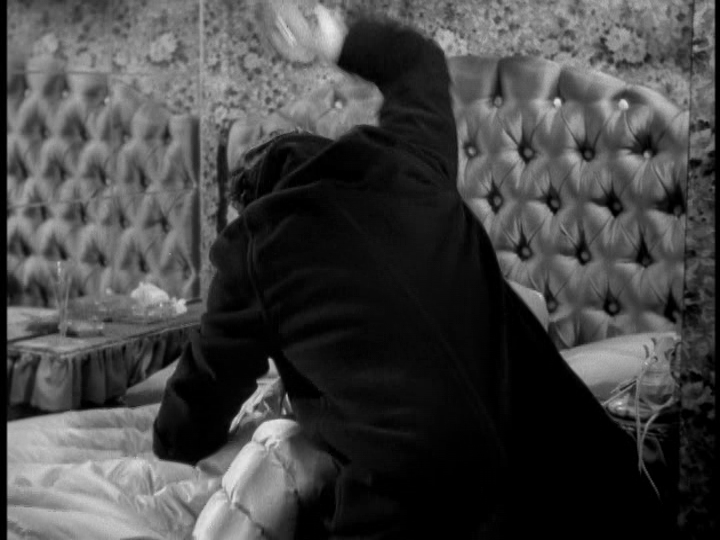
Chris loves to paint, but he’s also lonely. His marriage to Adele is a bitter disappointment because it not only failed to solve the latter problem, but jeopardizes his freedom to engage in the former activity when she threatens to give all his paintings and supplies to the junkman in retaliation for him not buying her a radio. Kitty gives him sustenance until, abruptly, she doesn’t. Although Mark Osteen is technically correct when in his Journal of Film and Video article “Framed: Forging Identities in Film Noir” he pinpoints Chris’s disavowal of his identity as an artist as the moment “Chris’s painter self dies along with the lover and the cashier,” but that self likely would have starved to death anyway even if Chris had responded to Kitty laughing in his face and saying “you’re old and ugly and I’m sick of you” by calmly placing the fateful ice pick back on the table he knocked it off of and walking away instead of, well, you know:
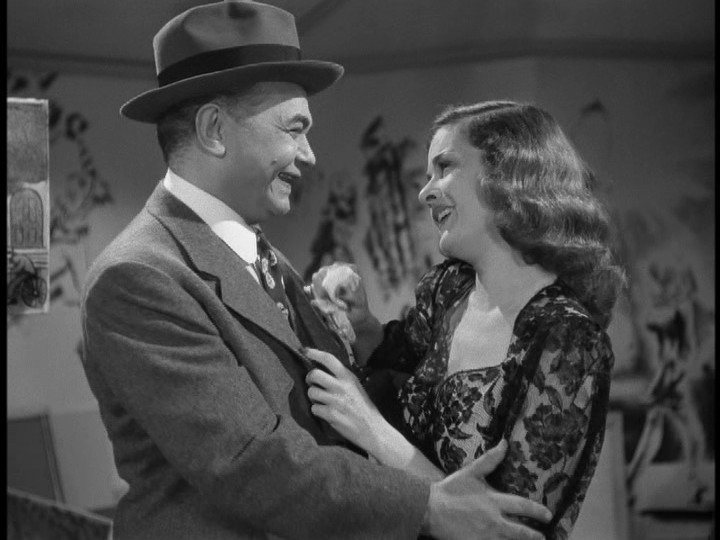
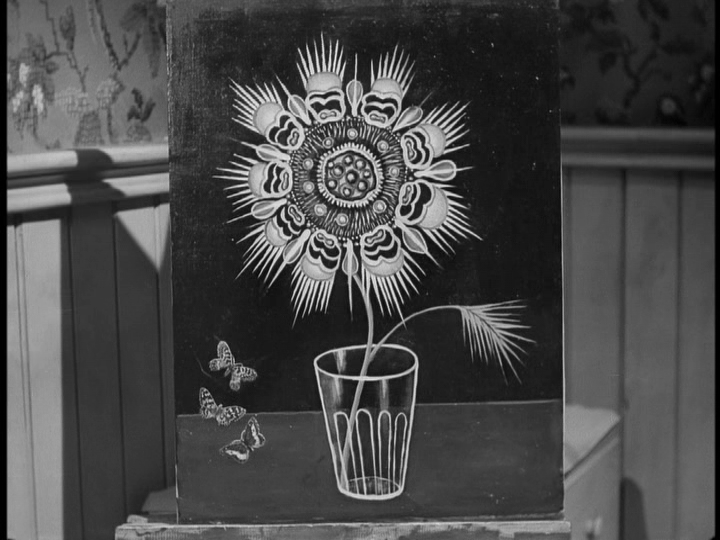
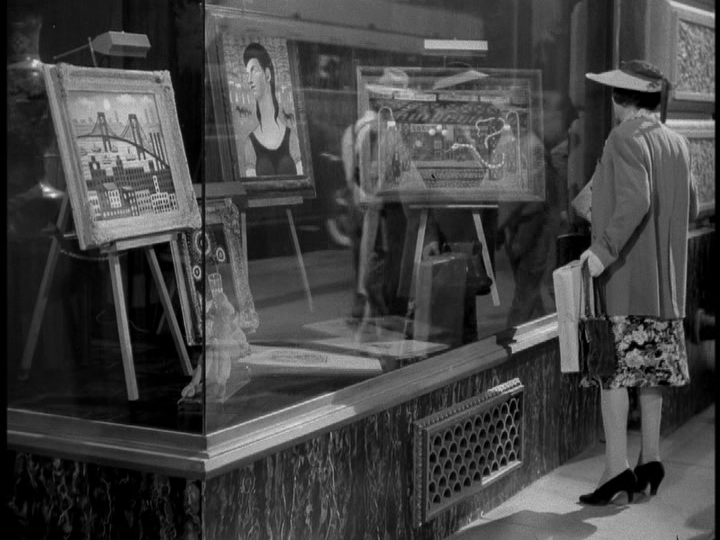
One of my favorite things about Scarlet Street is its treatment of Chris’s paintings, which were modeled after the work of Henri Rousseau and created by a friend of Fritz Lang named John Decker (who I assume was also responsible for the illustrations by “Tony Rivera” which adorn the walls of the apartment Chris rents for Kitty). Hall is right that the movie is unusual in the way it “encourages viewers to reflect on the socially-constructed and class-based nature of art and aesthetics by insistently raising questions about the quality of Chris’s work and persistently refusing to answer them.” Like Kitty, I personally think this one is pretty excellent:
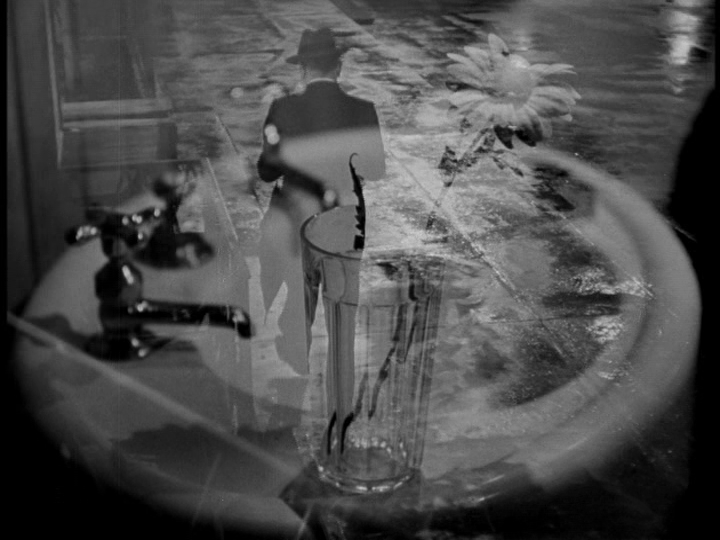
And although “Self-Portrait” is a title he will later bestow upon a painting of Kitty, one of the film’s many dissolves suggests that maybe it would have been better applied here:
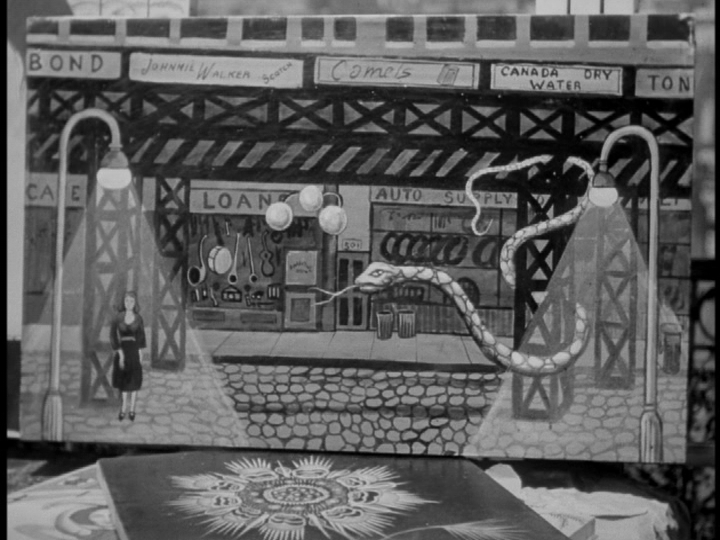
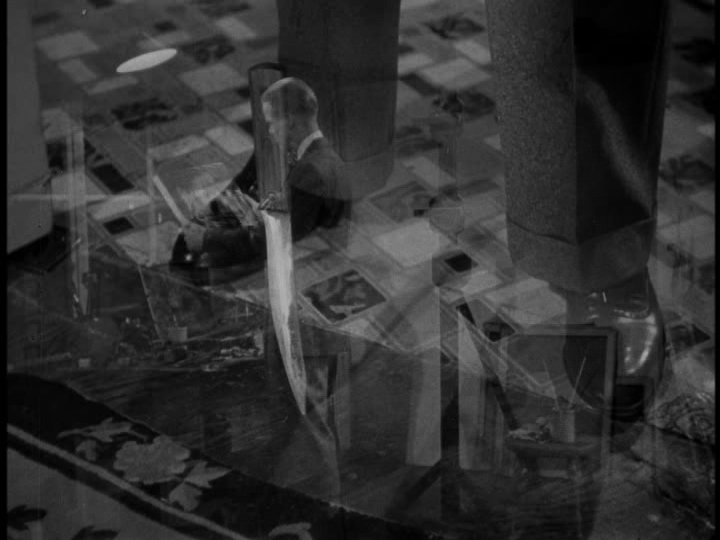
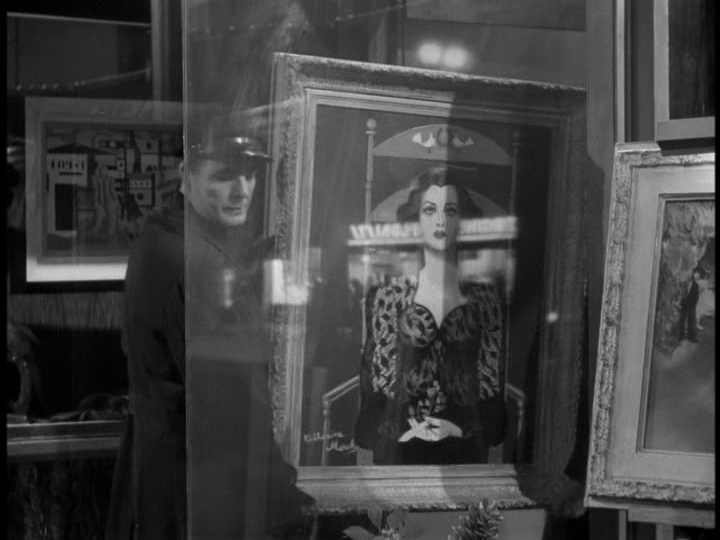
Meanwhile, the other painting which inspired this month’s photograph certainly is interesting:
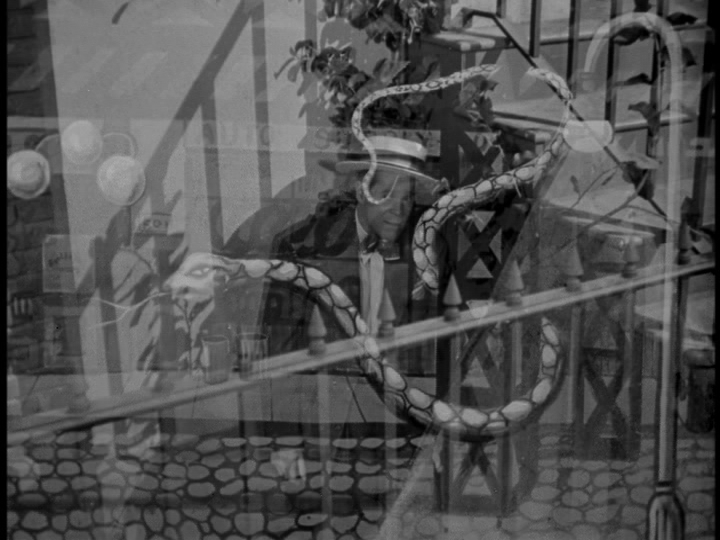
Some of the other dissolves are absolutely brilliant, including these two involving of Johnny which Gunning discusses at length:
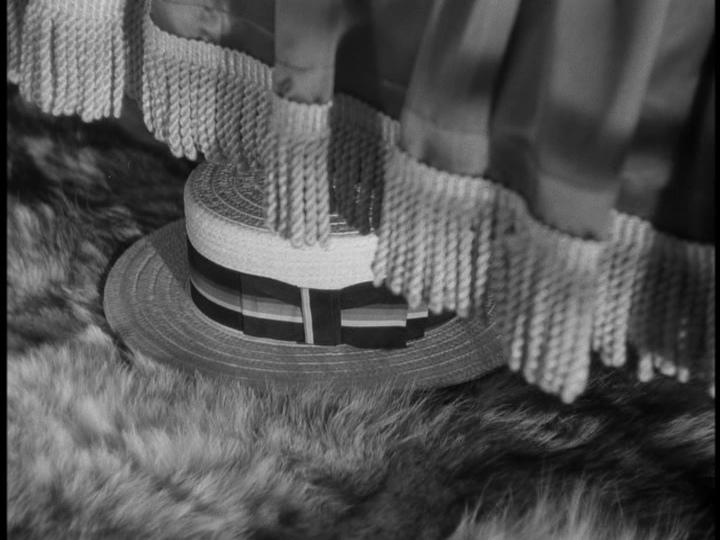
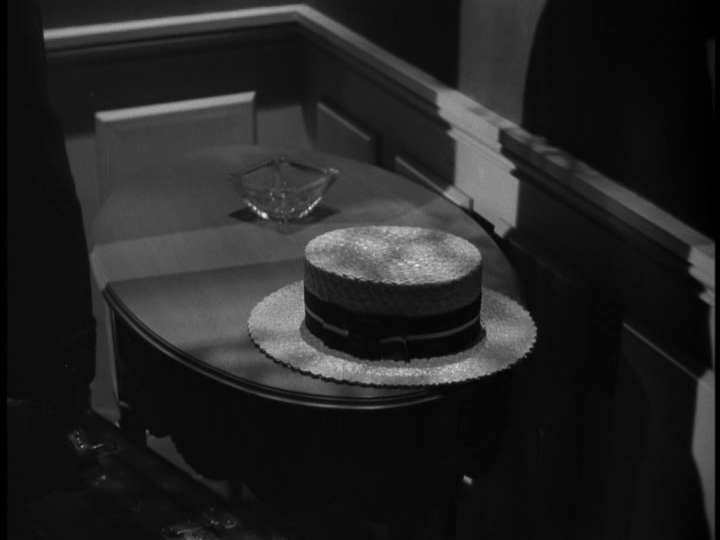
In the process of doing so, Gunning describes Johnny as being “[a]s nasty, slimy, sadistic, cowardly, lazy, ignorant and venial a character as one could find in a Hollywood film,” which is accurate. Dan Duryea is so effective in this role that I wonder if it was detrimental to his career–I recently saw Thunder Bay for the first time, and although his Johnny Gambi turns out to be a perfectly decent person, I kept waiting for him to do something horrible, which was incredibly distracting! The distinctively out-of-style hat he dons in Scarlet Street is practically a character in its own right, as evinced by these two different close-ups:
And as documented by Mike Grost, the rest of Johnny’s wardrobe is interesting, too. Other things to love or hate include the masterful use of practical effects to make studio lot exterior scenes look like they were shot on location:
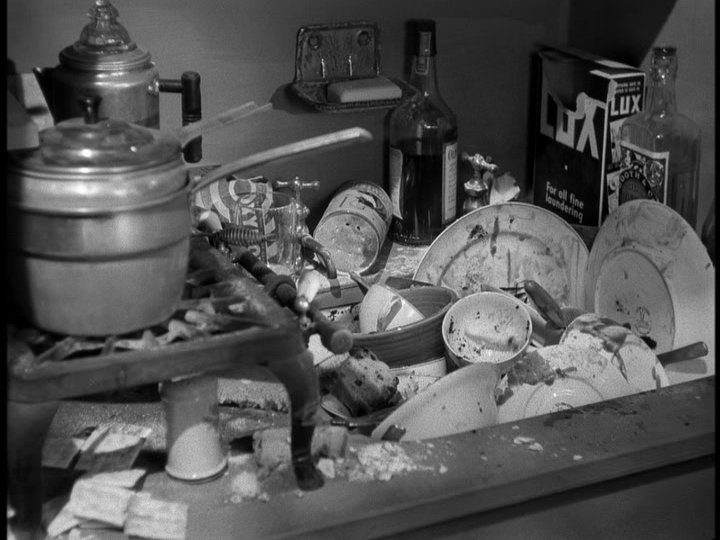
And the dirty dishes in Kitty’s kitchen sink, aka my worst nightmare:
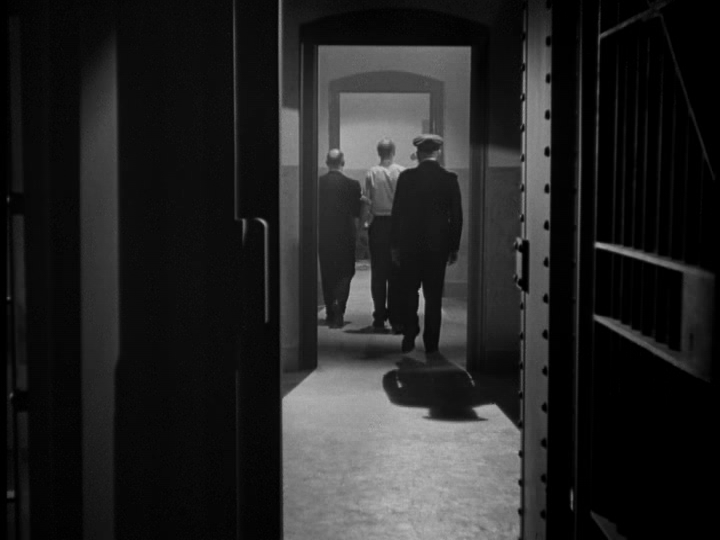
What makes this one of the most unforgettable movies ever made, though, is the way it ends. In a shocking plot twist, Johnny is sent to the electric chair for the murder committed by Chris.
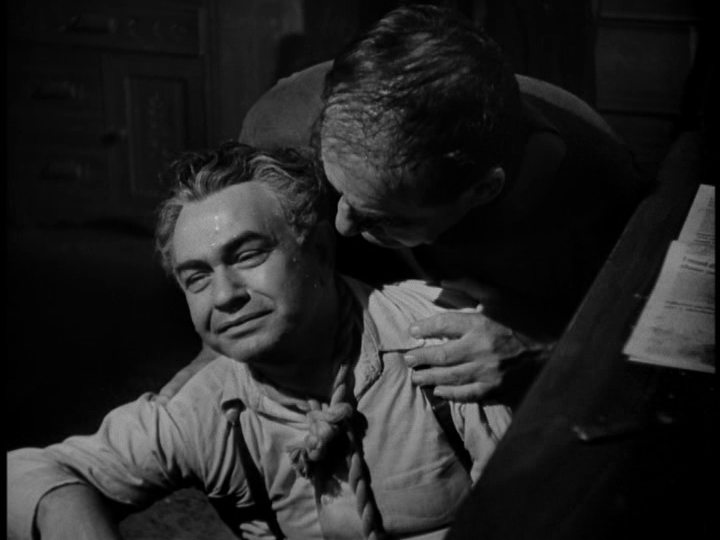
Unable to shake the vision of Johnny and Kitty happily together in the afterlife, Chris tries to commit suicide, but is unsuccessful.
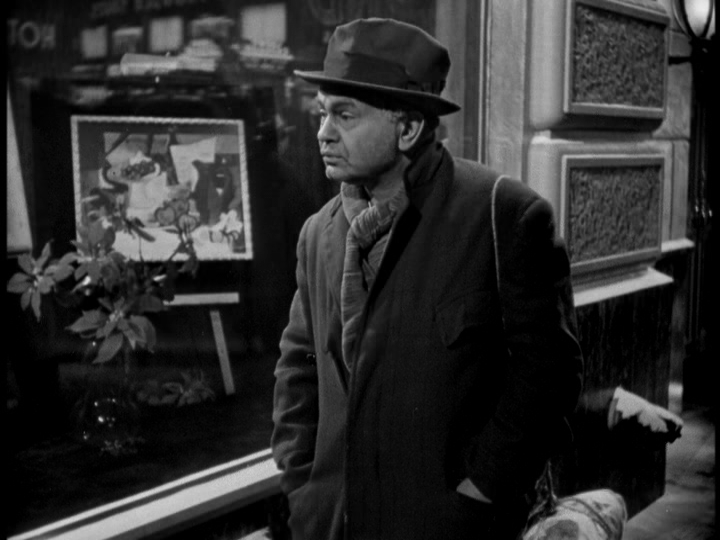
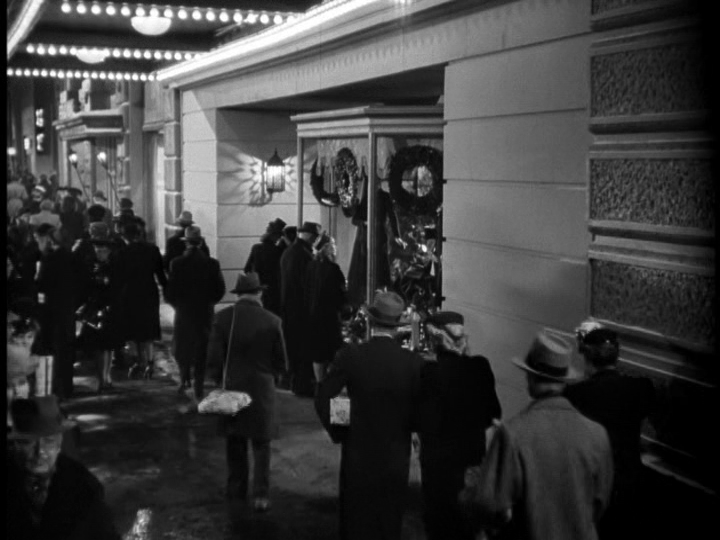
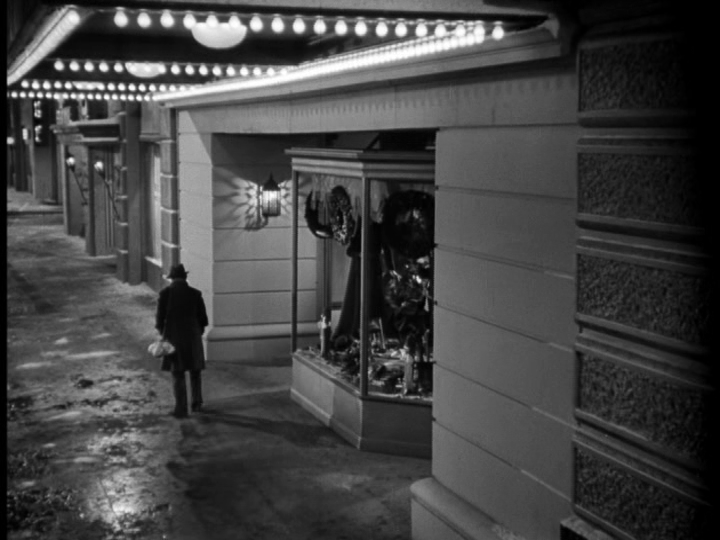
Years pass in an instant and now he is a derelict shuffling down the street to the tune of the Christmas carol “O Come All Ye Faithful,” which as Robert B. Pippin notes inFatalism in American FilmNoir “is a hymn to the baby Jesus”:
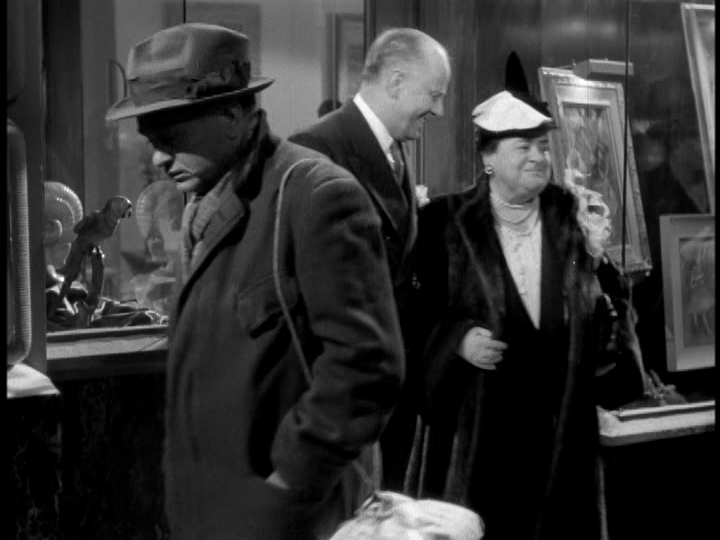
The soundtrack then shifts to “Melancholy Baby,” which is utilized throughout the film in a variety of versions for a wide range of purposes. One way to look at this is as simply a logical accompaniment to the painting which two men are carrying out of the gallery he’s passing by, which is of course his/Kitty March’s aforementioned “Self-Portrait.”
But Pippin has another interpretation:
The Christian notion of eschatological time suggests both that there is this radical revolutionary possibility in historical time, such that everything is different, full of new possibilities, after the Incarnation, and that an individual can be born again, decisively become almost literally a different person, free of the burden of the past, forgiven, after having been saved. Lang’s irony about this assumption is absolutely withering. The ‘baby’ of real relevance is not the baby Jesus, but, the music reveals, our melancholy baby. The aspiration for such revolutionary change is paired musically with the reality of the stuck-in-time, repetitive melancholy baby. And that means not only ‘melancholy’ because this tempting Christian way of thinking about time is naïve, but because melancholy is melancholy, not mourning in Freud’s famous sense. It is the impossibility of ‘moving on’ from a traumatic event, a compulsive need to suffer it all again and again, a refusal of the liberating work of mourning (a fate, in other words).
Wow! The soundtrack then shifts back to a Christmas carol, this time “Jingle Bells.” There is, again, an obvious explanation: the gallery owner Dellarowe (Arthur Loft) is saying to his customer (Constance Purdy), “well, there goes her masterpiece. I really hate to part with it.” To which she replies, “for ten thousand dollars, I shouldn’t think you’d mind!” So the jingling bells are those of the cash register.
But Pippin’s reading does this one better: “[t]he fate that Christianity naïvely believes can be mastered is not cosmic or divine fate but a socioeconomic, drastic restriction of possibilities, and it appears here as all powerful.” Whichever view you subscribe to, Scarlet Street‘s final images are independently shattering. Chris beholds the painting, but his expression barely changes. He puts his head down and resumes his slow walk:
Suddenly, all the people disappear:
It is, as Gunning describes it, “[a]s if a neutron bomb had exploded.” We hear Kitty’s voice whisper “jeepers I love you Johnny” one final time, and with that it’s all over.
Brrr. Typically I recommend mixing up the drinks in these posts before the movie I’m pairing them with starts, but it in this case you might want to save it for the end because you’re going to need something to warm you up afterward!
Cheers!
All original photographs in this post are by Marion Penning, aka My Loving Wife.Links to all of the entries in this series can be found here.
What I’m Seeing This Week: I haven’t seen many films by Finnish auteur Aki Kaurismäki, so I’m going with Fallen Leavessince you’ve got to start somewhere. It’s at Cinemapolis for one week only starting today.
Also in Theaters:The Boy and the Heron, which continues its run at Cinemapolis this week in both dubbed and subtitled versions and at the Regal Ithaca Mall with subtitles only, is one of my favorite films of Movie Year 2023. Poor Things, which remains at Cinemapolis, is another. If Fallen Leaves wasn’t here for such a limited time, I’d probably be seeing Napoleon this week since I missed it during it’s first Ithaca run last year. It’s back at the Regal for one show a day. Speaking of the Regal, one of the reasons it will be a tragedy if it ever does close for real is because they do a great job of programming new films from India. Two Telugu-language films, Guntur Kaaram and Hanu Man, open there today. Finally, I’m banking on The Color Purple, which is at Cinemapolis, picking up Oscar nominations in a couple of week and sticking around in or returning to local theaters, but you might prefer not to take the risk.
Home Video: Over winter break I watched as many documentaries directed by the talented Belgian-Cameroonian filmmaker Rosine Mbakam as I could get my hands on in preparation for my EMRO review of her stellar first narrative feature Mambar Pierrete. My favorite was Chez Jolie Coiffure, which is about a Brussels hair salon. The most audacious is Delphine’s Prayers, which invites us into a room with one of the director’s fellow Cameroonian transplants and keeps us there until she’s said everything she has to say. Last but by no means least, Mbakam’s feature-length debut The Two Faces of a Bamiléké Woman and the collaborative (with An van Dienderen and Éléonore Yaméogo) essay film Prism are the ones most essential for understanding what she’s doing in Mambar Pierrette. Current Cornell University faculty, staff, and students have access to all of them through a great platform called Docuseek that the library subscribes to. Even if you aren’t so fortunate, they’re all available on DVD or a variety of commercial streaming video platforms from Icarus Films.
Previous “Ithaca Film Journal” posts canbe found here.
What I’m Seeing This Week: I pivoted to The Iron Claw last week for scheduling reasons, so Ferrari remains next up on my list. It is now playing at the Regal Ithaca Mall.
Also in Theaters:The Boy and the Heron, a dazzling inventive grown-up fairy tale which rates among director Hayao Miyazaki’s finest work, is back at Cinemapolis in both dubbed and subtitled versions and remains at the Regal with subtitles only. Poor Things, which continues its run at Cinemapolis, is a raunchy, steampunk-inflected ode to “practical love” which includes some of the years best images, sounds, and performances. The Iron Claw is a first-rate sports movie which will be at Cinemapolis for at least one more week. You can’t go wrong with any of them, so pick whichever one sounds the most like your jam! Among movies I haven’t yet seen, the one with the best buzz in the circles I run in after Ferrari is probably Godzilla Minus One, which is at the Regal.
Home Video: There are still two months to go before I write about my favorite films of the year on Oscar night since so many significant releases haven’t yet reached Ithaca, but the list is already starting to take shape. One title that will definitely appear on it is A Thousand and One, which is now streaming on Prime Video with a subscription and available for purchase on Blu-ray and DVD. “Well-executed period piece with a terrific female lead” describes a gratifyingly large number of recent films, but director A.V. Rockwell’s debut feature can stand toe to toe with any of them. Teyana Taylor is a force of nature and Spotify informs me that the opening theme by Gary Gunn was one of my most-listened-to songs of 2023, but maybe the most impressive thing about it is the way an empty apartment first gradually turns into a home, then suddenly becomes a haunted ruin.
Previous “Ithaca Film Journal” posts canbe found here.
What I’m Seeing This Week: I wasn’t able to make it to Poor Things in Baltimore during our holiday travels, so I’m going to catch a matinee screening at Cinemapolis on New Year’s Eve. Then, to avoid falling too far behind on new releases, I’m going to see Ferrari later in the week either there or at the Regal Ithaca Mall.
Also in Theaters: I’m at an unusual disadvantage in that I haven’t yet seen most of the films playing in Ithaca! Of those I have, though, my clear favorite is The Boy and the Heron, which continues its run at the Regal. As I mentioned a couple of weeks ago, seeing director Hayao Miyazaki’s Spirited Away was one of the great moviegoing experiences of my life. If you know his work, you should see his latest because it ranks with the best of his oeuvre; if you don’t, you should see it for the same reason by way of getting acquainted.
Home Video:One More Time, which is now streaming on Netflix with a subscription, is not a remake of Groundhog Day, but it features a similar “time loop” narrative and deliberately (there’s literally a scene in which the main character watches the earlier film for clues about what’s happening to her) hits a lot of the same beats. To take a cue from One More Time‘s soundtrack, it has a similar relationship to its inspiration as Ashnikko’s “L8r Boi” does to Avril Levigne’s “Sk8er Boi,” only Jonatan Etzler and company aren’t so much reconstructing a beloved text with a bad foundation as reworking the facade a bit. Crucially, they understand that Phil Connor’s journey was not necessarily toward becoming a *better* person, but rather one who knows what he really wants. Throw in a good lead performance by Hedda Stiernnstedt, colorful secondary characters, and a depiction of the early aughts that this member of Conestoga Valley High School’s Class of 2000 found convincing if a bit rosy, and you have a fine example of what My Loving Wife and I call a “Friday night movie.” Hat tip: Elisabeth Vincentelli in the New York Times.
Previous “Ithaca Film Journal” posts canbe found here.
What I’m Seeing This Week:Poor Things, which opened at Cinemapolis yesterday, is one of my most anticipated new movies of the year. We’ll be on the road all week, so I won’t be able to see it here, but I’m hoping to catch a screening at the Charles Theatre in Baltimore during our travels.
Also in Theaters: My top recommendation is The Boy and the Heron, which is at Cinemapolis until Saturday and at the Regal Ithaca Mall one day longer, albeit only with subtitles. Maestro is already available on Netflix (which is why I ended up choosing Dream Scenario over it last week), but you can see it on the big screen at Cinemapolis until Sunday. My Loving Wife, who is a rower, is excited to see The Boys in the Boat, which opens at Cinemapolis and the Regal on Christmas Eve. Ferrari, which opens at the Regal then as well and at Cinemapolis on Christmas Day, is directed by Michael Mann, which makes it an event for me. Last but not least, I’ve heard good things about The Iron Claw, which is at both Cinemapolis and the Regal all week.
Home Video: Michael Fassbender’s eponymous main character from The Killer and Alain Delon’s Jef Costello from Le Samouraï would probably enjoy not talking to each other over dinner. They’re both in the same line of work, are clearly intelligent, and appear to live according to a strict code. So why is one considered the epitome of a certain notion of “cool” while the other comes across as sort of a doofus? Part of this is attributable to costume design: the clothes they wear may both be precision engineered to blend in to their respective milieus, but it seems unlikely that The Killer’s German tourist attire will still regularly garner attention from fashion writers they way Costello’s perfectly calibrated fedora and trench coat do more than fifty years later. More importantly, though, we can hear The Killer’s thoughts and thus are privy to the DETAILS of his philosophy of life as opposed to just having a brief quote from a made-up samurai text to go on. And so it is that one man’s escape from the suddenly undeniably corrupt world he inhabits registers as noble and pure while the other’s decision to permanently retreat to an island paradise very much doesn’t. I revisted Le Samouraï as recently as just the other day and it remains one of the most icily beautiful films I’ve ever seen, but there’s a lot more going on in The Killer. I particularly enjoyed the main character’s fondness for Amazon lockers, Egg McMuffins, and rideshare scooters, which in addition to being character note are a reminder that an average middle class person in 2023 has access to luxuries that would be the envy of wealthy monarchs from centuries past. Meanwhile, Erik Messerschmidt’s cinematography is ostentatiously spectacular, and Trent Reznor and Atticus Ross have once again produced one of my favorite scores of the year, following up their work on Empire of Light with something similarly spare, but much different in tone. The Killer is now streaming on Netflix with a subscription. Highly recommended!
Previous “Ithaca Film Journal” posts canbe found here.
What I’m Seeing This Week: My official selection is Maestro, which opens at Cinemapolis today, but I think we’re also going to take the girls to see It’s a Wonderful Life there on Sunday as part of the “Family Classics Picture Show” series. More information about this screening, which costs only $2 per person or $10 for a family or group, can be found here.
Also in Theaters: In 2002 a bunch of college friends and I piled into a car and headed north to attend the Toronto International Film Festival for one weekend. We prioritized a handful of new releases by directors we were already familiar with like Michael Moore’s Bowling for Columbine, but for the most part we just went by the descriptions in the program and created a schedule that allowed us to see as many movies as possible. And so it was that I found myself watching a man I had never heard of named Hayao Miyazaki introduce his latest film Spirited Away. The subsequent two hours remain one of the most magical and unexpected moviegoing experiences of my life, and the best compliment I can think to pay The Boy and the Heron, which is now playing at both Cinemapolis and the Regal Ithaca Mall, is to say that I believe I’d feel exactly the same way if *it* had been the film I had saw that day instead. The next best new film in local theaters that I’ve seen is The Holdovers, which ends its run at Cinemapolis on Sunday but continues at the Regal at least through the end of the week. Other holiday options include Die Hard, which continues at the Regal all next week; my most recent Drink & a Movie selection National Lampoon’s Christmas Vacation, which is there on Saturday; and The Polar Express, which is there on Sunday. Finally, two films open in Ithaca at the end of the week that I’ve heard nothing but good things about: Poor Things and The Iron Claw, which both arrive at Cinemapolis on Thursday. The latter starts a run at the Regal then as well.
Home Video: I’ve mentioned a few times recently that my family typically watches nothing but Christmas movies during the month of December, but we’ve actually done a pretty terrible job of it so far this year! We did all gather in the living room together for my December, 2022 Drink & a Movie selection Elf this past weekend, though, and I’m delighted to report that my oldest daughter is so interested in how films are made that she basically asked me to provide a commentary track focused on the practical effects used in the North Pole sequences, which is one of the cooler things that has happened in my life recently. We have it on DVD, but you can also stream it on Max with a subscription or rent it from pretty much any major platform. If you’re looking for anything but a holiday movie, the Shah Rukh Khan vehicle Jawan, which I enjoyed thoroughly when I saw it at the Regal in September, is now available on Netflix with a subscription.
Previous “Ithaca Film Journal” posts canbe found here.
What I’m Seeing This Week: Director Hayao Miyazaki’s latest film The Boy and the Heron, which opened at both Cinemapolis and the Regal Ithaca Mall yesterday, headlines this week’s new releases, but I’m confident that it’s going to stick around for awhile (and ready with a backup plan just in case), so I’m going with actor Nicolas Cage’s new movie Dream Scenario, which continues its run at the same two theaters.
Also in Theaters: This time of year is a mixed blessing: on one hand, there’s an abundance of films playing Ithaca that I want to see! On the other hand, there’s no chance I can make it to all of them. Critics whose opinions I respect seem to like Godzilla Minus One, which is at the Regal Ithaca Mall, but I’m probably going to need to wait to see it myself until it hits the streaming services next year. Ditto for Napoleon and Saltburn, which are more divisive, and which are at both Cinemapolis and the Regal. Of the new titles I’ve already seen, I heartily recommend The Holdovers, which continues its run at both Cinemapolis and the Regal Ithaca Mall, and Oppenheimer, which is back at the Regal. As far as repertory fare goes, Die Hard (which scholar David Bordwell called “masterpiece of Hollywood filmmaking” in a 2019 blog post that he re-posted earlier this week) and Love Actually are both at the Regal. There’s also a Frozen sing-along and mystery screening at Cornell Cinema on Monday before they go on hiatus for winter break. Finally, Ithaca mayor Laura Lewis is hosting a free screening of the documentary film It’s Basic at Cinemapolis on Tuesday. You can register for tickets here.
Home Video: I can tell my cinephile origin story in as few as two words: Star Wars. The “special edition” versions of the original trilogy were released theatrically in 1997, my freshman year of high school, and me and all of my nerd friends saw each film multiple times. When we started to get our driver’s licenses shortly afterward, we expanded our horizons slightly by going to all of the movies we had spent the previous months watching previews for. One was Starship Troopers, which I plan to cover in a future Drink & a Movie post; another was Event Horizon, which is now streaming on The Criterion Channel with a subscription. If that sounds wrong to you, go watch the movie! But if you need extra convincing, check out this interview with director Paul W.S. Anderson that film critic Bilge Ebiri conducted for Vulture last year. Ghost stories are, after all, a Christmas tradition!
Previous “Ithaca Film Journal” posts canbe found here.
About a decade ago I started watching National Lampoon’s Christmas Vacation more often each December than any other holiday movie. I’ve been meaning to explore why this is ever since I started this blog in 2018, which is right around the same time I discovered food writer Michael Ruhlman’s aged eggnog recipe. And this, dear reader, is how a Drink & a Movie pairing is born! To begin with the former, this is the specific eggnog that I make every year as one of our family’s holiday traditions. I don’t remember where I first came across it, but considering that planning ahead and preserved foods are two of my favorite things in the world, I imagine it was love at first sight! It also allows plenty of room for variation, so it never becomes boring, and someday if I come into a pile of money at just the right time I’m totally going to try it with a single malt from Oban as suggested in the notes section of Ruhlman’s blog post. The toasted sugar Tennessee whiskey meringue (which is a fantastic way to utilize the egg whites that don’t go into the nog) is a twist on the brown sugar bourbon meringue published on the blog Proportional Plate a few years ago, with toasted sugar a la Stella Parks (cooked for three hours to a light ivory color) replacing the brown and a little “help from Jack Daniels.” Here’s how we made the batch pictured below:
Whisk egg yolks and sugar together in a large bowl until well-blended and creamy using a stand mixer or by hand, then add remaining ingredients and stir or whisk to combine. Transfer mixture to a one-gallon glass jar or multiple smaller jars and place in the refrigerator for 30 days. Serve in a moose-shaped glass topped with a dollop of toasted sugar Tennessee whiskey meringue and garnished with freshly-ground nutmeg.
Ruhlman correctly observes that this is a boozy concoction and it’s also quite rich, so you’ll want to go easy, but this is a feature not a bug as far as I’m concerned: if something takes up space in my fridge for a month, I want it to last awhile! Dark rum adds the molasses notes that I’m looking for in a winter beverage, but you could substitute Smith & Cross if you want to highlight the funkiness which I otherwise find surprisingly mild: the real benefit of aging is that it allows all the flavors to marry. You could also, of course, use Jack as your primary base spirit if you wanted to forgo the meringue but maintain the Christmas Vacation connection.
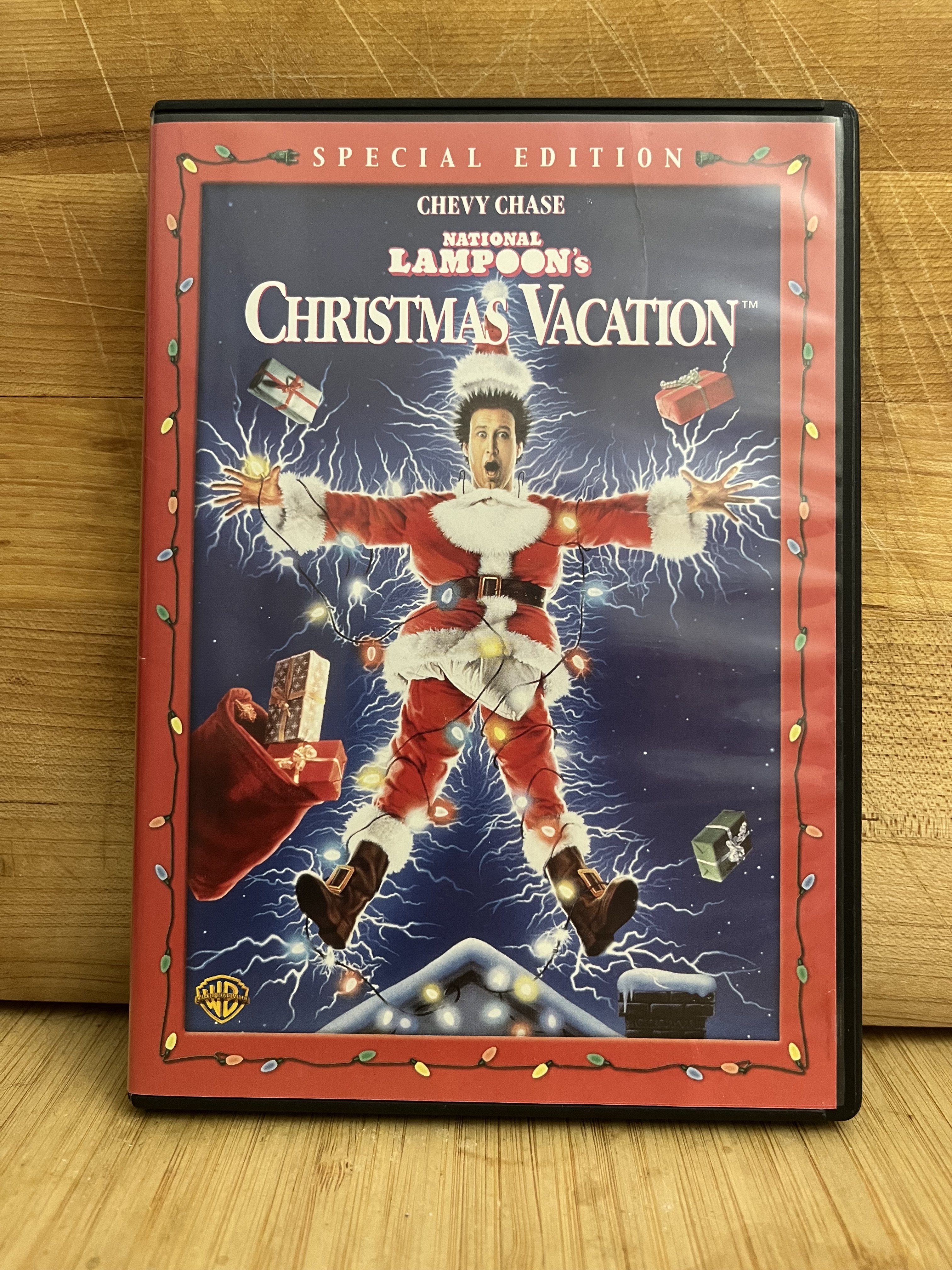
Speaking of which, here’s a picture of the Warner Home Video Special Edition DVD release which hangs out in a box in a basement with all of our other Christmas movies for most of the year:
It can also be streamed via Max with a subscription or Apple TV and Prime Video for a rental fee.
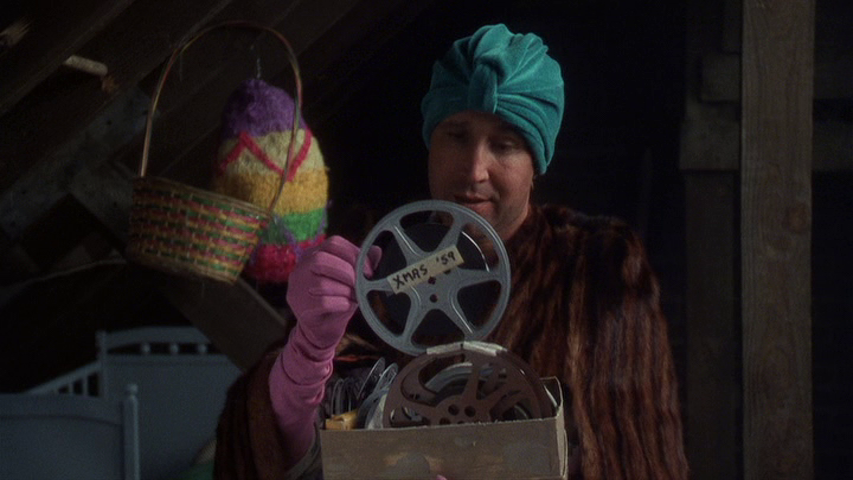
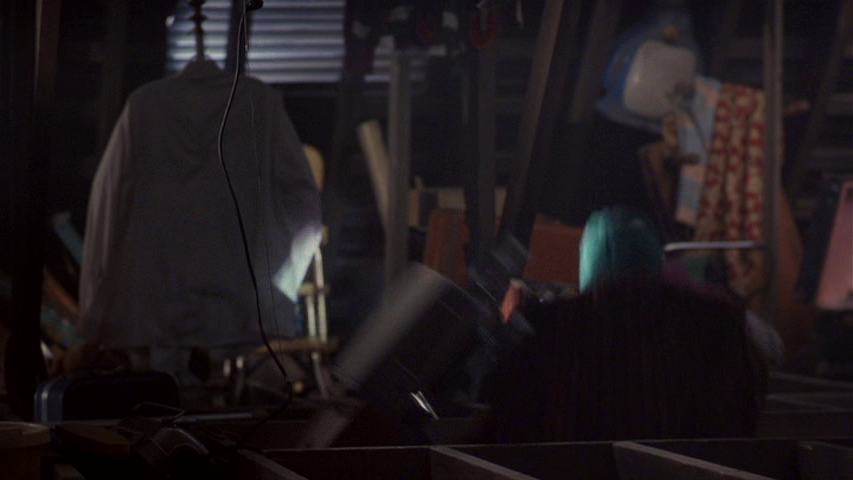
On June 21, 1987 the New York Times published an interview with Stanley Kubrick by Francis X. Clines which began with the legendary auteur praising a series of recent Michelob beer commercials: “they’re just boy-girl, night-fun, leading up to pouring the beer, all in 30 seconds, beautifully edited and photographed.” The person who directed them was one Jeremiah S. Chechik, and according to a 2016 Slash Film oral history by Blake Harris, his phone started ringing off the hook the next day. Less than two years later he was directing his first feature film. “Economy of statement is not something that films are noted for,” Kubrick went on to tell Clines, and Christmas Vacation is no exception, but as Dave Kehr noted in a contemporary review for the Chicago Tribune, it definitely does exhibit a “fine sense of timing.” Nowhere is this more apparent than in my favorite scene. Hapless patriarch Clark Griswold (Chevy Chase) has found himself trapped in a cold attic while his family goes shopping:
While searching for warm clothing, he finds a box of home movies:
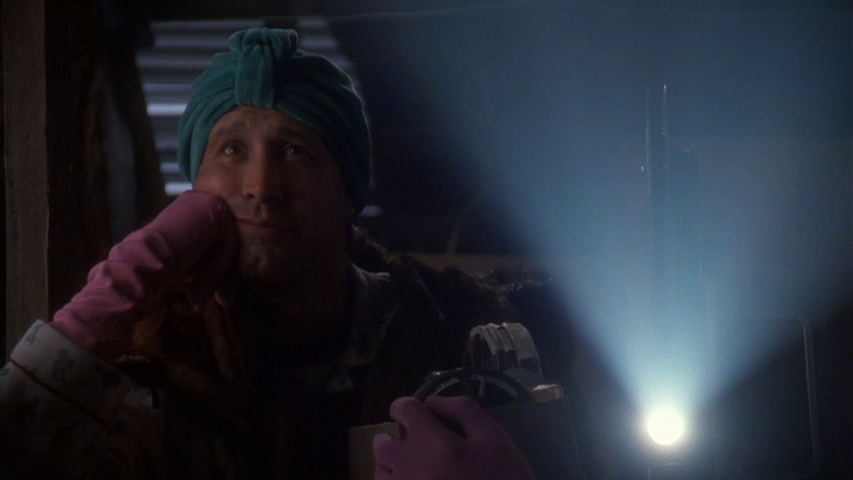
The scene which follows is a smidge under two minutes long and begins with a 37-second lateral tracking shot which brings Clark into the right third of the frame with a film projector in the foreground:
Then swings around to show us what he’s watching from over his shoulder:
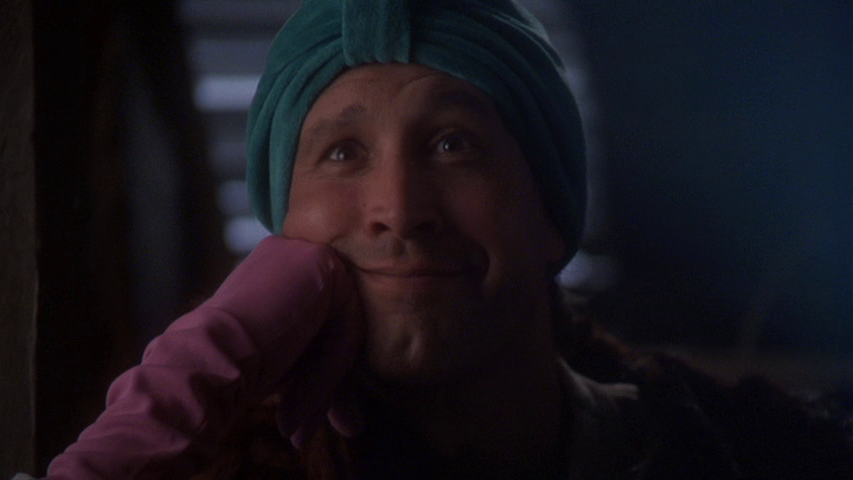
There’s a cut to a head-on shot of Clark occupying the left two-thirds of the screen and the light from the projector filling the rest which lasts about three seconds:
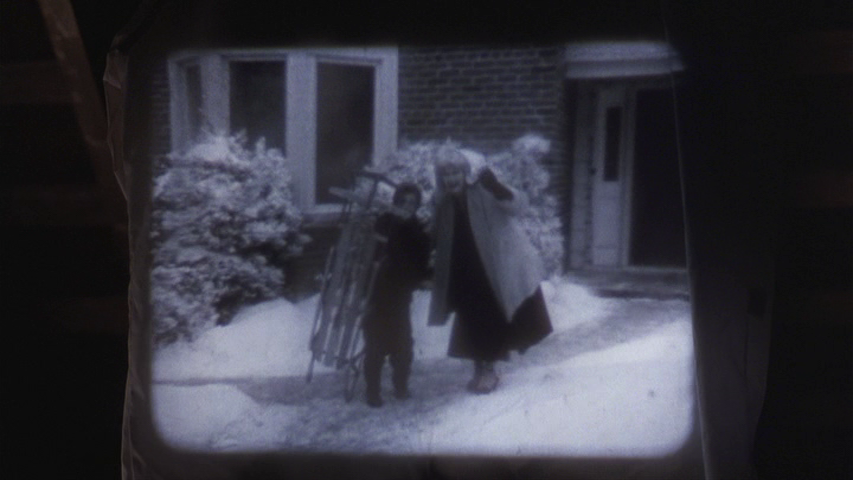
Then a cut to a title card followed by approximately twelve seconds of home movie footage starring people identifiable as younger versions of characters from Christmas Vacation:
This sequence repeats itself with very similar timing, but this time the camera also tracks in on Clark slightly:
Cut to an exterior shot of the rest of the Griswolds arriving home:
Then back to twelve more seconds of home movie footage followed by another ten seconds spent tracking in to an even tighter close-up of Clark’s face:
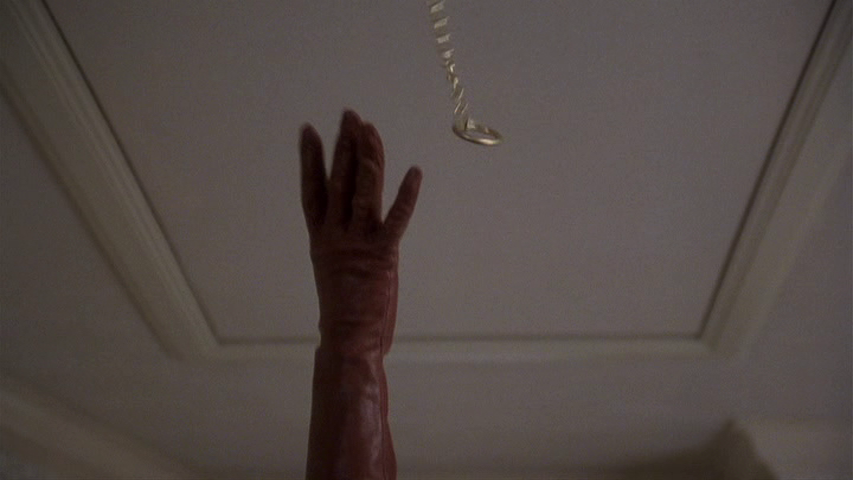
Cut to a shot of Clark’s wife Ellen (Beverly D’Angelo) coming up the stairs with an armful of presents which ends with a close-up of her gloved handing grasping for the chain one pulls to open the attic:
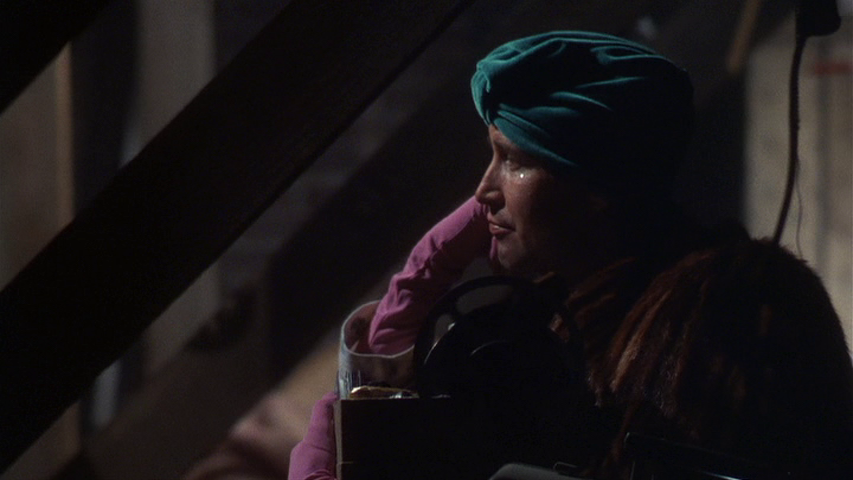
Followed by one last close-up of Clark which holds for just a second or two before the music abruptly ends and he falls through the floor:
Considered against the entire sweep of film history, Chechik and crew aren’t doing anything original in this scene, but it stands out within the realm of holiday movies because it finds a perfect balance between sentimentality and slapstick. The pratfall at the end of this scene is funny because it’s surprising: we know something is coming, but not what, since we have no way of knowing that Clark set his projector up right on top of the attic door. Meanwhile, the 2:1 (after the initial tracking shot) ratio of documentary evidence of what the “fun, old-fashioned family Christmas” that he’s trying to recreate looked like to his emotional responses to it helps us understand what he’s struggling to achieve elsewhere in the film and why. Last but not least, the marriage of these images to Ray Charles’s “That Spirit of Christmas” is absolutely perfect.
Music is a crucial aspect of a number of other scenes as well. Angelo Badalamenti’s use of a drum to accompany Clark’s reaction to his son Rusty’s (Johnny Galecki) question “did you bring a saw?”
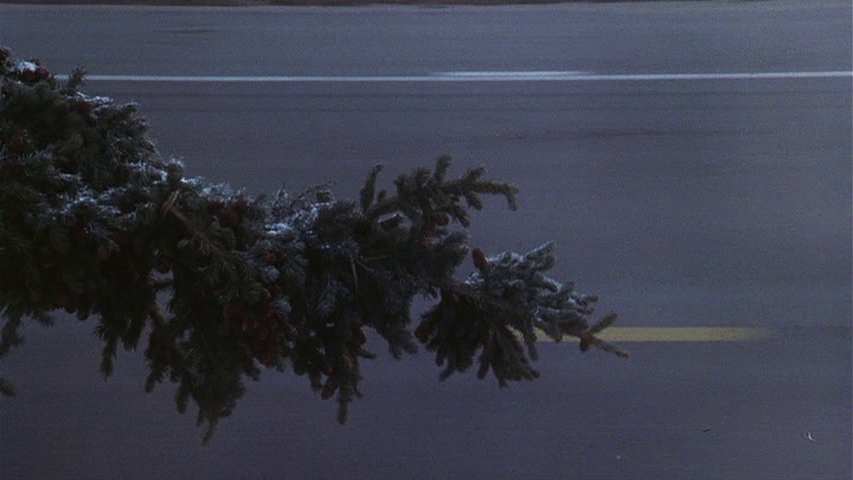
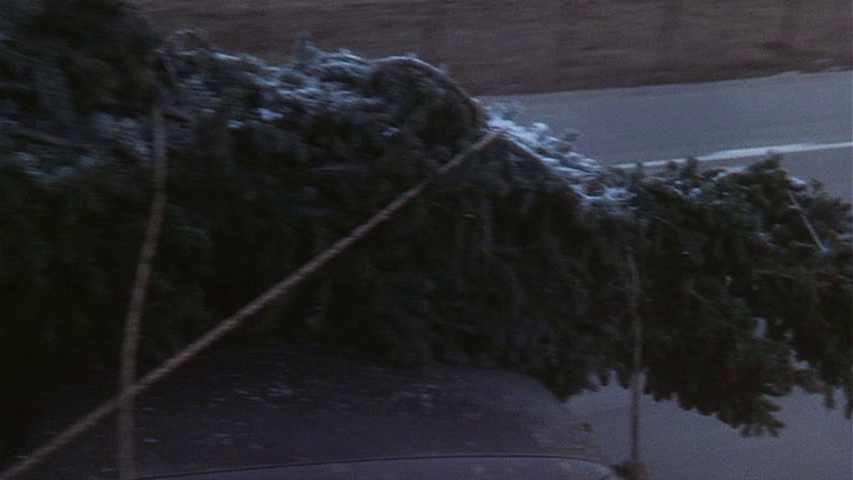
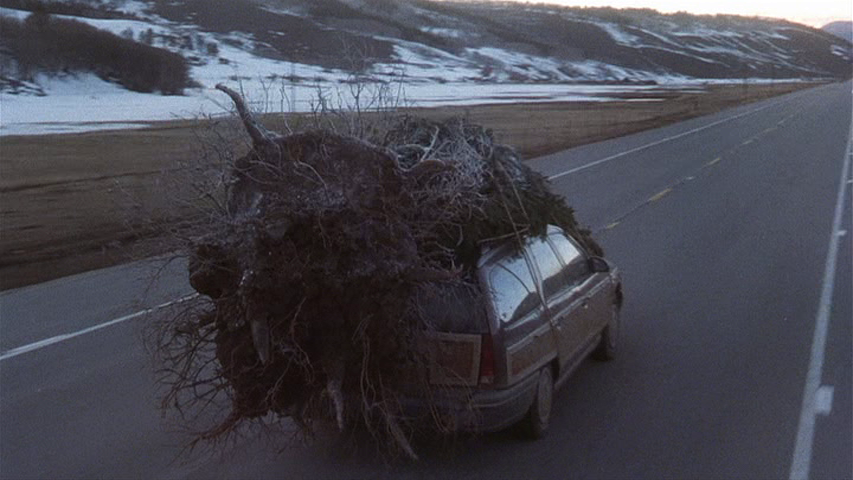
And then a lone, melancholy (French?) horn playing “O Come, All Ye Faithful” over footage of the tree they picked out tied to the top of the Griswold’s “front-wheel drive sleigh” is why this gag works:
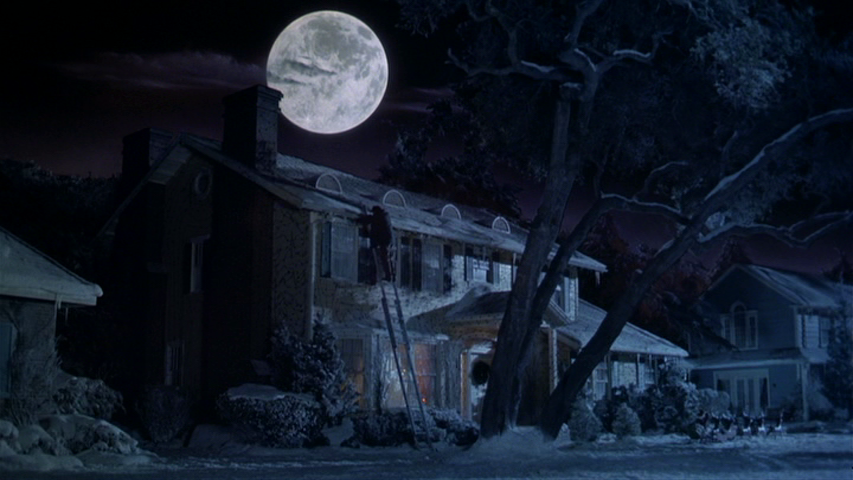
And the decision to let the rendition of “Silent Night” which plays over footage of the rest of the family asleep in their beds end before the shot of Clark on his ladder underneath a huge moon re-checking each of the thousands of bulbs which failed to light earlier in the evening makes him seem even more cold and lonely:
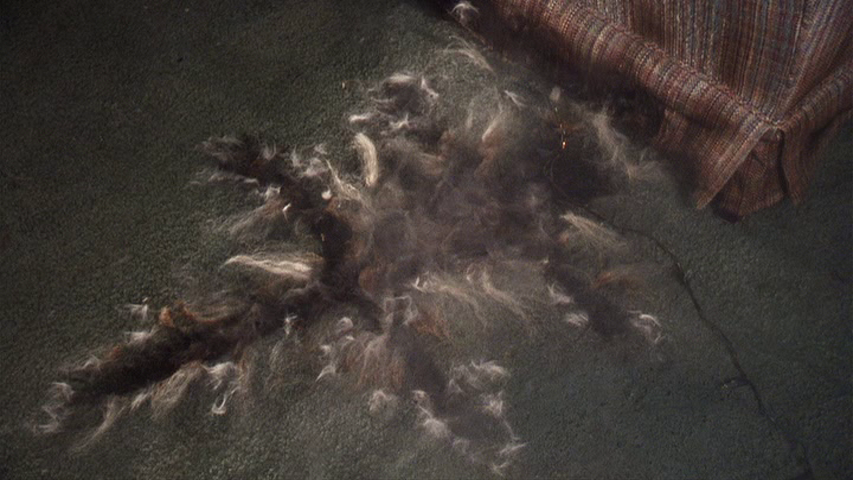
Which brings me back to the question I mentioned at the outset of this post: why did I all of a sudden become much more interested in Christmas Vacation about ten years ago? After all, although I wouldn’t say I “grew up” with this film, it is one I watched for the first time as a child, when family lore has it that I started bawling my eyes out after Aunt Bethany’s (Mae Questel) cat meets its demise:
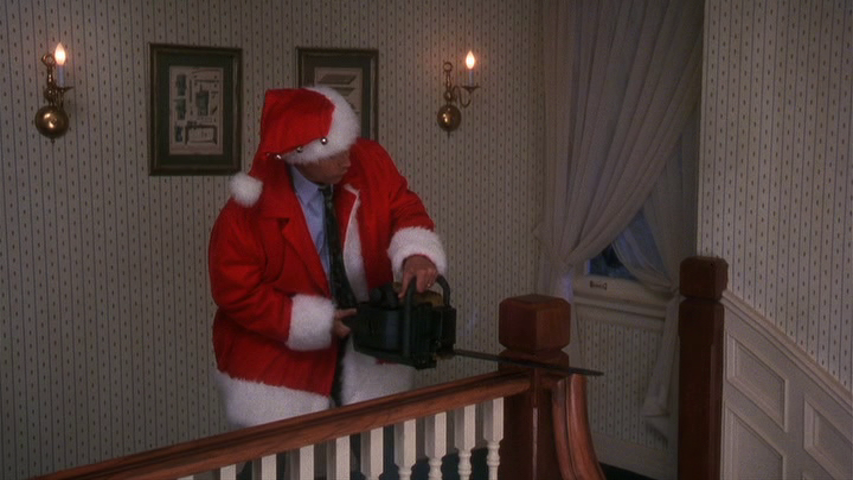
In a contemporary review for the Los Angeles Times, Michael Wilmington observed that Chechik and screenwriter John Hughes “deliberately mix up horror movies and sentimental family comedies in their imagery.” He’s specifically talking about this scene near the end of the film when Clark “fixes the newel post”:
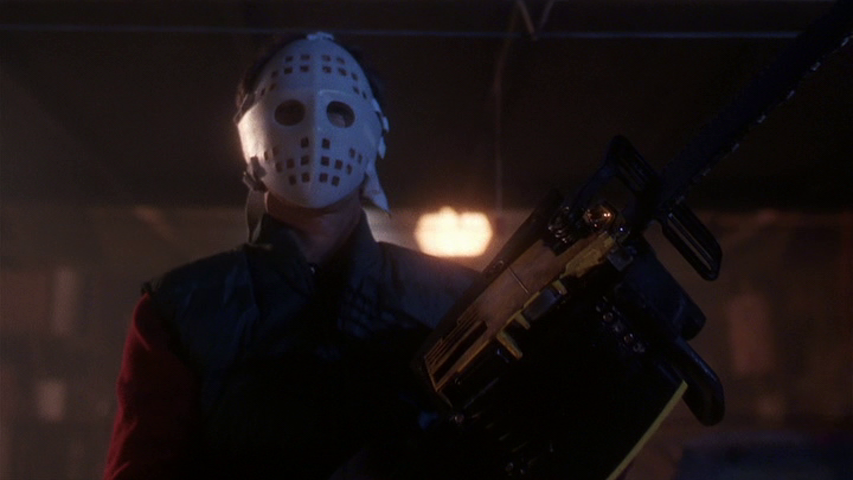
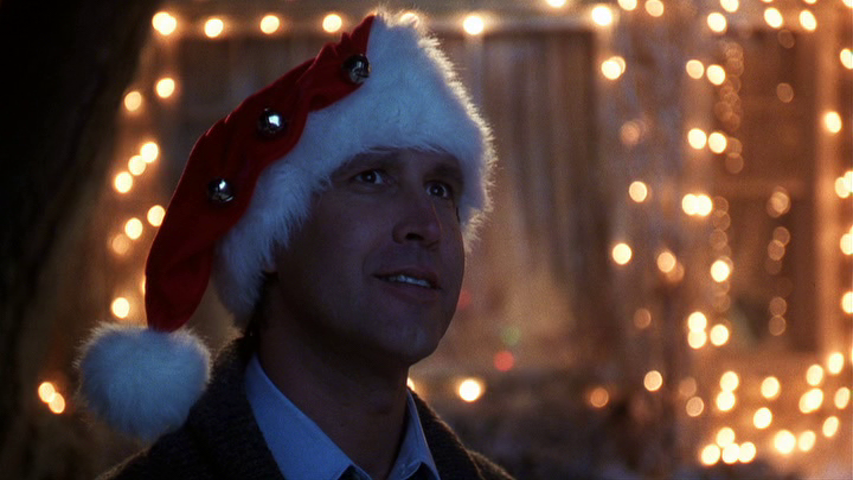
Which, per Wilmington, “fuses imagery from ‘It’s a Wonderful Life’ and ‘The Texas Chain Saw Massacre’ in a single visual gag,” a connection we are prepared to make by an earlier scene in which Clark dons a hockey match before cutting his tree down to size:
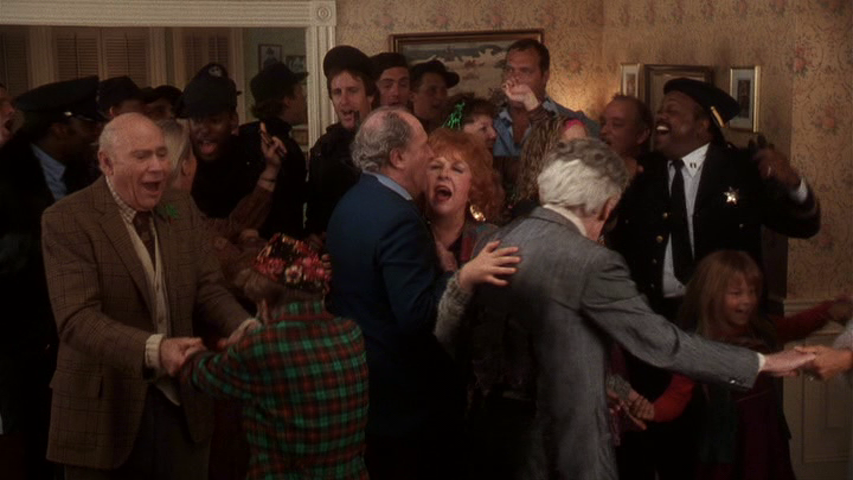
Wilmington is dead-on when he notes that point is to underscore the “fiery obsessiveness behind [Clark’s] desire, constantly thwarted, to construct the ideal Christmas.” The key is that the childhood holidays immortalized in film strips Clark finds in his attic weren’t perfect–as he says to his father (John Randolph) a bit later on, “all our holidays were always such a mess.” His desire to improve upon them comes from a good place: he wants to give his family an experience that they’ll still remember fondly 30 years later, just as he was moved to tears by images of “Xmas 1955.” But it’s also at its core a selfish project and thus not one that he necessarily deserves to be celebrated for. The final line of Christmas Vacation is one I think of often when we host holiday get-togethers. As a chaotic Christmas Eve improbably ends with everyone happily singing and dancing:
Clark and Ellen share a kiss outside:
She joins the rest of the family inside, leaving him alone. “I did it,” he says with a smile:
One way to interpret this is as further evidence that Clark is delusional. But another, more charitable explanation is that he has finally realized that the work is the reward, which I think would be enough to make this a movie about hosting Christmas and hospitality in general. It hardly seems like a coincidence that I would really begin appreciating Christmas Vacation at the same time I acquired in-laws and planning seasonal gatherings became a prominent part of my life.
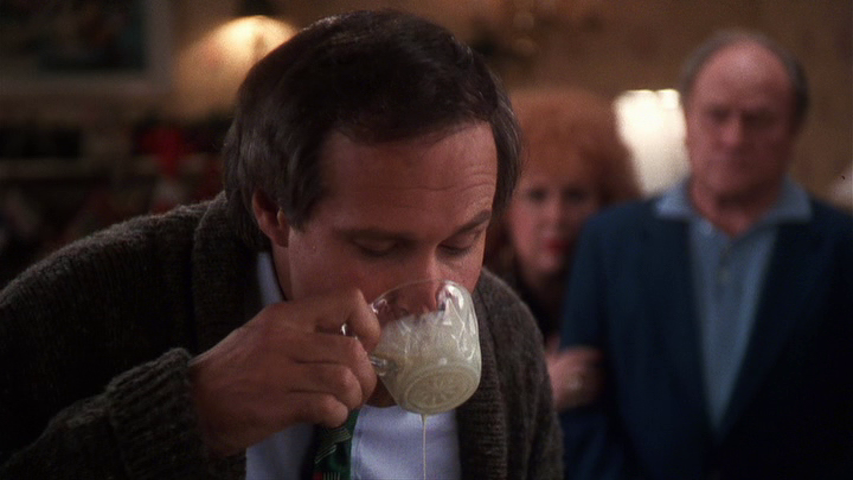
I thought about ending this post with a more in-depth discussion of the eggnog scenes, but although “it’s good, it’s good” is invariably what I say whenever I quaff this particular beverage:
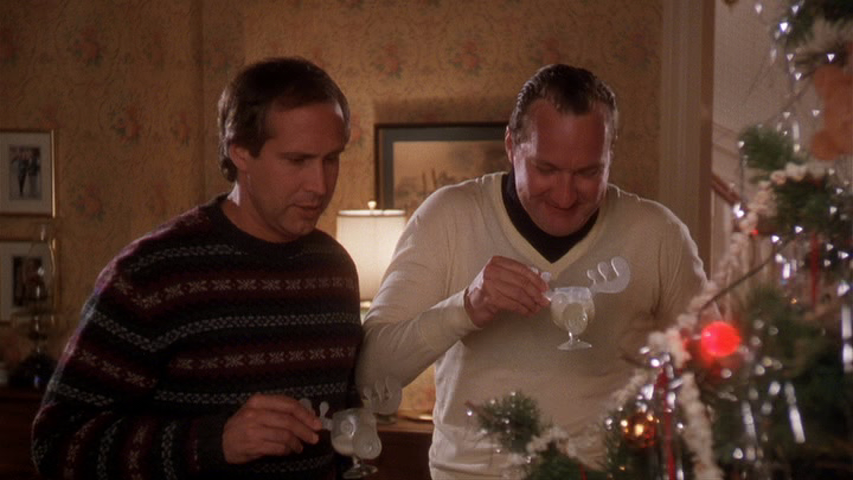
It’s really nothing more than a prop for Chevy Chase and Randy Quaid (who plays Cousin Eddie) and a showcase for the glassware so delightfully cheesy that we just had to have it:
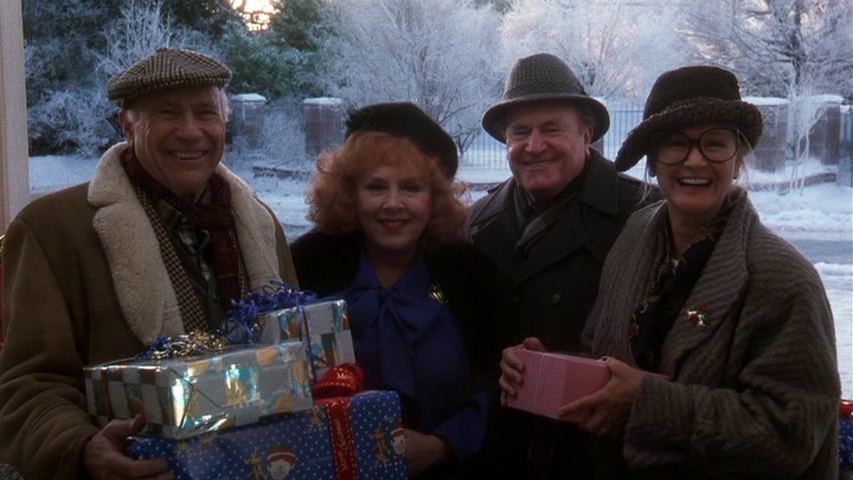
Another option would be to call out the incredible ensemble cast that plays the Griswold grandparents, which in addition to John Randolph as Clark, Sr. also includes Diane Ladd as Clark’s mother, E.G. Marshall as Ellen’s father, and Doris Roberts (who I mentioned in my September, 2022 Drink & a Movie post about Hester Street) as her mother:
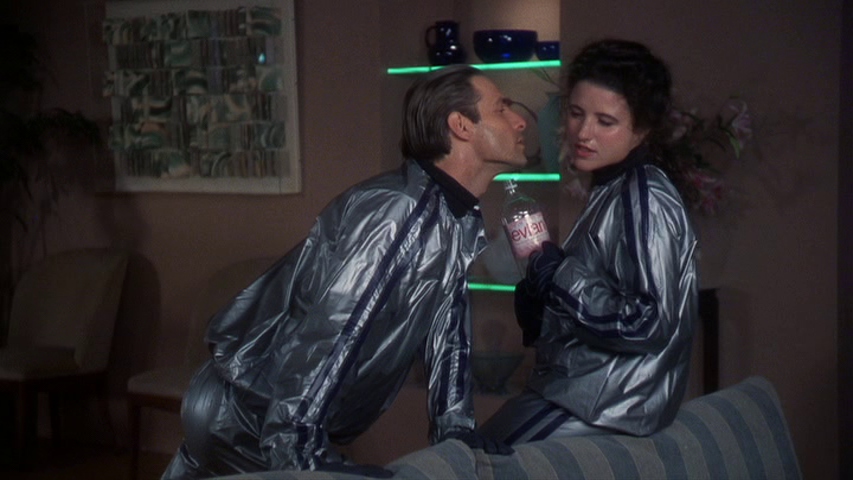
Or these ridiculous tracksuits worn by the Griswold’s yuppie neighbors Todd (Nicholas Guest) and Margot (Julia Louis-Dreyfuss):
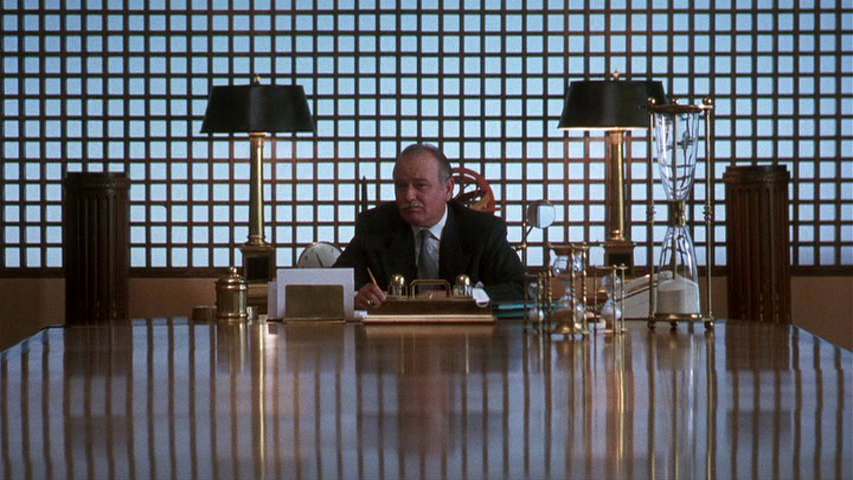
Or Brian Doyle-Murray’s bad boss for the ages Frank Shirley:
Or one of the other lines we quote over and over again each December like “lotta sap in here. It looks great! Little full, lotta sap.”
Instead, I’ll conclude with a question: what in the world are we supposed to make of the fact that the animated opening credit sequence appears to show that Santa’s hat has a skeleton?
Now *that’s* horrifying. Cheers!
All original photographs in this post are by Marion Penning, aka My Loving Wife.Links to all of the entries in this series can be found here.
What I’m Seeing This Week: It’s a close call for me between the documentary Smoke Sauna Sisterhood, which screens at Cornell Cinema on Monday, and Nicolas Cage’s latest film Dream Scenario, which opened at Cinemapolis and the Regal Ithaca Mall yesterday. I’m currently intending to go with the former, but reserve the right to change my mind at the last minute! My Loving Wife and I may also see Napoleon, which continues its run at both of those same theaters, with her history buff uncle depending on how many other relatives come to Ithaca this weekend for our girls’ Irish dance recital and how willing they are to babysit.
Also in Theaters: It has been a few years since I literally recorded music onto an actual audiocassette, but I still use the term “mixtape” for certain Spotify and iTunes playlists. The thing they all have in common is intentionality: I restrict them to a certain length and put thought into how the songs flow into one another and fit together as a whole. I’ve always believed that you can do the same thing with movies. A film studies course syllabus is one obvious example, and a film series is another. Holiday movie watching can be, too, if you approach it the right way. We binge on Christmas movies each December in our house, but I don’t want the exact same thing over and over again. The Holdovers, which continues its run at Cinemapolis and the Regal Ithaca Mall this week, has the potential to be a great “holiday mixtape movie” in that it’s set during a private boarding school’s winter break and features twinkling lights and Andy Williams singing “The Most Wonderful Time of the Year,” but also quite a few somber notes, making it a seasonally appropriate change of pace. More traditional holiday fare screening at local theaters this week includes The Polar Express and National Lampoon’s Christmas Vacation (the subject of my next Drink & a Movie post!), which are at the Regal Ithaca Mall on Saturday and Sunday respectively.
Home Video: Another great holiday mixtape movie is Metropolitan, which a friend of mine mentioned in an email earlier this week. Although the 10-day period when it unfolds spans Christmas Eve and Day, its focus is specifically on the debutante parties which take place in Manhattan during this time. The Oscar-nominated screenplay is absolutely brilliant and contains one of my single favorite lines from any movie ever, Tom Townsend’s observation to Audrey Rouget that her behavior is “not something Jane Austen would have done.” Edward Clements and Carolyn Farina are terrific in those two roles, and the rest of the cast is great as well. Metropolitan is a Criterion Collection title and is now streaming on both The Criterion Channel and Max with a subscription.
Previous “Ithaca Film Journal” posts canbe found here.











 The Prodigal Cinephile