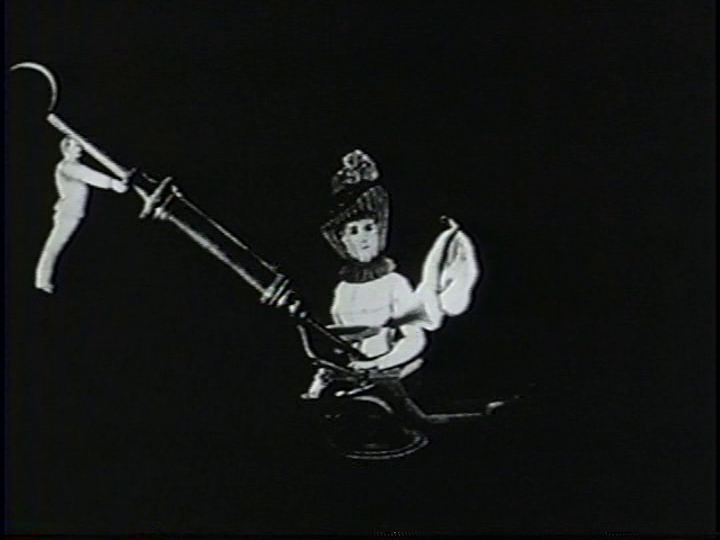
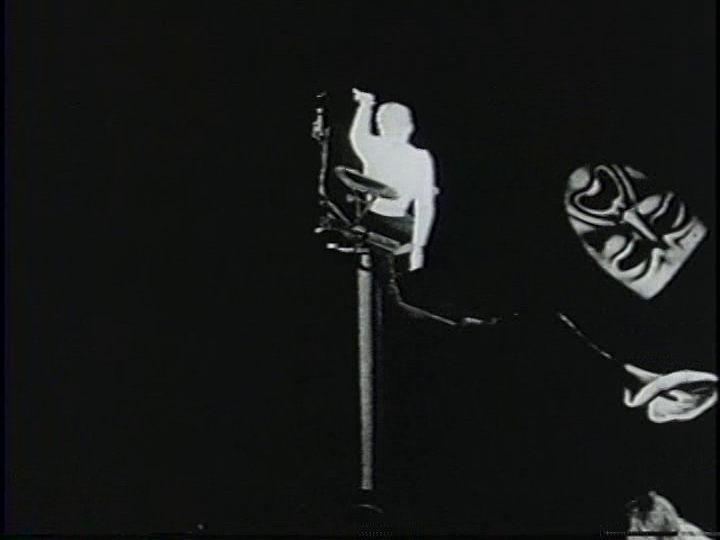
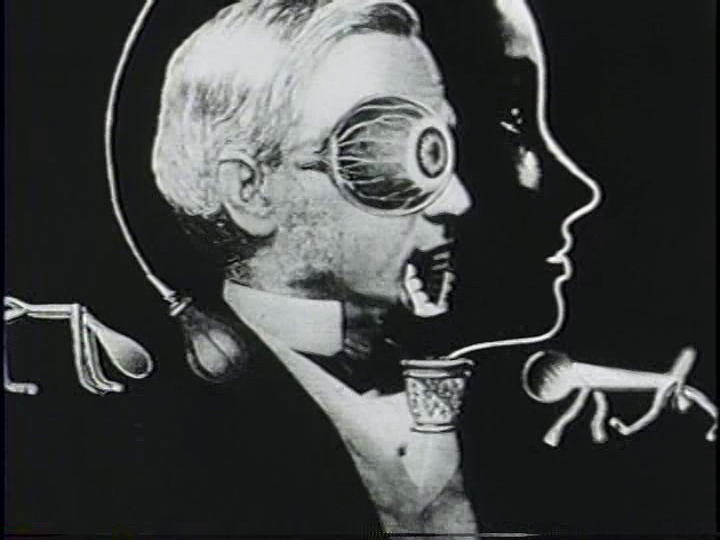
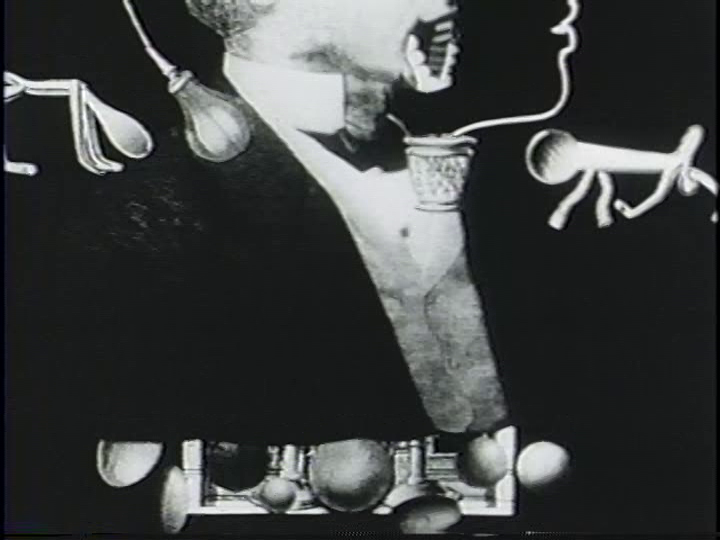
November, 2023 Drink & a Movie: Last Word + Pyaasa

I knew from the moment my Drink & a Movie series was born that I would eventually feature the Last Word, and by the time the credits rolled on my first viewing of Pyaasa last year there was no doubt which movie I would pair it with. I originally slotted this post for late fall with a vague thought that I could mention actor-director Guru Dutt’s facial hair in the context of Movember or because of National Novel Writing Month, even though the character he plays is a poet. Sadly, the recent passing of Seattle bartender Murray Stenson, who is credited with rescuing the Last Word from obscurity, made my timing even more appropriate.

The main things you need to know about this concoction in 2023 are that: 1) it’s not for everyone, as I learned the hard way about ten years ago when we ordered a round for our table at a conference and one by one they all got passed over to me as each of my colleagues decided they weren’t a fan, which eventually resulted in me singing karaoke in front of co-workers for the first and only time in my life; and 2) if you are a fan of Green Chartreuse, this is (along with drizzling it over the best chocolate ice cream you can find) one of the few uses for the bottle you hoarded away a few months ago that is superior to just drinking the stuff straight as a digestif. Here’s how to make it:

3/4 oz. Gin (Broker’s)
3/4 oz. Maraschino liqueur
3/4 oz. Green Chartreuse
3/4 oz. Lime juice

Shake all ingredients with ice and strain into a chilled coupe glass.

Last Word in a coupe glass in front of lace and surrounded by fog

Most Last Word recipes note that it was invented at the Detroit Athletic Club prior to Prohibition, included in Ted Saucier’s 1951 book Bottoms Up, then rediscovered and popularized by Stenson 50-odd years later. The origins of its name deserve to be more well known, too. As described in Gary Regan’s book The Joy of Mixology, it was introduced to New York by famous vaudevillian Frank Fogarty, who Regan quotes as saying “you can kill the whole point of a gag by merely [using one] unnecessary word.” The Last Word is rather tart, but although adding a bit of simple syrup might make it more accessible, I don’t recommend it: the assertiveness of this cocktail is its best quality! Acid, spice from the gin, and herbs from the Chartreuse explode on the palate. With the latter clocking in at 110 ABV, you definitely should consider making it your final drink of the evening, though.

The screengrabs in this post come from a copy of the Yash Raj Films DVD release which I borrowed via interlibrary loan:
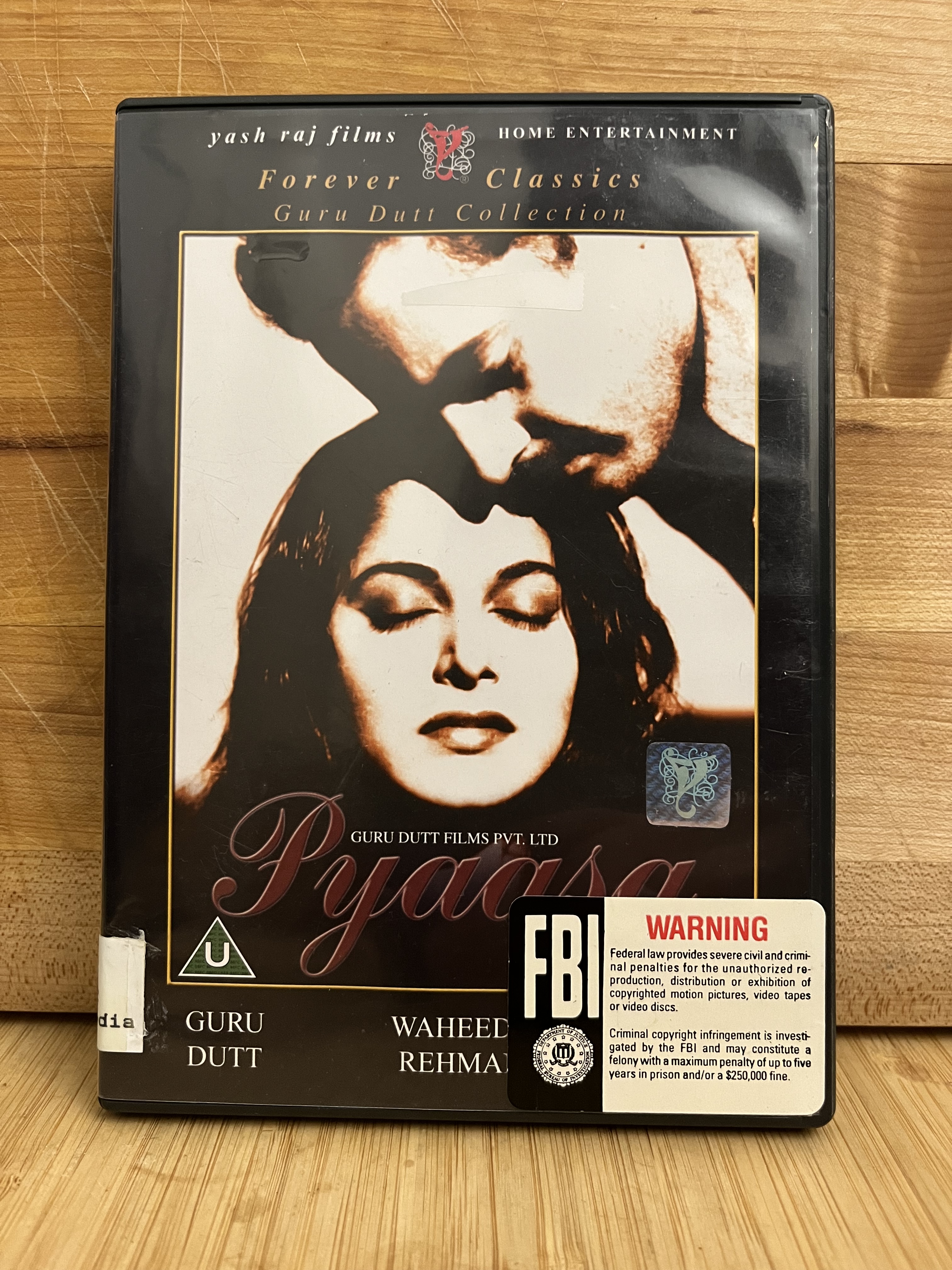
Pyaasa DVD case

I actually own a DVD copy of the film released by Ultra Media, but it has a persistent watermark in the top left corner (yuck!) and I was thrilled to get my hands on the edition that DVDBeaver identified as being the best one available. It can also be streamed on Prime Video for a rental fee.

Pyaasa begins with falling blossoms waking Dutt’s Vijay up from a night spent sleeping rough in a park:

Close-up of Vijay waking up

The beauty of nature moves him to compose a poem: “These smiling flowers/These fragrant gardens/This world filled with glorious colours/The nectar intoxicates the bees/What little have I to add to this splendor save a few tears, a few sighs.”

Extreme close-up of a bee gathering pollen from a flower

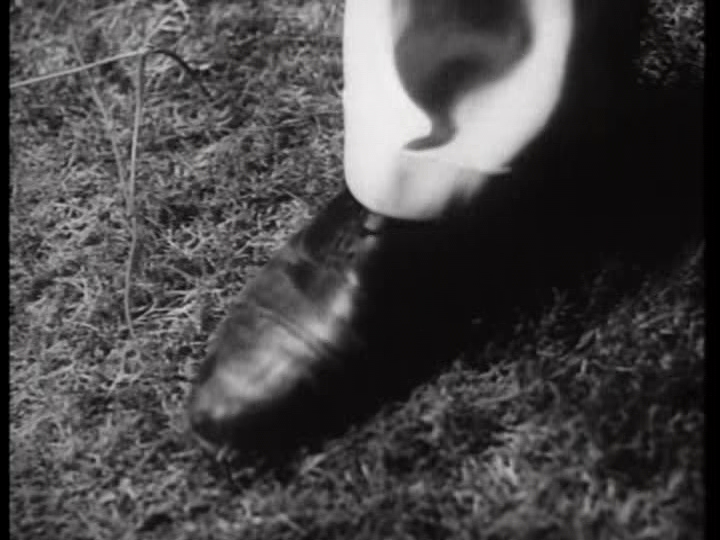
But then, as he watches, a bee lights on the grass, where it is trampled by one of his fellow Kolkatans:


Close-up of Vijay
Point of view shot of a bee in the grass
A shoe steps on the bee

This may be for me the best example of what I think scholar Corey Creekmur is writing about in his chapter on the film for editor Lalitha Gopalan’s book The Cinema of India when he says it “may well be the Hindi Citizen Kane (1941), a work whose audacious style, autobiographical resonance and lasting impact on filmmakers have exceeded its initial success.” The scene is a subliminally effective stage-setter on the first viewing. It struck me as perhaps a bit heavy-handed on the second. Beginning with the third, though, all sorts of interpretations start to open up: the bee is Guru Dutt! It is a worker bee! One bee alone may be helpless to oppose a shoe, but consider the swarm!

The story is fairly straightforward. Vijay can barely afford to feed himself because no one will buy his poems, except when his half-brothers sell them as wastepaper. Gulabo (Waheeda Rehman) is a prostitute who chances upon them and recognizes their worth. They meet cute when, thinking he’s a potential customer, she tries to seduce him with his own composition in a scene which uses columns and shadows well to hide and reveal her face:

Close-up of Gulabo

Vijay is initially oblivious to her affection both because he’s consumed with his work, and because his first love Meena (Mala Sinha) reenters his life in the following scene, which includes a flashback to the two of them in college:
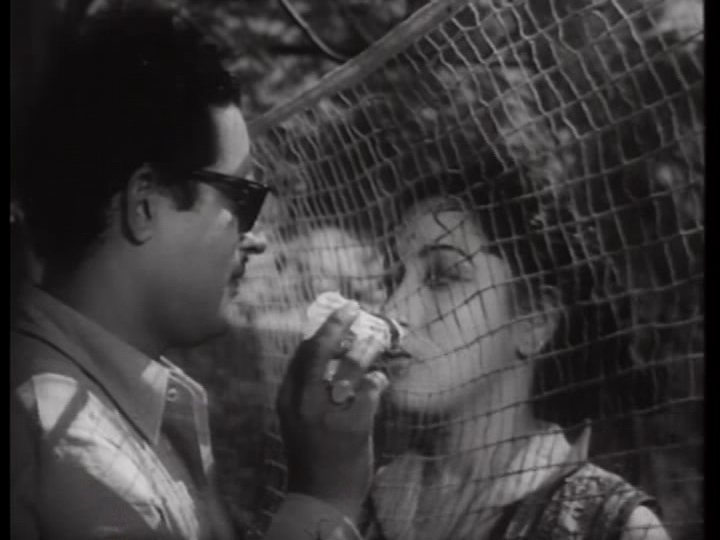
Vijay and Meena hold hands through a badminton net

As scholar Carrie Messenger notes in a chapter on the film in editor Marlisa Santos’s book Verse, Voice, and Vision: Poetry and the Cinema, this is a reworking of the themes of Saratchandra Chattopadhyay’s novel Devdas with poetry taking the place of alcohol as an “addictive and destructive” force in the protagonist’s life. Messenger adds that the triangle of Meena/Vijay/Gulabo would have reminded many contemporary viewers of gossip that Dutt, Rehman, and playback singer Geeta Dutt constituted a real-life love triangle and that Pyaasa “features song sequences where the voice of Guru Dutt’s actual wife is channeled through the body of the lover, both through Gulabo and through Meena, a tension that disembodies the voice at the same time that it also creates the strange embodiment of an idealized creation, a Frankenstein, the best of both of these women as well as Geeta Dutt’s voice,” which is fascinating.

The songs are one of the best parts of the film. My favorite is probably “Sar Jo Tera Chakraye,” which is sung by Mohammed Rafi and set to a comic set piece featuring Johnny Walker, a member of my personal character actor hall of fame.
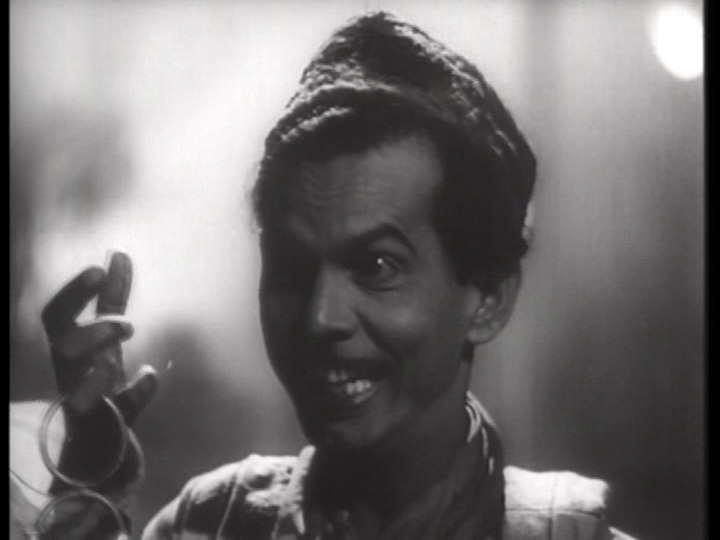
Close-up of Johnny Walker as Abdul Sattar

“Aaj Sajan Mohe Ang Laga Lo” features some first-rate unrequited longing, which I’m a total sucker for–Gulabo actually isn’t resting her head on Vijay’s shoulder here, but rather hovering just above it, and he has no idea she’s there:

Gulabo fights the urge to lay her head on Vijay's shoulder

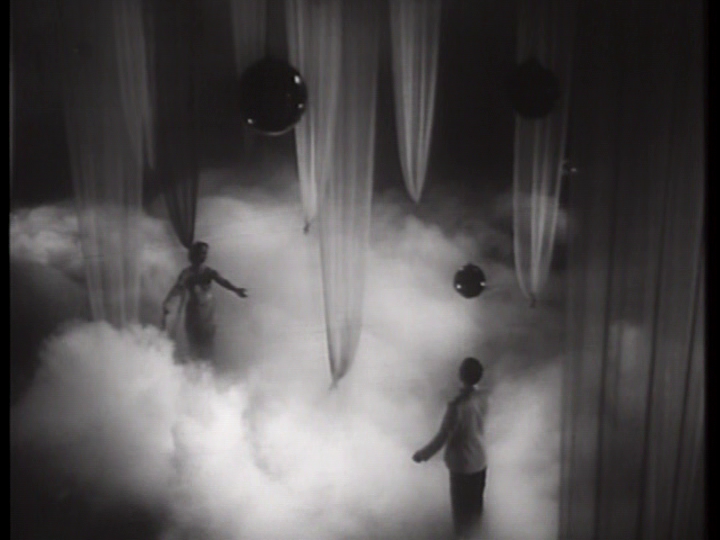
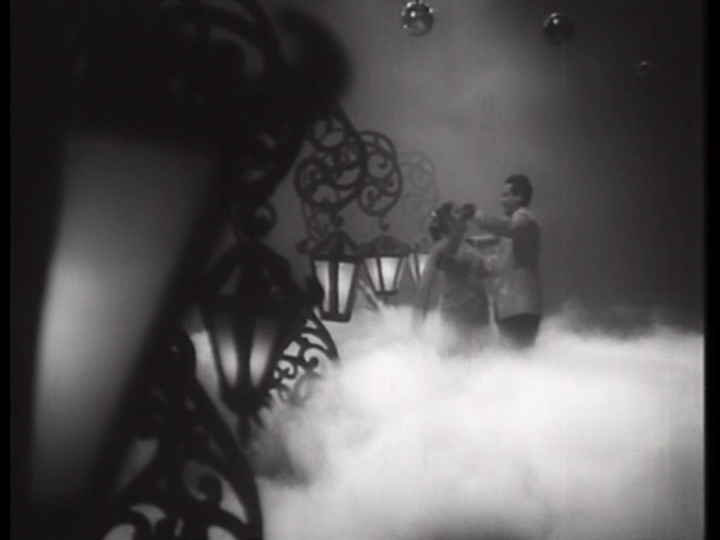
And the extravagant production design in “Hum Aap Ki Ankhon Mein,” which obviously inspired our Last Word photograph, is exactly what a daydream sequence within a flashback (!) calls for:
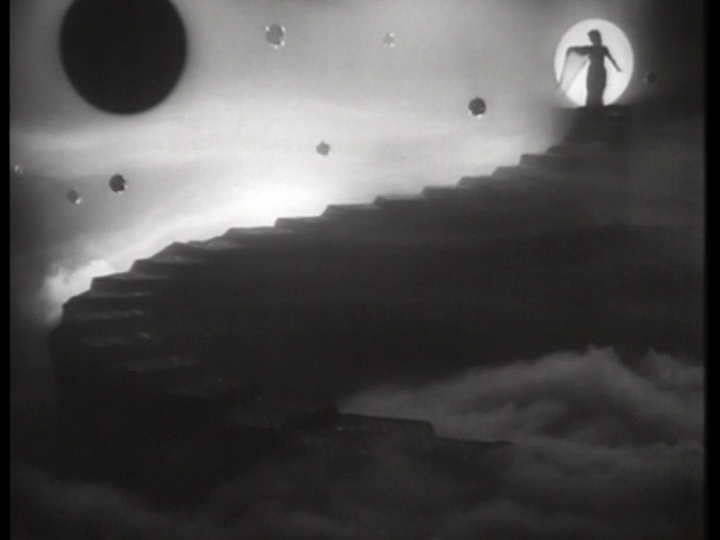
A silhouetted figure descends a winding stairway shrouded in fog
Vijay and Meena waltz on a fog-covered dancefloor next to a row of lamps
Vijay and Meena stand apart, with arms open wind, across a foggy dancefloor which is also decorated with curtains and balloons

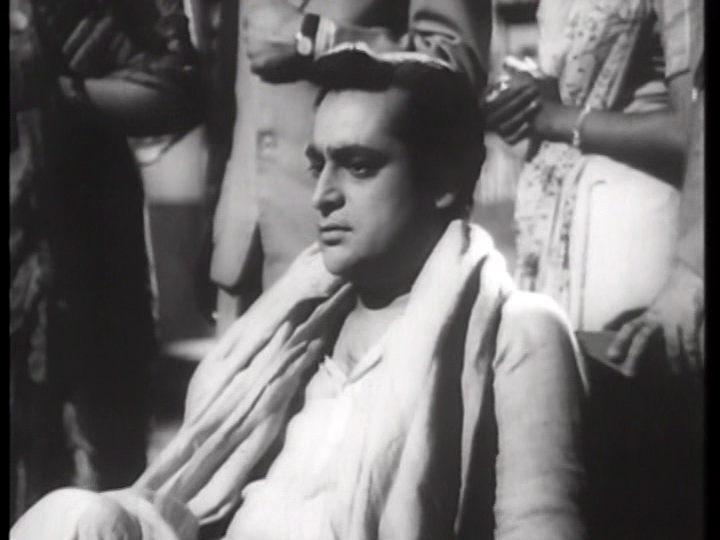
Dutt saves the best for last, though. “Yeh Duniya Agar Mil Bhi Jaye To” builds to a crescendo in some of the most incredible marriages of image and music ever captured on film. The scene takes place at a ceremony commemorating what is presumed to be the one-year anniversary of Vijay’s death. Mr. Ghosh (Rehman Khan), the publisher who organized it and the man who Meena married for money, breaking Vijay’s heart, knows that he is very much alive, as do Vijay’s half-brothers and his childhood friend Shyam (Shyam). Everyone else is shocked when the poet they only know through best-selling book that Gulabo paid Ghosh to publish “posthumously” appears at the back of the auditorium and begins reciting a verse railing against the corruption of the world:
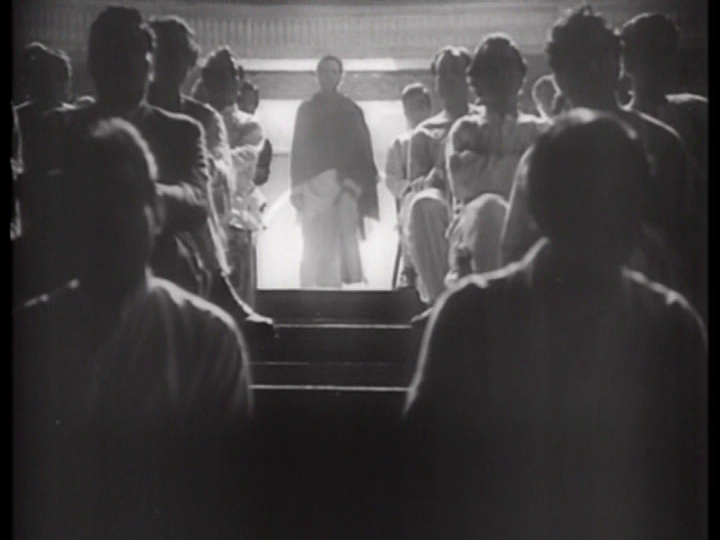
Vijay appears in a backlit doorway

As Ghosh’s henchmen try to drag Vijay away, he breaks free of them and rushes forward as the camera pulls away from him, singing “burn this world! Blow it asunder!”
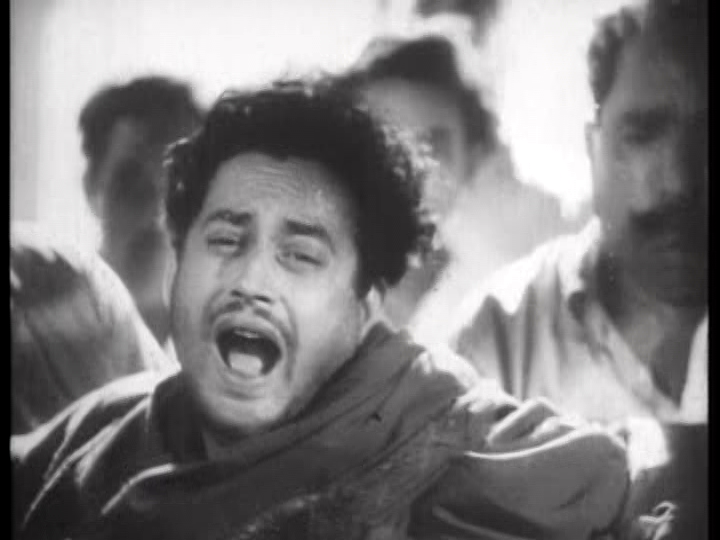
Close-up of Vijay singing

This scene is, in fact, primarily constructed of tracking shots, and they appear all throughout this film and the next and final one Gutt directed, Kaagaz Ke Phool. I consider them to be some of the most expressive camera movements in all of cinema. Creekmur says that “when the camera moves in and out throughout Pyaasa, it seems to replicate the physical act of breathing, or the opening and closing of the heart’s valves.” This is just about perfect, but it misses an important element: the velocity of the camera often changes during the movement, creating a disorienting effect like being on an elevator or a roller coaster, which to me feels like my heart skipping a beat or getting caught in my throat.

One of the best places to study these shots is during the scene where Vijay recites a poem for a reunion that his classmate Pushpa (Tun Tun) has told him about. As he spots Meena in the crowd, the camera tracks in to a close-up of his face then cuts to one of her which continues the motion:
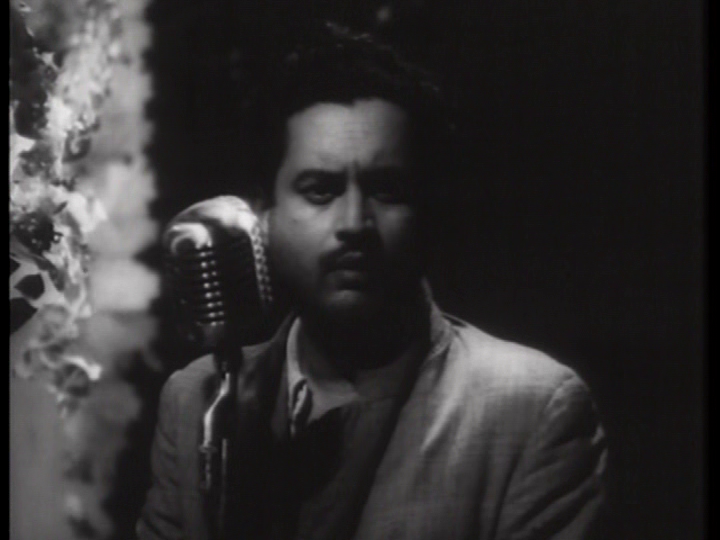
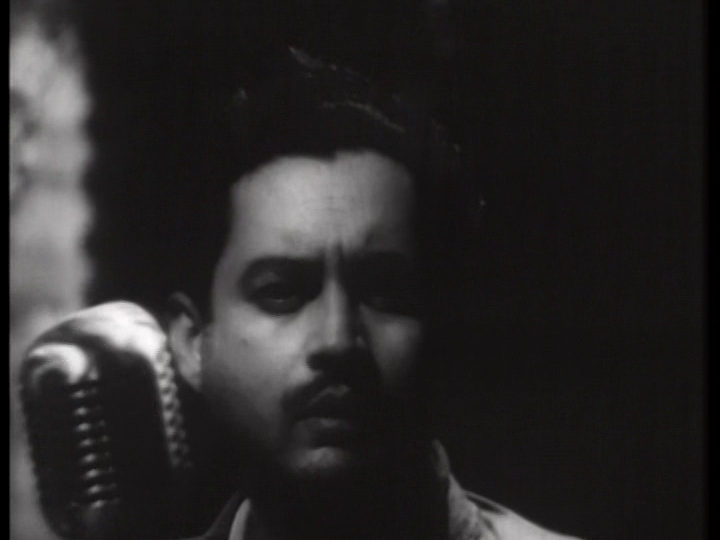
Medium shot of Vijay
Close-up of Vijay
Medium shot of Meena

As he begins to speak (“I am weary of this troubled life . . . “) the camera tracks away from him:

Close-up of Vijay at a microphone with a hand over his face

Then toward Meena and Ghosh, who is watching her intently, in the kind of rhythmic back-and-forth described by Creekmur:

Ghosh watches Meena watch Vijay

The same thing happens as Vijay says “today I break all belief with the illusion of hope,” but with the addition of a sudden acceleration:

Close-up of Vijay which begins a tracking shot
Close-up of Meena which ends one

These shots also figure prominently in a scene in which Vijay, who Ghosh has hired to work as a servant at a literary party he is throwing, is moved to recite one of his own works in response to poems by two honored guests. Here and elsewhere the movements sometimes parallel each other, as when the camera tracks in first on Meena, then Ghosh:
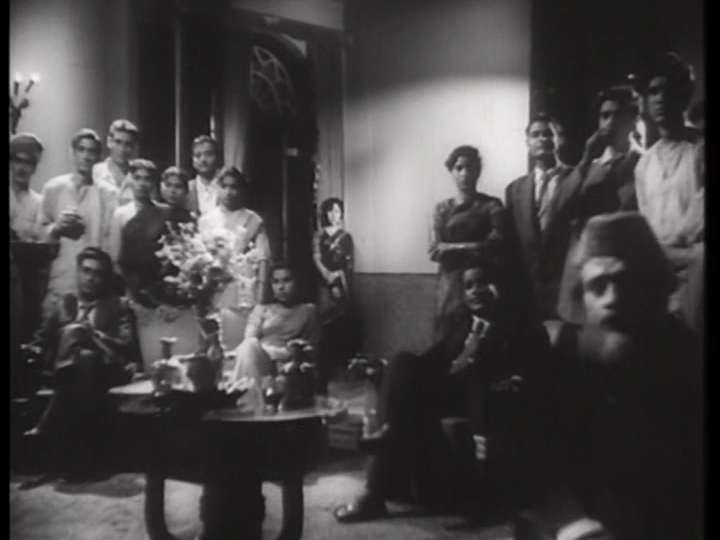
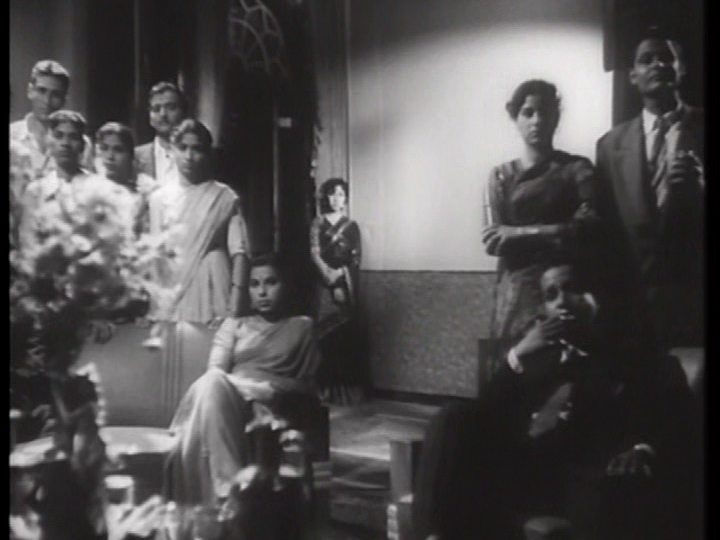
Meena from a distance at the beginning of a tracking shot
Meena closer at the end of one
Ghosh at the beginning of a parallel camera movement

In both cases the effect is to link the emotional responses of characters to a common event, here Vijay’s manifestation as a savior who could rescue Meena from her unhappy life if only she could transcend her desire for wealth and high position in society. Any doubts that a first-time viewer might have about whether this should be considered a deliberately Christ-like pose:
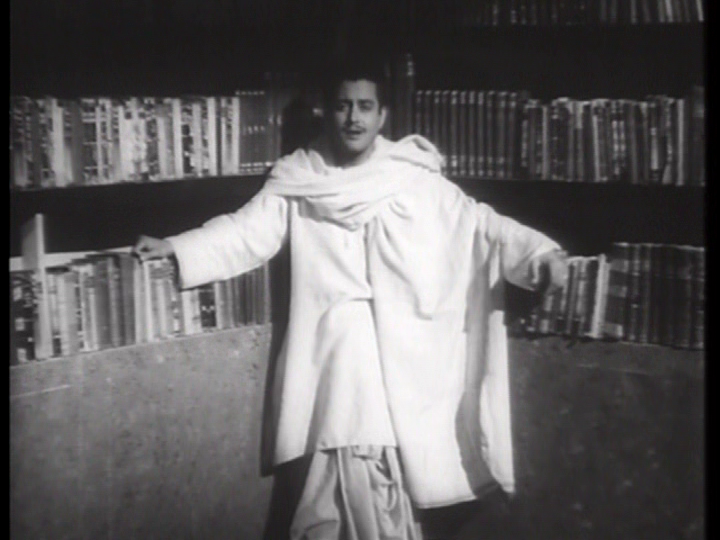
Will be laid to rest in either the next scene, in which Meena denies her love for Vijay to Ghosh three times, or if not then, when this Life magazine cover makes an appearance a bit later on:

Meena reads an issue of Life magazine with a Christ on the cover

Vijay spreads his arms wide again in the final reel:
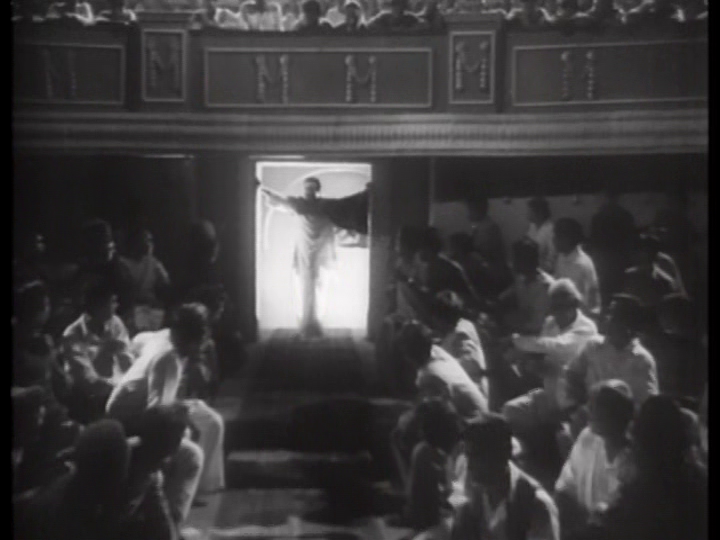
Vijay as Christ, redux

Which also contains a direct callback to Pyaasa‘s opening sequence when Gulabo falls and someone steps on her:
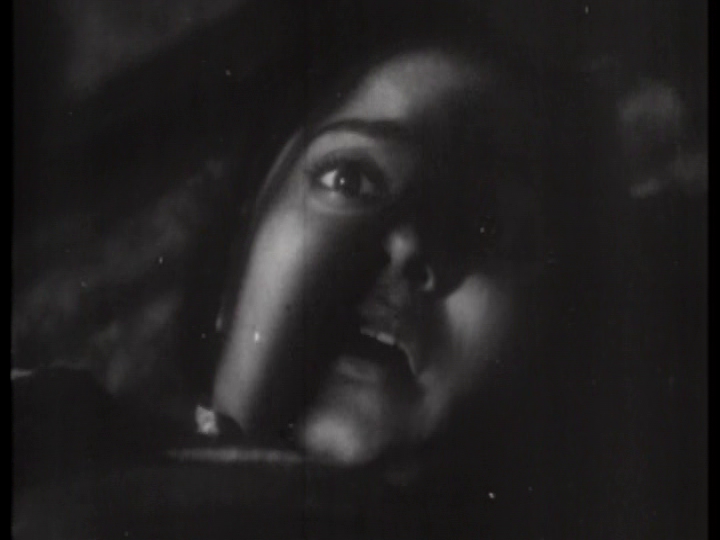

Extreme close-up of Gulabo
POV shot of a shoe from Gulabo's perspective
Extreme close-up of someone stepping on Gulabo

As was the case with the bee, I found the Christ imagery amusing at first, then precious, but ultimately embraced it as representing more than meets the eye. Jesus died so that the world’s sins could be forgiven; Vijay doesn’t die and as a result its hypocrisy is laid bare. This is at worst an intriguingly cynical inversion, but I agree with scholar Arun Khopkar’s (as translated by Shanta Gokhale) in-depth argument in Guru Dutt: A Tragedy in Three Acts that its use here is far more complex.

Pyaasa ends with Vijay and Gulabo literally holding hands and disappearing into the sunset together:
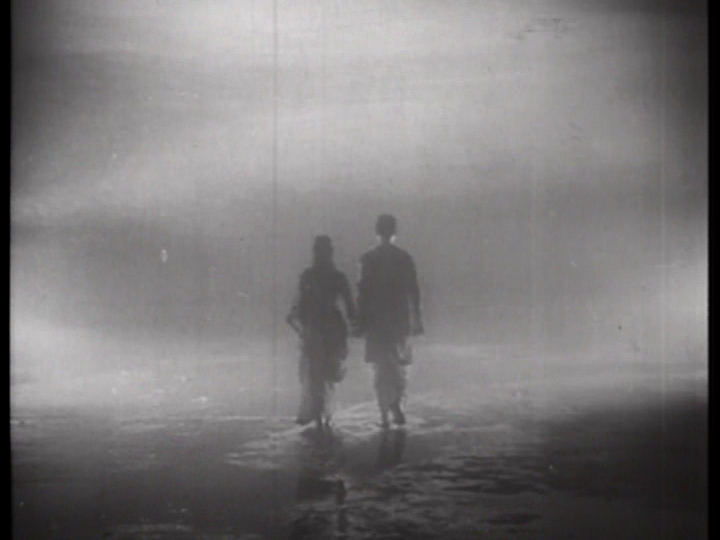
Extreme long shot of Vijay and Gulabo

Guru Dutt’s younger brother Devi describes it brilliantly in a quote included in Guru Dutt: A Life in Cinema by Nasreen Munni Kabir as “a sort of [my italics] happier ending” than the one originally planned for the film. Here’s screenwriter Abrar Alvi’s account of it from the same book:

I believed that Vijay should not leave and go away in the last scene of the film, but that he should stay and fight the system. I told Guru Dutt, ‘Wherever Vijay goes he will find the same society, the same values, the same system.’ We discussed the scene at length, but I was overruled by Guru Dutt. So I wrote the ending in which Vijay comes to Gulab and tells her to go away with him to a place from where he will not need to go any further. I asked Guru Dutt, ‘Where does such a place exist in this world?’ But Guru Dutt put his foot down.

The 5,327,708.80 rupee question is, I think: will Vijay find it satisfying to, in the immortal words of Eden Ahbez, simply “love and be loved in return?” If I could wave a magic wand and conjure up a lavish Criterion Collection release of any film, it would be a box set of Pyaasa and Kaagaz Ke Phool. Perhaps I’ll wish for an essay answering this question to include in the booklet while I’m at it!

Cheers!

All original photographs in this post are by Marion Penning, aka My Loving Wife. Links to all of the entries in this series can be found here.

Ithaca Film Journal: 10/27/23

What I’m Seeing This Week: My Loving Wife has asked me to let Killers of the Flower Moon, which continues to play Cinemapolis and the Regal Ithaca Mall, ride for another week so that we can hopefully see it together, so I’m going with Palme d’Or winner Anatomy of a Fall at Cinemapolis.

Also in Theaters: The excellent “From Silent Film Star to American Icon: Celebrating Anna May Wong” film series continues this week with a screening of Peter Pan, which critic Jonathan Rosenbaum called “one of the loveliest movies for and about children ever made,” at Cornell Cinema on Sunday. As someone who lived in Pittsburgh for a decade, I am contractually obligated (and very happy!) to note that the classic George A. Romero-directed zombie film Night of the Living Dead plays Cinemapolis on Monday and that it’s sequel Dawn of the Dead will be at the Regal Ithaca Mall all week. Spirited Away, which would get *my* vote for the loveliest children’s film of all time, plays the Regal Ithaca Mall with subtitles on Saturday and Tuesday and dubbed on Sunday, Monday, and Wednesday. Those who missed them last week have one more chance each to see Jeanne Dielman, 23 quai du Commerce, 1080 Bruxelles and Vertigo at Cornell Cinema on Friday and Saturday respectively. Both are part of their “The Greatest Films of All Time?” series.

Home Video: I was travelling for work for much of the week but found time finally catch up with The Phantom Carriage, which has been near the top of my personal “Humiliations” list at least since David Bordwell and Kristin Thompson named it one of the ten best films of 1921. It did not disappoint! Although it’s set on New Year’s Eve, it’s a ghost story (think A Christmas Carol) which makes it seasonally appropriate. The special effects would be good for 1931, and the scene in which David Holm takes an axe to a door is even more harrowing than its descendent in The Shining, which is a testament to Victor Sjöström skill as both an actor and a director. Now streaming on The Criterion Channel.

Previous “Ithaca Film Journal” posts can be found here.

Ithaca Film Journal: 10/20/23

What I’m Seeing This Week: I’m excited to see Piccadilly, the latest installment in the “From Silent Film Star to American Icon: Celebrating Anna May Wong” film series I’ve written about a couple of times in this space, at Cornell Cinema on Thursday! It will be preceded by a lecture by Shirley J. Lim, Professor of History at Stony Brook University, and both events are free.

Also in Theaters: It might be a week or two before I’m able to catch Killers of the Flower Moon myself, but a new film from director Martin Scorsese is worth mentioning regardless. It is now playing Cinemapolis and the Regal Ithaca Mall. There are films directed by Alfred Hitchcock at two local theaters: The Birds screens at the Regal Ithaca Mall on Sunday and Monday in celebration of its 60th anniversary and Vertigo plays Cornell Cinema on Wednesday as part of their “The Greatest Films of All Time?” series. Speaking of which: Jeanne Dielman, 23 quai du Commerce, 1080 Bruxelles, which according to the latest Sight and Sound critics’ poll is *the* GOAT, screens at Cornell Cinema on Saturday and Sunday. Finally, this week’s worthwhile Halloween fare includes 30th anniversary screenings of The Nightmare Before Christmas at the Regal Ithaca Mall starting on Friday and Evil Dead II at Cinemapolis on Tuesday.

Home Video: My oldest daughter recently started playing the violin and really seems to be taking to it, which inspired me to purchase a Blu-ray copy of Kino Classic’s release of A Heart in Winter. I’m happy to report that it’s every bit as good as I remembered, if not better! Daniel Auteuil’s Stéphane, like Thomas Schubert’s Leon from this year’s Afire, is frequently unpleasant, but obviously has the affection of characters who aren’t anyway, which makes him a compelling mystery. The rest of the cast, including André Dussollier and Emmanuelle Béart, is excellent as well, but what really makes this movie special are the detailed depictions of Stéphane’s work as a maker and repairer of string instruments. This is one of my very favorite thing about cinema–its capacity to open up a window into parts of the world which might otherwise remain invisible.

Previous “Ithaca Film Journal” posts can be found here.

Ithaca Film Journal: 10/13/23

What I’m Seeing This Week: I audibled to When Evil Lurks last week to catch it before it left Cinemapolis, so my choice is once again The Royal Hotel. For real this time!

Also in Theaters: This week’s big news is that Killers of the Flower Moon, the latest film by all-time great director Martin Scorsese, opens at Cinemapolis and the Regal Ithaca Mall on Thursday. If you don’t have other plans, I can think of *far* worse ways to spend a Saturday evening than making a double feature out of the screenings of the 4k restoration of Contempt and 35mm print of Tokyo Story screening at Cornell Cinema. Daughter of the Dragon, the second installment in the “From Silent Film Star to American Icon: Celebrating Anna May Wong” series co-sponsored by a trio of local film organizations, plays Cinemapolis on Thursday. The Toll of the Sea, which opened it last month, is one of the highlights of my movie year so far. Last but by no means least, the Ithaca Experimental Film Festival will be at Cinemapolis on Saturday and Sunday.

Home Video: The Detroit Lions, Cincinnati Bengals, and Chicago Bears all won their Week 5 NFL games, which is a confluence of events I’ve been waiting patiently for so that I can say: oh my! Now must be a good time to watch The Wizard of Oz, which I’ve had the pleasure of seeing twice this year under most excellent circumstances! First I was in the audience for a print from 1945 which screened at the Nitrate Picture Show in June. Then I watched it on DVD a few months later with my five- and seven-year old daughters, who had never seen it before, as one of my selections (we rotate) for our weekly Family Movie Night. I’m happy to report that they loved it! You can also stream Wizard on Max with a subscription or rent it from most other commercial streaming video platforms. In other news, Elemental, which I’ve been championing in this space as one of my favorite movies of the year, is now available on Disney+.

Previous “Ithaca Film Journal” posts can be found here.

Ithaca Film Journal: 10/6/23

What I’m Seeing This Week: Director Kitty Green’s previous film The Assistant was one of the last movies I saw in theaters before COVID. I remember that it definitely got to me, so I’m going with The Royal Hotel at Cinemapolis.

Also in Theaters: Cornell Cinema is screening The Cabinet of Dr. Caligari at Cornell’s Sage Chapel on Wednesday with a live soundtrack by The Invincible Czars. I had a good time watching them accompany Nosferatu there last year. Drylongso, which got a Criterion Collection release in August, is playing their regular venue in Willard Straight Hall the following evening. Hocus Pocus wasn’t a big part of *my* childhood, but my kids love it and we’d probably be planning to catch one of the 30th anniversary screenings at the Regal Ithaca Mall this week if we weren’t heading north for the first half of it for Canadian Thanksgiving. Hopefully it will stick around for awhile!

Home Video: Black Sheep, which is now available on the Criterion Channel as part of their “Directed by Allan Dwan” series, is the most fun I’ve had watching a movie in I don’t know how long. Total catnip for me, down to the presence of Eugene Pallette, more or less realistic poker hands, and period (1935)-interesting drink orders like crème de menthe frappé and Dubonnet. David Cairns got it exactly right as he so often does when he noted that stars Edmund Lowe and Claire Trevor deserved a whole series of Thin Man-like films and lamented the fact “sometimes film history just misses a trick.” Highest possible recommendation!

Previous “Ithaca Film Journal” posts can be found here.

October, 2023 Drink & a Movie: Corpse Reviver #2 + Heaven and Earth Magic / The Very Eye of Night Double Feature (and Chili!)

This month’s Drink & a Movie post is dedicated to Ithaca, New York legend Park Doing, who has one of the greatest Halloween rituals I’ve ever encountered. Each year he watches Harry Smith’s twelfth (I mention this because it’s sometimes referred to as No. 12) film Heaven and Earth Magic with whatever friends and neighbors find themselves at his house. It’s a non-intuitive, but inspired choice, which makes it absolutely perfect for this series. What I thought I’d do here is combine Park’s tradition with one my family borrowed from chef Grant Achatz a few years ago and a couple of new ones. Let us begin with a beverage. In Vintage Spirits and Forgotten Cocktails, Ted Haigh observes that the Corpse Reviver originated at the turn of the twentieth century as “more a class of drink than a single recipe” which was sometimes referred to simply as a “reviver” or an “eye opener.” In other words, it was originally meant to be imbibed in the morning! Albeit cautiously: as Harry Craddock notes in The Savoy Cocktail Book, “four of these taken in quick succession will unrevive the corpse again.” My recommendation is therefore to consume just one to give you fortitude at the beginning of the evening. Here’s how we make it:

3/4 oz. Dry gin (Broker’s)
3/4 oz. Lillet Blanc
3/4 oz. Cointreau
3/4 oz. Lemon juice
1 tsp. Absinthe (St. George Absinthe Verte)

Shake all ingredients with ice and strain into chilled cocktail glass. Garnish with a cherry impaled on a skull pick.

Corpse Reviver #2 in a cocktail glass

I shamelessly pilfered the skull and cherry presentation from local establishment Nowhere Special Libations Parlor, which uses it to striking effect. We prefer Craddock’s proportions for this drink, which if we follow David Wondrich’s lead once again like we did in August should lead us to use only 1/4 teaspoon of absinthe. Ted Haigh similarly calls for just 1-3 drops and Jim Meehan goes with a rinse in the PDT Cocktail Book, but we think a full teaspoon works wonders here. Broker’s has been our house London Dry gin for awhile, and we’re not the only ones–I’ve had at least three conversations recently about how it’s one of the best spirits values around right now!

Next, of course, we have a movie. Here’s a picture of the Harry Smith Archives DVD release of the Heaven and Earth Magic that I borrowed via interlibrary loan:

Heaven and Earth Magic DVD

I actually do own a DVD-R copy of the film that I bought off eBay awhile back, but I didn’t want to use images from it because its provenance is uncertain. I’d love to add a Harry Smith Archives edition to my personal collection, but unfortunately it has been out of print for ages.

Most people’s primary source of information about Heaven and Earth Magic seems to be P. Adams Sitney’s Visionary Film: The American Avant-Garde, 1943-2000 which includes notes that Harry Smith composed for the catalog of the Film-Makers’ Cooperative which describe his “semi-realistic animated collages” as being part of his “alchemical labors of 1957 to 1962” and indicate that the film was made under the influence of “almost anything, but mainly deprivation.” They also summarize the movie’s plot:

The first part depicts the heroine’s toothache consequent to the loss of a very valuable watermelon, her dentistry and transportation to heaven. Next follows an elaborate exposition of the heavenly land in terms of Israel, Montreal and the second part depicts the return to earth from being eaten by Max Muller on the day Edward the Seventh dedicated the Great Sewer of London.

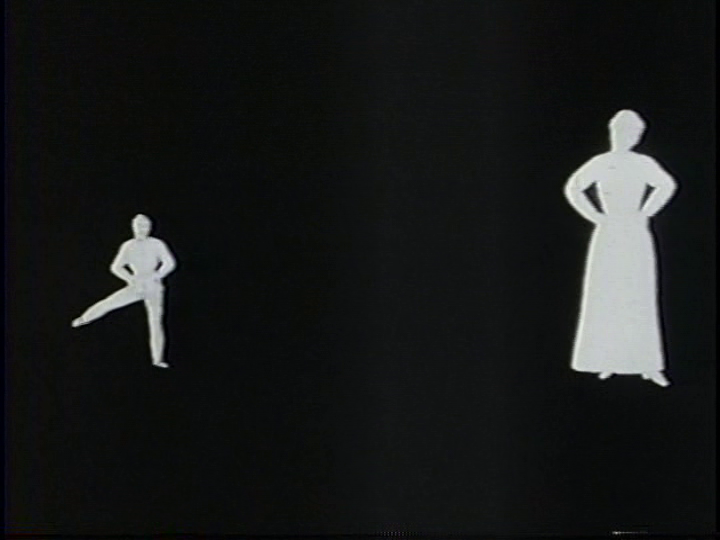
Sitney characterizes this synopsis as “ironic,” but notes that it is accurate in broad terms; he also provides his own interpretation. The main characters are a man and a woman:

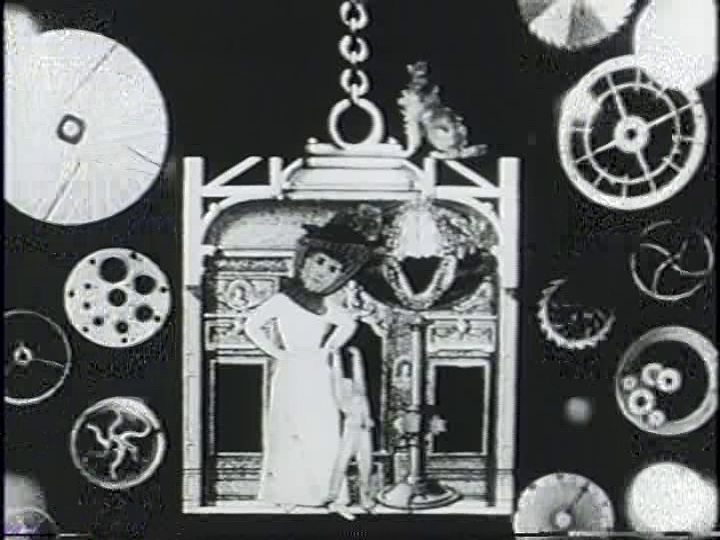
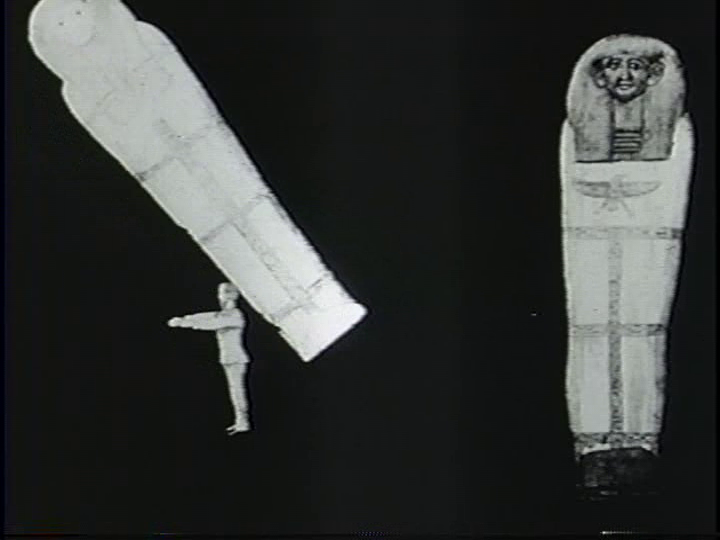
The main characters from Heaven and Earth magic

Like many of the film’s elements, both started life as engravings from a late-nineteenth-century illustrated magazine. Per Sitney, the man is identifiable as a magus by “his continual manipulations in the alchemical context of No. 12, coupled with his almost absolute resistance to change when everything else, including the heroine, is under constant metamorphosis.” As she sits in a “diabolical” dentist’s chair, the magus injects her with a magical potion:

The magus injects the woman with a potion

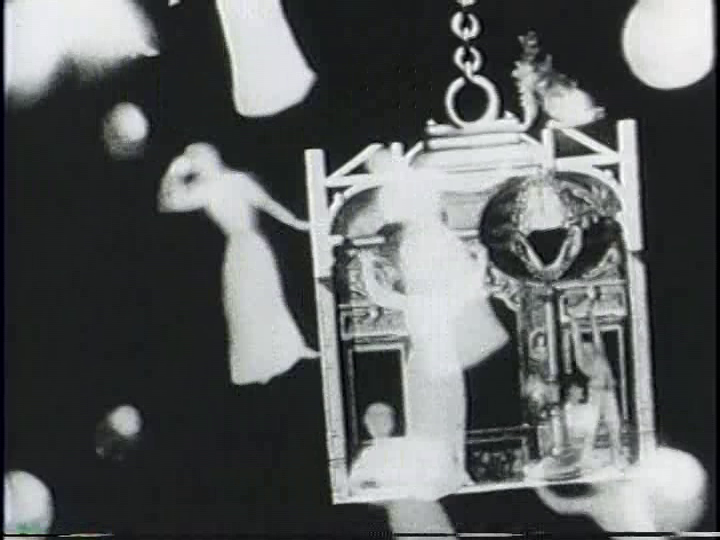
This causes her to rise to heaven, where she becomes fragmented:

The woman becomes fragmented

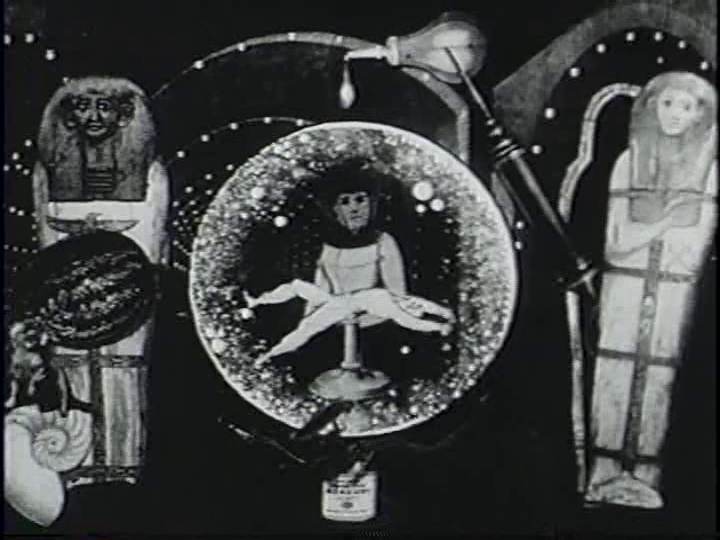
He spends much of the rest of the movie attempting to put her back together again, but “does not succeed until after they are eaten by the giant head of a man (Max Muller), and they are descending to earth in an elevator”:

The head of Max Muller
Descending to earth
The woman reassembled

This narrative absolutely is discernable upon repeat viewings, and Heaven and Earth Magic easily lends itself to a variety of interpretations as well. Scholar Noël Carroll, for instance, reads it as a “mimesis of the drug experience” and a “metaphor of cinema as mind.” The viewer does need to put some effort into it, though, which lends credence to Sitney’s claim that Heaven and Earth Magic is Harry Smith’s “most ambitious and difficult work.” Whether or not you enjoy this film is utterly dependent on how interesting you find its images and musique concrète score. Apparently Smith preferred an original cut which was more than four times as long, but I think it’s just about perfect at 66 minutes. The use of what Carroll calls “literalization” is consistently surprising and hilarious, such as when the theft of the watermelon is accompanied by the sound of water:

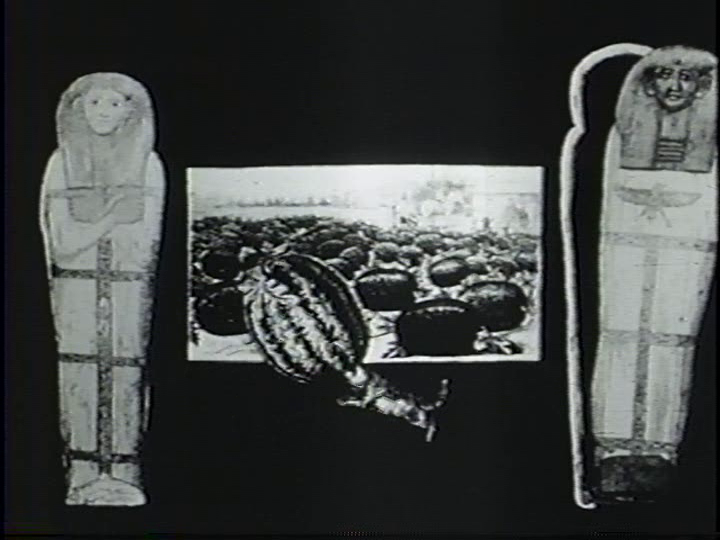
Dog stealing a watermelon

As is the doggedness (pun very much intended) with which these Victorian ladies pursue the thief:

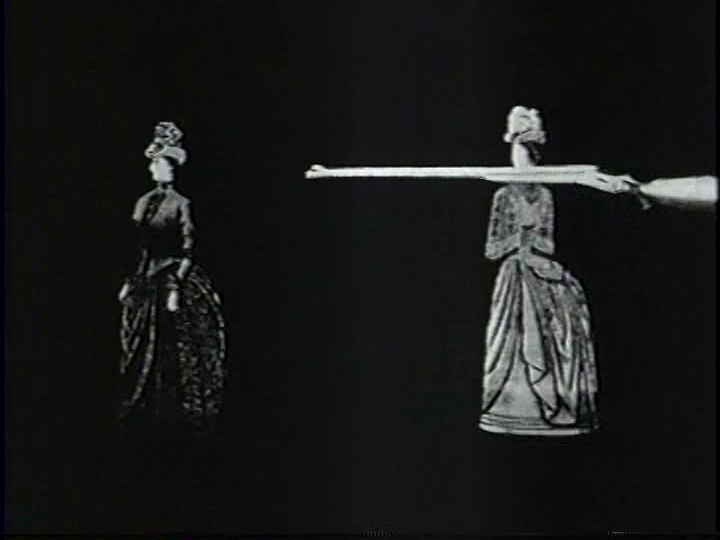
Two Victorian ladies pursue the watermelon thief with a shotgun

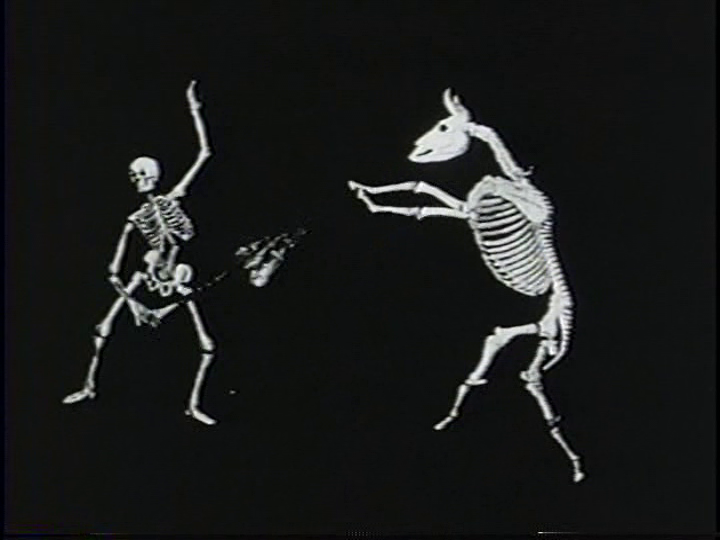
These dancing skeletons remind me of my oldest daughter’s equine phase, which included a brief but intense fascination with a Nature mini-series called “Equus: Story of the Horse”:

A human skeleton and a horse skeleton

I love these wild phantasmic images which appear later in the elevator sequence referenced above:

Ghost like-images of the woman fill the screen

And the symmetry of Heaven and Earth Magic‘s final and first images, which mirror each other, is quite satisfying:

Image from the end of Heaven and Earth Magic
Image from the beginning of the film which mirrors the previous one

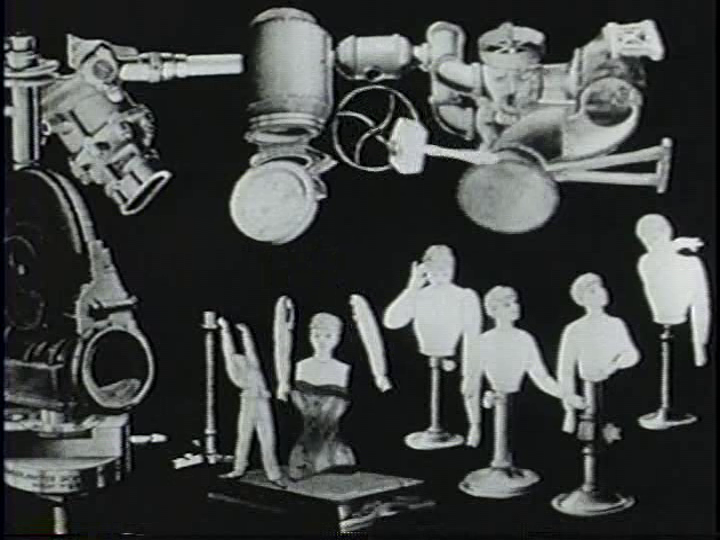
My Loving Wife (who has a graduate degree in art history) observed that Smith is an obvious influence on the animated sequences Terry Gilliam created forMonty Python’s Flying Circus and flagged this scene as her favorite:

The magus assembles busts of human beings

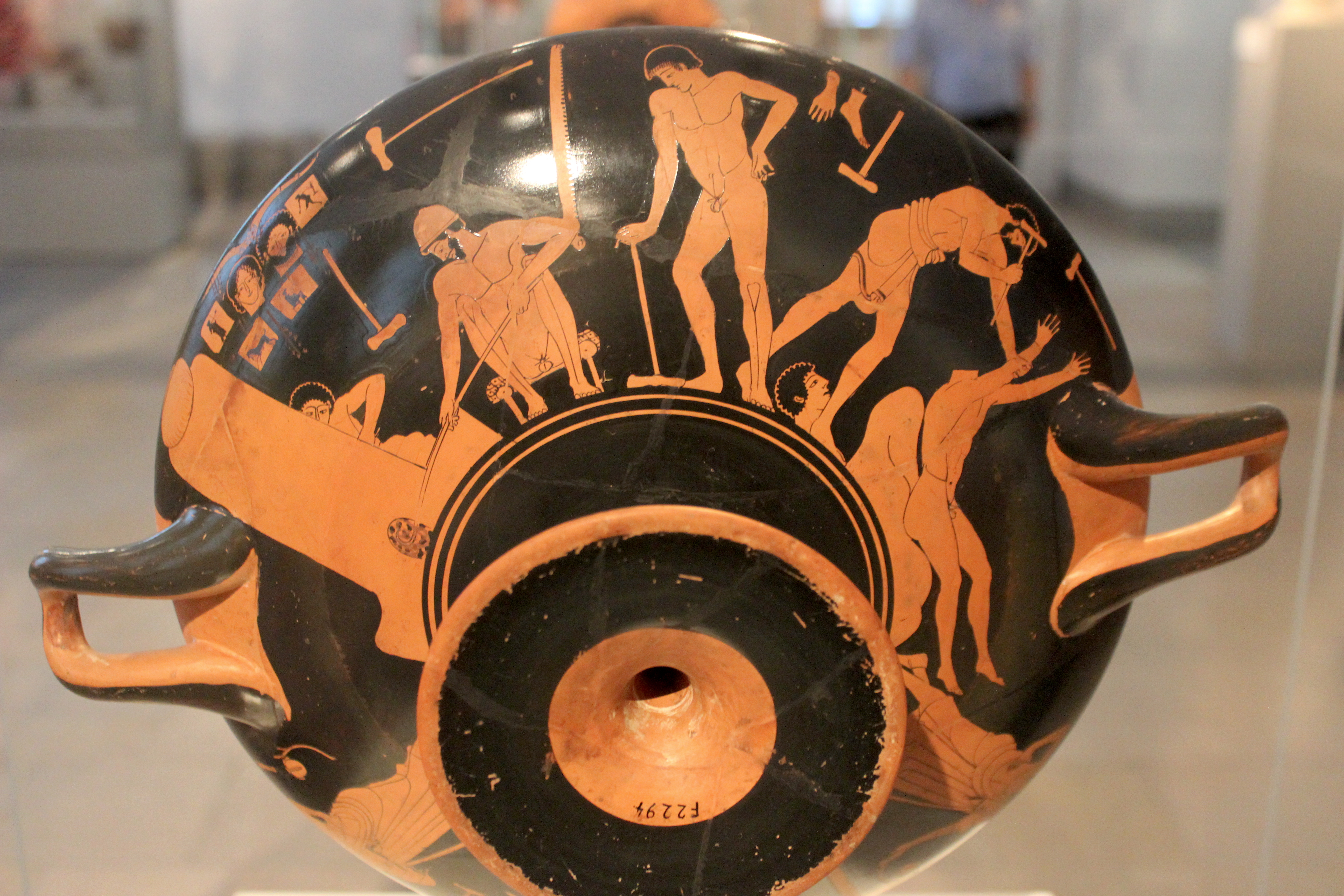
Because it reminded her of the Berlin Foundry Cup, which depicts a Athenian bronze workshop:

Photo by Miguel Hermoso Cuesta and used according to the terms of a CC BY-SA 4.0 license

And this brings us to a second movie. You see, this is an example of red-figure vase painting, and that is precisely what the negative photography in Maya Deren’s The Very Eye of Night has always made me think of! Considering the facts that with its 15-minute runtime, this film plus Heaven and Earth Magic are roughly the same length as a short feature, and that both are frequently lumped together as examples of avant-garde/experimental/underground cinema, this struck me as a perfect opportunity for a double feature. So here’s a picture of my Kino Lorber/Re:Voir DVD release of The Maya Deren Collection:

The Very Eye of Night DVD

Although The Very Eye of Night (like Heaven and Earth Magic) does not appear to be currently on commercial streaming video platforms, some people may have access to it via Kanopy through a license paid for by their local academic or public library.

In an article about the film, scholar Elinor Cleghorn refers to The Very Eye of Night as Maya Deren’s “most technically complex and medium-specific film” and clearly establishes that it was regarded as a major work during its initial screenings in 1959. The titles of recent appreciations by Ok Hee Jeong (“Reflections on Maya Deren’s Forgotten Film, The Very Eye of Night) and Harmony Bench (“Cinematography, choreography and cultural influence: rethinking Maya Deren’s The Very Eye of Night) demonstrate that it is not thought of as such today, which Cleghorn attributes to our friend P. Adams Sitney, who was otherwise a champion of Deren but dismissive of this film, which he felt represented an unwise divergence from “the powerful element of psycho-drama” that he prized in her earlier work.

The Very Eye of Night is similar to Heaven and Earth Magic in that it has an elaborate story that can probably only be followed by viewers who know what to look for. As described by scholar Sarah Keller in her book Maya Deren: Incomplete Control, it begins with an elaborate credit sequence which introduces the characters and “upholds the philosophical, mythical, and/or metaphysical principles espoused by the film as a whole,” as in the case of this image which references an eye with an iris, the yin-and-yang symbol, and Leonardo da Vinci’s “Vitruvian Man”:

Card from The Very Eye of Night's opening credits

It is more than a minute after the final title card before the first dancers (Richard Englund as Uranus and Rosemary Williams as Urania) appear, arcing across a field of stars accompanied by music by Deren’s future husband Teiji Ito:

A male dancer gestures at a woman dancer with her back to him

Doubling/mirroring proliferates throughout the film, not just in the way the dancers are paired with one another:

A male and female dancer with arms clasped

But also through costume elements such as the tights worn by the actors who portray Gemini (Don Freisinger and Richard Sandifer):

Two actors portraying Gemini in black and white tights which mirror each other

And this ribbon:

White woman dancer with a black ribbon

The most enchanting images for me are the ensemble shots:

Ensemble of six dancers

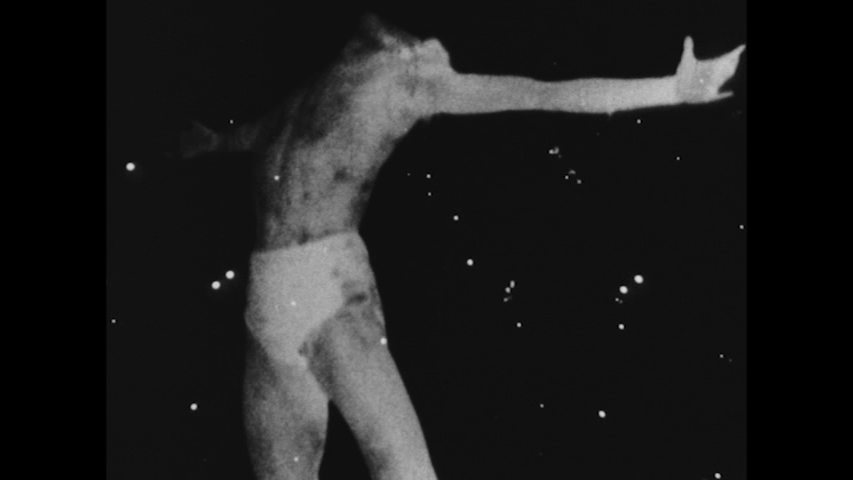
But the entire film has a timeless quality which supports Deren’s statement of purpose which was originally published in Film Culture magazine and reprinted in the book Essential Deren: Collected Writings on Film: “whether or not the viewer formulates it, I am convinced that he will know that I am proposing that day life and night life are as negatives of each other, and that he will feel the presence of Destiny in the imperturbable logics of the night sky and in the irrevocable, interdependent patterns of gravitational orbits.” In an essay called “‘The Eye for Magic’: Maya and Méliès” published in Maya Deren and the American Avant-Garde, scholar Lucy Fischer argues that “for Deren the sky was a site of rapture” and that “just as outer space presents a field in which earthly laws are violated and superseded, so the domain of film dance liberates the body through the magic of cinematography and editing.” I think something of this mindset can be seen in the triumphant gesture which concludes the dancing:

Close up of Uranus with his arms spread wide

It is fair to observe that The Very Eye of Night is not as rigorous as Heaven and Earth Magic, but to my eyes it’s also more beautiful, and I don’t consistently prefer one over the other. Meanwhile, both are perfect fits thematically and visually for a night associated with transformation, mystery, and experimentation. I’d actually suggest watching them in reverse order of how they’re discussed in this post, staring with The Very Eye of Night as an accompaniment to your Corpse Reviver #2 and saving Heaven and Earth Magic for after trick-or-treating is over. You’ll probably be hungry, which brings me to my final recommendation: this recipe for beef chili with beans. Author Grant Achatz notes that it’s a modified version of the one his mother made for him and his cousins every Halloween. We gave it a try a couple of years ago and have been making it annually ever since. Although Achatz says he ate it at the beginning of the evening “as a way to counteract the sugar buzz to come,” we prefer to save it for after we return home both as a way to warm up from a usually cold (and sometimes rainy) night outside and a strategy for breaking up our kids’ candy consumption. It’s hard to make chili look good, but here’s a picture of the pot which is now hanging out in our freezer awaiting its big night anyway:

Pot of chili

Definitely don’t skimp on the ancho and pasilla powders, which you can easily make yourself as far in advance as you want by toasting seeded and stemmed dried chilies, letting them cool, and then grinding them. We usually grind our own beef as well, but that’s nowhere near as essential. The recipe itself doesn’t mention them, but serving them with sour cream and cilantro as shown in the picture in Food & Wine is a great move.

And there you have it, a ready-made itinerary for your upcoming All Hallow’s Eve festivities!

Cheers!

All original photographs in this post are by Marion Penning, aka My Loving Wife. Links to all of the entries in this series can be found here.
Ithaca Film Journal: 9/29/23

What I’m Seeing This Week: Cornell Cinema kicks off Ithaca’s 12th annual Silent Movie Month on Sunday with a screening of The Toll of the Sea accompanied by an “original, live experimental score” by local ensemble Cloud Chamber Orchestra. This is part of a series that they are presenting in partnership with Cinemapolis and the Wharton Studio Museum called “From Silent Film Star to American Icon: Celebrating Anna May Wong.” In addition to featuring Wong’s first starring roll, Cornell Cinema’s website notes that The Toll of the Sea is also the first-ever two-strip Technicolor film. With a runtime of just 48 minutes, this will only require giving up a small portion of my football Sunday and even less than usual with the Falcons and Jaguars playing in London at 9:30am Eastern, which seems well worth it!

Also in Theaters: A restored version of director Jonathan Demme’s Talking Heads concert film Stop Making Sense opens at Cinemapolis on Friday to commemorate the film’s 40th anniversary. Oppenheimer enters the final week of its run there and probably the Regal Ithaca Mall (where it’s down to just one screening a day) as well, although it will be coming to Cornell Cinema soon. As reported by The Ithaca Voice, a documentary with local ties called Common Ground will screen at Cinemapolis on Sunday followed by a “talk-back” event.

Home Video: Critic Farran Smith Nehme aka the Self-Style Siren recently tweeted a link to an updated version of an old essay about the Joan Fontaine vehicle Ivy, which is now available on the Criterion Channel as part of their “Noir by Gaslight” series. It contains some striking cinematography by Russell Metty, breathtakingly perfect costume design by Orry-Kelly, effective use of music by Daniele Amfitheatrof, and quite possibly my favorite performance by Fontaine that I’ve seen so far.

Previous “Ithaca Film Journal” posts can be found here.

Ithaca Film Journal: 9/22/23

What I’m Seeing This Week: Our Body would be an easy choice for me, but unfortunately neither of the two showtimes at Cornell Cinema is compatible with my schedule. Meanwhile, My Loving Wife and I enjoyed the first two Hercule Poirot films directed by Kenneth Branagh and she has made it clear that she does not want me to see A Haunting in Venice, which is at both Cinemapolis and the Regal Ithaca Mall, without her. So it transpires that I’m going to revisit In the Mood for Love, which is regularly cited as one of the best films of the millennium, but which I’ve never even thought of as one of my favorite movies directed by Wong Kar-Wai. Considering that Cornell Cinema is showing a restored 35mm print, it seems quite possible that I will look back on my calendar mishegoss as a blessing in disguise.

Also in Theaters: I’m not sure why Jawan, which continues its run at the Regal this week, hasn’t gotten more attention stateside. Our nation has turned its lonely eyes to Tom Cruise to save cinema, but he can’t do it on his own–after all, even Joltin’ Joe DiMaggio shared the film with eight other Yankees! Shah Rukh Khan is a Star and this is a Movie. So is Oppenheimer, which continues its runs at Cinemapolis and the Regal this week and which remains my pick for best new film of 2023 for now. If you just don’t have nearly three hours to spare, I recommend Bottoms, which is playing the same two theaters and clocks in at a clip 90 minutes. If you’re in the mood for repertory fare, Interstellar features an unforgettable lunar rover chase scene and screens at Cornell Cinema tomorrow.

Home Video: Critic Jason Bailey helpfully notes that Annihilation is leaving Netflix on September 29. I saw this and Twin Peaks: The Return for the first time during lockdown, and they will forever be linked in my mind as texts which capture the relentlessly haunting feeling that the call you dread receiving may be coming from INSIDE YOUR OWN BODY. If you’re looking for something lighter, High Tension, which is now available on the Criterion Channel as part of their “Directed by Allan Dwan” series, contains a nice bit of business with a piano.

Previous “Ithaca Film Journal” posts can be found here.

Ithaca Film Journal: 9/15/23

What I’m Seeing This Week: There aren’t a ton of reviews of the Indian action spectacle Jawan, which is now playing the Regal Ithaca Mall, floating around on the movie publications I frequent, but I’m intrigued by the ones that are.

Also in Theaters: It’s a good week for family-friendly fare in Ithaca! You can see Singin’ in the Rain, a mortal lock for any Top 25 Movies of All Time I might ever compose, for just $2 at Cinemapolis or $10 for a “family group” of five or more on Sunday as part of their Family Classics Picture Show. Meanwhile, Cornell Cinema is screening Mary Poppins on Saturday and Sunday as part of their 100 Years of Disney series. I took my then four- and six-year old daughters to see this film at Cinemapolis last year with, and while it was a bit long for them, they loved it. Cornell Cinema is also showing Elemental, which at least for the time being remains one of my favorite movies of the year, on Monday. More mature moviegoers who haven’t already seen it should prioritize Sweet Sweetback’s Baadasssss Song, which screens at Cornell Cinema tonight as part of their Cult Classics series.

Home Video: As a virtually uncoachable (for reasons of, er, let’s say “youthful overconfidence”) former cross country runner, I’m puzzled that it took me until last week to finally watch The Loneliness of the Long Distance Runner! It’s now screening on WatchTCM with a subscription, and although it doesn’t quite measure up to its fellow British “kitchen sink” realist film This Sporting Life (which is currently available on the Criterion Channel with a subscription), I like it for a lot of the same reasons. Sports fans far too often forget that there are real-life human beings under the laundry they root for, but these movies are reminders that when the game is over, the athletes who played in them often have to go back to work or under the knife to treat their latest injury. And whether you’re an anonymous amateur or Aaron Rodgers, the latter hurts like hell.

Previous “Ithaca Film Journal” posts can be found here.

Ithaca Film Journal: 9/8/23

What I’m Seeing This Week: I finally caught up with Shiva Baby, the harrowing first full-length collaboration between director Emma Seligman and star Rachel Sennott, on Max and am now excited to see their follow-up effort Bottoms at Cinemapolis!

Also in Theaters: I saw Blue Jean, which plays Cornell Cinema tonight and Monday, at the Gene Siskel Film Center this summer when I was in Chicago for a conference and recommend it for Rosey McEwan’s terrific performance in the lead role and as a generally impressive debut feature by director Georgia Oakley. There’s a John Carpenter film at the Regal Ithaca Mall for the second week in a row, which is awesome! This time they’re honoring the 40th anniversary of Christine with screenings on Wednesday and Friday. That’s also the only place in town where you can see the new Shah Rukh Khan vehicle Jawan. Finally, Oldboy, which is even more epically demented than I remembered, remains at Cinemapolis until at least Thursday.

Home Video: Last week I recommended two films directed by Shōhei Imamura, but was remiss in not mentioning a third: with Oppenheimer still in theaters, now is a perfect time to watch Black Rain, which Jonathan Rosenbaum called “one of the few movies that’s addressed Hiroshima without blinking.” It is now available on Mubi with a subscription as part of a double feature with The Ballad of Narayama. With director Yorgos Lanthimos’s Poor Things earning an eight-minute standing ovation at the Venice Film Festival, I also recommended checking out 2017 Oscar nominee (for Best Original Screenplay) The Lobster on Max with a subscription.

Previous “Ithaca Film Journal” posts can be found here.