Professor Bill Judson must have told the story recounted by Jonas Mekas in the anthology Stan Brakhage: Filmmaker when he screened Window Water Baby Moving for the Experimental Cinema class I took with him at the University of Pittsburgh in the early 2000s, because for two decades it was part and parcel of my memory of the film:
On December of 1959 a screening took place at the Living Theater, corner of Fourteenth Street and Sixth Avenue, New York City. A program of five or six films was projected. One of the films was Stan Brakhage’s New York premiere of Window Water Baby Moving. Stan was the projectionist for the evening. After the screening of Stan’s film, Maya Deren came before the audience to declare, very emphatically, that giving birth was a very “private matter,” and it shouldn’t ever be made into a public affair. “Even the animals, when they give birth, retreat into a secret place,” said Maya.
I don’t recall whether he or one of my classmates evoked the idea of the “holy of holies” then, if I picked it up somewhere else, or if I came up with it on my own, but that’s the phrase I always associated with this movie until just last year when I revisited it for the first time in decades. With two cut umbilical cords under my belt, Window Water Baby Moving no longer felt like the kind of “secret place” of Deren’s description; another movie included in the Criterion Collection’s By Brakhage Blu-ray/DVD box set that I watched for the first time the following day definitely did, though. Here’s what I said about The Act of Seeing with One’s Own Eyes on Letterboxd after that viewing:
An even more rigorous cinematic rendering of the holy of holies than Window Water Baby Moving. This is a humble work, and director Stan Brakhage casts himself as neither high priest nor the one who tears the temple veil–he is, rather, just the person holding the camera. Extraordinary.
In this review I am, of course, speaking metaphorically. As defined by David P. Wright in The Anchor Yale Bible Dictionary, holiness in the Old Testament “is a positive cultic or moral condition of God, people, things, places, and time,” and as biblical scholar Menahem Haran writes in his book Temples and Temple-Service in Ancient Israel, “there is a gradation in the taboo of the ritual circles” associated with holy places like the ancient Israelites’ tabernacle which “is least strong when applied to the court and becomes progressively more powerful as one proceeds inside the tabernacle, until the area which is taboo even for the priests themselves is reached.”
Haran further notes that “a non-priest may not even look at any of the articles of furniture within the tabernacle,” which are “concealed behind curtains.” While Deren’s comments about Window Water Baby Moving indicate that she felt that childbirth was similarly best kept veiled, my own experiences suggest that 21st-century mainstream American society disagrees. The autopsy room where The Act of Seeing is set, however, remains what Hollis Frampton calls “one of the forbidden, terrific locations of our culture” in his oft-cited Film-Makers’ Coop program notes for it.
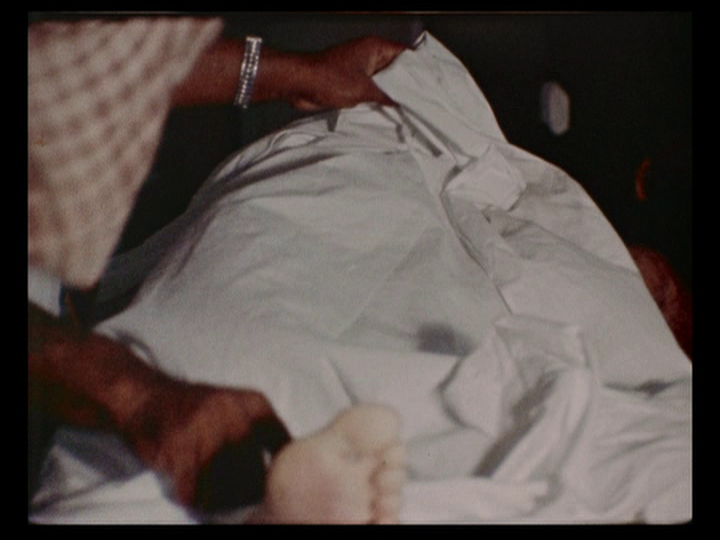
Frampton celebrates Brakhage’s work for “staring with perfect compassion where we can scarcely bear to glance,” and at the simplest level this is what I appreciate most about it as well, but those willing to steel their gaze will find that my religious analogy holds up well to closer scrutiny. As Bart Testa argues in his chapter on The Act of Seeing in the book Documenting the Documentary, “this is not a film about how human, or animal, bodies are abused or disrespected under autopsy; on the contrary, the dismemberment by the coroners is treated in this film as a serious and respectful, if also mysterious, ritual.” He identifies three basic compositional devices that achieve this effect, which he calls “solemnity”: veiling, juxtaposition, and camera movement.
Veiling typically takes the form of the morgue workers whom Brakhage is documenting covering bodies with white cloths:
And blocking screen space with their lab coats, such as when the first incision is made about a third of the way through The Act of Seeing‘s 32-minute runtime:
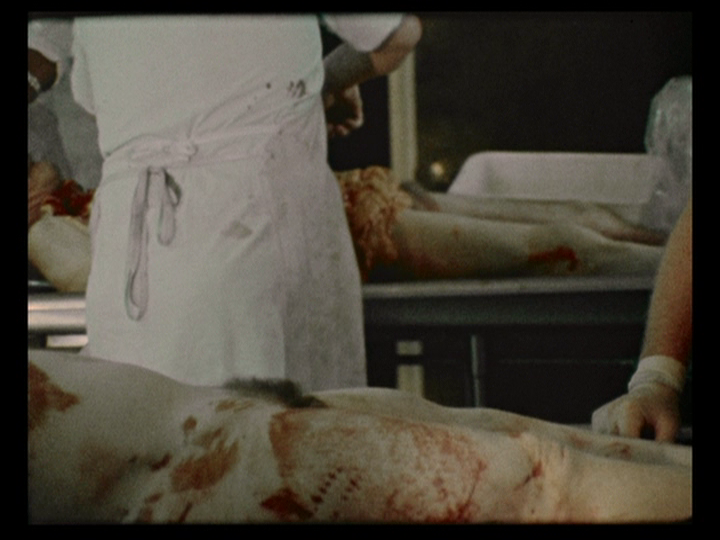
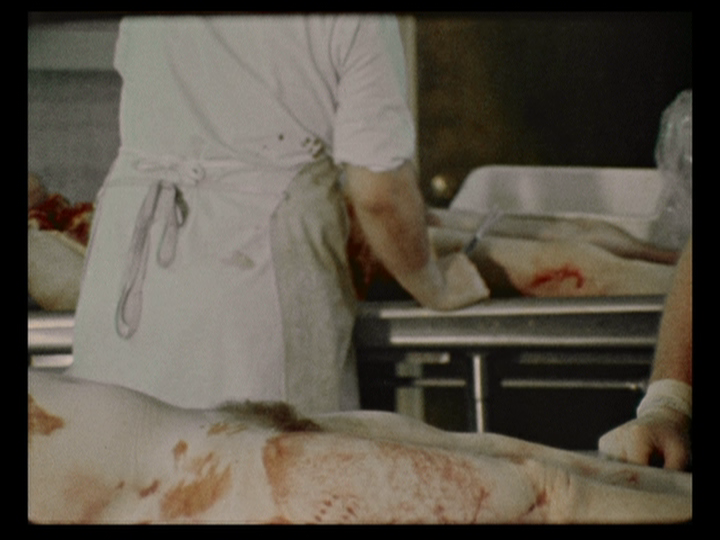
This device also helps to establish a color pattern, which Testa calls “a red/white antinomy.” R. Bruce Elder observes the same thing in his book The Films of Stan Brakhage in the American Tradition of Ezra Pound, Gertrude Stein, and Charles Olson, referring to an alternation “between blue-white and various shades of red” that he notes “parallels the modulation between more distanced images and more engaging images.”
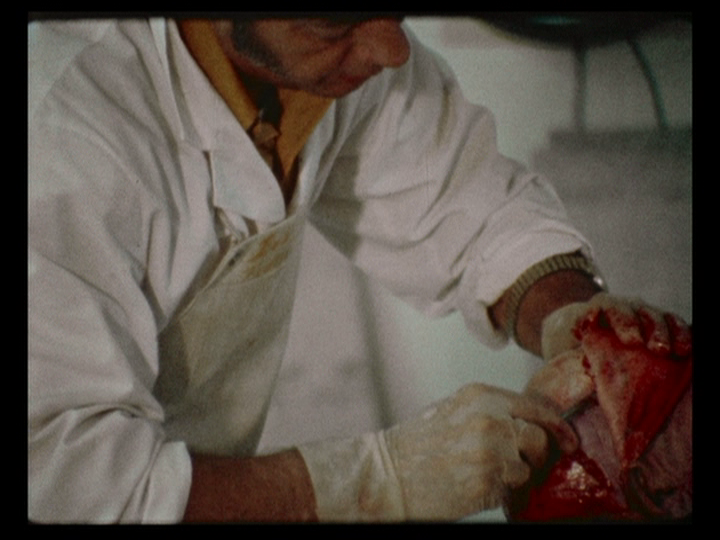
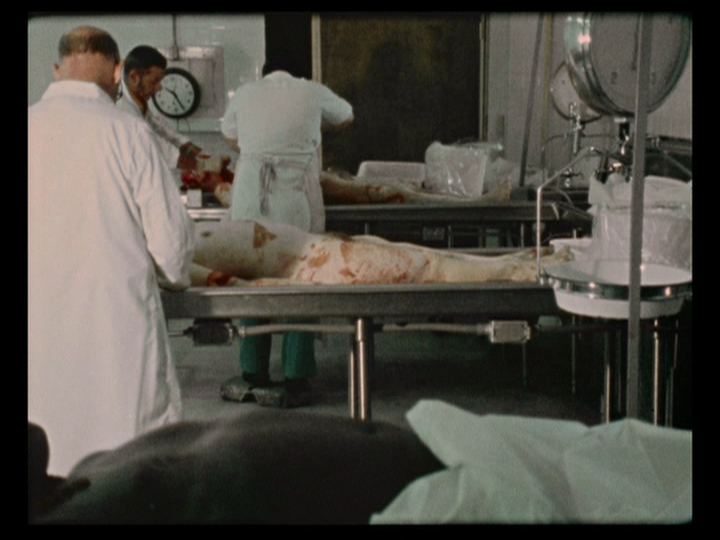
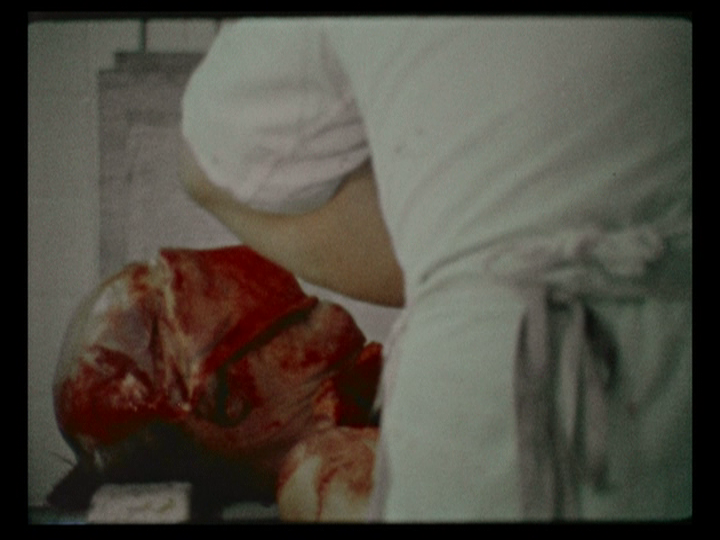
Interestingly, this echoes the blue, purple, and scarlet curtain that according to Exodus 26:31 separated the holy of holies from the rest of the tabernacle.
Testa’s second and third techniques, juxtaposition and camera movement, also parallel arguments Elder makes about The Act of Seeing. As observed by the former, Brakhage establishes a manner for depicting the morgue workers in his opening shots: “they are represented by synecdoche–their hands, arms, and hips–almost never their faces.”
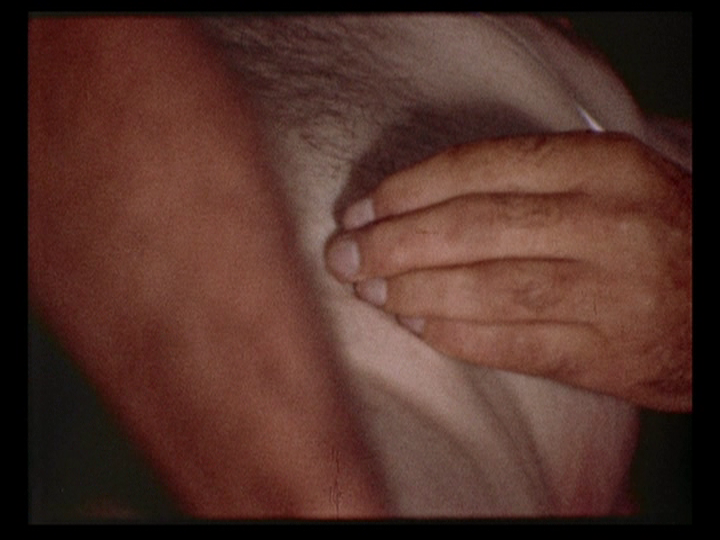
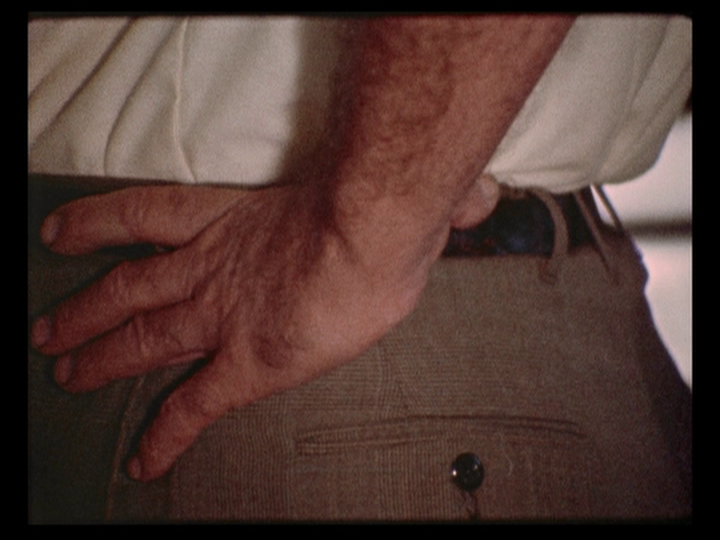
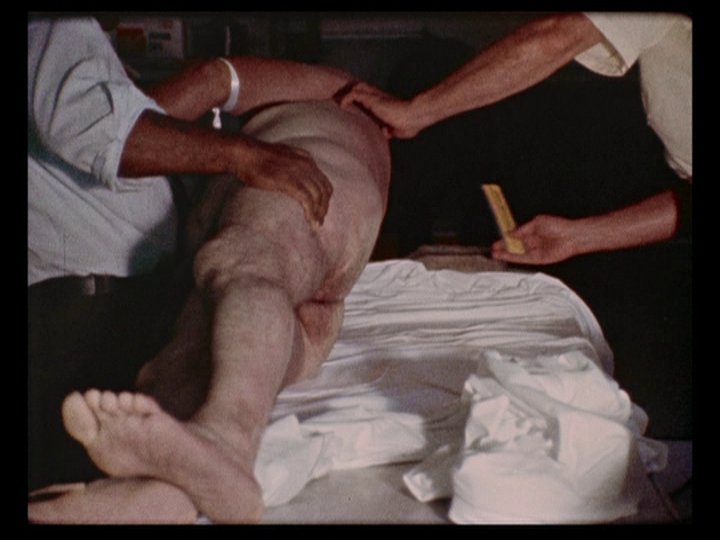
Which, per Elder, is an example of a distancing device he terms “motivic conversion” whereby Brakhage uses “visual rhymes” to lift our attention from what we are seeing and redirect it towards The Act of Seeing‘s construction. This restrained editing strategy is balanced out by emotional cinematography which, as described by Testa, sometimes conspicuously withdraws from the film’s more graphic images, and which Elder suggests trembles slightly and in doing so “embodies the pulse of Brakhage’s body as he holds it” in a reminder of life as he and we contemplate death. The resulting mood is one of reverence.
If we translate Maya Deren’s objections to Window Water Baby Moving into the terms I’m using to discuss The Act of Seeing, her primary concern would seem to be that, as Wright explains, “sanctuaries or holy places are desecrated by encroachment of those unauthorized.” This is serious business because, in the words of Haran, “complete avoidance of all contact with this holiness is an absolute necessity, for anyone who contracts it is liable to meet immediate death at the hands of heaven.” Of course, a cynic might contend that the consequence of this taboo Haran notes a page earlier is in fact its whole point: “thus the tabernacle and most of the court become an enclosed domain, inaccessible to the common people.”
Deren was presumably trying to preserve the mysteries of childbirth because she saw them as a source of feminine power. Window Water Baby Moving isn’t the subject of this post, so I’m not going to adjudicate her claim, but she raises a good question to ask about The Act of Seeing: who benefits from keeping us in fear of dying? To use a term that would enter the national vernacular in the decade following that 1959 screening, is it not the patriarchy’s parent corporation The Man? That would be an argument for toughing out apprehensiveness or revulsion, though, and those aren’t actually the feelings I have when I watch this movie.
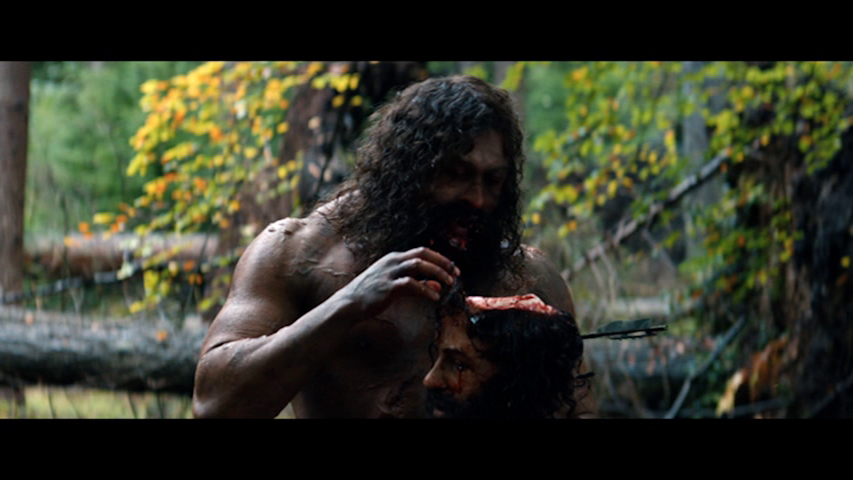
S. Brent Plate notes in his book Religion and Film that “because a majority of us moderns have seen hundreds, even thousands, more fictional, represented deaths than actual deaths, our eyes have been trained to see death in particular ways.” This is certainly true for me, and it’s telling that although I didn’t think twice about including a screengrab from 28 Years Later: The Bone Temple of Chi Lewis-Parry’s Samson eating human brains out of a decapitated head in my recent “A Canticle for Dr. Kelson” blog post:
I thought long and hard before deciding to include images from The Act of Seeing like the ones which follow that depict a skull being cut open and its contents removed:
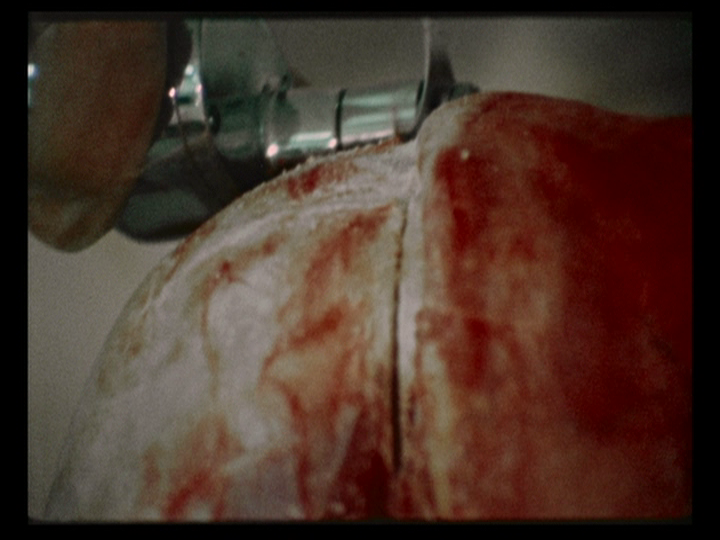
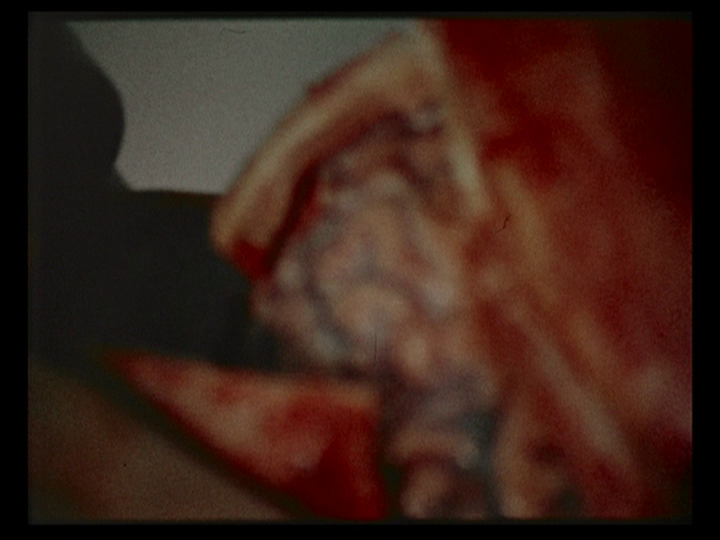
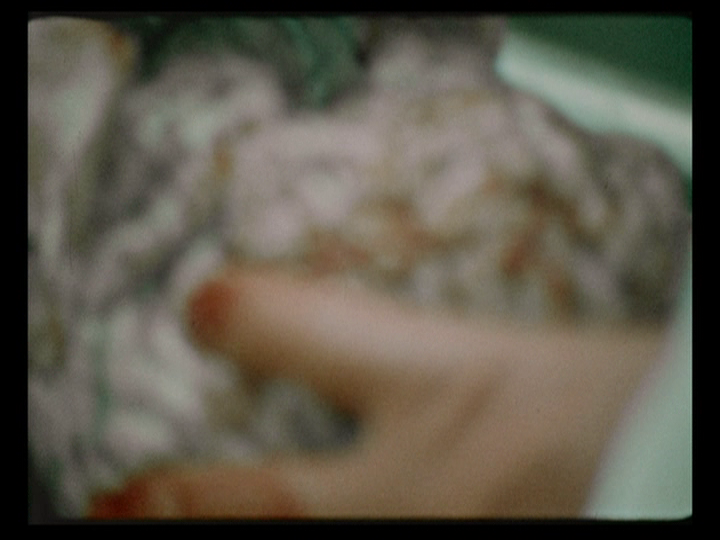
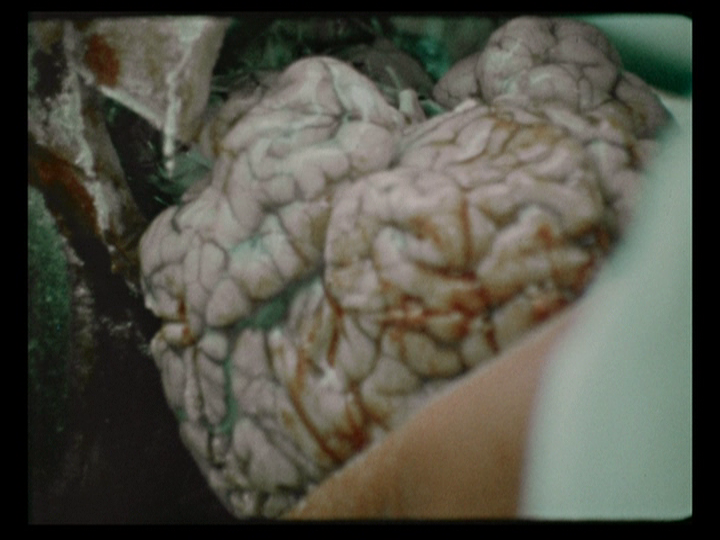
But how can I not when they’re central to what makes the film a masterpiece? Writing about the same sequence, Plate suggests that “Brakhage’s camera dissects the dissection process, unveiling something else, not unlike how anthropologist Michael Taussig considers the power of ‘defacement’ as a mode of understanding how the despoiling of something beautiful and/or sacred can in itself become mysterious and thus reaffirm the sacred.” And so:
The body is literally defaced, and through such activity the mysteries of the human brain–this soft spongy stuff responsible for tremendous acts of creation, invention, and destruction–is [sic] revealed. Even with all the advances of science we really know little about how this bodily substance can produce activity in the world. This gap in knowledge, then, between inhabited body and knowledge about that body, and through the process of defacement, creates a curious magic.
In other words, to reclaim an overused phrase, this sequence and the movie it is contained within are awe-inspiring.
Daniel M. Gurtner writes in the introduction to his book The Torn Veil that the most common modern interpretation of the eponymous event holds that it’s important because, quoting John Calvin, “it was then that Christ ‘opened for us the way to the celestial Sanctuary, that we should no longer stand away in the courtyard, but freely advance into the sight of God.’” Returning to this idea in his conclusion, he notes that this “meshes nicely with Matthew’s unique portrayal of the atoning significance of Jesus’ death,” which worked by “removing the prohibition of visual accessibility to God.”
To Frampton, the autopsy room is a place where “life is cherished” that “exists to affirm that no one of us may die without our knowing exactly why,” and The Act of Seeing with One’s Own Eyes concludes with the individual he mentions in his next sentence speaking into a dictaphone. “All of us,” writes Frampton, “in the person of the coroner, must see that, for ourselves, with our own eyes.” It’s significant that while said person is introduced with a medium long shot that cuts to a rare close-up showing his face:
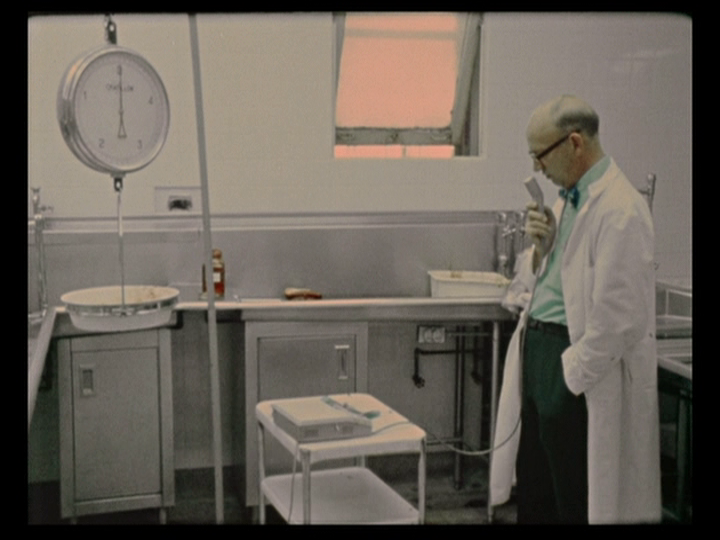
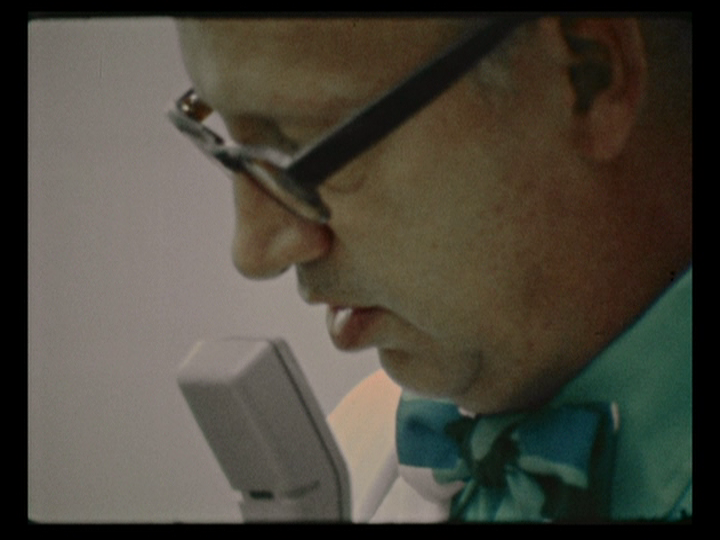
The camera then pans down and, in a final act of juxtaposition/motivic conversion, the film ends on a shot of his hands:
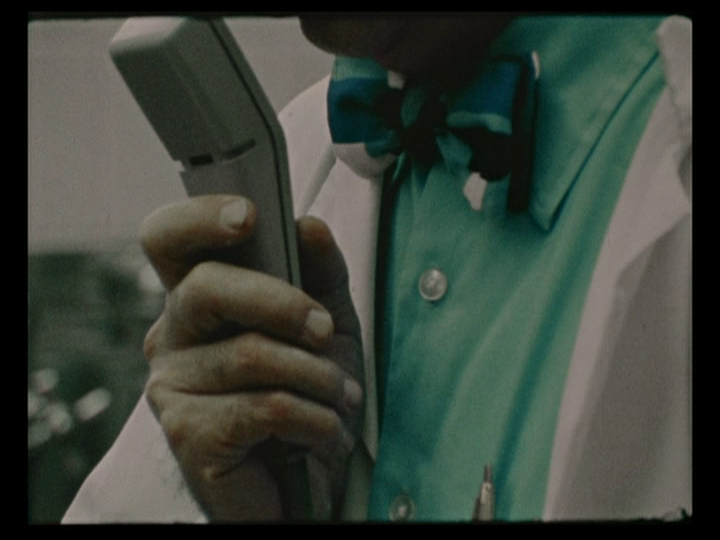
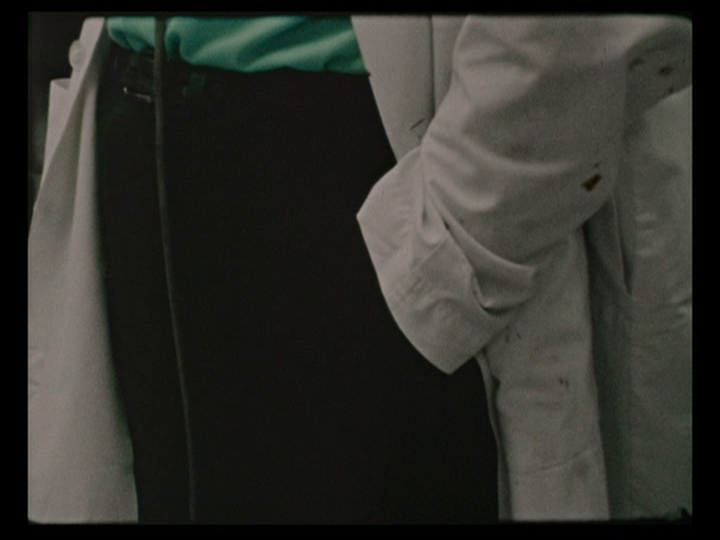
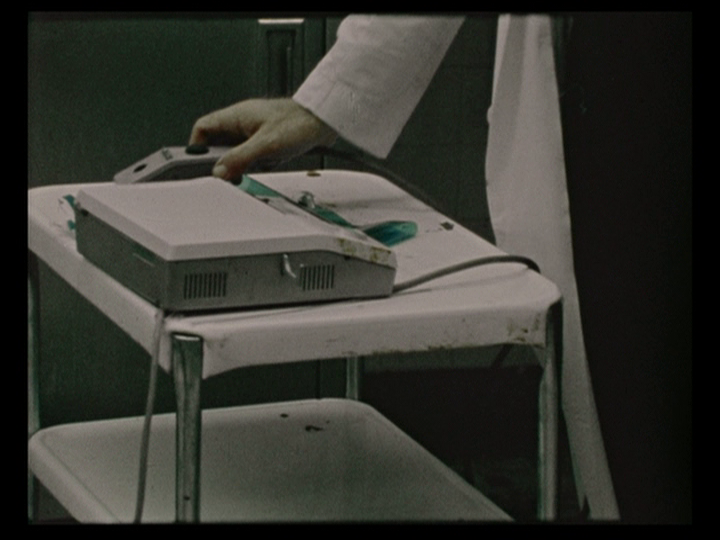
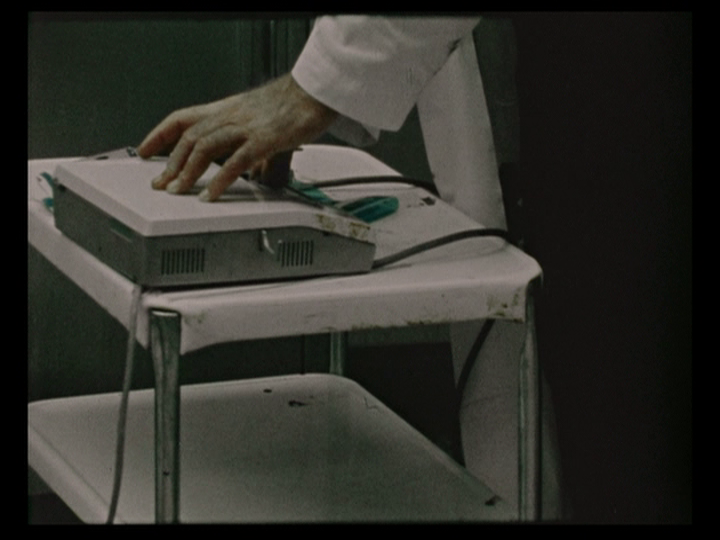
Fred Camper writes in his Criterion Collection liner notes that “Brakhage was required not to show any identifiable faces” when making The Act of Seeing, but this must have applied only to the dead. Brakhage closes with an image of hands anyway because throughout the film they are the appendages that have made possible the titular act of seeing: the hands of the morgue workers which parted the curtains of flesh, the hands of the coroner who records what they found, and the hands that held the camera that gave our eyes the ability to look within, confront our mortality, and walk away more consciously alive than ever.


