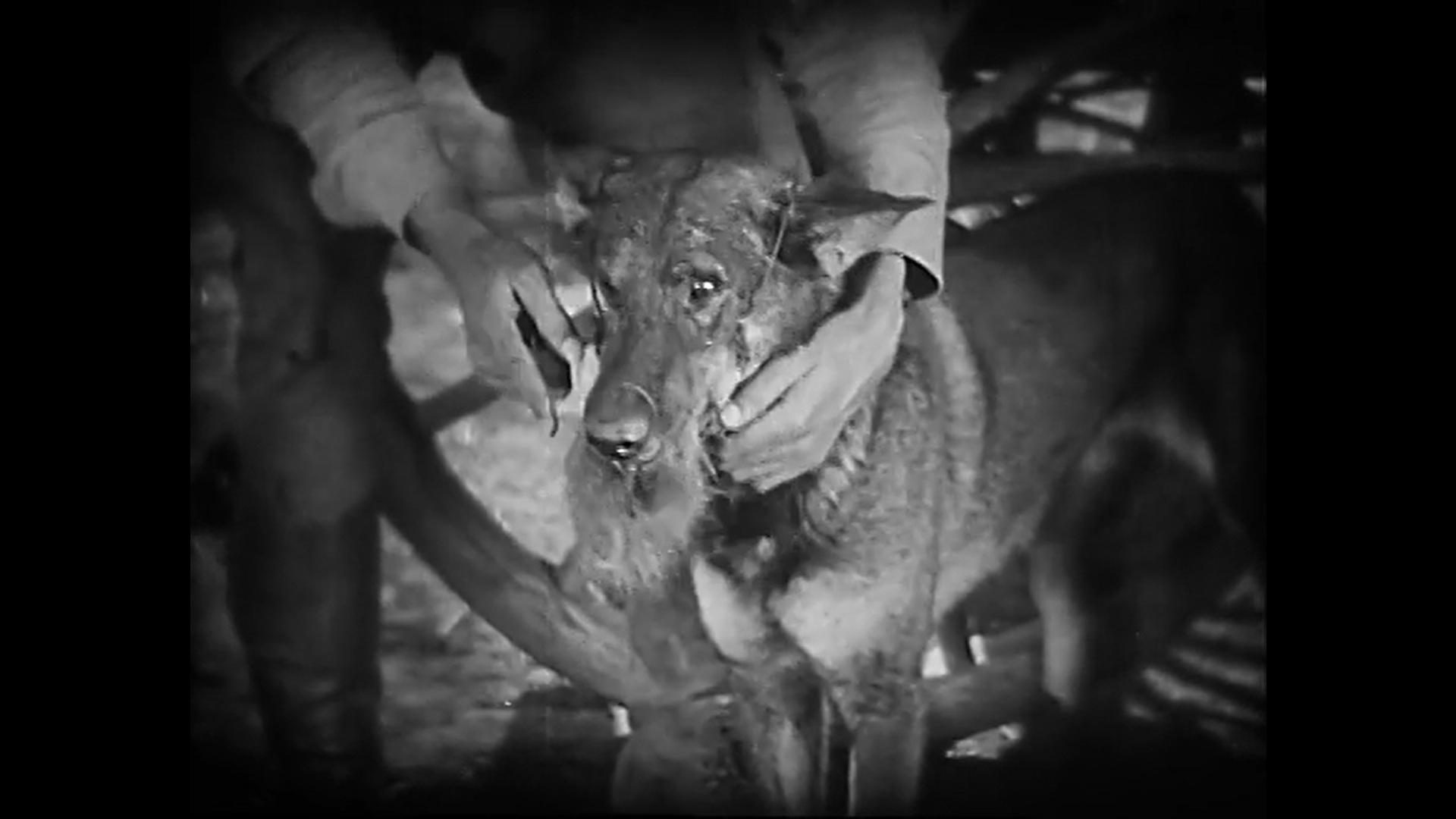
When I interviewed Finger Lakes Environmental Film Festival Co-Directors Michael Richardson and Andrew Utterson last month, they explained that their ideal FLEFF theme “will resonate with a range of different films, but not be too determining of how we think about them.” It perhaps therefore shouldn’t be a surprise that only two of the 12 movies I saw at this year’s edition directly address “Migrations” in the most obvious sense of animals or people moving from one geographical location to another. Appropriately for an opener, that’s how Clash of the Wolves, a Rin Tin Tin vehicle (my first) from 1925 accompanied by event mainstays L’il Anne and Hot Cayenne, begins: the famous canine’s Lobo leads his wolf pack down from forest fire-ravaged mountains to the desert, where borax prospector Dave Weston (Charles Farrell) earns his loyalty by removing a cactus thorn from his paw. Hijinks ensue when Dave brings Lobo, who is known throughout the region, to town in a bizarrely effective beard disguise that makes him look like Dr. Fido Freud:
Per Utterson, “connecting the early 20th century with debates that resonate 100 or so years later” is one of the reasons FLEFF continues to include silent films in their programming each year, and the intersections between Clash and winner of the Grand Jury Prize for Best Documentary at Sundance 2026 Nuisance Bear are a great example of what this looks like in practice. Co-directed by hometown hero Jack Weisman, the latter drew one of the biggest crowds of any event I attended, and just as the fest’s first audience applauded when Lobo’s pack mauled Pat Hartigan’s villain in the final reel, these folks were audibly Team Ursine. But while the box office draw of animals may not have changed much in the past hundred years, the tone of the narratives they appear in definitely has, and where the earlier picture celebrates Dave for taming Lobo, Bear‘s subject is the dangers of disrupting the natural order. Both films are also noteworthy for their cinematography: intro speaker Thomas Bohn described the Joshua Tree National Park locations as something that set Clash apart from the backlot and studio sets the major studios favored at the time, while the best thing about Bear are its horizon line widescreen compositions and the way it zooms out to expose the “human infrastructure” deliberately hidden by other arctic photographers.
Utterson’s “historical vectors” are also at work in the way Seeds, which won the prize for Best Documentary at Sundance last year, can be read as having the same relationship to restored 1978 fellow black and white stunner Northern Lights as the antiwar classic Come and See has to Agnieszka Holland’s 2024 movie Green Border. Just as the descendants of Belarusians victimized by the Nazis went on to use Middle Eastern refugees as sacrificial pawns in a chess match against the European Union a few generations later, so too will the sons and daughters of the Scandinavian immigrants in Lights become the tormenters of Seeds‘ Southern Black family farmers who stayed behind during the Great Migration. The plainspoken lessons about economic power structures from Robert Behling’s labor organizer Ray Sorensen must have rubbed off in more ways than one!
My biggest disappointment was Our Land for reasons I detailed on Letterboxd, but mainly just because it pales in comparison to director Lucrecia Martel’s fiction films. The Blue Trail didn’t quite live up to expectations raised by its status as the festival’s closer either, although the conclusion reminiscent of Abe Simpson’s reading of Rudyard Kipling’s “If—” was a cheerful note to go out on. Mare’s Nest also brought a classic Simpsons episode to mind, but its post-apocalyptic world populated only by children is more comically uncanny than Trail‘s “Logan’s Run with a walker” take on the end times it often feels like we’re living through the beginning of. Dessert is fine and good, but dark resonates more with the anxious absurdity of the present moment than an optimistic ending.
While nothing I mentioned in the previous paragraph has more than a tenuous connection to the theme, that also describes the two titles in this year’s lineup that I enjoyed most. The bigger stretch was Faust, a rewatch for me which was accompanied by an excellent (portentous at the beginning and appropriately big throughout) live score by Cloud Chamber Orchestra, another friend of the festival. Richardson’s introduction identified plagues as one throughline from the medieval milieu of the setting to the 1920s when it was shot to today, and I suppose you could argue that Faust’s personal growth is a migration of sorts? Or not. But who cares? The glint in Faust’s eye early and off the ring he gives Gretchen later rank among the most ingenious uses of lighting in all of cinema, and it was awesome to bask in their big screen splendor. Meanwhile, my favorite new movie, The Love That Remains, is an Icelandic “Break Up in a Small Town” that features a flock of migrating geese responsible for a morbidly hilarious plane crash, an artist who works in weather and rust, and striking seasonal landscapes, but is far more Scenes from a Marriage than Koyaanisqatsi.
One highlight among the more traditional “environmental film” fare was the ethnographic agitprop The Falling Sky. It occasionally comes across a bit too much like Twin Peaks: The Return: The Documentary, but opens with an incredible reset-your-clock long take and a dramatic turn to the second person that reminded me of In girum imus nocte et consumimur igni, which I saw at Cinemapolis a week before the festival started. Silent Friend advocates even more effectively for thinking and feeling on a slower timeframe by grounding its three era-spanning narratives set at a German university (shades of Sound of Falling) in the perspective of a giant gingko tree in its botanical garden. But the biggest surprise at all was A Life Illuminated. While it touches all the biodoc bases, the movie is interestingly much more about Dr. Edith Widder’s work than her life and as the father of two girls whose creative ambitions often outpace their patience, I appreciate the way it presents failure as a disappointing but unavoidable and even necessary part of scientific progress. It’s also a wonder to see how far deep-sea marine biology has come during Widder’s lifetime, a tale initially told through archival footage that graduates first to grainy but beautiful black-and-white recordings of bioluminescence which could stand alone as an awesome experimental film, then to astonishingly beautiful capstone original images that capture one of her crowning achievements.
I didn’t originally include A Life Illuminated on my viewing schedule, and my biggest takeaway from 2026 is that it’s safe to trust the good people programming it and take a flyer on things! This edition is the first one I’ve gone whole hog on since moving to Ithaca, and more movies also meant more fun connections with the non-FLEFF films playing local theaters at the same time like Alpha, another diary of a plague year, and the kiddie and grown-up sci fi adventure stories about suddenly inhospitable ecosystems Hoppers and Project Hail Mary. Here’s to doing it next year when the festival turns 30!
Previous film festival dispatches can be found here.


