Happy Canada Day! This month’s post honors that country’s first citizen of cinema, David Cronenberg, and its de facto national cocktail, the Caesar. To begin with the former, here’s a picture of my Neon DVD copy of Crimes of the Future, one of *my* best movies of the 21st century so far:

It’s also currently available on Hulu with a subscription and via a number of other platforms for a rental fee, and some people may have access to it through Kanopy via a license paid for by their local academic or public library as well.
Everyone in my household except me is a Canadian citizen and we spend a lot of time north of the border, so Caesars are a staple of our holiday and other gatherings. I knew that I eventually wanted to write about a drink from the excellent book Caesar Country: Cocktails, Clams & Canada by Aaron Harowitz & Zack Silverman, which was published the same year this series began, and when I settled on Crimes of the Future as the movie I’d be pairing it with the choice became obvious. Here’s how to make our very slightly modified version of their ingenious Waltermelon:
1 1/2 ozs. Reposado tequila (Espolòn)
2 ozs. Watermelon juice
2 ozs. Caesar mix
1/4 oz. Simple syrup
1/4 oz. Lemon juice
Make the Caesar mix by roasting 4 1/2 lbs. halved Roma tomatoes cut-side down on a baking sheet lined with parchment paper or a Silpat mat with a seeded, stemmed, and halved jalapeño chili (skin-side up) and four whole cloves of garlic with their skins left on about 30 minutes until nicely browned. Let cool completely, then remove the skins from the garlic, add everything to a blender with two tablespoons fresh oregano (or two teaspoons dried), and blend until smooth. Add one cup of water, 1/2 cup clam juice, 1/4 cup lemon juice, 1/4 cup simple syrup, and two teaspoons sea salt and blend again to homogenize. Add 1/4 teaspoon cayenne powder, 1/4 teaspoon celery seed, 1/4 teaspoon freshly-ground black pepper, 1/4 teaspoon onion powder, and 1/4 teaspoon paprika and quickly blend again. Strain the mixture through a fine-mesh strainer and cheesecloth (you’ll need to squeeze, which can be messy if you’re not careful) and adjust the consistency with additional water as needed and/or seasoning with more salt. To make the cocktail, stir all of the ingredients with ice and strain into a chilled Collins or highball glass rimmed with kosher salt. Serve on the rocks garnished with cubes of feta cheese and watermelon on a skewer.

This beverage is certain to surprise and delight Caesar fans for sure, but even more so anyone who only knows its cousin the Bloody Mary. Thanks to the addition of watermelon juice, which per Harowitz & Silverman was inspired by an observation by chef José Andrés that “tomatoes with watermelon is a simple, refreshing, and perfectly balanced combination,” it’s sweeter and much lighter in body than the brunch staple you’re familiar with, which I personally find unpleasantly sludgy. Watermelon is also probably the flavor that will dominate your initial impression, but only because it’s unexpected: starting with the second sip, it feels like the world’s most natural companion to the umami-rich Caesar base. Finally, there’s a nice bit of heat on the finish, which is also where you finally pick up agave notes from the tequila and the oregano (one of the ingredients in the original Caesar created by Calgary bartender Walter Chell, as the book notes) we added as a second connection to Greece, where Crimes of the Future was shot. The first is of course the cubed feta garnish, which reminds me a bit of these trapezoidal purple “candy bars”:
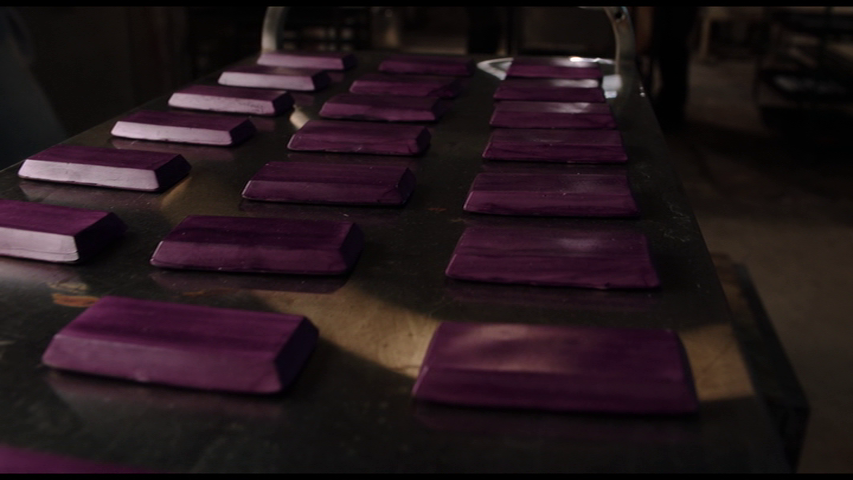
They aren’t actually candy, hence the scare quotes: this is, rather, what you eat after you get the elective surgery that leaves these scars:
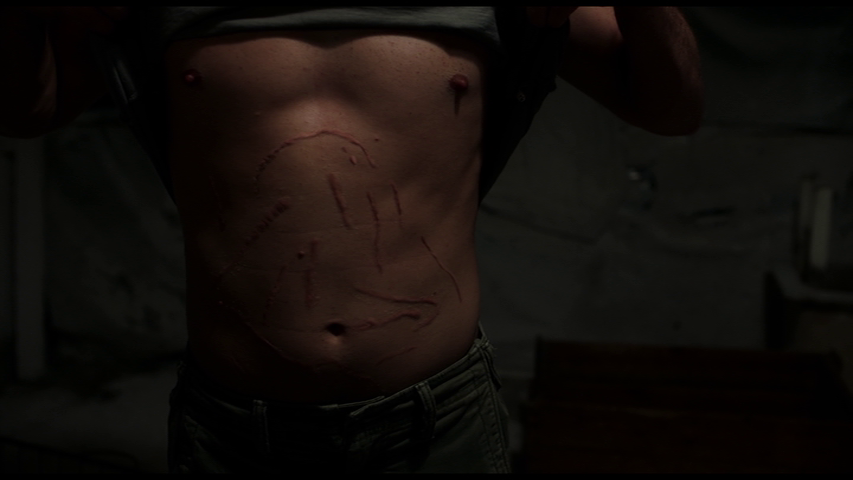
And replaces your digestive system with one capable of converting reprocessed industrial waste into energy. But we’re getting just a bit ahead of ourselves. Following the opening credits sequence that inspired this month’s drink photo:
Crimes of the Future begins with a shot of a structure that looks simultaneously futuristic and decrepit viewed from the shoreline of a rocky beach:

The camera pulls back to reveal a boy (Sotiris Siozos) sitting next to a rusty can and digging in the water with a spoon:
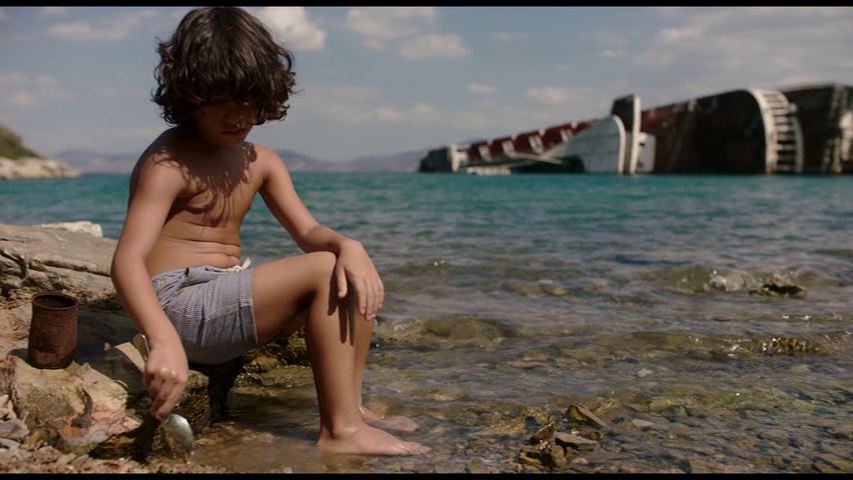
Then circles around to the right before tracking in, almost as if were studying him. A woman’s voice says “Brecken” and he looks up:

Cut to a long shot of the speaker, his mother Djuna (Lihi Kornowski): “I don’t want you eating anything you find in there, you understand me? I don’t care what it is.”
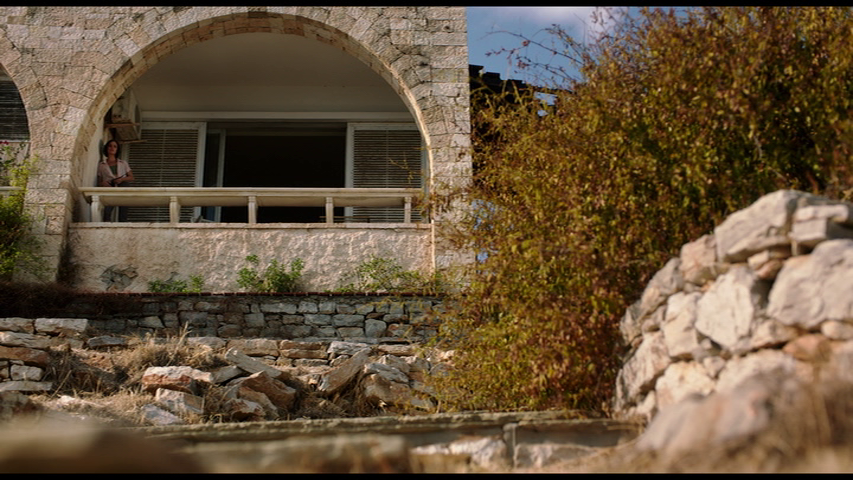
Cut back to Brecken, who rises, then back to a medium shot of Djuna as she mutters “I don’t care what it is” to herself a second time, her voice quavering.

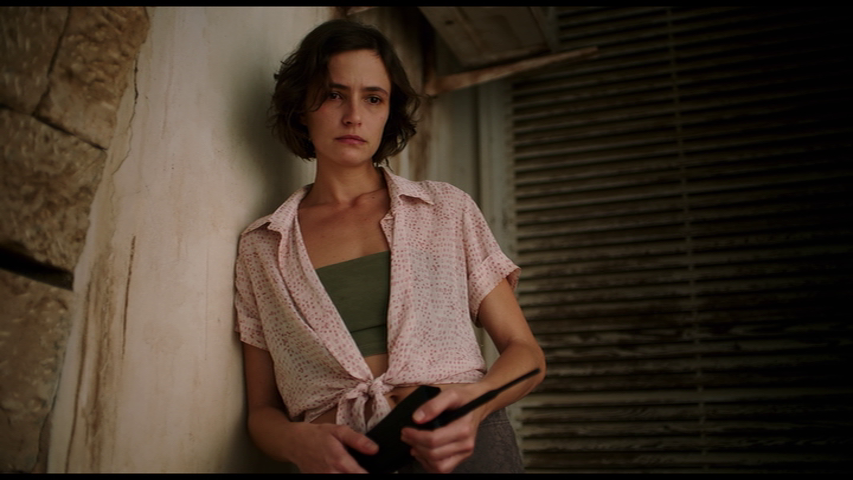
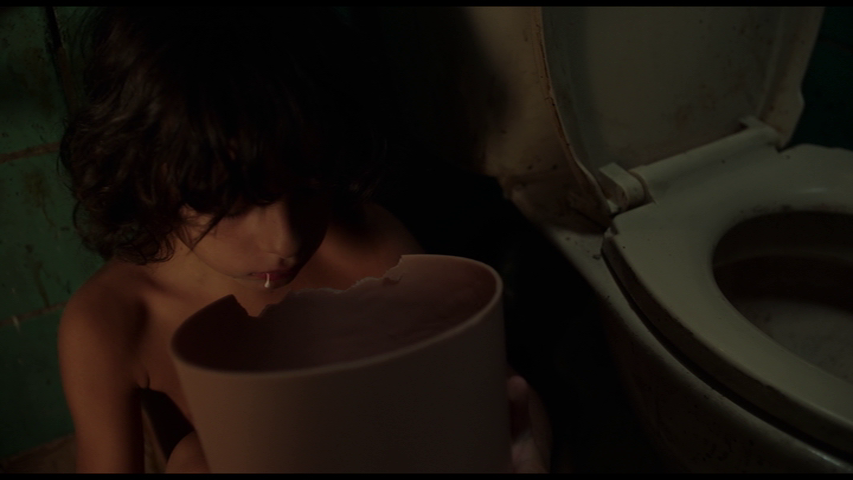
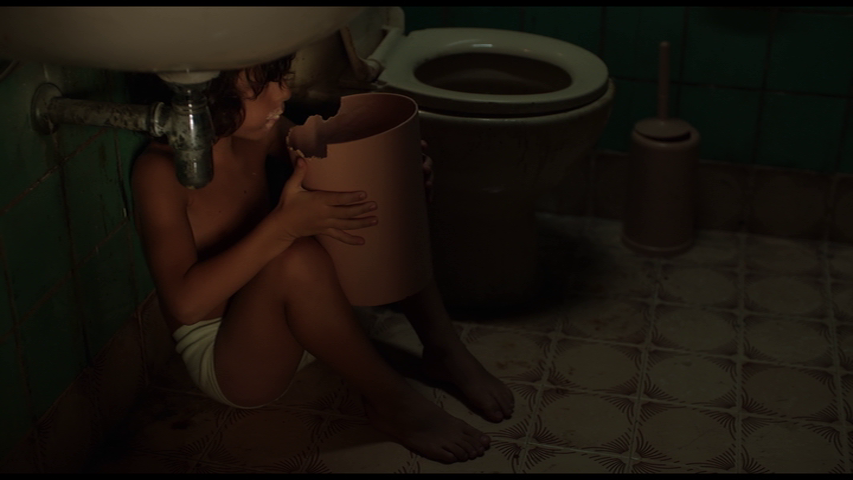
It’s an odd exchange and on a first viewing the logical assumption is that she’s concerned about him consuming marine animals or fish, possibly because the water is polluted? But the real cause of her duress is revealed about 30 seconds later when Brecken finishes brushing his teeth and begins to munch on a plastic wastebasket as Djuna looks on:
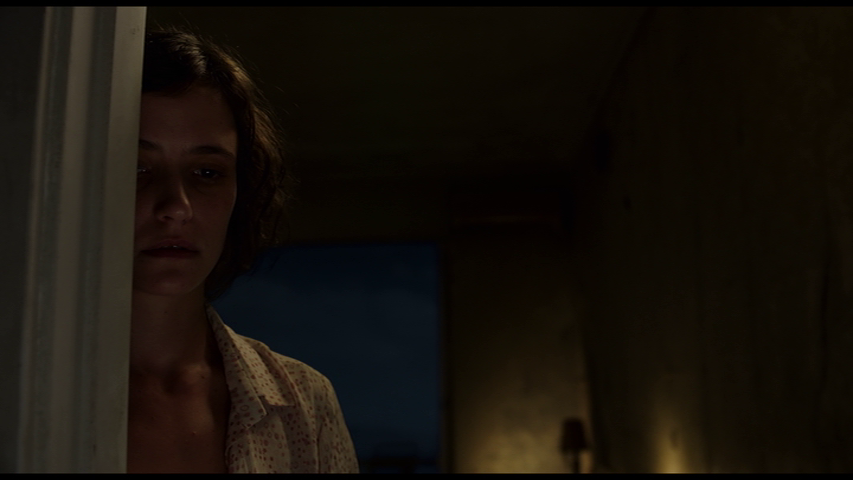
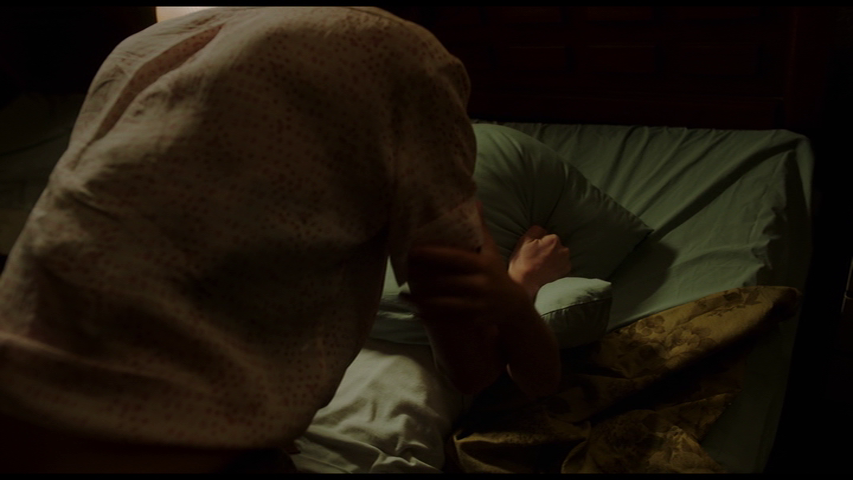
What happens next is even more shocking. As Brecken sleeps, Djuna smothers him with a pillow:
She confesses her crime over the phone in the scene that follows, and although her words are unrepentant (“yes, yes, I mean the Brecken thing”), there are tears in her eyes when she hangs up:

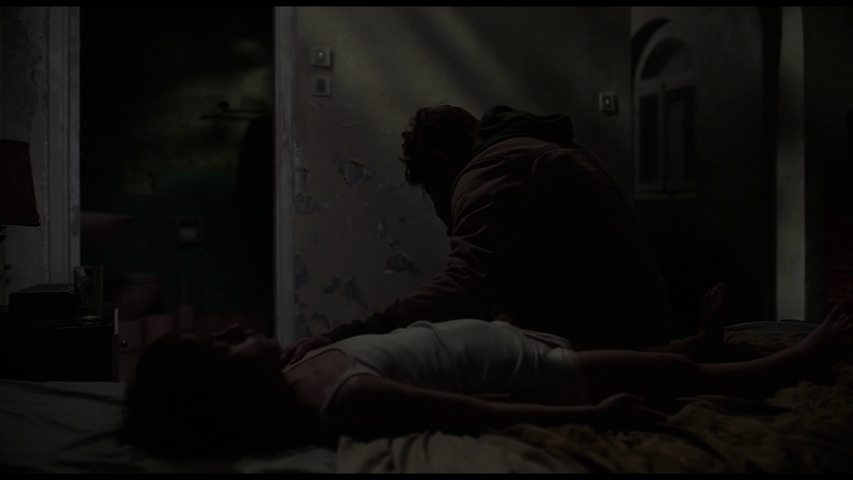
The person at the other end of the line is an associate of Djuna’s ex-husband Lang (Scott Speedman), who is understandably also reduced to sobs when he shows up to claim his son’s body:
And with one murder in the books, we’re off. The next shot introduces us to Crimes of the Future‘s protagonists, Saul Tenser (Viggo Mortensen) and his partner Caprice (Léa Seydoux). She awakens him from a restless night in his LifeFormWare OrchidBed with good news: there’s a new hormone in his body!
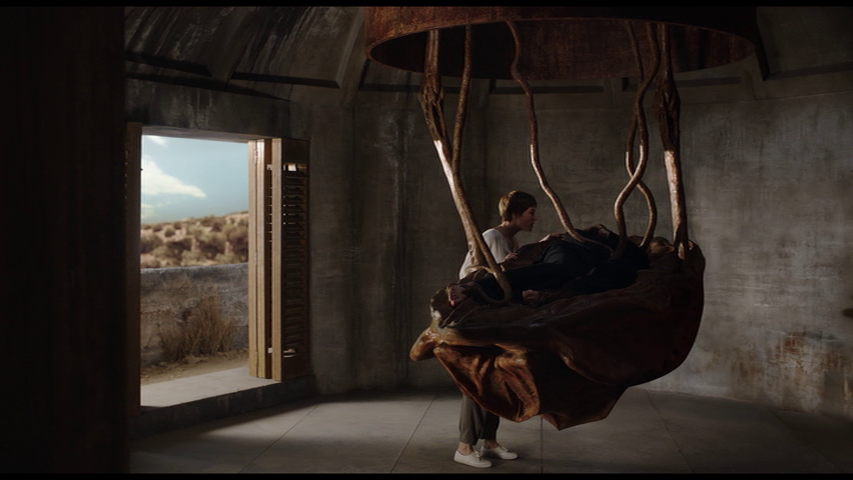
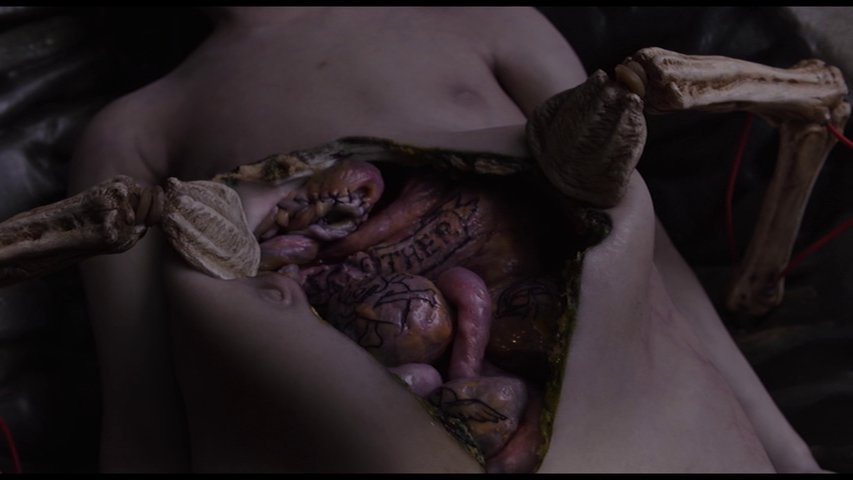
You see, he suffers from a condition called Accelerated Evolution Syndrome whereby his body produces new organs, which Caprice tattoos while they’re still in his body:
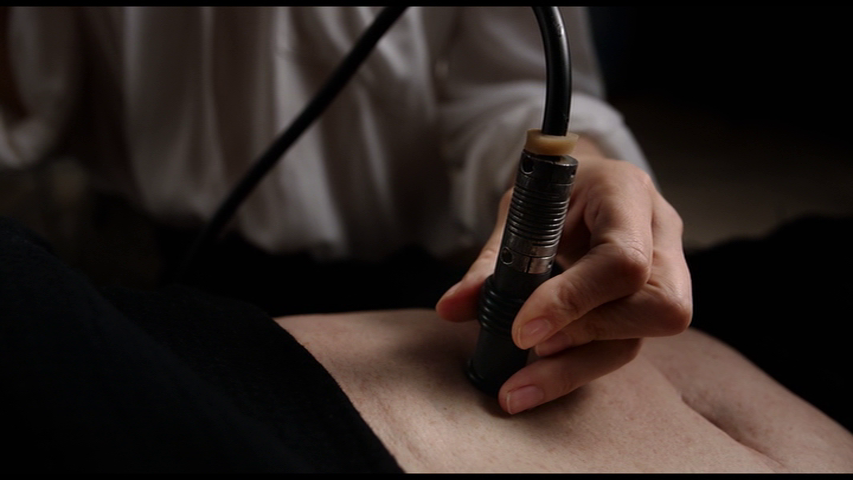
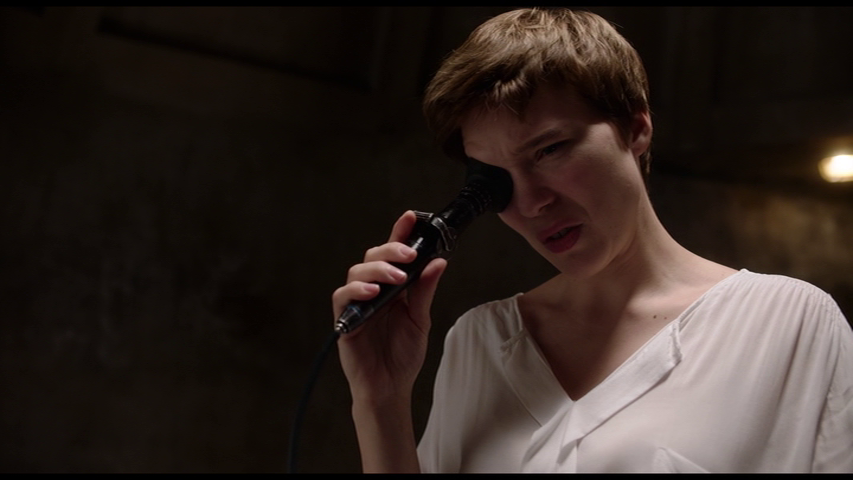
Then removes in front of a live audience using another LifeFormWare product, the Sark autopsy module, which has made them stars of the performance art world:
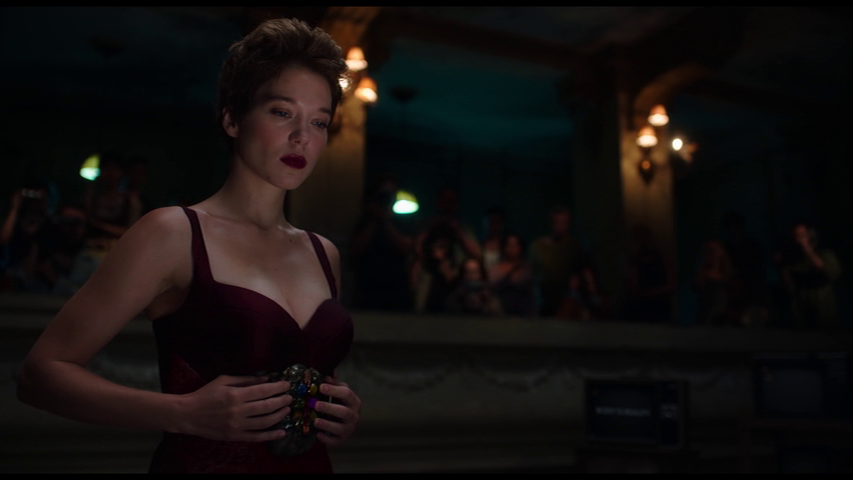
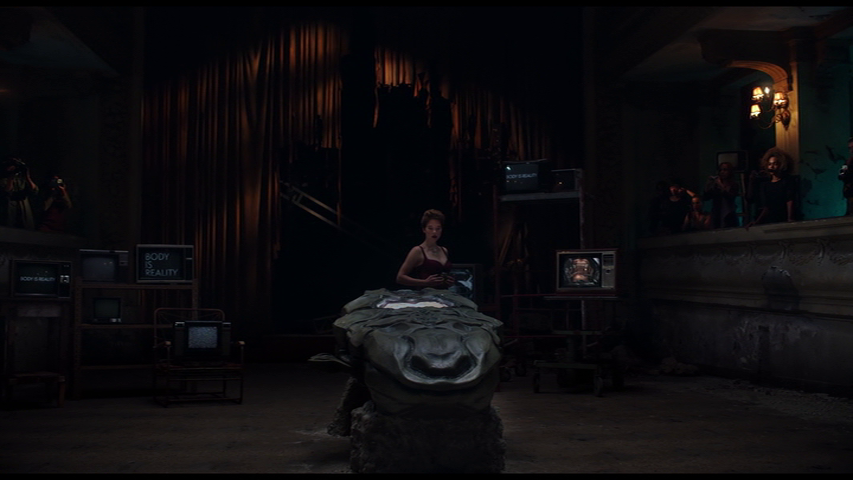
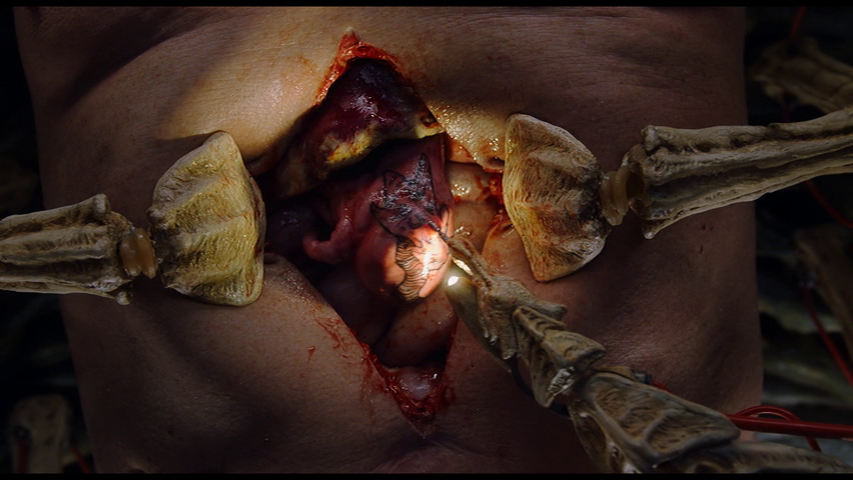
There’s no need for anesthesia or sterilization because human beings have ceased to feel pain except in their sleep and infections have disappeared for reasons unknown. People now get their thrills from a new fad called “desktop surgery,” which basically consists of cutting into each other:
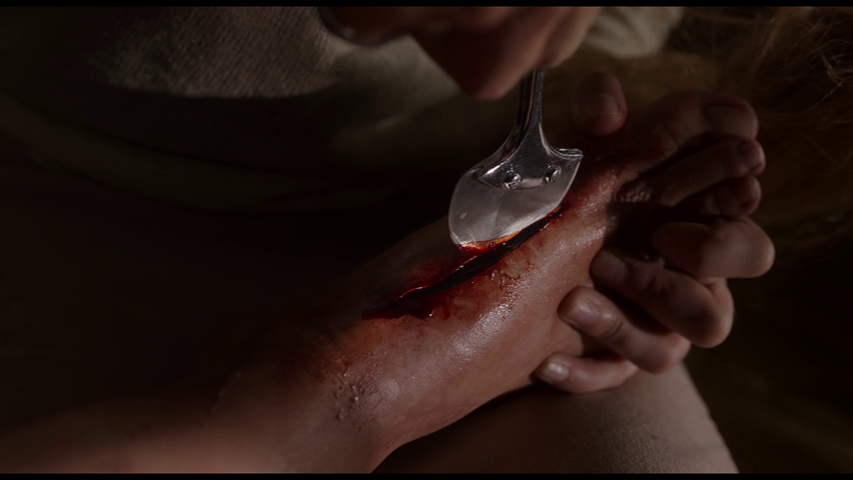
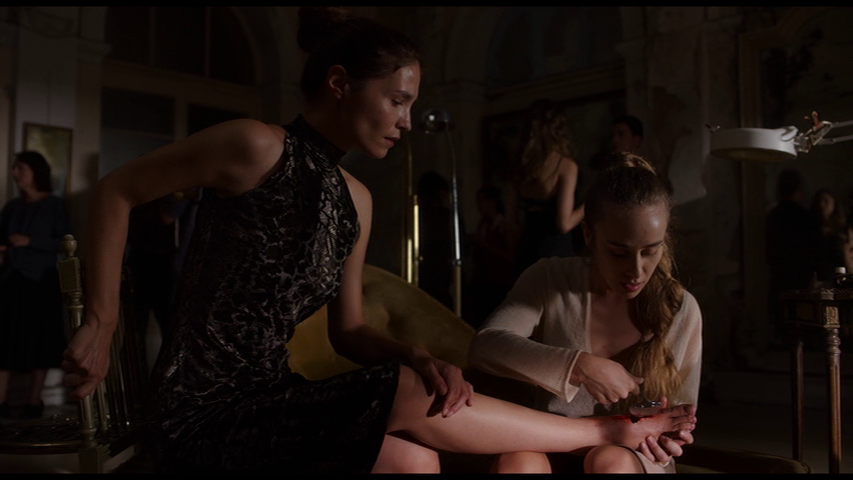
And the entire situation is making the government nervous. As the two bureaucrats who staff the National Organ Registry it establishes in response explain, “human evolution is the concern. That it’s going wrong. That it’s . . . uncontrolled, it’s . . . insurrectional.”
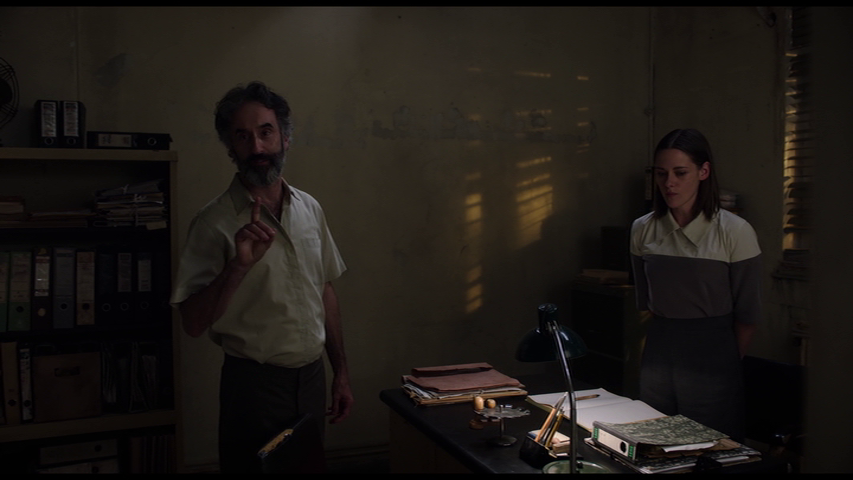
Violet Lucca reads Crimes as being deeply autobiographical in her monograph on Cronenberg, but immediately goes on to note that there’s far more going on here than just taking stock and settling scores:
Saul is Cronenberg himself, performance art is cinema, “body art” is “body horror” (the questionable subgenre Cronenberg supposedly invented), the National Organ Registry stands in for TIFF and Telefilm Canada, and Timlin (Kristen Stewart) and Wippet (Don McKellar), the jittery geeks who work at the NOR, are a heady mix of film fans and people who work in film (critics, archivists, programmers, publicists, or whatever). However, the way in which these parallels are drawn–and Saul’s succinctly croaked objections to the various interpretations of his work, the state of performance art, and to the state of the world–are commentaries that are just as applicable to our reality as they are in the film’s. The government’s endeavors to control both art and body are meant to protect those who are already powerful, going so far as to deny nature and very clear biological warnings.
What takes the movie to the next level and makes it what Neil Bahadur calls on Letterboxd “one of the most visionary works of science fiction in the history of cinema” is how this is accomplished: “it deemphasizes technology for exploring changes in human habit, psychology, and physiology.” Deemphasizes is exactly the word–there’s plenty of tech in the movie, but like LifeFormWare’s Breakfaster Chair it’s shown to be unable to keep pace with the body’s endeavors to heal itself.
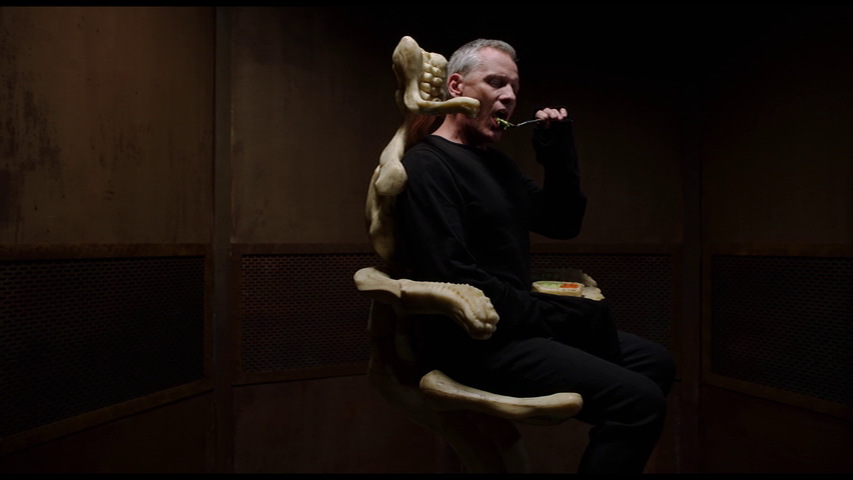
Enter Lang, who is not only Brecken’s father, but also the leader of the “plastic-eaters” mentioned above. He cannot explain how their body modifications came to manifest naturally in a new generation beyond referring to the boy as their “miracle child,” but approaches Saul and Caprice with the idea of performing a public autopsy on his son’s body “to show the world that the future of humanity existed and was good–was at peace and harmony with the techno world that we’ve created.”
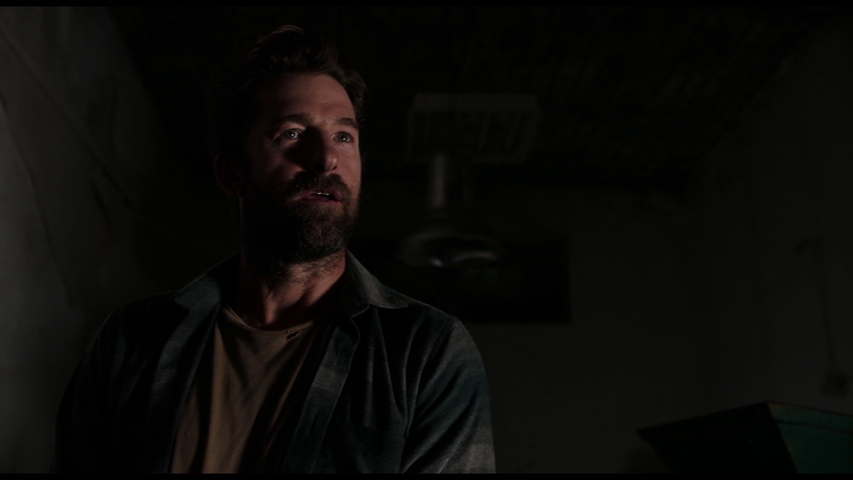
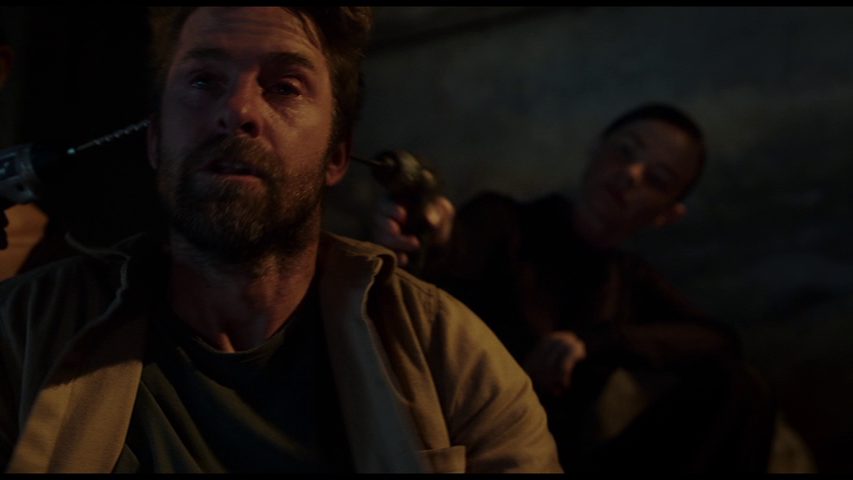
Saul accepts under orders from his handler in the government’s New Vice Unit, which unbeknownst even to Caprice he works for as an undercover agent, ostensibly to earn Lang’s trust so that he can infiltrate his group, but really because they’ve already gotten to Brecken’s body:
Meanwhile, LifeFormWare is making plans of its own to ensure the continued viability of its products:
Crimes of the Future is also quite erotic, to the point where the album Pinkerton by Weezer could almost function as an alternative soundtrack to it, especially the tracks “Tired of Sex,” which matches well with this awkward encounter between Saul and Timlin:
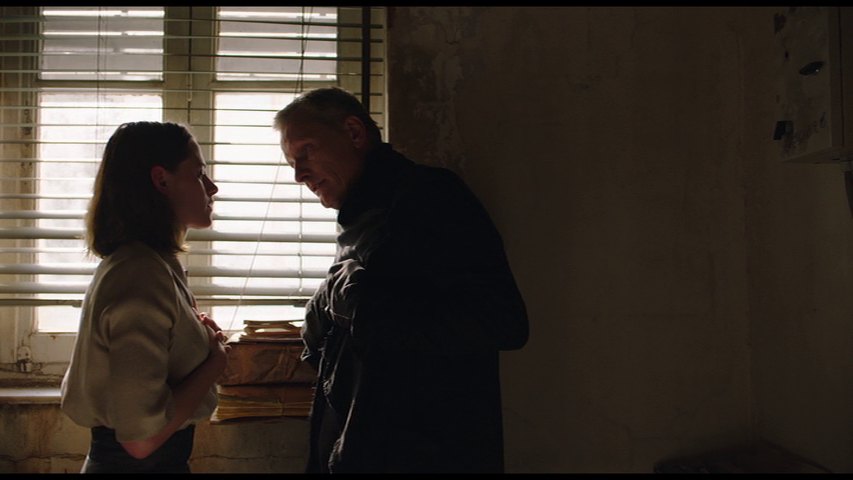
“The Good Life,” which might as well be all about him, and “Butterfly,” our new accompaniment to the end titles that follow this brilliant final image:

Speaking of which, many critics identify it as a reference to my February, 2023 Drink & a Movie selection The Passion of Joan of Arc, but it also marks the conclusion of a motif that started with the 14th and 15th screengrabs in this post by putting a new twist on it. Djuna and Lang both weep for things lost, in her case the familiar world she knew in her youth, and in his the unexpected delay of long-anticipated future he thought had already arrived. Saul’s tear, on the other hand, is like Joan’s a sign of acceptance. Caprice gives him a bite of Lang’s “modern food”:
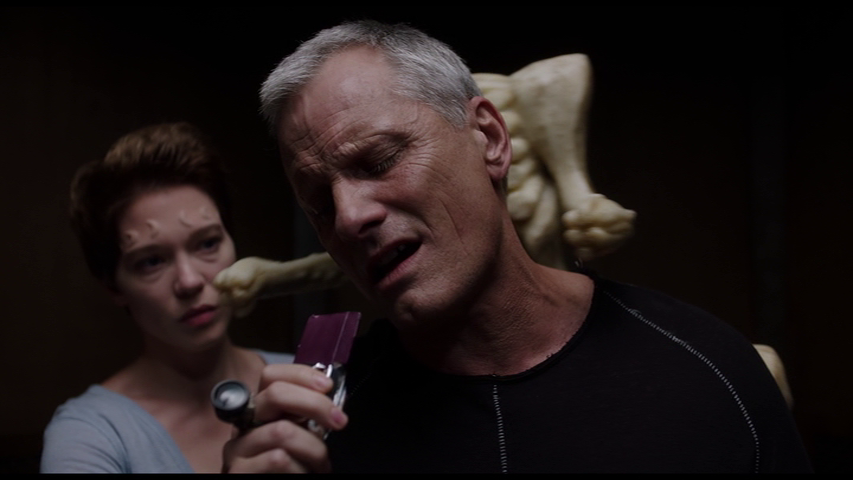
The Breakfaster Chair stops moving:
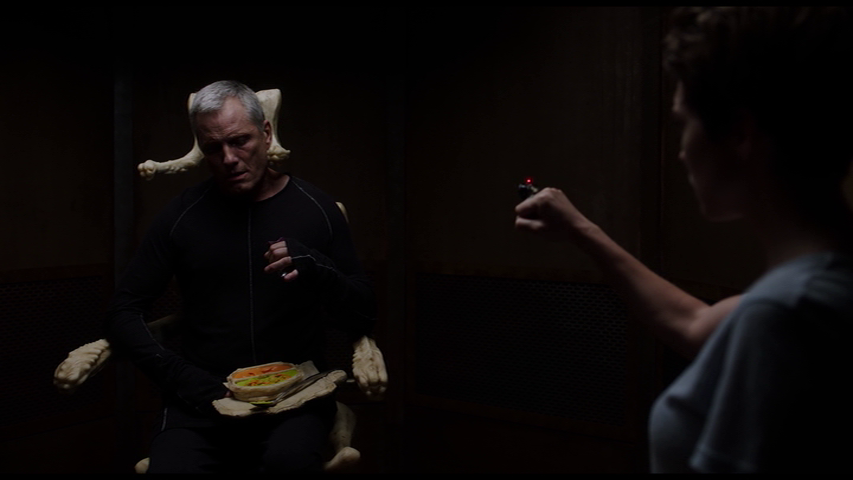
And to paraphrase a different set of alternative rockers active in the 90s, it’s the end of the world as we know it–but he feels fine. To Bahadur, “Cronenberg’s deep fear here – as it should be to all of us – is of reactionaryism: that those who are deemed different are then deemed subhuman, if not human at all. The title is in reference to this alone: is difference or the new the crime of the future? Is it already the crime of the now?” Noel Vera similarly suggests in a blog post about Crimes that by the end for Saul “the coming apocalypse isn’t so much a calamity as a fascinating new condition to explore and exploit, even embrace.” He also observes in passing that his name might be a reference to Alfred Bester’s classic sci fi novel The Demolished Man, something that occurred to me as well, specifically this nonsense rhyme that Ben Reich learns to prevent his thoughts from being read in a future where telepathy is common:
 Eight, sir; seven, sir;
 Six, sir; five, sir;
 Four, sir; three, sir;
 Two, sir; one!
 Tenser, said the Tensor.
 Tenser, said the Tensor.
 Tension, apprehension,
 And dissension have begun.
What’s interesting is the way that story ends. It revolves around Reich’s attempts to commit the perfect crime and escape his world’s worst punishment, something with the threatening name of “Demolition.” But it’s not what we think it is, as we finally discover in the final pages:
Reich squalled and twitched.
“How’s the treatment coming?”
“Wonderful. He’s got the stamina to take anything. We’re stepping him up. Ought to be ready for rebirth in a year.”
“I’m waiting for it. We need men like Reich. It would have been a shame to lose him.”
“Lose him? How’s that possible? You think a little fall like that could–“
“No, I mean something else. Three or four hundred years ago, cops used to catch people like Reich just to kill them. Capital punishment, they called it.”
“You’re kidding.”
“Scout’s honor.”
“But it doesn’t make sense. If a man’s got the talent and guts to buck society, he’s obviously above average. You want to hold on to him. You straighten him out and turn him into a plus value. Why throw him away? Do that enough and all you’ve got left are the sheep.”
“I don’t know. Maybe in those days they wanted sheep.”
Harowitz & Silverman argue that a big part of what makes the Caesar a great drink is that it’s infinitely customizable: they define it as “a cocktail (alcoholic or non-alcoholic) made with a base of vegetable juice and an element of the sea.” It thus can be adapted to almost any dietary preference or restriction, so mix yourself up a Watermelon like we recommend or try something different: whether you do or don’t drink, are an omnivore or vegetarian, or even (judging from Crimes‘ first line) eat plastic, Caesar Country is your roadmap to a satisfying Canada Day concoction.
Cheers!
All original photographs in this post are by Marion Penning, aka My Loving Wife. Links to all of the entries in this series can be found here.

 The Prodigal Cinephile