One of the most fun parts of my “Drink & a Movie” series has been the twin experiences of, 1) seeing a movie for the first time and thinking of a cocktail that would pair great with it, and 2) trying a new drink and connecting it with a film. Pyaasa was an example of the former: as I tweeted shortly after I watched it, I knew right away that it was destined to accompany a Last Word. The Light and Day, which I discovered in the Death & Co. Modern Classic Cocktails book, is an example of the latter. Here’s how you make it:
2 ozs. Plymouth gin
1/2 oz. Yellow Chartreuse
1/4 oz. Maraschino Liqueur (Luxardo)
1/4 oz. Orange juice
4 dashes Peychaud’s bitters
Stir all of the ingredients with ice and strain into a chilled coupe glass.

Creator Alex Day described it in Vice as “somewhat of a martini but also sort of a sour drink” inspired by an Aviation. Per Day “it follows no convention of a cocktail,” but is absolutely delicious nonetheless. One of its distinctive features is that many of its ingredients are relatively gentle: Plymouth is one of the less assertive representatives of the London Dry style of gin, Yellow Chartreuse is Green’s more approachable sibling, and orange juice is far more easygoing than lemon or lime. This matches its pastel hue, but don’t be fooled: with two-and-a-half ounces of booze in it, the Light and Day packs a punch! It’s a sweet drink to be sure, but the maraschino and Chartreuse contribute a ton of complexity and harmonize beautifully to create something bright and sunny which is just the ticket in the middle of winter, especially since that’s when oranges are at their best.
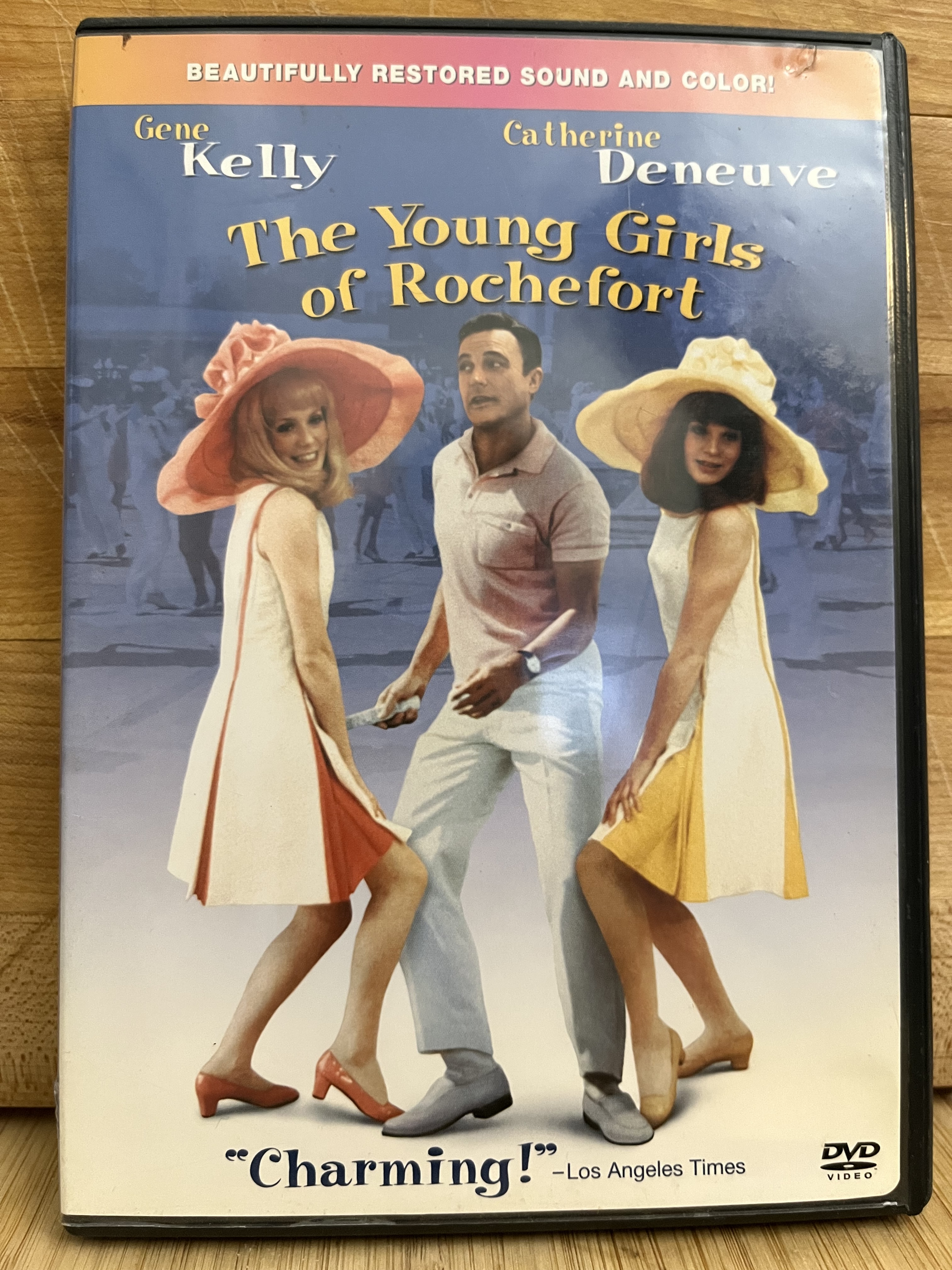
When I saw and tasted this soft but serious concoction, The Young Girls of Rochefort immediately popped into my head. Here’s a picture of my Miramax DVD release:
It can also be streamed on The Criterion Channel and Max with a subscription or on Apple TV+ or Prime Video for a rental fee.
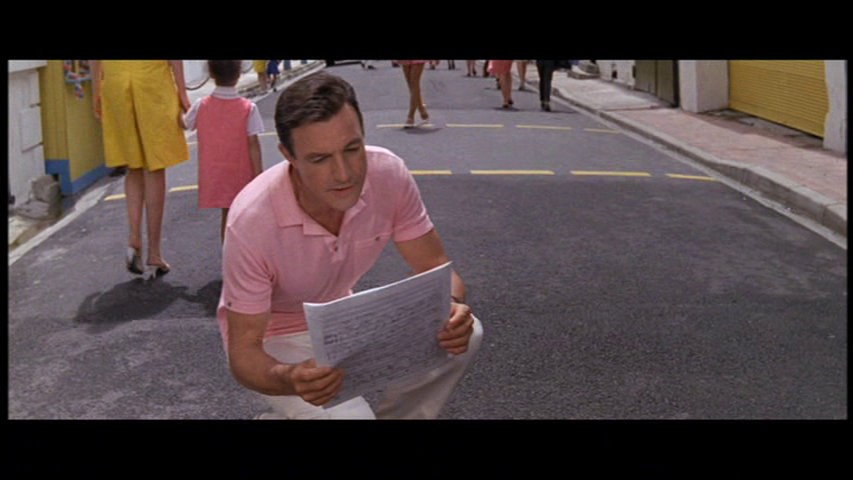
To begin, as you would with a cocktail, with the film’s appearance, critic Stephanie Zacharek noted in 1998 that director Jacques Demy “understood color as sheer entertainment.” The best exemplar of this for both of us is the attire of Gene Kelly’s Andy Miller. For her he is “one of the few performers of our era who could not only carry off a lilac sport coat, but also turn it into a symbol of enlightened masculinity.”

While I would argue that the pink polo shirt he wears under it looks even more glorious on its own:
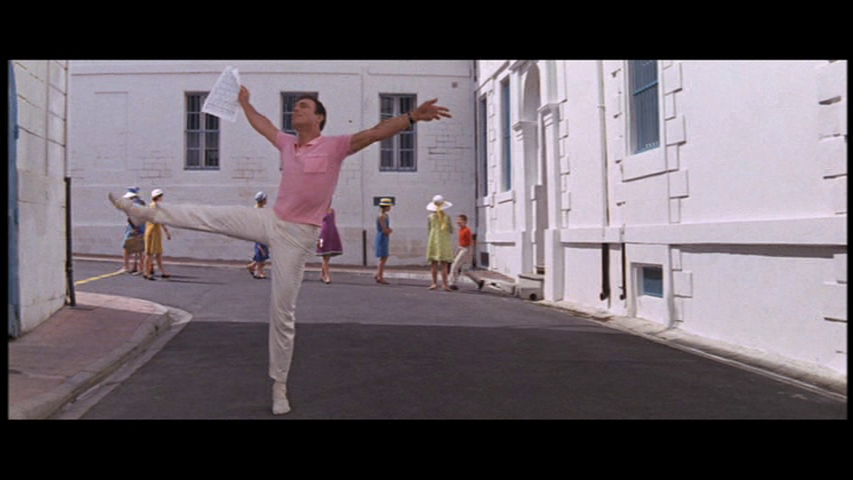
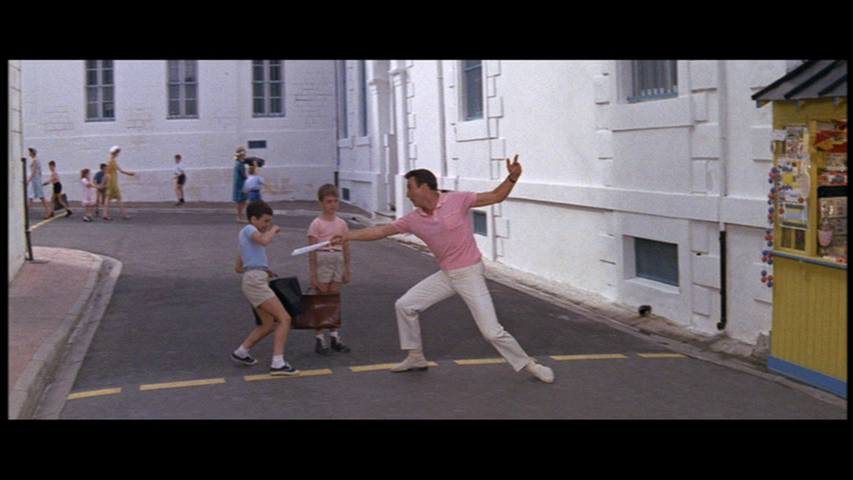
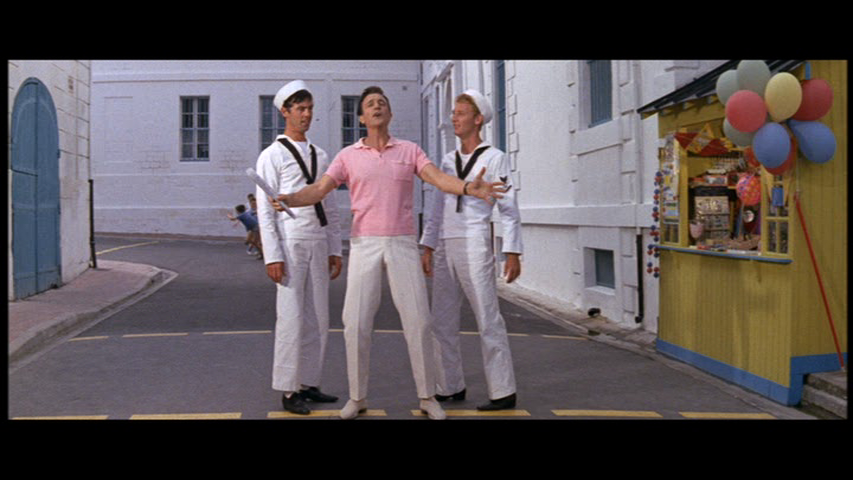
Of course, the most important parts of his wardrobe are (to again quote Zacharek) the “confident grace and ease” on display in the dance scenes which (per Darren Waldron in his monograph on Demy) he choreographed himself:
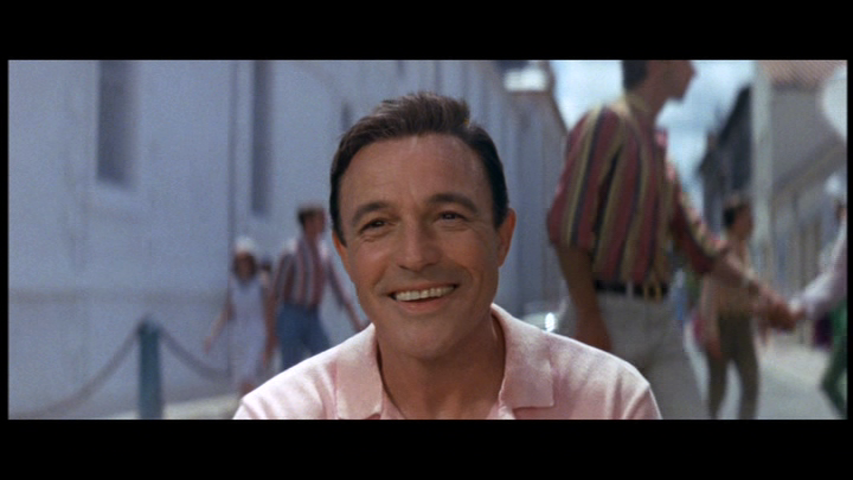
And most especially in the radiant smile he wears when he first lays eyes on his soul mate Solange Garnier (Françoise Dorléac):
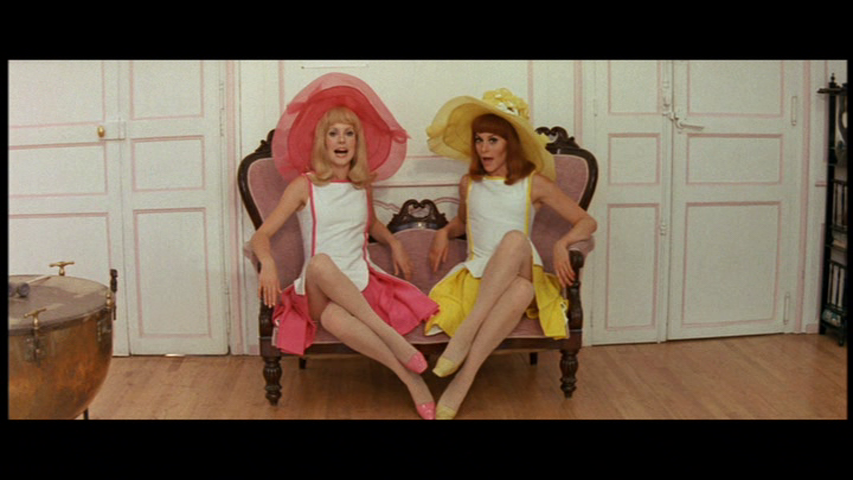
Speaking of whom, the complementary outfits she and real-life sister Catherine Deneuve’s Delphine Garnier don in their scenes together are also wonderful:
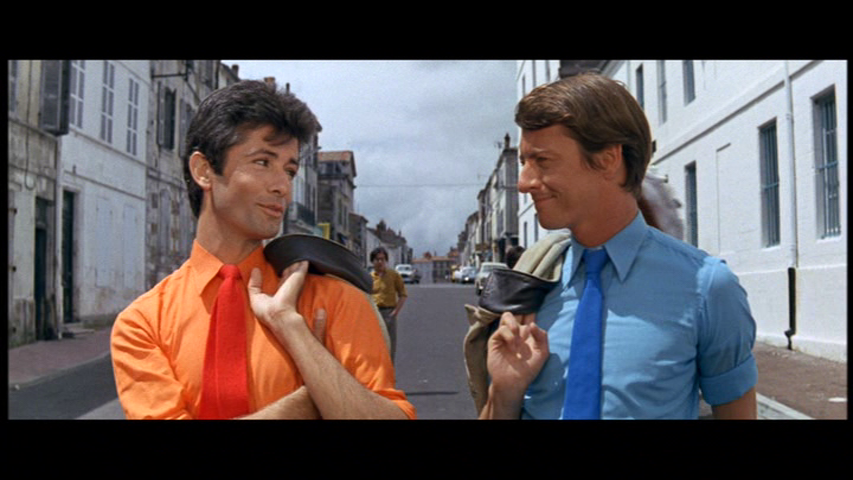
As are the brilliant blue and orange (go Knicks and Mets!) button-up shirt and tie ensembles worn by George Chakiris’s Etienne and Grover Dale’s Bill which inspired this month’s drink photo:
Their dancing is terrific, too, by the way, especially their speed skater-like footwork in the musical number “Nous voyageons de ville en ville”:
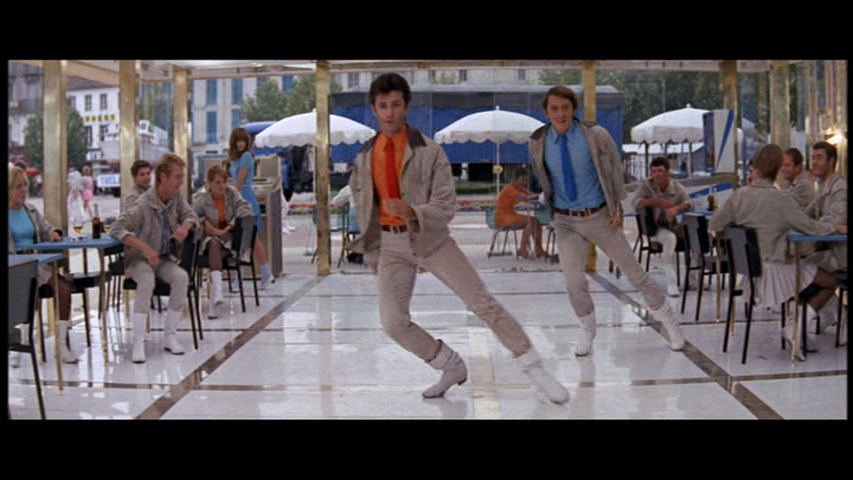
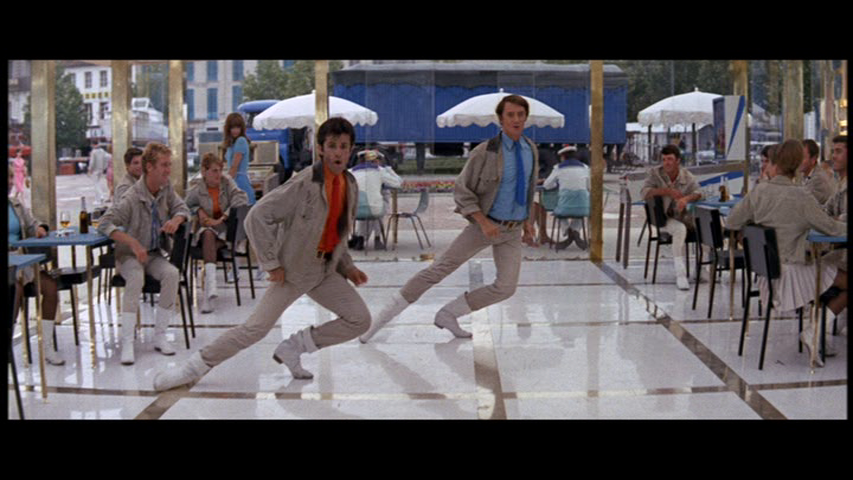
Unfortunately, to many critics, the professional moves of Kelly, Chakiris, and Grove only serve to underscore a perceived “amateurish” lack of perfect timing elsewhere. For me this is mostly an unimportant byproduct of on-location shooting and Demy’s ambitious camerawork. Consider, for instance, the 84-second-long crane shot near the beginning of the film that starts with pole dancing on Rochefort’s Place Colbert:

Follows Bill and Etienne and company past the café where many subsequent scenes will take place:


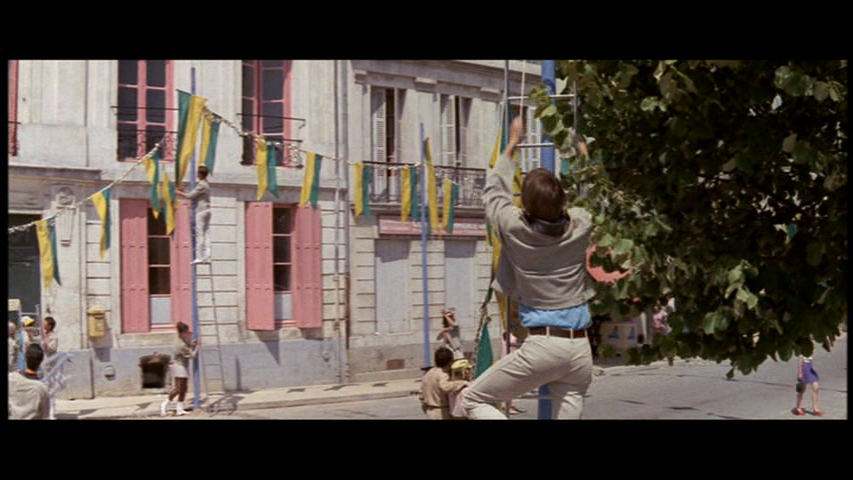
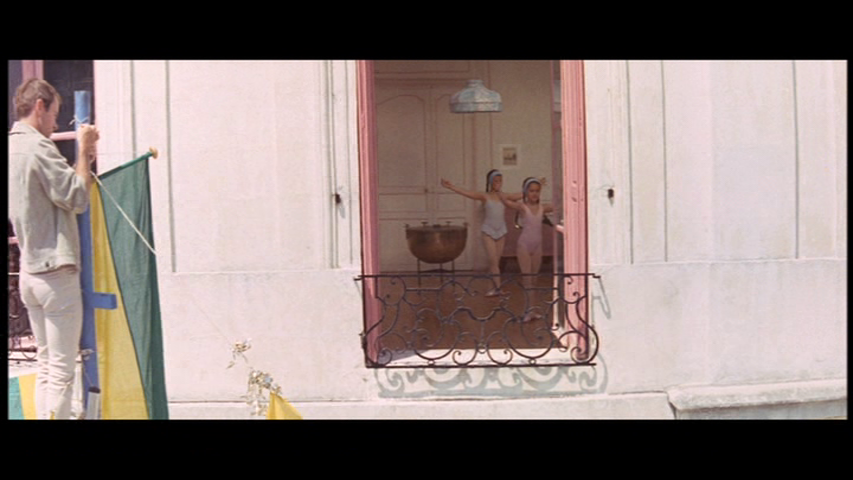
And then ascends up to and through a second story window where Solange and Delphine are teaching a dance class:


Perhaps even more impressive is the 56-second-long tracking shot which follows Delphine as she walks from her half-brother Boubou’s (Patrick Jeantet) school to her soon to be ex-boyfriend Guillaume Lancien’s (Jacques Riberolles) art gallery, which critic Jonathan Rosenbaum celebrated for the sense of “exuberance combined with a sublime sense of absurdity” created by her slipping in and out of the choreography of the pedestrians dancing all around her. It begins in long shot:

Includes a medium shot of her being lifted by a sailor as she crosses the street:

And then resumes following her in long shot the rest of the way to her destination:
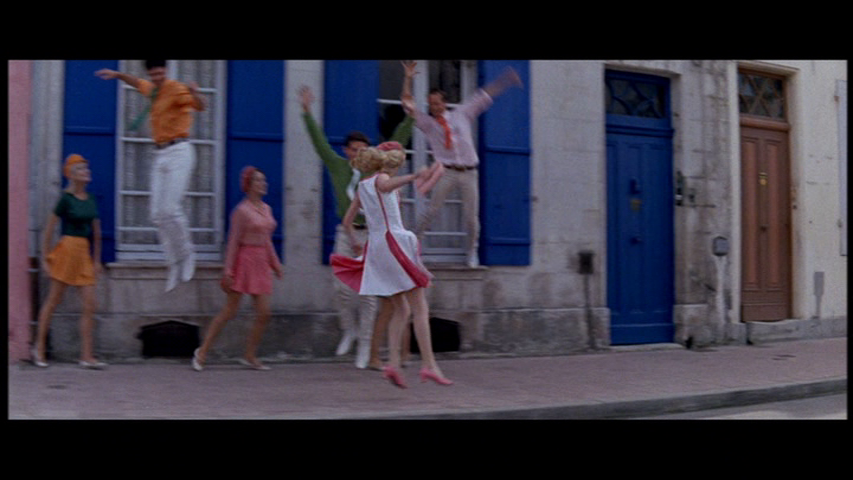
By my count 44 dancers, two moving cars, and three bike riders appear on screen, which is quite a feat of coordination even if everyone’s movements aren’t totally synchronized. Scholar Carlos Valladares (who is now a PhD student at Yale) goes a step further in a 2016 paper published in the Stanford Undergraduate Research Journal called “Dance and the Postmodern Sublime in Jacques Demy’s The Young Girls of Rochefort (1967).” He analyzes the “simple” (distinguishing it from the two sequences I cite above) dance on a transporter bridge which accompanies the opening credits, among other scenes, and contends that the movie’s “deliberately ‘sloppy’ steps are a realistic look at (and criticism of) traditional movie musicals” which challenges “the perception of the musical as an elitist art that only a few select masters (Minnelli, Donen, Kelly) have mastered.”
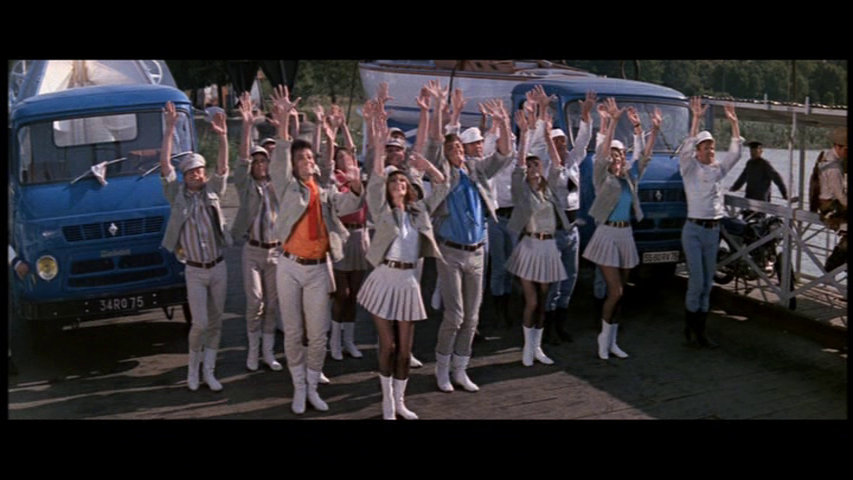
Whatever reading you prefer, this strikes me as a perfect example of the same kind of polite disregard for the rules that led to the creation of the Light and Day.
Tasting notes usually conclude with a discussion of the drink’s finish, and that’s where The Young Girls of Rochefort really shines. Rosenbaum’s most perceptive comments about the movie are related to what he calls “perhaps the most beautiful dovetailing of failed and achieved connections apart from Shakespeare and Jacques Tati’s Playtime.” Pointing as well to the lyrics of the song “La femme coupée en morceaux,” which is about an axe murder, and the threat of war omnipresent in newspaper headlines and Rochefort’s status as a garrison town:

He argues that even though the film “is on all counts Demy’s most optimistic film–the one in which every character eventually finds the person she or he is looking for–the missed connections preceding this resolution are relentless, and one may still wind up with a feeling of hopeless despair despite the overdetermined happy ending.” Michel Legrand’s addictive (my family is glad that I finally finished this post because I’ve been listening to it on repeat for weeks!) score, which might be my favorite movie music ever, deserves a huge amount of credit for this. The tragic death of Françoise Dorléac mere months after The Young Girls of Rochefort‘s premiere also casts a shadow over it for those who know that she and Deneuve would never again appear on screen together. But for me a lot of the welcome bitter counterpoint to its more apparent saccharine elements comes from the characters themselves. As Waldron observes:
We hear evidence of the selfishness that frames the construction of each character, preoccupied with their own narcissistic pursuit of happiness and lacking responsibility and compassion for others. Yvonne allows strangers Bill and Etienne to pickup Boubou up from school, and Solange dismisses Delphine when she claims she is sad after rupturing her relationship with Guillaume. Such egotism is extended in the Garnier women’s vanity; when flattered by Bill and Etienne, Yvonne and Delphine retort, separately, ‘on me l’a déjà dit’ (‘I’ve already been told that’).
And then, of course, there’s the whole matter of Yvonne (who is played by (Danielle Darrieux) leaving her fiancé Simon Dame (Michel Piccoli) because of his name! I recently mentioned to my friend Scott that one of my hopes for this series is that when I look back on it my choices will tell a story. My vague idea was that it might have something to do with seasonality, but he replied with the much more interesting suggestion that my theme is “the human experience of trying to become a better person,” with emphasis on the process employed by characters who are successful and the price for not doing “the right thing” paid by those who are not. The Young Girls of Rochefort may be the exception that proves the rule. Yvonne and Simon end up together in the end, but it is this the result of growth or just regret?

After all, sometimes the difference between leaving town in the company of carnies by yourself after your twin sister inexplicably no-shows without explanation:
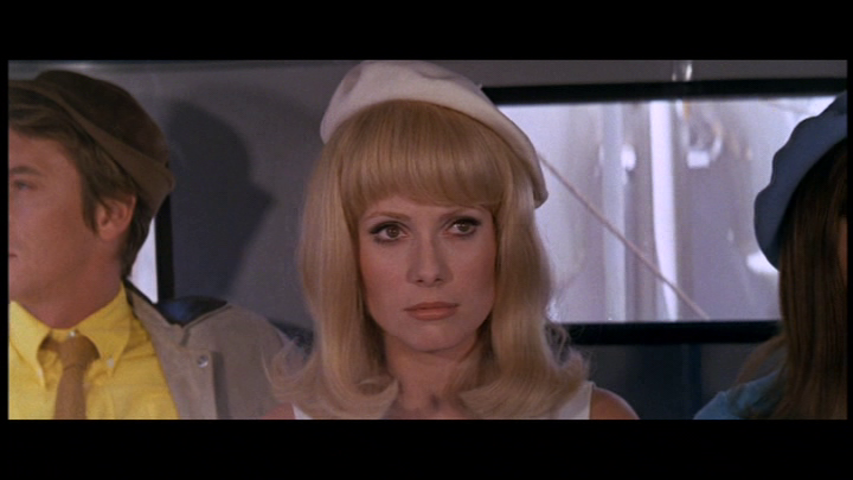
And having your masculine ideal (aka Jacques Perrin’s Maxence) as your travelling companion is simply a matter of bad or good timing:

Cheers!
All original photographs in this post are by Marion Penning, aka My Loving Wife. Links to all of the entries in this series can be found here.

 The Prodigal Cinephile
Andy,
I was introduced to this film from your best of film list. I ended up watching it three times over a November weekend (and have listed to the soundtrack multiple times). Great essay on a wonderful fun film…..oh no I can’t get the song “Chanson des Jumelles” out of my head…watch the film and listen to the soundtrack!
LikeLike
Thanks, Scott! I’m delighted to hear that my affection for this film is responsible for a least a couple of other people (Marion falls into this category as well) watching it who might not have otherwise!
LikeLike