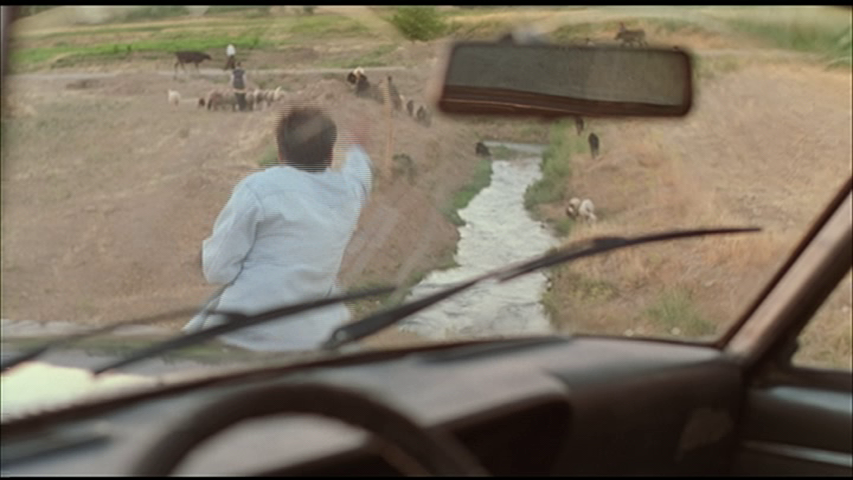
I started my Drink & a Movie series last January as motivation to write more. I quickly discovered another reason to keep it going, which was as a convenient excuse to spend time with films I love but haven’t seen recently. I’m happy to report that thus far not a single one has disappointed! In fact, I’ve been discovering all sorts of new things to admire about them. Case in point is this month’s selection, Abbas Kiarostami’s The Wind Will Carry Us. I remembered it for Behzad Dorani’s madcap (Kent Jones described him as “looking as if he had been drawn by Chuck Jones” in a 2000 Film Comment review) dashes through the streets and alleyways of the Kurdish village of Siah Dareh:


These scenes are some of the cinema’s finest dramatizations of how technology is simultaneously liberating (Behzad never would have traveled to such a remote place if he wasn’t able to remain in contact with his home base of Tehran) and binding (but every time his phone rings he needs to drop what he’s doing, run to his car, and drive to a place where he has better reception), but they’re far from the only reason to watch this film. First things first: the drink I’m pairing it with is the Hurricane, which has a surprisingly murky provenance. It is popularly believed to have been invented at the New Orleans stalwart Pat O’Brien’s in the 1940s in order to put their excess quantities of rum to good use and named after the lamp-shaped glass it was served in. Others trace its origin to the 1939 World’s Fair in Queens, New York where there was an establishment called the Hurricane Bar. The problem with both of these theories is that a drink called a Hurricane was apparently served in a 1939 movie I haven’t seen called Naughty but Nice which per IMDb was in production from October-December, 1938. Whatever it’s origins, one thing is for certain: the Hurricane is a delicious cocktail! The ingredients and proportions below are taken from Beachbum Berry’s Grog Log by Jeff Berry and Annene Kay, but can be found reprinted in all sorts of other books including Smuggler’s Cove, whose passion fruit syrup recipe (equal parts passion fruit puree and 2:1 simple syrup) is just about perfect in my opinion. Here’s how we make this drink:
2 oz. Dark rum (Gosling’s Black Seal)
1 oz. Lemon juice
1 oz. Passion fruit syrup
Fill a 10 ounce hurricane glass with crushed (use of a “Schmallet” is highly recommended!) ice, add all ingredients, and gently stir a few times to combine. Garnish with a lemon slice.
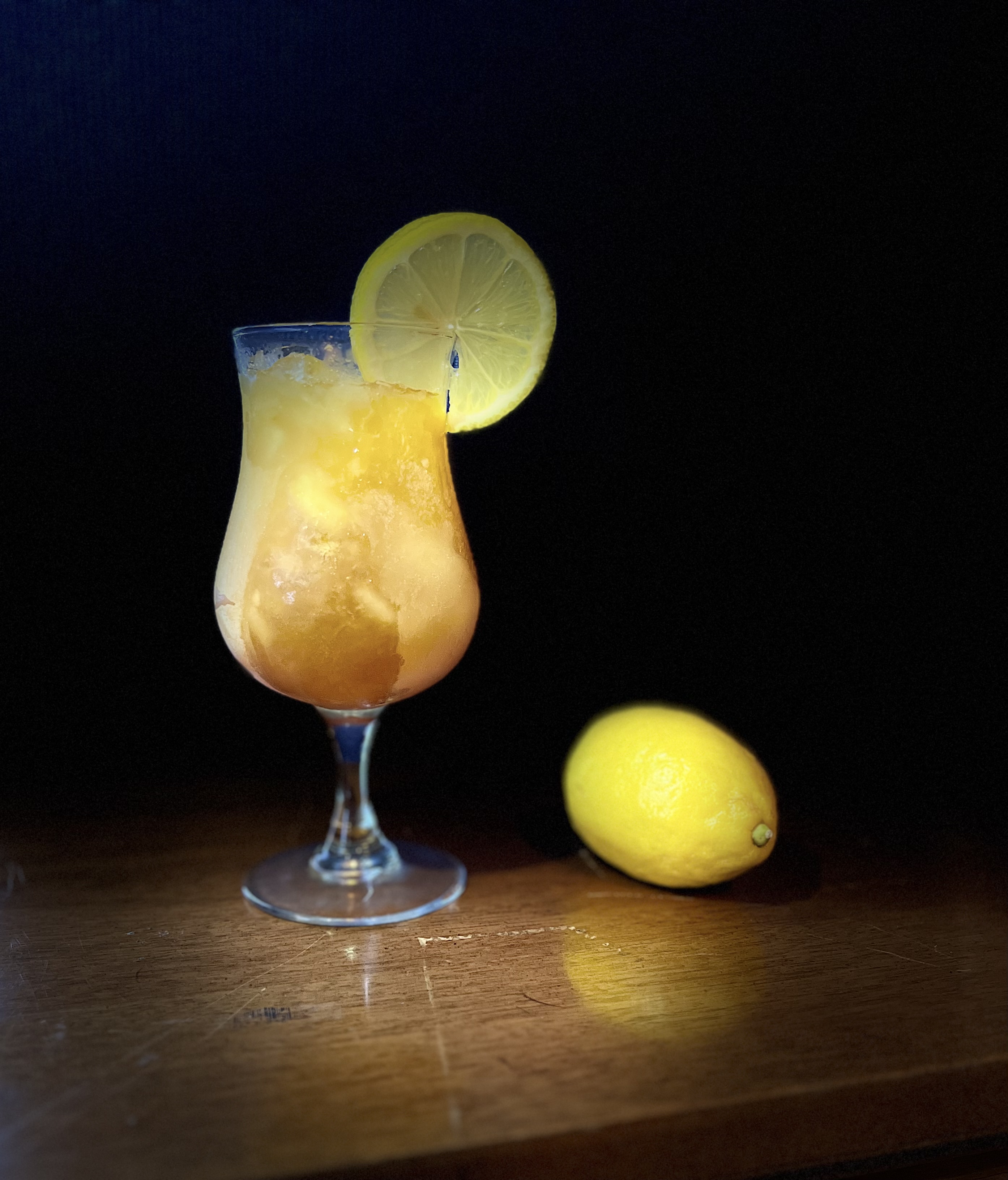
Most Hurricane recipes call for at least four ounces of spirits (according to Wikipedia the one in Naughty but Nice uses a whopping six!), but that’s a bit much for a single serving under normal circumstances, yeah? You’ll also find recipes for it which include additional ingredients like fassionola and Galliano, but for me it’s all about the brilliantly simple combination of passion fruit (a personal favorite), a bit more tartness from lemon juice, and the molasses and vanilla notes of a good dark rum. Our go-to in this category is Gosling’s Black Seal, which we keep on hand for Dark and Stormys.
The screengrabs in this blog post come from my trusty 2002 New Yorker Video release of The Wind Will Carry Us:

Gary Tooze and Jordan Cronk both say the version you want is the 2014 Cohen Media Group Blu-ray, though. Sadly, both are out of print, but the film can be streamed via Amazon Prime for a rental fee.
The Wind Will Carry us opens with an extreme long shot of a car traversing a winding road as the inhabitants argue over directions.
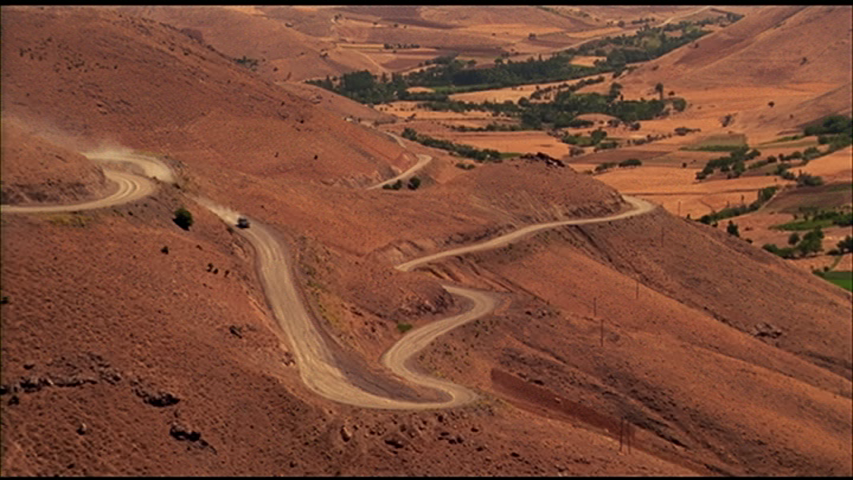
This may not resonate with anyone else, but revelation number one for me was that this sequence ties The Wind Will Carry Us to another one of my all-time favorite movies, Groundhog Day. Here’s how Ryan Gilbey describes the beginning of that film in his BFI Modern Classics monograph on it:
The first thing we see is a completely blue screen. Phil’s opening line gives a hint of what lies in store for him. ‘Somebody asked me today: “Phil, if you could be anywhere in the world, where would you like to be?” And I said to them, “Probably right here.”‘
On ‘here’, his hand moves into view. He is gesturing at the middle of the vast blue void. The place where he would most like to be is in that void: the middle of nowhere, off the map.
Now consider the opening dialogue from The Wind Will Carry Us:
BEHZAD: Where’s the tunnel then?
CREW MEMBER: We’ve passed it.
BEHZAD: When?
CREW MEMBER: Someone’s been sleeping!
BEHZAD: Where is it?
CREW MEMBER: We’ve passed it, back near Biston.
BEHZAD: We’re heading nowhere.
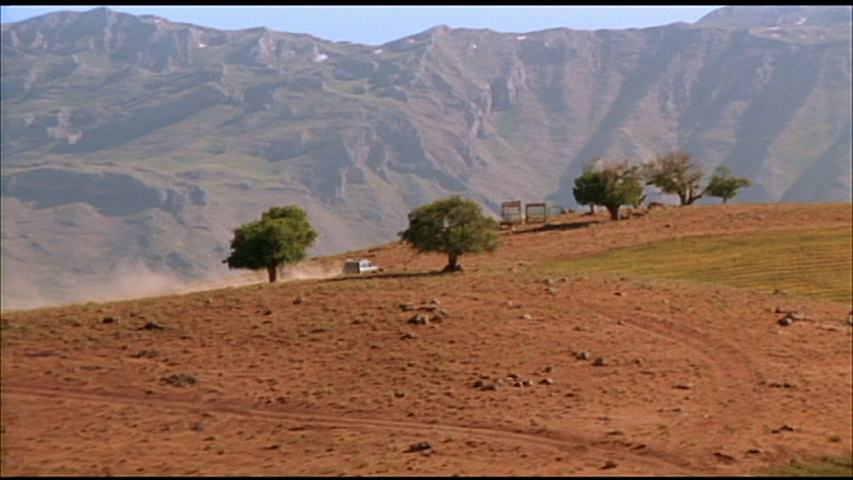
The two films are similar in the way they depict the repetitious events that comprise the core of their respective narratives. Just as we only need to see Phil Connor’s morning routine once in its entirety to understand the subsequent reappearance of bits and pieces of it to mean that he’s living the same day over and over again, so too is Kiarostami able to rely just on shots this increasingly well-traveled road to depict Behzad’s second through fifth phone calls:
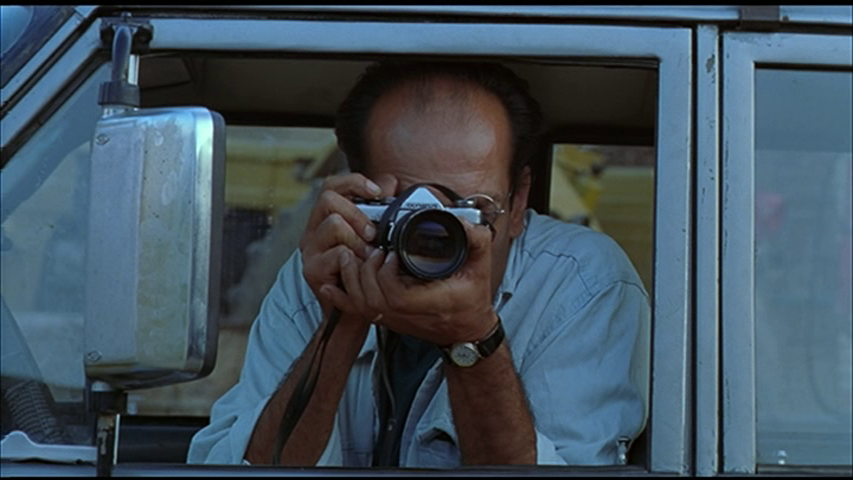
Both films also advance their plots at crucial moments via characters quoting poetry, and even their endings have the same bittersweet flavor. Despite everything they’ve learned, Phil’s final line is “we’ll rent to start” and Behzad snaps a few photos of the mourning ritual he came to Siah Dareh to film on his way out of town:
More relevant to this month’s pairing is the cellar scene which takes place just over halfway through the film. Behzad goes looking for the home of the woman he has spied bringing milk to the ditchdigger named Yossef he has befriended from afar, ostensibly because he wants some for himself and his crew, but more likely in the hope of seeing her close up. Upon arriving at the correct house, he is directed by an offscreen voice to go down to the cellar.
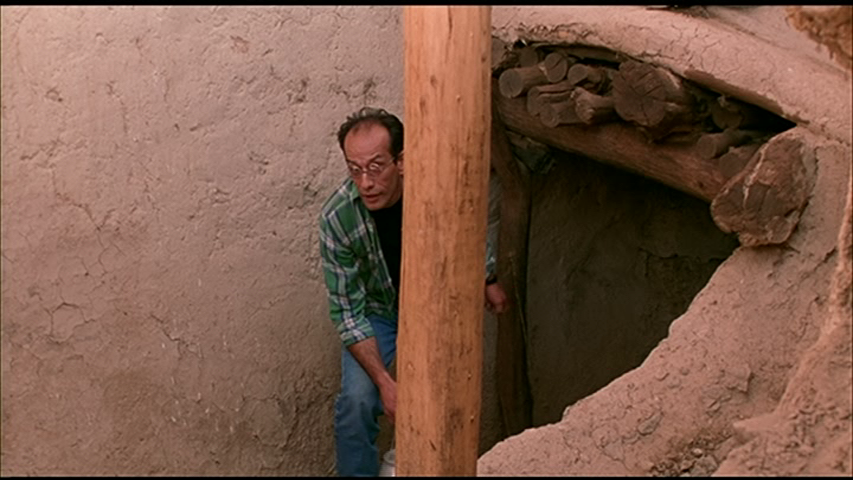
“Why is it so dark here?” he asks. “There’s a hurricane lamp (Ed: !), it’s not dark,” the voice answers. “Is there someone down there?” Behzad asks. “Yes, Miss Zeynab,” is the reply. “Zeynab, come here, this gentleman needs milk,” the voice continues. Despite what the voice (which we will soon learn belongs to Zeynab’s mother) says, it is dark in the cellar: in fact, the screen goes completely black for about fifteen seconds after Behzad enters it. But then we hear a cow low and the same woman Behzad glimpsed earlier appears holding a lamp:
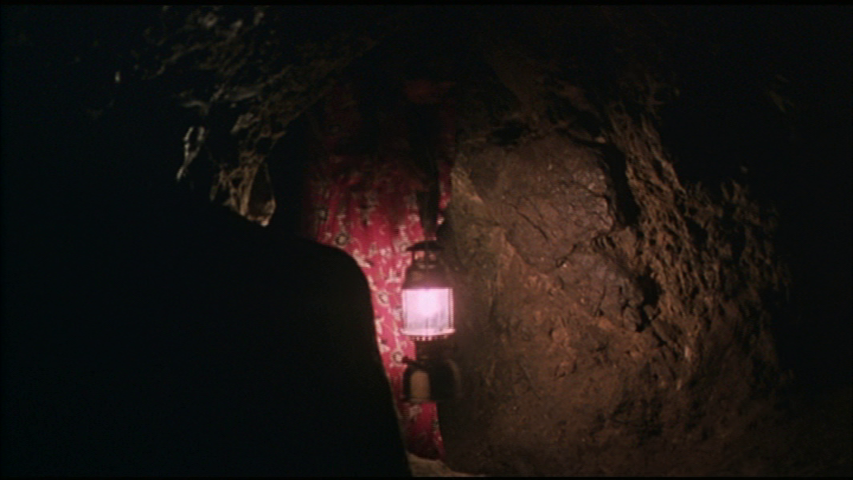
“Can you milk the cow for me?” Behzad asks. Then: “It’s so dark. How can you milk in here?” Zeynab replies, “I’m used to it. I work here.” He asks her age (16), whether or not she has been to school, and if she knows the poet Forugh Farrokhzad. Then, as Zeynab milks the cow, he flirtatiously recites one of Forugh’s poems, stopping occasionally to offer unsolicited interpretations of its meaning.
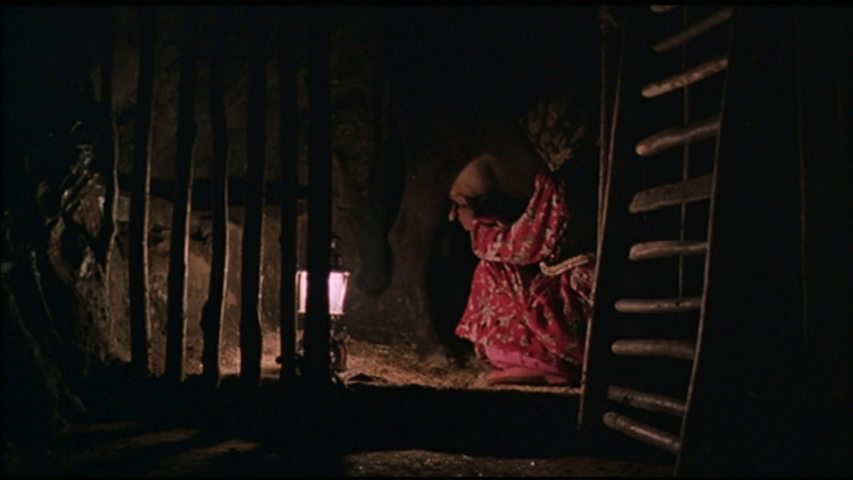
The poem concludes with the line, “the wind will carry us!” Behzad tells Zeynab that he is Yossef’s boss and attempts to command her to raise the lamp so that he can see her face. She freezes. After a few seconds pass, Behzad says, “at least light the ground so I don’t trip.” She rises and they exit the cellar together. As they walk, she asks how long Forugh studied. “You know, writing poetry has nothing to do with diplomas,” Behzad tells her. “If you have talent, you can do it too.” When they reach the door he asks how much he owes her. “Pay my mother,” she says, but as he walks away after completing the transaction she calls to her mother, “why did you take the money? Go and give it back to him.” She briefly peeks around the corner to make sure he turns to come back:
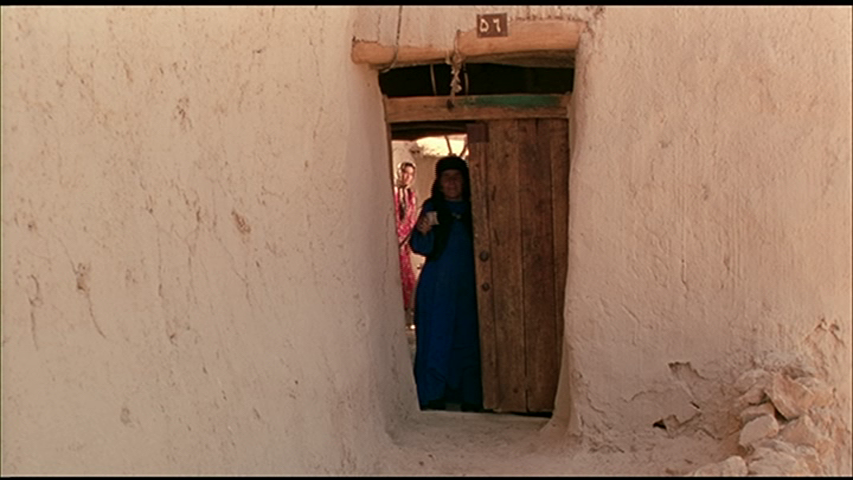
Scholar Hamid Dabashi famously called this scene “one of the most violent rape scenes in all cinema” in his 2001 book Close Up: Iranian Cinema, Past, Present and Future but this is difficult for me to square with the fact that it’s tonally very similar to a later one in which a frustrated Behzad kicks over a tortoise:
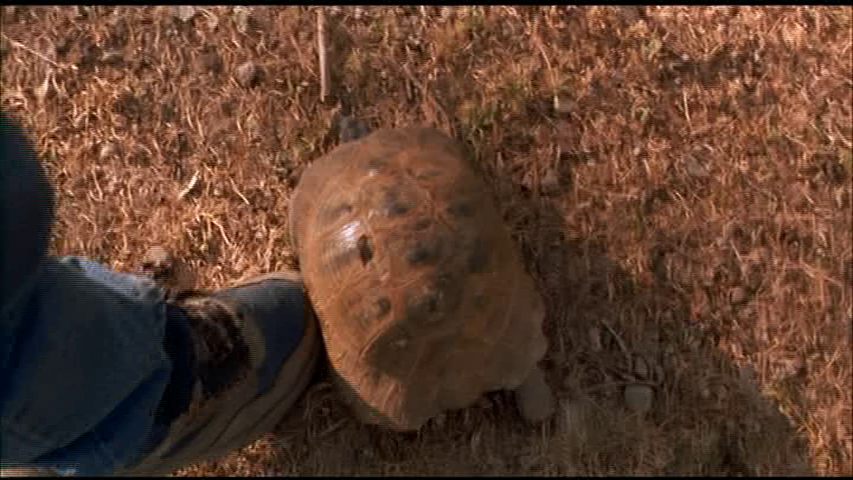
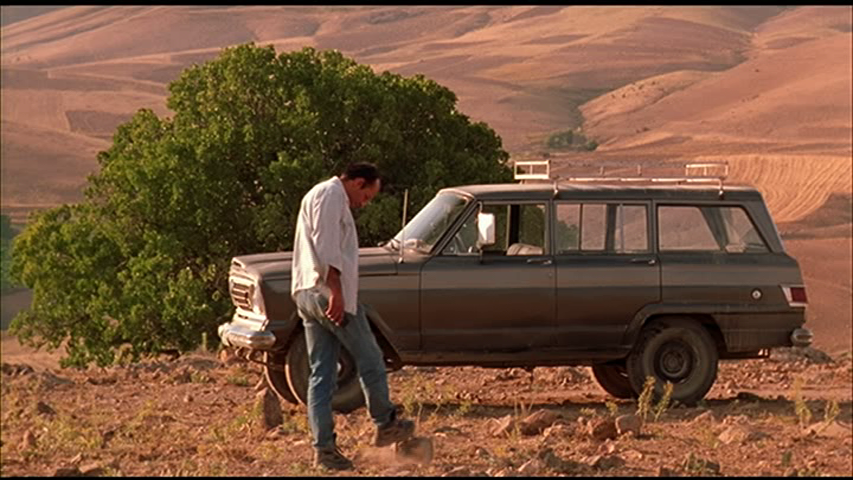
That scene ends with the tortoise righting itself with little effort as Behzad drives away, and in a 2009 Journal of Film and Video article scholar Chris Lippard argues about the cellar scene that “[i]f there is much of the feel of a seduction here, there is also, to extend the metaphor, a firm and decisive no.” To me Behzad’s admittedly aggressive behavior is reminiscent of the petulant outbursts of a bored child. Because he does not appear to cause any lasting damage, it seems fair to say no harm, no foul.
Zeynab’s job as a basement milkmaid is just plain bizarre, but in other moments The Wind Will Carry Us definitely seems to have something to say about gender roles in Iran at the turn of the millennium. A spirited argument breaks out in a café when the proprietor Tajdolat observes that “[a]ll women serve. They have three trades: by day, they’re workers. In the evening, they serve and at night they work.”
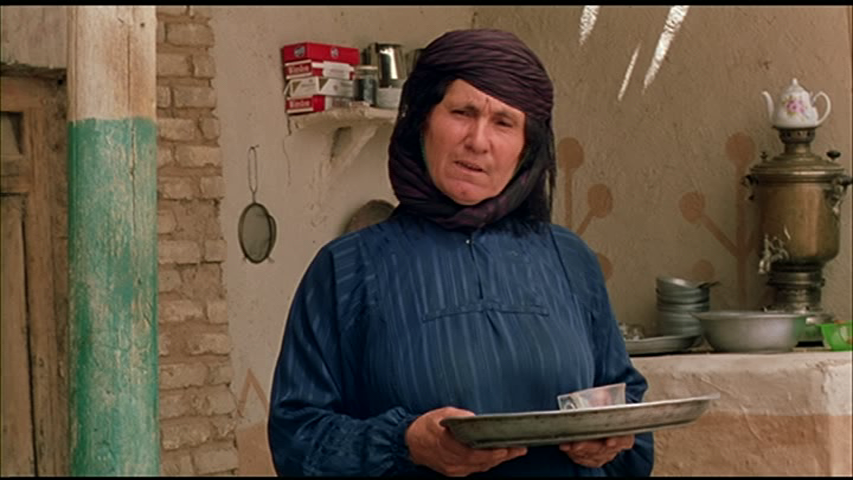
To which her husband offers the rejoinder, “don’t men have a third job, too?” Later, Behzad’s hostess resumes her waiting on him and his crew one day after giving birth to her tenth child:
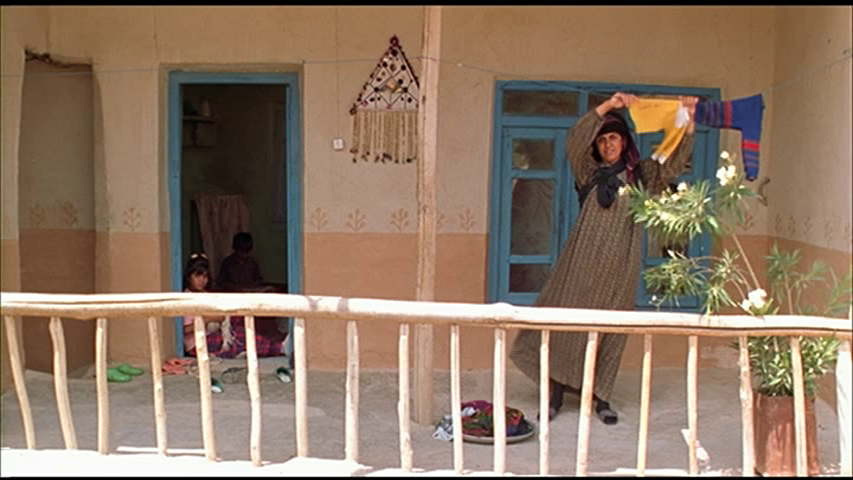
It also absolutely must be noted that the village of Siah Dareh is a character in its own right and looks fabulous in shots such as this night/morning dissolve:
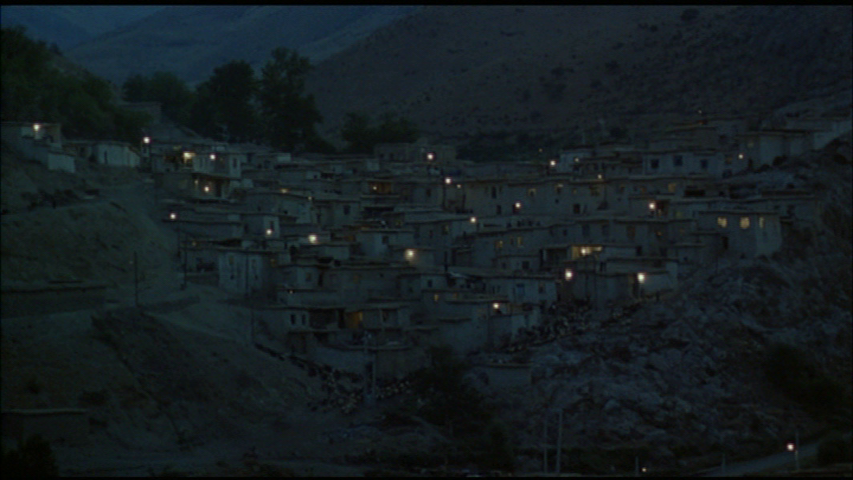
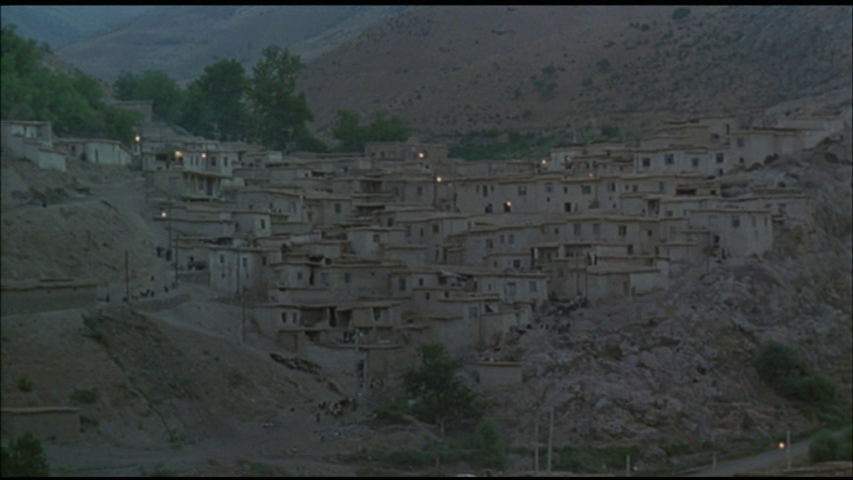
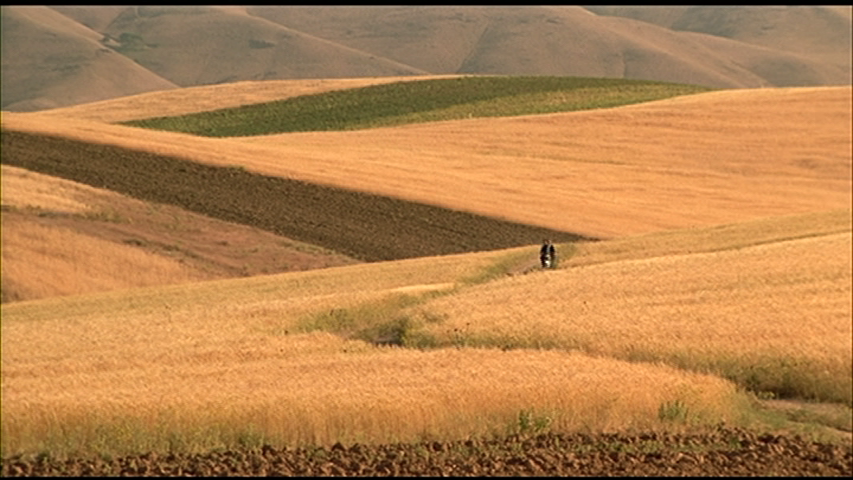
Finally, another reason to pair this film with a Hurricane is because the color of the drink closely matches the amber hues of the barley fields that Behzad rides through on the back of the motorcycle of the doctor who attends to Yossef when the hole he is digging caves in:
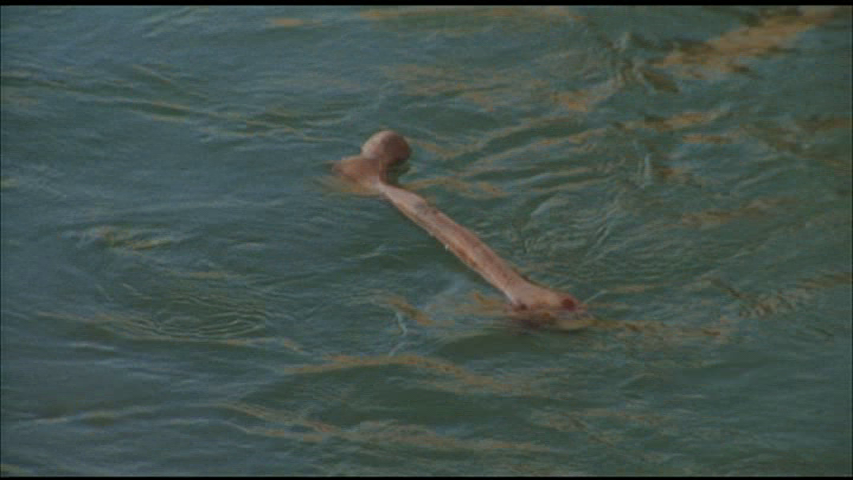
The Wind Will Carry Us ends with Behzad washing the windshield of his car, then throwing a femur bone from a nearby ancient cemetery that he has been carrying around on his dashboard since the beginning of the film into a creek:
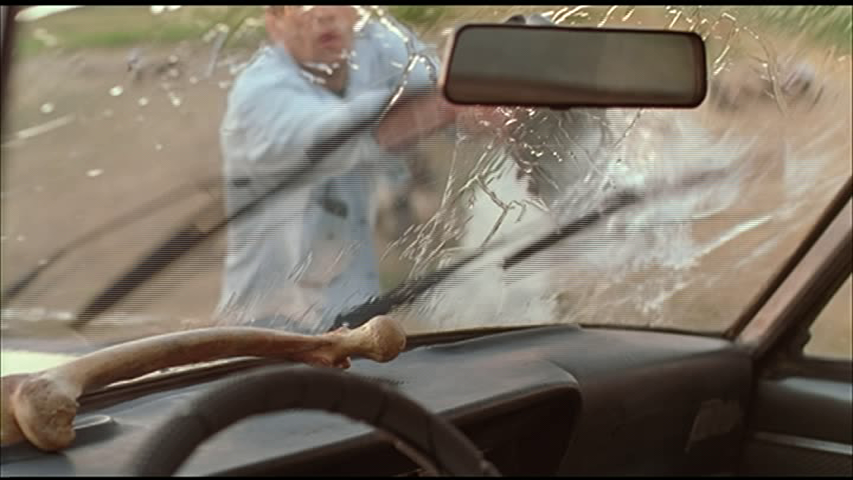
The final images follow the bone as it floats downstream accompanied by the film’s first non-diegetic music:
I mentioned a number of similarities between The Wind Will Carry Us and Groundhog Day above, but left out the most obvious one. Behzad and Phil Connor both work in television, travel from the city to the sticks, get stuck there much longer than they intended to, and leave transformed. How exactly and to what extent they are different is largely left to viewers to decide for themselves, which is one of my favorite things about both movies. The universe holds Behzad and Phil in place until they start to truly see what’s all around them. We can learn from their example to do so of our own accord and reap the same rewards. No one trip or cocktail is likely to change your life, but each has the potential to make it better as long as you’re paying attention. So, in the doubly apropos words of Omar Khayyam as quoted in The Wind Will Carry Us:
They tell me she is as as beautiful as a houri from heaven!
Yet I say that the juice of the vine is better.
Prefer the present to these fine promises.
Even a drum sounds melodious from afar.
Cheers!
All original photographs in this post are by Marion Penning, aka My Loving Wife. Other entries in this series can be found here.

 The Prodigal Cinephile