It’s right around this time every summer that I start to really look forward to the start of football season. By now I’ve usually finished reading the Football Outsiders Almanac, I’m catching bits and pieces of CFL games on ESPN2, and I’m starting to prepare for my family/friends fantasy football league draft, which usually takes place over Labor Day weekend. This month’s drink selection is therefore a tribute to the pigs who so generously donate their skins to our true national pastime each year, the Benton’s Old-Fashioned from The PDT Cocktail Book, which was created by Don Lee in 2007:
2 oz. Benton’s Bacon Fat-Infused Four Roses Bourbon
1/4 oz. Maple Syrup
2 dashes Angostura Bitters
Stir with ice and strain into a chilled rocks glass filled with one large cube. Garnish with an orange twist.
To “fat-wash” the bourbon: combine 1.5 ozs. molten Benton’s bacon fat and one 750 ml bottle of Four Roses bourbon (the one folk used to refer to as “yellow label” before the bottle got a facelift in 2018) in a large nonreactive container and stir. Infuse for four hours, then place the container in the freezer for two hours. Remove solid fat, fine-strain the bourbon through a terry cloth or cheesecloth, and bottle.

I know what you’re thinking: didn’t the whole bacon cocktail thing run its course a decade ago? The bourbon in this drink isn’t just bacon fat-infused, though, it’s Benton’s bacon fat-infused. We are talking about a product that tastes so much like a campfire that my children, six and four years old as of this writing, refuse to eat it. The drink was originally made with Benton’s country ham, which is also delicious. The point is, not just any cured pork product will do. I’m sure there are plenty of others that would work here, but make sure you taste the original first so that you know exactly what you’re looking for. We buy ours at The Wine Source when we’re visiting family in Baltimore, but you can also order it online.
The spirit which results from the marriage of Benton’s bacon fat and bourbon is savory with a rich mouthfeel and a predominant flavor of smoke, which puts me more in the mind of pechuga mezcal than breakfast, even after you add maple syrup. Speaking of which: most recipes for this drink that you can find online call for “Grade B” syrup, but such a thing no longer exists as of 2015. The equivalent new rating is “Grade A Dark Robust,” but you should just use the best syrup you can get your hands on. We are fortunate to have relatives in Ontario who make their own! Add in Angostura bitters for complexity and essential oils from the orange twist for brightness, and what you have is a clever, endlessly quaffable concoction that I’m not at all surprised turned out to be one of PDT’s all-time best sellers.
The movie I’m pairing this drink with takes everything I love about football and turns it on its head: the Marx brothers film Horse Feathers, which exactly no one attributes to director Norman Z. McLeod. Here’s a picture of my copy of Universal’s “The Marx Brothers: Silver Screen Collection” DVD set:
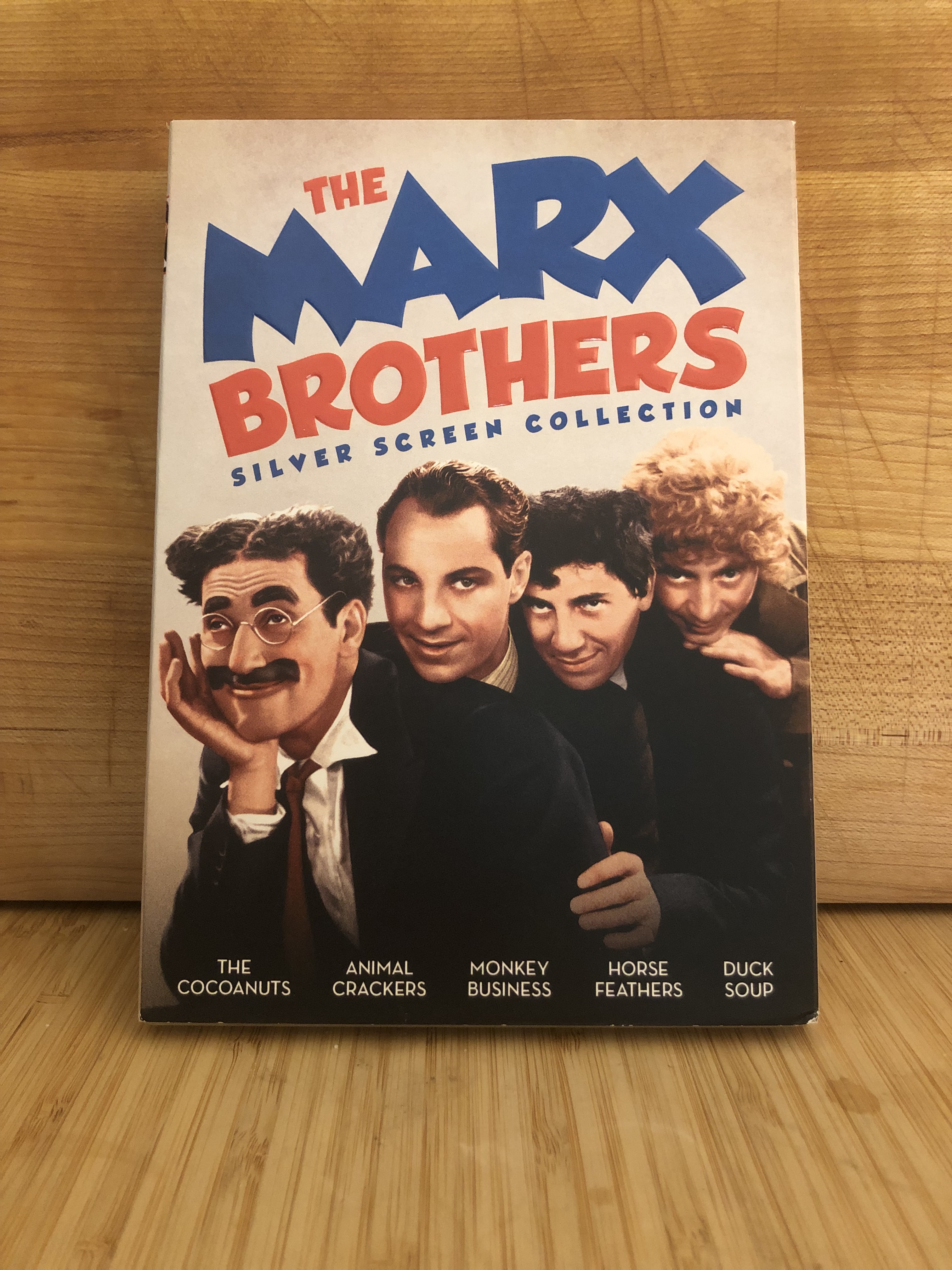
The film begins with Groucho Marx’s Professor Quincy Adams Wagstaff outlining his leadership philosophy (“whatever it is, I’m against it!”) for the assembled faculty and students of Huxley College.

We soon learn that his son Frank (Zeppo Marx) is a 12th-year senior at Huxley who somehow still has football eligibility. Frank informs his father that Huxley has had a new president every year since 1888, which might explain why someone as obviously unqualified as Wagstaff was able to get the job, although perhaps not why his predecessor made such a big deal about leaving. Huxley also hasn’t won a football game during this time, and Frank, who clearly hasn’t taken a statistics course yet, thinks this must surely be a causal relationship. He tells his father that two of the best football players in the country hang out at the local speakeasy, and Wagstaff sets out to recruit them to play in the upcoming rivalry game against Darwin College. Unfortunately, a gambler named Jennings (David Landau) who’s betting on the opposition has beat him to the punch:
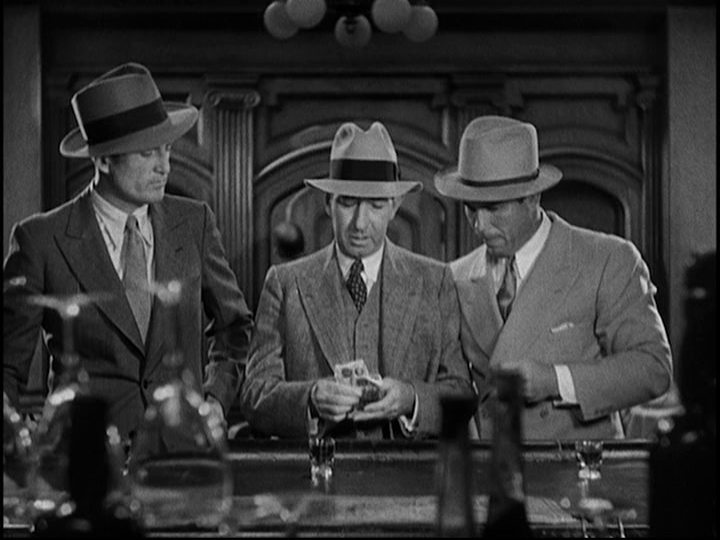
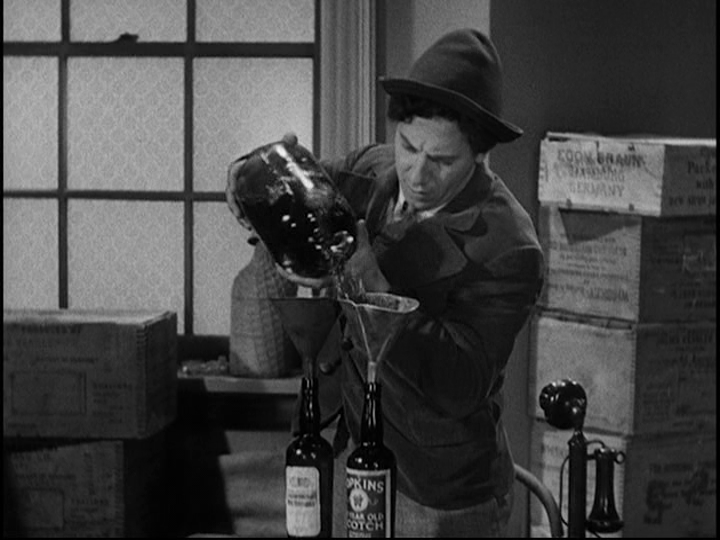
About this guy: if Huxley hasn’t won a game in 40 years, surely there’s no way they’re the favorites in this contest, right? So if Jennings is going to go to the trouble of fixing the game, why wouldn’t he do so on behalf of the underdogs to maximize his profits? Worst gambler ever! Anyway, Wagstaff mistakes speakeasy employees Baravelli (Chico Marx) and Pinky (Harpo Marx) for the real football players Frank mentioned and recruits them instead. Many hijinks ensue over the course of the 45 minutes of screen time leading up to the climactic football sequence, including this shot of Baravelli filling an order for one quart of Scotch and one quart of rye from a common source, which hurts my soul as a lover of fine spirits:
And this one of Pinky, who by the way is also a dog catcher, gleefully shoveling books into a fire, which pains me as a librarian:

Finally, it’s game time. Baravelli and Pinky arrive late after their attempt to kidnap Darwin’s new best players goes awry and they end up locked in a bedroom instead. Despite the deck being stacked in their favor, Darwin is only up 12-0 heading into the fourth quarter, which: maybe Jennings was on to something after all! Suddenly, the tide begins to turn. First, Professor Wagstaff enters the game mid-play and makes a crucial tackle along the sideline:

Then one of Darwin’s ringers suffers a finger injury when Pinky decides it would make an excellent substitute for the hot dog he lost during the previous play and bites down:

Huxley soon turns the ball over, but this gives Pinky the chance to tie a string to it:

Which leads directly to a pick-six. Huxley converts the extra point to pull within five. Let us pretend (since it doesn’t really matter for plot purposes) that Huxley doesn’t then receive the subsequent kickoff despite being the team that scored, and that we instead see Darwin punt to give the ball back to Huxley, implying that the latter team’s defense did its job instead of that the folks who cut this film don’t know the rules of football. As Professor Wagstaff lights a cigar and Pinky munches on a banana, they snap the ball to begin the next play:

The call is a left end run by Frank, and it has all the appearances of being a game winner thanks to Pinky’s innovative use of banana peels to prevent Darwin’s players from making a tackle:
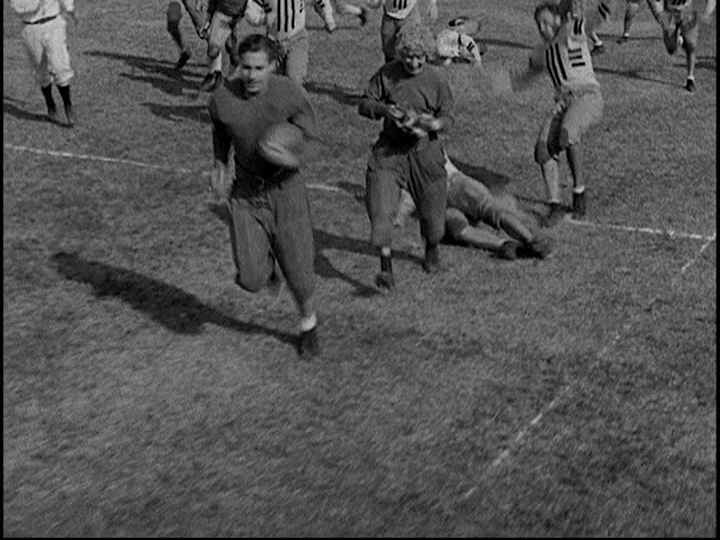
Alas, Frank makes the mistake of saying “nice work, Pinky!” while the play is still in progress, which of course prompts Pinky to trip him shy of the end zone. Luckily there’s still enough time on the clock for another play. This time the ball goes to Pinky and he’s running free up the middle when a dog bursts onto the field. Pinky reverses direction to try to catch it, but is convinced by the characters played by the other Marx Brothers to abandon his pursuit and instead jump with them into the horse-drawn garbage chariot he had arrived at the game in earlier and apparently parked in the field of play. They all race up the field for the game-winning score.

Just for good measure, Pinky’s teammates toss him three more balls which he also places on the ground in the end zone:

The scorekeeper diligently awards Huxley six points each time, making the final score 31-13.
I grew up rooting for the New York Mets and watching big events like the Olympics, Super Bowl, and World Cup, but didn’t become a general sports fan until college. Attending a Division I school (the University of Pittsburgh) with a proud football history during its basketball program’s Golden Age (RIP the Jamie Dixon era!) helped, as did living in a hockey- and football-mad city at a time when its teams in both sports lucked into a series of franchise-altering talents (Ben Roethlisberger, Evgeni Malkin, Sidney Crosby) who won them multiple championships. This is why I root for Pitt, the Penguins, and the Steelers. It doesn’t quite explain why I reliably watch three to five NFL games every week between the months of August and January no matter who’s playing. For that, we must turn to the Peyton Manning Colts. I can remember sitting in a crowded bar ignoring everyone I came there with in favor of a TV on silent showing Manning playing chess with the opposing team’s defensive coordinator, altering plays and lofting passes to spots where only his gifted wide receivers Marvin Harrison and Reggie Wayne could catch them. They’d then proceed to defy the laws of physics and contort their bodies in impossible ways to get both of their feet down in bounds with the ball.
This combination of strategy and graceful athleticism is what fascinates me about football: throw in analytics and the salary cap, and in the modern passing era it’s more like watching two ballet companies compete against each other in a full-contact version of something like the Eschaton game from David Foster Wallace’s Infinite Jest than the battle of brute strength that I used to assume it was. I enjoy football movies like Oliver Stone’s Any Given Sunday and Peter Berg’s Friday Night Lights enough to return to them from time to time, but I’ve never seen a film that gets *this* aspect of the sport right. Unless, that is, you count Horse Feathers. When I remember great NFL moments like Santonio Holmes’s game winning touchdown catch in Super Bowl XLIII, I don’t just think about the play itself, but also the drive that made it possible, the offseasons that brought the players involved in it to Pittsburgh, and the ruling on the field that yes, this really was a completion. But what counts as a catch and what doesn’t in the NFL is based on rules that at the end of the day are essentially arbitrary and subject to change, as indeed they have multiple times since that February night in 2009!
Horse Feathers understands this fundamental truth about football, even as it’s indifferent to it otherwise except as a platform for jokes. Baravelli announcing the play that Huxley is about to run (“Humpty Dumpty sat on the wall, Professor Wagstaff gets the ball!”) is basically the exact opposite of Peyton Manning calling out audibles at the line of scrimmage. Either way, you’ve got adults play[act]ing something that started out as a children’s game. I’d argue that in both cases the principles have elevated what they’re doing to the status of art, but if you aren’t having fun watching them, you’re doing it wrong.
Cheers!
All original photographs in this post are by Marion Penning, aka My Loving Wife. Other entries in this series can be found here.

 The Prodigal Cinephile