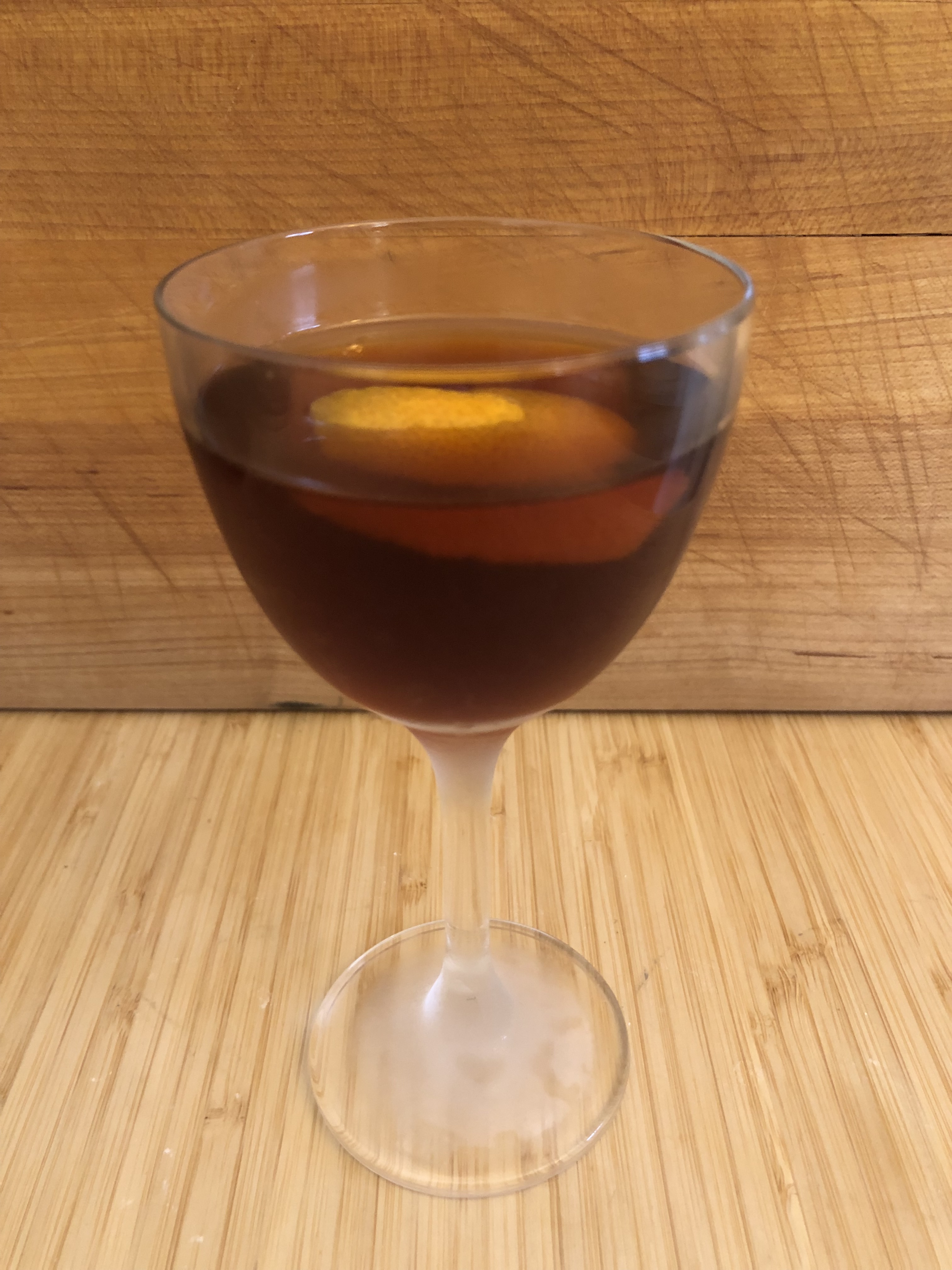
The idea for my first Drink & a Movie post started with the beverage, while the inspiration for the second one was the film. This month’s edition is sort of a hybrid. I was cycling through possible hooks (lions, lambs, March Madness, etc.) when my mind lit on Pi Day. I immediately remembered the bottle of Zirbenz Stone Pine Liqueur of the Alps that I bought over the holidays, and suddenly I was all set! The drink I’m writing about today is a concoction by Misty Kalkofen of Boston, Massachusetts (whose name you’ll see again if I keep this series going) called In Vida Veritas. With a hat tip to the Haus Alpenz website, here’s how you make it:
1 1/2 oz. Del Maguey Vida Mezcal (Vida de Muertos)
3/4 oz. Zirbenz
3/4 oz. Nux Alpina Walnut Liqueur
1/2 oz. Benedictine
10 drops Xocolatl Mole Bitters (Bittermens)
Stir with ice, strain into a chilled Nick and Nora glass, and garnish with an orange twist.
The movie I’m selecting to go with it is Arnaud Desplechin’s A Christmas Tale. Here’s a picture of the DVD I bought from the Criterion Collection Store during a flash sale of yore:
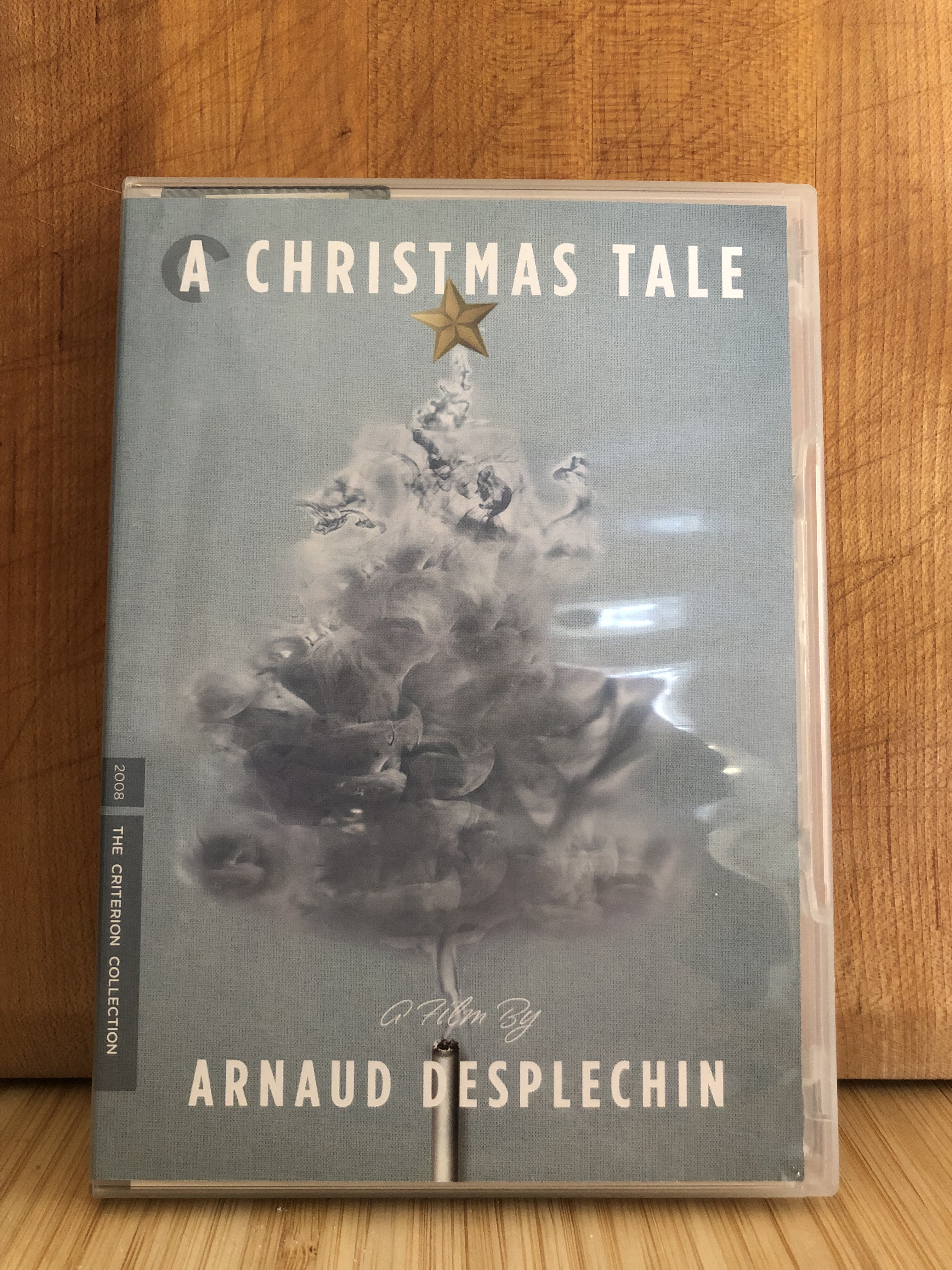
It’s still available there on both DVD and Blu-Ray, and can also be streamed via the Criterion Channel with a subscription or Amazon Prime for a rental fee. On a very superficial level, the drink (thanks to the pine notes of the Zirbenz) and the movie share a Yuletide vibe. They both also feature casts of eccentric characters that don’t seem like they should be able to co-exist in the same glass or house until they do, but afterward you almost can’t imagine them apart from each other. Here are the stars of In Vida Veritas:
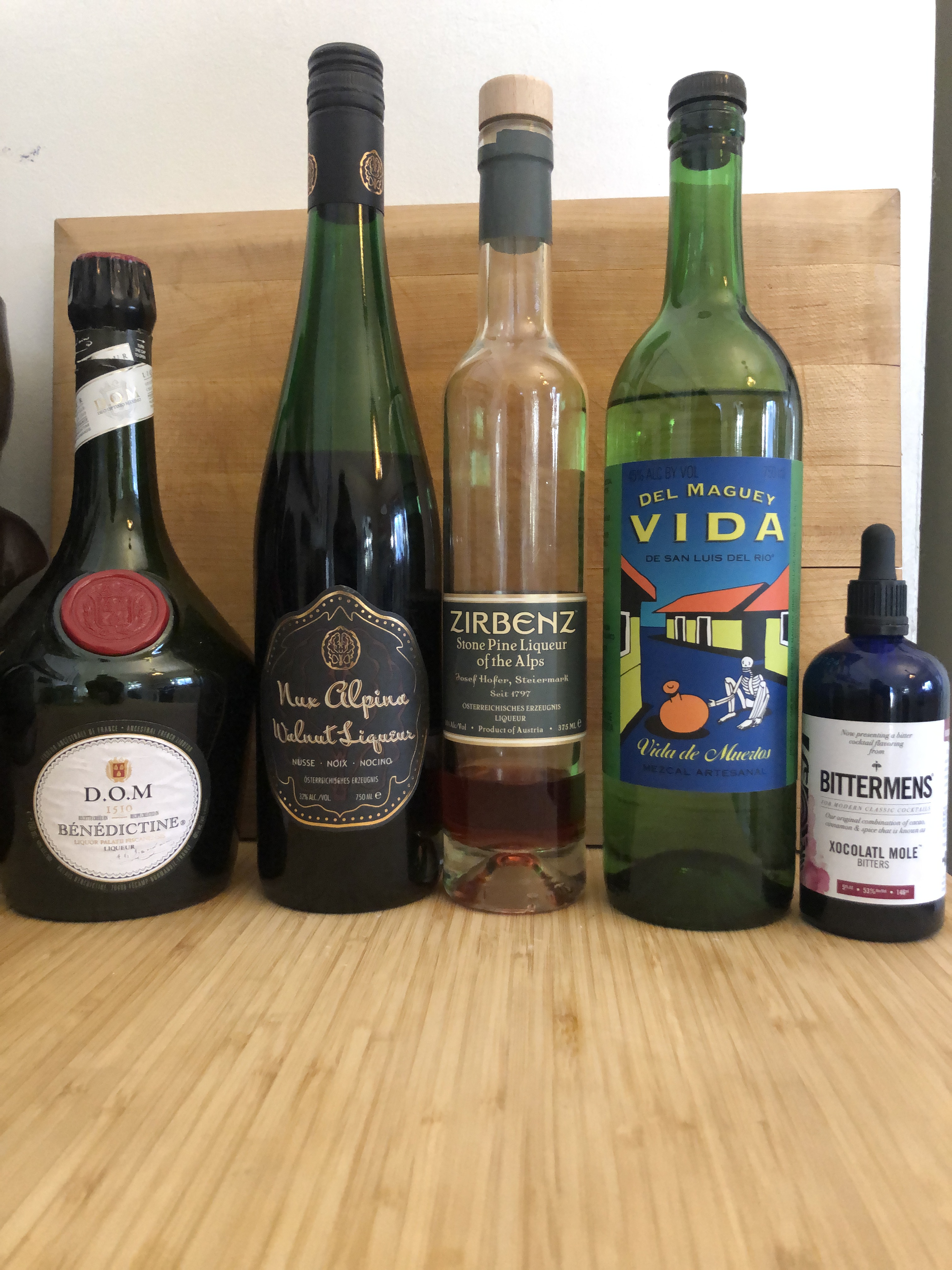
Be forewarned: some of these ingredients may be hard to source. I had to ask the good people at Red Feet Wine Market in Ithaca to special order me a bottle of the Nux Alpina, for instance. That’s also the only place around here I’ve seen Xocolatl Mole bitters. The version of the recipe published on Kindred Cocktails calls for Fee Brothers Whiskey Barrel-Aged Bitters instead, which might not require as much of a search. No matter which one you choose, I like how the bitters bring a bit more CONCACAF thunder to the party to keep the mezcal company amidst all these Europeans. Speaking of which, Del Maguey Vida Mezcal is one of my absolute favorite value spirits. Where I live a decent bottle of single malt Scotch will set you back $80 easy, but even the 45 ABV Vida de Muertos special release pictured here costs half that and delivers something just as complex, smoky, and sippable. Anyway, whatever effort you have to put in will be amply rewarded! This exactly is the kind of deeply intriguing, miraculously balanced drink that made me fall in love with cocktails in the first place.
As far as the movie is concerned, the connection to Pi Day is a scene in which Claude (Hippolyte Girardot), a Fields Medal-winning mathematician, shows up to help his wife’s family decide whether or not their matriarch Junon Vuillard (Catherine Deneuve) should accept a bone-marrow transplant to treat the degenerative cancer that has a 75% chance of killing her or decline based on the fact that it could result in a condition called graft versus host disease or GVH that itself has a 35% mortality rate.
It begins not quite halfway through the film with a shot of a pile of books gradually coming into focus as seen through a frosty window pane.
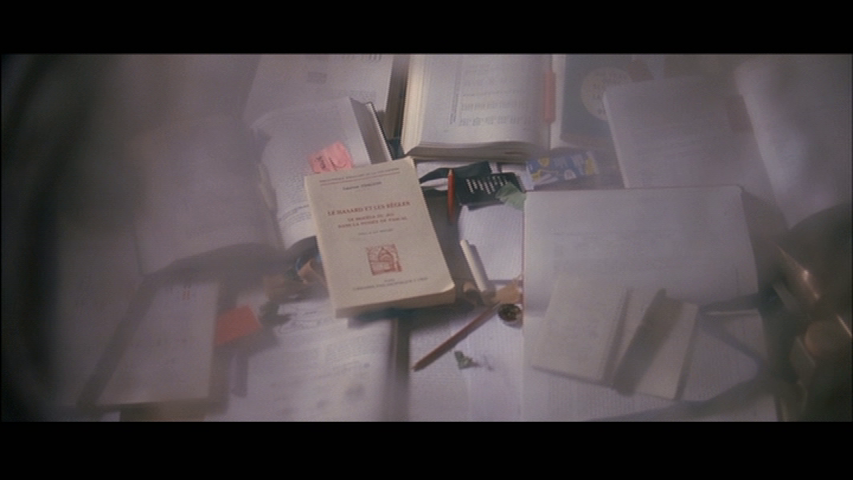
Cut to Claude.

What he’s beholding here are the chalkboards and easel pads which his father in law Abel (Jean-Paul Roussillon) has been using to try to calculate the correct course of action. “What’s this?” he asks.

“I can’t remember what I wrote,” Abel replies. “There’s still a tiny chance that Junon’s not sick.” Claude taps the board.
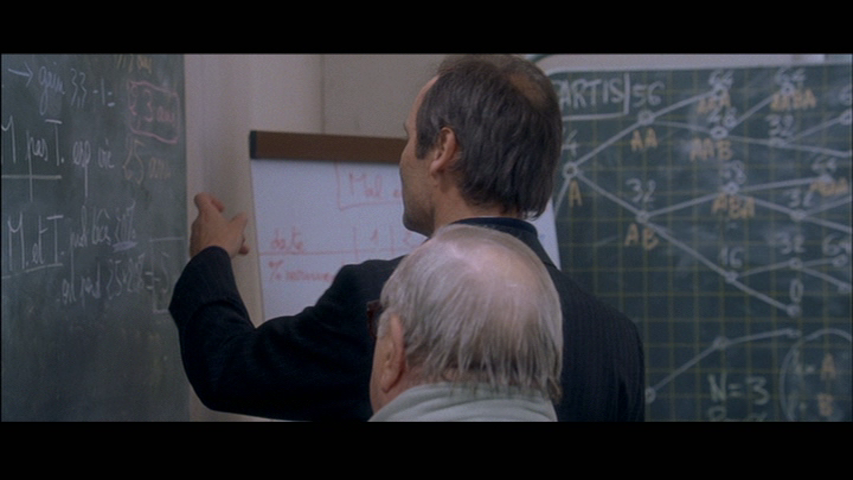
“You’re pessimistic,” he says. “Survival increases life expectancy. This is what you’re scared of. The doctors kill a healthy woman.” “She’d lose five years without being sick!” Abel replies. So Claude goes to work. “You can’t keep reasoning in segments. Counting from one year to another. Junon is going to die at a precise moment. Not on an anniversary.”
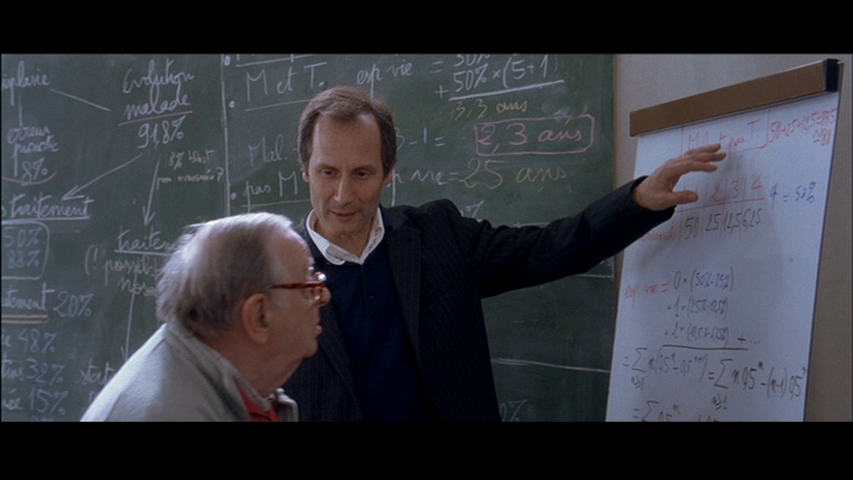
“Getting hurt or dying are absolute events,” he continues. “You don’t die a 10 or 12% death. You get the entire event. The game is on, like it or not. You either treat it or you don’t. You die or you don’t. You’re playing the game. Go from the discrete to the continuous.” He grabs a marker.
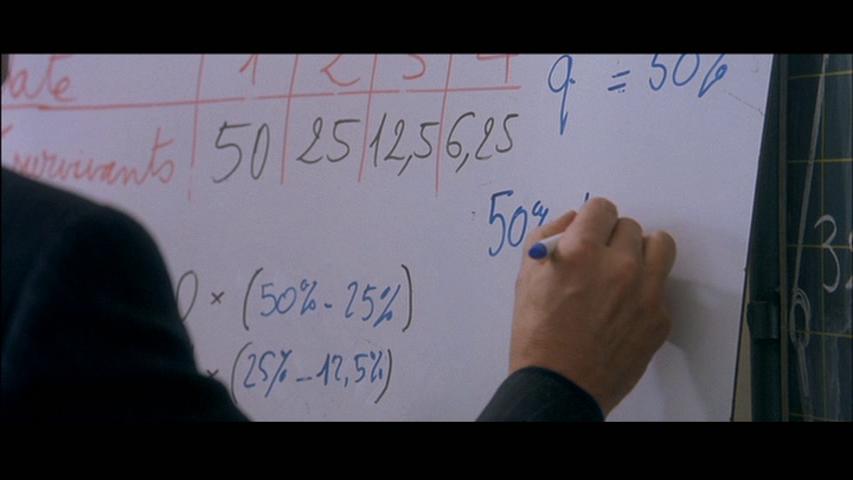
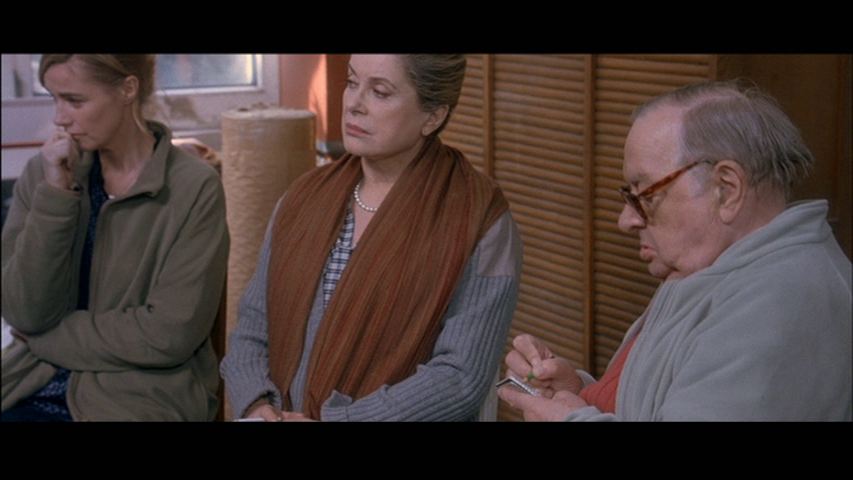
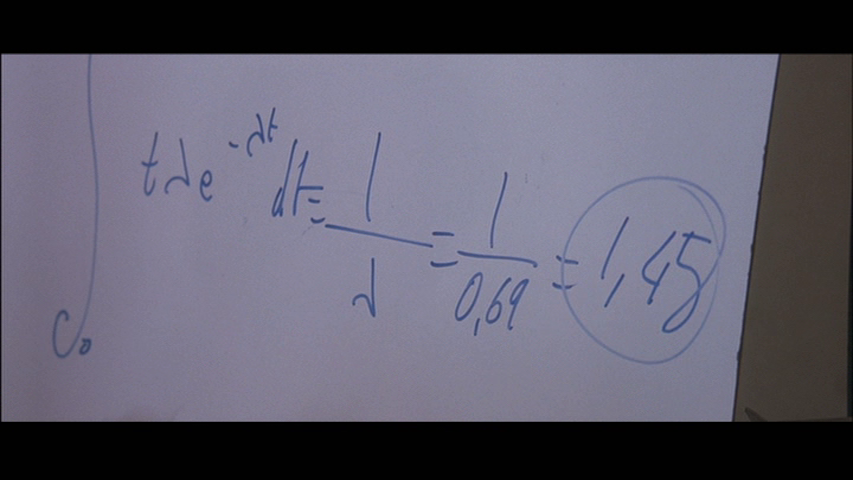
“The ratio is not one half. 50% equals 1 minus exponential minus lambda. Lambda, the logarithm of 2. The survival formula is an integral from zero to infinity.” Abel takes notes on a pad while his wife and daughter Elizabeth (Claude’s wife, who is played by Anne Consigny) listen.
“1.45 years,” Claude declares, circling the answer.
He switches back to the chalkboard. “No transplant gets you six more months. In the same way, with treatment, this increases to 3.7.” He circles that number, too.

“Now weigh your living five fewer years with its low probability against 2.3 extra years with treatment weighed with a higher probability,” Claude continues. “And you get. . . . ” Abel interrupts him. “May I?” he asks. “Be my guest,” Claude replies. He approaches the board and solves the equation.
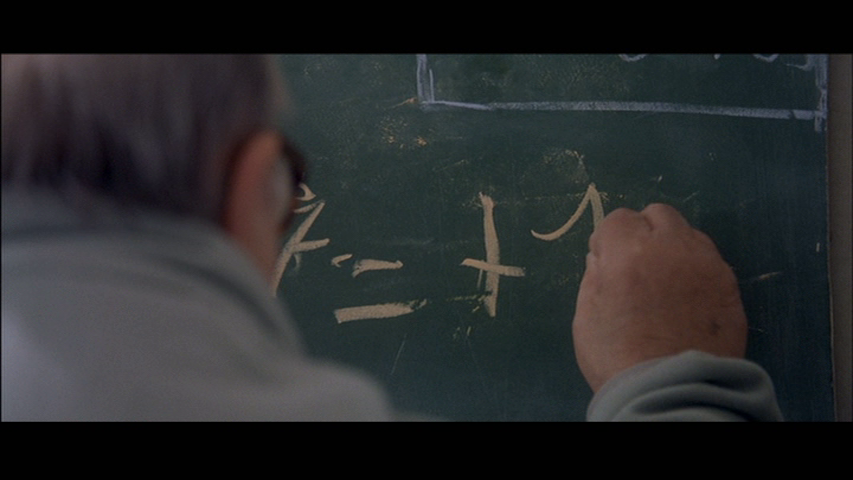
“Sick or not, if you’re treated you gain about two years,” Claude explains. “You’d rather pass. Your only freedom is to bet.” Abel’s response: “That’s better.” Although the expression on Junon’s face makes it clear that she is not similarly reassured, she, too, will eventually come to the same conclusion.
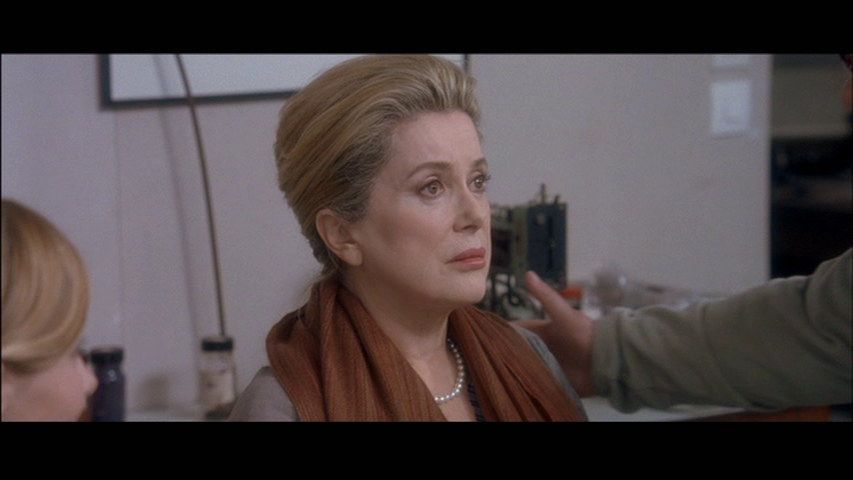
This scene resonates with me because it basically explains why I got a pi tattoo twenty odd years ago. The idea wasn’t that pi itself has any particular significance for me, but rather that it represents something that does. And this is it! When I first learned about irrational numbers as a child, I was captivated. The idea that you could spend a lifetime calculating, but never succeed in expressing them in decimal form fascinated me, as did the notion that from a practical standpoint, it doesn’t matter! Because pi can be represented by a single character just as surely as the numbers one, two, and three can: π. My twelve-year-old self saw this as inspirational: maybe you can’t ever figure out exactly who you are, but that doesn’t mean you can’t still be useful!
There’s a lesson in this for the Vuillard clan, I think. Each of them is a relentless seeker of meaning, whether they look for it in books, the bottle, or the bedroom. But that isn’t what makes them a family. Similarly, the numbers on Abel’s chalkboards and pads aren’t a perfect representation of reality, but they don’t need to be. Like Claude says, the game is afoot, and that means that even if Junon refuses to act, she is nonetheless making a decision, whether she realizes it or not. By showing her and her family this, Claude illuminates the path they are on and makes others visible. Seeing the paths laid out before them and where they lead, they can choose which one they want to take. Choosing sets them free. How cool is that?
A Christmas Tale is a dense film bursting with references and allusions, wonderful performances, and delightful cinematographic tricks. I could easily write a whole other post on any of those things, and maybe someday I will. For now, though, I’m going to close with an observation that surely must be trite by now, but is new to this blog. I didn’t think there was anything unusual about any of the scenes that featured Doctor Zraïdi (Azize Kabouche):
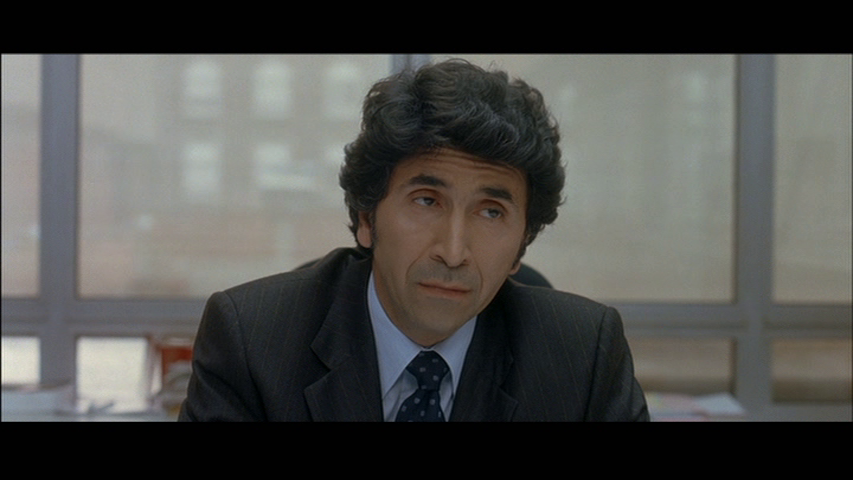
Or any of the scenes that included Henri (Mathieu Amalric):
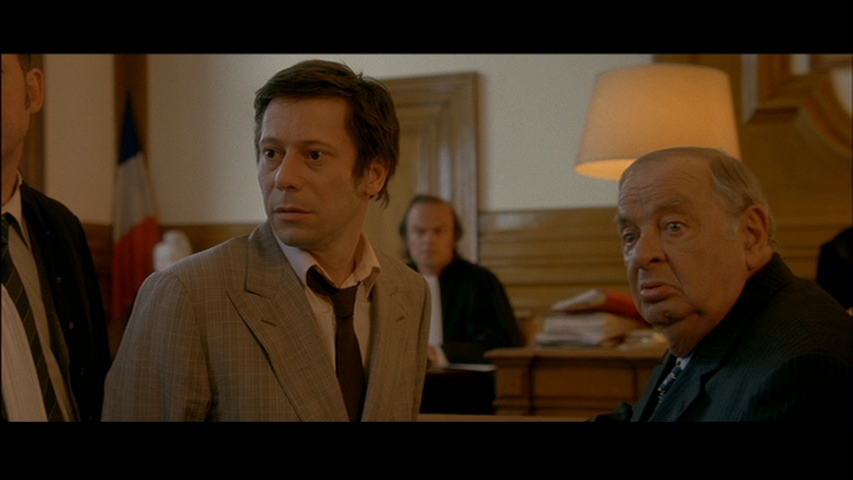
Until very late in the film when they appear like this:
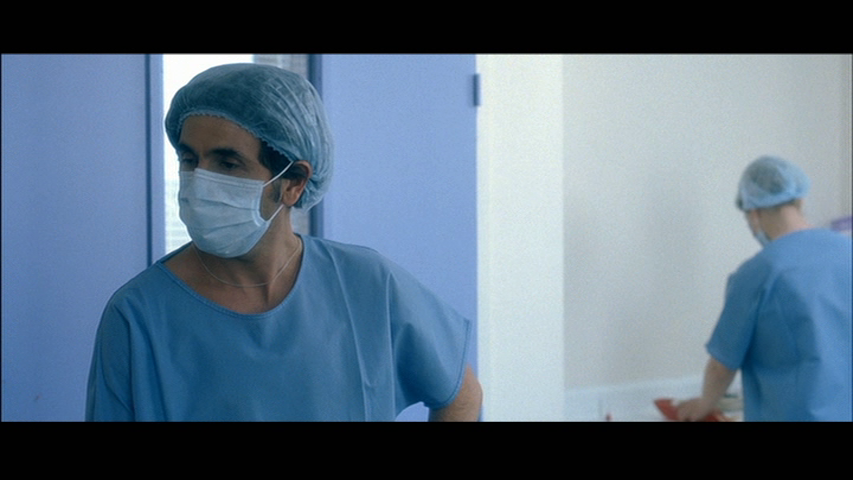
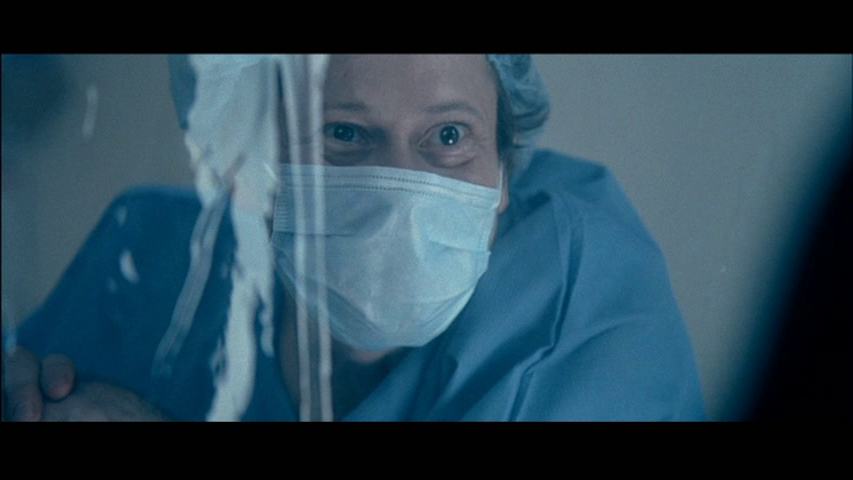
Which, this looks more normal to me now! But maybe not for much longer, though? One can hope.
Cheers!
All original photographs in this post are by Marion Penning, aka My Loving Wife. Other entries in this series can be found here.

 The Prodigal Cinephile