On December 13 I tweeted about an interesting conversation that media librarians were having on the Videolib listserv about a Wired article by Brian Raftery called “The Best (Free) Streaming Service You’ve Never Heard Of”:
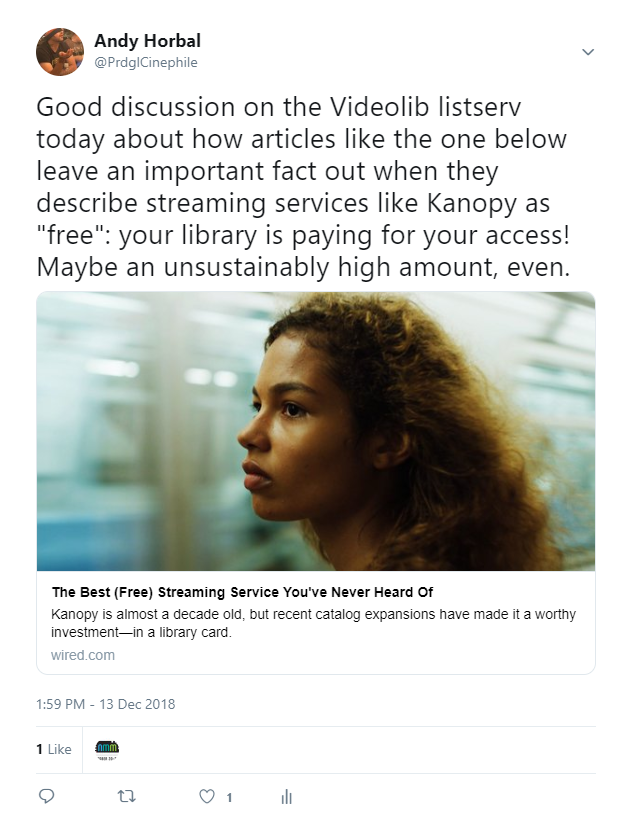
Also mentioned in this thread were an IndieWire piece by Chris O’Falt called “Free Streaming Nirvana: How to Access a Collection of the Greatest Movies Using Your Library Card” and the fact that Kanopy’s website touts its product as “streaming now for free with your library card.” On January 29, a Videolib poster drew attention to an Entertainment Weekly article by Maureen Lee Lenker called “What You Need to Know About (Free!) Streaming Video Service Kanopy,” and a few days later the following tweet by writer Jonah Wiener appeared on my timeline:
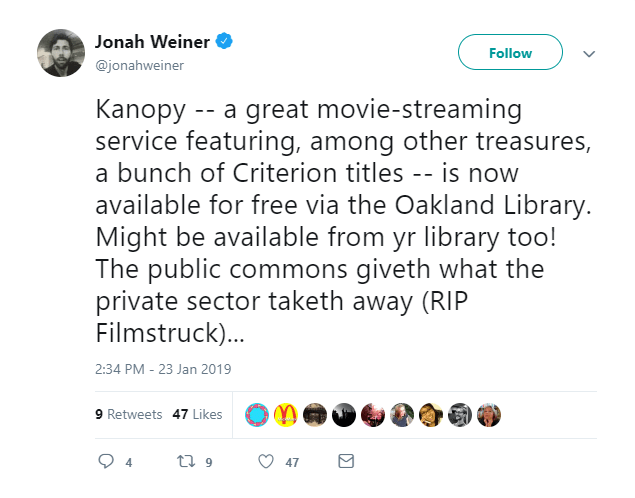
Both the Wired and IndieWire articles, like Weiner’s tweet, hail Kanopy as an alternative to the subscription streaming video service FilmStruck, which ceased operations in November, 2018. To be fair, the IndieWire article does accurately describe Kanopy as a company which sells a product to a market that consists primarily of libraries, schools, and other non-profit organizations; the Entertainment Weekly article dips briefly into discussion of Kanopy’s business model as well, although it also refers to libraries and academic institutions as Kanopy’s “partners,” which obscures the fact that this is a vendor-customer relationship.
I have been reluctant to say much on this topic because I have very little firsthand experience with Kanopy aside from a few brief conversations with their representatives at National Media Market circa 2013-14. I am on the record as suggesting (on page 185) that use-driven acquisitions or UDA (which also goes by other names and acronyms including DDA, for demand-driven acquisitions, and PDA, for patron-driven acquisitions) plans like the one Kanopy offers might represent a better value for libraries than curated streaming video collections, so I’m not hostile toward their business model, but I call for more research on the subject later in the same article (on page 187), so I’m probably best described as a skeptic. That’s not really what worries me about articles and tweets like the ones I link to above, though. My concerns came into better focus as I was flipping through Rick Anderson’s recent book Scholarly Communication: What Everyone Needs to Know the other day. Here’s the passage that caught my eye:
In reality, of course, no library does anything for free. Library patrons are most assuredly paying for the services they receive–but since the payments are made indirectly (usually in the form of property taxes, tuition, or student fees) and since payment is separated in both time and space from the experience of library services, those services can easily give the false impression of being offered at no charge. In other words, the fact that you can walk into a library, select five books, and take them home with you without money changing hands during the transaction makes the transaction feel as if it came without cost. In reality, however, the money changed hands earlier, and made its way indirectly from your picket to the library’s budget.
Why is this point worth making? Because the proposition that libraries offer “free services” poses two risks that are mirror images of each other. First, it poses the risk that library services will be undervalued by those whose financial support is essential to their survival. It is a common rule of thumb in economics that we tend to value least those things in which we have the least invested, and for this reason alone it is unwise for any library to pretend that its patrons have not made concrete monetary investments in the library and its services.
More subtly, the claim that libraries provide “free services” is risky because it simply does not pass the smell test. Anyone who hears that claim and takes even a few moments to consider it will immediately recognize its falsity and may then start to wonder whether other things said by librarians (and their supporters) are actually trustworthy.
For libraries and their boosters who want to encourage better and more widespread use of the library, a more accurate and effective message might be: “Come see how we are making wise and effective use of the money you have entrusted us with.”
Presumably, Raftery, Lenker, and Weiner all chose to write about Kanopy out of a genuine desire to draw attention to the great films available through its streaming video service to patrons of the libraries and other institutions that subscribe to it. By failing to delve into the details of exactly how this happens, though, they may be contributing to a situation whereby the films are only free “until it’s unsustainable and your library has to switch to mediated access,” as one Videolib poster put it. After all, Kanopy is every bit as much of a commercial entity as FilmStruck was. I’d like to see more articles like O’Falt’s (headline aside) and this one that Glenn Kenny wrote for the New York Times called “Library Cards Unlock Film Vaults,” which are every bit as enthusiastic about the opportunity Kanopy represents for movie lovers, but without neglecting to express curiosity about what’s going on behind the scenes. Otherwise, the history of disappointment associated with FilmStruck might be doomed to repeat itself.
 The Prodigal Cinephile