How you watch a film inarguably impacts the way you respond to it. The Nitrate Picture Show is a unique viewing experience in a very obvious way: every screening features specific nitrate prints that people in the audience worked on, projected by individuals who, far from remaining anonymous as they typically would, are instead introduced each time as the stars of the show. Because nitrate was phased out in the early 1950s, it also consists exclusively of titles made before then. Lately I’ve been thinking about some proclivities of mine which I believe matter to my personal brand of cinephilia. For instance, even though movies are a hugely important part of how I make sense of the world, they’re something that I fit into my life around my family and job. The way I accomplish this is by favoring sparsely attended late afternoon and early evening showtimes. I also prefer to be near the screen–not necessarily as close as possible to “receive the images first” like Matthew from The Dreamers, but ideally in the middle of the third or fourth row–which in practice means I don’t always even know whether or not I’m the only person in the theater (I frequently am) because anyone else who arrives is likely to sit behind me.
NPS screenings are all packed, and not just anyone is willing to travel to Rochester, New York for an event like this, so in addition to being the biggest crowds I’m likely to be part of this year, they were also probably the most intelligent and opinionated. All of this absolutely affects my reactions. As does the weather! This year we were blessed with sunny days great for walking that introductory speaker Bryony Dixon described as perfect conditions for experiencing A Day in the Country, which played as the second half of a double featurette with The Plow That Broke the Plains. The two served as a study in how captivating black-and-white skies can be on nitrate: the ones in the latter showcased about 50,000 different shades of gray, while the former was distinguished by a mesmerizingly deep, dark color that my brain keeps insisting must actually have been blue. The low-angle shots of Sylvia Bataille‘s Henrietta standing up on a swing set were not at all ruined for me by Dixon’s tongue-in-cheek description of them as “upskirting” and were probably the most joyous images I saw all weekend.
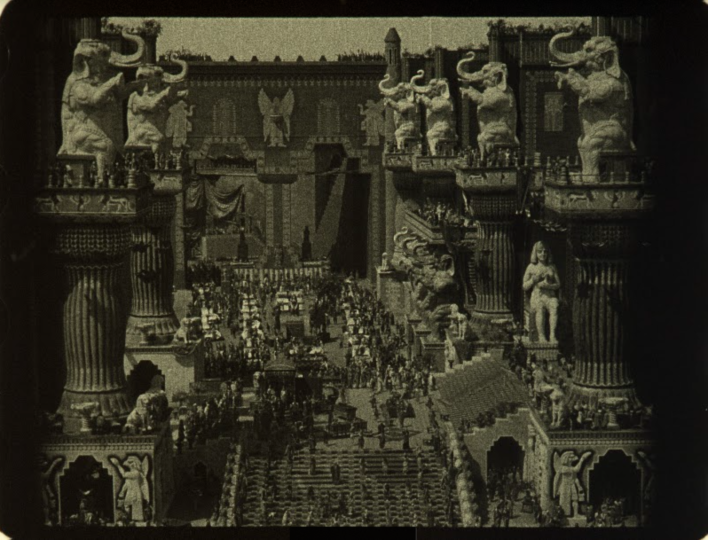
The closest competitor for this honor would probably be the lavish Babylon sequences from opener Intolerance, which can be glimpsed in the image at the top of this post that I grabbed off the NPS website. This film is also connected to Plow via World War I, which ties it to the first feature that screened the next day as well. De Mayerling à Sarajevo portrays Archduke Franz Ferdinand (John Lodge) as a would-be reformer cut down too early by the enemies of tolerance and love; in fact, I kept wanting to identify war as a throughline for the whole festival, but its appearance in so many movies may be attributable to nothing more than the entirety of the nitrate era being within a decade of a global conflict. Anyway: I’ve always respected Intolerance, but now appreciate it more than ever as a full-fledged masterpiece made barely twenty years after the Lumière brothers introduced the world to moving pictures. I particularly enjoyed the hallucinatory Temple of Love scenes and emotional close-ups of the stellar female leads Mae Marsh, Margery Wilson, and Constance Talmadge, which are another link to Sarajevo: there’s a shot of Edwige Feuillère in a pearl-studded veil that would have fit perfectly alongside them.
Per introductory speaker Peter Bagrov, director Max Ophüls rushed to finish that film in the early days of World War II, which is perhaps most evident in a handful of still images used in place of actual establishing shots which felt extremely out of place in a work otherwise characterized by a lively camera. A still image of ambiguous intentionality also appears in the first movie that screened in the “Nitrate Shorts Program” that kicked off day two of the festival, The Flute of Krishna, which like Intolerance was accompanied by the legendary Philip Carli on piano. This dance film attributed to Martha Graham and an uncredited Rouben Mamoulian was shot at Rochester’s Eastman Theatre and features beautiful, strong colors produced by an experimental Kodachrome two-color process. Unlike last year, the majority of the rest of the movies in the program were black-and-white or tinted, such as the five burlesque films compiled into a single program and given the name Juke-Box Follies. The exceptions were a Terrytoons cartoon starring Gandy Goose and Sourpuss the Cat called Lights Out and two “advertising snipes” which would have played in between movies during the nitrate era, a Chevrolet ad called A Wise Choice and a promo for a “Halloween Fun Fest.” Like Know for Sure, a film about the dangers of syphilis and how to avoid it that Lewis Milestone directed for the United States Public Health Services, all of these titles served as welcome reminders that that the moviegoing experience has always encompassed more than just features. NPS’s didactic impulses were also on display in the decision to screen Disney’s The Skeleton Dance twice in a row: we were told that we’d see safety diacetate and nitrate prints back to back, but not in what order, and then asked to guess which was which. Most everyone (again: this is a smart crowd!) realized that the one with inkier blacks was actually the safety print, which looked “better” because it was in superior condition–the unique properties of nitrate are worth celebrating, but it isn’t magic.
The shorts were rounded out by Le Vieux Chateau, an animated film with cubist influences set to a lighthearted song about a haunted and rat-infested medieval mansion by the French duo Pills and Tabet that is now on our Halloween mix, a delightfully absurd amateur/experimental film by native Rochesterian James Sibley Watson Jr. called It Never Happened, and the highlight of the program Zarozhdenie Zhizni, which uses a variety of frame rates to create what director Vsevelod Pudovkin called a “close-up in time.” It also contains a shirtless reaper whose body glistens with sweat that rhymes with the glint of sunlight on the blade of his scythe and the sparkling dew on the grass he’s mowing who I won’t soon forget.
My most noteworthy discovery was The Good Fairy. It opens with children being led in song by a woman who exhorts them to sing with “more freedom,” then the camera pulls back to reveal the bars of the fence that surrounds the orphanage they all live in. Real and metaphorical jails figured in many of this year’s NPS selections, but here it’s just the first of an avalanche of jokes, which is hardly surprising considering that the screenplay is adapted from Ferenc Molnár’s Hungarian play by Preston Sturges, who must have loved the fact that the main character’s name is Luisa Ginglebusher. She’s played by an utterly charming Margaret Sullavan, who gets to swing from a light fixture and admire herself in an infinity mirror wearing “genuine foxine.” This movie got bigger laughs than any other, and when Herbert Marshall’s Dr. Max Sporum finally kisses Luisa, everyone applauded. But my favorite part was the fairy tale ending at the end, unless it was the scene in which Sporum waxes poetic about a new pencil sharpener, or maybe it was Frank Marshall’s business tycoon pretending to be a “wizard” in a film made four full years before that actor was cast the titular role of a certain Judy Garland vehicle that played NPS last year. In other words, it was a blast! The print we saw came from director William Wyler’s personal collection, which was also cool.
The Good Fairy was one of three movies that Alan Hale appeared in, along with Stella Dallas and The Strawberry Blonde. He plays a carousing gambler who falls on hard times in the former, which had quite a few people in tears. The one moment that almost got me was Barbara O’Neil’s Helen leaving the blinds open so that Barbara Stanwyck‘s Stella Dallas can watch her daughter Laurel (a radiant Anne Shirley) get married without attending the wedding, but I was too distracted by doubts that this noble “sacrifice” was either necessary or even good for Laurel to really lose myself in it. Hale’s best performance of all, though, is as the quick-tempered father to James Cagney’s Biff Grimes in The Strawberry Blonde, a love letter to the Gay Nineties which I had somehow never gotten around to seeing before. I’ll definitely be coming back to it for Olivia de Havilland perfecting the art of the suggestive wink, Rita Hayworth stealing a kiss from Cagney in silhouette, and the dinner scene in which a bunch of perplexed Americans square off against an unfamiliar foreign delicacy called “spaghetti” for the first time.
A very different attitude toward the past is on display in Kikyō, a somber and ultimately angry elegy for the soul of post-war Japan directed by Hideo Ōba, a filmmaker I confess I wasn’t previously familiar with who intro speaker Jo Osawa described as a mentor to Japanese New Wave icon Nagisa Ōshima. Per Peter Bagrov this was the first known U.S. screening of this movie since 1978, which explains why it isn’t better known in this country. Kikyō ends with an image of a man smoking a cigarette in front of his own grave, but this is exponentially less bitter than the conclusion of Germany Year Zero, a chronicle of life in another defeated Axis power which is right up there with Intolerance as my most memorable screening of NPS 2024. Protagonist Edmund Köhler (Edmund Moeschke) is almost exactly the same age as Willing Mandible, the hero of Lionel Shriver’s novel The Mandibles: A Family, 2029-2047; both are only slightly older than my children, and my fear that there’s no good reason to think this can’t happen here are further exacerbated by my having seen The Natural History of Destruction, which shows how prosperous Germany Year Zero‘s bombed-out Berlin settings looked just a few years earlier, at last year’s Finger Lakes Environmental Film Festival. This movie’s subject is something that pretty much no one wanted to see when it was made in 1948: Ken Fox’s program notes describe it as “a bitter pill for either victor or vanquished to swallow” which temporarily (thankfully!) destroyed director Roberto Rossellini’s reputation. That’s exactly what makes it essential, though. “We saw disaster coming and did nothing to prevent it,” says Edmund’s father (Ernst Pittschau)–if we lack the conviction to ask whether or not this describes us, too, we’re begging to suffer the same fate.
Germany Year Zero is a devastating and brilliant film, never more so than during its one moment of transcendence, a man playing an organ in the ruins of a church, which is abruptly cut short; the Finnish release print we watched, which featured both Finnish and Swedish printed-in subtitles, also taught me a lesson itself. My local arthouse theater Cinemapolis has a great practice that they call “Captioned Wednesday” whereby all screenings between 5-6pm on that day are presented with English subtitles. Although I think this is a terrific initiative, I’ve been avoiding these screenings myself, but I now see that this is silly: neither the subtitles on this movie nor the German ones on De Mayerling à Sarajevo distracted me at all! This isn’t all I learned. I mentioned earlier that we were quizzed after The Skeleton Dance. I did not raise my hand even though I thought I knew which print was which because I wasn’t sure, but last year I probably wouldn’t have had any idea, and maybe next year I’ll have the confidence to venture a guess. The point is that NPS isn’t just a lot of fun, it’s also making me a more educated and perceptive viewer. Throw in Rochester’s great food and drink options (Swillburger and Rohrbach Brewing Company‘s Space Kitty Double IPA were my favorite new experiences on this trip) and the fact that I can get there quickly and cheaply via OurBus, and I’m starting to believe that I’d be crazy not to make this an annual excursion. Certainly I’m going to return next year, schedule permitting. Till then!
Previous film festival dispatches can be found here.

 The Prodigal Cinephile