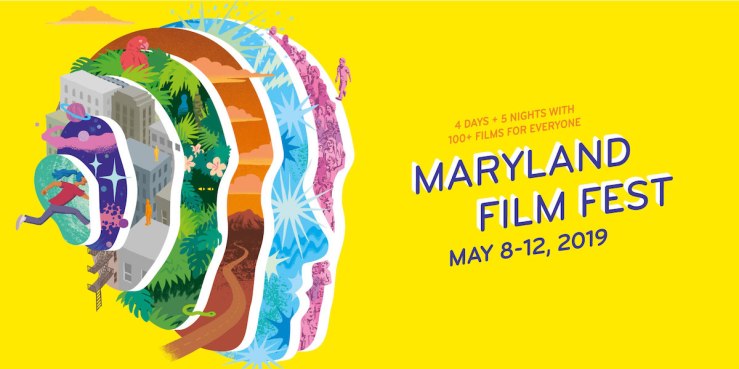
I have been slowly working my way through Negative Space: Manny Farber on the Movies for the first time in years the past few months. My favorite essays in the book are Farber’s dispatches from the New York Film Festival, which see him taking advantage of the opportunity that watching a large number of new movies in a short period of time presents to draw conclusions about the current state of cinema. This seems to me to be the most highly evolved version of an irresistible temptation inherent in the film festival experience: cataloging the inevitable connections between everything you see. After all, there are only so many techniques and themes available to even the most gifted artists.
The most obvious and potentially meaningful commonality I noticed at this year’s Maryland Film Festival was a preoccupation with fake news. Donbass begins with actors preparing to appear on a television news broadcast as witnesses to a shelling attack. They will return at the end of the movie, when the price of their complicity in this deception is revealed. In between, director Sergei Loznitsa’s protagonist-less film presents roughly a dozen other vignettes depicting life in the Donbass region of Eastern Ukraine amidst the separatist conflict which started in the aftermath of Russia’s annexation of Crimea in 2014, and which does not appear (as someone who reads four news sites every day, it’s crazy how little I know about this) to have ever ended. As the credits rolled, I felt exhausted by the film’s relentless pessimism; three weeks later, however, I find myself thinking about Donbass more often than anything else I saw at MDFF. A room full of well-dressed men on their cell phones begging for money in particular has emerged as probably my favorite movie scene of the year so far.
The hijacking of the media by government interests was a topic near and dear to the heart of the subject of the only documentary I saw at this year’s festival, Recorder: The Marion Stokes Project. Alarmed by the way the official story about the Iran Hostage Crisis seemed to change nightly, Stokes, a public intellectual and former librarian from Philadelphia, began recording television news programs in 1979. This project eventually expanded into a 24/7 operation capturing everything shown on multiple networks, an endeavor involving more than 70,000 VHS tapes, entire apartments used for nothing but storage, and the assistance of paid help. The film falters toward the end when it tries too hard to use Stokes’s archive to make a case for her as a visionary without really grappling with the fact that only an EXTREMELY WEALTHY person would have had access to the immense (forgotten fact: video tapes were pretty expensive for much of the thirty year period Stokes was recording) resources this project required. Recorder is nevertheless a fascinating story about a unique individual and a welcome nod to the good people at the Internet Archive doing the hard work of making Stokes’s tapes available to the public.
In contrast to the sophisticated propaganda machines in Donbass and Recorder, the military government which haunts Aäläm-Wärqe Davidian’s Fig Tree doesn’t even bother trying to deceive anyone about what it’s up to. While 16-year-old Mina (Betalehem Asmamawe) lives in constant terror that her boyfriend will be impressed into military service, dictator Mengistu Haile Mariam makes speeches castigating the Ethiopian people for raising a “generation of cowards” because they don’t volunteer their sons to fight as soon as they’re old enough to hold a gun. Although Davidian succeeds in creating a palpable sense of what it was like for her to come of age in Addis Ababa against a backdrop of civil war, I felt that Fig Tree was outshined by another debut feature which also ends with a shot of its young woman protagonist running toward the camera, Annabelle Attanasio’s Mickey and the Bear.
Like Mina, Mickey (Camila Morrone) is struggling to navigate a path to adulthood complicated by war. In her case, it comes in the form of her father Hank (James Badge Dale), a survivor of two tours in Iraq struggling with a host of afflictions including PTSD, poverty, alcoholism, drug addiction, a war injury, and grief at the loss of his wife (Mickey’s mother) to cancer. As Mickey approaches the end of her senior year of high school, Hank’s destructive impulses begin to manifest in increasingly creepy and threatening forms, leaving her with an impossible choice between abandoning a loved one to his demons to accept a college scholarship and risking her own health and happiness to stay by the side of a man the film clearly identifies as being beyond saving. I thought Mickey and the Bear‘s Anaconda, Montana setting and the scenes of Mickey at work in her part time job as a taxidermist were terrific, but wanted much more of both, and I’m conflicted by the film’s depiction of Hank as a problem without a good solution. There’s no denying, though, that Morrone’s and Dale’s performances constitute some of the best acting I’m likely to see this year.
Ham on Rye (yet another debut feature) deals with a similar stage in life, but couldn’t be more different from Fig Tree and Mickey and the Bear. Working with a cast featuring numerous veterans of Disney Channel and Nickelodeon shows such as Danny Tamberelli (All That, The Adventures of Pete & Pete), Lori Beth Denberg (All That), Clayton Snyder (Lizzie McGuire), and Aaron Schwartz (The Adventures of Pete & Pete), director Tyler Taormina and cinematographer Carson Lund (who wrote about his experience shooting the film for Filmmaker Magazine) focus single-mindedly on recreating the feeling of finishing high school and going off to college (or not) in the suburbs in the late 90s and early 00s. As a member of Conestoga Valley High School‘s class of 2000, I was definitely picking up what Ham on Rye was laying down, but I still thought the film was overlong, an impression reinforced by my fonder memories of Little Waves, the short film which preceded it. The latter probably wouldn’t have worked as well stretched out to feature length either, but the point is that it wasn’t.
Rites of passage also figure prominently in my favorite of all the movies I saw at MDFF, South Mountain. It opens with Talia Balsam’s Lila and Scott Cohen’s Edgar hosting close friends for dinner at their home in the Catskills. Edgar excuses himself, supposedly to take a call about a script he’s working on, but in actuality to witness the birth of his child with another woman on his iPhone. The rest of the film could accurately be said to focus narrowly on Lila’s efforts to come to terms with this specific event and its aftermath while still trying to be there for an old friend recovering from breast surgery and her two daughters, one of whom is returning from camp and the other from a sea voyage. It would be even truer, however, to say that it’s more generally about coping with change that arrives at precisely a moment when you are planning on settling down for awhile, a theme that most viewers can likely relate to. I must admit that South Mountain appealed to me in part because of Lila’s house, which in real life belongs to director Hilary Brougher’s mother: I spent much of my time in between MDFF screenings setting up appointments to view houses for rent in Ithaca, so I enjoyed spending so much time with a lovely piece of upstate New York real estate. I was also extremely impressed by how present nature was in the film both visually and as part of the soundtrack.
All in all, the 2019 Maryland Film Festival was a fitting way to say farewell to the Baltimore film scene. I was never able to become as involved in it as I would have liked, but I’m still leaving with quite a few great memories. Most notably: meeting John Waters, meeting DeRay Mckessen (who’s quite the cinephile, by the way!), managing to visibly annoy Alex Karpovsky by not knowing when to let something go at a Q&A for Supporting Characters (“does that answer your question?” he asked, to which I replied, “no, not really . . . “), muddling my way through managing a sold out screening attended by not-yet-disgraced mayor Catherine Pugh, and all my interactions over the years with the wonderful MDFF staff and scores of my fellow volunteers. Special shout out here to Karol Martinez-Doane, who was always awesome to work with as Venue Manager, and who brought me bibimbap from Brown Rice Korean Grill one year just because! Of course, I still have family and friends in Baltimore, so this isn’t really goodbye. Let’s say, instead: ’till we meet again!

 The Prodigal Cinephile